
eNews
What TRAI’s digital audio rollout recommendations mean for the radio folks?


NEW DELHI: India’s telecom regulator has thrown struggling FM broadcasters a lifeline, recommending a graduated payment structure for digital radio spectrum that defers most costs for a decade while the receiver ecosystem develops.
The Telecom Regulatory Authority of India (TRAI) proposes auctioning two digital frequencies in each of 13 major cities—including Mumbai, Delhi, Chennai and Bengaluru—at reserve prices ranging from Rs 20.52 crore to Rs 194.08 crore. Crucially, successful bidders choosing instalment payments would pay nothing for digital spectrum components during the first five years, when device adoption will be negligible.
The phased approach reflects harsh commercial realities. Private FM radio advertising revenues have flatlined at Rs 1,819 crore in 2024-25, barely recovering to 2015-16 levels despite more operational channels. The sector faces mounting competition from music streaming platforms and shifting listener habits.
“The business model of radio broadcasters is primarily driven by advertising revenues, which is closely linked to listener reach,” TRAI notes in recommendations released on 3 October 2025. “Without affordable receivers, broadcasters may have little incentive to adopt digital radio.”
Under the staggered payment plan, analogue spectrum costs would be recovered in equal instalments over 15 years. But digital spectrum fees—representing one-third of total valuation—would be waived entirely for five years, then recovered at one-third rates from years six to ten, and two-thirds rates from years 11 to 15. All payments would protect net present value using State Bank of India’s marginal cost of lending rate, currently 8.75 per cent.
The delay acknowledges brutal adoption timelines. TRAI estimates two years for service rollout, three more for widespread device availability, and another five to reach break-even—consuming two-thirds of the 15-year authorisation period before meaningful returns materialise.
Digital radio allows multiple channels on single frequencies through simulcast transmission—one analogue channel plus three digital channels and one data channel per frequency. But the technology requires new receivers. Mobile handset manufacturers have shown little interest in integration, despite government advisories. Vehicle infotainment systems may take 15 years to reach full penetration given replacement cycles.
The regulator stops short of mandating a specific technology, recommending government choose between HD Radio and Digital Radio Mondiale (DRM) after consulting industry. “Selection of technology among the two technologies suitable in VHF Band-II for deployment in India…may be done in consultation with the industry, including radio broadcasters and radio receiver manufacturers,” TRAI states.
Both technologies are recognised by the International Telecommunication Union. HD Radio, used in North America, requires 400 kHz bandwidth. DRM needs just 300 kHz and is open-source, avoiding royalty fees. The authority warns against allowing multiple standards, citing interoperability nightmares and market fragmentation.
Existing FM broadcasters could voluntarily migrate to simulcast by paying the difference between auction prices and their proportionate remaining licence fees. A six-month window would follow auctions for migration decisions.
The recommendations tackle infrastructure bottlenecks head-on. Common transmission infrastructure in existing cities cannot accommodate new digital channels. TRAI proposes either broadcaster consortiums or assignment to Broadcast Engineering Consultants India Ltd should create new facilities within three months. Mandatory co-location with government infrastructure would be scrapped.
Prasar Bharati, the public broadcaster, should offer land, tower and transmission infrastructure at concessional rates whilst recovering operational expenses, TRAI adds.
Annual authorisation fees would be set at four per cent of adjusted gross revenue for most cities, dropping to two per cent for three years in northeastern states, Jammu and Kashmir and island territories. The regulator proposes a new category of radio broadcasting infrastructure providers authorised to build and lease facilities commercially.
Controversially, TRAI recommends allowing terrestrial radio streaming without user controls like download or playback. This extends reach globally whilst the authority dismisses potential copyright concerns as beyond its remit, noting broadcasters “shall be subject to Copyright Act, 1957.”
The measured rollout—just two frequencies per city initially—contrasts sharply with July 2025’s disastrous auction, where only 63 of 730 channels found buyers across 234 cities. That debacle underscores sector weakness and justifies cautious expansion.
Whether broadcasters bite remains uncertain. The staggered payment plan reduces upfront barriers, but fundamental economics remain challenging. Streaming platforms offer unlimited choice and user control. Digital radio offers better audio quality and emergency alert capabilities, but competes for ears in an increasingly crowded audio landscape.
TRAI’s recommendations now await government action. Implementation timelines are unclear, but the regulator urges swift technology selection before financial bidding begins. The decade-long journey to digital radio viability starts with that choice.











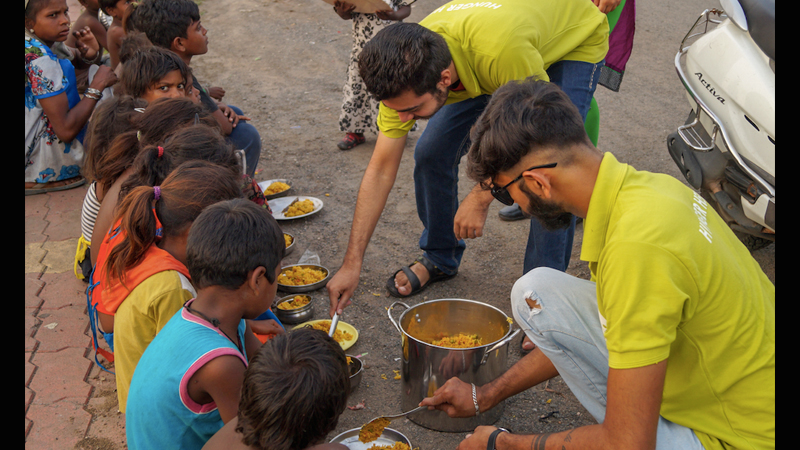
MUMBAI: Hunger may be stubborn, but Feeding India is proving it is not unbeatable. The not-for-profit has served more than 23 crore meals over the past seven years, turning nourishment into a nationwide movement that now spans over 150 cities, according to its Annual Report for FY 2024–25.
Titled A Year of Nourishing Dreams, the report captures a year in which the organisation sharpened its focus from simply filling plates to shaping futures. At the heart of its work is the fight against child malnutrition, with Feeding India now supporting over 1.4 lakh children every day through its partner network.
Its daily feeding programme has grown into a vast ecosystem, covering 1,097 partner schools and 726 Anganwadi centres. These include 275 formal schools, 720 informal learning centres, 58 schools for children with disabilities, and 32 orphan homes. Menus are tailored to local tastes, from rajma chawal in the North to idli sambhar in the South, ensuring meals are nutritious, culturally familiar and widely accepted. Food is provided through a mix of on-site kitchens and centralised cooking facilities.
Recognising that malnutrition often begins long before children enter classrooms, Feeding India has stepped deeper into early childhood care. Across districts such as Gurugram, Kushinagar and Varanasi, the organisation has worked with 726 Anganwadi centres, impacting around 27,000 children aged 0–6 years. More than 30 Anganwadis have been upgraded using Building as Learning Aid concepts, creating brighter, safer and more child-friendly spaces. In Varanasi, a pilot programme now provides full breakfast and lunch meals, a significant shift from the usual supplementary snacks.
The year also tested the organisation’s ability to respond in crisis. During 2024–25, Feeding India distributed nearly 2,000 ration kits following floods in Assam and landslides in Kerala, and served over 1.9 lakh hot meals after the Uttarakhand cloudburst. Relief operations extended to Bihar, Andhra Pradesh and Tamil Nadu in the wake of Cyclone Fengal.
Community participation remains central to the model. Events such as the Zomato Feeding India Concert, featuring Dua Lipa, brought together 28,000 people in 2024, while initiatives like Poshan Potli nutrition kits supported tuberculosis patients during recovery in Varanasi.
Funding patterns underline the power of platforms. Zomato users contributed nearly 80 per cent of total funds, amounting to Rs 74 crore, while Blinkit customers added 15 per cent, or Rs 14 crore. The remaining around 5 per cent came from institutional donors, employees and direct website contributions. Donors can track their impact directly via the Zomato or Blinkit apps, seeing how many meals they have funded and where those meals were served.
The report also highlights tangible outcomes. At the Malvi Educational and Charitable Trust in Gujarat, students recorded an average BMI improvement of 9.50 per cent after daily nutritious meals were introduced.
“Every meal represents hope, dignity and opportunity for a child who might otherwise go hungry,” a Feeding India spokesperson said, adding that the focus remains on nourishing potential through nutrition, infrastructure and care.
As the numbers grow, the message is simple but powerful, feeding a child today is an investment in tomorrow, and Feeding India is determined to keep that promise alive, one meal at a time.
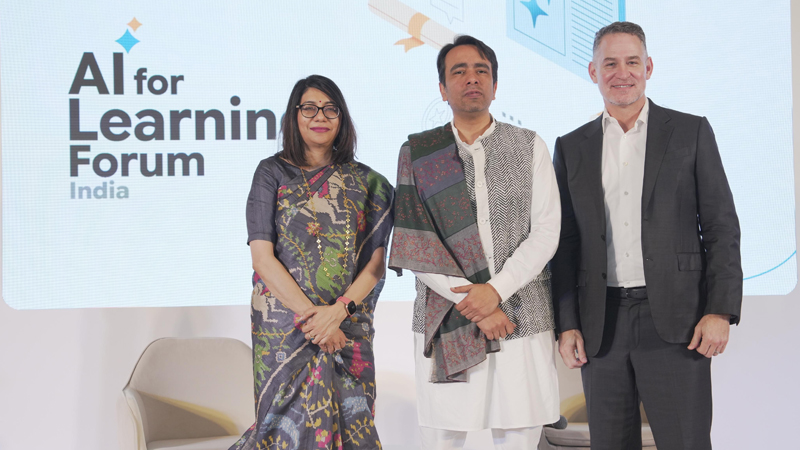
MUMBAI: If skills are the engine of Viksit Bharat, artificial intelligence is being fitted firmly under the bonnet. The Ministry of Skill Development and Entrepreneurship has announced a collaboration with Google Cloud and Chaudhary Charan Singh University to build a national framework for modernising India’s vocational and higher education ecosystem using cloud and AI technologies.
Unveiled at Google’s AI for Learning Forum in Delhi, the initiative positions CCSU, Meerut as a national pilot institution that will test how AI can be embedded into everyday teaching, administration and skill development. The announcement was made in the presence of Jayant Chaudhary, alongside senior officials from the Ministries of Skill Development and Education.
At the heart of the pilot is the use of Google Cloud’s Gemini Enterprise platform to address real-world challenges faced by universities. These include automating administrative workflows, improving staff efficiency, supporting research, and enabling personalised learning through AI tutors and skill-gap analysis. The aim is to make learning more adaptive, efficient and aligned with evolving workforce needs.
The programme is designed to act as an equaliser. By enabling vernacular language support and personalised AI-driven mentorship, it seeks to extend access to high-quality learning tools to students in regional institutions who are often constrained by geography, language or resources. Faculty members will also be supported with AI tools to design curriculum content, simulations and multilingual teaching aids tailored to different learning speeds.
Beyond classrooms, the initiative focuses on operational reform. Intelligent document processing and automated workflows are expected to reduce administrative load, allowing institutions to function more efficiently while improving service delivery to students.
Crucially, the CCSU pilot will feed into a larger ambition. Insights from the project will be used by MSDE to develop a National Best Practice Framework that can guide more than 50,000 colleges and over 1,200 universities in adopting AI responsibly and self-certifying as “AI-enabled universities”.
As a designated Centre of Excellence, CCSU will also host knowledge-sharing sessions to demonstrate how AI can be scaled across India’s diverse education landscape. The goal is clear: ensure that future-ready skills are not confined to elite campuses, but become part of the everyday learning experience for students across the country.

MUMBAI: It is January 28, 2026. Today, the world observes Data Privacy Day. But let’s be honest: for the other 364 days of the year, we are usually too busy scrolling to care. We click “Accept All Cookies” to read an article. We trade our email addresses for 10% off a pair of sneakers. We spill our deepest thoughts to AI chatbots without wondering where that data goes.
The result? You are leaving a trail of “digital exhaust” that is being vacuumed up, packaged, and sold to the highest bidder.
Today is the day we hit the brakes. Privacy is no longer a luxury for the paranoid; it is a necessity for the free. Here is why this matters right now, and how you can fix it fast.
The New Threat: It’s not just hackers anymore
In the past, we worried about criminals stealing our credit card numbers. In 2026, the game has changed. The entity hungry for your data isn’t just a hoodie-wearing hacker in a basement—it’s the legitimate apps on your phone and the algorithms training on your behavior.
• The AI Mirror: Every prompt you type into a public AI model can theoretically become part of its brain. Your distinct writing style, your problems, and your ideas are the fuel.
• Biometric Overload: We pay with our faces and unlock doors with our fingerprints. If a password gets stolen, you change it. If your biometric data gets stolen, you can’t change your face.
• The “Free” Trap: If an app is free, you aren’t the customer; you are the product. Your location history, health stats, and spending habits are the inventory.
The 15-minute privacy sprint
You don’t need to go off the grid or move to a cabin in the woods. You just need to tighten the bolts. Here is your rapid-fire action plan for today:
1. Kill the zombies
We all have “zombie accounts”—old logins for fitness apps we used once in 2021 or shopping sites we forgot about. These are security holes waiting to happen.
The Fix: If you haven’t logged in for 12 months, delete the account. Not the app—the account.
2. Starve the chatbot
AI is useful, but it doesn’t need to know your secrets.
The Fix: Turn off “Chat History” in your AI settings where possible. Never enter financial details, legal documents, or medical info into a public Generative AI tool.
3. The “location” audit
Does your flashlight app need to know you are in a coffee shop? Does your calculator need your contact list? Absolutely not.
The Fix: Go to Settings > Privacy > Location Services (on iOS or Android). Change permissions from “Always Allow” to “While Using” or, even better, “Never” for non-essential apps.
4. Ditch the SMS two-factor
Hackers can swap SIM cards easier than they can crack passwords. Receiving your 2FA codes via text message is the weak link in 2026.
The Fix: Switch to an Authenticator App or use a physical security key (like a YubiKey). It takes five minutes to set up and multiplies your security by ten.
The bottom line
Data Privacy Day isn’t about fear; it’s about agency.
Your data is an extension of your physical self. It is your identity, your history, and your future. By taking control of it, you aren’t just securing a device; you are reclaiming your right to be a person, rather than a data point.
Don’t wait for next January. Make privacy a habit, starting now.

Mukesh Ambani, Larry Fink come together for CNBC-TV18 exclusive

Nielsen launches co-viewing pilot to sharpen TV measurement

Netflix celebrates a decade in India with Shah Rukh Khan-narrated tribute film

Delhivery chairman Deepak Kapoor, independent director Saugata Gupta quit board

Meta appoints Anuvrat Rao as APAC head of commerce partnerships

Brnd.me enters Europe as haircare brands power global expansion

TechnoSport taps quick commerce with launch on Slikk’s 60-minute platform

These ’90s fashion trends are making a comeback in 2017
The final 6 ‘Game of Thrones’ episodes might feel like a full season
According to Dior Couture, this taboo fashion accessory is back
The old and New Edition cast comes together to perform
Phillies’ Aaron Altherr makes mind-boggling barehanded play
Uber and Lyft are finally available in all of New York State
Disney’s live-action Aladdin finally finds its stars
Mukesh Ambani, Larry Fink come together for CNBC-TV18 exclusive
Nielsen launches co-viewing pilot to sharpen TV measurement
Netflix celebrates a decade in India with Shah Rukh Khan-narrated tribute film
Delhivery chairman Deepak Kapoor, independent director Saugata Gupta quit board
Meta appoints Anuvrat Rao as APAC head of commerce partnerships
Brnd.me enters Europe as haircare brands power global expansion
TechnoSport taps quick commerce with launch on Slikk’s 60-minute platform
-
 News Broadcasting1 day ago
Mukesh Ambani, Larry Fink come together for CNBC-TV18 exclusive
-
 iWorld5 days ago
Netflix celebrates a decade in India with Shah Rukh Khan-narrated tribute film
-
 I&B Ministry3 months ago
India steps up fight against digital piracy
-
 iWorld3 months ago
Tips Music turns up the heat with Tamil party anthem Mayangiren
-
 MAM1 day ago
Nielsen launches co-viewing pilot to sharpen TV measurement
-
 iWorld12 months ago
BSNL rings in a revival with Rs 4,969 crore revenue
-
 MAM3 months ago
HoABL soars high with dazzling Nagpur sebut
-
 News Broadcasting2 months ago
CNN-News18 dominates Bihar election coverage with record viewership