
Factual
Television Audience Measurement: What next?


Yesterday, BARC took a decisive step forward. Punit Goenka in his role as Chairman, BARC announced the issuance of a Request for Information or RFI from entities worldwide who might be interested in participating in the forthcoming Request for Proposal stage.
While the television rating system in India has shown great durability and adaptiveness, the pace of growth and change in the television landscape has consistently outstripped it. BARC is premised on finding and adopting best-in-class tools, technologies and processes that will not just close the gap, but create a constantly evolving and, thus, future ready audience measurement infrastructure.
Here are the challenges that the new system will be expected to meet and overcome.
1. Comprehensiveness: Television reaches very nearly two-thirds of all households in India. As economic development continues apace and more people have discretionary income, entertainment and information start assuming increasing prominence in their scheme of things. A cable-connected television is, and will remain, the least expensive single-point source of meeting this need, and new consumers waste little time in acquiring it.
The household is now exposed to content but also to advertising that becomes a potent driver of new demand for a range of previously unknown products and services. Over the last decade, almost 10 million new households have entered the television footprint every year and the number doesn’t appear to be slowing down yet. A comprehensive measurement system must be able to recognise these burgeoning television households and keep them in the sights of broadcasters, advertisers and advertising agencies.

2. Accuracy: There has been talk over the years of making broadcasters more accountable for audience deliveries. A number of deals are done on the basis of cost-per-rating-point (CPRP) but broadcasters have, rightly, complained that fair valuation of their inventory would have to be based on cost-per-thousand (CPT) or, as the print media call it, the mille rate. The current system falls some ways short of being able to facilitate the change from CPRP to CPT. Marketeers and broadcasters are looking forward to a system where actual audience deliveries in a defined target audience can be accurately quantified so that accountability for audiences can be fixed and reciprocally paid for.
3. Adaptiveness: We still talk of single television homes as being the dominant model in India. Apparently, we are oblivious of the emergence of second and third screens that are being used by the younger demographic for consuming what was previously available exclusively on the television in the family room. The emergence of the smartphone and more recently of new devices like tablets (or even more recently, the rather inelegantly named ‘phablets’) has placed new content consumption devices in the hands of millions of young consumers. Content is now available to be consumed not just at a location but while on the move. Just like cellular telephony transformed communication from locational to personal, these screens and a constantly improving wireless broadband infrastructure are transforming television. The imminent arrival of 4G and crashing tablet prices will place highly mobile content consumption devices in millions of hands. The audience measurement system must be able to capture such mobile content consumption and stay adaptive with every future transformation of the television environment.
4. Auditability: Being owned and managed by BARC, a joint industry body (or JIB in the pro parlance), stakeholders will have audit rights over the system that can ask searching questions about every aspect of the process, thus ensuring its integrity and ethical standards. All the key stakeholders are represented within BARC and this will ensure that the system remains always true, fair and transparent.
These are not challenges unique to India but are faced universally by every television audience measurement system. Responses to the RFI will unearth a great body of valuable knowledge that the BARC can use to start building a gold standard system in India.
It is good to finally say this: BARC has BITE.












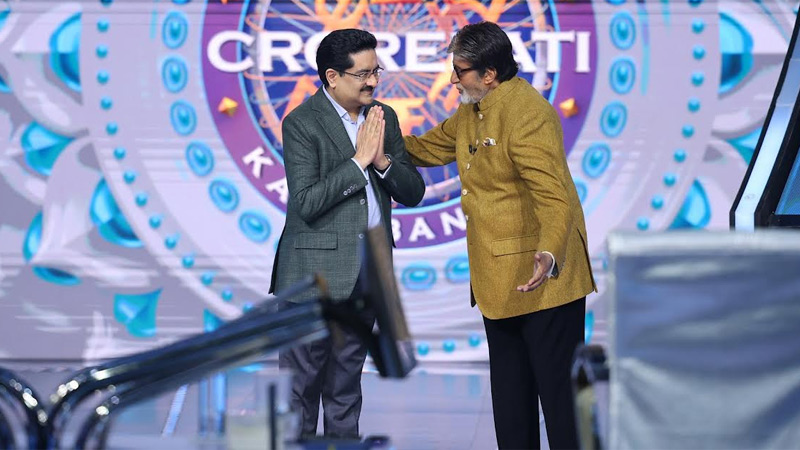
MUMBAI: India’s most famous hot seat is about to welcome an unlikely first-timer. For the first time on Hindi general entertainment television, industrialist Kumar Mangalam Birla will appear on Kaun Banega Crorepati, the iconic quiz show hosted by Amitabh Bachchan.
The special episode marks a rare meeting point of boardroom heft and prime-time television, bringing one of India’s most influential business leaders face to face with the country’s most enduring screen legend. It is a crossover that blends intellect, leadership and popular culture, all under KBC’s familiar spotlight.
Birla’s appearance dovetails neatly with the show’s current theme, Jahaan Akal Hai, Wahan Akad Hai, which celebrates the confidence that comes from clarity of thought and knowledge. His presence lends weight to the idea that sharp thinking and conviction are as vital in life as they are in the quiz chair.
In a thoughtful conversation with Bachchan, Birla shared an upbeat view of India’s economic journey, pointing to the nation’s rapid growth and the scale of opportunity opening up across industries and communities. He spoke of momentum, ambition and a future shaped by enterprise and ideas.
The episode is not all serious talk. In lighter moments, Birla confessed his long-standing admiration for Bachchan, calling him his favourite actor and admitting to a touch of nervousness at answering questions in front of the Shahenshah himself. The candour adds a human touch to a man more often seen in headlines than on television sets.
The special episode airs on Monday, 29 December at 9.00 pm on Sony Entertainment Television and Sony LIV.
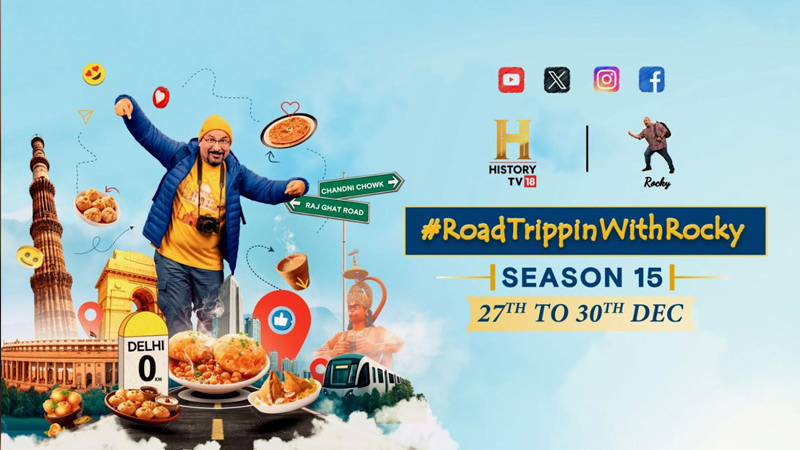
MUMBAI: Winter’s bite just got tastier. Road Trippin With Rocky is back for its 15th season, with Rocky Singh rolling through the NCR to plate up comfort food, cult favourites and cold-weather cravings from 27 to 30 December.
The four-day journey opens in Noida, where Rocky kicks off with the much-loved Jain Tikki Wala in Sector 27 before wrapping the day at the always-humming Social. Faridabad follows, with stops shaped by local recommendations, while Gurugram brings a balance of indulgence and restraint from a standout vegetarian spread to smoky carnivore fare at The Pit, finished with Thai flavours at Banng.
Saving the grand finale for Delhi, Rocky dives into the capital’s contrasts from humble roadside falahar to refined fine-dining tables that define New Delhi’s evolving food scene. The promise is simple: honest recommendations that belong on every serious food lover’s list.
Over the years, #RoadTrippin has grown into one of HistoryTV18’s most successful digital-first properties. Built for viewers who snack on content on the move, the format’s easy humour, spontaneity and conversational style have kept audiences coming back season after season.
The numbers underline its pull. Across platforms, the franchise has clocked over 2 billion impressions and more than 550 million video views, turning each new season into a highly anticipated return.
Season 15 of #RoadTrippinWithRocky will play out across HistoryTV18’s and Rocky’s social media handles, a winter road trip that proves once again that in NCR, the cold only makes the food hotter.
MUMBAI: The cries may have gone unheard, but the stories now refuse to stay silent. Warner Bros. Discovery and Times Network have come together to shine a piercing, humanising light on Delhi’s GB Road, one of India’s most stigmatised spaces with Unheard Cries at GB Road, a documentary that trades sensationalism for truth, and myth for lived reality. The film premiered on 17 November 2025 on discovery+, offering rare, unfiltered access to a world long discussed but rarely listened to.
Crafted under Times Now Studios and shaped by producer and co-writer Rohit Chadda, the documentary draws on over 50 in-depth interviews with survivors, sex workers, police officials, social workers and experts. Instead of dramatisation or stylised retellings, the film builds itself on first-hand accounts bringing to the fore women whose lives have often been spoken about, yet scarcely spoken to.
At its heart, Unheard Cries at GB Road is a testament to the women who battle cycles of trauma, exploitation and coercion, while still searching for small, stubborn pockets of hope. Their accounts, delivered on record and often at great personal risk, reveal the emotional, physical and psychological landscapes of a district too frequently flattened by stereotype.
Warner Bros. Discovery, head of factual entertainment, lifestyle & kids for South Asia,Sai Abishek said the project demanded both courage and care. “Unheard Cries at GB Road is a story that demands to be seen and heard. Factual storytelling carries responsibility, and this film embodies that commitment. By giving these women the space to speak for themselves, the documentary brings rare honesty and emotional depth to a subject too often misunderstood.”
The production team gained access to the interiors of brothels, capturing the quiet routines, the harsh constraints and the precarious negotiations that shape daily life. Insights from the Delhi Police, NGO workers and legal experts situate these personal stories within the larger systems of trafficking, safety failures and legal gaps that the women must navigate.
Rohit Chadda said, “We made this film to confront a truth that has long remained ignored. Our commitment from the very beginning was to tell these stories with honesty, dignity, and responsibility – and we hope it resonates deeply enough to spark reflection, conversation, and a sense of hope, which results in long term change. Unheard Cries at GB Road is the first production under the banner of Times Now Studios, and we intend to build on this foundation by creating more meaningful, purpose-driven stories that deserve a platform and a voice.”
“This special documentary, produced under Times Now Studios and directed by Rohit Chadda and Yatharth Chauhan, is built on more than 50 in-depth interviews.”
While the documentary does not attempt to provide simple solutions, it offers something more vital, a vantage point grounded in truth. By presenting the voices of women who endure the unseen and the unimaginable on a daily basis, the film asks viewers to confront the complexity of GB Road with empathy rather than judgement.
Unheard Cries at GB Road is streaming now on discovery+, inviting the nation to listen truly listen to stories that can no longer remain in the shadows.


Mukesh Ambani, Larry Fink come together for CNBC-TV18 exclusive

Nielsen launches co-viewing pilot to sharpen TV measurement

Netflix celebrates a decade in India with Shah Rukh Khan-narrated tribute film

Delhivery chairman Deepak Kapoor, independent director Saugata Gupta quit board

Meta appoints Anuvrat Rao as APAC head of commerce partnerships

Brnd.me enters Europe as haircare brands power global expansion

TechnoSport taps quick commerce with launch on Slikk’s 60-minute platform

These ’90s fashion trends are making a comeback in 2017
The final 6 ‘Game of Thrones’ episodes might feel like a full season
According to Dior Couture, this taboo fashion accessory is back
The old and New Edition cast comes together to perform
Phillies’ Aaron Altherr makes mind-boggling barehanded play
Uber and Lyft are finally available in all of New York State
Disney’s live-action Aladdin finally finds its stars
Mukesh Ambani, Larry Fink come together for CNBC-TV18 exclusive
Nielsen launches co-viewing pilot to sharpen TV measurement
Netflix celebrates a decade in India with Shah Rukh Khan-narrated tribute film
Delhivery chairman Deepak Kapoor, independent director Saugata Gupta quit board
Meta appoints Anuvrat Rao as APAC head of commerce partnerships
Brnd.me enters Europe as haircare brands power global expansion
TechnoSport taps quick commerce with launch on Slikk’s 60-minute platform
-
 News Broadcasting4 days ago
Mukesh Ambani, Larry Fink come together for CNBC-TV18 exclusive
-
 iWorld1 week ago
Netflix celebrates a decade in India with Shah Rukh Khan-narrated tribute film
-
 MAM3 months ago
HoABL soars high with dazzling Nagpur sebut
-
 MAM4 days ago
Nielsen launches co-viewing pilot to sharpen TV measurement
-
 iWorld12 months ago
BSNL rings in a revival with Rs 4,969 crore revenue
-
 I&B Ministry3 months ago
India steps up fight against digital piracy
-
 iWorld3 months ago
Tips Music turns up the heat with Tamil party anthem Mayangiren
-

 Film Production1 week ago
UFO Moviez rides high on strong Q3 earnings
