
GECs
2001-2010: Small screen touched lives in a big way

The decade seems to have whizzed by. It almost seems like yesterday when the country‘s first television crorepati took home his Rs 1 crore cheque for excelling in KBC (Kaun Banega Crorepati) from its suave and sophisticated host Amitabh Bachchan.
 But for television the past 10 years have packed in a lot of punch and gut-wrenching change. I will try and examine what are the 10 major trends that have characterised the past television decade. The list is not comprehensive and I am sure there are many other highlights others may want to add; but this is my effort.
From competition to super competition: In the past decade, even a back-of-the-envelope calculation tells us that around 300-400 new channels have been launched, in almost every genre: news, religion, regional language, general entertainment channels (GECs), Hindi GECs, specialised city specific channels, youth channels, movie channels, alternate movie channels- you name it and you have it. Others are waiting to be launched: luxury channels, golf channels, cookery channels, and what have you.
Concurrently, the advertising and subscription costs have not gone up in proportion. So channel managements have to innovate to be profitable, even as the costs have been rising. People retention is a major challenge for almost every player in the television space, because of the paucity of professionals. Because of the competition and the fact that programming executives are risk averse, most of the channels for a large part – have over the past decade – been following a single strategy: if one type of programme works well on a channel or in a network, the others follow and develop a similar one. Net result is that all the television channels almost look the same because of similarity of content. For most of them therefore, there is a battle on the ground level to increase their visibility and this has led to an escalation in distribution costs in terms of carriage and placement.
The changing face of drama and soaps: At the beginning of the decade, were the saas bahu sagas on Star Plus, which focused on the interaction and travails of women in extended wealthy ethnic families. Shows like Kyuunki Saas Bhi Kabhi Bahu Thi, Kahaani Ghar Ghar Ki, Kasauti Zindagi Kay, Kahin To Hoga, ran for what seemed like ever and retaining their audiences despite. You had a rare CID, Astitva and Jassi Jaisi Koi Nahin which deviated from the beaten path. You also had comedies such as Kichdhi, Baa Bahu aur Baby, Office Office which sparkled and added to the audiences‘ mirth.
Then with the arrival of Colors the focus shifted to social issue based rural shows – aka as social dramas – like Balika Vadhu, Na Aane is des… Laado and Uttaran. Almost every channel followed with similar shows. While Zee had Agle Janam Mohe…, Imagine TV came up with Devi, among many other programmes of similar ilk.
Themes such as child marriage, female foeticide, women trafficking, the caste system, feudalism, farmers‘ suicide and superstition formed the thread of many a programme.

Of course, comedies received a big boost thanks to Sab TV a channel from the Sony Entertainment Network which has a surfeit of comedies, and some comedy shows on Sony.
 The emergence of reality TV: Reality TV roared into the forefront in the past decade. The nation watched inmates in a house being cooped together in a home for around three months and their reactions to each other in that closed environment in Bigg Boss in its seasons. Celebrities and their tolerance to extreme tasks were tested in Khatron Ke Khiladi. Then, youth went around on a predefined route on bikes in MTV‘s Roadies. From the UTV stable emerged a show that shook the nation with its focus on infidelity in the form of Bindass‘ Emotional Atyachaar. Partners were discovered on TV and marriage took place on shows like Rakhi Ka Swaywamvar and Rahul Dulhaniya Le Jayega. Individuals bared their most hidden secrets to Rajiv Khandelwal in the popular Sach Ka Saamna. Past life regression was explored in Raaz Pichle Janam Ka. Talent hunts such as Sa Re Ga Ma Pa, Indian Idol, Nach Baliye, Jhalak Dikhla Ja, Dance India Dance added oodles of reality punch to enthrall Indian viewers.
The debate over regulation: In the midst of all this, both industry and government continued to dither over regulation.
Time and again, government raised an alarm that content was going out of hand in both the news and general entertainment spaces. News took the route of sensationalising and glorifying almost everything and tabloid television became the norm.
News excesses became glaringly evident in the case of the coverage of the 26/11 terrorist attacks in Mumbai.The news industry responded by setting up the News Broadcasters‘ Association, the Broadcast Editors‘ Association, a code of ethics and programming, and also set up structures which allowed viewers to resort to a complain mechanism in case they felt that news was going beyond its brief.
 On the general entertainment side, an attempt is being made to set up a programming code and ways of compliance to it by the Indian Broadcasters‘ Foundation. While there were moves afoot on the content front, the government pussyfooted its way into regulation on the distribution front.
In the early part of the decade it mandated the spread of set-top boxes and conditional access systems as part of its digitalisation plans, but then it took no decision to further it to another 55 cities or monitor and further its spread in the four metros where it had ordered the cable operators to digitize. It restricted broadcasters from charging more than Rs 5 per channel to subscribers and hence kept the cable TV subscription prices for viewers in check.
Even as the decade was towards its last leg, there was no clarity on whether selfregulation was what the industry would be governed by or was it co-regulation.
The emergence of production houses: The demand for content led to the emergence of new production powerhouses. UTV Television, Synergy (now Big Synergy), Sagar Arts, Cinevistaas, Miditech, Creative Eye, Siddhant, DJs, Contiloe, Optymystix and Balaji Telefilms were the leaders at the start of the decade. The end of the decade had seen multinationals and more new Indian production houses adding to that list. Fremantle Media, Endemol, Zodiak (through SOL) belonged to the international list and was behind some of the real big productions. Amongst the newer indigenous ones who had forayed and made their mark included Directors Kut, Sphere Origin, Shakuntalam Telefilms, Walkwater Media, The Right Picture, Wizcraft, Cineyug, Playmate etc.
At the same time, producers were forced to put their houses in order with the associations striking to raise their wages, limited hours of working, and more structured production cycles.
The explosion in new talent: Talent costs spiralled out of reach as experienced actors started charging sky-high rates even as film actors, directors, producers hopped on to the television bandwagon. Producing cost-effectively meant that new talents had to be scouted and cast at lower rates. Hence, producers and channels worked closely with casting directors to find new faces, most of whom had next-door looks. Younger people were cast from colleges, from street corners and they went on to become big names.
 Sport as a grand television spectacle: Cheerleaders, belles and whistles, the involvement of filmstars in teams, the decade saw sports becoming a television spectacle like nothing else. Sports – read cricket – television was serious business in the seventies, eighties and even the nineties and meant for serious students of the game. But in an effort to broadbase the sport and make it appealing to women, female commentators were brought in whose clothes made the headlines.
Then came the IPL 20-20 form of the sport which allowed industrialists and the Bollywood brigade to own teams in a quick-bite format of cricket. Big doses of entertainment were thrown in with lots of pomp, loud music, bands and scantilyclad girls waving from the sidelines, owner-actors and industrialists egging on their teams. And the nation took to it like no other form of entertainment.
Meeting the needs of region-specific audiences: Thanks to its many languages, India is not an easy market, especially for the media owners. The decade saw a ballooning of regional language television with broadcast networks adding channels with content catering to local audiences of the state. The south has the Sun Network as the leader with languages catering to all the southern language states. Amongst the national players, Zee was a pioneer in this and today runs general entertainment television channels in Gujarati, Marathi, Telugu, Tamil, Kannada, Bengali, among others. The other networks are not far behind with Star, Sony, and even Viacom18 moving aggressively into the language space.
The proliferation of news: News burgeoned through the decade with specialised general news channels, city-specific channels, business news channels and even entertainment news channels being launched. And the spate of news channels was not just in the national language, they proliferated in regional languages too.
 Close to 1,200 hours a to 1,200 hours a day of news is churned out daily by the news channels. According to an estimate, around 600 channels have been licensed to uplink from India. Of this, a majority of the applications were for channels in the news space. So much has been the rush in the news television space that even a state such as Andhra Pradesh has about 15-16 news channels in Telugu.
Along with channels news anchors have also emerged as stars of sorts. At times, they give their actor kin a run for celebritydom, having notched up huge fan followings for themselves.
New distribution platforms: First, there was only Doordarshan. Then came cable TV in the nineties. The first decade of the new millennium has been characterised by the emergence of digital TV, mainly DTH TV homes. Of the 150 odd million TV homes, around 110 million have either a cable TV or DTH connection. Six platforms waging a cutthroat battle have resulted in extremely low subscriber costs with fees being as low as Rs 150. Cable TV has also been forced to keep its prices extremely low because of the competition from DTH. On the horizon are newer modes of broadcasting such as HDTV, IPTV and streaming of content over wireless broadband. Clearly, for customers there is a harvest of plenty in store.









CHENNAI: It appears there is still plenty of Sun to go around in the Indian broadcasting landscape, even if a few clouds have drifted across the financial horizon. Sun TV Network Limited, the Chennai-based behemoth that dominates airwaves across seven languages, has tuned into a steady frequency for the quarter ending 31 December 2025. While the numbers show a resilient revenue stream, the company’s latest broadcast reveals a few static-filled spots in its profit margins.
For the quarter in question, Sun TV’s total income climbed by approximately 3.31 per cent, reaching Rs 958.39 crores compared to Rs 927.66 crores in the same period last year. Revenue from operations also saw a healthy bump, rising 4.32 per cent to Rs 827.87 crores.
The real star of the show, however, was domestic subscription revenue, which surged by 8.86 per cent to Rs 472.99 crores. This growth highlights the enduring appetite for Sun’s diverse content, which spans everything from daily soaps in Tamil and Telugu to its burgeoning OTT platform, Sun NXT.
Despite the revenue growth, the picture quality of the profits was slightly blurred by rising costs. Eitda for the quarter stood at Rs 409.79 crores, a dip from the Rs 432.14 crores recorded in the corresponding 2024 quarter.
The profit after tax followed a similar downward trend, settling at Rs 316.44 crores against the previous year’s Rs 347.17 crores. Advertisers also seemed to have switched channels slightly, with advertisement revenues sliding to Rs 291.94 crores from Rs 332.17 crores.
Sun TV isn’t just playing on home turf; its sporting ambitions are becoming increasingly global. The network now owns three major cricket franchises: SunRisers Hyderabad in the IPL, SunRisers Eastern Cape in SA20, and SunRisers Leeds Limited in The Hundred (UK).
The foray into British cricket saw the company acquire a 100 per cent stake in Northern Superchargers Limited (now SunRisers Leeds) for approximately £100 million. While these franchises brought in Rs 14.61 crores this quarter, they also incurred corresponding costs of Rs 19.89 crores. Over the nine-month period, however, the cricket business is a major player, contributing Rs 487.64 crores in income.
The company’s bottom line took a minor hit from exceptional items, including a Rs 4.23 crore charge related to India’s new Labour Codes, which consolidated 29 existing labour laws. Additionally, the consolidated results reflect the amalgamation of Kal Radio Limited with Udaya FM, a move that became effective in May 2025 and required a restatement of previous figures.
To keep investors from reaching for the remote, the Board has declared an interim dividend of 50 per cent, that’s Rs 2.50 per equity share. This comes on top of earlier dividends of 100 per cent (Rs 5.00) and 75 per cent (Rs 3.75) declared in August and November 2025, respectively.
With a massive cash reserve and a dominant position in the South Indian market, Sun TV continues to shine, even if the current quarter required a bit of fine-tuning. For now, shareholders can sit back, relax, and enjoy the show.
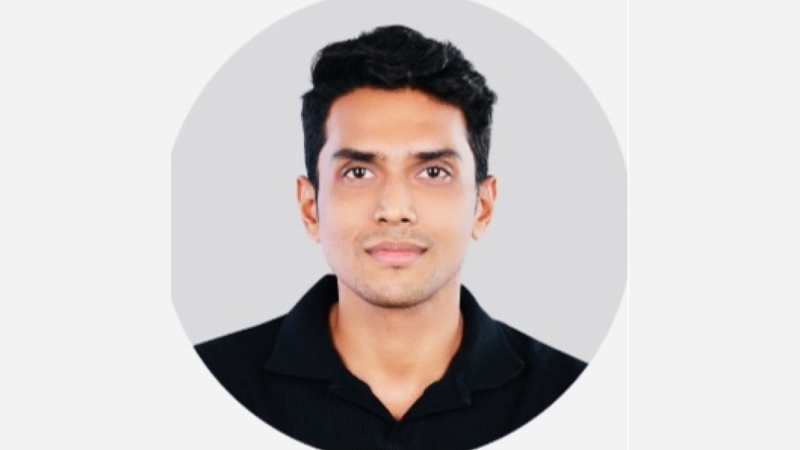
MUMBAI: Sony Pictures Networks India has hired Pradeep M to handle standards and practices for its southern market, bolstering its compliance bench as content rules tighten across platforms.
Pradeep, who has nearly 13 years in the entertainment media industry, takes on responsibility for content standards in a region that is both linguistically diverse and regulatorily sensitive. His brief spans television, OTT, sports and digital platforms.
He specialises in content review and compliance across shows, commercials, on-air promotions and international feeds, ensuring alignment with broadcast, OTT and advertising codes. He has also handled brand approvals and sponsorship integrations for heavily regulated categories—including online gaming, cryptocurrency, NFTs and lottery brands—offering guidance shaped by fast-evolving rules.
Before Sony, Pradeep worked at Jiostar as assistant manager for content regulation from November 2024 to January 2026. Earlier, he spent nearly seven years at Viacom18 Media, rising from senior executive to assistant manager in content regulation between 2018 and 2024. There he served as a key compliance touchpoint for the network.
His career began on the creative side. Between 2013 and 2018, he worked as executive producer on feature films and television shows, gaining hands-on exposure to production. He also had a stint as a non-fiction show director at Star TV Network in 2017. That mix of creative and regulatory experience gives him a dual lens—how content is made and how it must be managed.
As regulators, platforms and advertisers all tighten the screws, broadcasters are investing more in gatekeepers who can keep creativity within the lines. Sony’s latest hire shows where the industry is heading: in the streaming age, compliance is content’s quiet co-star.

MUMBAI: Colors Gujarati has unveiled two new prime-time shows as part of its push to strengthen culturally rooted storytelling for regional audiences. The channel will premiere the devotional saga Gangasati–Paanbai at 7.30 pm, followed by the romantic family drama Manmelo at 9.30 pm from February 2.
Inspired by Gujarat’s spiritual and literary heritage, Gangasati–Paanbai: Shyam Dhun No Navo Adhyay draws from the timeless bhajans and poetry of saint-poetesses Gangasati and Paanbai, weaving devotion and human values into a contemporary narrative aimed at younger viewers.
In contrast, Manmelo explores love and responsibility across social divides, tracing the lives of three middle-class sisters whose relationships with three affluent brothers reshape their futures. The show delves into ambition, emotional conflict and the realities of married life, offering a layered family drama.
A Colors Gujarati spokesperson said the new launches reflect the channel’s commitment to authentic Gujarati entertainment that blends cultural values with modern storytelling.



MIB sets OTT accessibility rules, mandates captions and audio description

Boney Kapoor acquires remake rights of Tamil political satire Thalaivar Thambi Thalaimaiyil

Netflix India names Rekha Rane director of films and series marketing

Zabeen signs off from TV9 after shaping the network’s public voice

Dhawan steps up to bat for Delhi’s grassroots sports push

Orient Beverages pops the fizz with steady Q3 gains and rising profits

Cheekatilo shines in the dark with record debut on Prime Video

These ’90s fashion trends are making a comeback in 2017

Swiggy Instamart’s GOV surges 103 per cent year on year to Rs 7,938 crore
The final 6 ‘Game of Thrones’ episodes might feel like a full season
According to Dior Couture, this taboo fashion accessory is back
The old and New Edition cast comes together to perform
Phillies’ Aaron Altherr makes mind-boggling barehanded play
Uber and Lyft are finally available in all of New York State
MIB sets OTT accessibility rules, mandates captions and audio description
Boney Kapoor acquires remake rights of Tamil political satire Thalaivar Thambi Thalaimaiyil
Netflix India names Rekha Rane director of films and series marketing
Zabeen signs off from TV9 after shaping the network’s public voice
Dhawan steps up to bat for Delhi’s grassroots sports push
Orient Beverages pops the fizz with steady Q3 gains and rising profits
Cheekatilo shines in the dark with record debut on Prime Video
-
 e-commerce3 weeks ago
Swiggy Instamart’s GOV surges 103 per cent year on year to Rs 7,938 crore
-

 News Headline2 months ago
From selfies to big bucks, India’s influencer economy explodes in 2025
-
 News Headline2 years ago
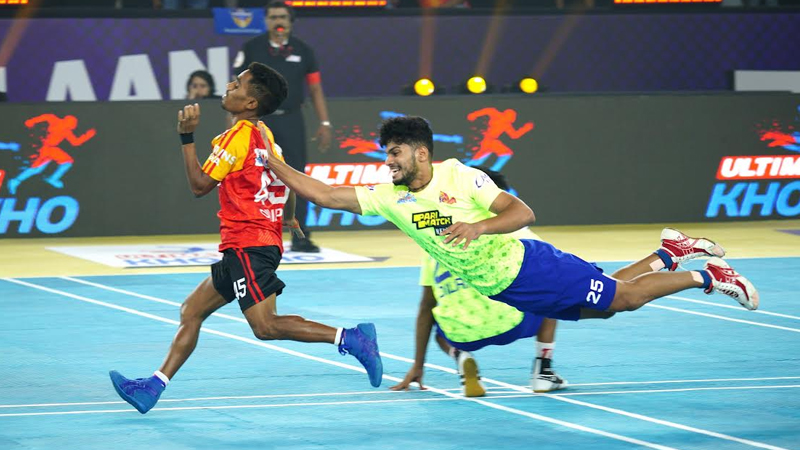
Odisha to host Ultimate Kho Kho Season 2 from December 24
-

 News Broadcasting3 weeks ago
Mukesh Ambani, Larry Fink come together for CNBC-TV18 exclusive
-
 iWorld6 months ago
Billions still offline despite mobile internet surge: GSMA
-

 News Headline2 months ago
2025: The year Indian sports saw chaos, comebacks, and breakthroughs
-
 MAM2 years ago
Ultimate Kho Kho raises valuation, secures a series-A PE funding from UK-based BNP group
-

 News Headline2 months ago
Game on again as 2025 powers up a record year and sets the stage for 2030


