
Applications
Broadband connectivity key to bridge digital divide: Kalam

NEW DELHI: President APJ Abdul Kalam laid out his vision for the Commonwealth Connect programme at Vigyan Bhavan here today, stressing the call of the hour is to shift from information to a knowledge society. Inaugurating the Commonwealth Connects summit Kalam said, “The telecom revolution in India has opened multiple windows of opportunities and the benefits of this revolution are in the process of percolating to the vast majority of our villages. It is through this network that people living in the villages would be able to access modern education, healthcare services and employment opportunities. And I believe, this would be true for many countries in the Commonwealth spectrum. Broadband connectivity is key to realising the stated socio-economic goals.” |
He stressed that large scale utilisation of local languages would enable people of the Commonwealth to create content with ease and authenticity which, when shared, would have a positive effect in the growth of economy of all the countries of Commonwealth through the benefits of telecom revolution and related internet and multimedia tools. |
“Bandwidth is demolisher of imbalances and a great leveller in the knowledge society. Making the bandwidth available is like the government laying the roads,” he said. “In the modern digital economy driven by knowledge products, bits and bytes traverse the network and create wealth and this will recover the cost of investments in the bandwidth. Thus, a singular action of making the bandwidth available to all our people will bridge the perceived divide. The free bandwidth will make economic sense if we appropriately cost the services offered using the bandwidth,” he added. India has the fiber infrastructure ready up to block level, last mile wireless technologies are being implemented and the VSAT technologies for the unreachable are in place in the form of satellite services. “Hence, we are well on course to bridge the digital gap. We are in the midst of convergence of digital technologies,” Kalam said. The total installed bandwidth capacity in India is in the range of 19-20 Terra bytes and lit-up capacity is progressively increasing with enhanced economic activity. Explaining that 70 per cent of Indians live in villages, he said: “We are in the process of a societal transformation towards sustainable development for our growth. This we propose to realise in a time-bound manner through a knowledge society for empowering the entire nation. Electronic and knowledge connectivity is the key to realise this goal. Connecting a billion people gives multiple challenges.” Sharing the Indian experience, he said that in the proposed model in this country, the inter-connectivity among the three sectors of the economy is brought about by four grids. He said these are the Knowledge Grid, Health Grid, e-Governance Grid and the Rural Grid. “Each grid is a system of multiple portals. This system of grid will bring prosperity to 700 million people in the rural areas and 300 million plus people in the urban areas. In the process, it will ensure that the lives of 220 million people are transformed from below the poverty line.” Though India has rich knowledge institutions, what needs to be added is connectivity. “This connectivity today is technologically possible but would need creation of high bandwidth reliable network infrastructure to the extent of minimum 10 Gigabits per second all through the country to provide uniform access of knowledge in different regions leading to the creation of Knowledge Grid,” Kalam held. The mission of telemedicine with healthcare Grid is gaining momentum and it will spread to all the equipped primary health centres in the country, medical colleges and research institutions. Connectivity between 35 urban super-specialty hospitals with 165 remotely located healthcare centres has been established through Indian Space Research Organisation (ISRO) telemedicine grid, he informed. Good governance is being recognised as an important goal by many countries across the world. They have taken up specific initiatives for open and transparent governance. Freedom of information is being redefined and supported by detailed guidelines, he said. “The internet revolution has proved to be a powerful tool for good governance initiatives. An important dimension of the internet potential is the possibility of providing services any time anywhere. Along with this there is a conscious effort to put the citizen as the centre of focus of the governance. “Citizens are being perceived as customers and clients. E-governance has to be citizen friendly. Delivery of services to citizens is considered as a primary function of the government. “Particularly in a democratic nation of a billion people like India, e-Governance should enable seamless access to information and seamless flow of information across the state and central government in the federal setup crossing the inter-departmental barriers. It is on this point that he took up the future vision, with election as the model, and using a presentation he had developed, showed how everything can be done – including voting – from homes and offices, and the audience went into splits with his side remarks on politicians, their education levels, bank balances and credits taken and said, using all the indices, an officer would be able to decided who would make a successful politician! “Typical scenario: I visualize an election scenario, where a candidate files his nomination from a particular constituency. Immediately the election officer verifies his/her authenticity from the national citizen ID database through multifactor authentication, through a multipurpose Citizen ID card. “The education credentials of the candidate come from the university records. Candidate‘s track record of employment comes from various employers with whom the candidate had worked. His or her income and wealth resources come from the income-tax department, and other sources. Candidate‘s property record comes from the registration of land authority across the country. Candidate‘s credit history comes form various credit institutions like banks. Candidate‘s civic consciousness and citizenship behaviour comes from the police crime record. Candidate‘s legal track records come from the judicial system. “All the details arrive at the computer terminal of the election officer within few seconds automatically by the act of e-Governance software agents which crawls across the various state and central government web services directories through the network Grid and collects the information automatically and presents the facts in real-time without any bias. “Artificial intelligence software analyses the credentials of the candidate and gives a rating on how successful he or she will be as a politician.” “Election officer sitting at the remote block of the country decides on the spot and the election process starts. All the voters vote from their home through virtual polling booths. If we consider the breakthroughs and expansion in telecommunication and internet in the last five years, this visualization is no longer a dream and is possible to be achieved by many nations. “To establish a system what I have visualized, we need a high bandwidth broadband connectivity across the many Government departments such as State and District Administration, Election commission, Universities, Banks, Home/Police Departments, Insurance companies etc., “This scenario requires vertical and horizontal e-Governance grid established across various institutions and the Government. Hence, we can draw information and feed information from these GRIDs for seamless flow of data to achieve the goal of good governance. Now let me discuss the significance of the sustainable development through establishing Rural Grid,” Kalam said. India with six hundred thousand villages and seven hundred million people living in the rural areas needs an unique rural development model called PURA. PURA envisages provision of three connectivities namely physical connectivity, electronic connectivity and knowledge connectivity leading to economic connectivity, Kalam said. “For providing the knowledge connectivity to the PURA (Providing Urban Amenities in Rural Areas) complexes, Village Knowledge Centres will act as frontline delivery system. The Village Knowledge Centre should provide the essential data required for the targeted population such as farmers, fishermen, craftsmen, traders, businessmen, entrepreneurs, unemployed youth and the students. “Now the Ministry of Communication and Information Technology is in the process of establishing 100,000 Common Service Centre (CSC‘s) across the country through public-private partnership model. “We have so far discussed all the four connectivities at the national level required for the societal transformation leading to empowerment. Now, I would like to share with you the experience of establishing a Pan African e-Network for providing connectivity among 53 African nations,” he said. During the year 2003-04, Kalam had visited African countries such as Sudan, Tanzania, Zanzibar and South Africa. “I addressed the Pan African Parliament on 16 Sept 2004, at Johannesburg, South Africa which was attended by Heads of 53 member countries of the African Union. Based on my study of the communication, healthcare and education needs of the African countries, I proposed the concept of Pan African e-Network for providing seamless and integrated satellite, fibre optics and wireless network connecting 53 African countries,” he said. The Pan-African e-Network project is estimated to cost around US$100 million. As part of the project 12 universities (7 from India and 5 from Africa), 17 Super Specialty Hospitals (12 from India and 5 from Africa), 53 tele-medicine centers and 53 tele-education centres in Africa will be connected, he explained. The pilot project on tele-education and tele-medicine in Ethiopia has already been commissioned. One of our Indian Universities has taken up the MBA Course for 34 Ethiopian students of Addis Ababa and Harmaya Universities. As regards, tele-medicine, the specialists from CARE Hospital, Hyderabad are providing one-hour live tele-consultation to doctors in Black Lion Hospital, Addis Ababa in Cardiology and Radiology since November 2006. The Pan African e-Network will primarily provide Tele-Education, Tele-Medicine, internet, videoconferencing and VOIP services. It also supports e-Governance, e-Commerce, infotainment, resource mapping and meteorological services. Each remote location will be able to access the internet through the network by linking the HUB to internet backbone. Using this network the Heads of the State in all the 53 countries will be connected for instant communication. The network is designed to have 169 terminals and a central hub to deliver tele-education and tele-medicine services. The proposed network will utilize state-of-the-art technology and can be integrated with the latest broadband technologies like Wi-Fi and Wi-Max. The network is scalable to support different applications catering to increased number of users. “I am happy to inform you that 22 countries will be connected in the first half of 2007 and the rest will be operationalised by early 2008,” Kalam informed. “I am sure many Commonwealth countries participating in today‘s summit have several experiences to share and Commonwealth connects programme can formulate a plan to integrate the core-competence of nations for mutual benefit. “This power of networking can definitely be used by Commonwealth countries for sharing their core competencies and building a knowledge platform for serving the development aspirations of the individual nations through collective wisdom,” he said. He concluded his delectable speech with several suggestions. Evolving guidelines for common telecommunication policy to share resources, network, infrastructure, without any barrier and facilitate implementation through a Commonwealth co-ordination centre. Evolving guidelines for Common Information Security policy in IT. Modernising education through state of the art skill development programmes among the Commonwealth nations leading to skill certification and acceptance among the countries for global employment opportunities. Undertaking study of e-governance implementations across the Commonwealth nations and suggest the best practices for the G2G and G2C implementations. Creating a mechanism which will facilitate pooling of core competence of nations for developing knowledge products and systems for serving the global market in education, healthcare and e- governance. Identifying gaps in educational standards of IT professionals in the Global business scenario in IT, ITES and BPO services and creating institutional mechanisms for training, accreditation and grading based on performance. Creating a common web portal for sharing information and knowledge among Commonwealth countries. Creating a Commonwealth Connects Fund and Institute a Commonwealth committee to address the above mentioned suggestions. The 53 countries of Commonwealth constitute a population of 2 billion i.e. one third of the population of the planet. This network of independent nations in the past has taken up many initiatives for interconnecting their heritage in art, culture, science and technology, history, sports and way of living. Such a strong base of relationship and the core competence of the countries can be further integrated into a very useful partnership by providing connectivity through the Evolution of a Commonwealth Knowledge Grid. “This can address many common challenges for development such as developing a knowledge society through quality education, providing affordable quality healthcare to all, sustainable rural development through cluster approach, providing transparent people-friendly-governance and above all evolution of an enlightened society for improving the National Prosperity Index of all the partner countries. The model developed by the Commonwealth Nations will have the potential to be extended to the entire Planet,” he said. Incredibly, he said in the end: “In just a few minutes, my paper will be accessible on my website. www.presidentofindia.nic.in. If any of you have any suggestions, send them to me and I will reply back within 24 hours.” The first day of the two-day meet was devoted to moving from digital divide to digital opportunities and to successful public-private sector partnership (PPP). Delegates from Mozambique, South Africa, Namibia, Kenya, and Sri Lanka related various instances where PPP had very successfully helped transform societies through greater use of IT. The information minister of Kenya M Kagwa related the instance of collaboration with the multi-national Vodaphone to create e-banking and money transfers through ‘m-pesa’ which had helped his government to change the situation in the country in just 18 months. He said that attempts had now been made to set up computers in every village in the country and help people access information. He said the gaps between revenue and literacy created digital divides, but an attempt was being made to overcome this. The delegate from Mozambique referred to shortage of financial resources, but said the entry of private partnership had helped to overcome this. Sri Lanka‘s science and technology minister Prof. Tissa Vitarana said recent initiatives had helped the country through PPP to take science and technology to the villages with the use of computer technology. T Chakravarty of Tata Consultancy Services which sponsored the meet said that a collaboration with the company affairs ministry had made it possible to put all information on a website and help any individual set up a company within an hour compared to 80 days until just over three years earlier. He also referred to the successful experiment in Andhra Pradesh where technology had been taken to the villages through Common Service Centres where computers were available for any person to access and get information on any subject. CII director general Lieutenant General S S Mehta said in his concluding remarks that there was need to move from pilot projects to fruition of such experiments, He said IT was the oxygen of the new world of cyberspace, and people should not be wary of breathing it. He wanted nations to draw up their own priorities and use modern technology to realize their goals. |


CALIFORNIA: Moltbook, a Reddit-style social platform built exclusively for artificial intelligence agents, has emerged as the latest obsession in Silicon Valley, drawing intense attention for its explosive growth and surreal bot-driven interactions.
The platform hosts more than 100 communities where AI agents post, argue and joke about topics ranging from governance theory to esoteric “crayfish debugging” concepts. Within days of launch, Moltbook recorded tens of thousands of posts, nearly 200,000 comments and more than 1 million human visitors observing the activity.
Yet the numbers and the autonomy are under scrutiny, as per media reports. A security researcher has suggested as many as 500,000 accounts may trace back to a single address, raising doubts about Moltbook’s membership claims. Many posts could also be the result of humans instructing their AI tools to publish content, rather than bots acting independently.
The platform runs on agentic AI, powered by an open-source tool called OpenClaw, formerly known as Moltbot. Unlike chatbots such as ChatGPT or Gemini, these agents are designed to perform tasks on users’ devices, from sending messages to managing calendars, with minimal human input. Once authorised, they can interact freely on Moltbook.
Some tech figures have hailed the platform as a glimpse of a post-human internet. Head of crypto custody firm BitGo Bill Lees, called it evidence that “we’re in the singularity”.
Academics are less convinced. Petar Radanliev, an AI and cybersecurity expert at the University of Oxford, said the idea of agents acting independently was “misleading”, describing Moltbook instead as automated coordination within human-set constraints. Columbia Business School assistant professor David Holtz, dismissed the spectacle as “thousands of bots yelling into the void and repeating themselves”.
Beyond hype, security worries loom large. ESET global cybersecurity advisor Jake Moore, warned that granting AI agents access to emails, private messages and files risks prioritising efficiency over privacy. Andrew Rogoyski of the University of Surrey said high-level system access could lead to serious damage, from erased data to compromised company accounts.
Even OpenClaw’s founder Peter Steinberger, has felt the darker side of attention, with scammers hijacking his old social media handles after the platform’s rebrand.
For now, Moltbook remains a strange digital zoo: part experiment, part spectacle, where AI agents banter about philosophy, productivity and, occasionally, their fondness for their human operators.

CALIFORNIA: Apple has handed a bigger global brief to a long-time insider. Avtar Ram Singh has taken over as head of international marketing for the App Store, Apple Arcade and the Apple Games app, deepening his remit across one of the company’s fastest-growing businesses.
“I’m happy to share that I’m starting a new position as head of international marketing, App Store, Apple Arcade and Games App at Apple,” Singh said while announcing the move.
The promotion crowns nearly seven years at Apple, where Singh has led services marketing across Southeast Asia and India and previously served as head of marketing for Southeast Asia content and services, business lead for Apple Podcasts in the region and interim marketing lead for the App Store internationally.
His new portfolio spans three pillars of Apple’s services push. The App Store, which Apple positions as a safe and trusted discovery platform, now attracts more than 850 million average weekly users globally. Since 2008, developers have earned over $550 billion on the platform.
Apple Arcade, the company’s gaming subscription service, offers unlimited access to a catalogue ranging from brain teasers to big-name franchises. The recent addition of Sid Meier’s Civilization VII Arcade Edition brings a AAA PC title to iPhone, iPad and Mac from 5 February.
Then there is the Apple Games app, unveiled at WWDC as a unified destination for games from the App Store and Arcade. It aggregates titles in one place, surfaces personalised recommendations, tracks events and achievements, and lets users compete with friends or connect controllers for a console-like experience.
Singh arrives with a hybrid background in strategy, data and creativity. His career spans digital and social media marketing, business intelligence, content, editorial and analytics across culturally diverse markets. He has worked on brands including P&G, Accor, Audi, UBS, Nikon, Samsung, Sony, Pizza Hut, HBO and Singapore Airlines-linked businesses such as Scoot.
Before Apple, Singh led strategy at Falcon Agency, focusing on performance marketing and ROI-driven digital frameworks. He earlier ran the social practice at Publicis Singapore, where he oversaw operations, business development and regional social strategy for multinational clients. His career also includes roles at Ogilvy-linked Circus Social, Rocket Internet ventures Lazada and Zalora, and research firm IDC in Bangkok, where he analysed technology markets and won early awards for collaboration and client retention.
At Apple, he has been close to several service launches and expansions, including Apple Fitness+ in Singapore, Apple Creator Studio, global podcast subscriptions and new App Store marketing tools.
The timing is notable. Apple’s services business has posted record years, and gaming is becoming a sharper battleground as platforms chase engagement and recurring revenue. Singh’s brief sits at the intersection of content, community and commerce.
In a market where attention is scarce and loyalty scarcer, Apple is betting that sharper storytelling and smarter marketing can keep users inside its ecosystem. Singh now holds the megaphone. The real test will be how loudly the world listens.
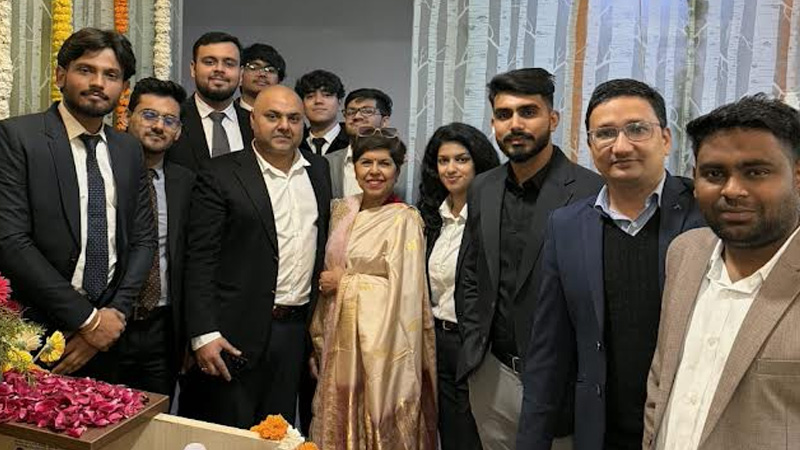
MUMBAI: Bharathcloud is bringing its cloud closer to power. The Hyderabad-based sovereign AI cloud services provider has opened its Delhi office, marking its formal entry into North India and setting the stage for its next phase of growth.
The expansion comes as India’s digital transformation fuels rising demand for AI-ready cloud infrastructure, driven by wider adoption of artificial intelligence, machine learning, the Internet of Things and data-heavy applications. With the new office, Bharathcloud plans to onboard more than 100 employees in 2026, strengthening its workforce to support customers across government, enterprises, MSMEs and social sectors.
The Delhi presence is expected to sharpen the company’s engagement with organisations seeking secure, scalable and cost-efficient cloud platforms that comply with India’s data sovereignty requirements. It also positions Bharathcloud closer to policy, public sector and enterprise decision-makers in the region.
Founded in Hyderabad, Bharathcloud offers AI-ready cloud infrastructure including Kubernetes-as-a-Service, zero-trust security architecture and multi-level data protection frameworks. Its platform supports AI and ML workloads, blockchain application migration from hyperscalers and distributed data management, with an emphasis on reliability, low latency and operational continuity.
“With the Delhi expansion, we are positioning Bharathcloud to engage more closely with AI-driven enterprises and technology hubs in North India,” said Bharathcloud co-founder Rahul Takallapally. He added that the move would help nurture local cloud and AI talent while accelerating the adoption of secure and resilient AI infrastructure across sectors.
The company currently operates in Hyderabad, Bengaluru, Mumbai, Kolkata, Lucknow and Chennai, employing over 200 people and serving more than 1,500 clients across manufacturing, healthcare, financial services, IT and media. Aligned with national initiatives such as Digital India and Make in India, Bharathcloud continues to focus on building indigenous AI-cloud infrastructure to support data localisation and the country’s growing appetite for next-generation digital solutions.
With its Delhi office now live, the company is signalling a clear intent: to make sovereign, AI-ready cloud infrastructure not just an alternative, but a mainstream choice for India’s north as well as its tech capitals.



MIB sets OTT accessibility rules, mandates captions and audio description

Boney Kapoor acquires remake rights of Tamil political satire Thalaivar Thambi Thalaimaiyil

Netflix India names Rekha Rane director of films and series marketing

Zabeen signs off from TV9 after shaping the network’s public voice

Dhawan steps up to bat for Delhi’s grassroots sports push

Orient Beverages pops the fizz with steady Q3 gains and rising profits

Cheekatilo shines in the dark with record debut on Prime Video

Swiggy Instamart’s GOV surges 103 per cent year on year to Rs 7,938 crore

These ’90s fashion trends are making a comeback in 2017
The final 6 ‘Game of Thrones’ episodes might feel like a full season
According to Dior Couture, this taboo fashion accessory is back
File sharing services infringing copyright: US Supreme Court

ATN International brings ATN Bangla to Canada
The old and New Edition cast comes together to perform
MIB sets OTT accessibility rules, mandates captions and audio description
Boney Kapoor acquires remake rights of Tamil political satire Thalaivar Thambi Thalaimaiyil
Netflix India names Rekha Rane director of films and series marketing
Zabeen signs off from TV9 after shaping the network’s public voice
Dhawan steps up to bat for Delhi’s grassroots sports push
Orient Beverages pops the fizz with steady Q3 gains and rising profits
Cheekatilo shines in the dark with record debut on Prime Video
-
 e-commerce1 month ago
Swiggy Instamart’s GOV surges 103 per cent year on year to Rs 7,938 crore
-
 iWorld1 year ago
Kuku TV transforms India’s OTT space with vertical microdrama boom
-
 News Headline1 year ago
TRAI puts a ‘stop’ to unsolicited calls and messages
-

 News Headline2 months ago
From selfies to big bucks, India’s influencer economy explodes in 2025
-
 Comedy2 years ago
Taarak Mehta Ka Ooltah Chashmah celebrates 4,000 episodes
-
 MAM2 years ago
OpenAI joins C2PA steering committee
-
 News Headline2 years ago
Odisha to host Ultimate Kho Kho Season 2 from December 24
-
 News Headline1 year ago
Abhishek Bachchan joins as co-owner of European T20 Premier League


