Tag: ZeeMelt

  • ZeeMELT and Kyoorius celebrate memorable moments of TV industry

    ZeeMELT and Kyoorius celebrate memorable moments of TV industry

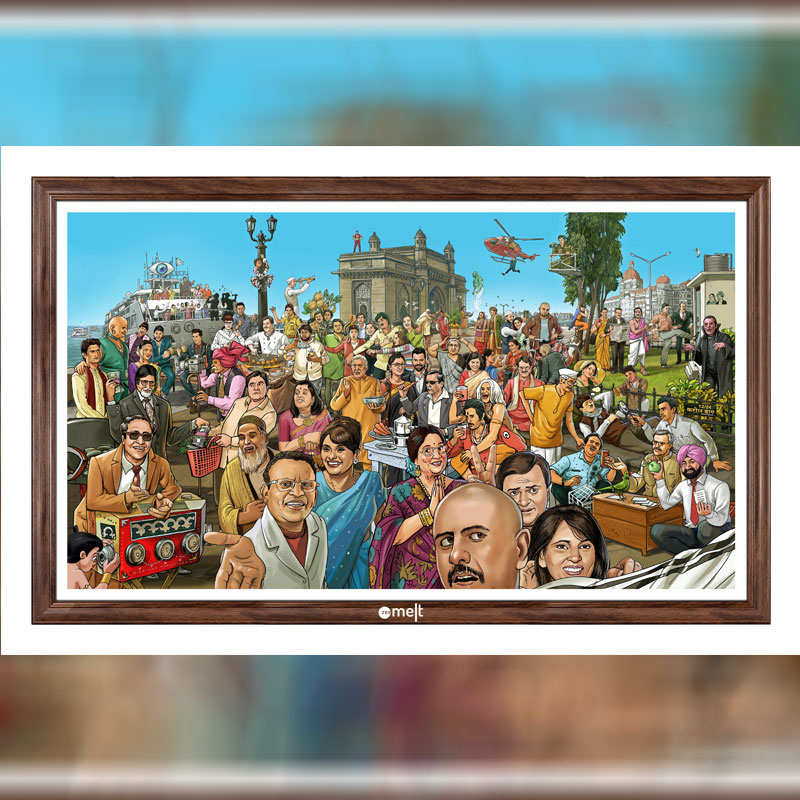
    KOLKATA: Kyoorius, in continuation of the campaign launched at ZeeMelt 2019, released a montage image that features 58 memorable characters from TV serials and shows broadcast across Doordarshan and Hindi GECs.

    “I thoroughly enjoyed this brilliant piece of art and loved the process of identifying my favourite characters from the world of television. There is a beautiful relationship which gets created between a viewer and the character, and this painting celebrates this bond and the power of the entertainment platform. I congratulate the teams from Kyoorius and BBDO, who have created this masterpiece. I wish them all the best and look forward to a yet another successful edition of ZeeMELT,” Zee Entertainment Enterprises Ltd MD & CEO Punit Goenka said.

    “Last year, to mark ZeeMELT, we had created a collage of memorable moments from Indian advertising. It was no surprise to us that the image went viral as consumers enjoyed competing with each other to see who had identified more moments and brands. Programming and advertising are both content as far as our viewers are concerned and this painting is a natural progression of the original thought," Kyoorius founder & CEO  Rajesh Kejriwal said. 

    He was confident that the image would go viral again. “The painting is a wonderful example of communication riding on popular culture. TV is popular culture in India, and, across the country, much time is spent of discussing TV content and thousands of social media messages discuss developments on TV shows and the performances of characters," he added.

    "Last year's ZeeMELT poster was a fun guessing game of the most memorable Indian ads over time. This year, more ambitiously, we decided to create an interactive poster with famous shows that filled our living rooms with life. We've tried to capture the memories and times of the last 40 odd years through the characters who gave us our most memorable TV moments. The result is not just a guessing game, it's an outpouring of nostalgia — a glorious look at where we come from," BBDO India CCO and chairman Josy Paul said.

  • ZeeMelt: OTTs add to momentum of FB & Youtube video consumption

    MUMBAI: “Digital video is not the regular video which is differentiated by the screen size but everyone is aware about digital videos. If someone is working on a TVC, then bring your brand within first five seconds to get your brand liftup,” said Google creative head Haani Mirza.

    “To lift the brand, marketers will have to focus on ABCD, which is Attract, Brand, Connect and Direct the viewers,” he added.

    Talking about digital advertisments, Kantar Insights CEO – media & digital Gonzalo Fuentes said, “86 per cent people have observed the frequency of advt has increased as compared to past three years, and 32 per cent of Gen Z in South East Asia and India have installed ad blockers.”

    “Digital Advertising industry can change the trend by focusing on the data which is fully consumer-centric and building engagement through creativity and consistency — creativity which is not targeting the audience gives a negative impact,” he added.

    Speaking about videos on social media and OTT platforms, Kantar IMRB MD media, digital & retail Hemant Mehta said, “Over the last few years, video is dominating the social media, and mobile screens attract more engagement than any other media. All the OTT platforms add to the momentum which was inbuilt in the social consumption. India has more than 20 million avid-video consumers spending 45 minutes a day and 22 hours a month.”

    Culture Machine CEO & co- founder Samir Pitalwalla added to Mehta’s view, “90 per cent of the consumers are watching videos on Youtube and Facebook in which three out of 10 consumers access OTT platforms. Music & entertainment are most dominant categories, and the fastest growing are: education and news.”

    Also Read:

    YouTube’s Top 50: T-Series tops & SET India bags 5th slot 

    Adspend: Twitter fastest growing, FB & Google control 20% 

    YouTube challenges Facebook & Twitter with mobile live

  • ZeeMelt: Bitcoin to be biggest disruptor, predicts Project X’s Nicholas Russel

    MUMBAI: It’s the third year of disruptive marketing communication. Established companies had a hard time understanding why this model is a thing of the past. What it all comes down to is: that customers have become market-savvy forward-thinkers.

    Startups are entering the game and are giving customers what they want. They are disrupting the industry and forcing incumbents to catch up or fall behind.

    WATConsult CEO Rajiv Dingra said, “It’s very important to know what disruption is — it’s not an event, it is a process, and digital creates a lot of disruption — in many ways, like pricing and promotion.”

    Talking about disruptive pricing, Project X founder Nicholas Russel said, “If we think about pricing contextually, disruptive pricing is jumping in the real world and starts acting like pricing online. The main concern is about cost price and value. Considering Apple as a brand, the cost of making is $211 and the price we get it from the market is around $550, which helps in reaching the margin to $399, i.e 60%.

    Comparing Amazon with Walmart, the former pays 1/3rd of what Walmart pays for its retail stores.” Amazon retail online EB/EBITA ratio is 26.41.

    Talking about what e-commerce (Amazon) can do which retail can’t, he said, “E-commerce can have discounted price as compared to retail stores. And, it may lower the price for the good conditioned used products.”

    “Bitcoin is going to be the biggest disrupting things in the future which is not controlled by anyone, it is the market altogether. In future, it is possible that you won’t see the price tag on products — it will be available after you scan the barcode on the product,” Russel said.

    Dingra added, “Amazon is not an e-commerce company — it has now become an ecosystem company.”

    Lava business head & CMO Sunil Raina said, “Disrupting only happens through technological advancements. The challenges faced by Lava to be one of the best and trusted brands in industry are rapid tech changes, short product life cycle, transparent product, demonstration-based selling, different marketing, one brand mutiple channels, multiple pricing and the ever-evolving customer.

    To acheive the goal, Lava and XOLO have busted many myths in the industry and the business model of Lava and XOLO are single-layer distribution followed by cash & carry. Keeping the quality in mind it stands on two pillars — first, the consistent product quality, and second, consistent great service. “For us, quality is not a trade-off for price,” Raina said.

    Lava claimed to have the highest reach of 1,65,000 retailers with $2 billion annual global revenue. About competition, Rana added, “We are building our base for the last seven years, and after an year, we will be prepared to take on Vivo and Oppo.”

    SapientRazorfish VP Saurabh Das said, “Service is basically — live up to your brand promise wherever and whenever customers come calling. A brand needs to accelerate innovation in the service experience to create greater value for customers — stay differentiated & monetise.”

  • Ads low in print with greater customer feedback in digital mediums

    Ads low in print with greater customer feedback in digital mediums

    NEW DELHI: There was a growth of forty per cent in advertising in the United Kingdom in fifiteen years from the turn of the millennium, but the the print medium saw a fall of 65 per cent in advertising in the same period.

    Online advertising is the dominant source in the UK cornering 74 per cent, according to Financial Times Chief Data Officer Tom Betts.

    In a presentation on Data Insights: Disrupting News at the just concluded ZEEMelt, Betts said however, that sixty per cent do not remember what they read on the social media and agreed with a comment that the digital medium had sight and sound but the touch was missing and that was why the primt medium continued to grow in many countries.

    However, it was equally true that there is very little feedback in the print medium unlike the data driven growth in digital technologies. “Customer data is at the centre” and was the customer DNA in digital platforms, he said.

    “It is really exciting times for news just as it is for advertising”, he said, with mobiles and i-pads providing competition to the print medium.

    Digital technology has also helped to bring personal finance to the top and the advertising wold has to cater to that.

    But customer engagement comes from ‘Recency, Frquency, and Volume’ and advertising is analytically power driven through personalised products and data-supported discovery often depending on what he termed as ‘digital serendipity.’

    Echoing these same sentiments in another session on ‘The future oif storytelling’, Conde Nast Digital Director Gaurav Mishra said today’s consumer wanted on-the-go content.

    As a result, interest graphs were narrowing as the consumer only wanted to see what interested him.There was also ‘digital serendipity’ resulting in a lot of sharing on the social platforms. This led to a shared purpose and passion.

  • Ads low in print with greater customer feedback in digital mediums

    Ads low in print with greater customer feedback in digital mediums

    NEW DELHI: There was a growth of forty per cent in advertising in the United Kingdom in fifiteen years from the turn of the millennium, but the the print medium saw a fall of 65 per cent in advertising in the same period.

    Online advertising is the dominant source in the UK cornering 74 per cent, according to Financial Times Chief Data Officer Tom Betts.

    In a presentation on Data Insights: Disrupting News at the just concluded ZEEMelt, Betts said however, that sixty per cent do not remember what they read on the social media and agreed with a comment that the digital medium had sight and sound but the touch was missing and that was why the primt medium continued to grow in many countries.

    However, it was equally true that there is very little feedback in the print medium unlike the data driven growth in digital technologies. “Customer data is at the centre” and was the customer DNA in digital platforms, he said.

    “It is really exciting times for news just as it is for advertising”, he said, with mobiles and i-pads providing competition to the print medium.

    Digital technology has also helped to bring personal finance to the top and the advertising wold has to cater to that.

    But customer engagement comes from ‘Recency, Frquency, and Volume’ and advertising is analytically power driven through personalised products and data-supported discovery often depending on what he termed as ‘digital serendipity.’

    Echoing these same sentiments in another session on ‘The future oif storytelling’, Conde Nast Digital Director Gaurav Mishra said today’s consumer wanted on-the-go content.

    As a result, interest graphs were narrowing as the consumer only wanted to see what interested him.There was also ‘digital serendipity’ resulting in a lot of sharing on the social platforms. This led to a shared purpose and passion.