|
Tag: Zee Turner
-
Zee Turner: Budget should stop double taxation from broadcasters
-

TDSAT adjourns Tata Sky vs Zee case
NEW DELHI: The Telecom Disputes Settlement Appellate Tribunal on Friday adjourned the hearing in the appeal by Tata Sky against Zee Turner’s demand for carrying all the channels they have on offer.
The case, which relates also to the technical issue of transponder constraint, has been adjourned till 9 February, as the counsel for Zee Turner contested the contention of Tata Sky that the regulations of Trai did not have a “must carry” provison., but just a “must provide” provision.
The Zee Turner counsel said that there exist two specific Trai-issued documents that could be placed in the court right away, or later, as the court thought fit, which show that Trai regulations carry a “must carry” provision. The court finally fixed 9 February as the date for filing those documents with a note from the Zee counsel.
Reading out the affidavit to seek to prove his point, the Tata Sky counsel said that Trai had made four points in the affidavit: first, that it was considering the issue and consultative paper would be issued, without fixing a timeframe for that; secondly, that the affidavit does say that there are capacity constraints on the transponders; thirdly, that DTH is at par with the cable operations, being an addressable system; and finally, that Trai says its regulations did have a “must provide”, but not a “must carry” provision.
Tata Sky’s argument was that since the regulations did not enforce any “must carry” provision, the DTH operator was not bound to carry all the channels provided as package/s by a broadcaster.
To this, however, the Zee counsel asserted that there were two earlier documents by Trai that specifically assert a “must carry” provision, and these could be produced in the court.
Part of the dispute between Tata Sky and Zee Turner rests on the fact that the latter has been insisting that the DTH operator carry all its channels and could not “pick and chose” from them.The former had argued that the transponder constraint does not allow them to run each and every channel from a broadcaster they take signals from.
In this context, in the earlier hearing on 2 January, Tdsat had asked Trai to look into the transponder issue as well as other issues. Trai has said today that transponder constraint is a reality.
On this, Tata Sky today pleaded that since Trai was considering issuing a consultation paper, and yet, not fixed a date for that, Tdsat may ask Trai to fix a date and issue an interim order to that effect.
However, the proceedings took a different turn with the Zee Turner counsel bringing up the issue of Trai documents mandating a “must carry” provision.
-

Zonemedia to take on management of Extreme Sports Channel
MUMBAI: Global media firm Chellomedia has consolidated its multi-territory thematic channel business by transferring the Extreme Sports Channel to Zonemedia (formerly Zone Vision Networks).
Zonemedia has over the years consolidated its reputation for launching and delivering thematic channels and the move is seen as a natural progression for the well established channel. Its channel Reality TV is distributed in India by Zee Turner.
The Extreme Sports Channel will continue to excite viewers with action, from surfing to skateboarding, snowboarding to BMX, and Moto X to mountain biking. Zonemedia says that its acquisitions team is committed to continued investment in high end programming.
It is anticipated that the move will see Zonemedia enhance the channel’s international brand profile by offering cross promotional opportunities through its other channels and further drive audience market share. The transfer, which takes operational effect immediately, will also offer day to day efficiencies.
One of the world’s most recognized television brands, the Extreme Sports Channel will keep its current name and identity. The transfer will complement Zonemedia’s existing portfolio of highly successful thematic channels
-

HBO in awareness building drive for CAS; looks for further customisation
MUMBAI: 2006 has not been an easy year for the English movie genre. Firstly there was the order from the Mumbai High Court, which saw HBO and Star Movies off air in a key market. While Star Movies is still off air, HBO recently came back on.
The second challenge is that viewership share of English film channels has been falling. Then the distribution landscape is changing. DTH is growing. Conditional Access (CAS) comes in next year.
HBO South Asia country manager Shruti Bajpai says that the key in this period of change is to build brand loyalty.
“Our first challenge is to make sure that we are in the priority list of channels in homes which will get the set top box. New platforms mean that there is more room for new English entertainment channels. At the same time you have to be on your toes. To educate the viewers on HBO with the advent of CAS, we will be running a campaign, which will kick off in the final week of this month. This will be on air on our channel and possibly across Zee Turner and also in print, radio and outdoors.
“While the final touches are being given, our campaign talks about the brand and what the channel has to offer for those who take a set top box. Our push will be along the lines of our tagline for next year – bigger and better. Our concern at the moment is not the pricing of Rs 5. It is to see that we get into enough homes. That is why we have a big property King Kong at the start of the year.
“We are platform neutral and we will wait and see how the new platforms fare. Perhaps two or three years down the line we might have an offering without ads for a platform if the growth of that platform and the customers demand justifies it.”
In terms of the fall in channel share, she notes that the challenge is that not only does one have to compete with new entrants but also the fact that the viewer is spoilt for choices. “There are games, multiplexes. While there will be volatility with CAS coming in, in the long run it is the strong brands that will survive. I think that HBO has done a good job in building up its brand over the years. If you look at it, the English entertainment genre share has fallen as a whole.
“While viewers of our channels do watch other genres, what you see on English films is that there is more stickiness. On a genre like infotainment there is dip in and dip out viewing. On the other hand if a viewer likes a film he/she will stay tuned. We also expect new viewers to come in from the mini Metros and small towns that are growing. As the economy booms and more people become affluent more of them will start watching English films.” This, the channel hopes will compensate for the fact that some of its core audience is also watching other genres.
The other issue is how HBO is working with the Censor Board. To this Bajpai says that the results so far have been good. Films she says have been cleared on a priority basis and as of now there has been no trouble with the scheduling. HBO has so far not encountered the situation where it could not air a film. Some films have been cut and then aired. It also helps that its major films like the upcoming King Kong have aired in cinemas and thus have a certificate.
Further Customisation: The focus in 2007 for the channel will rest on customisation. The aim is to build up the non-primetime slots. One way of doing this is to have slots that appeal to certain demographics. So there is Time Out at 11:30 in the morning for the housewife. In addition to this the channel has added It’s A Guy Thing for men. This airs at 2 pm on Saturdays. Then there is Whazz up? for youth. This airs on the weekdays before the 9pm film.
HBO has SMS contests for this block and also a mini site on hboindia.com. Bajpai asserts that HBO will also be more focussed on co-ordinating specials with Indian festivals like Holi. While it has been done in the past, more effort will go into this from next year to make it more cohesive.
HBO’s next big film is King Kong with Naomi Watts. It airs next month. A microsite will go up where fans can find downloads and basic games. There will also be an on-air contest and the grand prize could involve a trip to a foreign destination. Bajpai adds that HBO will air four to five of its series next year. This year just two had been aired.
While declining to divulge further details Bajpai says that one show will look at men’s lives in a big city.
This could well be a counter point to Sex And the City, which had looked at the lives of single women.
As has already been reported by Indiantelevision.com, HBO will air Tsunami: The Aftermath on 26 December without any commercial breaks. In terms of its original movies, the situation at the moment is a little uncertain, as titles have to be cleared. HBO also gets involved with the theatrical releases of films from its studio partners. It will push the animation film Happy Feet as well as the Denzel Washington film Deja Vu. There will be features like The Big Preview as well as public screenings.
-

IndusInd Media appoints Samson Jesudas as chief marketing & distribution officer
MUMBAI : IndusInd Media and Communications Ltd (IMCL), which runs the media business of Hinduja TMT including Incablenet, has appointed Samson Jesudas as its chief marketing and distribution officer, ahead of CAS (conditional access system). Jesudas moves in from Zee Turner where he was serving as assistant vice-president, looking after the western region.
In IMCL, Jesudas will be in charge of marketing and distribution of all products and service offerings of IMCL. This will include digital set-top boxes (STBs) in CAS areas and expansion of internet business to new cities. He will also evolve and execute different marketing schemes for all products and services.
IMCL is planning to add new channels through its STBs. Jesudas will look after media content and also liasion with ground distribution, broadcasters and content providers. He will also provide market intelligence support to identify and exploit growth opportunities while coordinating with finance, technical and customer care divisions.
Before joining Zee Turner, Jesudas was working in Pehla in the Middle East and in Star India’s distribution team.
-

Zee Turner channels switched off in Jaipur city
NEW DELHI: Zee Turner Limited has switched off 19 bouquet channels on a leading multi system operator in Jaipur due to non-signing of agreement with correct numbers of cable homes and non payment of outstanding cable subscription charges.
Interestingly, a day prior to deactivation the MSO had moved broadcast disputes tribunal TDSAT requesting a stay on deactivation of channels. The request was rejected.
Industry sources said that the Jaipur MSO switched off is Bhaskar TV, the television wing of regional media powerhouse Bhaskar Group, which has a joint venture with Zee promoter Subhash Chandra for DNA newspaper.
Zee Turner is a distribution joint venture between the Subhash Chandra-promoted Zee Telefilms Limited and Time Warner company Turner International India.
Latest NRS data confirms that Jaipur city has more than 2,25,000 C&S homes and the MSO controls almost 90 per cent households (2,02,500) in the city.
The households declared by the operator to Zee Turner were 38,782, which has been interpreted by the latter as under declaration.
The operator’s subscription agreement with Zee Turner expired in December
2005 and a fresh agreement had not been signed, Zee Turner said.On expiry of a 21-day notice period on 11 October, the MSO moved TDSAT seeking a stay on deactivation of channels.
According to Zee Turner Ltd CEO Arun Poddar, “The (Jaipur) operator, taking advantage of its monopoly situation, has been avoiding signing subscription agreement and has also been under declaring subscriber households by 81 per cent. This is not acceptable to us by any means.”
Poddar added his company had been trying to resolve the issue in a “cordial manner” but “non cooperation on part of the operator” has forced them to take a harsh step and resort to deactivation.
“We are really concerned about our viewers and regret the inconvenience caused to them. We are in the process of making alternative arrangements and assure our viewers that Zee Turner channels will reach each and every household in Jaipur city very soon,” he said.
The 19 channels switched off include Zee TV, Zee Cinema, Zee Sports, Zee News, Zee Studio, HBO, Pogo, Awaaz, VH1, Zee Business Zee Bengali, Zee Gujarati, Zee Marathi, Zee Punjabi, Cartoon Network, Reality TV, CNBC, CNN, Zee Trendz and Zee Café
-

Zee Sports yet to sign up with Mumbai’s major MSOs
MUMBAI: Zee Sports, which was available to viewers in Mumbai for the India-West Indies cricket match, is once again blacked out from the major cable networks in Mumbai today evening.
“Major operators in Mumbai have still not reached an agreement for continuation of signals for the sports channel. Since the operators are being stubborn and are not agreeing to sign the agreement, we are being compelled to switch off the channel on defaulting networks,” says Zee Turner CEO Arun Poddar.
Counters Cable Operators and Distributors Association (CODA) vice-president Ravi Singh, “If we have not signed the agreement, how can we be turned as defaulters? Zee Sports is asking us to pay for an unreasonable subscriber base.”
Zee Turner had restored the signals of Zee Sports channel early in the day on assurance from MSOs like Hathway Cable & Datacom and Incablenet that they would be signing the pay channel agreement in Mumbai.
In a meeting with major operators held in Mumbai, the operators had to discuss and sign the pay channel subscription agreement and had requested Zee Turner to allow the signals for today’s India-West Indies match. Considering the request from cable operators, Zee Turner had allowed the signals of Zee Sports to these networks in Mumbai, says Poddar. “The operators that have already signed the agreement will continue to get the signals for rest of the matches on Zee Sports,” he adds.
CODA had an internal meeting in the afternoon but could not agree to Zee Sports demand. “The channel does not have telecast rights to any major event after this. If we can withstand the pressure over the next few days, we needn’t yield to their demands,” says a CODA member. The DLF tri-series will last till 24 September.
Zee Sports, which has bought the telecast rights from BCCI (Board of Control for Cricket in India) for cricket matches to be played by India in non cricket playing countries over the next five years, will be showing the India-Australia match on Saturday.
The channel, however, is back on cable networks in Pune after the Pune District Consumer Disputes Redressal Forum directed Zee Sports to restore the signals till further hearings on 21 September. “We have restored the signals in Pune following the order. The next hearing comes up on 21 September,” a Zee Turner spokesperson confirms.
Zee Sports is also available in Chennai as SCV signed a commercial agreement with the channel for the conditional access system (CAS) market. The channel, however, is blacked out in other parts of Tamil Nadu where SCV has not signed up.
-

HBO, Star Movies start to feel blackout pinch
MUMBAI: It has been two weeks since English film channels HBO and Star Movies have been off air in Mumbai. While the Hindi film channels have returned with the undertaking not to air ‘A’ rated films, the problem with the above mentioned two channels is that they do not have enough films rated U and U/A to put on air for 24 hours.
In Mumbai, Hathway and InCable, which control 55 per cent of the cable homes in Mumbai, have not resumed telecast of these two channels. Even some other areas of Mumbai that have other service providers are not getting them. The first problem is that a significant percentage of the viewership for English movie channels (around 15 per cent) each week, comes from Mumbai.
The second difficulty is that the channels have to get their films cleared by the Censor Board. A Star official says that the channel is in the process of submitting the films. He was non committal when asked as to when the channel was expected to be back on air.
HBO too, has a significant backlog to be cleared. While attempts to contact HBO proved unsuccessful, a Zee Turner official says that it is looking to help HBO in the process. The repercussions of the blackout are already starting to show however.
On the ad revenue front, information available with Indiantelevision.com indicates that agencies will ask for some kind of compensation if the problem is not resolved soon. The amount of course will depend on the delay in getting the channels back on the air.
On the distribution front though, the Zee Turner official says that the cable fraternity has been cooperative and understanding of the situation. Of course subscribers in Mumbai will continue to pay for HBO. So there is no loss there in the absence of addressability.
The longer this drags on the better it is for the likes of Zee Studio and Pix. While the ratings are not yet out they would have benefitted to some extent as some viewers who would normally watch HBO and Star Movies tune in to them.
What is interesting though is that Zee spokesperson Ashish Kaul says that the blackout is too restrictive to be a reason for the channel to do anything drastic like push forward its planned marketing campaign. “Had it been a nationwide blackout, the situation would have been different. While more people in Mumbai will tune in to us we need to push ourselves more for them to stay with the channel once HBO and Star Movies come back on. We will be launching new properties and a campaign in around three weeks time. If the blackout is still on (which looks likely) then we will certainly see more visibility.
“However we recognise that the blackout is temporary and to get viewership in the long term we need to create better visibility for ourselves. It is important that our brand position of being a channel for the movie connoisseur be clear.”
Another beneficiary from the blackout would be DVD libraries. A spokesperson from a library says that more English movie DVDs are being rented on the weekends. The blackout does not affect rentals the weekdays as people in any case do not have the time, he says. On weekends though the number of English film DVDs being rented is up by around 15 per cent over the past couple of weeks.
-

‘In some areas, we have done better than One Alliance, while in some areas we have done as well as Star. But no denying that at a national level Star bouquet is way ahead of others’ : Arun Poddar – Zee-Turner CEO
Arun Poddar is an industry veteran with an enriched experience and excellent track record of over 23 years in sales and distribution. He brings with him vast experience in media and broadcasting industry and proven ability in the FMCG sector. A business management graduate, Poddar started his career with Maxwell Industry. During his tenure of seven years with Maxwell, he successfully established a robust distribution network in the eastern region of the country.
One of the many important tasks that Poddar undertook during a stint at ESPN was seamless transition of ESPN from Modi Entertainment Network, which used to be responsible for ESPN’s distribution. After working with ESPN Star Sports for seven years, Poddar joined Ten Sports as vice-president, distribution and marketing. Utilizing his expertise in sales and distribution, garnered over 21 years, he successfully structured and developed an in-house distribution team. At Ten Sports, he also established a working and monitoring format to create a direct relation between company and trade.
After spending two years at Ten Sports, Poddar joined Zee Turner as its chief executive. A person who loves to read, paint and listen to music, Poddar in this interview with Indiantelevision.com Anjan Mitra holds forth on various aspects of the broadcast industry.Excerpts:
What is your overview of the present scenario of the broadcast industry?
If you really see the broadcast industry in the last 10 years, then it has evolved a lot from being totally fragmented to a situation where big corporate bodies have come in and are trying to evolve a corporate structure. The distribution segment too has seen this happening with big MSOs coming in and trying to bring a semblance of order in the business.At one point when big corporate entities started coming into the industry’s various segments it was felt that the industry as a whole would shape up faster having well defined corporate identities and professionally managed businesses as in other sectors. Unfortunately, that did not happen.
From a broadcaster’s point of view under-declaration of the subscriber base had always been an issue, which slowly became an accepted norm. The whole flip-flop on CAS since 2003 has added to the confusion in the market. However, CAS in its second inning now seems to be more of a reality than just talking about bringing in new technologies.
With the arrival of DTH and CAS, the choice of a consumer gets widened. It gives broadcasters a competitive edge as good content and a strong channel would be a winner. From cable operators’ point of view, new technologies not only bring in transparency in the whole system, but also some orderliness.
Don’t you think that intra-industry differences and constant appealing to the umpire (the government or the regulator) has impeded industry’s growth?
Fundamentally, everybody had their own agenda. There has always this issue of declaration or under-declaration between the cable fraternity and broadcasters. Most industry disputes emerged from this basic issue of want of more declaration of the subscriber base or a resistance to it.Now this basic issue gave rise to subsidiary areas of dispute. I’d say that want of more subscriber base, price hike and introduction of new channels on limited bandwidth are at the core of ills afflicting the industry. These always created an environment that was not very conducive for business on either side.
The regulator’s efforts to address industry issues cannot be negated. At the end of the day, any industry difference would affect the subscriber. It’s always beneficial to have a neutral agency to oversee an industry as it helps the industry too to go to such a body and bounce off ideas.
Over the last 18 months or so every issue, major or otherwise, seems to be going to disputes tribunal, which results in loss of time and inconvenience to subscribers. What do you have to say about this trend?
This was bound to happen. When (industry) grievances are kept captive for long one glimmer of hope in a tribunal makes stakeholders run to it. Had there been a regulator or a disputes tribunal from the start or even earlier, the rush of cases in TDSAT would not have been there. It’s like giving vent to accumulated fury.As part of the broadcast industry, are you, unlike some others, in favour of a regulator?
I am definitely in favour of a regulatory body.Even if the regulatory body may end up over-regulating the industry?
A regulation is a regulation. At least in India you have the freedom to stand up and ask the reasons for a particular regulation and what led to its formulation. Ideally, a regulatory body should take care of the interest of all stakeholders, including consumers. It’s foolish to think that broadcasters should grow and the MSOs shouldn’t. If a particular segment is not growing, then the whole industry suffers.It’s easy to put the blame for all industry ills on one particular segment, but that’s not the case and a regulator should see it turns out to be a win-win situation for all.
What do you think of the revenue share formula that the Telecom Regulatory Authority of India (Trai) has mandated?
At this point of time, I feel there is scope to better it (from a broadcaster’s point of view). Also, at this juncture we could put across our views to the regulatory body, which would be done in all probability.If you ask me, what should have been the broadcasters’ share of revenue accruing from pay channels, I’d say 50 per cent, instead of 45 per cent. The remaining could have been divided in the ratio of 20:30 between the MSOs and local cable operators.
I am giving the LCOs more share as they are the retailers, while MSOs are whole sellers. In marketing practices, retailers always have the bigger margin.
Why do you think broadcasters’ share of the revenue gravy should be more?
Simply because broadcasters are making investments in programming. If cable TV subscribers and viewers in general want high quality programming, then broadcasters need to invest in such shows. Quality production can only come through higher investments and costs cannot be limited or capped.How would broadcasters bring quality stuff if their margins are clipped? Every business runs on the formula that the return on investment is balanced. Low investments could also mean low quality production values. Would Indian viewers settle for shoddy programmes and production values?
What’s your opinion on Trai’s move to legitimize carriage fee charged by MSOs, a reality that was never discussed openly or accepted?
I don’t think carriage or a fee paid for carriage on cable networks’ prime band would be an issue in a digital era towards which everybody is working. A digital system will take care of not only quality of broadcasting, but also the shortage of space that’s plaguing cable networks.Do you feel that ratings of various TV channels will get affected during initial phase of CAS, scheduled to be rolled out from 1 January 2007?
Any change will have its rub-off effect on all stakeholders, including customers. A transition phase always throws up some doubts, which would get ironed out over a period of time.
'Ideally, a regulator should take care of the interest of all stakeholders.
It’s foolish to think that b'casters should grow & MSOs shouldn’t'Is there a chance of some pay TV channels going free in CAS areas to safeguard their reach, which is important vis-?-vis advertising revenue?
I really don’t think so. If the content is powerful, consumers will pay for a channel. It can happen that broadcasters introduce new free to air channels. I don’t foresee a scenario where existing pay channels turn free to air.Do you foresee a scenario where a consumer picks and chooses channels in a CAS regime depending on events for a short period of time?
It is a possibility and will revolve around marketing initiatives. For example, a pay channel can be made available to a consumer for a year at X price. Now if that consumer wants the channel for just six months, then the cost would X plus a certain percentage. Shorter the period, higher would be the premium.This trend could be a big concern for sports broadcasters as actual pay-per-view comes into vogue. These are advanced technologies, which will follow when digitalization, DTH and CAS set in properly.
Will CAS turn out to be beneficial from a distribution point of view?
Certainly. Apart from bringing about some transparency in the whole system, CAS would make the environment competitive, while giving more choice to a consumer. Distribution will have a bigger role to play in such a scenario.With the introduction of CAS and expansion of DTH services, the focus of distribution will be more on consumer rather than just a broadcaster’s client, which is the MSO. As a distribution person, I’ll also have to keep in mind the interest of my client’s clients (consumers). Therefore, there would be a lot of play while servicing clients.
To facilitate a loyal customer base for a cable operator, it will be very important for me to also go and directly talk to the consumer about a broadcasting product.
What will Zee Turner do to dial the customer directly?
The primary objective should be the content and then creating awareness about it. As a company we would try to create a communication channel with the consumer/viewer to keep him in the loop about my product in its entirety.The approach would have to be 360 degree in the sense that we get feedback from consumers, hitherto not permitted by cable operators to approach directly, and then create products or upgrade existing channels depending on the feedback.
In a small way, Zee Turner has started hooking up with the consumer. But it’ll take more time for this exercise to bloom fully as some doubts still persist. Those uncertainties have to be removed before a full-fledged consumer relationship exercise can be rolled out.
What are the future plans for Zee Turner?
With consumer becoming the king as options for him open up, thanks to new technologies, I need to be more close to him. Most company activities will be revolving around this theme of getting up close to the consumer, apart from satisfying my direct customers, the MSOs.For this to happen, activities like events have to be organized either via TV channels or on the ground. As a bouquet, Zee Turner has the largest number of channels (32) across most possible genres of programming. The task before us is to pick up our positives and pass it on to the consumer in a way that is understood by him.
'In some areas, we have done better than One Alliance, while in some areas we have done as well as Star. But no denying that at a national level Star bouquet is way ahead of others'
Do you think the regulator is doing a fair job on the pricing front? (The question was asked before Trai mandated all pay channels will be priced at Rs 5.)
I think the regulator is trying to do a fair job.Has a deal with Tata Sky been concluded?
We are talking to each other. We had suggested a price for Zee Turner bouquet of channels based on the formula mandated by a disputes tribunal in case of Dish TV and Star India. Tata Sky is not comfortable with the suggested price.What are the issues bogging down an agreement to be concluded?
Tata Sky wants to be selective in terms of channels (from the Zee Turner bouquet), which we are not agreeable to; especially when such a criteria has not been adopted for other bouquets.Has Tata Sky given any reason for being selective with Zee Turner channels?
The reason is quite obvious: lack of transponder space to accommodate all channels. But we also feel this reason is not true. We are keen on giving our channels to Tata Sky, but one cannot have different set of conditions for different broadcasters. Moreover, we are guided by an order from TDSAT.What are the revenue targets for Zee Turner this financial year?
Zee Turner with a subscriber base of 4 million for bouquet 1 and 3.7 million for bouquet 2 is targeting a turnover of Rs 4000 million by the end of this financial year in March 2007. This should translate into 30-35 per cent growth in revenue compared to last year. I am not taking into account bouquet 3 as the subscriber base and revenue is negligible at this point of time.I can say with pride that we have been improving our performance. In some areas, we have done better than One Alliance (Discovery-Sony distribution joint venture), while in some areas we have done as well as Star. But there is no denying that at a national level, the Star bouquet is way ahead of others.
-

Zee Turner, Tata Sky spat reaches court
NEW DELHI: It has come a full circle for the Zee group. DTH service provider Tata Sky has dragged distribution company Zee Turner to court for acting pricey on giving its channels to the new entrant in the Indian DTH arena.
The case filed some days back in a Delhi court by Tata Sky states that Zee Turner is setting “unreasonable” terms for negotiations for its bouquet of channels, which amounts to a breach of various directives issued by the sector regulator.
The case is slated for a hearing today. However, court sources indicated that its unlikely arguments will take place in the first hearing.
Tata Sky, which began its commercial operations few weeks back, is presently offering consumers 55-odd TV channels at a price that is more than the Subhash Chandra-promoted Dish TV, which is country’s first pay TV platform.
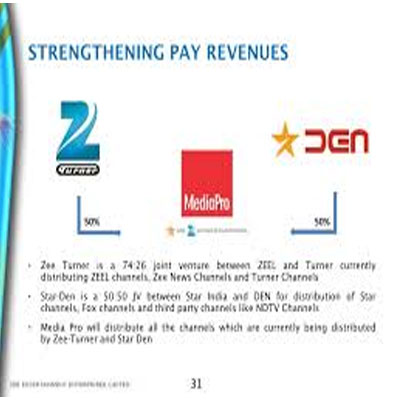
Zee Turner is a 74:26 distribution joint venture between the Chandra-controlled Zee Telefilms and Time Warner company Turner International India.
The genesis of the present face-off is lack of consensus on pricing of Zee Turner channels and Tata Sky’s insistence on select TV channels from the bouquet of 32 channels.
While India’s second pay digital platform Tata Sky wants select Zee Turner channels for a reported sum of below Rs. 40 per subscriber, the latter is insisting all its 32 channels should be taken.
As reported by Indiantelevision.com earlier, sources close to the negotiations said Zee Turner has conveyed that it’s ready to give all its channels to Tata Sky’s DTH platform for Rs. 74 per subscriber per month, which is 50 per cent of the price that cable operators pay for the Zee Turner bouquet.
Bouquet 1 of Zee Turner comprises Zee TV, Zee Cinema, Zee News, Zee Studio, Zee Bengali, Zee Gujarati, Zee Marathi, Zee Punjabi, Cartoon Network, Reality TV, CNBC, CNN, Zee Café, Zee Trendz, ETC, ETC Punjabi, Zee Jagran, Zee Smile, Zee Telgu and Zee Music.
The second bouquet includes HBO, Pogo, Awaaz, VH1 and Zee Business. Zee Turner is soft bundling Zee Sports at a price benefit.
The third bouquet, called Breakfree, consists of Zee Action, Zee Premier and Zee Classic, which air movies of different genre and are primarily available on Dish TV DTH platform.
Zee Turner had earlier reasoned that its demand is based on a recent ruling of a disputes tribunal in Dish TV vs. Star case wherein Star was asked to make available its channel to Dish at Rs. 27 per subscriber, which is 50 per cent less than the price cable ops pay.
Dish TV had to wait for over 18 months since launch to finally manage to get Star channels on its DTH platform.
After having got powerful products like Star Plus, Dish TV has announced that it will not charge its consumers for some months anything extra for the Star channels, most of which are in the basic tier of 78-odd channels and can be had for Rs. 185 per month by a subscriber of Dish TV.