Tag: Zee Media

  • Making the news: A look at what news broadcasters did in 2017

    Making the news: A look at what news broadcasters did in 2017

    MUMBAI: News channels were thrown into a storm of activity in 2017 with each player keeping up its oars to wade out of challenges that hit at them like ten-foot waves. With elections and sensational news driving up viewership at various points throughout the year, English news channels had to fight back to the onslaught that was Republic TV.

    The entry of Arnab Goswami-led channel Republic TV increased the overall news viewing pie at the time of its launch but the hype did not last long and the genre went back to its minuscule share.

    To add to the theatrics, there were several top-level executive shifts in 2017. Let’s take a look at the various channels and their performance during the year.

    English News

    Republic TV stole the limelight with the news channel becoming the news itself. After its launch in May, the genre witnessed tough competition between Goswami’s former employer Times Now and his newly launched baby. According to BARC India, Republic TV hasn’t budged from the top from its inaugural week till week 50. It claimed to have 52 per cent market share in its very first week of operations, which started on 6 May 2017.

    Times Network had two big events to boast of-the rebranding of ET Now from a full-time business news channel to a general news channel and the launch of Mirror Now. Mirror Now’s launch got good response, especially from Bangalore and Chennai, with Faye D’Souza as the executive editor.

    For Times Television staffers who were working the late-night shift at the Kamala Mills Compound in Mumbai, the night of 28 December 2017 was a nightmare. The conflagration that swept through restaurant 1Above and claimed 14 lives could have gutted the Times TV Network premises, too, which was on the first floor of the same building.

    The net result: Times channels including Times Now, ET Now and Mirror Now went off air. And most distribution platforms carried an apology notice, in place of the live feed, which stated that the channel signals could not be received because of technical difficulties. In a recent interaction with Indiantelevision.com, Times Network MD and CEO MK Anand said that the channels’ success was the result of a combination of brand, process and team.

    Anand expects news to be more active and exciting in 2018. “And with better market conditions, now that GST and demonetisation are behind us, the overall English and news space is poised for a truly great ride through the new year,” he said. 

    The disruption that Republic TV brought about in the TV news genre was momentous and chaotic. Arnab’s new avatar unleashed not only a slew of litigations (the fight for copyright over phrases like ‘the nation wants to know’, for example) but also a flurry of allegations of malpractice and biased reporting. The News Broadcasters Association (NBA) wrote to the Telecom Regulatory Authority of India (TRAI) and to the Broadcast Audience Research Council (BARC) to hold up Republic TV’s ratings and get them checked, accusing it of broadcasting the channel on two LCNs on cable TV. When BARC refused to do so, NBA channels pulled out of the ratings for a week. Months later, Republic TV became a part of the NBA.

    NDTV group saw many ups and downs in 2017, which began with the raid at the NDTV office and home of cofounders Prannoy Roy and his wife Radhika Roy. In June, the CBI raided the residence of the Roy family alleging that the promoters and a private company linked to them, RRPR Holding, were involved in defrauding ICICI Bank and allegedly causing it losses involving loans extended in 2008.

    In the same month, NDTV Profit was shut down and the group decided to transfer its business programming from Profit to regular business and finance segments of NDTV 24X7. In September, there was a rumour that Spice Jet’s Ajay Singh was set to take a controlling stake in the company which was vehemently denied. Singh was apparently unimpressed with the channel’s litigations and bad finances.

    The saddest for it was the demise of KVL Narayan Rao, CEO and executive vice chairperson of the NDTV group at the age of 63. Later, Suparna Singh was appointed as the CEO of NDTV.

    In the month of December, NDTV group came up with a turnaround plan to improve profitability, which involved reducing the workforce by up to 25 per cent. A part of this plan was implemented in the last quarter and included the much-noted move to new technologies, including mobile journalism.

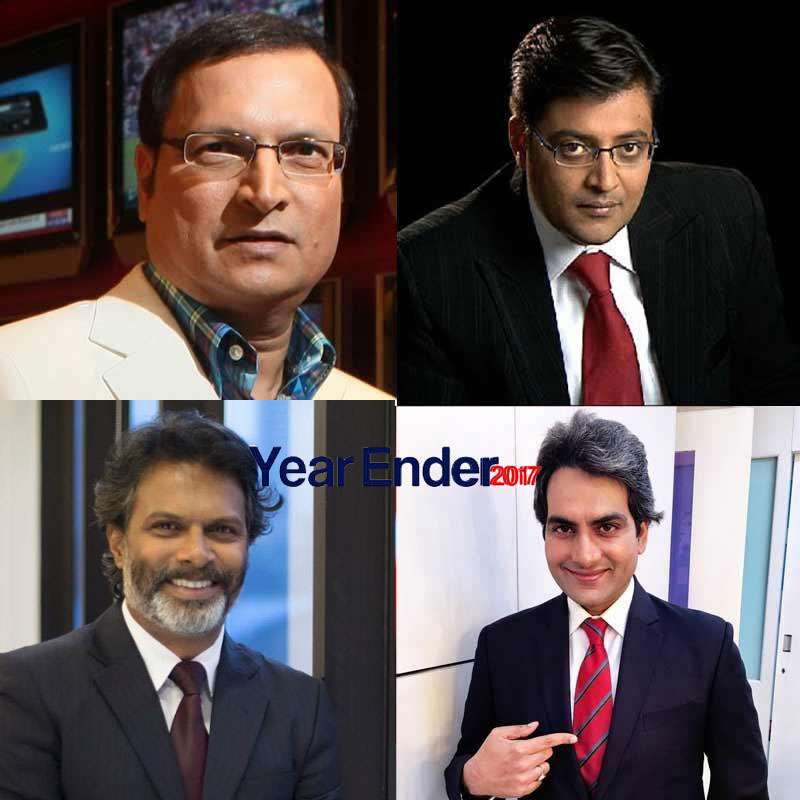
    Zee Group’s Sudhir Chaudhary was elevated as editor-in-chief of Zee News, Zee Business and WION (World in One News). The network launched several regional channels including Zee Hindustan, Zee Uttar Pradesh/Uttarakhand and it reworked Zee Salaam from a GEC to a news channel.

    In October, India Today Group elevated Kalli Purie as the vice chairperson from the editorial director (broadcast and new media). The group CEO Ashish Bagga, resigned in the month of July and in his replacement Vivek Khanna was appointed. Rajeev Dubey was elevated to managing editor business (TV and digital).

    Hindi News 

    India TV chairman and editor-in-chief Rajat Sharma was elected as president of NBA. Ashok Venkatramani left ABP News as the CEO in 2016 and joined Chrome Data Analytics and Media as a consulting director in July 2017. 

    A news director or an editor leaving a media house isn’t exactly headline material. But in this case, it is noteworthy because of the circumstances leading up to his departure and 16-year-long association with the channel. India TV news director Hemant Sharma was under the scanner for his role in an alleged case of corruption involving certain officials in the Union Health Ministry and owners of a medical college. Sharma left India TV to pursue his first love – writing.

    TV18 Broadcast president- revenue Joy Chakraborthy said, “2017 started off on a weak note with the effects of demonetisation very clearly there. However, budget onwards, things started to pick up and we had a great first quarter. July saw the rollout of GST, the effects of which are gradually waning and business is picking up. 2017 also saw the re-alignment of media spends from Hindi, regional and English across genres, with monies moving out of English to Hindi and regional.”

    Regional News 

    Zee Media has increased its regional reach by launch Zee Salaam (Urdu) and Zee Uttar Pradesh/Uttarakhand last year.

    Jagdish Chandra, after spending eight years at ETV network, joined Zee Media Corporation Limited (ZMCL) as the CEO for the regional channels in January. In his new profile at Zee Media Corporation Limited, he handled a large bouquet of channels, including 24 Ghanta (Bengali), Zee Madhya Pradesh-Chhattisgarh, Zee Punjab Haryana Himachal (Punjabi and Hindi), Zee Sangam (Hindi), Zee 24 Taas (Marathi), Zee Purvaiya (Hindi), Zee Kalinga (Oriya), Zee Marudhara (Hindi), Zee 24 Gantalu (Telugu), and Zee Kashmir.

    In the month of March, Chandra got additional responsibility as CEO of DNA and in next couple of months, Zee Media Corp restructured the top deck for its regional news network, reducing the role of Chandra to just three channels – Zee Rajasthan, Zee Hindustan and Zee Salam (Urdu) and DNA Jaipur. Chandra continued to be on the board of ZMCL and DNA while stepping down as CEO of DNA in the same month.

    iTV Network expanded its regional news space with the launch of India News Gujarat on 4 December 2017, just before the Gujarat elections. Uday Nirgudkar joined News18 Lokmat as group editor by quitting from the post of channel head of Zee24 Taas and CEO and editor-in-chief of DNA newspaper. Senior journalist Vijay Kuvalekar took over as the editor of the news channel.

    Umesh Kumawat, who was the senior editor at ABP news, started his new innings at TV9 Marathi in 2017, but within a month resigned from the post of managing editor of the channel.

    Focus Group, which already has footprints in the regional news market including Focus Haryana, Bangla, Odisha and NE, intends to launch a Kannada news channel by the end of 2017.

    For news channels, next year holds much promise. As general elections are due in 2019, a lot of positive news can be expected, with supporting developments during the year. Branded content is likely to continue its upward trend. With advertisers beginning to realise the value of regional channels, we are in for some exciting times in 2018.
  • ZEEL gets NCLT approval for restructuring acquired Anil Ambani GEC business

    MUMBAI: The Essel Group owned Zee Entertainment Enterprises Ltd (Zeel) is moving ahead on getting legal approvals for the restructuring of the Anil Ambani-promoted Reliance general entertainment television broadcasting business.

    Yesterday, it got the thumbs up from the Mumbai bench of the National Company Law Tribunal (NCLT) for its arrangement to demerge the general entertainment broadcast business Reliance Big Broadcasting (RBB) Pvt Ltd, Big Magic Ltd (BML) and Azalia Broadcast Pvt Ltd.

    These companies had come its way when it announced its deal to acquire 100 per cent of Reliance Broadcast Network Ltd’s (RBNL’s) TV business while sister company Zee Media Corp swallowed 49 per cent of its radio business for approximately Rs 1,900 crore in late November 2016. The

    At the time of the acquisition, RBBL, BML and Azalia had top lines of Rs 61.17 crore, Rs 58.95 crore and Rs 0.06 crore respectively for the year ended 31 March 2016. While the first had five TV channel licences (two were operational –Big Magic and Big Ganga, three non-operational Big Gaurav, Big Magic Punjab and Big Magic HD), the second looked after the ad sales and distribution of the channels, and the third had one TV licence for Big Magic Thrill.

  • Zee Media to seek shareholder nod to demerge DNA print business

    MUMBAI: Print and TV news. For some that would make for a heady combination. But, not for the Essel group-promoted Zee Media Corp Ltd (ZMCL) which runs the Zee News channels as well as the newspaper DNA through a clutch of unlisted subsidiaries. DNA has a print edition in Mumbai and has launched in Delhi recently.

    ZMCL is seeking shareholder approval (on 27 March in Mumbai) to demerge its DNA business (which is operated under Digital Media Corp Ltd – DMCL, MediaVest India Pvt Ltd and Pri-Media Services) from itself even as it merges another company Maurya TV (which runs the current affairs channel Zee Purvaiya) with itself. The scheme got ZMCL board approval earlier.

    The carving out of the print media assets from ZMCL will result in its shareholders getting one DMCL share (face value of Re 1) for every four ZMCL shares (face value Re 1). The date for the demerger and amalgamation has been noted as 1 April 2017.

    What’s compelling ZMCL and DMCL to take this step? According to its notice filing with the BSE over the weekend, the print and media businesses are run and managed differently and can attract a different set of investors, strategic partners, lenders and other stakeholders. This apart, FDI regulations permit 26 per cent foreign investment in print and 49 per cent in news TV after government approvals.

    While ZMCL had revenues of around Rs 394 crore in the year to 31 March 2016, DMCL reported a topline of around Rs 110 crore in the same period, according to the filing with the BSE. The latter had a loss of Rs 8.72 crore for the same period while the former had a net profit of Rs 18.75 crore.

    The group is proposing to list DMCL on the stock exchanges on getting shareholder and other regulatory and listing approvals.

    AlsO Read :

    http://www.indiantelevision.com/television/tv-channels/news-broadcasting/zee-media-ad-revenue-up-in-q3-17-170206

    http://www.indiantelevision.com/regulators/ib-ministry/zee-medias-49-stake-in-927-big-fm-gets-it-59-radio-channels-161123

    http://www.indiantelevision.com/television/tv-channels/news-broadcasting/big-fm-india-today-deals-zee-media-seeks-shareholder-nod-for-loans-161223

    http://www.indiantelevision.com/television/tv-channels/people/the-key-is-to-consolidate-zeel-zmcl-zee-digital-and-dna-business-ashish-sehgal-160404

  • Zee Media elevates Purushottam Vaishnava as deputy CEO of regional channels

    Zee Media elevates Purushottam Vaishnava as deputy CEO of regional channels

    MUMBAI: After Jagdish Chandra now confirmed to have joined Zee Media as the CEO of its regional channels, Zee Media has witnessed another significant movement in the management.

    Zee Media has elevated Purushottam Vaishnava as the deputy CEO of Zee regional channels such as — Zee 24 Taas, Zee Punjab, Zee Madhya Pradesh. Vaishnava has been serving as the channel head of Zee Marudhara Rajasthan and Zee Purvaiya (Bihar and Jharkhand).

    A source close to the development confirmed the news to Indiantelevision.com and informed that Vaishnava will directly work with Chandra.

    Chandra was a senior administrator in Rajasthan before he took voluntary retirement in 2008 to join ETV Madhya Pradesh and ETV Rajasthan, and also head the editorial section. 

    Also Read:   Is ETV’s Jagdish Chandra joining Zee Media?

  • Zee Media elevates Purushottam Vaishnava as deputy CEO of regional channels

    Zee Media elevates Purushottam Vaishnava as deputy CEO of regional channels

    MUMBAI: After Jagdish Chandra now confirmed to have joined Zee Media as the CEO of its regional channels, Zee Media has witnessed another significant movement in the management.

    Zee Media has elevated Purushottam Vaishnava as the deputy CEO of Zee regional channels such as — Zee 24 Taas, Zee Punjab, Zee Madhya Pradesh. Vaishnava has been serving as the channel head of Zee Marudhara Rajasthan and Zee Purvaiya (Bihar and Jharkhand).

    A source close to the development confirmed the news to Indiantelevision.com and informed that Vaishnava will directly work with Chandra.

    Chandra was a senior administrator in Rajasthan before he took voluntary retirement in 2008 to join ETV Madhya Pradesh and ETV Rajasthan, and also head the editorial section. 

    Also Read:   Is ETV’s Jagdish Chandra joining Zee Media?

  • Is ETV’s Jagdish Chandra joining Zee Media?

    Is ETV’s Jagdish Chandra joining Zee Media?

    MUMBAI: ETV News Network’ Jagdish Chandra has called it a day as the company’s CEO and has already served his notice period.

    Chandra, a source said, plans to join Zee Media Corporation and is already negotiating with Essel Group chairman Subhash Chandra. He was not available for comment.

    It is interesting to note that Zee Business, an arm of Zee Media, does not have a head as of yet.  

    Chandra was a senior administrator in Rajasthan before he took voluntary retirement in 2008 to join ETV Madhya Pradesh and ETV Rajasthan, and also head the editorial section.

    Recently, ETV hired Samsung’s Rajiv Mishra as the business head for the group to manage satellite TV channels namely — News18 Tamil Nadu, News18  Kerala,  News18  Assam and North East,  ETV Rajasthan, ETV Uttar Pradesh and Uttrakhand, ETV Madhya Pradesh and Chhattisgarh, ETV Bihar and Jharkhand, ETV Urdu, ETV Haryana and Himachal Pradesh, ETV News Gujarati, ETV News Bangla, ETV News Kannada and ETV News Odia.

    TV18 Broadcast, a subsidiary of Network 18, acquired the Ramoji Rao-promoted ETV network in January 2014 for Rs 2,053 crore. The deal resulted in it acquiring 100 per cent of regional Hindi news channels ETV Uttar Pradesh, ETV Madhya  Pradesh,  ETV Rajasthan, ETV Bihar and ETV Urdu and 50 per cent in ETV Marathi, ETV Kannada, ETV Bangla, ETV Gujarati and ETV Odia.

    Telugu news and GEC channels ETV Telugu and ETV Telugu News will, however, see TV18 owning only 24.50 per cent equity.

  • Is ETV’s Jagdish Chandra joining Zee Media?

    Is ETV’s Jagdish Chandra joining Zee Media?

    MUMBAI: ETV News Network’ Jagdish Chandra has called it a day as the company’s CEO and has already served his notice period.

    Chandra, a source said, plans to join Zee Media Corporation and is already negotiating with Essel Group chairman Subhash Chandra. He was not available for comment.

    It is interesting to note that Zee Business, an arm of Zee Media, does not have a head as of yet.  

    Chandra was a senior administrator in Rajasthan before he took voluntary retirement in 2008 to join ETV Madhya Pradesh and ETV Rajasthan, and also head the editorial section.

    Recently, ETV hired Samsung’s Rajiv Mishra as the business head for the group to manage satellite TV channels namely — News18 Tamil Nadu, News18  Kerala,  News18  Assam and North East,  ETV Rajasthan, ETV Uttar Pradesh and Uttrakhand, ETV Madhya Pradesh and Chhattisgarh, ETV Bihar and Jharkhand, ETV Urdu, ETV Haryana and Himachal Pradesh, ETV News Gujarati, ETV News Bangla, ETV News Kannada and ETV News Odia.

    TV18 Broadcast, a subsidiary of Network 18, acquired the Ramoji Rao-promoted ETV network in January 2014 for Rs 2,053 crore. The deal resulted in it acquiring 100 per cent of regional Hindi news channels ETV Uttar Pradesh, ETV Madhya  Pradesh,  ETV Rajasthan, ETV Bihar and ETV Urdu and 50 per cent in ETV Marathi, ETV Kannada, ETV Bangla, ETV Gujarati and ETV Odia.

    Telugu news and GEC channels ETV Telugu and ETV Telugu News will, however, see TV18 owning only 24.50 per cent equity.

  • 2016: The Year of Disruption: Growth, revenues, M&As, new techs, flip-flops in times of demonetisation

    2016: The Year of Disruption: Growth, revenues, M&As, new techs, flip-flops in times of demonetisation

    Year 2016 was a rare instance when the Indian government and a global company’s projections for the Indian media and entertainment industry seemed to be matching for a large part of the year. Almost. Considering the differences in parameters that the government adopts for economic outlook calculations, convergence on data (give and take a few billions here and there) was startling — and pleasant too.

    PwC’s mid-year Global Entertainment & Media Outlook 2016-20 said India’s entertainment and media sector was expected to grow steadily over the next four years and exceed US$40,000million (or US$ 40 billion) by 2020.

    Ditto for the government’s predictions, which were looking as pretty, but then came demonetisation and the figures have since been revised.

    The website of India Brand Equity Foundation (IBEF), a think-tank established by India’s Ministry of Commerce, states that the media & entertainment sector is expected to grow at a CAGR of 14.3 per cent to touch Rs 2.26 trillion (US$ 33.7 billion) by 2020; revenues from advertising are expected to grow at 15.9 per cent to Rs 99,400 crore (US$ 14.82 billion).

    Even though these numbers may seem fabulous for many in snail like growth economies, the fact is that the government seems to have moderated its outlook as the website was updated in December 2016.

    These projections, coupled with some bold regulatory and policy initiatives in 2016, stll indicate a fairly good pace of growth this year and continuing momentum over the next few years.

    The goals seemed achievable and an easy cruise till Prime Minister Modi’s currency demonetisation bomb exploded on 8 November and resulted in the shifting of various goalposts.

    Despite lofty ideals of fighting the menace of black economy, of enabling a digital cashless society, and enriching the poor via the demonetisation move, uncertainties over policy decisions, are gradually sinking in and slowing down various segments of the economy, including the media and entertainment sector.

    public://dishtv-videocon_1.jpgAs India grapples with challenging times, we at indiantelevision.com bring to you the first episode in our year-ender 2016 series, which will look at various segments of the M&E industry; especially the broadcast and cable segments. Presenting to you the 2016 Big Picture.

    Mergers & Acquisitions and Consolidations

    The year saw some big mergers and acquisitions (M&A) moves, subject to regulatory approvals, of course, but also signalling that the highly fragmented Indian broadcast and cable sector was witnessing some consolidation, which has been talked about for over five years now.

    For example, an oft repeated question of overseas media observers tracking Indian media sector was: even if  India is a huge market, how long can it sustain six private sector DTH services and pubcaster Doordarshan’s free DTH service FreeDish in terms of  burgeoning subscriber numbers and also rising expenditure on servicing them?

    The question got answered when Zee/Essel Group’s Dish TV and Videocon D2h announced that the latter would merge with the former under a complex share swap with the merged entity — to be called Dish TV Videocon Ltd — becoming a cable and satellite behemoth serving 27.6 million net subscribers (based on September 30, 2016 numbers) out of a total of 175 million TV households in India.

    In the combined satellite platform, to be led by India’s DTH pioneer Jawahar Goel, Dish TV would be holding a 36 per cent stake with Videocon D2h promoters owning a 28 per cent equity stake. Later, the two announced that the former has agreed  to buy an additional 9.90 per cent equity in the company in two tranches from the promoters of Videocon d2h going forward within the next two years.

    Not content with grabbing access to additional DTH homes, the Subhash Chandra-led Essel group went on an on an acquisition spree. In two separate developments in November, through two different corporate entities — Zee Entertainment and Zee Media — Zee took  full control of the general entertainment TV business and a 49 per cent stake in the radio business of the Anil Ambani-led Reliance ADA group, respectively. Both these acquisitions have not only given the Zee group access to a few Indian language GECs and 59 FM radio channels, but also scope for monetising additional eyeballs, ears and reach.  

     Zee Entertainment shed some weight and agreed to sell its sports TV channels, marketed under the Ten Sports brand name, to Sony Pictures Network leaving the 21 st Century Fox owned Star (which was earlier this year valued at $14 billion by financial services firm Edelweiss Capital) and Sony-ESPN combine to slug it out in the sports broadcasting ring. Of course, Nimbus Sports continues to hover around as a comparatively small player.

    Cable TV’s tough road; the struggle continues

    It was a year of deja-vu for cable TV firms and broadcasters as the effort to eke out more subscription revenues from the ground met with limited and marginal success. That meant those in distribution continued to struggle to get their acts together even as those companies which were listed had their stocks being hammered as cable TV digitisation in Phase III areas stalled because of a legal stalemate and a court decision which took a long time a-coming.

    With limited leeway in bringing about change in things cable TV, the MSOs  upped their investments in the higher ARPU delivering broadband and focused on signing on subscribers for the same. With much succees.

    In times like this, companies such as DEN  Networks  brought back veteran cable TV executive SN Sharma as CEO and even raised $21 million through a private placement with Goldman Sachs.

     On the other hand, leading MSO Hathway Cable worked on a management restructuring with old hand CEO Jagdish Kumar parting ways and Rajan Gupta being appointed in his place.

    Speculations in media circles regarding Zee’s sister MSO company Siti Networks acquiring fully or partially DEN continued for the first half of the year, but they were  officially scotched. However, the national MSO swallowed a few smaller cable TV operations across India.

    There could have also  been a few other small M&As in the cable sector with big regional MSOs gobbling up smaller LCOs, but they failed to make much of a blip.

    Hopes were high that the digital rollout would commence with great gusto followed the court dismissing petitions favoring  the Phase III DAS stay and the sunset date of 31 December 2016 approaching for Phase IV. But, much to media observers and industry’s consternation the ministry of information and broadcasting (MIB) announced that the Phase III sunset was being pushed forward to 31 January 2017 and Phase IV to 31 March 2017 two days before Christmas. 

    Hopefully, the government will not once again backpedal and go for another postponment when these dates near. India’s cable TV sector needs some desperate measures and they need to be taken.

    Demonetisation

    On 8 November 2016, Prime Minister Narendra Modi announced the biggest-ever demonetisation exercise India has ever seen by abruptly withdrawing Rs 500 and Rs1,000 notes from public use in a bid to clamp down on black money, fake currency menace, terror funding and corruption. Clap, clap. Only the brave dare to tread the path even angels fear and for that PM Modi should be applauded.

    public://1K6A2295_1.jpgBut the policy flip-flops that has been following that announcement, coupled with inadequacies in implementing a good-intentioned scheme and large-scale insensitivity of the ruling class to inconveniences caused to the general public, has started claiming collateral damage — including that on the economy, which seems to be slowing down sending out cascading effects on various other industries.

    The media industry was no exception. With cash hard to come by courtesy the shortage of currency notes, consumers went easy, spending only on essential items. Additionally, cash has been the lifeblood of the entire product distribution chain right from wholesalers to retailiers for most product manufacturers.

     Advertisers and brands – fearing that with cash drying up and consumers wary of spulrging  – believed there was not much purpose in promoting on television or other media.  Hence, they immediately tied the knot on their ad spend budgets. Net result: almost everyone in the media ecosystem was yelping in pain right from broadcasters to TV producers.

    From initial estimates made by media stakeholders that demonetisation of high currency notes would lead to a loss of Rs. 8,000 million, including advertising segment, the number has soared. Recent ad industry estimates fear the loss could be as high Rs. 25,000 million — unless the government gets it act together like Usain Bolt running in the last Olympics.

    The changes in buying and consumption patterns of people have resulted in lesser revenues, compelling companies to slash their promotional and marketing budgets.

    The news channels seem to have taken a big hit. Ditto with the GECs. Small regional TV channels, depending a lot on local advertising, too are getting hit as those advertisers are drying up.

    TRAI’s Push for Ambiguity-free Regulatory Regime

     Widely criticised for over regulating the telecoms and broadcast & cable sectors, Telecom Regulatory Authority of India (TRAI) stuck to its avowed and stated aim of attempting to create a regulatory regime that would reduce ambiguities and create a level playing field for all stakeholders.

    From trying to deal with issues in a piecemeal fashion to smoothening the road ahead for the players via its various guidelines and recommendations, TRAI, under chairman RS Sharma, has not shied away from confronting any bull (like Facebook) — some players, however, say it acted like a bull in a China shop.

    Whether it was the issue of Net Neutrality or zero tariffs offered by telcos for certain services or tariffs, interconnect and quality of services in the broadcast carriage sector or pushing MSOs on digital rollout or suggesting free limited data to rural India to give a fillip to digital economy or cracking the whip on mobile phone call drops, or on interoperability of DTH and cable TV, TRAI has quite ably been walking the tight rope between regulations and industry and political lobbying.

    A Government In Search of Investor-Friendly Policies

    When the ministry of commerce mid-year announced a slew of steps aimed at liberalising foreign investments in broadcast carriage businesses, amongst other business segments, it was hoped FDI would flow in quickly. But that did not happen as envisaged.

    The MIB did manage to shave to an extent the time period taken to obtain a licence for uplink or downlink for TV channels and teleports, but failed on many counts to be proactive on developing issues (like controversial appointments in several MIB-controlled media institutions and attempted content regulation by non-authorised organisations, for example) and its reactionary approach complicated matters further.

    But now it’s incumbent on the MIB to push through some big ongoing reforms like  rollout of  digital TV services in India. With the judiciary having cleared the cobwebs around digitisation by dismissing cases on implementation processes and TRAI aiming to remove remaining potholes, it’s to be seen whether MIB can withstand pressures arising out of demonetisation and from political allies going forward in 2017.

    Government Attempts On Content Regulation, Censorship & Flip-flops

    In a year when media, in general, went hyper on nationalism — Arnab Goswami, notwithstanding — and floated a narrative that it was questionable to question government directives and actions, developments highlighted that the MIB and its allied organisations could oscillate between being a facilitator (after all PM Modi and his Finance Minister were working towards the ease of doing business) and playing Big Brother.

    From the film certification board (helmed by a self-confessed Modi fan) trying to censor what Indians should see or shouldn’t in films ( for instance, clipping of kissing scenes between James Bond and his girlfriends in the last 007 flick) to suggestions that even TV content should obtain certification to paid news to cracking the whip on a news channel for allegedly  flouting content norms related to national security, it has been an eventful year when the need for stricter self-regulation by TV industry couldn’t be more visible.

    That the MIB had to keep aside a one-day blackout order handed to NDTV India for allegedly airing security details relating to terrorism activities and anti-terror ops is a story in itself. But the message that the government could attempt a back-door entry intocontent regulation was driven home effectively.

    The year also saw the Indo-Pak faceoff leading to a ban on Indian DTH dishes and on content  in Pakistan. India too retaliated but with a hesitant ban on Pakistani artistes working in India.

    BARC India Measures Up To Transparency, Credibility

    The two-year old new age TV audience measurement regime of India, complete with water-marked channels, hack-proof gadgets and alert number-crunchers keeping tabs on unusual spikes and blips in viewing habits, has not only managed to open up new monetisation avenues for its subscribers, but also ruffle some feathers in the process.

    The rural India audience data being now supplied by BARC for a year continued to throw up surprises in ratings and it also highlight India’s viewing patterns.

    However, towards the end of the year, BARC’s search for truth, transparency and data credibility created a few headlines, but in a still highly-fragmented and complicated market like India, it, probably, was expected.

    Mushrooming OTT Players, Arrival of 4G and Disruptive Tactics

    Interestingly in a country where bandwidth is still patchy, data cost high and ambiguous norms relating to online content make things interesting, OTT players seem to be mushrooming all over hoping to get a slice of the El Dorado someday, if not today.


    public://AAA_0.jpgWith Amazon Prime too launching in India in December, along with many other parts on Planet Earth, India continued to be a playground where global and home-grown players are rubbing shoulders attempting to differentiate themselves and carve out a subscriber base and some revenue.
    The list seems interesting. Indian players (some of them extensions of established broadcasting companies) like Hotstar, Voot, dittoTV, Savvn, Box TV, Alt, Eros Now, etc are all there in the Indian ballroom tangoing with the likes of Netflix, Amazon Prime, Hooq, YouTube and Viu.

    Is there money to be made? Certainly, yes. Are the ARPUs worth speaking about now? Oh, shut up as these are early days. Is the consumer biting? Yes, but mostly urban-centric. What are the differentiators in services? Let me think. What about (impending) regulations? We’ll cross the bridge when it comes, but hush; don’t give ideas to the regulator. What’s so interesting about India despite various challenges? Oh boy, don’t be dumb, it’s a huge market and the pace of penetration of mobile devices is phenomenal. Final outcome? Hmmmmmmmm!

    Many of these hems and haws, probably, saw a ray of light when 4G services rolled out this year. It meant less buffering and a more enjoyable consumer experience (read more subscription money). But true to a style, honed to the level of being a talent, Reliance came with its Jio 4G service, announced free unlimited data (subsequently toned down for fair usage by all consumers) and a host of other freebies that wiped out billions of dollars in market capitalisation of existing telcos, all of whom have fat budgets, indifferent services. Each one of them scurried to roll out their own 4G services and freebies.

    If a marketing guru said Reliance managed to disrupt the market good and proper, it wouldn’t be an observation much off the mark.

    But then 2016 has been a year of disruptions and disruptive tactics all around. But we at indiantelevision.com wish you Christmas cheer and  a disruption-free Happy 2017!

  • 2016: The Year of Disruption: Growth, revenues, M&As, new techs, flip-flops in times of demonetisation

    2016: The Year of Disruption: Growth, revenues, M&As, new techs, flip-flops in times of demonetisation

    Year 2016 was a rare instance when the Indian government and a global company’s projections for the Indian media and entertainment industry seemed to be matching for a large part of the year. Almost. Considering the differences in parameters that the government adopts for economic outlook calculations, convergence on data (give and take a few billions here and there) was startling — and pleasant too.

    PwC’s mid-year Global Entertainment & Media Outlook 2016-20 said India’s entertainment and media sector was expected to grow steadily over the next four years and exceed US$40,000million (or US$ 40 billion) by 2020.

    Ditto for the government’s predictions, which were looking as pretty, but then came demonetisation and the figures have since been revised.

    The website of India Brand Equity Foundation (IBEF), a think-tank established by India’s Ministry of Commerce, states that the media & entertainment sector is expected to grow at a CAGR of 14.3 per cent to touch Rs 2.26 trillion (US$ 33.7 billion) by 2020; revenues from advertising are expected to grow at 15.9 per cent to Rs 99,400 crore (US$ 14.82 billion).

    Even though these numbers may seem fabulous for many in snail like growth economies, the fact is that the government seems to have moderated its outlook as the website was updated in December 2016.

    These projections, coupled with some bold regulatory and policy initiatives in 2016, stll indicate a fairly good pace of growth this year and continuing momentum over the next few years.

    The goals seemed achievable and an easy cruise till Prime Minister Modi’s currency demonetisation bomb exploded on 8 November and resulted in the shifting of various goalposts.

    Despite lofty ideals of fighting the menace of black economy, of enabling a digital cashless society, and enriching the poor via the demonetisation move, uncertainties over policy decisions, are gradually sinking in and slowing down various segments of the economy, including the media and entertainment sector.

    public://dishtv-videocon_1.jpgAs India grapples with challenging times, we at indiantelevision.com bring to you the first episode in our year-ender 2016 series, which will look at various segments of the M&E industry; especially the broadcast and cable segments. Presenting to you the 2016 Big Picture.

    Mergers & Acquisitions and Consolidations

    The year saw some big mergers and acquisitions (M&A) moves, subject to regulatory approvals, of course, but also signalling that the highly fragmented Indian broadcast and cable sector was witnessing some consolidation, which has been talked about for over five years now.

    For example, an oft repeated question of overseas media observers tracking Indian media sector was: even if  India is a huge market, how long can it sustain six private sector DTH services and pubcaster Doordarshan’s free DTH service FreeDish in terms of  burgeoning subscriber numbers and also rising expenditure on servicing them?

    The question got answered when Zee/Essel Group’s Dish TV and Videocon D2h announced that the latter would merge with the former under a complex share swap with the merged entity — to be called Dish TV Videocon Ltd — becoming a cable and satellite behemoth serving 27.6 million net subscribers (based on September 30, 2016 numbers) out of a total of 175 million TV households in India.

    In the combined satellite platform, to be led by India’s DTH pioneer Jawahar Goel, Dish TV would be holding a 36 per cent stake with Videocon D2h promoters owning a 28 per cent equity stake. Later, the two announced that the former has agreed  to buy an additional 9.90 per cent equity in the company in two tranches from the promoters of Videocon d2h going forward within the next two years.

    Not content with grabbing access to additional DTH homes, the Subhash Chandra-led Essel group went on an on an acquisition spree. In two separate developments in November, through two different corporate entities — Zee Entertainment and Zee Media — Zee took  full control of the general entertainment TV business and a 49 per cent stake in the radio business of the Anil Ambani-led Reliance ADA group, respectively. Both these acquisitions have not only given the Zee group access to a few Indian language GECs and 59 FM radio channels, but also scope for monetising additional eyeballs, ears and reach.  

     Zee Entertainment shed some weight and agreed to sell its sports TV channels, marketed under the Ten Sports brand name, to Sony Pictures Network leaving the 21 st Century Fox owned Star (which was earlier this year valued at $14 billion by financial services firm Edelweiss Capital) and Sony-ESPN combine to slug it out in the sports broadcasting ring. Of course, Nimbus Sports continues to hover around as a comparatively small player.

    Cable TV’s tough road; the struggle continues

    It was a year of deja-vu for cable TV firms and broadcasters as the effort to eke out more subscription revenues from the ground met with limited and marginal success. That meant those in distribution continued to struggle to get their acts together even as those companies which were listed had their stocks being hammered as cable TV digitisation in Phase III areas stalled because of a legal stalemate and a court decision which took a long time a-coming.

    With limited leeway in bringing about change in things cable TV, the MSOs  upped their investments in the higher ARPU delivering broadband and focused on signing on subscribers for the same. With much succees.

    In times like this, companies such as DEN  Networks  brought back veteran cable TV executive SN Sharma as CEO and even raised $21 million through a private placement with Goldman Sachs.

     On the other hand, leading MSO Hathway Cable worked on a management restructuring with old hand CEO Jagdish Kumar parting ways and Rajan Gupta being appointed in his place.

    Speculations in media circles regarding Zee’s sister MSO company Siti Networks acquiring fully or partially DEN continued for the first half of the year, but they were  officially scotched. However, the national MSO swallowed a few smaller cable TV operations across India.

    There could have also  been a few other small M&As in the cable sector with big regional MSOs gobbling up smaller LCOs, but they failed to make much of a blip.

    Hopes were high that the digital rollout would commence with great gusto followed the court dismissing petitions favoring  the Phase III DAS stay and the sunset date of 31 December 2016 approaching for Phase IV. But, much to media observers and industry’s consternation the ministry of information and broadcasting (MIB) announced that the Phase III sunset was being pushed forward to 31 January 2017 and Phase IV to 31 March 2017 two days before Christmas. 

    Hopefully, the government will not once again backpedal and go for another postponment when these dates near. India’s cable TV sector needs some desperate measures and they need to be taken.

    Demonetisation

    On 8 November 2016, Prime Minister Narendra Modi announced the biggest-ever demonetisation exercise India has ever seen by abruptly withdrawing Rs 500 and Rs1,000 notes from public use in a bid to clamp down on black money, fake currency menace, terror funding and corruption. Clap, clap. Only the brave dare to tread the path even angels fear and for that PM Modi should be applauded.

    public://1K6A2295_1.jpgBut the policy flip-flops that has been following that announcement, coupled with inadequacies in implementing a good-intentioned scheme and large-scale insensitivity of the ruling class to inconveniences caused to the general public, has started claiming collateral damage — including that on the economy, which seems to be slowing down sending out cascading effects on various other industries.

    The media industry was no exception. With cash hard to come by courtesy the shortage of currency notes, consumers went easy, spending only on essential items. Additionally, cash has been the lifeblood of the entire product distribution chain right from wholesalers to retailiers for most product manufacturers.

     Advertisers and brands – fearing that with cash drying up and consumers wary of spulrging  – believed there was not much purpose in promoting on television or other media.  Hence, they immediately tied the knot on their ad spend budgets. Net result: almost everyone in the media ecosystem was yelping in pain right from broadcasters to TV producers.

    From initial estimates made by media stakeholders that demonetisation of high currency notes would lead to a loss of Rs. 8,000 million, including advertising segment, the number has soared. Recent ad industry estimates fear the loss could be as high Rs. 25,000 million — unless the government gets it act together like Usain Bolt running in the last Olympics.

    The changes in buying and consumption patterns of people have resulted in lesser revenues, compelling companies to slash their promotional and marketing budgets.

    The news channels seem to have taken a big hit. Ditto with the GECs. Small regional TV channels, depending a lot on local advertising, too are getting hit as those advertisers are drying up.

    TRAI’s Push for Ambiguity-free Regulatory Regime

     Widely criticised for over regulating the telecoms and broadcast & cable sectors, Telecom Regulatory Authority of India (TRAI) stuck to its avowed and stated aim of attempting to create a regulatory regime that would reduce ambiguities and create a level playing field for all stakeholders.

    From trying to deal with issues in a piecemeal fashion to smoothening the road ahead for the players via its various guidelines and recommendations, TRAI, under chairman RS Sharma, has not shied away from confronting any bull (like Facebook) — some players, however, say it acted like a bull in a China shop.

    Whether it was the issue of Net Neutrality or zero tariffs offered by telcos for certain services or tariffs, interconnect and quality of services in the broadcast carriage sector or pushing MSOs on digital rollout or suggesting free limited data to rural India to give a fillip to digital economy or cracking the whip on mobile phone call drops, or on interoperability of DTH and cable TV, TRAI has quite ably been walking the tight rope between regulations and industry and political lobbying.

    A Government In Search of Investor-Friendly Policies

    When the ministry of commerce mid-year announced a slew of steps aimed at liberalising foreign investments in broadcast carriage businesses, amongst other business segments, it was hoped FDI would flow in quickly. But that did not happen as envisaged.

    The MIB did manage to shave to an extent the time period taken to obtain a licence for uplink or downlink for TV channels and teleports, but failed on many counts to be proactive on developing issues (like controversial appointments in several MIB-controlled media institutions and attempted content regulation by non-authorised organisations, for example) and its reactionary approach complicated matters further.

    But now it’s incumbent on the MIB to push through some big ongoing reforms like  rollout of  digital TV services in India. With the judiciary having cleared the cobwebs around digitisation by dismissing cases on implementation processes and TRAI aiming to remove remaining potholes, it’s to be seen whether MIB can withstand pressures arising out of demonetisation and from political allies going forward in 2017.

    Government Attempts On Content Regulation, Censorship & Flip-flops

    In a year when media, in general, went hyper on nationalism — Arnab Goswami, notwithstanding — and floated a narrative that it was questionable to question government directives and actions, developments highlighted that the MIB and its allied organisations could oscillate between being a facilitator (after all PM Modi and his Finance Minister were working towards the ease of doing business) and playing Big Brother.

    From the film certification board (helmed by a self-confessed Modi fan) trying to censor what Indians should see or shouldn’t in films ( for instance, clipping of kissing scenes between James Bond and his girlfriends in the last 007 flick) to suggestions that even TV content should obtain certification to paid news to cracking the whip on a news channel for allegedly  flouting content norms related to national security, it has been an eventful year when the need for stricter self-regulation by TV industry couldn’t be more visible.

    That the MIB had to keep aside a one-day blackout order handed to NDTV India for allegedly airing security details relating to terrorism activities and anti-terror ops is a story in itself. But the message that the government could attempt a back-door entry intocontent regulation was driven home effectively.

    The year also saw the Indo-Pak faceoff leading to a ban on Indian DTH dishes and on content  in Pakistan. India too retaliated but with a hesitant ban on Pakistani artistes working in India.

    BARC India Measures Up To Transparency, Credibility

    The two-year old new age TV audience measurement regime of India, complete with water-marked channels, hack-proof gadgets and alert number-crunchers keeping tabs on unusual spikes and blips in viewing habits, has not only managed to open up new monetisation avenues for its subscribers, but also ruffle some feathers in the process.

    The rural India audience data being now supplied by BARC for a year continued to throw up surprises in ratings and it also highlight India’s viewing patterns.

    However, towards the end of the year, BARC’s search for truth, transparency and data credibility created a few headlines, but in a still highly-fragmented and complicated market like India, it, probably, was expected.

    Mushrooming OTT Players, Arrival of 4G and Disruptive Tactics

    Interestingly in a country where bandwidth is still patchy, data cost high and ambiguous norms relating to online content make things interesting, OTT players seem to be mushrooming all over hoping to get a slice of the El Dorado someday, if not today.


    public://AAA_0.jpgWith Amazon Prime too launching in India in December, along with many other parts on Planet Earth, India continued to be a playground where global and home-grown players are rubbing shoulders attempting to differentiate themselves and carve out a subscriber base and some revenue.

    The list seems interesting. Indian players (some of them extensions of established broadcasting companies) like Hotstar, Voot, dittoTV, Savvn, Box TV, Alt, Eros Now, etc are all there in the Indian ballroom tangoing with the likes of Netflix, Amazon Prime, Hooq, YouTube and Viu.

    Is there money to be made? Certainly, yes. Are the ARPUs worth speaking about now? Oh, shut up as these are early days. Is the consumer biting? Yes, but mostly urban-centric. What are the differentiators in services? Let me think. What about (impending) regulations? We’ll cross the bridge when it comes, but hush; don’t give ideas to the regulator. What’s so interesting about India despite various challenges? Oh boy, don’t be dumb, it’s a huge market and the pace of penetration of mobile devices is phenomenal. Final outcome? Hmmmmmmmm!

    Many of these hems and haws, probably, saw a ray of light when 4G services rolled out this year. It meant less buffering and a more enjoyable consumer experience (read more subscription money). But true to a style, honed to the level of being a talent, Reliance came with its Jio 4G service, announced free unlimited data (subsequently toned down for fair usage by all consumers) and a host of other freebies that wiped out billions of dollars in market capitalisation of existing telcos, all of whom have fat budgets, indifferent services. Each one of them scurried to roll out their own 4G services and freebies.

    If a marketing guru said Reliance managed to disrupt the market good and proper, it wouldn’t be an observation much off the mark.

    But then 2016 has been a year of disruptions and disruptive tactics all around. But we at indiantelevision.com wish you Christmas cheer and  a disruption-free Happy 2017!

  • Zee Media appoints Sumit Kapoor as CFO

    Zee Media appoints Sumit Kapoor as CFO

    MUMBAI: Zee Media Corporation Limited (ZMCL) has informed the BSE and the National Stock Exchange of India that Sumit Kapoor has been appointed as the chief financial officer (CFO) of the company with effect from 16 December, 2016. Kapoor has replaced Dinesh Garg, ZMCL company secretary Pushpal Sanghavi informed the exchanges.

    Kapoor, a commerce with MBA from IIT Roorkee (with specialisation in finnnce & marketing) has also completed one-year Certificate Programme in Management and Leadership from Harvard Business School, Boston.

    Kapoor is a senior professional with experience of over 15 years in business strategy and planning, investment proposals (national/international) and investors relations with various corporate houses including Monnet Group, E&Y, CB Richard Ellis and Delloitle.

    His last assignment was with Monnet Group, Delhi, as a senior resource – strategic finance/business strategy & head – investors relations.