Tag: Zee Media

  • HT Digital CCO Nilanjana Bhaduri Jha quits

    HT Digital CCO Nilanjana Bhaduri Jha quits

    MUMBAI: HT Digital Streams chief content officer Nilanjana Bhaduri Jha has stepped down from her role after a 15-month stint. 21 June 2019 was her last day at the organisation.

    Jha’s exit follows that of HT Digital Streams CEO Rajeev Bansal, who resigned earlier this year in April.

    Jha had joined HT from NDTV Convergence where she held the position of chief content officer.

    According to sources close to the development, Zee Media group editor (digital) Prasad Sanyal is among the candidates the company is looking at to fill the role of chief content officer.

  • Despite 30% y-o-y growth, Indian digital ad industry lagging behind global market

    Despite 30% y-o-y growth, Indian digital ad industry lagging behind global market

    MUMBAI: Even though the digital advertising industry is showing impressive growth, touching a year-on-year rise of around 30 per cent, there is scope for it to boom when compared to the global market. “If we look at expenditure made on digital advertisements in India, the average is still 4 dollars per view, while in countries like the US and China it is quite higher. China’s ad spends per view are at $88 per view. Even sub-Sahara African regions, which have a different GDP than ours, are spending much more than us,” said Interactive Avenues (a Reprise network company), IPGMediabrands COO Shantanu Sirohi at Future of Video-India conference in Mumbai, recently.

    He was the part of a panel discussing if digital ad spends are shifting back to TV. Joining him on the dais were Dentsu Aegis Network CEO, greater south and chairman, CEO, India Ashish Bhasin, and Zee Media managing director Ashok Venkatramani.

    The panel unanimously declined any possibility of such a shift and maintained that digital is showing tremendous growth and will continue to do so for the foreseeable future. They also said that advertisement on television is also growing, though at a slower pace.

    However, the panel highlighted some of the constraints that might hamper this glorious growth rate of the digital advertising industry in the future. Venkatramani said that the industry has come to realise that one can’t build a brand using just the digital platform. He quoted, “Digital serves a purpose, which is of performance marketing. It creates impact and also high marketability as you know what your input is and what your output is. The spends on digital also give very quick results. But what one can’t do using digital is build the brand in a classical sense.”

    Further highlighting the constraints that can hamper digital’s growth, from an advertising perspective, Ashish Bhasin added, “From an advertising perspective, digital can land into trouble in two areas. One is this whole [issue related to] reliability, credibility and fake news, wherever one’s ad is appearing. That is starting to scare off the people a little bit. And the second thing is the lack of a measurement system. This should be the most measured medium but as an industry, we haven’t come to a consensus on a common currency like BARC or IRS.”

    Sirohi concluded by saying that when it comes to keeping a tab on data, the digital medium has been ‘always over-measured’. He said, “You always have third-party applications that you can run to measure the data. The entire concept of fraudulent e-links or bots comes in when agencies or the clients are not doing what they are supposed to do. They must plan around the media and pass only the end-goal metric to the third party. Otherwise, there always are people who will figure out the way to make a little more money from the advertiser. But on the whole, the internet is not the problem.”

  • Analysis: Latest news television trends and consumption patterns

    Analysis: Latest news television trends and consumption patterns

    BENGALURU: The FICCI M&E 2019 report says that 43 percent of the 885 private TV channels in India are ‘news channels’. It further states that news, which commands a 7 percent share of viewership, garnered a disproportionately high share of advertising volumes.

    The FICCI M&E2019 report quotes Zee Media Corporation MD Ashok Venkatramani : “I am bullish on News TV. With the elections round the corner, its consumption can only go up. TV is still the best bet for getting the least cost reach and impact. Regional and hyper local TV would lead growth.”

    Further, according to a Broadcast Audience Research Council of India (BARC) report, after Hindi GEC and Hindi movies, Hindi news is the most watched genre in the country. The report also says that contrary to popular perception, TV viewership is high amongst youth (15-30 years) even in the digital age. Youth contribute 32 percent to total viewership with a 30 percent and 32 percent split between urban and rural India.

    An earlier BARC report says that news events cannot escape the lure of drama. And drama includes elections and election results, deaths of celebrities, high court and supreme court verdicts on celebrities and sensitive issues, major changes such as demonetisation announced by the central government, major public holidays such as Independence and Republic days, terrorist attacks and counter-attacks, etc.

    Until recently, (week 05 of 2019) BARC has been releasing weekly viewership data across a number of genres – in the public domain this has been limited to viewership data of the top 5 channels and programmes for the specific genre for channels that have its watermark. There are cases, such as Hindi GECs, performances across genres, etc., where BARC releases data across the top 10 channels, and there are genres such as Hindi business news which has only 2 channels, or the youth genre which age. BARC has gone dark subsequent to implementation of TRAI’s new tariff order and has stopped sharing viewership data in the public domain.

    Further, until 2018, BARC released viewership data of the top 5 Hindi news channels in the overall or combined Hindi speaking market or HSM (U+R), rural HSM or HSM (R) and urban HSM or HSM (U) and the top 5 English news channels. Since the first week of 2018,  BARC commenced releasing weekly data of the top 5 news channels in Kannada, Malayalam, Tamil and Telugu. Starting week 35 of 2018, BARC went a step further, it also started sharing data for the top 5 News channels in Assamese, Bangla, Marathi and Odisha languages in the public domain. Hence, it must be noted that the findings contained in this report are limited to viewership data of the top 5 news channels in a language or market.

    This report has been created by an analysis of BARC data of top 5 news channels of the respective channel/market starting from week 35 of 2018 and ending with week 5 of 2019 – hence data across 23 weeks in all. 

    It must be further noted that the period under consideration was eventful – the assembly elections to five Indian states were held during this period, hence the average news consumption during the same is likely to be higher than an annual average.

    So, how do Indians consume news across India? Granted that Hindi news genre is a large genre in its markets – more specifically the Hindi speaking market (HSM) across its rural (R) and urban (U) populations. But how much of it does each person in HSM watch? What is the breakup between HSM (R) and HSM (U) viewership of Hindi news? What about news in other languages? This paper looks at news watching trends across 10 languages and 12 markets. BARC has specified the following demographics of the news channels for the data that it releases in the public domain.

    (a)     Assamese News in Assam / North East / Sikkim(U+R): NCCS All: 2+ Individuals,
    (b)     Bangla News in West Bengal or WB (U+R): NCCS All : 2+ Individuals
    (c)     English News All India (U+R) : NCCS AB : Males 22+ Individuals
    (d)     Hindi News in HSM (U+R): NCCS All 15+ Individuals
    (d.1)            Hindi News in HSM (R): NCCS All 15+ Individuals
    (d,2)            Hindi News in HSM (U): NCCS All 15+ Individuals
    (e)    Kannada News: Karnataka  (U+R): NCCS All: 2+ Individuals
    (f)    Malayalam News: Kerala (U+R): NCCS All: 2+ Individuals
    (g)    Marathi News in Maharashtra/ Goa (U+R) : NCCS All : 2+ Individuals
    (h)    Oriya News in Odisha (U+R) : NCCS All : 2+ Individuals
    (i)    Tamil News: Tamil Nadu/Puducherry (U+R): NCCS All: 2+ Individuals
    (j)    Telugu News: Andhra Pradesh or AP/Telangana (U+R): NCCS All: 2+ Individuals

    To arrive at the per capita viewership or consumption, the author has considered the 23 week average number divided by the respective population of the respective market as per BARC India, households and individuals universe estimate – 2018 (BARC Population Estimates 2018). BARC considers HSM or Hindi speaking market as All India without the four South Indian markets. Hence, the author has subtracted the NCCS 15+ population of the four South Indian markets from the All India NCCS 15+ population to arrive at the HSM 15+ population numbers. BARC’s latest universe estimate 2018 was not adopted from week 01 of 2018, hence there could be a variance in the figures calculated in this report.

    In the case of per capita consumption for South India, the author has taken the sum of average weekly impressions of the top 5 channels for each language and then added the four sums to arrive at the total average weekly impressions for South India, this total average has then been divided by the combined 2+ population figures for each of the four languages/six states as per BARC Population Estimates 2018. In the case of English News, the author has calculated the NCCS 22+ Males population by extrapolating the overall male and female ratio and the ratio of the 22+ individuals with the all India population as per BARC individual numbers for NCCS A 22+ and NCCS B 22+. To arrive at the per capita consumption of news on the top 5 channels for the country, the 23 week average viewership of the 10languages has been divided by the 2+ population of India as per the above mentioned BARC Universe estimates. Individual HSM (R) and HSM (U) viewership numbers have not been considered to arrive at the per capita consumption of news on the top 5 channels for the country.

    Overall, Indians consumed a little more than 2.53(2.5339) weekly impressions of top 5 news channels across languages per person across the country during the 23 weeks under consideration. Comparative numbers for calendar year 2018 have not been indicated because of limitations of BARC data for the four of the languages which, as mentioned above were made available only week 35 of 2018 onward.

    Within individual markets, Malayalam news on the top 5 Malayalam news channels in Kerala had the highest per capita weekly consumption at slightly over 3.89 impressions during the 23 week period under consideration. The 52 week per capita average consumption of Malayalam news on the top 5 Malayalam news channels during calendar year 2018 was 3.34, which also was the highest in 8 markets across 5 languages – these were Hindi, the four South Indian languages and English.

    Assamese per capita news consumption on top 5 News channels in Assam / North East / Sikkim was next – at 3.84 weekly impressions during the 23 week period under consideration.
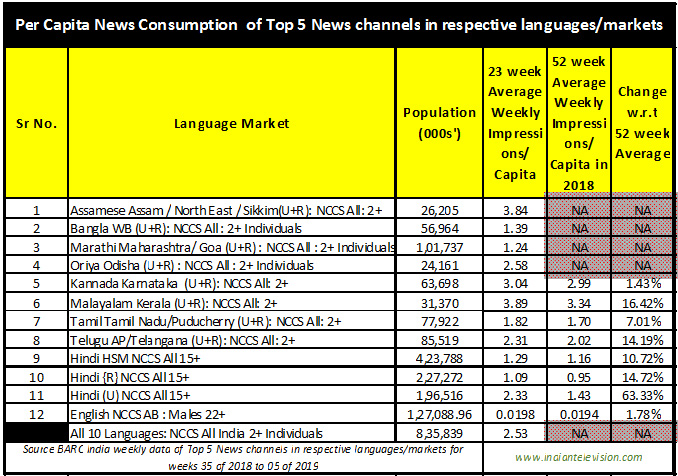
    From the chart above it is quite obvious that normally Indians consume more of regional news of top 5 news channels per capita in their respective regional markets as compared to Hindi news consumption per capita of Top 5 Hindi news channels in HSM. 

    In terms of absolute numbers, though more Hindi news is consumed than in any other language due to its larger population, the per capita consumption is lower than news consumption in regional markets, the exceptions being Marathi news in Maharashtra/Goa and Bengali news in West Bengal.

    Events such as elections result in a spike in news television viewership – as per the chart above, Hindi news viewership in HSM urban markets had a much bigger spike in viewership than other languages during election results week.

    Hindi, English and South Indian news channels performances during 2018 have already been reported by us.

    Here below are the details of performances of the top 5 news channels in the four languages based on analysis of BARC’S weekly lists released since week 35 of 2018 until week 05 of 2019.

    Assamese News in Assam/North East/Sikkim (Assamese region)

    As mentioned above, Assamese per capita news consumption on top 5 news channels in the Assamese region was just behind Malayalam news consumption on top 5 Malayalam news channels in Kerala. 

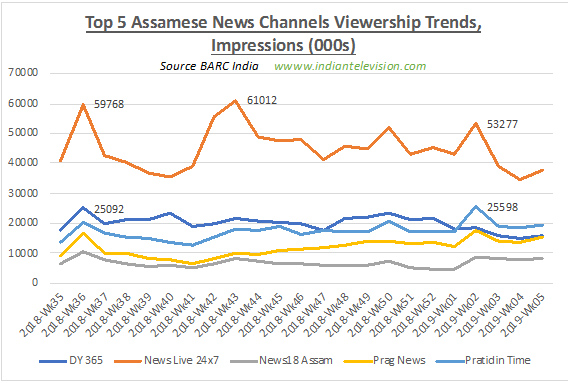
    As in the case of the other regional channels, there was one Assamese news channel – News Live 24×7 whose viewership far exceeded the viewership of other Assamese news channels. There were 5 channels that appeared in all the 23 BARC weekly lists of top 5 Assamese news channels.  Please refer to the chart below:
    Bangla News in West Bengal

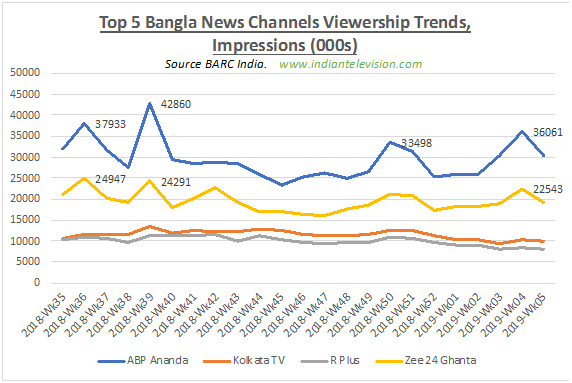
    Bangla News per capita consumption in West Bengal of Top 5 Bangla news channels was the lowest in East India – at just 1.39 impressions per week during the period under consideration. One Bangla news channel from the homegrown Bengali Media group Ananda Bazaar Patrika (ABP) – ABP News topped ratings during all the 23 weeks under consideration in this paper. Four channels were present in BARC’s weekly lists of top 5 Bangla news channels during the 23 weeks under consideration in this paper. ABP News was followed by Zee Media Corporation’s Zee Bangla. Kolkata TV and R Plus were the other two channels that were present in BARC’s weekly lists.

    Besides the above mentioned four channels, two other channels – Bangla Time (15 weeks) and News 18 Bangla (8 weeks) also appeared in BARC’s weekly lists of top 5 Bangla News channels during the period under consideration.
    Oriya News channels in Orissa

    Ten Oriya News channels  appeared in BARC’s weekly lists of top 5 Oriya News channels during the 23 weeks under consideration. They were-DY 365,Kanak News, News Live 24×7, News World Odisha, News18 Assam, News18 Odia    News7, Odisha TV, Prag News    Pratidin Time, Zee Kalinga News, Zee Odisha. None of the ten channels appeared in all the 23 weeks under consideration.

    Marathi News channels in Maharashtra/Goa

    As mentioned above, Marathi. News per capita consumption of the top 5 Marathi News channels in the Marathi market (Maharashtra and Goa) was the lowest among the languages/markets during the 23 weeks under consideration at just 1.24 impressions. Further, in the case of Marathi News also, all the 5 channels were present in BARC’s list of top 5 Marathi News channels during all the 23 weeks under consideration. 

    ABP’s ABP Majha led viewership in the Marathi News space also. Saam TV was next, and was closely followed by Zee Media Corporation’s Zee 24 Taas. Please refer to the chart below for the performance of top 5 Marathi News channels during the 23 week period.


     

  • Ex Times Now marketing head Sujeet Mishra joins Zee Media

    Ex Times Now marketing head Sujeet Mishra joins Zee Media

    MUMBAI: Sujeet Mishra, Times Now’s former marketing head has joined Zee Media. Confirming the news to Indiantelevision.com, Mishra said that his last day in Times Now was on 5 September 2018.

    Having joined Times Now in December last year, Mishra was leading the brand’s strategic planning and communication, including new brand initiatives, consumer research, market development across ATL, BTL and digital platforms.

    With over 13 years of experience in marketing and brand communications, Mishra had joined Times Now after a successful stint at ABP News Network where he was overseeing four news brands, managed IP events and played a pivotal role in the brand transition of the channel from Star News to ABP News.

    Prior to joining ABP News Network in 2006, Mishra was working with Dainik Jagran and ETV Network. Mishra is an alumnus of IIM Ahmedabad’s marketing executive development program.

  • With four elections due, networks with regional news channels set to benefit

    With four elections due, networks with regional news channels set to benefit

    MUMBAI: With four key assembly elections lined up towards the end of the year, India’s regional news channels could be laughing their way to the bank. In a bid to maximize their revenues, channels are in the process of sprucing up their programming and hiking ad rates. iTV Network, Network18, Zee News Network will be the ones set to benefit the most because due to their presence in the Hindi, English and regional markets.

    Rajasthan, Madhya Pradesh, Chhattisgarh and Mizoram are the our states going to polls ahead of the big 2019 general election.

    iTV Network CEO Varun Kohli says, “If you see, the regional market is growing and the local people want to consume content in local languages. Regional channels in the coming future are going to be the biggest growth areas than anybody else and the coverage will be hyper local. In a national channel the programming will be of an hour or so, but the regional channel will cover the elections for 24 hours a day.”

    News24 editor-in-chief Annuradha Prasad feels, “Three elections in the Rajasthan, MP and Chhattisgarh they are all Hindi heartland channels and national news channels expect a better response from the brands and advertisers unlike the Karnataka elections which didn’t have a great impact on the national news channels because of the local language affinity.”

    The news genre contributes eight per cent to the total TV viewership. It was the third biggest genre on television in terms of viewership in 2017, as per the Broadcast Audience Research Council (BARC) India data.

    Zee Media CEO- regional news Purushottam Vaishnava says, “We have started four programmes based on the coming elections. Our focus is to reach all the constituencies and give a real picture of the issues. At the time of elections the general entertainment channels (GEC) viewers shift to news channels and we are expecting minimum of 25-30 per cent hike in ad rates for our regional channels.”

    iTV Network has NewsX in English, India News in Hindi and for the regional focus on elections India News Rajasthan and India News MP-CG.

    “The increase in consumption helps in getting advertisers as they look at the eyeballs. Both national and local advertisers show interest at the time of elections and for national advertisers it is not that expensive like the Hindi news channels. Ad rates at the time of elections grow by 25-30 per cent. The regional news channels command half the price  of Hindi news channels”, Kohli adds.

    FMCG, retail and India-based multinational companies are the major advertisers on Hindi news channels, whereas automobile, banking financial services and electronic brands tend to utilize their ad spend on English news channels. FMCG brands and local retail brands are the primary advertisers on regional channels.

    Network18 has dedicated channels – News18 Rajasthan, News18 MP-CG and News18 Assam/North-East –  in all the election-bound states.

    TV18 president- revenue and Forbes India CEO Joy Chakraborthy said, “Every state elections has become the national things these days, in the recent Karnataka elections, the national channels also made good money along with the regional channels.”

    Zee Media’s regional sales team is pitching to national brands and corporates. The state assembly elections are a very big opportunity for companies that are planning enter the tier two, three and four markets.  

    On national brands approaching regional news channel for greater air time Prasad says, “ Yes, that happens because viewers watch the regional channel at the time of elections and get to know about each constituency. But the reach of a Hindi news channel cannot be matched by anyone.”

    Network18 is planning to increase the ad rates 10-12 times for all the English, Hindi and regional channels.

     “The counting day ad rates are sold at a high premium compared to the normal rates. The rates touch Rs 1 lakh mark at some special spots on the counting days”, Chakraborthy points out.

    Also Read:

    BTVI to leverage digital mediums for growth

    Karnataka election helps news channels increase ratings

  • Zee Media reports improved numbers for fiscal 2018

    Zee Media reports improved numbers for fiscal 2018

    BENGALURU: The Essel group’s news arm, Zee Media Corporation Limited (ZMCL), reported higher revenue, and profit after tax for the year ended 31 March 2018 (FY 2018, year under review) as compared to the previous year FY 2017. ZMCL’s revenue from operations increased 25.9 percent in FY 2018 to Rs 587.40 crore from Rs 466.46 crore in FY 2017. ZMCL reported profit of Rs 27.84 crore in FY 2018 as compared to a loss of Rs 16.06 crore in FY 2017. ZMCL’s EBIDTA increased 14.2 percent to Rs 166.36 crore (28.8 percent margin on operating revenue) from Rs 145.71 crore (32.4 percent margin).

    ZMCL’s advertising revenue for FY 2018 increased 29.2 percent to Rs 510.6 crore from Rs 395.25 crore in FY 2017. Subscription revenue reduced 0.9 percent in the year under review to Rs 47.49 crore from Rs 47.94 crore in the previous year. Other sales and services revenue more than tripled (grew 200.5 percent) in the year under review to Rs 19.92 crore from Rs 6.63 crore reported in FY 2017. It may be noted that revenue from ZMCL’s e-commerce business (ezmall.com) grew to Rs 4.53 crore in FY 2018.

  • WION focuses on HSM, starts Hindi audio feed

    WION focuses on HSM, starts Hindi audio feed

    MUMBAI: English news network World Is One News (WION), spearheaded by Sudhir Chaudhary, has started the Hindi audio option on viewers’ demand. The Zee-owned channel provides global stories with the Indian perspective. 

    This is the first time in India that a news channel is providing dual audio feed to its viewers, which may get substantial traction from the elite Hindi-speaking market (HSM).

    Speaking on the occasion, Sudhir Chaudhary, editor-in-chief of WION, said, “This move has been in the pipeline for quite some time now and we are extremely happy that finally we are able to give our viewers global stories in the language they love. The thought behind this was why Hindi-speaking audiences should be deprived of good international stories. This step will help us reach viewers who have been wanting to watch global news but, due to the language barrier, they were not able to. Though we have just started, we are confident that our viewers would take yet another innovation by WION in good stride and we shall be able to connect with people who until now were fence sitters.”

    Apart from India, the channel operates in countries such as Australia, Sri Lanka, Bangladesh, Nigeria and Kenya.

    Looking at how viewers’ tastes and preferences have evolved over the years, this move has the potential to strengthen the channel’s credibility as the go-to source of global news in India. 

    Also Read :

    Making the news: A look at what news broadcasters did in 2017

    Hindi news channels continue strong run in 2018

  • Jagdish Chandra quits as Zee Media’s regional news CEO

    Jagdish Chandra quits as Zee Media’s regional news CEO

    MUMBAI: Zee Media CEO for regional news network, Jagdish Chandra, has decided to move away from the network and has put down his papers. Chandra was on a five-year contract with the network but has decided to quit only after a year in service.

    Zee Media’s current deputy CEO of regional channel Purushottam Vaishnav will replace Chandra.

    Chandra joined Zee Media in January 2017 and has been known for his contribution in making the network’s regional channels a success.

    During his tenure at Zee, he looked after the regional portfolio which included channels like Zee Madhya Pradesh-Chhattisgarh, Zee Purvaiya (Bihar-Jharkhand), Zee Uttar Pradesh-Uttarakhand (India 24×7), Zee Salam, Zee 24 Ghanta, Zee 24 Taas and Zee Punjab-Haryana-Himachal Pradesh.