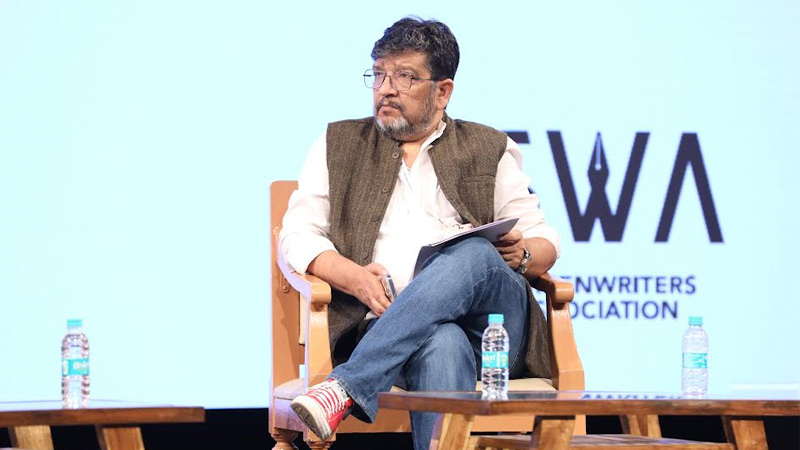
Tag: Zama Habib

  • The Screenwriter’s Association (SWA) endorses global initiative for ethical AI use in scriptwriting

    The Screenwriter’s Association (SWA) endorses global initiative for ethical AI use in scriptwriting

    Mumbai: The Screenwriter’s Association (SWA), a collective voice for the rights and welfare of screenwriters in India, has expressed its support for the collaborative efforts of the Federation of Screenwriters in Europe (FSE) and the International Affiliation of Writers Guilds (IAWG). The organisations recently came out with a joint resolution outlining a set of guidelines to establish an ethical framework for the use of AI in scriptwriting.

    The resolution, consisting of five key principles, affirms the role of writers as the sole creators of literary material and advocates for mechanisms to ensure transparency, informed consent, and fair compensation in the use of writers’ intellectual property. The FSE brings together 32 screenwriters’ organizations from 26 European countries and the IAWG has 14 members from 12 countries.

    These organizations are committed to advocating for fair contracts and ensuring the protection and fair compensation of writers. SWA currently has over 65,000 members operating across India including prominent writers-filmmakers like Raj Shekhar, Anjum Rajabali, Zama Habib, Saket Chaudhary, Preeti Mamgain, Hitesh Kewalya, Sriram Raghavan, Sujoy Ghosh, Ashwiny Iyer Tiwari, among many others.

    Speaking about this, SWA general secretary Zama Habib said, “SWA stands firmly with IAWG and  FSE in championing ethical standards for AI integration in scriptwriting. Only human creativity can craft genuine screenwriting works. We advocate for transparency, consent, and fair remuneration to uphold writers’ rights in the ever-evolving landscape of storytelling.”

    Adding further, German screenwriter and FSE president Carolin Otto said, “While we applaud the work of the EU to enact the AI Act, there are unresolved issues with respect to the unauthorized use of our intellectual property for training large language models, and uncertainty regarding authorship and copyright of machine-generated script material. We intend to voice our concerns in both national and global policy arenas, as well as develop standard language film and television writers can demand in their contracts.”

    Irish screenwriter and IAWG chair, Jennifer Davidson, said, “The members of the IAWG seek to build on the hard-won protections our sister Guilds in America, the WGAE and the WGAW, were able to achieve during their strike: namely that it should be a tool to enhance our writing process, not diminish the value of our work or replace us. Last year, we campaigned at UNESCO and this year we will take our position to WIPO, support each other during collective bargaining, and invite representatives of the tech community to the 6th World Conference of Screenwriters in Galway.”

    A joint resolution passed by IAWG and FSE states that their member guilds will:

    1)  Affirm that only writers create literary material and that large language models (LLMs) or any other present or future forms of artificial intelligence (AI), cannot be used in place of writers;

    2)  Work to create mechanisms for obligatory transparency and accountability and to ensure writers are informed if AI generated material is used to write, rewrite, polish or perform any additional writing services;

    3)  Advocate for robust licensing mechanisms that require explicit and informed consent for the use of writers’ intellectual property in AI training data with a goal to ensure only intellectual property that has been licensed for such use be included in the datasets of commercialized LLMs, or any other present or future forms of AI;

    4)  Ensure that only human beings are entitled to authors rights and recognized under copyright law in the context of machine generated material;

    5)  Advocate for fair remuneration for the use of writers’ intellectual property in LLMs or any other present or future forms of AI.
  • Indian Screenwriters’ Conference: Star Plus to stop 7-days-a-week soaps, says Gaurav Banerjee

    Indian Screenwriters’ Conference: Star Plus to stop 7-days-a-week soaps, says Gaurav Banerjee

    MUMBAI: What kind of content works on Hindi general entertainment channels? Content that reflects our society or the content that is simply driven by the ratings? Are TV producers making content for dumb audiences or content is making audiences dumb? Why we don’t talk about the economy or politics on TV shows? Why are we so much focused on saas-bahu sagas? And most importantly in today’s TV who is telling the story, a producer, writer, broadcaster or a programming team or a research team?

    The Film Writers’ Association had a session entitled Serial Killer during the ongoing fourth edition of the Indian Screenwriters Conference 2016 in Mumbai in a bid to get some answers.

    And to answer all these questions, you could not have had a better set of panelists than Star India deputy chief creative officer Gaurav Banerjee, Epic TV head of content Ravina Kohli, Balika Vadhu writer Purnendu Shekhar, Sasural Simar Ka and Saathiya writer Ved Raj and Sasural Genda Phool’s writer Zama Habib to get some answers.

    The session was moderated by Saurabh Tewari who runs a production house named after himself, but in earlier avatars had donned the hat of a fiction programmer when he worked at Colors and the now defunct Imagine TV.

    The highlight of the session was the admission on a public forum by by Gaurav on a public forum that Star Plus may have erred by starting the mad race of pursuing seven days of soap and drama every week from the five day formula earlier.

    He admitted: “I confess that it was a mistake because we reduced the ideation time of writers and of actors as well. We thought that we could manage the workload and it won’t affect the product that we deliver but unfortunately we were thinking of the TV industry as a pizza delivery service which was a big mistake.”

    He also that announced that from next month Star Plus would stop airing seven days a week programming.

    Tewari set the ball rolling for the session by appreciating the kind of work and content that both Star Plus and Epic were churning out. He spoke especially in reference to Epic TV as it had carved out its own identity. “TV ratings should not always be the only way to measure the content and the feel of channel,” he opined.

    “Epic, since its beginning had a particular DNA which was supposed to be followed and we tried to stick to that goal and it’s been a struggle,” expressed a hapless Kohli. “We have received great feedback, people appreciated our work but what we don’t have, are ratings.”

    Often it so happens that the content is strong and good but it fails to garner the desired ratings, hence the broadcaster has to yank it off.

    “We have a very fragmented audience, may be the data that we are getting is not addressing to that group. In Epic TV, I have not made anything that has been driven by TRPs,” explained Kohli.

    There are some channels that have a very niche audience, and they end up doing very well in that specific demographic. We also have shows on Doordarshan, which are doing well as they have a different set of audience, expressed Tewari.

    Getting to the crux of the matter, was Purnendu whose show Balika Vadhu was not only critically-acclaimed but has also done fabulously well commercially for Colors. “When I wrote Balika Vadhu, many said that it’s D Dish content and, on a satellite channel, rural backdrops will not work. But thanks to Ashwini (Yardi, the Colors programming head then) who had the courage to select the show,” shared Shekhar.

    Purnendu thanked Tewari (Tewari was at Colors for a period when Balika Vadhu was on air) and the entire channel team for giving him the freedom to work on the story as in most of the cases, the conflict between the writer and the broadcaster arises because both have different visions.

    Shekhar also expressed his agony that there were only two broadcasters present on the panel. “Only Gaurav and Ravina are representing the broadcaster side and both of them are doing good things with a vision. And the channels on which we see dumb content have no representation today,” he cried out.

    It’s really important to remember that when we talk about the TV content we shouldn’t forget that saas bahu dramas are the most important part of TV today, opined Raj as they are consumed by the masses. There has been a never ending debate on these shows but the truth is because of this, these are in demand.

    Contradicting Purnendu, Raj said: “We have all reached a conclusion that everything that has been happening on primetime is wrong. There is something good in this dumb content. TV is a mass medium and my first responsibility will be for them. I am not a police, teacher or judge and I am not even at that level from where my audiences look dumb to me.”

    Tewari then raised the question that quantity has subsumed quality over the past 10 years. From once a week, the channels have taken soaps and dramas to seven days a week. While this has meant money for all concerned, it is a dangerous trend. Though business is important and producers and broadcasters are in the business of creating content and if the content is suffering due to business pressures then how long will the business itself last? asked Tewari.

    Talking about the TV ratings, Gaurav elaborated: “Our measurement system is not that sophisticated. We have seen major changes in the TV industry when BARC came in and now we have to wait for next level of innovation in TV ratings. If every story is unique then the tool to measure that story should be different. You can’t compare Star Plus with Epic as both the channels serve a different kind of audience.”

    A lot has been said about the low quality of TV content but who is responsible for that, broadcaster, writer, producer or the audience, expressed Gaurav.

    “Saathiya is a very well-written show. There are two types of writing scientific and artificial. But I am totally against what Ved said that you give what audience demands. The producer and writer should create the market why do we follow the market. If you will give something new and different to them that has always worked and will work. Most producers don’t care about the story, all they want channel to approve to the show,” he added.

    Several varying perspectives ruled the well-moderated session. TV is essentially a two-way communication medium. However, innovation in TV content is essential was the conclusion as one needs to inject some amount of reality in the content that is churned out for the masses.

  • Indian Screenwriters’ Conference: Star Plus to stop 7-days-a-week soaps, says Gaurav Banerjee

    Indian Screenwriters’ Conference: Star Plus to stop 7-days-a-week soaps, says Gaurav Banerjee

    MUMBAI: What kind of content works on Hindi general entertainment channels? Content that reflects our society or the content that is simply driven by the ratings? Are TV producers making content for dumb audiences or content is making audiences dumb? Why we don’t talk about the economy or politics on TV shows? Why are we so much focused on saas-bahu sagas? And most importantly in today’s TV who is telling the story, a producer, writer, broadcaster or a programming team or a research team?

    The Film Writers’ Association had a session entitled Serial Killer during the ongoing fourth edition of the Indian Screenwriters Conference 2016 in Mumbai in a bid to get some answers.

    And to answer all these questions, you could not have had a better set of panelists than Star India deputy chief creative officer Gaurav Banerjee, Epic TV head of content Ravina Kohli, Balika Vadhu writer Purnendu Shekhar, Sasural Simar Ka and Saathiya writer Ved Raj and Sasural Genda Phool’s writer Zama Habib to get some answers.

    The session was moderated by Saurabh Tewari who runs a production house named after himself, but in earlier avatars had donned the hat of a fiction programmer when he worked at Colors and the now defunct Imagine TV.

    The highlight of the session was the admission on a public forum by by Gaurav on a public forum that Star Plus may have erred by starting the mad race of pursuing seven days of soap and drama every week from the five day formula earlier.

    He admitted: “I confess that it was a mistake because we reduced the ideation time of writers and of actors as well. We thought that we could manage the workload and it won’t affect the product that we deliver but unfortunately we were thinking of the TV industry as a pizza delivery service which was a big mistake.”

    He also that announced that from next month Star Plus would stop airing seven days a week programming.

    Tewari set the ball rolling for the session by appreciating the kind of work and content that both Star Plus and Epic were churning out. He spoke especially in reference to Epic TV as it had carved out its own identity. “TV ratings should not always be the only way to measure the content and the feel of channel,” he opined.

    “Epic, since its beginning had a particular DNA which was supposed to be followed and we tried to stick to that goal and it’s been a struggle,” expressed a hapless Kohli. “We have received great feedback, people appreciated our work but what we don’t have, are ratings.”

    Often it so happens that the content is strong and good but it fails to garner the desired ratings, hence the broadcaster has to yank it off.

    “We have a very fragmented audience, may be the data that we are getting is not addressing to that group. In Epic TV, I have not made anything that has been driven by TRPs,” explained Kohli.

    There are some channels that have a very niche audience, and they end up doing very well in that specific demographic. We also have shows on Doordarshan, which are doing well as they have a different set of audience, expressed Tewari.

    Getting to the crux of the matter, was Purnendu whose show Balika Vadhu was not only critically-acclaimed but has also done fabulously well commercially for Colors. “When I wrote Balika Vadhu, many said that it’s D Dish content and, on a satellite channel, rural backdrops will not work. But thanks to Ashwini (Yardi, the Colors programming head then) who had the courage to select the show,” shared Shekhar.

    Purnendu thanked Tewari (Tewari was at Colors for a period when Balika Vadhu was on air) and the entire channel team for giving him the freedom to work on the story as in most of the cases, the conflict between the writer and the broadcaster arises because both have different visions.

    Shekhar also expressed his agony that there were only two broadcasters present on the panel. “Only Gaurav and Ravina are representing the broadcaster side and both of them are doing good things with a vision. And the channels on which we see dumb content have no representation today,” he cried out.

    It’s really important to remember that when we talk about the TV content we shouldn’t forget that saas bahu dramas are the most important part of TV today, opined Raj as they are consumed by the masses. There has been a never ending debate on these shows but the truth is because of this, these are in demand.

    Contradicting Purnendu, Raj said: “We have all reached a conclusion that everything that has been happening on primetime is wrong. There is something good in this dumb content. TV is a mass medium and my first responsibility will be for them. I am not a police, teacher or judge and I am not even at that level from where my audiences look dumb to me.”

    Tewari then raised the question that quantity has subsumed quality over the past 10 years. From once a week, the channels have taken soaps and dramas to seven days a week. While this has meant money for all concerned, it is a dangerous trend. Though business is important and producers and broadcasters are in the business of creating content and if the content is suffering due to business pressures then how long will the business itself last? asked Tewari.

    Talking about the TV ratings, Gaurav elaborated: “Our measurement system is not that sophisticated. We have seen major changes in the TV industry when BARC came in and now we have to wait for next level of innovation in TV ratings. If every story is unique then the tool to measure that story should be different. You can’t compare Star Plus with Epic as both the channels serve a different kind of audience.”

    A lot has been said about the low quality of TV content but who is responsible for that, broadcaster, writer, producer or the audience, expressed Gaurav.

    “Saathiya is a very well-written show. There are two types of writing scientific and artificial. But I am totally against what Ved said that you give what audience demands. The producer and writer should create the market why do we follow the market. If you will give something new and different to them that has always worked and will work. Most producers don’t care about the story, all they want channel to approve to the show,” he added.

    Several varying perspectives ruled the well-moderated session. TV is essentially a two-way communication medium. However, innovation in TV content is essential was the conclusion as one needs to inject some amount of reality in the content that is churned out for the masses.