Tag: YouTube

  • Peter England aims at being relevant to youth

    Peter England aims at being relevant to youth

    MUMBAI: Peter England is desirous of strengthening its appeal among the newer generation of users while retaining the same core principles on which the legacy of the clothing brand has been built. Its latest campaign marks a big shift in tonality/brand conversation distinct from earlier messaging.

    The new campaign is inspired by the philosophy of young India that life experiences are as important as material wealth.

    It’s no longer about a single minded goal, but a host of exciting things happening at the same time. Increasingly, the youth don’t want to be stereotyped as unidimensional and want to be seen as their multidimensional self

    This campaign includes print ads led by the TVC of a young man at an interview. He faces a panel of three ‘formal’ gentlemen who ask him what is probably the most repeated interview question: “Where do you see yourself five years from now?” The protagonist’s answer is the perfect showcase of this generation’s multidimensional and eclectic thought process. The multitude of experiences, not only showcase the protagonist’s passions in life but also highlight the versatility and range of Peter England’s apparel within those experiences.

    The baseline “Be everything you love” is carefully crafted to sum up the attitude of today’s youth. It also aims to reinforce the idea that whoever you wish to be, Peter England lets you be fashionable while pursuing this goal.

    The campaign has garnered an impressive 352,000+ views on Facebook and a remarkably fast 470,000+ views on YouTube for its innovative breakthrough commercial.

    DDB Mudra group chairman and chief creative officer Sonal Dabral says, “There is a restless creative energy about the youth that makes them want to learn more, explore more. Peter England as a brand has always been a beacon to them, never preaching but always encouraging, guiding them in their journey. In keeping with the many exciting options and choices youth face today the brand’s new campaign encourages the young to try out the opportunities, to evolve, to be creative and yet with some conscience and goodness attached to it. Most importantly it tells the young that the old codes of success are not applicable anymore. Go ahead and succeed on your terms. I’m very excited by this campaign from our teams in DDB Mudra South & East. It’s being loved by our audience and it’s another example of great creative and effective work now being produced by offices across the DDB Mudra Group.”

  • YouTube encourages women to tickle your funny bone

    YouTube encourages women to tickle your funny bone

    MUMBAI: YouTube Space has partnered with WhoHaHa and Elizabeth Banks to celebrate and empower women around the world through comedy through the #FindYourFunny series. With the help of professionally designed sets and assistance from trained production crews provided by the team at YouTube Space, YouTube creators will be invited to create epic female-driven comedy videos over a twelve-week period.

    Designed to foster female comedic talent on YouTube, the production program aims to inspire and support female storytellers, who use comedy as a medium for opportunity and change. Indian mentors Aahana Kumra and Jamie Lever came together for a fun mentorship session with five wonderful female creators – Blush, Slayypoint, Dhwani Bhatt, TheoryandStrings and Heli_Ved, who come together for a fun session. The first leg of the series also saw prominent names including Bollywood writer Disha Rindani, theatre/TV and film actor Namit Das andcinematographer/director Siddharth Vasani bringing in their expertise to help Indian creators ideate, conceptualise and think out-of-the-box.

    Elizabeth Banks says, “At WhoHaha we believe it’s not only important but essential for women to have a platform to be able to share their voices and creativity and that’s why we’re excited to be teaming up with YouTube Space on this initiative that’s providing such a ground-breaking opportunity to creators all over the world.”

    The program has been launched in Los Angeles, New York, Toronto, Rio, Paris, Berlin, London, Tokyo, and Mumbai. As part of the partnership, WhoHaha and Elizabeth Banks will provide creative consultation and mentorship for creators. Select creators from across YouTube spaces will get a chance to work closely with WhoHaHa and Elizabeth Banks to produce their respective YouTube series pilot.

    In 2015, YouTube Space launched its first initiative to spotlight creators who catalyse more female-driven content on YouTube for global audiences to enjoy. This year’s program marks a continuation of these efforts tied to one of the most powerful of genres in entertainment: comedy.

  • YouTube launches TV app in the US to better serve in-home viewing

    YouTube launches TV app in the US to better serve in-home viewing

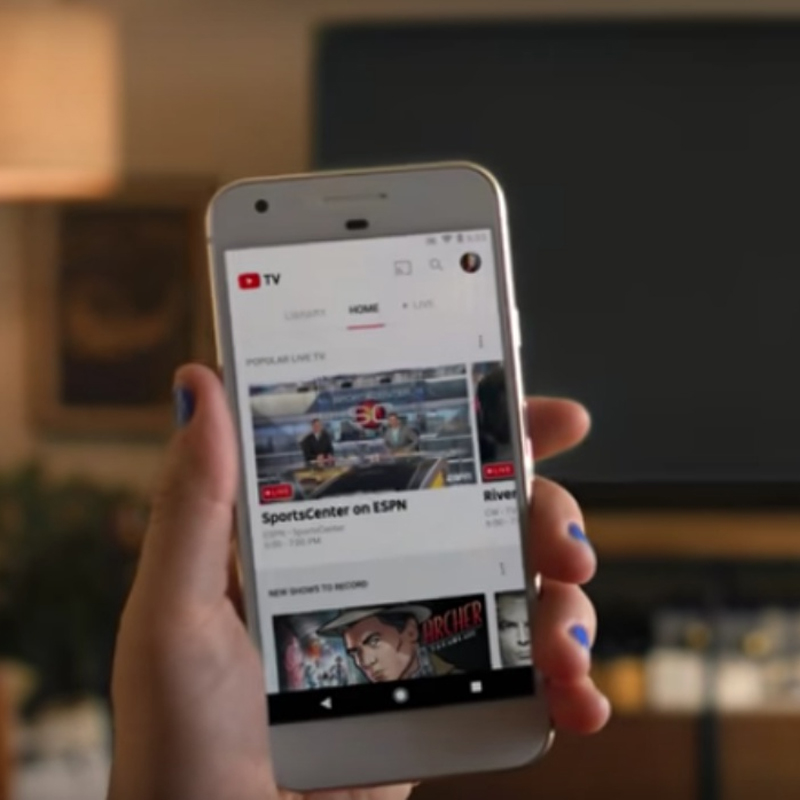
    MUMBAI: YouTube continues to march into traditional TV’s domain. Earlier this year, it launched its 40 channel bundle in the US for about $35 in certain markets. Along with some originals, the personalisation and recommendation has helped its content consumption skyrocket. Using Chromecast, viewers in 50 markets in the US can now watch it on their TV sets, apart from wirelessly watching it on their tablets, their phones and their computers.

    But that was a thing of the past: it has just announced the launch of its own YouTube app which will first be available on the Android app store for any Android TVs and Xbox Ones, followed by releases on Apple TV, Roku and smart TVs from Samsung Sony and LG.

    Why did the streaming service-turned- cloud pay TV operator have to take this route? YouTube executives state that customers insisted that they wanted it on more fixed devices, especially in US living rooms which are primarily TVs. Data showed that despite the mobile first option, living room is still the hub of entertainment.

    Additionally, it is just protecting its turf. Traditional advertising on desktop browsers is sliding, and mobile ads are picking up the slack, even as viewers are continuing to consume content in living rooms on their TV sets. By launching an app for its YouTube TV, it will be able to capture some more ad dollars is the reasoning.

    The YouTube TV app has an in-depth programming guide. Each channel has a page which features the top programmes, a zapper sidebar lets you scroll through channels even as a you watch a show of your own. And what’s most important is the voice enabled search which allows you to talk to your TV set.

    The YouTube TV app built for actual television sets doesn’t cut any of the features you find on the mobile version, but it does add a bunch of new ones. Mobile didn’t feature an in-depth programming guide, but the living room experience has one, so you can see what’s playing a few hours in the future. There are also channel pages that show off top picks from network partners. The programming team built the app in HTML so it can easily be ported onto any device without having to recreate it for other operating systems of other smart TVs.

    Recent data releases from YouTube have revealed that close to a billion hours of video are being watched every day. Mobile viewing accounts for 600 million; desktop is at 300 million hours, while TV accounts for 100 million hours. But the last is growing at a rapid 70 per cent per annum; hence the YouTube App will only see it accelerate faster.

    Clearly, the battle for viewers eyeballs with traditionally delivered cable TV is only going to get more intense. When the service will arrive in India is not known. But it’s something that both India’s struggling cable TV MSOs and operators need to keep a close watch on. Google, with its billions of dollars in cash reserves, can turn on the switch in a second. And that might be too late for the low-on-cash Indian cable TV distribution system.

  • 100 mn hrs of YouTube viewed on TV: Google CEO Sundar Pichai

    100 mn hrs of YouTube viewed on TV: Google CEO Sundar Pichai

    MUMBAI: In the era where consumption is increasing on mobile devices, YouTube is all set to create a new record. In the third quarter earnings call, Google’s parent company Alphabet announced that Youtube’s viewership within living rooms on TV sets is up to 100 million hours per day, with a 70 per cent increase over the previous year. Alphabet also mentioned how YouTube is a major revenue builder for it.

    Google CEO Sundar Pichai talked about the growth and future perspective of YouTube. He said, “Youtube continues to see phenomenal growth” with over 1.5 billion users globally.

    Pichai said that an average user spends 60 minutes at least a day on YouTube on mobile devices. YouTube isn’t just restricted to desktops and smartphones but has also extended to the TV either via the interne ot through devices like set-top boxes or gaming consoles.

    YouTube had previously said that majority of its viewing takes place on mobile devices. Earlier this year, YouTube said people were watching a billion hours of its videos per day. According to the facts and figures issued on July 2017 in Fortunelords, the total number of people who use YouTube is 1.3 billion. In an average month, 8 out of 10 18-49 year-olds watch YouTube. By 2025, half of the viewers under 32 will not subscribe to a pay-TV service. 6 out of 10 people prefer online video platforms to live TV. The total number of hours of video watched on YouTube each month is 3.25 billion.

    Pichai also announced the future plans for YouTube with the company focusing on increasing its subscription-based monetised models. YouTube Red, the company’s first subscription service, would release over 40 original shows through the service this year.

    Stats for YouTube TV which broadcasts live from over 40 networks was also mentioned. YouTube TV now covers two-thirds of US households and is available in 50 metro areas.

    Seems like the remote controlled device has finally made sense to the digital-loving audience.

    Also Read:

    YouTube watch time grew 400% y-o-y, 80% on mobile

    Regional news’ online viewership is billion-plus every month: Vidooly

    Google takes down 1.7 bn. ads for violating policies

  • Airtel ad most watched on Youtube India in Q3 ’17

    Airtel ad most watched on Youtube India in Q3 ’17

    MUMBAI: YouTube has released the Q3 ’17 India Ads Leaderboard, a list of the top ads that Indian audiences consumed the most during the third quarter of the year. These ten ads clocked an astounding 3.5 million hours of watch time, with mobile devices accounting for 69 per cent of total watch time. As per App Annie*, every month, 180 million Indians watch YouTube on the mobile.

    Long format ads have emerged as the winning formula for Indian viewers this quarter. Five out of the 10 most watched ads in the quarter were over one-minute long. This clearly points to audiences’ willingness to invest their time and attention on ads that are narrative-driven – Xiaomi, Oppo, Panasonic, Droom and MuscleBlaze all capitalised on this. Anticipating consumer demand for electronic gadgets during this festive season, Oppo’s new six-and-a half minute ad, for F3 device garnered close to 30 lakh views in around 20 days.

    1. Airtel India

    2. MuscleBlaze

    3. Bajaj Finserv

    4. Panasonic Smartphones

    5. Flipkart

    6. OPPO Mobile India

    7. Xiaomi India

    8. ICICI Bank

    9. Let’s Droom

    10. Durex India

  • Nick and Colors Kannada among top FB, YouTube monthly views: Culture Machine analysis

    Nick and Colors Kannada among top FB, YouTube monthly views: Culture Machine analysis

    MUMBAI: Culture Machine, a subsidiary of The Aleph Group, Singapore, has established a leaderboard for publishers across multiple categories in India.

    Founded by Sameer Pitalwalla and Venkat Prasad in 2013, Culture Machine’s patent-pending tech IP ‘Intelligence Machine’ tracked the month on month performance of Indian channels on YouTube and Facebook to provide a comprehensive view of which publisher has a maximum engagement in terms of views, likes, comments, shares and subscribers.

    The partnerships with Google and Facebook, and with the use of proprietary algorithms, Intelligence Machine has the ability to track three billion videos, categorise the publishers and rank the publishers extensively.

    The current report provides insights on the entertainment and news category. Future analyses by the end of 2017 will include sports, fashion, beauty, automobile and food industry.

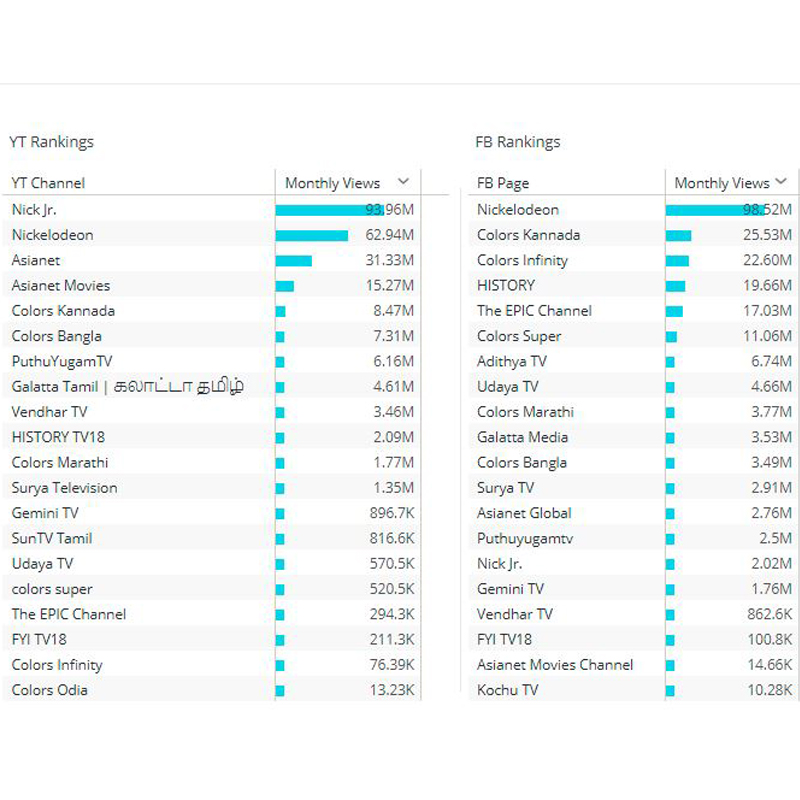
    According to Culture Machine’s report, the top five positions in Youtube ranking have been grabbed by Nick Jr. with 93.96 million monthly views, Nickelodeon with 62.94 million monthly views, Asianet with 31.33 million monthly views, Asianet Movies with 15.27 million monthly views and Colors Kannada with 8.47 million monthly views.

    In the Facebook ranking list, the top five positions were taken by Nickelodeon with 98.52 million monthly views, Colors Kannada with 25.53 million monthly views, Colors Infinity with 22.60 million monthly views, History TV18 with 19.66 million monthly views and The Epic Channel with 17.03 million monthly views.

  • How to create live video content sans pros, convert radio broadcast into visual show

    How to create live video content sans pros, convert radio broadcast into visual show

    MUMBAI: ChyronHego will be showcasing its live production, automation solutions at Broadcast India show in Mumbai in mid-October.

    Live compositor with live assist panels: Live Compositor from ChyronHego is a powerful and intuitive software solution for live multicamera production, allowing both new and experienced broadcasters to create compelling live video content without the need for  technically trained personnel. The solution includes video switching and audio mixing, a powerful video effects engine, multichannel graphics, multiple clip players, and robotic camera control, all packaged in an easy-to-use, all-in-one solution. ChyronHego will demonstrate Live Compositor with the Live Assist Panels platform, an all-new user interface and control panel creation tool. The Live Assist Panels platform leverages the latest multiuser web technologies to enable creation of custom-designed user interfaces for control of any ChyronHego product, and it also supports a growing range of protocols used by ChyronHego and by other leading industry vendors.

    Live assist playout automation: Also being showcased is ChyronHego’s Live Assist playout automation engine. Live Assist offers an ultra-intuitive user interface and open API for smooth integration with existing newsroom system.

    Visual radio: ChyronHego’s Visual Radio is a tool that enriches audio content with synced video to transform a radio broadcast into an entertaining and compelling visual show. The solution allows radio stations to take their shows to the next level by giving the audience the chance to experience unique radio moments as they happen and turn listeners into viewers. Visual Radio is a fully automated software solution that automatically switches cameras and plays graphics by analyzing audio signals and XML data from a radio station’s automation system. Visual Radio mimics a real director, leaving the radio presenters to do what they are good at, which is making radio. Visual Radio combines automatic camera switching, dynamic digital video effects (DVE), and graphic overlays with real-time XML updates and audio control. Visual Radio is designed for web, mobile, and TV platforms. Visual Radio is an add-on to a station’s current radio production system and does not require extra staff.

    Toolbox: ChyronHego’s Toolbox provides broadcasters with the flexibility to quickly capture content from a PC or the web and then convert it to air on live TV with just a few simple clicks. Toolbox allows broadcasters to utilize anydesktop content, play back any codec, and use content from video communication tools such as Skype, Google Hangouts, and Viber in their production. Key features of the Toolbox include a grabber, VLC plug-in, and generic return signal for video calls with a separate overlay for each function.

    The grabber feature allows users to select and grab any PC or web content such as a YouTube clip, PowerPoint slide, or Google Earth location and put it on air. The VLC plug-in takes troubled video files with unknown codecs and allows the user to drop the files in the VLC player and easily play back video files in the broadcast. The generic return signal option allows users to include remote interviews over Google Hangouts, Skype, and Viber in a live broadcast.

  • ABP News TV says it has crossed 7-mn mark on Twitter

    ABP News TV says it has crossed 7-mn mark on Twitter

    MUMBAI: @abpnewstv, the Twitter handle of ABP News, has claimed to have crossed seven million followers. This growth, ABP says, has been fuelled by what it called real-time updates and engaging content on latest news and happenings from across India.

    Excited about reaching this milestone, ABP News head – digital Ramakrishnan Laxman said, “We continue to drive interesting conversations with interesting and compelling content.”

    Their digital umbrella ABP Live is even bigger now with the increasing number of fans on FB, YouTube and now Twitter as well leaving behind their competition.

    ABP Live, the digital arm of ABP News Network, has eight web portals in six regional languages — Hindi, English, Marathi, Gujarati, Bengali and Punjabi.

    For news on the go, ABP also has an award-winning Mobile Application integrating all its language sites.

    ABP News Network claims to be the fastest growing digital network worldwide since its establishment in December 2013. It’s remarkable growth can be gauged by the penetrative reach of 350 million page views and 30 unique visitors as per Google Analytics, ABP says.

  • Subramaniam is Prime interim head as Amazon seeks new leader

    MUMBAI: Amazon Prime Video India director – content Vijay Subramaniam has been appointed as the interim head till the time a suitable replacement is found for Prime India head Nitesh Kripalani who quit two days ago. Kripalani will however remain on the rolls of Amazon India till November.

    “We are looking to fill this position. In the interim, Subramaniam has stepped in,” an Amazon spokesperson said.

    Subramaniam, who has over 20 years of experience in television, radio and print, also worked with Disney, Turner, Magna and Star. He quitt Disney Media Networks in April 2017, and joined Prime shortly later. Before joining Disney, Subramaniam was with MTV India as the advertising sales director, responsible for delivering revenue objectives for MTV. 

    While free Youtube, which makes money with ads, is successful in India, Prime Video is among the first SVoDs which is succeeding owing to scale.

    Also Read:

    Amazon Prime country head Nitesh Kripalani quits

    Amazon Prime plans to add more originals & evaluating regional content

  • UK’s TV & online habits revealed, 40 mn watch episodes back-to-back

    MUMBAI: The UK has become a nation of binge-viewers, Ofcom research has revealed, with eight in 10 adults now watching multiple episodes of their favourite shows in a single sitting.

    The findings are part of Ofcom’s annual Communications Market Report 2017, which reveals stark differences in how older and younger people watch television.

    Eight in ten adults in the UK (79 per cent) – or 40 million people – use catch-up technology such as BBC iPlayer, or subscription services such as Netflix, to watch multiple episodes of a series in one sitting, wiping out the wait for next week’s instalment. One third (35 per cent) do so every week, and more than half (55 per cent) do it monthly.

    public://f1_3.jpg

    Most binge viewers (70 per cent) find this type of viewing relaxing and enjoyable, and for others it’s an opportunity to discuss with friends (24 per cent). But around a third (32 per cent) of adults admit the temptation to watch another episode has cost them sleep and left them feeling tired.

    Perhaps as a result, more than a third (35 per cent) of binge viewers, and almost half (47 per cent) of young adults aged 16-24 are trying to cut down their viewing in some way. This includes rationing their viewing (19 per cent), finding an alternative hobby (10 per cent), or even cancelling a TV subscription (4 per cent).

    Binge viewing has such a strong allure that many viewers say they don’t intend to do it, but the pull of the next episode keeps them tuned in. More than seven in ten (74 per cent) say they sometimes watch more than they intend to, while 18 per cent say this always happens.

    Bingeing is most popular among young people: more than half (53 per cent) of those aged 12-15 enjoy weekly watch-a-thons, compared to just 16 per cent of over-65s. For that older age group, more than half (59 per cent) prefer a traditional release of one episode per week.

    The trend has been driven, in part, by the availability of faster home internet speeds, a rise in the number of connected TVs, and increased take-up of smartphones and tablets.

    public://f2_3.jpg

    11 per cent of people aged 16-24 watch TV every day, compared to 0 per cent of people aged 65 per cent

    Spoiler alert!

    For many binge viewers, the desire to keep up with programmes is driven by fear of someone spoiling a programme’s ending (25 per cent). This can result in some (16 per cent) feeling under pressure to keep up with the viewing habits of family or friends.

    public://f3.jpg

    And for some, the days of being tied to the TV schedule are fading, as UK viewers take advantage of being able to watch whenever, wherever they like. More than a third of people watch TV on the move – while on holiday (24 per cent), while commuting (16 per cent) or even in the pub (7 per cent).

    Just over a half of people (51 per cent) watch TV in their bedroom, while others watch in the kitchen (16 per cent), the garden (9 per cent) or the bathroom (9 per cent).

    Adults in the UK watch programmes/films on any service or device in the bedroom 51 per cent of the time

    For many, watching TV is now a solo activity. Two in five adults say they watch TV alone every day, and almost nine in ten watch programmes alone at least once a week. One third of people say members of their household sit together, in the same room, watching different programmes on separate screens.

    public://f4.jpg

    Despite this, nine in ten people watch live TV every week, and family viewing is still an integral part of family life. Three in ten (30 per cent) adults say their family still watches the same programmes or films together every day, while 70 per cent do so at least once a week. Nearly seven in ten (68 per cent) say watching TV can bring the whole family together for a shared viewing experience.

    public://f5.jpg

    Ofcom’s research also reveals differences between the viewing habits of older and younger people, with the latter far more likely to take advantage of streaming services such as Amazon Prime.

    More than seven in ten (76 per cent) young people aged 16-24 use a subscription streaming service, compared to less than two in ten (19 per cent) older people aged 65 and over.

    68 per cent of adults in the UK agree that watching TV programmes/films brings the family together

    However, BBC iPlayer is the most popular on-demand service with 63 per cent of adults saying they use it, followed by ITV Hub at 40 per cent and then YouTube at 38 per cent and Netflix at 31 per cent.

    The public service broadcasters’ on-demand services, such as All 4 and ITV Hub, are popular with all age groups – 75 per cent of young adults aged 16-24s, and 59 per cent of over-65s, use these services.

    63 per cent of adults in the UK use BBC iPlayer for watching TV programmes/films

    Meanwhile, nearly six in ten (59 per cent) over-65s prefer a TV series to be released in the traditional manner, week by week, compared to 40 per cent and 36 per cent of young people aged 12-15 and 16-24 respectively.

    Lindsey Fussell, Consumer Group Director at Ofcom, said: “Technology has revolutionised the way we watch TV. The days of waiting a week for the next episode are largely gone, with people finding it hard to resist watching multiple episodes around the house or on the move.

    “But live television still has a special draw, and the power to bring the whole family together in a common experience.”

    Sharenting – a modern dilemma

    This year’s Communications Market Report also examines our online habits – looking particularly at the sharing of images, and wide differences in people’s approach to online privacy.

    public://f6.jpg

    It reveals that more than half (56 per cent) of parents don’t indulge in ‘sharenting’, the common practice of sharing pictures of children on social media. Among those who do not share, the main reason (87 per cent) is a wish to keep their children’s lives private.

    In contrast, 42 per cent of parents do share photos of their children, and half of these share photos at least once a month.

    Of those parents who do share photos, just over half (52 per cent) say their children are happy for them to do so, and eight in ten (84 per cent) say they only share photos or videos their children would be happy with. A large majority (85 per cent) of these parents say they are careful about who can access the material.

    Privacy know-how

    Understanding the privacy implications of sharing images is a critical media literacy skill, and some people are aware that, once they post an image, they no longer have control over it.

    Half of people understand that an uploaded photo is difficult to delete because it may have been shared or saved by someone else, but 17 per cent think it is easy to delete, and a further 16 per cent didn’t know.

    Older people are far less confident about using privacy settings than younger internet users. The large majority (81 per cent) of 18-24s feel comfortable changing settings, but this falls to 37 per cent of over-55s.

    70 per cent of people do not think that it is OK to share a photograph or video of other people without their permission. 36 per cent strongly agree that personal photographs should only be shared with friends and followers

    Most people are aware of other people’s privacy, with seven in ten (70 per cent) saying they wouldn’t share photos of other people without their permission, and three-quarters saying that personal images should only be shared with friends or followers.

    And six in ten (62 per cent) people who post photos of themselves (‘selfies’) say they have ‘untagged’ themselves from someone else’s photos or videos of them.

    Younger people are more relaxed about sharing photos. Almost two in ten (18 per cent) people aged 18-24 don’t mind sharing with everyone, compared to just 5 per cent of people over 35.

    The power of self-image

    More than a third (34 per cent) of those aged 18-24 say the pictures they post and share most often are selfies – more so than landscapes/buildings (32 per cent) and holidays (31 per cent).

    But among the wider population, holidays are still the most popular online snaps (24 per cent).

    People who post/share photos online like to post/share holiday images the most (24 per cent)

    Most selfie-takers (71 per cent) say it’s important to look their best in photos, and nearly half (47 per cent) feel pressure to look good online. This is more common among young people aged 18-24 (77 per cent), and significantly more so among women (82 per cent) than men (58 per cent).

    Almost three-quarters (74 per cent) are cynical about the photos that other people post. Seven in ten say other people’s photos offer a ‘rose-tinted’ view of that person, or make their life appear more exciting than it is. This view is strikingly high among younger people – 85 per cent of 18-24s, and 88 per cent of 25-34s, agree with it, compared to only 65 per cent of over-55s.

    Unfortunately, despite knowing that these photos might not be realistic, viewing these photos can have a negative impact. One third (32 per cent) say looking at other people’s photos makes them feel that their life doesn’t match up, rising to more than half (53 per cent) of 18-24s.