Tag: YouTube

  • YouTube reports $6 billon ad revenue in Q1, up 49% from year earlier

    YouTube reports $6 billon ad revenue in Q1, up 49% from year earlier

    KOLKATA: YouTube’s advertising revenue rose dramatically in the first quarter of 2021 , up 49 per cent from the same quarter in the last year. As the parent company Google/Alphabet reported its first quarter earnings, YouTube ad revenue amounting to $6 billion has trumped all expectations.

    Google and Alphabet chief financial officer Ruth Porat has credited “exceptional performance in direct response and ongoing strength in brand advertising” for the jump in ad revenue. The direct response business is now a large and fast-growing business for the segment, Google chief business officer Philipp Schindler added.

    The platform is also working on shopping capabilities of viewers on the platform. “I think we’re still scratching the surface on what’s possible really with commercial intent on YouTube,” Schindler said. He emphasised that advertisers are using YouTube to reach audience that they can’t find anywhere else. The video viewing platform is starting to see an advertiser mix of awareness and more action-oriented formats who are driving reach and results across the funnel.

    The video giant currently boasts of over two billion monthly logged users and over one billion hours of daily video consumption. Interestingly, its short video platform has also seen exponential growth. “YouTube Shorts continues to gain popularity with over 6.5 billion daily views as of March, up from 3.5 billion at the end of 2020,” Google and Alphabet CEO Sundar Pichai said.

    Overall, Alphabet reported $55.3 billion in Q1 revenue, up 34 per cent year-over-year. “Over the last year, people have turned to Google Search and many online services to stay informed, connected and entertained. We’ve continued our focus on delivering trusted services to help people around the world. Our Cloud services are helping businesses, big and small, accelerate their digital transformations,” Pichai said in a letter to the shareholders.

  • Will IPL 2021 prove to be a brand marketer’s delight?

    Will IPL 2021 prove to be a brand marketer’s delight?

    NEW DELHI: The countdown has begun for one of the biggest cricketing events – the 14th edition of Vivo IPL 2021. The sporting extravaganza will return home after two years following a stellar show in the United Arab Emirates last November.

    The season is all set to kickstart on 9 April in Chennai with a high octane clash between defending champions Mumbai Indians and Royal Challengers Bangalore. But once again, all the matches will be played in empty stadiums, with no enthusiastic fans to cheer their favourite teams. The second wave of Covid2019 continues to pose a challenge, as the league recovers from a pandemic-hit 2020.

    However, the Board of Control for Cricket in India (BCCI) said it is confident of hosting the IPL at home with the health and safety of players and all people involved being paramount. How will this arrangement pan out for the brands and advertisers, who have pinned high hopes on the league? Will there be an impact on TV viewership, with restrictions eased across most parts of the country and people back in offices? Will IPL 2021 be able to sustain the momentum it built last year?

    Some of these questions will take center stage at IPL 2021: Brand marketers' delight? – a virtual roundtable to be hosted by Indiantelevision.com today. An esteemed panel of representatives from media and advertising agencies will deliberate upon the potential power of the league and the opportunities it holds for brands and the M&E industry, as it looks to make a comeback on its home ground.

    The panel will comprise of Mediacom national buying head Srinivas Rao, Byju’s head of marketing Atit Mehta, dentsu India chief executive officer Anand Bhadkamkar, Initiative (IPG Mediabrands) south head & vice president Priya Iyer, and Indiantelevision.com’s founder, CEO & editor-in-chief Anil Wanvari.

    The virtual roundtable will begin at 3:30 pm on 7 April and will be live-streamed on YouTube, Facebook, and Twitter. Join us for stimulating conversations and interesting insights on the potential power of the IPL as it returns with its 14th edition.

  • Sony Entertainment Television crosses 100 million subscribers on YouTube

    Sony Entertainment Television crosses 100 million subscribers on YouTube

    NEW DELHI: After being a leader in the linear TV space, Sony Entertainment Television (SET) is making waves on the digital front too. The channel has reportedly crossed 100 million subscribers on YouTube, according to a press statement it released on Tuesday.

    SET’s YouTube channel had crossed the 1,000-subscriber mark in 2009, followed by 10 million in 2017, 50 million in 2019, and 100 million now. Since 2019, its YouTube channel has been registering an average of two million subscribers every month, making it one of the biggest subscriber bases for a broadcast brand.

    From hosting reality shows like Kaun Banega Crorepati to offering Kapil Sharma’s rib-tickling comedy and making India groove to some hypnotic dance moves in Super Dancer, the channel has attempted to headline the category with diverse genres and formats, bringing some of India’s most popular faces to the living rooms. It has also brought inspiring stories of women empowerment with shows like Ladies Special, Patiala Babes coupled with airing India’s longest-running crime shows CID and Crime Patrol that catered to a generation of audiences.

    “We are delighted to hit the 100 million subscription mark on YouTube as the first broadcaster globally. This milestone is a testimony that Sony Entertainment Television’s content performs exceedingly well across all three platforms – Sony Entertainment Television, SonyLIV, and YouTube. This trans platform content success helps us create a robust content pipeline that brings quality, variety, and novelty,” said Sony Pictures Networks digital business head – growth and monetisation Manish Aggarwal.

    With this, SET also becomes the first television channel in broadcasting history, as well as the fourth entity to globally reach 100 million subscribers on YouTube, said the company in a media statement. According to the broadcaster, its YouTube channel has reached over 278 million unique viewers globally in the last 90 days and registered more than half a billion (over lifetime) likes, shares, and comments for its engaging content.

    YouTube director – content partnerships Satya Raghavan said, “Their popularity is testimony to the fact that quality television content can have longevity on YouTube and foster loyal and vibrant communities. Their shows on YouTube are reaching new and diverse audiences every day and we are happy to see the Sony franchise grow across all screens simultaneously.”

  • Influencer marketing ready to explode in India: ClanConnect’s Kunal Kishore Sinha

    Influencer marketing ready to explode in India: ClanConnect’s Kunal Kishore Sinha

    MUMBAI: Even as the economy and businesses were reeling under the global upheaval in 2020, there were some that saw an opportunity in the disruption and took off during this tumultuous period. One such business was ClanConnect, a start-up born during the lockdown. Inspired by the growing investor interest in the digital and influencer marketing sector and the sustained visibility of brands on it during the lockdown, the ClanConnect team decided to take the plunge six months earlier than they had initially planned. In an in-depth conversation with Indiantelevision.com’s Anupama Sajeet, ClanConnect COO and co-founder Kunal Kishore Sinha talked about the booming influencer marketing industry, the impact of the recent ASCII guidelines, and how the fledgling firm plans to transform the digital marketing landscape with artificial intelligence and machine learning.

    Edited excerpts:

    On ClanConnect’s business model and what it means to be ‘India’s only AI-driven influencer marketing agency’.

    Influencer Marketing (IM) is in its infancy in India right now. It has opened up lots of opportunities for brands to connect with their consumers. But, it remains largely unorganised, which also led to fraudulent activities as creators began exploring unethical means to increase their followers. There was no scientific method to decide which influencer would be most suitable for a brand or campaign.

    We started ClanConnect to make this entire process more scientific with the help of machine learning. We came up with a marketplace where a brand has all possible tools to discover the right influencer for its campaign, engage with them online and also help them to manage its entire end-to-end campaign in an automated form.

    The technology engine is an amalgamation of some of the leading influencers across scale, categories, and geographies. Our AI recommendation tool can pull out any data point of any influencer with a following of more than 1000, across any geography in less than 24 hours. It also distinguishes between genuine and fake followers. We are trying to build an ecosystem where technology becomes the big differentiator.

    On the size of the influencer-driven market in India and globally.

    A global survey done by Business Insider on 5,000 marketers showed that 80 per cent of the marketers budgeted 10 per cent of their total advertising spend in influencer marketing. Globally, the influencer marketing spend was $9.7 billion for 2020 and it is expected to go up to $13.8 billion in 2021. It can be more in the case of some categories like online gaming. In 2019, the ad spend on gaming influencers in the US was $849 million. In India, companies engaging in mobile phones, automobiles, fashion, lifestyle, entertainment use a huge chunk of their ad spend on this segment.

    Two platforms have emerged in a big way – Twitch, an online game streaming company, and TikTok, though the latter has been banned in India. There are Indian companies like Rooter which provide a platform for online gamers to stream their game. With the increasing number of user-generated content platforms, there will be more and more content creators and this will translate into more advertising budgets. So this market is only going to explode.

    On the Tiktok ban effect.

    We were going live with our Instagram and YouTube and our next platform was TikTok. But, by the time we were ready with the TikTok platform engagement, it was banned and our six months of technology development work went down the drain. By far, TikTok is leading in the global IM space in terms of ad marketing spend. We are hopeful that other equivalent players will emerge. In short video format, we already have Instagram Reels, Mitron, Chingari, Moj, and some other local players. Each of them has some share of the market. The scale of the market is huge and I am sure brands are not going to wait to invest in it.

    On the new ASCII guidelines and challenges it entails for the industry.

    ASCII came out with these policies because they realised that influencer marketing was becoming a mainstream advertising space. We welcome this move because it highlights the potential of this market. We do not expect the guidelines to affect the influencer business per se, because most influencers anyways tag the brand while sharing a post. Instagram had, in fact, started this concept of tagging the brand when it’s a paid content much before ASCII came out with the policy.

    Also, I do not think any brand wishes to short-change their users by pushing something as organic when it’s a paid content. The influencers too want to ensure authenticity in their content. Now, if the influencer can provide visibility and awareness to a product that helps translate into sales, it generates RoI. It does not change if they mark it as a sponsored content. I believe this is going to help the market to become better. The problem, however, lies in implementation as there is still a grey area as to what is organic and what is paid content. How will you define the transaction between two parties when it’s a self-regulatory guideline? That will be a challenge for ASCII.

    On the way ahead for digital IM trend for consumers and brands.

    We are starting to see brands – be it hotels or cruise companies – who want to get their customers back after a year of bad business and less revenue. But they want to do it at a cost that has a larger RoI. They are following a cautious, focused approach. We have also had brands that had not experimented with influencer marketing until the lockdown happened. They saw the impact of the campaign on digital and increased their budget for influencer marketing.

    There are many young start-up d2c (direct to customer) brands, whose influencer spend is as much as 50 per cent of their total marketing spend. This is only going to grow. The pandemic opened up opportunities, which were previously not considered by the brand managers. Even in a back to pre-Covid scenario, the immersive valuation that an influencer could bring about a product or service would be difficult to achieve through say, an outdoor campaign, internet banner, or a newspaper ad. So there will always be space for all categories of advertising, including influencer marketing, in times to come. And just like digital marketing fought for its place in the past, this is a digital disruption that will eventually become the mainstay.

  • Guest column: Implications of the new digital media code for online content platforms

    Guest column: Implications of the new digital media code for online content platforms

    NEW DELHI: The Information Technology (Intermediary Guidelines and Digital Media Ethics Code) Rules 2021, framed under the Information Technology Act 2000, were notified on 25 February 2021. The Rules apply to publishers of online curated content (OCC), intermediaries, including social media intermediaries and significant social media intermediaries (ie those with 5,00,000 or more users), and publishers of digital news and current affairs.

    The rules have been issued amidst the backdrop of, and perhaps in response to, various public interest litigation matters that remain pending across the country, alleging that content published on significant OCC platforms is seditious, defamatory, contemptuous, infringing, obscene, offensive, and, or, is otherwise illegal.

    Regulation of OCC platforms

    The rules prescribe a Code of Ethics and guidelines for OCC platforms and publishers of digital news and current affairs content. These entities and their compliance with the rules will be overseen by the ministry of information and broadcasting (MIB).

    The rules prescribe a three-tier regulatory mechanism to ensure publishers (including OCC platforms) comply with the code. Further, the factors to be considered before publication of content on an OCC platform include the effect of the content on the sovereignty of India;  whether it could affect friendly relations with another state, incite violence or disturb public order; whether it could affect India’s multi-religious and multi-racial fabric; and, whether its publication would otherwise be prohibited under any law for the time being in force.

    The rating categories are to be assigned to the content after considering the depiction of themes and messages, violence, nudity, sex, language, drug and substance abuse, horror within the content and the target audience of the content.

    Implications of the rules on OCC platforms in India

    Under the Rules, ‘online curated content’ includes content which is owned, licensed, or contracted to be transmitted, and is made available on demand, including through subscription. The definition of ‘publisher of online curated content’ specifically excludes individuals who are not transmitting content in the course of a systematic business, professional or commercial activity.

    The Rules apply only to persons engaged in the distribution of content for commercial purposes, and clearly are not intended to regulate user-generated content uploaded on social media platforms. On a plain reading, it appears that the Rules may also regulate channels of social media influencers and celebrities on significant social media platforms such as YouTube, as these channels may be considered publishers of OCC. However, the rules do not make any specific reference to individuals generating content or social media influencers, and the position with respect to social media influencers is unclear. For instance, in the absence of a clarification, content on YouTube channels such as IISuperwomanII would pass the test of being ‘curated catalogues’ as these channels usually contain a mix of comedy sketches, podcasts, interviews, short films and news critiques, addressing an identified audience.

    The rules do not expressly address situations where news may be disseminated through non-traditional channels or could be considered to have been disseminated through an OCC platform (for example, Last Week Tonight on Disney+ Hotstar and the ScoopWhoop Unscripted YouTube channel). In theory, such OCC publishers may be required to comply with the entirety of the code, ie part I which addresses publishers of digital news and current affairs and part II which addresses OCC.

    The three-tier regulatory mechanism is similar to the self-regulation model that is already in place for non-news and news television broadcasters, and the rules have, therefore, been promulgated as an attempt to provide a level playing field to digital content platforms as opposed to the traditional forms of television and cinema broadcasting.

    The rules prescribe sanctions in the form of warning, requiring an apology, reclassification, editing, modification, deletion, and even blocking of access to the publisher of content violative of the rules. The new regulations do not suggest content censorship, and only prescribe matters to be considered before classifying and publishing content. Given that television content in India is quite conservative in comparison to the content currently available on OCC platforms, there is apprehension amongst the stakeholders that OCCs may be subjected to a similar level of ‘excessive’ censorship. However, OCC platforms have a distinct advantage over television – sophisticated software that enables age-gating of content and creation of buckets of content for different age groups. The interdepartmental committee of the MIB should bear this advantage in mind when issuing directions, orders or penalties under the rules.

    The rules may encourage OCC platforms to err on the side of caution and restrict the publication of content where apprehensions may arise regarding that content’s rating. This approach may adversely affect content creators’ constitutional right to freedom of speech and expression. In this context, it will be interesting to see whether the rules do, in fact, level the playing field not only in terms of regulation of various media but also result in availability of similar kinds of content across all modes of distribution. In any event, the rules may provide a much-needed structure to the OCC space.

    (The note has been authored by Kaushik Moitra, partner and Karnika Vallabh, associate at Bharucha & Partners. The views expressed in this article are their own and indiantelevision.com need not subscribe to them.)


  • India online video opportunity to scale to $4.5 billion by 2025

    India online video opportunity to scale to $4.5 billion by 2025

    NEW DELHI: 2020 was a breakthrough year for over the top (OTT) streaming platforms. India’s online video industry generated an estimated $1.4 billion in revenue in the year, with advertising contributing 64 per cent and subscription 36 per cent, said Media Partners Asia (MPA) in its ‘India Online Video and Broadband Distribution’ report.

    India is currently the fastest growing OTT market. According to MPA, the country's overall online video market is projected to grow at a compound annual growth rate of 26 per cent over 2020-25 to reach $4.5 billion.

    There are around 60 platforms operating in the Indian OTT landscape. However, YouTube (43 per cent), Disney+ Hotstar (16 per cent), Netflix (14 per cent), Amazon Prime Video (seven per cent) remained the top five platforms which accounted for a combined 80 per cent share of total revenues in 2020.

    “Subscription based online video services benefited significantly in 2020 as the country went into the lockdown. Key players are investing in premium local content while leveraging sports, movie rights and aggressive consumer pricing to drive subscriber adoption. The subscription video-on-demand (SVoD) market will remain competitive as Disney+ Hotstar scales its direct subscription business while Netflix and Amazon Prime Video deepen partnerships with mobile and fixed broadband operators. These three platforms accounted for almost 80 per cent of the SVoD revenues in 2020,” said MPA India vice president Mihir Shah.

    YouTube remains the market leader in AVoD, accounting for 67 per cent of total online video advertising in 2020. But, its market share is expected to decline to 55 per cent by 2025 as domestic broadcaster-backed platforms and short form user-generated content (UGC) video players expand their presence. “Local premium content and sports rights will help broadcaster-backed platforms gain share. Increased reach and engagement with rural millennials will improve monetisation for short-form video platforms,” added Shah.

    According to its projections, the SVoD market could reach $1.9 billion by 2025, a 30 per cent CAGR from 2020.

    Online video advertising reached an estimated $909 million in 2020, a marginal decline of two per cent y-o-y as reduced demand has forced advertisers to recalibrate advertising budgets. The AVoD segment is expected to expand at a CAGR of 24 per cent over the next five years to reach $2.6 billion by 2025.

    India OTT content investment reached $700 million in 2020 as both domestic and global platforms are investing in the country’s burgeoning SVoD opportunity. The budgets for originals and local acquisitions continue to trend upwards. As a result, the OTT content costs are projected to grow at a CAGR of 18 per cent in the next five years to reach $1.6 billion, said the report.

    The 4G revolution drove the country’s mobile broadband penetration to 43 per cent as of December 2019. With commercial rollout of 5G expected to begin in 2021, India’s mobile broadband penetration is forecast to grow steadily to 66 per cent by 2025. India's fixed broadband market remains under-penetrated at merely six per cent of households, but fresh investments by private telecom players have renewed the market. According to MPA, the country's fixed broadband market is projected to grow at a CAGR of 18 per cent between 2020 and 2025 to reach 45 million subscribers with more than 82 per cent of subscribers through fiber.

    With the infrastructure upgrades, consumers are identifying new uses for the expanded broadband capacity including work from home, education from home, video conferencing, as well as online video streaming.

    Alliances and partnerships are emerging which facilitate the sale of VOD and data bundling packages. Jio has collaborated with all leading platforms, while Airtel has tied-up with Amazon Prime Video and Zee5 for its fixed broadband offering.

  • ABP Majha crosses 7 million subscribers on YouTube

    ABP Majha crosses 7 million subscribers on YouTube

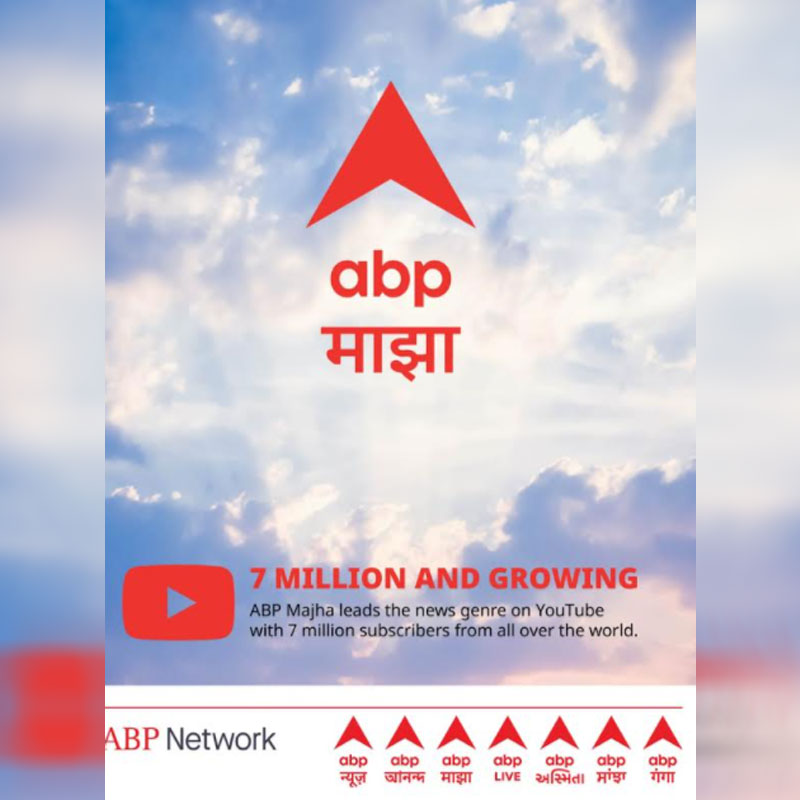
    NEW DELHI: Marking its leadership position in the digital sphere, ABP Network’s Marathi News Channel, ABP Majha has reached a whopping 7 million subscribers on YouTube. As ABP Majha, along with other regional & national channels, recently reinvented its look & feel with a brand new identity, the network is already starting to witness massive growth on all fronts. In fact, ABP Network’s regional properties have been thriving both on digital and broadcast by the dint of a fresh outlook on content & overall visual language. 

    While ABP Majha has always held a leadership position in the highly-competitive market of Maharashtra, its burgeoning subscriber base on YouTube further demonstrates the ever-growing potential of the news channel on digital.

    The new identity of ABP Majha, coupled with a fresh and unique take on content has certainly been critical in achieving this milestone. This accomplishment truly embodies the new vision of the network, which places focus on the striking concept of ‘limitlessness’. The concept of limitlessness not only lays emphasis on delivering truth ‘beyond limits’ to the viewers but also represents the network’s undying spirit to work towards betterment relentlessly and stop at nothing. 

    In terms of content, ABP Majha has extensively covered the COVID-19 situation in Maharashtra, while also pursuing exclusive stories on the issue. Other memorable coverages include the Nisarga Cyclone, the Ayodhya issue, and other exclusive content on Ganesh Chaturthi.  The flagship show of ABP Majha, ‘Majha Katta’ has also elevated the overall content offerings of the channel by having topical guests like Soham Wangchuk, Sonu Sood, Urmila Matondkar, Sanjay Raut, Ramdev Baba, Sudha Murty, Asha Bhosale, and Javed Akhtar on the show.

    Furthermore, ABP Majha was the first news channel to conduct a show (Majha Vision) on Maharashtra government’s response & planning in combating COVID-19. 

    In its new form, the channel is therefore breaking free from the shackles of conformity to bring something unique to its viewers every single day. Other than providing ‘news beyond limits’, the network is also putting together video content, podcasts and other forms of digital media to create greater value in this new era. This has been another major contributory factor towards the speedy growth of ABP Network.

    On this development, Mr. Avinash Pandey, CEO, ABP Network said, “This milestone only gives us more confidence to innovate and evolve ourselves with the changing times. All of our hard-work seems worth it, when we see the faith our viewers have in our content. This is just another stepping stone towards our ever-growing leadership and our goal to conquer the digital segment.”

  • Brand Twitter describes 2020 in one word

    Brand Twitter describes 2020 in one word

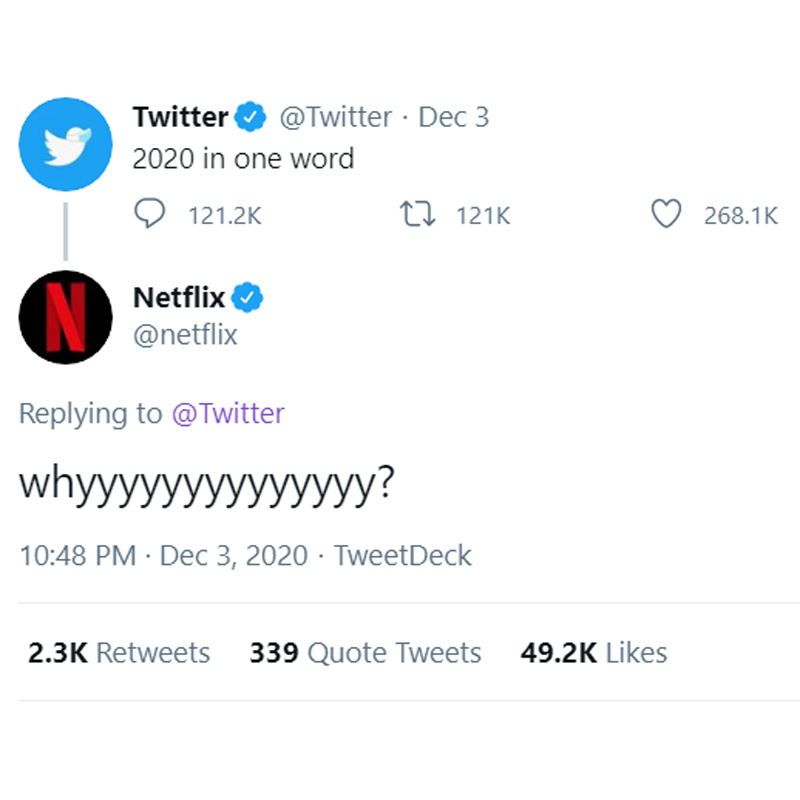
    NEW DELHI: As 2020 draws to a close (finally!), many are convinced it was a cursed year, when everything that could, did go wrong, and there was little cause for cheer. Of course, most of the blame was apportioned to the Covid2019 pandemic, but there were challenges on several other fronts too – which impacted the environment, people and businesses. So when Twitter’s official handle said to describe ‘2020 in one word’ and put it out in the universe, everyone had a lot to say. And Brand Twitter wasn’t far behind in expressing its thoughts on ‘the worst year in recent memory.’

    While some brands were all for the year to be over and done with…

    Windows

    Adobe

    YouTube

    Subway

    Others had a rather existentialist view of things…

    Netflix

    LEGO

    Zoom

    Microsoft Edge

    A few tried to look on the bright side…

    Shaadi.com

    Kerala Tourism

    Dolby India

    Meanwhile, Thrive Global founder & CEO Arianna Huffington has chosen ‘resilience’ as her word of the year. Resilience, or the capacity to recover quickly from difficulties, “is the quality that was summoned in us by all the challenges of 2020. It’s also the quality that’s going to carry us forward into 2021,” writes Huffington. And that’s a word to live by.

  • Harkirat Singh of Gath Productions wins #Zomatoloot

    Harkirat Singh of Gath Productions wins #Zomatoloot

    NEW DELHI: A little over a month ago, food-aggregator and delivery platform Zomato, in its ever-quirky way, had announced a unique competition for the people who were tired of seeing their unskippable ‘rich butter chicken’ and ‘creamy pasta’ ads on YouTube. Termed #Zomatoloot, the video creating challenge was an interesting way to incorporate user-generated content in a brand’s marketing strategy, besides promising Rs 25 lakh to the winner as well as a lot of visibility on digital and TV ads of Zomato. 

    The challenge attracted many interesting entries, but the victory went to Harkirat Singh, who runs a production house called Gath Productions. Singh’s rib-tickling ad depicting the story of every hostel ever was as relatable as it was funny and was a big hit with the Zomato’s social media followers.

    Singh is pretty psyched about winning the challenge and the recognition it is getting him. “I have been in the industry for four years now and have worked on a number of brand films as director and cinematographer but never got the recognition for it. At the end of it, ad films become the property of the agency. So, it is very exciting and heartening for me to get recognition for my film.”

    On being asked about how he landed upon the concept, Singh shared, “I got to know about it from a friend on the 27th of September, just a few days before the last date of submissions. As time was short, I was not very confident if something can be pulled off and told her that I will only be participating if I can create something good. Luckily, the same night the idea struck me. I was having dinner with my sister, there was something on her plate that I was trying to grab and that’s when it struck me. Then I connected it to my hostel days where I have had similar experiences of my friends taking my orders and eating them.”

    He added, “It also happened that just a few days back I had seen this building that looked like a hostel and instantly I knew the location too.”

    Singh then shot the entire film within a span of six hours.

    Here are all the other entries that made a podium finish:

  • Home Credit India launches Diwali campaign

    Home Credit India launches Diwali campaign

    New Delhi: Home Credit India, a local arm of the international consumer finance provider with operations spanning over Europe and Asia and committed to driving financial inclusion in India, today launched its Diwali campaign #ApneStyleKaTyohaar to celebrate this year’s festivities in one’s own style. As a part of the campaign and to support consumers in various ways, Home Credit India has partnered with Reliance Digital and My Jio Store, Samsung, LG, OPPO and Vivo to roll-out special festive offers and customer-friendly finance schemes on smartphones and home appliances. 

    Consumers can celebrate the festivities of Diwali in their own style with Home Credit as the company is ready with offers across industry’s favourite brands. Consumers can now purchase a Vivo, OPPO, LG and Samsung smartphone/home appliance with Home Credit at easy and affordable EMIs.

    Home Credit India chief marketing & customer experience officer Marko Carevic said, “Customers can now celebrate the festivities in their style, with us. With #ApneStyleKaTyohaar campaign, customers will be facilitated with our latest offerings and partnerships this festive season. They can choose the product of their choice from their favourite brands and can easily purchase with Home Credit’s easy finance options. Through this campaign, we hope to share the warmth of this Diwali season with everyone as we prepare to celebrate India’s biggest festival.”

    The campaign #ApneStyleKaTyohaar will be aired on Home Credit’s social media channels including Facebook, Twitter, Youtube and OTT platform like Hotstar, highlighting the company’s customer-centricity to enable consumers during these challenging times and inspire them to spread joy and rekindle hope & optimism for life.

    Home Credit serves 11.3 million customers with a plethora of hassle-free financing options which can be availed from a strong network of around 31,500 points-of-sale (PoS) presents across 350 cities. The company is committed to drive credit penetration and broaden financial inclusion through responsible lending in the country.