Tag: YouGov

  • Havas plugs into YouGov power to stitch audience insight gaps

    Havas plugs into YouGov power to stitch audience insight gaps

    MUMBAI: Havas has doubled down on data by expanding its tie-up with research heavyweight YouGov, now covering 30 markets across its media, creative, and health networks. This souped-up partnership adds a potent dose of health insights from YouGov’s chronic and seasonal condition panels—feeding straight into Havas’ AI-driven converged operating system.

    The move fuses first-party data with YouGov’s rich psychographic and attitudinal layers to create razor-sharp audience profiles at scale. The result? A 50 per cent bump in performance through faster activations and higher lead conversions.

    “By accelerating adoption of YouGov’s data and insights, we’ve been able to build larger, smarter models, creating increasingly sophisticated audiences that can be leveraged across the entire agency network in our Converged operating system. For our clients, we’ve boosted performance while safeguarding customer privacy, and for our people we’ve unlocked new efficiencies that empower them to focus on more strategic tasks,” shared Havas global chief data & technology officer Dan Hagen. 

    The collaboration has been four years in the making. “We’re incredibly proud of YouGov’s work with Dan and his team at Havas since our partnership started four years ago,” said YouGov co-founder & CEO Stephan Shakespeare. “The enhancement of the relationship is testament to how much they value the quality and connectivity of our data, our pioneering products and our deep expertise. We look forward to further expanding YouGov’s partnership with Havas in the years to come as we continue to develop innovative approaches to show consumers’ reality across the world.”

    With the Havas-YouGov power couple growing stronger, it’s clear: insight is no longer just nice to have—it’s the rocket fuel.

  • Indian consumers increasingly prefer streaming services and personalised ads

    Indian consumers increasingly prefer streaming services and personalised ads

    Mumbai: Moloco, a leader in operational machine learning (ML) and performance advertising, together with leading independent research company YouGov has announced the findings of the consumer Perceptions of Ads on Streamers Survey 2024. More than 1,000 consumers in India were surveyed for their perspective on advertising on streaming media platforms. More than 1,000 consumers in the US were also included in the same survey. Overall, the results signal a tipping point in consumer consumption habits as they shift from traditional TV to streaming platforms.

    “It’s important to get the ads experience right because consumers will cancel a subscription based on the ads experience. This research is a wake-up call for many streaming media platforms to transform their approach to building an ad business,” said Moloco growth initiatives general manager Dave Simon. “Consumers have a strong appetite for relevant, personalized ads that enhance the viewing experience. These ads are influencing their behavior and decision-making process. These combined trends signal the need for a more personalized approach to advertising on streamers, driven by leveraging advanced machine learning at scale.”

    “Indian consumers do not mind watching that extra ad which can lower or entirely remove subscription fee to watch content – this insight got validated when this survey showed that two-thirds of Indian consumers chose lower fees in exchange for watching ads. What’s even more interesting is that approx. 80 per cent of customers prefer personalized ads, which significantly influence their decision-making process.” said, Moloco India general manager Siddharth Jhawar.

    The study revealed that:

    1.  Consumer behavior is changing as more people move away from traditional TV to use streaming media platforms, particularly on mobile devices.
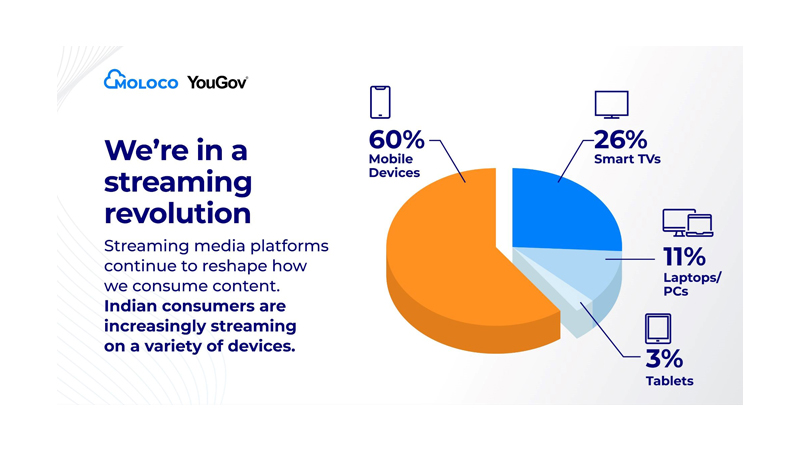
    a.  60 per cent of Indian consumers report that a mobile phone is the device most commonly used for personal streaming, compared with 26 per cent for Smart TV, 11 per cent for laptops/PCs, and 3 per cent for tablets.

    b.  34 per cent of Indian consumers report that they are cutting the cord with traditional TV services; an additional 27 per cent are considering it but have yet to do so.

    c.  66 per cent of Indian consumers would choose lower fees in exchange for watching ads.

    2.  Consumers report clear preferences for ad formats that enhance the viewing experience.

    1. 44 per cent of Indian consumers believe that ads that are interesting and relevant enhance the viewing experience.
    2. Pre- and post-roll ads are ranked most acceptable compared with mid-roll and banner or display ads.
    3. Banner or display ads and mid-roll ads are perceived as the most intrusive or disruptive.

    3.  Consumers care about the ads experience. They report that personalized ads are more compelling and more likely to result in a favorable response, such as a purchase.

    a. 41 per cent of Indian consumers have canceled a subscription specifically because of the ads experience.

    b. The majority of consumers in India prefer personalized ads, with 78 per cent indicating a preference. Of the 78 per cent total, 48 per cent prefer personalized ads based on viewing habits alone and 30 per cent prefer personalized ads based on viewing habits and personal data.

    c. Ads on streaming platforms are influential in the decision-making process for product or service purchases with 83 per cent reporting some level of influence.

    “The ads experience is clearly important, especially with consumers not just adjusting to ads on streaming media platforms but embracing ads,” said YouGov senior research manager Vanessa Khoo. “In addition, this research showed that consumers find ads compelling and influential in their overall decision-making process for product purchases. This study also showed that personalized ads can actually enhance the overall viewing experience.”

    Methodology:

    This survey was conducted online in India by YouGov focused on consumers who watch video content at least once a month, including streaming content. 1,005 respondents participated in the 10-minute online survey from 19 January 2024 – 5 February 2024.

  • Havas Media Network India fuels innovation with pioneering research through latest whitepaper

    Havas Media Network India fuels innovation with pioneering research through latest whitepaper

    Mumbai: In a resounding declaration of intent, Havas Media Network India, the media arm of Havas India, has embarked on a relentless quest to craft innovative and meaningful intellectual properties (IPs) that resonate powerfully with brands and marketers navigating the ever-evolving advertising industry. This whitepaper marks a pivotal milestone in understanding the evolving Indian e-commerce landscape.

    At the vanguard of this mission stands its latest and extremely timely whitepaper – ‘Shaping Consumer Experiences: How India Buys & How Tech is Shaping E-Commerce Adoption & Experience.’ This whitepaper is an uncharted expedition into the heart of India’s e-commerce realm, where seismic technological innovations forge its destiny. The report is launched at a time when India is taking valiant strides in the retail and ecommerce sector which is likely to touch $2 trillion in the next decade (source BCG*).

    In an era of rapid digital transformation, where technology and e-commerce are central to consumer shopping behaviour, this whitepaper delves into the catalytic role of technologies such as immersive AR/VR, AI-driven chatbots, Web 3.0, and ONDC in empowering consumers and driving business growth.

    This whitepaper was unveiled at the 12th edition of TiE Delhi-NCR’s Internet Day 2023 (iDay 2023), an initiative dedicated to fostering an ecosystem of technopreneurs and investors, bringing together industry-leading tech visionaries.

    Conducted in collaboration with YouGov and NFX across 10 key markets, this research prioritizes the preferences of online shoppers and tech enthusiasts aged 18 to 45 years. Data collection employed a hybrid approach, encompassing computer aided web interviews and focused group discussions alongside personal interviews.

    The study offers a profound analysis of how Indian consumers are reshaping the e-commerce landscape and how technology serves as the driving force behind this transformation. It sheds light on evolving consumer behaviour patterns, preferences, and expectations, emphasizing technology’s pivotal role in shaping these experiences.

    With the proliferation of smartphones, accessible internet connectivity, and innovative digital platforms, e-commerce in India has witnessed an unprecedented surge. These factors not only fuel online shopping adoption but also redefine consumer interactions with brands, purchase decisions, and post-purchase experiences.

    Key Insights – What can brands do to enhance customer experience in an ever-evolving digital landscape:

    Tier-Based Shopping Patterns: The whitepaper uncovers distinct shopping behaviours across different city tiers in India. Urban areas prioritize convenience and variety, while smaller towns emphasize affordability and value. Brands are encouraged to tailor their marketing strategies to cater to these unique preferences.

    Rise of Social Commerce: Instagram and Facebook now play a pivotal role in brand discovery and engagement. Peer and influencer-generated content drive shopping decisions, effectively turning social media into a direct shopping platform. Brands are urged to harness this trend for enhanced credibility, trust, and engagement.

    Elevated Role of Direct-to-Consumer Brands (D2C): D2C brands are gaining momentum, particularly among younger consumers. Their authentic narratives and personalized products are capturing interest. Established brands should consider collaboration with D2C brands to align with evolving consumer choices.

    Technological Empowerment & Convenience: Technology is revolutionizing shopping by providing convenience and empowerment. Features like chatbots, voice assistants, and AR offer seamless assistance, immersive experiences, and instant information. Brands that effectively integrate these technologies can elevate customer experiences and foster brand loyalty.

    Commenting on the report, Havas Media Network India CEO Mohit Joshi said, “The findings of this whitepaper emphasize the transformative power of technology in reshaping the retail landscape in India. As consumers embrace the convenience and possibilities offered by e-commerce, businesses must adapt to these changing dynamics. At Havas, we recognize the significance of these trends and remain committed to innovating strategies that bridge the gap between businesses and tech-savvy consumers. Our data-driven approach enables us to create resonant and meaningful connections, ensuring that brands thrive in this evolving business environment.”

    Havas Media India, chief strategy officer Sanchita Roy added, “Understanding the nuances of consumer behaviour at various city tiers is pivotal for brands to connect meaningfully with their audiences. The insights from this study underline the importance of localized strategies that align with distinct preferences. As the retail landscape evolves, customization of marketing approaches becomes a powerful tool for capturing consumer loyalty and driving growth.”

  • Celebrity-owned beauty brands trump endorsements by celebrities

    Celebrity-owned beauty brands trump endorsements by celebrities

    Mumbai: Latest data from YouGov shows that celebrity beauty brands are popular among people and more than three in five urban Indian consumers (62 per cent) say they have ever tried a beauty brand (skin, hair, nail, or makeup) owned by a celebrity.

    Among the various generations, millennials were most likely to say they have ever tried celebrity beauty brands (69 per cent).

    When it comes to trust, slightly over a fifth of urban Indians (22 per cent) said they trust celebrities with beauty brand endorsements, while a slightly higher percentage (28 per cent) trust them with advocacy of beauty brands owned by them. However, a large proportion (45 per cent) does not trust them with any kind of beauty endorsements- for self-owned or other brands.

    The data shows that consumers seem divided on their opinion of a celebrity’s influence on their purchase decision. A third say they are more likely to buy from a beauty brand endorsed by a celebrity (32 per cent), and another third disagree with this view (33 per cent). But when a brand is owned by a celebrity, they are more likely than unlikely to buy it.

    Interestingly, when it comes to comparison with influencers, consumers are more likely to say they trust influencers over celebrities for product recommendations (38 per cent vs 27 per cent). However, when the comparison is with Hollywood celebrities, urban Indians are more likely to trust Indian celebrities.

    Among those who have tried celebrity-owned beauty brands, 27 per cent claim they have had a bad experience but 45 per cent have not. The high price of products was the biggest reason for a sour experience with celeb brands (68 per cent), followed by poor quality products (38 per cent) and misleading information or false claims (28 per cent).

    When it comes to awareness of celebrities that own beauty brands, Deepika Padukone leads the table, with over a third of urban Indians (34 per cent) saying they are aware of her owning a beauty brand.

    Katrina Kaif and Priyanka Chopra follow in second (at 32 per cent) and third (30 per cent).

    On the trust barometer, Katrina Kaif comes on top, with almost a quarter saying they trust her (23 per cent). Deepika Padukone is a close second (at 22 per cent). One in five trust Hritik Roshan (20 per cent), and just as many (19 per cent) claim they trust Priyanka Chopra.

    It is interesting to see Hritik Roshan score high on awareness and trust in an industry dominated by women.

    Even though Alia Bhatt and Anushka Sharma do not own any beauty brands, people associate them with this category and a sizeable proportion trusts them with recommendations, a great advantage should they want to start their own line.

    Methodology: YouGov Surveys: Serviced provides quick survey results from nationally representative or targeted audiences in multiple markets. This data is based on a survey of adults aged above 18 years in India with a sample size of 1005 respondents. The survey was conducted online in August 2023.

  • YouTube dethrones Google, tops YouGov’s Best Brand Rankings 2022 in India

    YouTube dethrones Google, tops YouGov’s Best Brand Rankings 2022 in India

    Mumbai: Global tech giant YouTube has dethroned Google to top YouGov’s 2022 Best Brand Rankings in India, recording an increase of +2.5 to its year-on-year brand health score.

    YouGov’s latest rankings reveal the top ten brands in terms of overall brand health, according to urban Indians. The rankings are based on the index score from YouGov BrandIndex, which is a measure of overall brand health that indicates how well a brand is delivering on its brand promise on key attributes and is calculated by taking the average of the impression, quality, value, satisfaction, recommend and reputation scores collected in BrandIndex.

    Google moves down one spot to second (with a score of 54.9), and WhatsApp moves up to third (53.9) with a considerable increase in its year-on-year score.

    E-commerce giant Amazon moved down one spot to fourth, but its video-on-demand platform, Amazon Prime, moved off the list this year. Flipkart enhanced its brand perception over the past year but moved down three places in the 2022 rankings, to ninth (40.8).

    This year, many new brands make up the top ten list. Amul is fifth on the list with a score of 49.5. Tanishq follows in the sixth (42.2), Cadbury Dairy Milk in the seventh (41.3), and Dettol Disinfectant in the eighth (40.9). Zomato rounds up the top ten in tenth (40.0).

    The rankings also show the brands that have improved the most over the past 12 months. Air India is the most improved brand of the year, with a change in score of +7.1.

    Telegram is the second-best mover with a change in score of +5.2, along with other social media platforms such as Instagram (change in score +3.9) and WhatsApp (+3.5).

    Smartphone brands like Realme (+4.0) and global electronics company Apple (+3.4) appear in the list of improvers.

    Myntra (+3.3), Booking.com (3.0), Tata Motors (+2.8), and Flipkart (+2.7) are other brands to appear in India’s 2022 top ten improvers list.

  • Media experts are concerned about changing policies impacting their digital media buys: Report

    Media experts are concerned about changing policies impacting their digital media buys: Report

    Mumbai: Integral Ad Science (IAS), in collaboration with YouGov and a market research firm, has released its report ‘2022 Future of Privacy-First Advertising.’

    IAS surveyed 346 digital media experts and 1,131 consumers about their opinions on the future of ad targeting, upcoming changes to online data and privacy policies, and how media quality solutions can help marketers be more effective.

    The findings revealed that consumers have serious concerns about the security of their personal information when using the internet; that they are unaware of the laws governing the collection and use of their personal data; and that they are very uncomfortable when their online activity is used for advertising.

    IAS Global chief commercial officer Yannis Dosios said, “With upcoming online data and privacy policy changes coming down the pipe, privacy continues to be a priority for both consumers and media experts.”

    He further added, “IAS is well-suited to help ease the concerns of privacy policy transitions through our contextual targeting solutions that will help advertisers reach their ideal audience at scale, all while respecting their privacy.”

    The report explores a gap between what organisations are actually doing to deal with these changes and how crucial it is for media professionals to understand data privacy policies, as well as how concerned they are about how these policies will affect their work.

    The report also examines how brands are currently dealing with cookie depreciation through contextual, privacy-first advertising strategies that don’t use individuals’ personal information to target customers.

    Online data privacy 

    One of the report’s key findings was that while consumers value online data privacy, their trust in the security of their online data is low.

    While consumers agree that data privacy is important, only half (50 per cent) are confident in the security of their online data while surfing the web. More than two-thirds (67 per cent) of consumers also claim to be more cautious than ever when it comes to their privacy and online data.

    Targeting techniques 

    The study also discovered that consumers are aware of various targeting techniques. However, they might feel uncomfortable with their data being used for advertising.

    Although the majority of consumers (68 per cent) are still uncomfortable with personalisation, despite the fact that 90 per cent (nine in ten) of users are aware that websites and apps collect and share their data for advertising purposes.

    Brands have the chance to change the targeted ad experience so that contextual relevance is the driving factor. This would result in a better user experience for consumers and better results for advertisers.

    Privacy policy 

    Although the majority of media experts are concerned about evolving privacy policies, many are unaware of them and the majority lack a clear management strategy.

    Almost two-thirds (62 per cent) of media experts concur that this year it is important to understand data privacy, and an overwhelming majority (89 per cent) say that brands are particularly concerned about PII privacy.

    However, only about half of digital media experts are knowledgeable about privacy policy-related topics pertaining to browsers (53 per cent), regulations (51 per cent) or mobile identifiers (45 per cent).

    Furthermore, only 36 per cent of media experts claimed that their company had set up a team to handle upcoming policy changes, while 29 per cent said that they had taken no action.

    Contextual content

    The report suggested that brands should match their advertisements with contextually relevant content that appeals to consumers more.

    After seeing a targeted advertisement, 66 per cent of consumers said they are likely to visit a brand’s or product’s website.

    Considering consumers’ privacy concerns and desire for relevance, contextual targeting is an easy option for advertisers, but only 29 per cent of media experts have used this tactic.

    The majority of media experts (51 per cent) concur that ad buyers and sellers must actively cooperate throughout privacy changes and that media quality solutions will become more crucial for ensuring the right audiences are reached.

  • IPL engagement on digital is higher than TV: Report

    IPL engagement on digital is higher than TV: Report

    Mumbai: Over the years, The Indian Premier League (IPL) has become one of the biggest and most sought-after platforms to drive brand building and engagement. This year, the cricket extravaganza sees a 20 per cent jump over 2021 with 41 per cent fans saying that they will watch each and every match, according to the findings of Pre-IPL Trends Report, released by Havas Media Group India’s Hi-Cricket. The study revealed that while IPL continues to be a TV-first property, viewers on digital have higher involvement compared to TV.

    The league continues to have avid viewers who are engaged with the game at all levels, says the study, with 41 per cent stating they will watch each and every match, 47 per cent following stats closely, and 55 per cent actively participating on social media with posts, comments, match analytics.

    Some of the other significant pre-findings of IPL 2022 released by the study include: Over the years female viewership of the game has only increased. 36 per cent stated they will watch each and every match, while 44 per cent stated they watch matches wherein their favourite player/team is playing.

    The study found that IPL is an emotion shared with family and friends, with 54 per cent stating they watch it with the entire family while 44 per cent watch it with friends and colleagues. ‘Powerplay’ and ‘Death Overs’ are the most popular segments. The study also reveals that Fantasy leagues are gaining popularity, with 31 per cent respondents having created their own team in 2021.  

    Havas Media Group India partnered with YouGov, a global research & analytics agency, for its annual syndicated Hi-Cricket study, that helps advertisers measure the impact of their ads during the cricket event. 

    The Hi-Cricket 2022 study is being conducted across key markets in India – Mumbai, Delhi NCR, Kolkata, Chennai, Bangalore, Hyderabad, Jaipur, Pune, Ahmedabad, Lucknow and Chandigarh. 2700+ respondents are being interviewed using a structured quantitative research questionnaire over three waves – before the event (Pre-IPL wave), during the event (first wave – 30d post start) and post the event. The sampling frame will constitute YouGov’s online panel of 200,000 active respondents encompassing top four metros and seven top tier-1 cities. The sample size is two lakhs, as per the statement.

    Hi-Cricket 2022 aims to help brands to further bolster their meaningful connect with consumers and also identify the most meaningful campaigns during IPL. Over the multiple waves that were covered, there has also been a significant jump in brand recall and familiarity across various categories like auto, e-commerce, food delivery etc. Over the course of IPL, making this study an indicator of brand health.

    Hi-Cricket is the flagship property of Havas Sports & Entertainment and going forward, this study will cover other sports leagues with the number of cities covered and respondent base being much larger, according to Havas Media Group India. The study is critical for the group to understand the sentiments and performance of IPL in influencing brand metrics as several of its key clients are part of the tournament through various associations.

    Every year, Havas Media Group India commissions the Hi-Cricket study to understand the overall sentiments regarding the tournament and each of its elements including delivery, driving engagement for consumers, and creating unique brand experiences. This study captures all that brands are doing including on-ground sponsorships, innovations, exclusive tie-ups and so on, to understand which element drives highest engagement/ROI for them. 

    “The recent study tracks the impact of IPL 2022 on brand metrics in the endemic world as people have finally come out of isolation,” said Havas Media Group India head of strategy Sanchita Roy. “IPL is all about community building and enjoying the sports league with family and friends, so sentiments surrounding it are undoubtedly high. Involvement with IPL goes far beyond the actual matches as there are peripheral properties including fantasy leagues and gaming that ensure high engagement of viewers thereby making it the best choice for brands to connect with the audience. This makes Hi-Cricket a real time solution that consistently and accurately measures and monitors brand trends based on key indicators. It helps us identify the most meaningful brands and drive meaningful conversations with our clients as we help them understand the overall impact of their association with the IPL.”

    This recent study comes at a time when the economy is expected to make the most robust recovery on the back of buoyant market sentiments as the Board of Control for Cricket in India’s (BCCI) IPL is all set to take the centre stage in the endemic world. The study helps establish the efficacy of IPL as a platform when it comes to influencing mind measures and also answers one of the most critical questions that advertisers have today: the role of premium buys on brand health.

    “The Hi-Cricket research that YouGov India conducts annually in partnership with Havas Media Group India has become one of the most pivotal research exercises for us,” stated YouGov India general manager Deepa Bhatia. “Hi-Cricket provides an in-depth, customised look into the coveted Indian Premier League (IPL) as an advertising and sponsorship vehicle and is an invaluable tool for brands and marketers to understand how the tournament delivers on their marketing objectives. This is critical given the exponential growth in investment that’s pumped into this cricketing extravaganza by brands, which has in fact made the IPL the biggest platform to create long-term brand image and value. IPL 2022 is coming back with it’s first season in an endemic world. This study is designed to deliver valuable insights into a post-Covid world, within Havas’ Meaningful Brands framework.” 

  • E-commerce dominates IPL 2021, followed by durables & auto industries: Report

    E-commerce dominates IPL 2021, followed by durables & auto industries: Report

    Mumbai: E-commerce brands were the biggest spenders before and during the IPL, with Vivo and Amazon Prime at the top of the recall hierarchy given their high media spends on the tournament. This was followed by the durables & automobile industries, according to the ‘Hi-Cricket’ study commissioned by Havas Media Group India and YouGov. 

    The research which was conducted between 2 April and 7 May during the first leg of IPL 2021, encompasses 4500 online respondents across ten cities in India and gives a deeper understanding of how a larger-than-life platform like the IPL helps move mind measures. The findings of the second phase of the study identify the most meaningful and impactful brands and categories of IPL 2021. 

    The study revealed that food delivery brands like Swiggy had a high recall, with close to 80 per cent of respondents having ordered food online at least once during the match time. Dream11 was the highest recalled main sponsor, followed by Byju’s and PhonePe, as per the study.

    An increase in the number of fantasy gaming apps was observed during the IPL, however, the majority used it for playing fantasy cricket only. The overall impressions went up by 15 per cent in the first week of the IPL which dropped back to similar levels during the last week of the IPL. The study said that defending champions Mumbai Indians emerged as the favourite team at the onset of the IPL, followed by RCB and CSK.

    “One of the pertinent questions that clients ask is the business outcome of high-impact properties. At Havas, keeping in line with our ‘Meaningful Brands’ philosophy, we wanted to understand the effect that IPL has on driving meaningfulness for brands across key high spending categories,” said Havas Media Group India head of strategy Sanchita Roy. “Across all the brands that we tracked as part of this study, interestingly we saw positive shifts across every stage of the consumer funnel when we compare the pre vs during tournament numbers. Personal parameters like value for money & convenience and collective perceptions of trust & respect saw the highest increase across brands.”

    Almost all the top brands saw an increased association with personal and collective benefits, said the study. Automobile brands such as Hyundai, Renault, and Kia witnessed an increased loyalty conversion. Durable brands such as Voltas, Signify (Philips) and Havells also managed to increase loyalty conversions.

    Havas Media Group India president and national head of investments R Venkatasubramanian said IPL 2021 will be bigger for advertisers than last year along with an estimated 20-25 per cent increase in ad spends over 2020. “The second phase of IPL 2021 is going to be equally big or supersede the first phase in terms of ratings and revenue. The entry cost is relatively very less considering it’s a high-impact property that is coinciding with the festival period once again,” he said.

    “Star Sports has renewed and signed five co-presenting sponsors and ten associate sponsors for the second phase of the IPL which includes categories like e-commerce, gaming, online education, telecom, FMCG and several others. The inventory is almost sold out,” he added.

  • Havas Media Group launches study to understand IPL’s impact on brand health

    Havas Media Group launches study to understand IPL’s impact on brand health

    Havas Sports and Entertainment, which functions under Havas Media Group, in association with YouGov has launched Hi-CRICKET, a proprietary study to understand the impact of the Indian Premier League (IPL) 2021 in influencing brand health metrics across categories.

    The study, led by the Havas Insight team, has respondents from key cities in India to get a deeper understanding of how a larger-than-life platform such as IPL helps influence mind measures. HI-CRICKET will also answer the role of premium media buys in impacting brand health, one of the most critical questions raised by advertisers today.

    The respondents will be interviewed over five phases from 1 April 2021 to 1 June 2021 during IPL 2021. Each phase will track the impact of the game on brand health and capture shifts along with attributes that drive Meaningfulness as the league progresses. 

    Keeping in line with Havas Group’s Meaningful Brands philosophy, HI-CRICKET 2021 will help brands to further bolster their meaningful connect with consumers and will also identify the most meaningful campaigns during IPL this year. Havas’ Meaningful Brands framework constitutes of benefits brands offer across Functional (What does the product or service deliver?), Personal (How brands improve people's lives?) and Collective parameters (What’s their role in society?). Previous studies had suggested that all these benefits collectively drove brand performance. 

    Havas Media Group India CEO Mohit Joshi said that HI-CRICKET will help advertisers understand the overall impact of their association with IPL. 

    "This study will help advertisers understand the overall impact of their association with IPL. HI-CRICKET is the first initiative by Havas Insights and Havas Sports and Entertainment; we also intend to take the partnership into other sporting domains such as the Olympics, Hockey, Football, and Kabaddi," said Joshi. 

    YouGov India general manager Deepa Bhatia said, "Sports assets have impacted the recall of brands globally. YouGov panel constitutes data of 2 lakh active panel respondents who have participated in various surveys. During the IPL season, YouGov will consistently reach out to people who watch IPL to set up the study. Using Havas’ Meaningful attributes, the customized HI-CRICKET study will help us understand what drives meaningfulness for brands and to what extent are campaigns able to drive perceptions for brands based on functional, personal, and collective benefits."

  • After NTO implementation, Indians ditching TV for OTT: survey

    After NTO implementation, Indians ditching TV for OTT: survey

    MUMBAI: People are migrating to online media for content after Telecom Regulatory of India (TRAI) came up with the New Tariff Order (NTO), says a survey. According to a research done by YouGov, around half of Indian DTH subscribers (48 per cent) said the amount of time they spend watching original online content (on Netflix, Amazon Prime, Hotstar, etc.) has increased after the implementation of the TRAI tariff order last year. Almost as many (42 per cent) said the same for time spent watching television content digitally.

    The latest findings seem to validate its previous survey done in 2019. As per that survey, when the order was first passed, half of the 1020 respondents (49 per cent) indicated their inclination to spend more time online watching original content as a result of this amendment.

    TRAI is all set to implement the proposed NTO 2.0 starting 1 March 2020. Though the regulatory body argues that the new tariff order has benefitted the end consumer, the reality seems to be different.

    As per the earlier order, users were to choose channels they liked and pay standardised rates for only those they watch. Although this move was meant to enhance the customer’s television viewing experience, people did not seem too happy with its execution.

    The TRAI guidelines seem to have adversely impacted the business of television and 43 per cent said their TV-viewing time has decreased in the last year.

    Furthermore, one in six (16 per cent) claimed to have unsubscribed from a DTH connection or network because of the TRAI rule, and one in five (21 per cent) have unsubscribed and moved entirely online for content.

    Men were more likely than women to disconnect their cable connection (19 per cent vs 13 per cent) while the youngest generation, GenZ, were more likely than the rest to not just unsubscribe but migrate online as well (26 per cent).

    NTO 2.0 is likely to make subscriptions affordable by offering consumers 200 channels with the base slab of Rs 130 as opposed to 100 channels offered earlier. The data shows that the majority of respondents (60 per cent) favour the revised order, 14 per cent disapprove of it and 26 per cent have no view in this regard.

    Support could be due to the fact that people positively perceive this change and more than half (56 per cent) feel it will empower them to choose the channels they like. Although people largely support it, many (36 per cent) feel the new amendment will confuse consumers by giving them too many options to choose from.

    Following the introduction of the TRAI regulatory framework last year, 40 per cent TV-viewers selected channels individually and paid for each, 37 per cent bought a bundle pack and 23 per cent opted for free-to-air channels with few additions.

    The ones who bought a bundle pack were more likely to say they paid more than they used to earlier as compared to the ones who selected channels individually or kept all free channels- who instead were more likely to say they paid lesser than before (29 per cent and 30 per cent, respectively).

    If the new TRAI rule comes into force, most people (38 per cent) are still likely to individually select channels. The proportion of people wanting to buy a bundle pack as well as keep free channels is similar, at 31 per cent each, suggesting that people are equally receptive to each of the offerings.

    YouGov India general manager Deepa Bhatia said: “YouGov’s survey last year rightly predicted the likely impact of the new regulation on consumer viewership. The latest findings validate this prediction. The new order is likely to disrupt the business further and hence it is even more important for advertisers to study the changing consumer needs and behaviour and reallocate their media budgets accordingly.”