Tag: Yatin Gupta

  • Orange Alert as Media Chiefs Call Time on Sour Regulation

    Orange Alert as Media Chiefs Call Time on Sour Regulation

    MUMBAI: When your brightest industry minds start comparing creativity to citrus fruit, you know the discussion’s got some zest. At FICCI FRAMES 2025, the session titled “Regulating the Orange Economy: Past, Present, and Future” turned into a spirited masterclass on what’s holding back India’s most vibrant export creativity itself.

    Moderated by Koan Advisory’s Vivan Sharan, the panel brought together some of the sharpest voices in Indian broadcasting Avinash Pandey (CEO, Indian Broadcasting and Digital Foundation), Krishnan Kutty, head of cluster, Entertainment (South) – JioStar, Anil Malhotra (COO, Zee Media), and Yatin Gupta (COO, GTPL Hathway). Together, they dissected the bitter-sweet evolution of India’s media and entertainment (M&E) industry from its liberalisation glory days to today’s tangled web of red tape and regulation.

    Avinash Pandey kicked things off with a nostalgic rewind. “We were declared an industry in 1996, and for a brief while, we were actually treated like one,” he said dryly, drawing laughter from the crowd. He recounted how the early 2000s saw broadcasting boom as a sunrise sector driven by investment, private innovation, and minimal interference.

    “Then came a time when the government helped us grow,” he continued. “But today, every little aspect from pricing to packaging is regulated. We are living under a 2005 framework in a 2025 economy.”

    Pandey’s lament set the tone. The orange economy shorthand for industries fuelled by creativity and culture has turned ripe, but over-regulation, panelists warned, risks turning it sour.

    Krishnan Kutty of JioStar took the baton, calling for “a lighter hand and a smarter head” in policymaking. He drew a sharp comparison between legacy broadcasters and digital-first platforms. “Television is capped, controlled, and scrutinised. OTT platforms, meanwhile, stream what they want with almost no oversight,” he said.

    Kutty argued that the answer isn’t to regulate the new, but to liberate the old. “Over-prescription kills innovation. Consumers don’t need protection from choice they need access to more of it.” His words echoed across an audience that included broadcasters, policymakers, and streaming executives all trying to decode the new power balance between screens.

    Anil Malhotra from Zee Media added historical perspective and a dose of irony. “Cable TV arrived in India in 1985. It was regulated only in 1995. Broadcasting began in 2005, got regulated much later,” he said. “Regulation always comes late to the party and then overstays its welcome.”

    Malhotra argued that in a digital-first world, it makes no sense to hold traditional media hostage to older rulebooks. “If the government doesn’t regulate new tech like OTT and AI, it must deregulate the old. Otherwise, you’re penalising the legacy systems that built India’s media strength in the first place.”

    He also called for a “policy audit,” a comprehensive review of old broadcasting rules to identify those that have outlived their relevance. “We need regulation that enables, not restricts,” he stressed.

    GTPL Hathway’s Yatin Gupta brought the discussion closer to ground reality and homes still running on coaxial cables. “We’re the most regulated part of the media chain,” he said bluntly. “Every rate, every fee, every package is dictated. Yet, we’re expected to compete with digital platforms that face no such limits.”

    Gupta pointed out that India’s cable homes have dropped from 150 million a few years ago to around 100 million today, a staggering 30 per cent loss in a market still hungry for affordable entertainment. “We can’t evolve if we’re boxed in,” he added. “If the aim is to take India fully digital, we must support the legacy infrastructure that connects Bharat to the world.”

    He called for skill development, broadband integration, and hybrid models that let cable operators transform into full-fledged digital service providers. “If we don’t, we’ll end up with an uneven playing field and an excluded audience.”

    By the time Avinash Pandey took the mic again, his tone had sharpened. “Regulators talk about ‘orderly growth’,” he said with a knowing smile. “That’s a Soviet-era phrase. You can’t dictate how creativity grows, it defeats the very nature of innovation.”

    He urged policymakers to think of the media sector as a living organism, one that thrives on unpredictability. “Creativity doesn’t follow command-and-control models. It needs chaos, experimentation, and freedom to fail.”

    The audience broke into applause when he declared, “If you want free markets, let the market breathe.”

    Despite the fiery debate, the panel didn’t write television off. Far from it. “TV still delivers high-quality entertainment at the lowest cost per viewer,” Pandey noted. “There are over 100 million Indians yet to own a television. Growth is far from over but it will stall if innovation is strangled.”

    The panellists agreed that the future of India’s media sector lies in convergence television and digital not competing, but coexisting. With global streamers investing heavily in Indian stories and regional content booming across states, the creative economy stands at a crossroads.

    As the discussion wound down, what emerged was less of a gripe and more of a roadmap: deregulate the old, modernise the law, empower talent, and let creativity not bureaucracy set the tone.

    In a nation bursting with storytellers, artists, and innovators, the message was clear: the Orange Economy shouldn’t be juiced dry by rules made for an analogue age.

    If India truly wants to be a global creative powerhouse exporting not just IT services but imagination, it must give its creators the same freedom its coders enjoy. Or as one delegate quipped while leaving the hall, “You can’t make lemonade with red tape.”


  • VBS 2024: The OTT Aggregation game

    VBS 2024: The OTT Aggregation game

    Mumbai: India is in the grips of seisnic changes regarding video and broadband consumption. Pay TV cord-cutting is rampant even as free TV subscriptions are on the rise and OTT buy-ins are churning with the signs up for certain platforms stagnating even as others are seeing rapid increases and some are seeing cataclysmic drops. 

    Aggregators of OTTs are popping up on the horizon promising cheap bundles along with value-added services for cable TV and DTH. There’s a rush to set up free advertising-supported TV channels by TV set manufacturers and smart TV device makers. There’s the Jio factor where it seeks to convert most pay TV customers to free streaming of video content by offering free access to consumers at no cost. The consumer continues to demand bandwidth higher than ever imagined even as prices drop. Margins are under pressure as every player goes one-up on each other to acquire and retain customers.

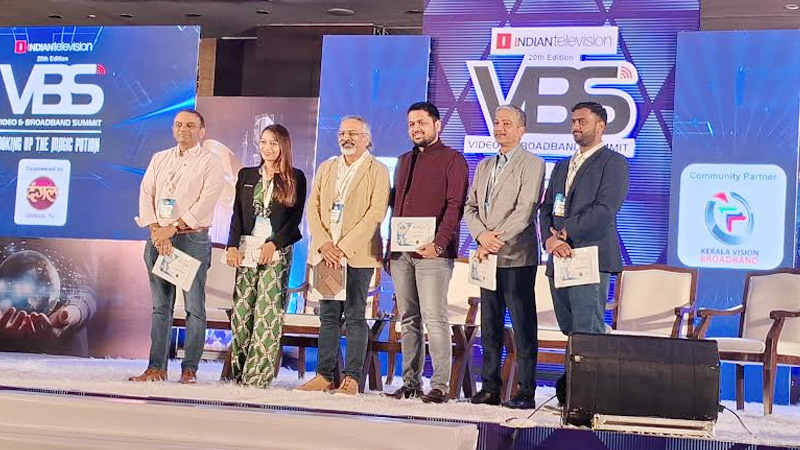
    The video and broadband distribution landscape has not been as vibrant as it is now.. How long will this pot-boiling continue? What will the magic potion of video and broadband look and taste like? And what’s the end game? Indiantelevision.com has held the 20th edition of Video and Broadband Summit better known as VBS at Sahara Star Hotel, Mumbai.

    The session chair for this panel was media consultant Anuj Gandhi along with the panelists: Arha Media & Broadcasting CEO Ravikant Sabnavis, GTPL Hathway Ltd senior VP Yatin Gupta, Dangal Play head Akshat Singhal, Playbox TV founder & CEO Aamir Mulani and OTT-Chana Jor, VHunt Digital Media COO Archita Jasani

    To light up the atmosphere, Gandhi asked the audience how many hours on average people spend on their mobile phones. He also dropped another question while spending time looking at phones, how much time is spent on watching SVOD OTT? The response was quite positive as an overwhelming number of people in the audience watched content on their mobile phones for a longer duration.

    As there was a considerable amount of audience who watched other lots of content besides OTT, Gandhi asked a broader question to all the panelists, “There is a belief and everybody says that aggregation is what went above consecutive recession, people said people subscribed to two and a half entities, but individual OTS there is a belief that beyond the point from D to C perspective or direct to consumer, you cannot cross the customer acquisition costs. There is another cost that is there.

    Sabnavis said, “If I look at it from the consumer perspective, Most perspective, there’s a lot of entertainment. Right? Be it a YouTube video, or simply chatting with somebody on the phone. I’m probably oversimplifying to make the point. There are limits to my time when whether it be five hours or three hours and in that time, I’m trying to watch OTTs as well, besides doing whatever I am for entertainment. So therefore you’re possibly right that there comes a time when growth when you look at it from our perspective around the consumer’s approach slows down. They’re gonna find it increasingly difficult to a) reach out to consumers and b) convince them to subscribe to a platform.”

    Jasani said, “There is a stagnation which is happening especially in metro cities. When we see that people, there is a capacity on how many hours can be on the mobile phones. Beyond that, I feel a lot of growth that can happen in tier-two and tier-three cities. Because these are the consumers who are town-tasting in the OTT  and entertainment segments. So here we see that there is a glass ceiling, probably happening towards the metros, but there is a use of potentiality in tier two and tier three cities. So hence the aggregation makes sense in a way that there is a d2c and b2c as well, which helps us to get the hang of the consumers.

    Amir Mulani commented that 90% of the time, consumers know what they want to watch, they will come to search, click the movie, and just start watching it. So I think my responsibility as a platform or as an aggregator, is beyond me to give him something that he wants to, and trying to keep it so easy, that it’s not confusing for them to decide.”

    Singhal said, “Earlier, people used to go to OTT platforms and search for content because the OTT platforms were very messy. Now, with so many OTT platforms, we need to go to the users, and see what they have. So that’s why like it’s important.”

    Gupta opined, “ We already have a cable product, which is an aggregation of channels. We have broadband as a service to augment this along with OTT. Looking at the consumer and saying that from this household. He’s already got cable, he’s already got broadband, and we may be able to give him OTT services as an aggregation.

    Whether it makes economic sense or not, of course, is a big question mark, because the OTT players are expecting a certain amount of guarantees, which may or may not. So we’ve been looking at all of that while deciding whether to go ahead with it and what to do.”

  • VBS 2021: Customer remains king for cable & broadband industry

    VBS 2021: Customer remains king for cable & broadband industry

    NEW DELHI: In the aftermath of Covid2019, businesses and organisations across the world tried to make sense of what hit them as they weighed their futures against the new lessons that the pandemic taught them, unlearning some of the established tenets in the process. Industry experts largely agree that the television broadcasting, video-on-demand (VoD) and broadband ecosystem had it relatively better off with their customers homebound and skyrocketing demands for connectivity and content. However, swift technological evolution and even swifter changes in consumer behaviour and demands posed challenges on this front too.

    And these challenges are what the seventeenth edition of the Video and Broadband Summit attempted to shine a light on. The insightful discussions during the summit rounded off with a session focusing on ‘Customer First’ moderated by PwC India Partner Raman Kalra. The panelists included some eminent names from the industry, such as JioFiber president Anuj Jain, Siti Networks DGM Strategy Anurag Nigam, UCN Cable Network head – operations Debashish Mohanty, GTPL Hathway vice president Yatin Gupta and Shemaroo entertainment COO – broadcasting business Sandeep Gupta.

    Kalra opened the session by commenting about how customers today are spoilt for choice when it comes to choosing content to consume, with mushrooming VoD and OTT platforms and ever increasing channels of entertainment. He noted that despite the demands for content and internet broadband having hit the roof during the pandemic, the challenge of remaining relevant is a concern for both the service and content provider in the highly competitive market today. Kalra posed the question on what strategies can be adopted by the industry players so as to ensure they continue to acquire and retain their customer base, keeping in mind the constantly changing customer demands and behaviour.

    Jain agreed that “customer first is the fundamental pillar” for their business. He stated three crucial points for the same—

    ·       How to enable the “right plan” for the customer to get associated with the brand

    ·       How do you deliver customer onboarding, meeting the promises that you made in the plan

    ·       Third is “in life” wherein after the customer gets activated, your service has to  perform and if not, you must be aware and able to pinpoint where, when and what went wrong through data analytics. To further make his point Jain shared what is referred to as the ‘death of call center’ set-up wherein the business must know about the disruption in service, before the customer breaks it to them.

    Gupta shared insights on the major consumer demand shift in the last twelve-odd months of Covid. “It reflected a huge spike in terms of subscriber base for cable TV which flattened out later. But the broadband business has continued to grow because people are still working from home, kids are still studying from home.”

    In order to deal with the impact of consumers’ pressing demands, altered business strategies had to be deployed, shared Mohanty. “In the present scenario customers have multiple demands- linear TV, OTT Content, online classes, work-from-home- everything he needs from a single desktop or device, sometimes. Basically FTH- Fibre-To-Home is the best solution for connectivity at least for the next few years.”

    He went on to say, “UCN is doing a QOS (quality of service) survey – on what the customer feels about UCN connectivity quality and bandwidth. As of now we are providing 100 Mbps which we have increased to 300 Mbps with unlimited plans,” and added that with increasing consumer demands, if a business today fails to provide a particular service, then someone else will.

    Nigam interjected how nobody could have imagined a year back that the entire India would work from home one day. “All this has forced an average household to stick to the basics, that is focus on the necessities and be frugal for as long as they can,” he said. If this continues for too long, it will impact the industry on multiple levels, whether it’s the broadcaster or a distribution partner.

    Citing an instance from MSO consumer behaviour post lockdown, he shared how consumers had become selective while opting for TV packages. “Consumers have downgraded from high value content package to low value package or they have opted for standard definition (SD) DPO pack and topped it with ala carte HD channels, instead of taking an HD package. Why? Because the pricing of SD was lower than HD, this despite having an HDTV at their disposal.” Even multiple TV households were decreasing and hybrid TVs were getting replaced with OTTs during the lockdown.

    Debashish took the discussion further by adding that lack of “exclusivity” in HD channel content is a major factor, since the customer is getting similar content on SD at a lower price. “So channel packaging needs to be done as per customer requirement,” he remarked. Entry barrier is also due to the higher pricing, as compared to SD. Only if HD content differs and is exclusive can we see real change, was broadly agreed by all.

    Competitiveness has also gotten fiercer, which can adversely impact the revenue of the whole industry in the long run. “Hence it is time that all industry players come up with product differentiation- exploring new customer segments, converting customer service departments into ‘customer experience enhancement’ departments  which can only be achieved if all the stakeholders work together towards a common goal- that’s ensuring customer success,” stated Nigam.

    From a content perspective, Shemaroo’s Sandeep Gupta said, “At Shemaroo, content is evaluated based on customer taste. So content has to keep evolving for, at the end of the day, consumers come to us looking for entertainment. For broadcasting, we look into the research and BARC data.”

    The discussion then steered to customer acquisition and on what are the leading practices being taken by the industry to ensure it. Jio’s Anuj Jain began by admitting they focused more on delivering on customer expectations and less on marketing. He added that fibre being a cherry picking market and more localised, it’s a different challenge altogether.

    When it comes to the cable industry, it is mostly a “one or two sizes fits all” kind of business, admitted GTPL Hathway’s Gupta, with not much being looked into individual customer preferences as long as they get their pack of choice. This situation is slowly changing, the company has begun ‘know your customer’ processes to understand who is the customer first and inform them about the innovative products or services on offer. “We were one of the very few platforms that started a campaign targeted at all DTH players called ‘Chhatri hatao, GTPL lagao’ to remove the Dish and replace with GTPL Hathway subscription, which got a fair amount of response from consumers,” he added.

    Knowing your consumer is a part of the process to enhance consumer experience, which also involves proactively handling tech / troubleshooting issues. “With our one million subscriber base, the total data that is collected from every customer per week is one Petabyte of data- which captures every aspect of the customer experience data- any sync issues, freezing, buffering issues etc. This is how we make customers the focus and part of the process,” explained Jain.

    Factors like user outreach and bettering their experience goes on to ensure customer stickiness. Brands need to be consistent, facilitate continuity, safeguard connectivity of service and target smooth onboarding experience to achieve this goal, suggested the panelists.

    The session concluded by highlighting that there’s a need for businesses to invest deeply in knowing and engaging with their customers. Analysing customers’ content consumption data can also lead to rich dividends and RoI. “Deep data insights and data intelligence can lead to immense possibilities for businesses,” Kalra summed up. In conclusion, enhancing customer service and experience is a key component to the success and growth of every stakeholder in the industry.