Tag: Xaxis

  • Xaxis launches programmatic media commerce solution Discovery Commerce

    Xaxis launches programmatic media commerce solution Discovery Commerce

    Mumbai: GroupM’s outcome media specialist, Xaxis, has launched a new programmatic media commerce solution in India called Discovery Commerce. This helps brands and advertisers navigate the evolving programmatic media commerce ecosystem and drives stronger outcomes from their media investments.

    Discovery Commerce enables advertisers to utilise data signals specifically around product adoptions, search patterns, and purchase patterns, then integrate additional advertising strategies that help drive sales, build brands, and engage customers on e-commerce platforms or brand-owned sites.

    Powered by Xaxis’ programmatic excellence, strong global partnerships, proprietary technology, and tailored data touchpoints, the solution creates a holistic approach to e-commerce performance, driving consumers towards purchase across various platforms and points of sale. Subsequently, the data and insights gathered from the various touchpoints will be used as benchmarks to inform future campaigns and audience planning.

    Xaxis has already onboarded multiple partners into Discovery Commerce, with specialised capabilities around data, inventory, technology, and creativity, including key partnerships with Shopalyst and Flipkart.

    Flipkart VP monetisation Sankalp Mehrotra said, “Commerce advertising today continues to grow faster than any digital channel. Over the years, Flipkart Ads has created solutions that are disruptive, unique, and scalable. Our partnership with Xaxis will unlock the next stage of exponential growth for brands of all sizes. Consumers will benefit from seeing communication that has higher relevance and a more seamless purchase journey.”

    In addition to driving stronger e-commerce performance and building benchmarks for future campaigns, Discovery Commerce helps brands better understand consumer behaviours and create more accurate target audiences by connecting online and offline data points. It can reach multiple online environments, premium publishers, leading marketplaces, and shoppable media ad formats, offering a simplified and consolidated service that unites previously siloed consumer data points.

    Shopalyst co-founder Girish Ramachandra said, “We are happy to partner with Xaxis. With Xaxis’ Discovery Commerce solution, brands can make their ads instantly shoppable and help drive impressions to conversions in one seamless journey for consumers.”

    One way Discovery Commerce uses that data to elevate brand outcomes is through the use of Shoppable Media, a solution powered by Xaxis’ in-house creative and execution shop, Xaxis Creative Studios (XCS). XCS leverages AI to understand real-time consumer behaviours on retailer websites and applies dynamic creative optimisation with data-driven product recommendations based on validated customer preferences. It provides a more convenient way for shoppers to add branded products to their preferred retailer’s basket, removing the need to remember the brand when they are online or in-store. It also significantly shortens the shopping journey for consumers, enabling them to browse, compare, and complete the order without leaving the ad.

    GroupM India president – data, performance and digital products Atique Kazi said, “We believe there could not be a more exciting time to launch this solution as there are so many opportunities for brands and advertisers to capitalise on e-commerce platform growth. From consistent datasets to campaign measurement and optimisation knowhow, there’s various key ingredients when it comes to doing e-commerce advertising right. We are delighted to be working with the likes of Shopalyst and Flipkart – further combined with the behavioural data segments from other partners, we can give our clients a deep understanding of how to leverage data to secure better outcomes.”

  • GroupM APAC senior leadership rejig: Arshan Saha named Nexus APAC CEO

    GroupM APAC senior leadership rejig: Arshan Saha named Nexus APAC CEO

    Mumbai: GroupM, WPP’s media investment group, has unveiled a roster of C-suite appointments in Asia Pacific who will lead the regional transformation of GroupM Nexus – the global performance organisation that unites the network’s performance talent and technologies into one single outfit.

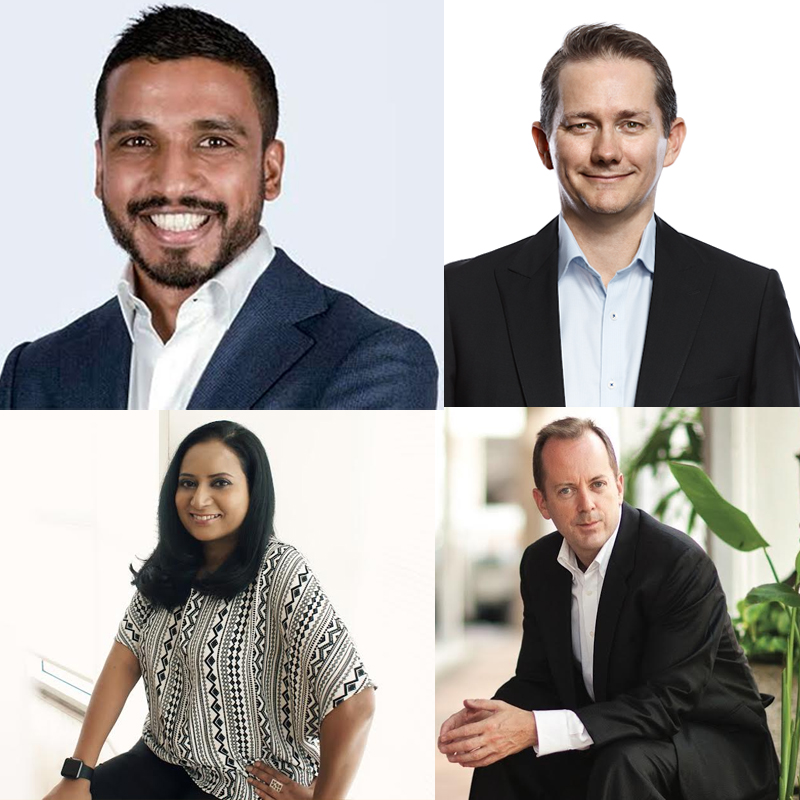
    Arshan Saha, formerly CEO of Xaxis & Specialty Businesses APAC, has been named GroupM Nexus APAC CEO.

    Jon Thurlow has been appointed GroupM Nexus APAC COO; this is an additional appointment to his corporate remit as COO of GroupM APAC.

    Xaxis—GroupM’s outcome-driven programmatic brand—has promoted former Xaxis APAC senior vice president Deepika Nikhilender to the chief executive officer role at Xaxis APAC.

    Completing the Nexus APAC leadership line-up, former managing director of Finecast Australia, Brett Poole, has been appointed the chief executive officer of Finecast APAC & AUNZ.

    Arshan Saha said, “GroupM Nexus is a cross-channel performance-led organisation that unites our expertise in service excellence, AI-technology, and the most advanced solutions. This is the future of marketing, and we are poised to offer our clients and agencies the most powerful performance engine that will accelerate their growth. I’m honoured to be working alongside some of the world’s best specialists at GroupM Nexus to collectively cultivate a better media ecosystem.”

    A founding member of Xaxis APAC, Saha rose through the ranks to become Asia-Pacific CEO of Xaxis & GroupM’s data-driven specialty businesses, including INCA, Finecast, Sightline, and Acceleration. For over a decade, he led the expansion of Xaxis—an A.I. powered programmatic engine—into 16 markets and multiplied its revenue by 20-fold.

    Having orchestrated ad-tech innovation for over 300 brands, large and mid-sized publishers as well as tech vendors across Southeast Asia, Saha was the youngest leader to be voted into the IAB Southeast Asia Leadership Council. He was also the winner of the Best Young Talent Below 30 Award (2012) and a nominee for Campaign Asia’s 40 under 40 Most Talented Individuals in APAC (2015).

    As the chief operating officer of GroupM Nexus APAC, Jon Thurlow will be driving the transformation of Nexus alongside Saha.

    One of the region’s most accomplished practitioners across the breadth of the network’s business, Jon architected the consolidation of GroupM’s search, social, commerce, programmatic, and addressable practices in Asia Pacific. For almost three years, he oversaw the complex integration of inter-network systems and structures across 16 markets into a unified campaign delivery platform.

    Jon Thurlow said, “I’m very excited about the launch of GroupM Nexus across the region. Building on the success of the past years, the expanded service and solutions offering that GroupM Nexus will create represents a wonderful opportunity to deliver genuine market-leading innovation and produce a positive business impact for our clients. For our people, it unlocks new career pathways in data, technology, and practices, giving them immense scope for new learning and development experiences.”

    Armed with over two decades of marketing and data science experience, Deepika Nikhilender steered Xaxis’ A.I. and machine-learning ambitions in the region while leading the design of marketing solutions, supply strategy, trading and operations excellence, as well as ad-tech and platforms strategy.

    Nikhilender said, “I’m thrilled to embark on this exciting challenge to lead Xaxis APAC into new frontiers where we can break new ground for our clients and agencies with our A.I. differentiated initiatives and solutions. With the digital ecosystem evolving at an unparalleled pace, Xaxis’ armoury of data intelligence and outcome-driven technologies will help future-proof our clients’ businesses. Together with the team, I look forward to cultivating a culture where our talents will continue to thrive as well as strengthening Xaxis’ capabilities to achieve our clients’ desired outcomes.”

    With over two decades of experience in product development, tech commercialisation, publishing and advertising platforms, Brett Poole has launched and built profitable businesses across native advertising (plista), data tech (mPLATFORM), programmatic trading (Xaxis), and most recently, television transformation in Australia, where his team grew the Finecast brand to become synonymous with addressable TV and TV innovation.

    On joining this new role, Brett Poole said, “I’m thrilled to be given the opportunity to continue growing Finecast across APAC as part of GroupM Nexus. Television is experiencing tremendous metamorphosis throughout the world and there is huge potential to further our TV transformation efforts in APAC, which is well-known for its diversity, talent, and innovative spirit—all the things that are close to my heart. I look forward to working closely with Nexus APAC leaders to build on the outstanding work of our Finecast APAC team.”

  • GroupM merges Essence and Mediacom, integrates Mindshare with Neo

    GroupM merges Essence and Mediacom, integrates Mindshare with Neo

    Mumbai: WPP’s media investment group GroupM announced on Wednesday its plans to merge Essence with MediaCom and Mindshare with Neo in its latest steps to transform and further simplify its operations. The moves, which build on the April 2021 launch of Choreograph, WPP’s global data and technology company, will create a new 9,000-strong cross-channel performance platform built on AI technology, it said.

    Additionally, Finecast, Xaxis, and GroupM Services – GroupM’s global community of activation experts – will be brought together to form media performance organisation, GroupM Nexus. Xaxis Global CEO Nicolas Bidon will oversee GroupM Nexus as Global CEO.

    Essence and MediaCom will merge to form EssenceMediacom, a new agency offering fusing the digital and data-driven DNA of Essence with MediaCom’s scaled multichannel audience planning and strategic media expertise.

    MediaCom Global CEO Nick Lawson will lead newly formed EssenceMediacom as Global CEO. Kyoko Matsushita, after eight years at Essence, is promoted to a new role as WPP’s CEO in Japan as the company continues to invest in expanding, high-growth markets.

    Mindshare will complete the integration with global performance agency Neo, wherein both will operate under the Mindshare brand but will retain and scale Neo’s operating model, focused on pureplay performance solutions at its heart, integrating this into Mindshare’s full-funnel offering.

    Neo’s 1,200 digital-first, performance experts and consultants will be integrated with Mindshare’s 10,000 media specialists and Neo’s digital-first services will be fully embedded into Mindshare and GroupM’s offering, stated the agency.

    With this reorganisation, GroupM’s five agency brands will be streamlined into Mindshare, Wavemaker, EssenceMediacom, GroupM Nexus and Choreograph.

    “The future of marketing is outcomes-driven, supported by audience-first planning and continually improving, AI-enabled performance standards,” stated GroupM Global CEO Christian Juhl. “Through GroupM Nexus and our agency powerhouses Mindshare, Wavemaker, and EssenceMediacom we are building a tech-enabled future, side-by-side with our clients, that is accountable to advertisers’ growth goals and to our vision for an advertising ecosystem that works for everyone. I also want to congratulate Kyoko, who has grown and strengthened Essence in her time as Global CEO, on her exciting new role as WPP’s CEO in Japan. We will continue to work closely together to strengthen the position of our agencies across APAC.”

    The merger of Essence and MediaCom builds on a record of strong business growth for both agencies, according to the agency. Comvergence ranked MediaCom first in the industry for new business wins in 2021 with $2.87 billion in new billings attributed to wins, while Essence has continued to grow and expand its remit with Google and other key clients.

    “The formation of EssenceMediacom builds on the strong and proven relationship between the agencies to create the agency model our clients want for the future — one founded on brilliant strategy and brand-building capabilities, with pioneering digital expertise running throughout,” said EssenceMediacom CEO Nick Lawson. “EssenceMediacom will not only help our clients see the bigger picture and reimagine what’s possible; it will also provide opportunities for our people to upskill and train in new areas, further enriching and enhancing their careers.”

    “Today’s global marketers need both agility and scale from their agency partners to properly support their businesses across international markets. Bringing together Essence and MediaCom – each with their own celebrated histories of excellence – will create a truly unique combination of agile innovation and global scale in a single agency,” added Kyoko Matsushita.

    GroupM Nexus will comprise 9,000 practitioners around the world, collectively responsible for the activation of more than two million campaigns managed by GroupM each year. This global community represents the industry’s leading team of experts in digital channels and platforms, search, social, programmatic, AI, cross-channel optimization, and data-driven technologies and software.

    GroupM Nexus unites GroupM’s addressable content and TV, AI technology (Copilot), and omnichannel solutions from Finecast, Xaxis, and GroupM Services into a single unit. The global organisation will be underpinned by a new cross-channel performance platform and international delivery hubs to set new benchmarks for performance innovation and efficiency for GroupM’s agencies and clients.

    “GroupM Nexus unites leading media talent, digital services excellence, cutting-edge AI technology and unique scaled partnerships into a new cross-channel performance organisation with one purpose: power growth for our people, our agencies and the amazing brands they represent. We cannot wait to innovate together and unlock new opportunities for everyone,” said GroupM Nexus CEO Nicolas Bidon.

    “This is a journey we’ve been on for the past year with many clients who have been demanding more diverse media services to drive their growth,” commented Mindshare Global CEO Adam Gerhart. “The merger delivers seamless access to Neo’s digital-first capabilities and a relentless focus on performance models to accelerate Good Growth. For our teams it means more opportunity and the ability to create greater impact across the world. I’m delighted to partner with Neo CEO Nasreen Madhany as we complete the integration of the two businesses and move into a new future together.”

  • Xaxis elevates Dimpy Yadav to general manager, India

    Xaxis elevates Dimpy Yadav to general manager, India

    Mumbai: Xaxis, GroupM’s outcome media specialist, on Thursday announced the elevation of Dimpy Yadav as general manager of Xaxis India. She will be based out of Gurugram and will report to GroupM India president of data, performance, and digital products Atique Kazi.

    In this new role, Yadav will be responsible for leading the agency and its clients through India’s rapidly growing digital media landscape. This includes an online retail market that is expected to triple its volume over the next five years, stated the agency.

    According to a statement, she will focus on three main areas of strategic development: Integration, Intelligence, and Innovation. This will include the continued development of advanced, omnichannel digital media solutions optimised with data and artificial intelligence technology to help brands earn valuable business outcomes.

    “In line with global trends, we are dedicated to driving cutting-edge omnichannel solutions powered by seamless integration of data-driven creative solutions that will help brands extract the maximum value from their media investments,” said Yadav. “I’d like to thank Xaxis for having the faith in me and I look forward to helping our clients address the growing complexity of the media landscape and earn real business outcomes.”

    Yadav’s journey with Xaxis began in 2017 as an engagement manager and evolved through several roles; her most recent position was national head for client engagement.

    “Dimpy has a first-rate knowledge of data, integration, and new age media. She has been leading client engagement for Xaxis India proficiently and has driven impactful solutions for our clients,” stated Atique Kazi. “She has always stayed ahead of the curve with her expertise and continuous innovation in client solutions. We are confident that she will play a pivotal role as the lead for Xaxis India.”

  • GroupM elevates Arshan Saha to APAC CEO, Xaxis & specialty businesses

    GroupM elevates Arshan Saha to APAC CEO, Xaxis & specialty businesses

    MUMBAI: WPP’s media investment group, GroupM on Tuesday announced that it has expanded Arshan Saha’s role to CEO of Xaxis & specialty businesses, APAC. Saha’s previous title was CEO of Xaxis APAC and in his new role, will lead GroupM’s data-driven specialty businesses including Xaxis (programmatic), INCA (influencer marketing), finecast (addressable TV), sightline (addressable out-of-home), and acceleration (data & tech consultancy practice).

    The consolidation of leadership for all data-driven specialty businesses for APAC, will ensure GroupM’s continued future-ready innovation and growth. Saha brings his experience in growing and scaling Xaxis across the region to further strengthen GroupM’s data and technology suite of products, said the company in a press statement.

    GroupM, APAC CEO, Ashutosh Srivastava commented, “As part of GroupM’s overall global strategy for growth, we have been investing in launching and growing several data-driven specialty businesses in the region. Apart from Xaxis, we have fast-growing businesses in INCA and finecast, and are on the verge of launching addressable OOH and data & tech consulting. Arshan has shown great product and commercial acumen in growing Xaxis, and we are confident of his success in scaling our performance and digital product offerings across Asia-Pacific.”

    Speaking on his new role, Saha said, “My journey at Xaxis has provided me with the perfect platform to succeed in this role. I am excited to embark on this new challenge, leading a high-growth portfolio of specialty businesses for GroupM in channels that are in high demand from our clients. This consolidation will empower our clients to make media work harder for them while allowing them to easily access GroupM’s digital expertise as a single unit.”

  • Xaxis’ latest ad campaign for Pizza Hut brings about surge in order volume

    Xaxis’ latest ad campaign for Pizza Hut brings about surge in order volume

    New Delhi: Xaxis, GroupM’s Outcome Media Company has announced that its recent voice-activated conversational ad campaign for Pizza Hut India has successfully led to a surge in order volumes and increased the customer engagement by 8.29 per cent over a period of two weeks.

    Xaxis Creative Studios (XCS) had created voice-activated conversational ads, engaging listeners in a dialogue to drive awareness of Pizza Hut’s Buy One Get One (BOGO) offer. The interactive audio content generated over 2,000 responses from 60,000 impressions during a 10-day pilot. XCS accessed advertising inventory on the Gaana music app and used voice-activated artificial intelligence (AI) advertising technology to help handle conversational elements.

    It also ran A/B tests to measure the effect of generic campaign creative elements vs. creative focused on dinnertime. The overall voice-engagement rate saw an 8.29 per cent increase, it stated on Tuesday.

    Pizza Hut India, chief marketing officer, Neha said the brand has been experimenting with innovative marketing formats that resonate with the millennial-minded audience. “I am thrilled to see that our voice-activated BOGO campaign has received such an excellent response. Kudos to the Xaxis team for perfectly conceptualizing and implementing it. I look forward to working with them on many more exciting projects going ahead,” she said.

    Brands have been using audio ads to drive awareness, but typical broadcast methods do not spur as much customer engagement as interactive formats.

    According to GroupM South Asia, CEO, Prasanth Kumar conversational ads are still in the nascent stage in India. “Pizza Hut expressed its openness to leverage the expertise of Xaxis Creative Studios and use two-way conversational audio ads to reach its target audience. With conversational audio ads, there is an opportunity for brands to craft a targeted and personalized customer engagement strategy. The results of this campaign are proof that our insight-driven approach and expertise drive impactful and measurable outcomes for the client,” said Kumar.

  • The challenges and benefits facing martech in India

    The challenges and benefits facing martech in India

    NEW DELHI: Martech sounds like quite a jargonistic word to many. But, put simply, it is the tech stack run by backroom geeks in glasses who use software and web-based services to manage, automate, or execute marketing tasks and processes. Data and analytics lie at the heart of martech, giving companies better customer and market insights, helping them to respond accordingly. 

    Globally, it is a booming business touching Rs 739,200 crore ($121 billion) in 2019, according to a report by advisory and research firm BDO and WARC in conjunction with the University of Bristol. In India, it is coming out of  its infancy  with marketers just about waking up to its utility, though the software development  sector has bitten a sizable piece of the global pie.

    Earlier this year,  WPP group company  Mirum India released its Martech Survey 2020 report, which did not give any indications of the sector’s size and scale, but it revealed that  marketers across India are bullish, with as many as 80 per cent of those surveyed expecting their organisation’s spends on these technologies to increase over the next five years. 

    Xaxis India country lead Bharat Khatri told Indiantelevision.com that there has been a significant rise in the investments that Indian brands and marketers are making in the martech space. “Around one-fourth of the overall marketing pie is being directed towards martech right now and this shift has occurred within the past few years only. Earlier, we were getting a minuscule share in the marketing pie, and it is definitely bound to grow further.” 

    However, according to him, despite growth in adoption, the core challenge for the industry remains that most of the people who are investing in the technologies are not aware of how it is benefiting them. “Around 50 per cent of the marketers today don’t know the exact functions of martech. There is a great need to educate the industry.” 

    Business head of a leading insurance company acknowledges in the Mirum India report that the biggest challenge is that there are too many hands involved in the martech implementation broth, thus leading to delays. “Adding to this is the pressure caused by marketers evaluating solutions only after they identify a specific business need, which leaves them with little time to plan before arriving at a decision,” he adds. He also points out to problems of integrating the martech tools with existing technologies in an organization and the pushback from internal stakeholders towards adopting change. 

    Another issue stifling  the sector’s growth is marketing budgets, which are limited. 
    Khatri explains that martech’s limitation, in the Indian context, is that one cannot instantaneously get to know if the investment being poured into it is worth it.

    “It takes two to three  years to understand the kind of impact the martech tools have had and the ROI. Now, for some marketers, it gets difficult to get the budgets sanctioned, and with a pandemic like Covid-19, when everyone is holding back their budgets, it is creating a big problem,” he says. 

    However, the industry believes that Covid2019 pandemic has certainly opened up newer and exciting opportunities for martech, and it will be wiser for the brands to latch on to it. 

    “COVID2019 has impacted consumer behaviour a lot and accentuated some of the consumer trends too. In the past four months, we have seen how the adoption and usage of online channels have increased,” says Logicserve Digital founder &  CEO Prasad Shejale. “Consumer journeys have changed significantly and have also affected brand loyalty. This is actually a great opportunity, and smart marketers are investing in analytics tools to understand changing customer behaviour.” 

    Adds Khatri:  “What brands are using martech for most is understanding the consumer behaviour and their journeys –  what they like, where and when they shop, etc. This has resulted in marketing being market-driven instead of sales-driven. This has resulted in great demand for technologies like customer data platforms (CDMs), tools for customer relationship management (CRM), and mobile phone data.”

    Shejale agrees: “The most important tools right now are the combination of analytics-insights-CRM/CDP. These tools, along with a focused approach on the consolidation of consumer data to understand them better, are important to provide better service to the consumers across their journeys, whether online or offline. For a smooth and convenient journey across online and offline channels, CRM tools can be very effective. They can also assist in sending the right communication to your audience at the right time through the right channels.” 

    Another interesting trend that is, arguably, impacting the growth of martech in India is global domination in the arena. The Indian industry is currently dotted by a lot of foreign players who have been active in the space for a long time. Khatri suggests that platforms like Salesforce are quite popular. 

    In a e previous episode of the Media Minds  2, Zoo Media & FoxyMoron co-founders Suveer Bajaj and Pratik Gupta had said, “India, by virtue of the fact that we have been a tech hotspot so as to speak, with big boys at Infosys, Wipro  and TCS setting the agenda, is globally acting as a back office for a lot of martech and a lot of adtech companies for generations. It’s funny though, like for example, even if you look at programmatic, we are about 18 months behind and what the rest of the world is.” 

    But Indian players are also catching up fast. 

    “India has a big advantage in making technology in-house and there are a lot of independent firms and also companies like ours who are a part of big global networks investing great time and energy in creating tools and technologies here. For example, last year we launched Xaxis Places, a completely homegrown technology and now 30 plus  markets across the globe are using it,” Khatri shares.

    Adds Zoo Media’s Pratik Gupta:  “We are struggling as an agency to be able to wrap our heads around all of the marketing tech and adtech that exists pretty much out there (but) there are a lot of things that we are doing. For example, there is a marketing technology and ad technology platform that we are building inside of Instagram, which is a landing page solution providing first-party data on e-commerce.” 

    Ambient, C Lab, ROOH, Brandscope director Deepak Kumar, also sheds some light on the in house technologies that the agency is working on. “We created a tool called Star Metrics, which helps identify the geographical heat map indicating where the fanbase of a particular star is and where the consumers of a brand are. If those heat maps match, a darker hotspot is created indicating the perfect fitment of both, ensuring maximum engagement.”

    He also mentions that the team is about to launch another technology to complement this in the coming weeks. 

    According to Khatri,  many independent firms are also getting active in this space. Albeit one problem that these players might face in the coming few months is  the market sentiment that has been created due to the pandemic, but he is sure that this is temporary. 

    Indeed, with the tide now rising for martech in India, it won’t be too long before it washes over many more who have been playing a wait and watch game.  
     

  • What you should know before pressing ‘I Agree’ button

    What you should know before pressing ‘I Agree’ button

    NEW DELHI: 'Data is the new oil' is what we have been hearing for a long time now and observing how the marketing industry is relying on this pool of numbers to guess user behaviour, identify target consumers and customer-centric marketing campaigns. One mode of reaching out to prospective customers has been the use of programmatic advertising, using buying and selling of data using artificial intelligence.

    While this gives the marketers and advertisers great power in hand to grow their business, it also raises pertinent questions about the pressing topic of consumer data protection, too.

    In a virtual press meet, organised by Xaxis India, country head Bharat Khatri addressed the issue. While there are options for the consumers to protect their data and limit access they give to the apps and browsers, the lag remains in making them aware about these choices.

    “To give you a quick example, you can use the settings option on your android device to opt-out of ad personalisation, which means stop sharing your advertising ID with any of the apps, or on a music streaming platform like Spotify, you can see and monitor all the data you are sharing with them,” Khatri said.

    He added, “Yes, in a country like India, there is a lot that can be done to make the consumers aware of these options. There needs to be education around this.”

    In a separate telephonic conversation with Indiantelevision.com, IdeateLabs MD Amit Tripathi also stated that data privacy is a big issue as digital grows. “Data is not very safe online. With every “I Agree” button you click, you are sharing lots of personal information with the platform. It makes sense from a business perspective, as to provide you with free services, they will have to get the advertisers’ money coming in.”

    While all these digital platforms, the apps or browsers, give the users the option to opt-out of data sharing, limiting access to personal information, etc., is a cumbersome procedure. People need to be educated about this.

    “I think there is a vast opportunity for entrepreneurs to work in this field and I believe that in future, not so distant, we will have actual training for how to protect your data online, or how to deal with cyber bullying. There are a lot of progressive schools that are already teaching the latter, and I think, in future, it is going to be even more rampant,” Tripathi commented.

    He continued that only drafting policies might not be a solution as in a big country like India, it will take some time to get it implemented. “For example, even for setting a cybercrime cell, you need trained manpower, hackers to compete with hackers, people who understand data; and this force can’t be created overnight. We obviously will need to train people and set up a system.”

  • Xaxis and Mindshare create first programmatic outdoor airport campaign for Grofers

    Xaxis and Mindshare create first programmatic outdoor airport campaign for Grofers

    MUMBAI:  GroupM’s advanced programmatic arm, Xaxis, and global media agency network, Mindshare, have worked with digital out-of-home (DOOH) platform Lemma to launch an industry-first programmatic DOOH campaign at India’s busiest airport, CSI Mumbai for online grocery delivery service Grofers. 

    The project combined Xaxis' audience targeting capabilities, Mindshare's strategic media planning, and Lemma’s programmatic DOOH platform to increase visibility of Grofers' Grand Orange Bag Day sale, just as a competing retailer launched its own promotion. 

    Starting with CSI Mumbai Airport, the campaign successfully introduced DOOH screens as a new environment for digital display advertising. In addition to the airport, Xaxis activated the campaign announcing the Grand Orange Bag Day sale across Mumbai railway and metro screens to target suburban commuters. The company's data-driven approach to DOOH enabled rich online and offline behavioural insights to be applied to the audiences reached at the Mumbai airport and across the city.

    Along with Lemma’s platform, and Mindshare’s media buying, the TimesOOH screens were made available for bidding in real-time. Xaxis activated the programmatic direct campaign via Google’s DV360 demand-side platform. 

    The Grofers initiative was scheduled for the same time that a competing retailer was running a promotion, so the online grocer needed Grand Orange Bag Day to stand out during this period of high media noise. 

    Grofers director of marketing Ankur Ogra said, “Since Grofers is an online retail store, we try in all our communications to bring our consumers a unique experience that they can relate to better. With this campaign, we wanted to surprise our existing, highly-valued consumers and create brand awareness among our potential consumers. We believe in pushing the boundaries with every campaign and that this activity did just that.”

    Xaxis India country lead Bharat Khatri commented, “Time and again it has been proven that out-of-home media has a strong influence on consumer action. Our partnership with Mindshare and Lemma on this campaign is an exciting step forward in digital-out-of-home. Xaxis is committed to bridging the gap between the digital and physical worlds by offering advertisers a frictionless integration of strategies in a single platform allowing them to control their audience targeting across channels.”

    Mindshare India chief digital officer Vinod Thadani said, “In this campaign, Grofers' data provided the insights to craft the right message and Xaxis’ targeting capabilities allowed the message to be delivered to the right place at the right time. The expansion of digital channels and unified platforms to manage omnichannel ad campaigns help brands reach their customers – both online and offline – more effectively. ” 

    Lemma founder and CEO of Gulab Patil added, “This Grofers campaign has established digital out-of-home as a new display environment for digital ads. In time, more integrated campaigns like these will pave the way for programmatic DOOH strategies to transition from a ‘test and learn’ activity to a media plan ‘must-have’.”

  • Xaxis, M’Six and Lemma join hands to drive sales growth for brands through programmatic DOOH campaign

    Xaxis, M’Six and Lemma join hands to drive sales growth for brands through programmatic DOOH campaign

    MUMBAI: Xaxis, the outcome media company and GroupM’s advanced programmatic arm, in partnership with m/SIX and Lemma recently announced the results of their pioneering digital out-of-home (DOOH) campaign for Veeba Sauces. The campaign showcased a new real-time audience targeting and measurement capabilities for out-of-home advertising and helped increase in-store sales by more than 15 per cent.

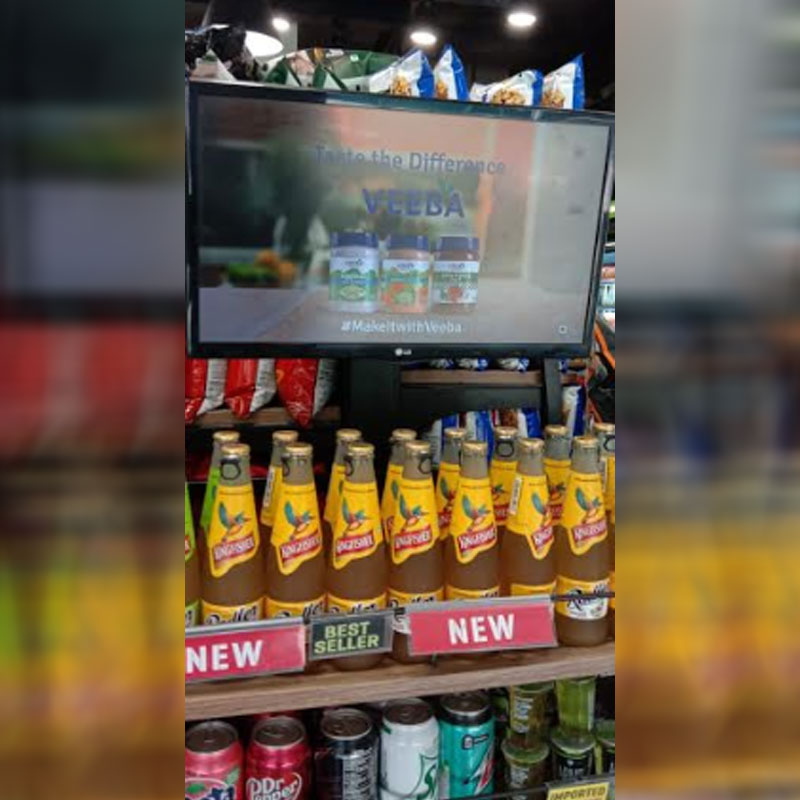
    Identifying buying patterns among consumers for Veeba Sauces, Xaxis designed the campaign to target the upper-middle-class population in Delhi. With a host of competing brands, standing out in stores was also a challenge. To reach out to their target audience, customers were targeted at three key touchpoints at the supermarket: before they entered the store, at the store and at the billing counter. Using Xaxis’ proprietary platform intelligence the campaign gained richer insights and analysis of all audience dynamics, enabling attribution of the effects of the contextualized content strategy as well as its impact on brand engagement and in-store behaviour.

    As consumer attention becomes increasingly elusive, Xaxis’ DOOH capabilities, allowed Veeba Sauces to build connections with target audiences in real-time and understand the direct impact of DOOH on the customer journey. By leveraging DOOH, brands can enjoy the benefits of digital display advertising, including data-driven targeting, measurement, and live creative updates, in localized, high-impact media sites. By 2021, digital is expected to account for 45 per cent of all outdoor media spend (WARC Global Ad Trends report, November 2018).

    Veeba Food Services brand manager Ankit Sharma commented: “Xaxis presented us an opportunity to deliver programmatically digital out of home. With our fantastic product line-up, being able to display our message in target stores supported by mobile activity, remarketing to users who were within 20 meters of a DOOH location, was a smart approach. The campaign helped increase sales by 15% across the target 24/7 stores in Delhi. Moving forward, it is a channel we will be considering within our media mix.”

    m/SIX India senior vice president Saket Sinha said: "M/SIX has always believed in outcome-based advertising and that connecting with walk-in consumers at a store is a critical part of the marketing funnel. By enabling brands to tap into the benefits of programmatic advertising, we were able to provide Veeba Sauces with a unique medium to reach consumers with eye-level messaging and cover an area far greater than what was possible through traditional OOH.”

    Xaxis India country lead Bharat Khatri added: “Out-of-home advertising has always been an effective media channel to drive awareness for brands and now combined with programmatic technology this medium is more automated and measurable than ever before. We saw all the benefits of programmatic DOOH come to light, the ability to communicate in real-time through networked digital screens, Wi-Fi and mobile broadband to deliver contextually relevant messaging, and drive more immediate consideration, trial, and purchase. This is a compelling reason for brands to invest in DOOH.”

    Lemma founder and CEO Gulab Patil said: “Mapping audience parameters and behavioural tendencies to locations has taken DOOH advertising to new heights. Furthermore, programmatic technology has enhanced DOOH outputs with dynamic creative rendering abilities that empower advertisers to leverage the essence of the surrounding. In this case, contextualized creatives for Veeba in sync with audience profile, placement & density influenced consumers in the last mile of the purchase journey, subsequently resulting in higher sales. Not only this, technology like ours provide data-mining opportunities that help brands garner information beyond mere exposures.