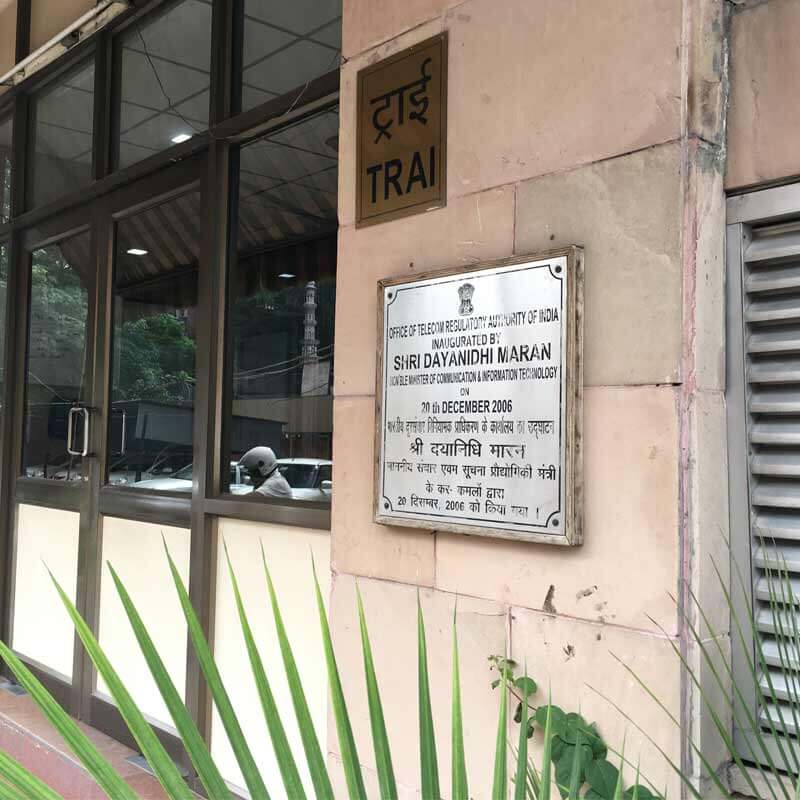
Tag: www.trai.gov.in

  • TRAI recommends e-KYC for outstation customers

    TRAI recommends e-KYC for outstation customers

    MUMBAI: The Telecom Regulatory Authority of India (TRAI) has issued its Recommendations on
    (i) “Verification of existing mobile subscribers through Aadhaar based e-KYC services”
    and
    (ii) “Permitting outstation Aadhaar card holders for e-KYC of mobile subscribers.”

    2.Aadhaar linked e-KYC service provides a robust mechanism to verify the identity of the person electronically and instantaneously from the source itself, based on the biometrics of the person. Thus, it takes care of the issues relating to fake/forged identity proof, manual entry into the system etc.

    3. In this regard, TRAI on 6th January 2016 recommended acceptance and adoption of Aadhaar based e-KYC service alongwith Aadhaar based e-Sign as a valid alternative process. Subsequently, on 16 August 2016, DoT permitted the use of Aadhaar based e-KYC service of Unique Identity Authority of India (UIDAI) for issuing mobile connections to customers. These instructions are applicable only for issue of new SIM cards but excludes the huge existing mobile subscriber base from the ambit of e-KYC. Further, use of e-KYC process was not permitted for outstation customers by DoT.

    4. The existing paper-based KYC process is not robust enough and the possibility of significant number of working SIMs, which may have been acquired on fake/forged identity, cannot be fully ruled out. The owner of such fake identity would not even be aware that SIM(s) are working in his/ her name. The Authority has received several cases from State Police (crime branch) wherein it has been found that hundreds of SIM cards have been obtained on fake documents. The existence of such SIM cards poses a real security challenge. It is essential that not only the new subscribers are enrolled through e-KYC process, but the existing subscriber base should also be verified through e-KYC process in a phased manner within a defined timeframe. Further, barring the e-KYC process for outstation customers results in artificial restriction and avoidable inconvenience.

    5. To overcome these challenges, the Authority has submitted its recommendations to DoT and the same have also been placed on TRAI’s website www.trai.gov.in. The main recommendations are:

    (a) DoT may work with the TSPs, to evolve a framework to verify the existing mobile subscribers through Aadhaar based e-KYC services in a phased manner and within a defined timeframe. However, this process should be optional to the service providers as well as mobile subscribers. The subscribers may have to be given some sops in terms of free talk-time or data to encourage them to undergo the e-KYC process.

    (b) Aadhaar based e-KYC should be permitted for outstation customers also at any place within the service area.

  • TRAI recommends e-KYC for outstation customers

    TRAI recommends e-KYC for outstation customers

    MUMBAI: The Telecom Regulatory Authority of India (TRAI) has issued its Recommendations on
    (i) “Verification of existing mobile subscribers through Aadhaar based e-KYC services”
    and
    (ii) “Permitting outstation Aadhaar card holders for e-KYC of mobile subscribers.”

    2.Aadhaar linked e-KYC service provides a robust mechanism to verify the identity of the person electronically and instantaneously from the source itself, based on the biometrics of the person. Thus, it takes care of the issues relating to fake/forged identity proof, manual entry into the system etc.

    3. In this regard, TRAI on 6th January 2016 recommended acceptance and adoption of Aadhaar based e-KYC service alongwith Aadhaar based e-Sign as a valid alternative process. Subsequently, on 16 August 2016, DoT permitted the use of Aadhaar based e-KYC service of Unique Identity Authority of India (UIDAI) for issuing mobile connections to customers. These instructions are applicable only for issue of new SIM cards but excludes the huge existing mobile subscriber base from the ambit of e-KYC. Further, use of e-KYC process was not permitted for outstation customers by DoT.

    4. The existing paper-based KYC process is not robust enough and the possibility of significant number of working SIMs, which may have been acquired on fake/forged identity, cannot be fully ruled out. The owner of such fake identity would not even be aware that SIM(s) are working in his/ her name. The Authority has received several cases from State Police (crime branch) wherein it has been found that hundreds of SIM cards have been obtained on fake documents. The existence of such SIM cards poses a real security challenge. It is essential that not only the new subscribers are enrolled through e-KYC process, but the existing subscriber base should also be verified through e-KYC process in a phased manner within a defined timeframe. Further, barring the e-KYC process for outstation customers results in artificial restriction and avoidable inconvenience.

    5. To overcome these challenges, the Authority has submitted its recommendations to DoT and the same have also been placed on TRAI’s website www.trai.gov.in. The main recommendations are:

    (a) DoT may work with the TSPs, to evolve a framework to verify the existing mobile subscribers through Aadhaar based e-KYC services in a phased manner and within a defined timeframe. However, this process should be optional to the service providers as well as mobile subscribers. The subscribers may have to be given some sops in terms of free talk-time or data to encourage them to undergo the e-KYC process.

    (b) Aadhaar based e-KYC should be permitted for outstation customers also at any place within the service area.

  • DTH: Trai supports interoperability, MDU tech

    DTH: Trai supports interoperability, MDU tech

    NEW DELHI: Keeping up its busy schedule on industry related issues, India’s broadcast regulator came out with suggestions on DTH regulations today. The regulator has pitched for mandatory interoperability for DTH services and has okayed multi- dwelling unit (MDU) technology with certain riders in consumer interest.

    Telecom Regulatory Authority of India (Trai) today said that the new set of recommendations provide for “clarifications to certain provisions of the (DTH) licensing conditions” and guidelines to be followed in the adoption of MDU technology, which is basically perceived to be in consumer interest.

    According to Trai, the suggested guidelines relating to DTH will ensure that “interests of the consumers,” cable operators and other DTH players are protected.

    Some of the major DTH recommendations are as follows:

    # Personal Video Recorders and Interoperability: There should not be any amendment in Articles 7.1 and 7.2 of the DTH license agreement, which mandate technical interoperability among DTH service providers.

    # The license conditions should be amended to provide for casting an obligation on the service provider to inform and educate the consumers about the limited technical interoperability of the Set Top Boxes with Personal Video Recorders/Digital Video Recorders.

    # Uplinking and Platform Services: The guidelines for uplinking from India should be amended to exclude DTH platform services aimed at enabling the subscribers to utilize the platform efficiently and informing them of platform functionality and services.

    # MDU technology: The DTH license conditions should be amended to specifically permit use of MDU technology subject to the following conditions:
    a. The DTH service provider should not insist on any exclusive arrangement for installation of MDU technology to the detriment of other distributors of TV channels.
    b. Signals from the MDU technology shall not be provided to a consumer outside the multi-dwelling unit building, where the MDU technology is installed.
    c. The MDU technology should not carry the content from any other service provider other than the DTH service provider and
    d. The DTH operator shall obtain written consent from those subscribers living in a multiple dwelling unit who are desirous of availing the facility of MDU technology, before installing the same. A general permission obtained from office bearers of the Residents Welfare Association/group housing society will not be considered sufficient.

    The government had sought Trai’s views regarding certain issues relating to the licensing provisions of DTH. A full text of Trai’s suggestions could be accessed at www.trai.gov.in.

  • Trai fixes revenue share for stakeholders; carriage fee to stay with MSOs

    Trai fixes revenue share for stakeholders; carriage fee to stay with MSOs

    NEW DELHI: The Indian broadcast regulator has finally legitimised carriage fee or the payment TV channels make to be on tunable bandwidths and cable networks. The Telecom Regulatory Authority of India (Trai) has also set the revenue sharing model for industry stakeholders.

    Trai said today that from the revenue generated from pay channels, broadcasters will keep 45 per cent, multi system operators (MSOs) 30 per cent cable operators 25 per cent.

    Additionally, carriage fee is to be retained fully by MSOs, while the basic tier services fee will be retained fully by local cable operators.
    MSOs, according to Trai, can operate throughout a CAS area without any restriction on area of operation.

    The objective of having standard interconnection agreements is to ensure that implementation of CAS does not get delayed in case service providers fail to enter into mutually acceptable interconnection agreements through negotiation within the stipulated time.

    In a statement, the regulator said that apart from providing standard interconnection agreements, those dated 10.12.2004 have also been amended to prohibit such clauses in interconnection agreements that would require a distributor of TV channels using an addressable system to pay a minimum guaranteed amount as subscription fee.

    Some of the highlights of the standard interconnection agreements are as follows:

    # The service providers are at a liberty to enter into mutually acceptable interconnection agreements which are different from the standard interconnection agreements

    # If any of the service providers in the CAS areas are not able to arrive at a mutually acceptable interconnection agreement within a time-period specified by the Authority, then they shall be required to enter into interconnection agreements as per the standard interconnection agreements

    # The standard interconnection agreements between broadcasters and multi system operators have been provided only for pay channels.

    # Term of standard interconnection agreements to be 12 months.

    # All service providers in CAS areas who do not have pre-existing interconnection agreements as on the date of issue of this Regulation and who are not able to arrive at a mutually acceptable agreement shall enter into interconnection agreements as per standard agreements within 10 days of the receipt of permission by MSOs from the government.

    # All the service providers in CAS areas who have a pre-existing interconnection agreement appropriate for operating in a CAS area as on the date of issue of this regulation, but are unable to arrive at a mutually acceptable agreement within 30 days of the expiry of the pre-existing interconnection agreement, shall enter into standard interconnection agreements within 30 days of the expiry of the pre-existing interconnection agreement.

    Other details of the regulator’s latest directives on interconnect are available on www.trai.gov.in.

  • Dish TV, Tata Sky lock horns over DVRs

    Dish TV, Tata Sky lock horns over DVRs

    NEW DELHI: Existing DTH player Dish TV has locked horns with Tata Sky over interoperability — or its waiver — of digital video recorders to be made available to consumers of a DTH service in India.

    DTH license holder ASC Enterprises, which operates the Dish TV brand, has told the broadcast regulator that if digital video recorders (DVRs) are not interoperable, as mandated in DTH guidelines, it would “compromise” consumer interest.

    On the other hand, Tata Sky and technology company NDS (controlled by Rupert Murdoch) have said that “interoperability is not feasible on high end devices” like DVRs.
    “The technical specifications vary with the (DVR) models that are introduced and these were not envisaged when BIS (Bureau of Indian Standards) drew up STB specifications,” Tata Sky has said in its submission to the regulator.

    ASC Enterprises has counter-punched by saying that existing clauses on interoperability of boxes protect the “consumer interests by ensuring they switch over their service providers for the basic functionality of watching the broadcast channels as per their option and choice.”

    If that was not enough, Tata Sky and residents’ welfare associations (RWAs) have come out in support of multi-dwelling unit (MDU) technology, which has been strongly opposed by all sections of the cable industry, including Cable Operators’ Federation of India (COFI), which feels cable ops stand to become redundant.

    MDU technology, being tested by Tata Sky for its proposed DTH service in a few cities, envisages making available a DTH service to multiple homes through a common dish antenna, but separate set-top boxes.

    The technology is being touted by its supporters as cost effective for consumers and as a safeguard for “aesthetic” senses in concrete jungles that Indian cities are turning into.

    Telecom Regulatory Authority of India (Trai) had asked for comments on various issues related to DTH, including whether certain clauses in the DTH guidelines need to be amended to exclude DVRs from being interoperable.

    Fifteen individuals/organizations, including a clutch of RWAs, have submitted their feedback, baring the fact there isn’t consensus on matters like DVRs and MDU technology, which have the potential of changing the way people consume television fare in India.

    Even a company like Anil Ambani’s Reliance Infocomm, whose DTH license application hasn’t been processed by the government, feels that DVRs should be kept interoperable.

    “The clauses 7.1 & 7.2 of DTH license conditions need not be amended to exclude digital video recorders. All set top boxes whether simple STB or personal video recorder/ DVR-enabled set top boxes should be interoperable,” Reliance has stated

    The full text of feedback, peppered with technical jargons and occasional innuendoes hitting at opponents, can be seen on the regulator’s website, www.trai.gov.in.