Tag: WPP

  • After WPP, Omnicom signs strategic deal with Twitter

    After WPP, Omnicom signs strategic deal with Twitter

    MUMBAI: Last year somewhere at this time Twitter, the popular microblogging site went ahead to strike a partnership deal with the holding company WPP. The association was initiated between two to build more efficient campaigns. In this partnership, Twitter data was integrated into WPP’s media and analytics products.


    Taking a step ahead, Twitter has now partnered with Omnicom Group. According to a report in Reuters, Omnicom Group’s media services division has signed a deal worth $230 million with Twitter that will integrate Omnicom’s automated ad buying unit Accuen with Twitter’s mobile ad exchange MoPub.


    Various other international reports also state that the two-year deal will lock in ad rates and inventory access for Omnicom agencies and will also give Omnicom a ‘first look’ at new ad units and opportunities being developed by the microblogging site.


    It will be interesting to see how the social networking site with the help of holding companies will sell out interesting ad inventories in the coming days.

  • JWT acquires majority stake in Social Wavelength

    JWT acquires majority stake in Social Wavelength

    MUMBAI: WPP Group’s JWT has acquired a majority stake in Social Wavelength.


    JWT’s acquisition of Social Wavelength is a logical confluence of social media and mainline expertise, coming together to create integrated communication for brands. The rich experience of five years that we have, in this young industry of Social and Digital Media, will find the next leap of growth, through this partnership. A socially connected world is going to create new challenges and opportunities for brands, and we will create solutions to help brands navigate those challenges,” said Social Wavelength joint CEOs Haresh Tibrewala and Sanjay Mehta.  


    The social media agency was founded in 2009, and headquartered in Mumbai, with offices in Delhi and Chennai. The agency now has over 170 professionals who offer social media communication services, social media listening services using Radian6,  influencer outreach program, application development, video and rich media content creation and media buying to over 50 leading brands.


    The acquisition marks a further step in WPP’s strategy of developing its networks in fast-growth markets and sectors. In India, WPP companies (including associates) generate revenues of nearly $500 million and employ almost 13,000 people.


    “We want to be a critical resource partner across the many solutions we provide to our clients. As we continue to relentlessly transform our offerings, Social Wavelength adds a huge dimension to our existing clients and the brands we steward. Across the marcom value chain and across various digital touch points the skills and capabilities of Social Wavelength will be that edge,” said JWT South Asia CEO Colvyn Harris.


    Social Wavelength’s revenues for the year ended 31 March 2013 were Rs 9.15 crore, with gross assets at the same date of Rs 5.92 crore. Social Wavelength marks WPP’s fifth acquisition in India in the last four years.


    JWT Asia Pacific has invested heavily in expanding its digital footprint over the last two years.  In addition to the acquisition of Hungama, in India, JWT acquired Post Visual in South Korea in 2013, and took a stake in Converge, in Pakistan, in 2012.  XM Asia, a digital agency owned by JWT, also acquired Designercity, in Hong Kong, and Thomas Idea, in Thailand, in 2013, and XM Gravity in 2012.

  • MEC appoints Sidhraj Shah as Head of Brand Activation

    MEC appoints Sidhraj Shah as Head of Brand Activation

    MUMBAI: MEC, a leading media agency and part of WPP, (www.mecglobal.com), today announced the appointment of Mr. Sidhraj Shah as Head of Brand Activation. His mandate is to deliver innovative consumer experiences and to expand MEC’s brand engagement and implementation services. Shah’s last assignment was at Wizcraft as Deputy General Manager. An MBA from Bombay University, he will report to T Gangadhar, Managing Director, MEC and to Dalveer Singh, Head Experiential Marketing, APAC, GroupM’s experiential marketing unit.

    Speaking about the appointment, T. Gangadhar said, “We are pleased to have Sidhraj on-board. His proven track record of helming award-winning campaigns will be a definite asset to MEC and to our clients. Integrated marketing communications (IMC) is at the core of MEC and I am confident Sidhraj’s experience will further improve the quality of our product.”

    With prior stints at O&M, SSC&B Lintas and Bates 141, Shah has conceived and executed ground-breaking campaigns for clients such as McDonald’s, Standard Chartered, Virgin Mobile, Siemens, MTV and MiD-Day. He has successfully executed activation programs that have become case studies within the industry – such as India’s 1st Pogo Flash Mob activation for McDonald’s, the RFID Tech innovation for Siemens Data Tracking at Elecrama (2012) to India’s largest 3D art-style façade for MCHI Exhibition (2013).

    On his appointment, Sidhraj Shah said, “I am very excited with this opportunity to be working with MEC. My aim will be to continue to deliver noteworthy and unique propositions for our clients and consumers alike.”

    Dalveer Singh added, “We set our sight at the highest level when looking for a new leader at MEC and I am pleased to say we have achieved our objective. We wanted a very high caliber person with a proven track record combined with fresh thinking and have the drive to do the unusual. I am personally very excited and welcome him to the family”

  • #WPPStream to discuss India’s digital future

    #WPPStream to discuss India’s digital future

    MUMBAI: If you thought business meetings can only be done in conference rooms and around round tables, it’s time to think again! To make work more than just work, Sir Martin Sorrel founded WPP’s best strategic planners are gathering in Jaipur to think about the digital future and what that means for communications, what it means for creativity and what it means for business.


    #WPPStream, an annual (un)conference, organised by WPP Group company is about no keynote presentations, no panel discussions and no ‘networking breaks’.


    Being held in India for the first time, Stream will see GroupM India employees along with WPP clients, WPP agencies and the broader technology industry gathering in Jaipur from 12-15 February. WPP Country Manager – India Ranjan Kapur will be playing the host in the country along with critically acclaimed filmmaker Shekhar Kapur.


    The focus of Stream India will be to celebrate and explore the growth and development of digital innovation in India. It will also bring Brands together with regional leaders from media and technology companies for a debate on India’s digital future.


    With over one hundred discussion sessions, Ignite talks (15 slides in 15 seconds), pitch show, tech lab, etc Stream India is going to be really prolific.


    Some of the topics to be discussed are:


    * More mobiles than books in India – can technology be used for better literacy?

    * Are Indian publishers geared up for digital publishing?

    * In Digital age, do we get connected or disconnected?

    * Digital technology is not a substitute to strong communication idea.

    * Mobile, your personal smart screen – how India is evolving

    * Online video – how will it change the concept of communication in India

    * Too much information. Does it lead to clarity or confusion?

    * If Medium is the Message, Can it light a Billion Souls?

    * Mobile – continuation or gradual transition of digital Web : Aren’t we killing the core proposition?

    * Will Mobile marketing be the gateway to digital for most brands in India?


    Midnight cooking, cinema, elephant polo and many other things are a part of the plan for an unwinding experience. 

  • There  is no Plan B for TAM if we lose our appeal in court: Kantar’s Eric Salama

    There is no Plan B for TAM if we lose our appeal in court: Kantar’s Eric Salama

    The Indian television industry is possibly heading towards a crisis of an audience ratings blackout. TAM Media Research, a joint venture between Nielsen (India) and Kantar Media Research, is currently the only agency that provides television audience viewership measurement services to advertisers and broadcasters.


    TAM has hit a roadblock in India with the government issuing policy guidelines for television ratings agencies in mid-January. It has an impossible deadline of mid-February to ensure that the shareholding in TAM is in accordance with the new policy guidelines.


    Apart from having substantial (more than 10%) stakes in TAM, the joint venture partners in the Indian television ratings provider also own advertising agencies in India, which is prohibited in the policy guidelines’ cross-holding norms.


    Nielsen appears to have taken a back seat and decided to let Kantar lead the challenge against the government’s new regulations and  let TAM face the situation as it develops


    Kantar has filed a petition in the Delhi High Court to get a stay on the shareholding norms specified in the guidelines or at least get an extension on the deadline for meeting meet the norms. There’s less than a fortnight left for TAM to comply with them, and it does not like its shareholders will be able to do so in the short time that was given to them.


    The launch of television audience measurement by Broadcast Audience Research Council (BARC), an initiative of advertisers, advertising agencies and broadcasters in India, is likely only by October this year.


    If Kantar fails to get some relief from the court, TAM will have to stop releasing audience ratings by mid-February which will obviously result in the absence of viewership being metered and measured till BARC is ready with its own services. And that is something which is giving both advertisers and agencies palpitations. Television audience ratings is a key input based on which advertisers base their advertising plans on.


    In order to understand what the situation is and what could unfold, indiantelevision.com’s Vishaka Chakrapani spoke to Eric Salama, chairman and CEO of the Kantar group since 2007. Salama has been with global advertising agency WPP, the owner of Kantar, since 1996.


    During the interaction, Salama rued that television ratings has become a matter of public debate and a “cricket ball” for everyone to hit. Excerpts:


    How different is it operating in India as compared to other countries when it comes to television ratings?


    We operate in most countries with the exception of Iran, Cuba and North Korea.  We’ve never had problems in India before, IMRB is the oldest research agency in Asia and we see India as a key market for us going forward.  We have some of our most talented people here.  The TV ratings market is very different to other markets in that it has become a source for public debate and a cricket ball for people to hit.


    How do you see TV ratings agencies progressing in India?


    We’ll know soon enough!


    Do you believe a ratings blackout is likely to happen? What could happen in such a scenario and how will the industry respond?


    Unless the court rules in our favour on cross ownership, we are heading for a blackout which will be extremely damaging to broadcasters, programmers, agencies, advertisers and everyone who cares for the Indian media industry.


    Do you think there is space for two ratings agencies to coexist?


    It happens in some markets such as Philippines but it’s extremely rare as the industry generally wants one currency for trading.


    I believe TAM has also applied to BARC for panel management in the industry-driven television ratings service. How do you see your relations with BARC taking shape?


    Once BARC is established, TAM will either be a supplier to them for some services or not.


    Should the sample size for arriving at television ratings be far bigger?


    If people wanted us to expand our sample to 20,000 we would.  When BARC is established it will be up to them to decide what they do.


    Accusations have been hurled at TAM and its credibility has been questioned. Do you think TAM has been judged wrongly?


    Some of the comments have been libellous. Many of them have been poorly informed.  TAM has performed extremely well for a long period in a very difficult environment and under huge pressure.


    What is the plan B if TAM is not allowed to function?


    There is no plan B.

  • Mission 2014: The rise of the political campaign

    Mission 2014: The rise of the political campaign

    While the two-horse race hasn’t disappointed so far, what with all the mudslinging, sloganeering, crowd-pleasing and promising, there seems to be not a marked difference between the election strategies of the main opponents.


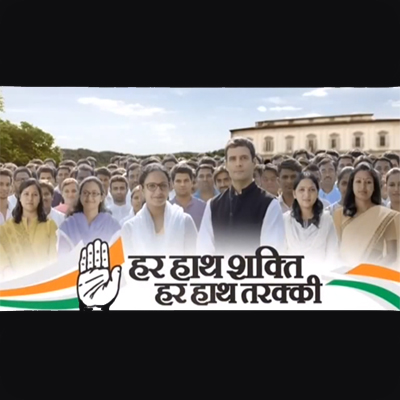
    The Congress Party has flagged off its Rs 500 crore advertising and publicity campaign to promote leading light Rahul Gandhi. With a slogan that reads ‘Har haath shakti, har haath tarakki’, the blitzkrieg mirrors the idea of power and progress to each and every person while focusing on the progress made by the nation in the past decade, albeit with the Congress at the helm of affairs. One of the ads even features a young, Muslim party member, Hasiba Amin, urging the youth to join RaGa along with the tagline ‘Kattar Soch Nahi, Yuva Josh’.


    Apart from this, the ruling alliance has initiated a Rs 100 crore Bharat Nirman campaign, which is being handled by ad agency Percept and run from the Information and Broadcasting Ministry’s budget headed by Manish Tewari.


    What’s more, recently, Times Now Editor-in-chief Arnab Goswami grilled the Gandhi scion in his first ever television interview since his political debut in 2004. RaGa answered questions including whether he is a reluctant politician and what are his views on the multiple scams facing UPA 2 but his answers elicited a mixed response where some found him frank and others felt he needed growing up, politically speaking.  


    Not far behind the Congress, the BJP is close to finalising the ad agency to kick-off its Rs 400 crore campaign around prime ministerial candidate Narendra Modi. It is learnt that McCann Worldgroup led by adman-lyricist Prasoon Joshi and WPP agency Contract Advertising are in the fray to grab the hotly-contested account.


    This – after the recent furore over Congress’ initial campaign slogan “Main nahin, hum”, which the party claimed had been lifted from NaMo’s tagline during the 2011 Gujarat Chintan Shivir. So much so, the Congress was forced to drop the tagline even after AICC media head Ajay Maken refuted BJP’s allegations by tweeting a picture featuring the slogan at a mushaira of Congress workers in Indore in 2010.


    So while the Congress and the BJP gear up for battle in the media space, it remains to be seen how much of this will translate into votes for their prime-ministerial hopefuls. Historically speaking, in 2004, the then ruling party, BJP, had run a similar campaign ‘India Shining’ highlighting all its good work but the aam junta wasn’t swayed. One of the main reasons for the failure of the campaign was people’s inability to relate to it.


    Whether things will work out differently this time one can’t really say but it might do well for both parties to take a cue from AAP’s unique strategy.


    Unlike its traditional parties, AAP has largely stuck to communicating through outdoor activation programs and social media while steering clear of mass media campaigns.


    The rookie party won 28 out of 70 seats in the Delhi Assembly Elections and went on to form the government in the national capital sans any campaigning worth writing home about.


    In establishing a door-to-door (person-to-person) connect with the common man in buses, trains, autos, juggis and bastis, the party’s volunteers stayed true to its one agenda – the aam aadmi.


    As Delhi Chief Minister, Arvind Kejriwal’s recent dharna won him (and the party) more brickbats than bouquets as it is unheard for a constitutional head in a democracy to resort to such means. However, it helped AAP become the darling of the masses at no humungous cost, allegations of using the media to advantage notwithstanding.


    Whether the junta will fall for the publicity and hype created by Congress and BJP or will give its nod to the AAP-brand of democracy, is highly debatable. Our only hope is let the best man (party) win!

  • What now for TV ratings and TAM

    What now for TV ratings and TAM

    MUMBAI: When the cabinet committee on economic affairs announced that it had approved the Telecom Regulatory of India (TRAI) recommendations on TV ratings guidelines in the first week of  2014 the first question that struck everyone was – what will TAM do now?


    The fracas between angry broadcasters and TAM has been brewing for  several years and finally came to its boiling point last year when seven TV networks announced that they were clicking on the TAM TV rating unsubscribe button. This put a big question mark over TAM’s very existence but it managed to get out of the corner it was in by hammering out a solution which was acceptable to most subscribers. 


    As far as the current threat to TAM’s continuance is concerned, the Cabinet’s go ahead to the proposed regulatory framework has now to be notified. When that will happen no one knows, though speculation is that it could be sooner than later. However, what is sure is that TAM will have 30 days from notification date to comply with its guidelines and then seek a licence from the Ministry of Information and Broadcasting (MIB).  From all angles it looks like a pressure cooker-like situation that the TV ratings provider has landed itself in. 


    Broadcasters seem to be the happiest of the lot. NDTV group CEO Vikram Chandra – whose company sued TAM in a New York court two years ago – is cock-a-hoop with delight that the government has affirmed what industry has been voicing since nearly six to seven years: that TAM and the ratings process in India needs to be spruced up.


    “The introduction of firm guidelines is a positive step as everything is clear now. It shows that we should never be hesitant to change something that isn’t right,” says Chandra.


    Whether TAM will manage to find the capital to ramp up its peoplemeter sample to 20,000 within a month or two is something that is concerning industry. What is also a big question mark is how the MIB will view the WPP group’s 50 per cent equity in TAM (through Kantar Media Research 20 per cent, and Cavendish Square Holdings 30 per cent), as mentioned in the NDTV suit with the supreme court in New York.


    “Kantar and Cavendish will have to exit since their parent is WPP. TAM has been worrisome and everyone has realised it. So now it has just two options, either shape up or ship out,” says a senior news broadcaster from the News Broadcasters Association (NBA).


    However, a source from the IBF presents another option. “We are a democratic country so the government cannot force things on anybody. TAM has the freedom to go to the court and appeal against the guidelines,” says the source.


     If TAM decides to oppose the guidelines and go to court and gets a stay order, then we might see some delays in the roll out of the guidelines. This will allow it to continue to operate until a final decision is given by the court, thus buying it some time. Additionally, the industry-backed Broadcast Audience Research Council (BARC) will also get some time to get its act together with the minimum 20,000 meters.


    Media agencies and advertisers aren’t too happy with the way the cabinet has thrust the deadline on TAM.


    Says a senior media professional:  “In the beginning of cable and satellite TV in India in the nineties, we had TAM and INTAM. The latter could not sustain itself and TAM continued. Then we had TAM and aMap in the mid of the previous decade. aMap too found the going tough without full industry support and folded up. The fact is TAM has started from scratch and survived so many upheavals. It is a sad situation to be destroying something that has been existing and running for so long. ”


    However, she is clutching on to a thin sliver of hope that TAM and BARC could co-exist for a while until things smooth out on the ratings front. 


    “The time given to follow and make all the changes as per the guidelines is impractical,” says Madison World chairman & MD Sam Balsara. “It is obvious that TAM will not be able to handle it all at such a short notice.”


    The Indian Society of Advertisers (ISA) chairman Hemant Bakshi says that he is discussing the consequences of the cabinet’s clearance to the new ratings guidelines with major advertisers and other players to gauge the possible impact on their businesses.


    One scenario that everyone is dreading is that TAM fails to comply with all the requirements within the time period it is given, and the courts dismiss its appeal, if it makes one. Will it then be forced to cease operations immediately and lead to a ratings-less period for the Indian television business? This is extremely alarming for all concerned.


    IPG Mediabrands CEO Shashi Sinha who is also in the technical committee of BARC feels that the management of the new proposed ratings system needs to pull their socks up, and accelerate the rollout of people meters. But even then he says that “we are hoping to be on our feet and start functioning only by September/October.”


    That seems a long, long time away, going by how things are moving. Madison’s Balsara is quite clear on the way forward. Says he: “As an industry we need ratings, all the time! Therefore, till BARC comes up, we need an alternate. As an industry we should appeal to the ministry to relax the deadline for the implementation.”


    Hence, it is imperative for all concerned – whether it is the MIB led by Manish Tewari, the government, TAM, the ISA, advertising agencies, broadcasters and BARC – to choose their next steps wisely.


     

  • Explore the corporate world with Sir Martin Sorrell

    Explore the corporate world with Sir Martin Sorrell

    MUMBAI: Network18’s business channel CNBC-TV18 has got a date with one of the most powerful man in the world of media and advertising. WPP chief executive of advertising services group Sir Martin Sorrell – under whose leadership the company has escalated to the position of the world’s largest agency network – will give viewers an insight in to the world of media, advertising and marketing with a programme, 30 Minutes with Martin Sorrell.


    It is a monthly half an hour show that will go on air on CNBC-TV18 from Friday, 29 November at 7:00 pm. The show will be hosted by Anant Rangaswami, editor of Storyboard and senior editor of Firstpost where he will speak to Sorrell on recent and imminent developments in the world of media, advertising and marketing.


    Sorrell is an astute businessman with an instinctive understanding of economics, finance and markets. He has changed the landscape of the communications industry through WPP’s consolidation drive over the last decade and more.


    With this show, the channel adds another topical show to its illustrious line-up to provide programming that its viewers can continue to benefit from. By leveraging its global edge, CNBC-TV18 brings Indian audiences Sorrell’s first exclusive monthly appearance on an Indian business news channel.