Tag: WPP

  • WPP appoints Roberto Quarta as chairman-designate

    WPP appoints Roberto Quarta as chairman-designate

    MUMBAI: WPP plc has appointed Roberto Quarta to its board as a non-executive director and chairman-designate. He will join the board on 1 January 2015 and will offer himself for re-election at the company’s Annual General Meeting to be held in June 2015. Subject to his re-election, he will be appointed chairman to succeed Philip Lader, who joined the board as chairman in 2001.

    Quarta is chairman of Smith & Nephew plc, a FTSE 100 global medical technology company, and chairman of IMI plc, a FTSE 250 engineering business. He is also a partner at the private equity firm Clayton, Dubilier & Rice and a non-executive director at Spie SA. Previously, he was chief executive and then chairman of BBA Group plc, Rexel SA chairman  and BAE Systems plc,  Equant NV, Foster Wheeler AG and PowerGen plc non-executive director.

    In the Company’s last Annual Report issued in April 2014, Lader announced his plan to step down as chairman at the close of 2014. The WPP board has requested that he continue until such time as Quarta steps down as Chairman of IMI plc.

    Lader said, “Roberto brings to WPP extensive, diverse experience in corporate governance and global commerce. This completes our refreshment of the board, which over the last three years has seen the appointment of 10 internationally recognized business leaders from four continents and the phased retirement of long-serving directors.”

    CEO Sir Martin Sorrell commented, “Following an exhaustive search, the Board has chosen Roberto to be its next Chairman, as his experience and background complement and will help develop WPP’s strategy in new markets, in new media, in data investment management and the application of technology and, last but not least, horizontality.”

    Quarta commented, “It is a great honour to join the board of WPP, a global leader in its field and an outstanding success story in British business. I look forward to working with the Board to help the company as it continues to build leadership positions in the fast changing media markets.”

    No disclosure obligations arise under paragraphs (1) to (6) of LR 9.6.13 R of the UK Listing Authority’s Listing Rules in respect of this appointment.

    Full details of Quarta’s remuneration arrangements will be given in the Directors’ Remuneration Report 2014.

    The transition in the chairman’s role will occur, if Quarta has resigned from the IMI board as anticipated, immediately at the close of WPP’s June AGM or thereafter upon such resignation.

    Quarta will be appointed to serve as a member of the Nomination and Governance Committee and the Compensation Committee.

    In the 14-year period Lader has served as chairman, WPP’s billings have grown from ?14 billion to ?46.2 billion, PBIT from ?378 million to ?1.583 billion, dividend per share from 3.75p to 34.21p, the dividend pay-out ratio from 13 per cent to 42 per cent. The shares have risen from 829p to 1313p, the market capitalisation from ?9.1 billion to ?17.3 billion and the number of employees (including associates) from 65,000 to 177,000.

  • Interactive Television: Throwing light at cinema advertising

    Interactive Television: Throwing light at cinema advertising

    MUMBAI: In the country where cricket and movies are more than a pastime, for Ajay Mehta films meant more than just a family business.

    Brought up in a household of film distributors, Mehta decided to do much more than that for the same industry. “I wanted to do something related but not join the family business and working with advertisers sounded exciting and fun,” he recalls.

    Founded in 1996 in New Delhi, Interactive Television, was set up as a marketing agency which provides cinema advertising and marketing services in multiplexes, malls, and shopping chains.

    However, the journey wasn’t a smooth one even though he belonged to the film fraternity. “The biggest challenge was to convince people of the medium without any data and in fact the cinema industry still does not offer enough data to advertisers,” says Mehta while adding that in the digital age that is simply unacceptable.

    Even though everyone knows that cinema is like a religion in India but without viewership data and demographics, advertisers are investing in the dark, highlights Mehta. To counter this, Cinema Audit Monitoring (CAM) was launched, which according to him was the first step in making the medium transparent and accountable.

    Today, working across 9000 screens in India, the company is country’s only integrated entertainment and retail marketing company, releasing CAM report each month, which gives comparative analysis of cinema advertising and movie marketing throughout the country.

    Satisfied with the journey so far, Mehta feels that the process of establishing a medium which was not in any major advertisers plans to one which is included in every major plan has been tremendous. “High point have been many, every conversion of a client is a high point especially the non believers, every innovation is a high point as it feels special to create an idea which has not been thought off before, advertising for Indian clients in international markets like the USA, UK and the UAE has been a high point as Indian movies now have a global reach and can offer a platform for clients trying to reach out to the Indian diaspora.”

    Seeing the potential, WPP had acquired the company, but it remains an independent company. “They have been fantastic shareholders and we have learnt a lot from them, apart from access to clients, we have learnt a lot on systems, processes, accountability   to clients.  The business has benefited from the insights which they have brought and we have managed to scale up the business post them coming on board,” informs Mehta.

    Started with just three people, the company now employees more than 70 in six cities which helps it to create exclusive packages for its clients. “Our people are our biggest strength and come from diverse backgrounds like cinema chains, media agencies, logistic companies, research agencies and ad sale houses. This is unmatched in the industry and gives us deep understanding of what clients want from their media investments and also gives us insights into how the cinema channel thinks. This ability to understand the entire landscape of cinema advertising is our biggest advantage.” The  company  has  been  responsible  for  immense  value  adds  to  promotions  for corporates like Samsung, HLL, ITC Foods, Reckitt Benckiser, Vodafone, Star Network, and many more.

    On the current market trend, Mehta believes that single screens have a lot of potential for advertisers trying to reach out to the mass market and categories such as FMCG, telecom, BFSI etc can leverage the reach and impact offered by the largest screen in the world i.e. the movie screen. “Digital cinema is an enabler for it and today new content reaches smaller cities on the same day as the Delhis and Mumbais of the world, this means piracy is controlled and newer audiences are embracing cinema. Till today, advertisers found advertising on single screens in small cities logistically difficult but this has changed completely with digital cinema. We think digital cinema will be the growth driver for the whole cinema advertising industry and we at Interactive want to lead this transition,” he pinpoints.

    As for the future plans, the agency wants to lead the process of making this medium more transparent and accountable through newer tools and Big Data. “We also think cinema is more than just the screen and is the only medium where one can have a live engagement with the audiences, off screen advertising is still pretty much a virgin territory and we want to ensure that gets its value,” concludes Mehta.


  • DTH, an innovative platform for advertisers: Matrix Publicities & Media

    DTH, an innovative platform for advertisers: Matrix Publicities & Media

    MUMBAI: It has been a stupendous growth story. Contrary to popular trade perception the DTH advertising growth story has only ended up surprising all.


    With approximately 65 to 68 million households across India and about 55 per cent of the C&S base in the country, this is one of the primary reason why a lot of advertisers are looking to engage customers on the medium. 


    What began with a low scale, low noise start with barely two to three advertisers three years ago, has grown more than 10 times in a very short span, says Matrix Publicities & Media India, a WPP company, which has been at the forefront of this revolutionary advertising blitzkrieg. 


    There are in all six DTH operators, who operate out of the paid DTH subscriber sphere, whilst planning, the agencies need to keep in mind the fact that DTH as a medium is a frequency builder and should necessarily be used to ensure incremental reach.  Like television, DTH reaches out to all SEC and demographic profiles, unlike otherwise perceived.  There are various options within the medium, however, to delivery impact too and on a case to case basis the medium allows innovations, albeit at a very competitive outlay.


    As a media sales aggregator for all the DTH operators to GroupM & non-GroupM clients and agencies, Matrix has been able to bridge the gap between the science, art and commerce for sales on this new age media platform. 


    The agency feels that the platform acts as a gatekeeper to the TV viewing audience and they are exposed to the DTH visuals prior to the TV channels.  Additionally, TV also faces a lot of clutter with regard to the various genres available for viewing.  With the 10+2 ad cap in place, in principle, with most channels, getting inventories across is also an issue.  All the factors put together have ensured that this medium has turned into a ‘pull’ medium from the erstwhile ‘push’ medium. 


    Hence, the company has not stopped at just mere vanilla sales as this is a philosophy that does not appeal to its business head Sparsh Ganguli, who has been at the forefront of this business since its inception three years ago.


    With this idea in mind, the advertisers have been divided into broad categories and an in-depth analysis has revealed a lot about the spending patterns of all advertisers on this medium.  Needless to say the research not only takes into consideration the brand spent from the GroupM set of clients but even some part of the non-Group M clients to help present a more clear and fair picture.  The efficacy of the study can be gauged from the fact that the entire categories can be bifurcated month wise and the spend patterns can be highlighted for future strategic pitches.


    The broad categories that have been the top spenders across this medium are: automobiles (two and four wheelers), FMCG, F&B, BFSI, e-commerce, watches and jewellery.


    A FMCG media planner says, “The DTH platform has been influential in targeting the housewives through sustained awareness campaigns during afternoon hours and worked phenomenally well for our client’s brands.  That’s the very reason why they look to optimise spends on these platforms.” 


    The ad rates are in sync with the growth of the medium.  The rates range from Rs 40,000 to Rs 1,00,000 depending on the options that are availed, highlights the agency.


    Ganguli, however, feels that there is still a lot of ground to be covered from the advertiser’s front.  He feels that technologically the platform is evolving in a positive manner that is both beneficial to the viewer as well as for the advertiser.  According to him, “The next revolutionary way of reaching out to the viewing household is on the spliced beam format which allows the advertiser to geo-target their consumers.  This has in turn made it possible for the brands to reach out and give a customised pre-buying experience, thus resulting into more reach and effective frequency for the brand campaign.” 


    He adds, “DTH has shown tremendous growth but I still feel clients can do a lot more, as of now we have been able to break new grounds by providing upgraded technology and this helps the clients and new clients to optimise the medium for every campaign as innovation is the way ahead.” 


  • GroupM takes over 49% stake of Haworth

    GroupM takes over 49% stake of Haworth

    MUMBAI: Haworth, an independent and employee-owned marketing and media agency based in Minneapolis, has announced a strategic partnership with GroupM, the media investment management division of WPP.


    Haworth will continue to offer personal, high-touch, creative-driven media – now backed by the industry leader in tools and data, thus linking the art of consumer connections with the most advanced marketplace analytics.


    “We believe this is a completely new, one-of-a-kind partnership that will bring tremendous value to our clients and our team,” said Haworth CEO Gary Tobey. “Our differences and assets will complement each other while Haworth’s culture and what we’ve built remains intact.”


    Haworth and its clients will benefit from full access to GroupM’s resources in digital, analytics, trading and proprietary technology and tool development.  GroupM will also provide a global expansion platform for Haworth and its clients.  The media agency will take a 49 per cent stake in Haworth.


    “We’ve admired what Gary and his team has done for many years,” said GroupM global chairman Irwin Gotlieb.  “We believe we can add to the compelling Haworth proposition through GroupM’s tools, technology, insights and trading scale.  And in turn, GroupM’s agencies and clients can benefit from Haworth’s proven expertise in integrating brands into popular culture and content.” 


    Haworth clients are happy about the new partnership with GroupM. DreamWorks Jeffrey Katzenberg said, “We’ve enjoyed a remarkable partnership with Gary Tobey and his team at Haworth over the years.  Their creativity and commitment to innovation has earned them great respect within the entertainment community – and this newest innovation has great potential.” 


    Omar Johnson, CMO at Beats Electronics CMO Omar Johnson added, “Our marketing strategy at Beats requires us to break the rules and challenge convention, which is why Haworth’s culture meshes so well with ours.  Their new model for media takes it to the next level as we continue to grow our global footprint.”


    Founded in 1970, Haworth provides strategic marketing and media solutions to blue-chip clients and iconic brands, including Target, Ben & Jerry’s, Beats by Dre, Honeywell, DreamWorks, The Oscars and Berkshire Hathaway Travel Protection.  Haworth has reported media billings of $700 million.

  • “Content is a key pillar to provide breakthrough solutions for clients”: Kartik Sharma

    “Content is a key pillar to provide breakthrough solutions for clients”: Kartik Sharma

    He took charge in January this year and since then there has been no looking back.


    The humble and calm, Kartik Sharma, the managing director south Asia of Maxus, has had a great year, so far. Maxus India began 2014 on a high note with several breakthrough campaigns like “Power of 49” for Tata Tea, winning business worth Rs 300 crore, new senior management appointments. The ‘agency of the year’ title at Emvies 2014 was the cherry on the cake.


    Sharma has been with the company for seven years and has contributed to shaping the Maxus brand, creating client delight and helping Maxus dominate industry awards along with Ajit Varghese who has been appointed CEO Asia Pacific.


    The agency was named as the fastest growing media agency by RECMA and retained the title of the most “dominant” agency profile for the fourth year in a row in 2013.


     Indiantelevison.com’s Meghna Sharma spoke to the man, who specialises in communication planning, behavioural economics, media research, analytics and technology, to know what Sharma attributes these achievements to; his blueprint for the agency in the coming months, and industry’s forecast.


    Excerpts…


    How does it feel to be the ‘Media Agency of the Year’? What made you differ from the competition?


    It’s a fantastic feeling to be ‘The’ media agency of the year, something which we have been dreaming for over seven years. Emvies being the most coveted and respected forums in India, winning here gives us tremendous satisfaction as the award is a reflection of effective work done for clients. The difference over competition is our focus across all clients (we won a metal for 10 clients) and across various categories suggest Maxus’s focus across various disciplines which we have been building over the years. Some of our competitors have won only on a few clients.


    Your client Tata Beverages won the ‘Client of the Year’ for ‘Power of 49’ campaign. Were you expecting it? According to you, what made the campaign a success?


    We were expecting good wins for the ‘Power of 49’ campaign. The client of the year was a bonus. The reason for the success of the campaign was that it was based on some fantastic insights and impeccable execution. Also, the entire timing of the campaign enhanced the effectiveness of the campaign.


    It’s not even been a year since you took charge as MD, how has the journey been so far?


    The journey so far has been fantastic. I couldn’t have asked for more. Apart from winning the Emvies ‘agency of the year,’ Maxus has been winning consistently over the last few months. Consistent wins across award forum which includes Asian Marketing effectiveness awards for data analytics innovation, win at the WPP Atticus on analytics, recent wins at the MMA, Smarties (1 gold, 2 silver, 2 bronze), again Agency of the year at the Big Bang held by Ad club Bangalore, highest award at the WPPED cream awards clearly indicates the focus that Maxus has on doing effective work across clients.


    Apart from the wins, we have added several senior leaders to Maxus who have rich experience in building brands. This helps us do cutting edge work for our clients. Overall, it has been an extremely satisfying journey so far, with many more exciting projects for the rest of the year.


    The year 2014 has started on a good note for Maxus with over Rs 300 crore businesses. What would you attribute it to?


    Our record at pitches is at the back of integrated thinking that we bring to the table backed by great insight. Every pitch we work very hard irrespective of the size of the business. We spend a lot of time understanding the brand challenge which helps us craft integrated communication solutions and not media plans.


    Apart from this, a lot of emphasis is also on delivering ROI and measurement.


    You also bought in new people to strengthen the team. What will they be looking and what more can we expect from Maxus in the coming months?


    All our senior leadership’s single line mandate is to provide client delight. Till now they have done a fantastic job and even in the future the mandate won’t change. Our goal is always to be the trusted partner for all our clients.


    The agency recently launched Resolve. What was the idea behind launching it and what has been the response from the clients on it?


    In today’s complex and dynamic media environment the shift from media plan to communication plan was imminent. We saw this coming and started work nearly three years ago where Maxus India worked with the global leadership team to develop a proprietary framework called “Relationship Media” (RM). The heart of RM is the ever evolving and non-linear purchase pathway & media has a critical role to play in this pathway. Also the pathway changes dramatically by the category type.  All the standard industry tools cover very limited touch points and also do not factor the brand/category challenge. For example whether you are selling a financial product or auto, which are typically targeted towards say men, the standard industry tools will throw similar media choices. This is because they don’t address consumer pathways. They just look at plain demographics. Resolve was our answer to address this challenge where more than 60 touch points are captured, the pathway for each category is mapped and a multi touchpoint optimisation now made possible at the hands of our planners. It’s a revolutionary tool which uses primary research done by Point logic for 25 categories with a sample size of more than 2000 individuals.


    The beauty of the tool is that it recommends the media task for the brand (beyond just building salience) and shows the most influential touch points (beyond just reach) to achieve a particular task. We have received extremely positive feedback across clients as such a tool doesn’t exist and is able to add terrific value to their communication plans. 


    Digital, data and technology were identified as the key growth drivers for Maxus. What are the key areas for you?


    I mentioned earlier in the year that Maxus will focus on digital, data and technology and there is no change in that. Additionally, I would say content is a key pillar, which can provide breakthrough solutions for clients. The ‘Power of 49’ campaign is a good example of the same. Over the next few months you will hear many more case studies from Maxus.


    Today digital is no longer just another medium but has become an integral part of a marketer’s plan. What digital strategies do clients expect from Maxus?


    The digital landscape is an ever evolving area and most of our clients expect integrated full service solutions from us. In fact we currently do many things beyond digital planning & buying. We work in other areas such as owned media management, social, creative development, website development and even CRM.


    Name some of your best digital campaigns.


    The list is pretty large. In no particular order a few examples are our search work for Fiat which was appreciated and won many awards. Our campaigns for Tata Sky where we demonstrated the product features across various websites using the remote and not the status bar, Vodafone Selfie is a great example of meshing digital with activation and many many more.


    GroupM revised annual advertising expenditure (AdEx) estimates for 2014 to 12.5 per cent from 11.6 per cent. What are the reasons for it? Which sectors are spending and how is the year looking?


    The sentiment post elections have been positive with a new and stable government. One of the key sectors adding to growth is retail and more specifically e-commerce brands. They are aggressively investing in building brands in both traditional and digital media. Other industries like auto, telecom, financial services & FMCG are expected to increase spends.


    What are the challenges ahead for you and Maxus?


    Currently, one of the key ingredients of our past few years’ success has been the culture and that’s critical for us to maintain at all times. The key challenge is to maintain the culture of Maxus at all times. At the end of the day ours is a people business and if we can keep the culture intact which we define as PACE (Passion, Agile, Collaborative & Entrepreneurial) then we will be in a good place. 

  • Interactive Television’s CAM auditing cinemas

    Interactive Television’s CAM auditing cinemas

    MUMBAI: The highly competitive market has created new venues for marketers to advertise their products and reach out to their audiences.


    With multiplexes mushrooming in every nook and corner of the country, cinema halls are providing ample space for advertisers. And to give a fair view to marketers if the money is well spent or not, Interactive Television, a part of WPP group, has released Cinema Audit Monitoring Report, which gives comparative analysis of cinema advertising and movie marketing throughout the country.


    Interactive Television’s proprietary tool CAM claims to be a game changer for brands investing in cinema advertising in India. “The results of the monthly audit will help our existing and potential clients recognise the growth opportunities for their brands whilst choosing cinema as an advertising medium. With this audit, we aim to provide transparency and visibility to our set of clients to assist them in result oriented media planning and buying. It is a key differentiator for our existing and potential clients,” says Interactive Television CEO Ajay Mehta.


    The report captures all the brand ads screened before the movie and during the interval. It also includes the order in which they are played. The analysis helps brands monitor if their ad was played on cinema or not and also to understand their presence in market in comparison with its competitors. The report provides useful insights for cinema media planning and buying similar to what exists for TV, print and radio.


    Two hundred premium multiplexes like PVR, Big Cinema, Cinemax, Inox, Fame, Fun, DT, SPI and Wave Cinemas are audited in Delhi & NCR, Mumbai, Chennai, Kolkata, Bangalore, Hyderabad, Ahmedabad and Pune. The monitoring is carried out in collaboration with IPSOS-MEDIA CT, and only shows between 12 noon and 8 pm are audited.


    The category with maximum spots is of course food and beverages followed by beauty and personal care.  Chocon featuring Katrina Kaif is the top most brand to be advertised.


    When asked how does it benefit the industry? Mehta says, “People in media have long recognised the power of cinema advertising but lack of measurement and accountability reduced cinema ads potential. As a result, clients always question the measurability and ROI of the medium.  As a solution to this problem ITV launched Cinema Audit Monitoring (CAM), a proprietary tool in 2013 to ensure transparency in the audit of cinema advertising. The monitoring is carried out in top eight cities, which contribute to approximately 60 per cent of the cinema ADEX in a given week. The main objective of CAM is to provide a study that will quantify the reach and impact of advertising in cinema. From consumer point of view, we conduct exit interviews among cinemagoers to understand the recall of brands active on cinema.”

  • HDFC Bank Named India’s Most Valuable Brand In Brand Ranking

    HDFC Bank Named India’s Most Valuable Brand In Brand Ranking

    MUMBAI: According to the first ever BrandZ™ Top 50 Most Valuable Indian Brands ranking announced today, the combined Brand Value of all the brands in the rankingis almost $70bn.HDFC Bank is India’s most valuable brand, with a value of $9.4bn. Carried out by marketing and brand consultancy Millward Brown in conjunction with WPP, the valuationis the only one in India that takes into account consumers’ opinion of brands to calculate thecontribution that product brands make to business success.

    The BrandZ™ India study shows that India’s unrestricted ‘right to play’ for businesses has nurturedgreat diversity amongst brands in the ranking.The Top 50 come from 13 different categories. Seventeen are multi-national corporations (MNCs), 26 are private Indian brands and seven are state-owned brands. This indicates that India is an open, fertile market for building valuable brands, irrespective of age, origin, structure, category, ownership or even price range.

    HDFC Bank, the no.1 brand, has a network in more than 2,100 cities. It is popular with its 28 million customers for launching mobile apps designed to make banking easier, and running literacy, education and skills training programmes in rural areas. The No.2 brand, Airtel, is the fourth largest mobile operator in the world with nearly 300 million customers, while India’s largest commercial bank, State Bank of India, is at No.3 in the ranking.

    Services businesses (Banking, Telecoms and Insurance), which are the nerve centre of today’s Indian economy, are prominent in the ranking.Seven of the Top 10 brands, and 30% of the Top 50 brands, come from the service sector. Financial services stand out, with the12 banks and insurers in the ranking holding the largest proportion (37%) of total Brand Value.Analysis shows these brands have built value by successfully achieving scale – both ingeographical reach and the diversity of their offerings. Telecoms, Personal Care, and the Food and Dairysectors also feature strongly in the Top 50. The data shows that these brands – along with the other FMCG brands in the ranking – excel at connecting with Indian consumers.

    The average Brand Contribution (ameasure of the impact brand alone has on value) of the Top 5 brands is far higher than the overall average of the Top 50, illustrating the positive impact that building a strong brand has on the financial valuation of the brand. These brands create powerful connections by being meaningful to consumers,and differentiating themselves from others.

    The BrandZ™ Top 50 Most Valuable Indian Brands 2014

    Key findings highlighted in the BrandZTMTop 50 Most Valuable Indian Brands include:

    •    Being meaningful and different builds value – India’s most valuable brands are highly relevant to consumers and differentiate themselves through service, new offerings and brand experiences. One such example is personal care brand Colgate (No.28) – even after 70 years in India the brand has successfully remained relevant and continues to differentiate itself from the competition.

    •    India has evolved into a brand powerhouse – its Top 50 most valuable brands have as much Brand Power (consumers’ predisposition to choose that brand over another) as the global Top 50, and are ahead of the other emerging economies.

    •    Private sector players and multinational corporations dominate – together these contribute around 85% of total brand value. They have succeeded by nurturing a strong relationship with Indian consumers.

    •    Megabrands lead the game – like other fast growing economies, India is dominated by a handful of big brands or companies that own stables of brands: the Top 5 account for 45% of the ranking’s total value. Their tremendous scale and ability to cater to a wide spectrum of the population has translated into financial gains.

    •    ‘Balanced brands’ is the mantra – brands that are able to build both strong connections with consumers and business scale that leads to the creation of financial value are contenders for entering or rising up the BrandZ ranking. Three out ofthe Top 5 Indian brands demonstrate this balance.

    •    Consumer technology is ‘the category waiting to happen’ – there are currently no home-grownconsumer technology brands in the Top 50, but this category is on the verge of emergence. The presence of Indians working in the sector globally is high, and consumer-facing technology brands founded by young entrepreneurshave already started to gain ground.

    •    ‘Indianizing’ products and services is important – the many successful international brands in the ranking have taken the time to understand Indian needs and tastes and adapt to them. Noodles, food seasoning, soup and sauce brand Maggi (No.18), personal care brand Colgate (No.28) and beverage brand Horlicks (No.20) are mastersat this – and are thought of as Indian brands by most consumers as a result.

    •    Old and new sit side by side – living with one foot in the ancient world and one in the modern makes consumers equally receptive to heritage brands (Bajaj Auto, No.5, established 1945) and new brands (Airtel, No. 2, established 1995). More than a quarter of the Top 50 brands were created after the economic liberalization in 1991 while Dabur, No.22, was established 130 years ago.

    Prasun Basu, Millward Brown’s Managing Director – South Asia, said, “The stronger the relationship a brand can build withconsumers in its category, and the more it canleverage that to build scale, the more sustainable and profitable it becomes. All of the Top 50brands are reputable, successful engines of growth for the future of India. Any global manufacturer that makes the effort to understand the diversity of the Indian consumer’s needs, tastes and aspirations, and which can build a proposition that is both meaningful and appropriately differentiated,will succeed in building a strong brand.”

    David Roth, CEO of The Store, WPP added,“With the second highest number of social networking users in the world, and the third highest number of users of mobile devices, developing an e-commerce strategy that focuses on social and mobile platforms is essential for brands in this region.”

    CVL Srinivas, CEO GroupM – South Asia, added,“We are already seeing the impact of the purchasing power of the internet and mobile users in India, with the exponential growth of e-commerce companies in the space of travel, e-tailing, ticketing and many main line brands increasing their brand building budgets to digital media in multiples.”

    In addition to the rankings, special awards were also presented to brands among the Top 50 under the following categories.

    Millward Brown BrandZ India Awards 2014


  • “We hope Brandz study will propel other brands to become like the top 50”: Prasun Basu

    “We hope Brandz study will propel other brands to become like the top 50”: Prasun Basu

    WPP CEO Sir Martin Sorrell calls him the data analyst expert.  Prasun Basu’s relationship with WPP’s brand, media and communications research company Millward Brown, goes back a couple of years.


    In 2013, two years after he joined Millward Brown as managing director of East Africa operations, he was elevated as managing director south Asia region. A frequent presenter and writer for many journals, publications and seminars, he co-authored the article ‘The New Indian Consumer’ published in the Harvard Business Review in 2006, and ‘The Curve-fitting Problem’ in the leading journal Philosophy of Science.


    On the debut launch of BrandZ top 50 most valued brands in India, indiantelevision.com’s Meghna Sharma caught up with the man for a quick conversation on how he sees the report helping the Indian market, the future scenario and any favourite brand which he would like to see on the list.


    Excerpts…


    You launched the BrandZ top 100 in China four years ago and two years ago came the top 50 in the Latin American market. Why made you opt for India now and not before?


    You need to ask this question to Martin. In the relative order of things, China is a much bigger economy today. There was a time when India and China were almost at par. India had a great story but China had a massive one in the last decade or so. The country has really pulled itself out of the crowd especially amongst the BRIC markets. And after seeing the success in China, it gave us enough confidence that we should go with India. It’s also important to remember that we don’t cover the UK or US. It’s just China, LatAm and India.


    In the coming years what changes do you see in the top 50 compilation? Currently, the top five have three from the financial sector.


    If you see our global reports, this year Google dislodged Apple and it did so with a huge margin. While last year, Apple had a large gap. So, I’m sure changes will come because India is a dynamic market than any other. India is also a very stable economy. If we look at the past, India was one of the less touched markets during recessions. I expect some changes by next year for sure.


    What expectations do you have from the new government and how do you see it impacting the market?


    The way the Prime Minister Narendra Modi is implementing his policies, there is a very clear sense that this will start having results, but the size of the economy at the current stage will take a little time to show results. So you might see results in six months, I don’t know. Two years down the line, probably yes. In his term we will see results.


    We are talking about FDI in railways, defence; nobody ever thought about FDI in defence. He has already taken up the limits in insurance. It is very clear in which direction he is heading. With ‘Make in India’, the country which has been driven by the service sector is not talking about manufacturing as well. So, while the service sector continues to do well and we manage to build the manufacturing industry then think about the quantum shift we will create.


    How do you see the report helping the Indian clients/brands?


    Actually it can help in a big way. For some of them, especially the big brands on the list, it can give them a very sound evaluation of the work they are doing, it will give them more confidence and more boldness to do what they are doing better. It will reinforce their talent in either building skill or building brand equity and consumer connect.


    The other thing it can do is that it will propel other brands to try to become like the top 50.


    Apart from this, the third community that will gain is the financial community within the companies like the CFOs, evaluation people etc.


    Globally, technology companies rule the list. Why is that not the case in India?


    Look at what is happening in the e-commerce sector in the country. So, who knows maybe we will see them in the list soon if they go public. Some of the best minds in technology are sitting somewhere else and with India being a very clear economy, global technology companies trade freely here. So as a result, building local outfits has not been much while it is quite opposite in China.


    How important is advertising when it comes to building of a brand?


    ICICI Bank was the first one in the financial sector to advertise years ago with Amitabh Bachchan. The campaign helped it reach the level it is today and since then, many have followed suit. Different brands have different strategies to succeed. Today, one doesn’t have to do just television advertising, social media route can be taken as well since it has become very important today. Some do CSR activities which help them connect with the consumers. Word-of-mouth is an excellent way as well, used by many high-end brands.


    Is there any particular brand which you would like to see on the list?


    We have followed a very transparent method in India and are very proud of the list we have come out with.


    I would like to see Indigo on the list because it has done an amazing work. It doesn’t believe much in TV advertising and concentrates more on outdoor, print etc. But they have built themselves very well and the service experience has been built through word of mouth. Their position is also very clear – arrive on time – and has struck to it over the years.

  • HDFC Bank tops the BrandZ Top 50 most valuable Indian brands 2014

    HDFC Bank tops the BrandZ Top 50 most valuable Indian brands 2014

    MUMBAI: Before the FIFA World Cup commenced in Brazil, several concerns were raised about its execution and other related issues, however when it started, all those concerns were laid to rest as the world experienced a strong tournament both on and off the field.

    With this example, WPP CEO Sir Martin Sorrell, while speaking at the launch of ‘Brandz Top 50 Indian brands’ emphasised on the importance of one. Highlighting the potential of the Indian market, Sorrell said that the worldwide advertising spend and revenue have remained constant and in mature markets it is not growing as rapidly as it is in fast-growing markets like India.

    With $500 million revenue from India, the conglomerate believes that the country has grown strongly for WPP and predicts a positive future as well, especially with the new government.

    After nine long years, the BrandZ valuations rankings, commissioned by WPP and carried out by Millward Brown, has finally entered the Indian market.

    In its debut year, the top 50 most valued bands report was unveiled in a glittering night in the presence of the media and corporate stalwarts by none other than Sorrell.  

    The list which includes the various sectors ranks HDFC Bank as the most valued brand in the banks category with the brand value of $9,425 million, followed by Airtel in telecom with $8,217 million. At the third position is once again a bank, State Bank of India, with $6,828 million brand value.

    The top 10 consisted of banks, automobiles, telecom industry with just one from the paint category, Asian Paints at number six with $2,812 million brand value.

    The research agency claims to be the only global rankings study that uses a unique brand valuation mechanism that combines officially released financial data and consumer-driven brand equity measurement to calculate brand value.

    “There is no other valuation which is statistically as rigorous as Millward Brown’s approach. Others lack the rigour and the credibility which BrandZ has,” said Sorrell while adding that the group has the global data and it was about time to tap the regional markets as well given the importance of the BRIC (Brazil, Russia, India and China) countries.

    The model of Brandz was thought of by Sorrell in 2006 with the vision of a common framework that will enable understanding of how brands work and help everyone in the WPP group.  It would also help the group understand the relationship brands have with consumers and help it service its clients.

    “The methodology is different and much more reliable, consistent and credible”, said Sorrell. Globally, the BrandZ study covers two million consumers and more than 10,000 different brands in over 30 countries, in India it was more than 25,000 consumers, 500 brands in 37 categories.

    The ranking combines rigorously analysed financial data from Bloomberg and Kantar Worldpanel with consumer opinions gathered from Indian consumers. “The core of the data comes from interviews with consumers and what relationship brands play with them,” added The Store CEO David Roth highlighting the big data collected by it.

    The brands valued in the report had to meet the eligibility criteria: of being owned by a company which is publicly traded in India, reported positive earnings and derived at least 25 per cent of revenue from retail business. The report that includes the MNCs trading in the country also spoke to rural consumers.

    Explaining the mathematics behind it, the Millward Brown MD south Asia Prasun Basu said that what makes the brand value is the financial value of a company along with the brand contribution for the consumers.

    The stronger the relationship a brand can build with consumers in its category and the more it can leverage that scale, the more profitable and sustainable it becomes, highlights the study while elaborating the key takeaways from it to help brands grow.

    One of the most important takeaways is that a brand needs to be meaningful to its consumers and be able to differentiate itself through its services. For example, the 70 year old brand, Colgate, has remained relevant and continues to differentiate itself from the competition.

    Also, one needs to have a perfect balance between brand equity and financial value to drive it.

    Examples like McDonalds tell how international brands have taken an understanding of Indian needs and tastes and adapted to it. “India has evolved into a powerhouse where premium as well mass brands survive and the story will only grow stronger,” said Basu.  

    With the middle class and disposable income growing, the conglomerate sees a massive growth potential in the country. “After a year or two, we might take the list to top 100!” concluded an optimistic Sorrell.

  • #Whattheblack : Colgate’s charcoal toothbrush

    #Whattheblack : Colgate’s charcoal toothbrush

    MUMBAI: Have you ever seen a black egg, black newspaper or a black toothbrush?  If not, then behold, Colgate-Palmolive (India) has launched a Colgate SlimSoft Charcoal toothbrush. Yes, charcoal.


    The country’s first and only toothbrush with bristles infused with Charcoal is based on the key Indian insight of the traditional oral care benefits of charcoal. The launch is focused towards growing Colgate’s leadership in the toothbrush category, with the present market share of 43.6 per cent (YTD June 2014).


    However, what is more interesting is the buzz created on the digital medium before the big announcement.


    With the advent of new tools of communications, the digital media channel has increasingly become an integral part of the communications mix for brands today. The platform brings an opportunity to build lasting relationships with consumers, who could become the most vocal champions or brand advocates. So, for a brand with a great product or service, consumers are curious about it and often reach out through the social media.


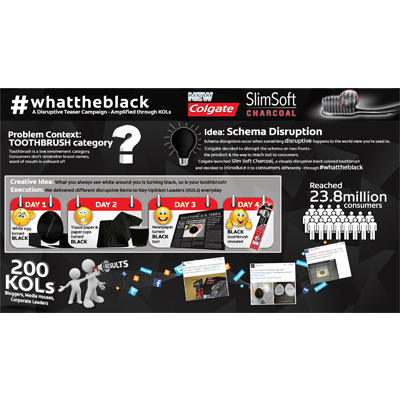
    The #whattheblack campaign, launched a few days before the announcement, was a unique approach to bring alive a category that often witnesses feature related communication. Going beyond traditional marketing techniques, through this campaign Colgate reached out to netizens for building advocacy. “For the first time the digital medium was innovatively used to launch a new product – through teasers, user generated content, creating conversations,” says the Colgate spokesperson.


    The campaign was conceptualised by Red Fuse Communications, WPP’s full-service integrated global agency dedicated to serving all of Colgate-Palmolive’s brands worldwide, and was executed by Candid Marketing.


    The insight which went into it was that toothbrush has traditionally been a low involvement category. Consumers don’t think or talk about it to others and the concept of word-of-mouth publicity has been non-existential in this category. However, with the launch of the new Colgate Slim Soft Charcoal toothbrush, unique opportunities have opened up, feels the brand and the agency.


    Black bristles in a category associated with white bristles is highly disruptive and this presented Colgate with an opportunity of creating brand visibility and advocacy through disruptive communication techniques. “To bring this alive, the approach was to generate curiosity and intrigue amongst the key opinion leaders. The objective of the campaign was to create schema disruption, leveraging the colour black. This was achieved by turning every day white items – such as eggs, newspapers, tissues – into black,” highlights the spokesperson while adding that the items were sent out on different days to media and key opinion leaders such as marketing professionals and bloggers across key metros without any mention of Colgate or the toothbrush. On the last day, the brand was revealed elaborating that the personal toothbrush has now turned black as well.


    All the campaign elements were tagged with the hashtag #whattheblack to further amplify visibility on digital platforms such as Facebook, Twitter and blogs. The campaign moniker #whattheblack through the digital platforms further assisted in developing user generated content.


    The campaign that was initially targeted towards 200 opinion leaders got amplified to 23.8 million consumers, a never before witnessed in this category.