Tag: WPP

  • Technology adoption makes banks lead ‘BrandZ Top 75 Most Valuable Indian Brands’

    Technology adoption makes banks lead ‘BrandZ Top 75 Most Valuable Indian Brands’

    MUMBAI: The slashing of corporate tax, from an effective 35 per cent to an effective 25.17 per cent, by finance minister Nirmala Sitharaman will translate into value increase for the brands working in the service sector, Kantar Insights Division chief client officer Vishikh Talwar told Indiantelevision.com on the sidelines of the “BrandZ Top 75 Most Valuable Indian Brands 2019” report launch in Mumbai on Wednesday.

    He said that there is a great growth potential for the top brands in the list and he is positive that by the next year, they will come up with even better performance.

    Introducing the key findings of the report, Talwar also noted that since 2014, not many brands have been able to earn consumer trust, which is one of the key driving factors that drive the brand in the list of most valuable ones.

    He indicated that it is necessary for brands to stick to their brand purpose to gain this consumer trust. “Brand purpose is more than just advertising. It goes farther. A brand will have to be very clear about what role it is going to play in a consumer’s life. It is not just about marketing people to be working on. The entire ecosystem within the organisation should be working towards serving that purpose. Cases in point are Swiggy and Zomato. It is the whole ecosystem which has to ensure, right from all the process, each of the process, each of the people in between, all their intermediaries, will have to ensure that they are providing the convenience of service and lifting the quality of life of consumers,” he added.

    Out of 75, 12 brands in the most valuable brands list are from banking, insurance, and payment sector, including the topmost HDFC Bank. Other names include LIC, ICICI Bank, Axis Bank, Paytm, and ICICI Prudential, among others.

    On being asked about why the category is dominating the list, Talwar said that that very simple reason for this is that all the names are great brands. “If you look at financial services in India, I think it is ahead of its counterparts in many other countries. The way they have adopted technology to serve the needs of the consumers, innovated their packages not just in terms of saving but equally in terms of loans, and how they have reached out to the end consumer, all of this comes together to make them the top brands.”

  • Brand-building for longevity and future growth becomes major focus for top brands in Brand Top 75 Most Valuable Indian Brands ranking

    Brand-building for longevity and future growth becomes major focus for top brands in Brand Top 75 Most Valuable Indian Brands ranking

    MUMBAI:–India’s most valuable brands, many of which have built their businessesthrough disruption, are now looking to capitalise on their achievements and invest in strategies for long-termgrowthand stability.This is a key finding of the sixth BrandZ™ Top 75 Most Valuable Indian Brands ranking, released today by WPP and Kantar. This year’s results revealed a 6 per cent rise in overall brand value to $228.2 billion, a moderate pace compared to previous years, given India’s recent macroeconomic challenges. Despite that, such growth is still in line with that of the BrandZ Top 100 Most Valuable Global brands, as India steadily rises in global economic rankings. 

    HDFC Bank, now ranked No. 1 for a sixth consecutive year,has demonstrated the rewards of maintaining a forward-thinking and innovative outlook,withits consistent focus on exceeding the changing needs of its customers. With new financial products, an ongoing drivetowards digital banking and new branches set-up throughout the country, the bankgrew 5 per cent in brand value to $22.7 billion. This is a positive contrast to the 8 per cent decline in value of the top 20 global banks .

    The BrandZ study, which is the only brand valuation ranking to combine companies’ financial data with consumer insight and opinion, shows that trust is key to develop the stabilityrequired for long-term success; highly trusted brands in the Top 75 are worth 129 per cent more than less trusted ones. 

    Trusted brands include many of the consumer-facing technology platforms and service providers. Despite owing their success to disruptive beginnings, these brands now also focus on activities to build trust such as ongoing and effective communications with consumers that generate comfort and familiarity with using the brand. With a 30 per cent increase in value, this sector was the fastest growing group of brands in the ranking.

    Notable brands include ecommerce site Flipkart (No. 12), which increased its brand value 14per cent to $4.7 billion, while unicorn brands hotel booking site Oyo($2.0 billion), online food ordering service Swiggy ($1.6 billion) and online restaurant marketplace Zomato ($1.0 billion) are newcomers to the ranking at No.30, No. 39 and No. 61 respectively.

    The fastest riser in the 2019 ranking is telecom provider, Jio, which climbed one place to No. 9 with a 34per cent increase in brand value to $5.5 billion.Itsdisruptive business model has made internet access available to many Indianswho were previously unable to afford it, thereby opening up access to digital platforms and services.Vodafone ($2.5 billion) meanwhile was the top-ranked newcomer at No. 24.

    Both digital and offlinebrandssuch as D-Mart (No. 25, $2.4 billion) have found success as a result of the rise of ‘middle India’; the growing number of people in the country’s second, third and fourth-tier cities and towns that are changing India’s traditional urban-rural divide.  These previously poorly-served segments increasingly have access to a variety of online services, with Swiggy and Zomatobuilding much of their growth on this shift.

    With an expanding choice of offerings to buy, Indian consumers increasingly care more about the quality of service than whether a brand originates in India, as long asit demonstrates that it understands what it means to be Indian. That insight is reflected in the decision by Amazon to launch itself a year ago as India’s ‘neighbourhood shop’.

    David Roth, CEO of The Store WPP EMEA and Asia and Chairman of BrandZ, says:“As India flexes its muscles on the world stage, it faces increased macroeconomic headwinds which have combined with a rise in global trade tensions to create a challenging environment.Successful Indian brands are adapting to these challenges andrecognising that longevity requires them to do more than just disrupt the status quo; long-term brand building requires new strategies that major on stability.”

    BrandZ Top 10 Most Valuable Indian Brands 2019

    Preeti Reddy, CEO South Asia, Insights Division, Kantar says “Consumer trust is a common thread among successful brands. However, it is concerning that only a few have succeeded in growing trust over the last five years. Those who done so, have done it through open and honest conversations with their customers. Brands would do well to consciously work at building consumer trust – it is the shield that gives a brand the resilience to face headwinds in uncertain times.”

    Vishikh Talwar, chief client officer, Kantar Insights Division, says: “The rise of ‘middle India’ combined with rapid growth of the mobile internet is providing unprecedented opportunities for brands.  But, with an almost overwhelming choice of products and servicesto buy, consumers are increasingly discerning; the Indian psyche requires that brands cater for local needs with offerings that genuinely improve daily life.  Today that’s as much about providing comfort and reliability as it is about generating new experiences.”

    In general, India’s top brands are taking a long-term approach to value creation. Over the past five years, a stock portfolio containing the BrandZ™ India Top 75 Most Valuable Indian Brands would have increased 33.8per cent in value. This compares to a rise of just 12.4per cent for India’s SENSEX, an index of 30 stocks on the Bombay Stock Exchange, demonstrating that valuable brands generate superior shareholder value. 

    Key trends highlighted in the BrandZ Indian Top 75 study include:

    Mobile internet access: Smartphone user numbers in India increased by 18per cent in 2018 (the fastest rate of growth in the world), mainly due to a combination of Jio’s own low tariffs and the renewed competition causing other telecom providers to reduce their rates.

    Buying power:Retail is the second fastest growing category, with online and offline both growing strongly. New entrantReliance Retail (No. 55, $1.1 billion)opened nearly 500 new stores and usedJio’s service to connect retail shops with grocery deliveries, while D-Mart ($2.4 billion) focused predominantly on offline, rising two places to No. 25.

    The Amazon effect:Amazon and Flipkart compete with many Indian brands across several sectors, with Amazon also opening its largest campus yet in India.  This has increased competition and driven brands to step up their operations to ensure they are meeting customers’ needs.

    A confident country: The success of unicorn brands such as Swiggy, Zomato and Oyo is fostering a new-found confidence in India.  This is augmented with the increasingly global outlook of these new brands as they actively seek to expand their operations outside India.

  • WPP and InMobi Group enter into a multi-year strategic partnership to co-build unique benefits for marketers

    WPP and InMobi Group enter into a multi-year strategic partnership to co-build unique benefits for marketers

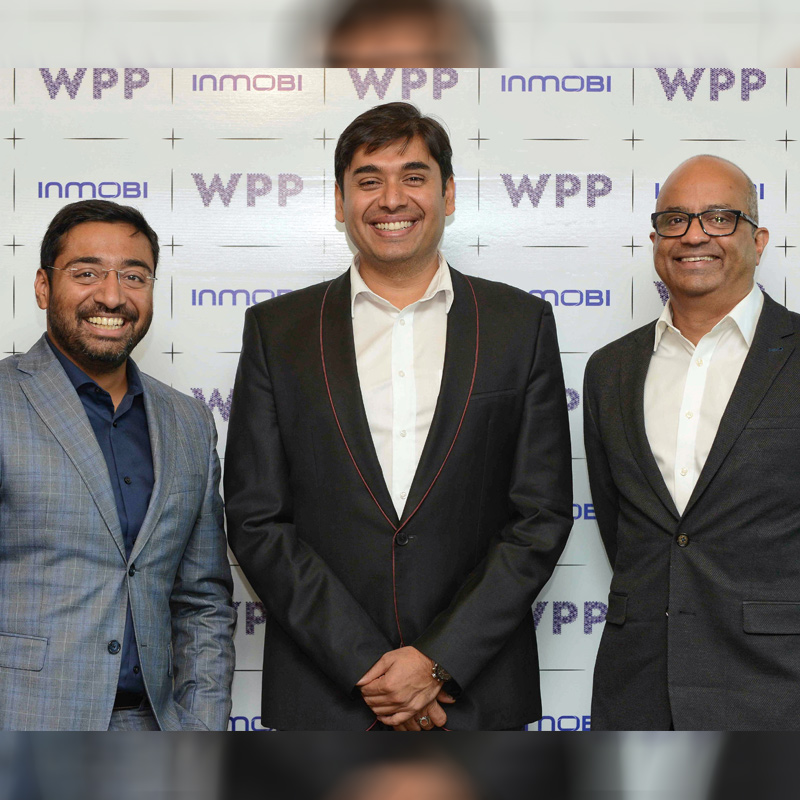
    Bangalore: WPP and InMobi Group have entered into a  long-term strategic partnership to build unique benefits for marketers. Leveraging the best of expertise from InMobi Group and WPP agencies, including GroupM and Kantar, the partnership aims to simplify complexity for Indian marketers.

    The collaboration between WPP and InMobi Group will enable brands to create personalized consumer experiences at scale. Through this partnership, brands will be able to translate up-to-the-moment insights into timely marketing action.

    WPP will provide in-depth expertise and a creative approach through four pillars – content, media, data and research. WPP’s GroupM will provide data-driven marketing and media planning with end-to-end audience insights integration and will also be sharing its unique engagement approach for in-app mobile content marketing. This partnership will also benefit from Kantar’s research insights, including recommendations that combine delivery, engagement and impact measures through media.

    InMobi Group will provide deep, mobile-first expertise across marketing software and media, data and consumer platforms. As a result of this partnership, brands will gain insights on and access to 200+ million mobile users in India through the InMobi Marketing Cloud, the only mobile platform to synthesize adtech and martech platforms. The InMobi Marketing Cloud includes Pulse, the world's leading mobile research platform and InMobi DSP, its in-app programmatic buying platform. Through Glance, the world's first screen-zero platform, brands will be able to reach more than 36 million Indian smartphone users on their lock screen. 

    CVL Srinivas, WPP country manager for India, said: "WPP's partnership with InMobi will simplify marketing processes for businesses. We recognize the challenges associated with managing and translating data insights into timely and relevant brand activity. Today's consumers are inundated with brand messages and we want to enable marketers to cut through the noise to provide their consumers with meaningful connections."

    "User journeys in a mobile-first world have become increasingly complex, and brands need an end-to-end solution that helps them to uncover and drive insights into action seamlessly," said Naveen Tewari, Founder & CEO of InMobi Group. "InMobi and WPP's strengths in technology and marketing expertise mean that we are best positioned to take the guesswork out of complex data and provide integrated solutions for brands to help them drive real connections with consumers."

    “WPP and InMobi have had a long-standing successful relationship,” said Abhay Singhal, Co-founder of InMobi Group and CEO of InMobi Marketing Cloud.  “We are thrilled with the evolution of this relationship into a strategic arrangement. We hope to co-create value for the entire ecosystem through innovation that leverages data, technology, media, and content.” 

    India represents one of the largest and fastest-growing consumer markets globally. WPP and InMobi Group's partnership will see both companies co-building more innovative mobile-first products for the future, to help position businesses ahead of the marketing curve.

  • WPP to launch two co-location campuses in India

    WPP to launch two co-location campuses in India

    MUMBAI: As part of its global growth strategy, WPP will invest in two co-location campuses in India. The roll-out will commence with more than 3,800 people moving into a new Mumbai campus in late August, while a Gurugram campus will be set up next year.

    All co-locations will support the WPP community with world-class facilities. The campuses include conducive spaces for talent to work and engage in collaboration and will also provide clients with easier access to WPP’s network of agencies.

    WPP CEO Mark Read said, “India represents a region with immense opportunities for WPP. We are committed to building further momentum for our businesses there, through our campus investments. Having modern, dynamic workplaces creates real impact for our people, and enables collaboration and ideas to thrive. We work with some of the most progressive clients and teams in India and we want to support their efforts in creating outstanding work.”

    WPP’s new Mumbai campus will be named BAY99, which alludes to the city’s historical roots and is also the campus’ postal code reference. Situated within The Orb, a brand-new complex next to the international airport in the Sahar area, the location offers various amenities, including convenient transport and social options. The Orb complex will also offer more than 40 dining and entertainment options within walking distance for staff to enjoy.

    In a first for WPP’s India offices, the co-location will bring together more than 16 companies under one roof, with a space of 380,000 square feet over a 10-year lease. On-site, staff will enjoy a host of modern facilities, ranging from a rooftop terrace, recreation lounge, library, cafeteria and more.

    Commenting on the new campus, WPP country manager for India CVL Srinivas said, “India is one of the most exciting markets for WPP with great growth potential. By investing in co-location campuses in key cities, we are bringing to life our vision to lead the market as a creative transformation company and to build a strong, cohesive WPP community. We support some of the biggest brand names in India and more than ever, clients want to be connected to easy processes and solutions, as well as a complete suite of services. The new campus means our teams will have increased access to each other’s expertise and this will go far in enabling our talent to do their very best work for clients.”

  • Mirum CEOs Hareesh Tibrewala & Sanjay Mehta on digital solutions and modern CMOs

    Mirum CEOs Hareesh Tibrewala & Sanjay Mehta on digital solutions and modern CMOs

    MUMBAI: Mirum, the borderless agency from the WPP network is on a venture to transform the digital marketing scenario of India into an experience-led domain led by great technological interventions. Earlier known as Social Wavelength, before WPP acquired it in 2014, the agency, under the astute leadership of founders and joint CEOs Hareesh Tibrewala and Sanjay Mehta is going leaps and bounds to make the Indian marketing campaigns stand at par with the global models.

    Tibrewala and Mehta, who make 40 per cent of the revenue from global clients, tell Indiantelevision.com that global clients are just a year ahead of us in terms of their requirements from the digital marketing agencies.

    Hareesh Tibrewala elaborates, “The focus on digital in India is still as a marketing medium whereas our global clients are using it to build more customer experiences. They have moved from ‘digital marketing’ to see ‘digital as a solution provider’. What it means is that you are looking at the consumer through the lens of every brand touchpoint and seek where you can add value. Complete customer experience is the focus.”

    Sanjay Mehta adds, “The difference this makes for us as an agency is that we are now looking at building full-fledged business solutions for the companies and not just one another creative campaign. We have a far more critical role to play. For example, the Mirum team in the US has created a product, which can retrofit in older cars to give them features like modern smart cars, for a telecom company.”

    He continues, “When you are playing such a big role as an integral part of the client’s business, you get more respect. You work directly with the CEOs and not just the brand managers and that also changes the way we (as agency partners) feel about our own work. It is good to feel that we are contributing to a larger solution.”

    Tibrewala and Mehta added that both the type of work and revenues from the western markets are better than what Indian clientele offers.

    Tibrewala says, “The difference is because of a few reasons. One is that we get better margins from markets abroad than in India, as they pay in dollars. Also, there the project terms are longer. For example, if we are working on a technology project, it might go on for a year or maybe two. It again boils down to the fundamental difference of digital marketing and digital solution provider approach that the clients have towards the agencies. The engagement levels are better there.”

    Mehta also shares similar views as he notes, “It is the whole rupee-dollar denomination difference that creates gaps in the revenue. Also, it depends on how much time you are taking in creating a digital asset. In the west, they are looking for that digital asset to move for several years. There the number of clients willing to invest in such digital properties are more and they invest more.”

    However, Mehta notes that Indian clients will take just a little time to bridge this gap in creativity. “The Indian client is evolving. Earlier the gap was bigger, but Indians are just a year behind their western counterparts. With technology, the world has shrunk and now the Indian clients have more exposure to where the world is going. There are quick learning and faster adoption. The kind of input that digital is giving into their business is definitely becoming more critical. So, the kind of work now Indian clients are expecting is improving significantly. In the past 2-3 years, it has grown much faster than you would expect.”

    Tibrewala adds, “The revenue gap, I feel, will bridge quickly. One of the reasons being global brands’ big investment in India. Plus there are certain sectors, for example, financial services, which are going completely digital-driven. Also, the Indian CMO is very literate now. They come with a lot of talent and understanding of the digital domain. Lots of companies, in fact, have created the chief digital officer profiles within the system.”

    Concurrently, Mehta feels while the CMOs of today are younger and are more willing to invest in technologies and work with agencies in creating path-breaking all-round solution-providing campaigns than just creative campaigns, it is quite complicated for them to get the budget approval from the management.

    He says, “If you may see five years back, there was little hesitation that Indian companies showed while adopting digital technologies. The reason was that people running marketing in these organisations saw digital as something that they did not know and they were apprehensive of taking the steps in this direction. Now, the CMOs are much younger and they know digital. With the workforce and clients becoming younger, the acceptance of digital technologies is much easier.”

    Mehta further adds, “Having said that, we also have to look at the role of CMO from just being the head of marketing to someone who also has to report to the management board. There is still a little baggage that they feel while working with these boards in terms of how you get the budgets across.”

    Citing the example of JW Marriott Hotels, which has worked tremendously well in utilising technology to create better customer experiences, Mehta says that an Indian CMO might also have the aspiration to do something on a similar scale but it comes at a higher price. “The aspiration is there, the interest is there but the budgets don’t flow at that pace. Large budgets are not easy to get sanctioned.”

    He clears that getting marketing budgets into digital is no longer a problem as it was a few years back, but companies are still hesitant in using transformational level budgets. Some of the reasons, he mentions, behind this lag is the legacy thought process of the management boards and lack of good Indian examples.

    “It is not as if we need thousands of crores for that. It is just a technology investment. So money is not the issue but belief and conviction are. If a CMO who was working with Rs 10-20 crore worth of budget asks for hundreds of crore suddenly, obviously, doubts will creep in,” Mehta points out.

    Mehta says that change is surely happening since some early-adopter brands are creating path-breaking stuff. “It just requires two or three really good examples to happen in the industry and the rest will surely follow as they just can’t not do this. It is a matter of survival.”

    Apart from this, the agency is now also trying to expand in the specialised verticals space, starting with the healthcare sector which has been somewhat laggard in adopting digital technology. But they can’t afford to not be present on digital now.
  • WPP announces proposed sale of 60 per cent of Kantar to Bain Capital

    WPP announces proposed sale of 60 per cent of Kantar to Bain Capital

    MUMBAI: One of the world’s largest advertising agencies, WPP, announced on Friday that it has entered into an agreement to sell 60 per cent stake in Kantar to US-based private equity firm Bain Capital. After severe turmoil in the last two years, especially after founder Martin Sorrell’s departure, the company is figuring out new ways to grow.

    “Kantar is a great business and we look forward to working with Bain Capital to unlock its full potential. As a strategic partner and shareholder in Kantar, WPP will continue to benefit from its future growth while our clients continue to benefit from its services and capabilities. I would like to thank Eric Salama, his team and everyone at Kantar for their tremendous contribution to WPP – a contribution that will continue as we develop the business together,” WPP chief executive officer Mark Read said.

    “This transaction creates value for WPP shareholders and further simplifies our company. With a much stronger balance sheet and a return of approximately 8 per cent of our current market value to shareholders planned, we are making good progress with our transformation,” he added.

    The proposed transaction of Bain Capital’s acquisition of 60 per cent of Kantar creates a strong partnership with WPP to accelerate the development of Kantar along with valuing it at c.$4 billion. WPP also highlighted that proceeds on completion, after tax and continuing investment in Kantar, were expected to be about $3.1 billion. It will further simplify and reposition WPP for growth, whilst unlocking significant value for shareholders.

    “Our new ownership structure presents a great opportunity for Kantar, our employees and our clients. In Bain Capital we have a partner who shares our ambition, brings relevant expertise and – with WPP – can help us accelerate our growth and impact for clients. We are focused on delivering ‘human understanding at scale and speed’ and the ‘best of Kantar’ more consistently. We will do so by investing more in talent and by becoming a more technology-driven solutions provider,” said Kantar CEO Eric Salama.

    “We believe that we are well-positioned to support Kantar, alongside WPP, in driving forward the business in a rapidly changing industry. Our deep sector knowledge, operational expertise and strong track record of partnering with management teams to accelerate growth gives us confidence that we can help Kantar grow both organically and by acquisition,” Bain Capital Private Equity managing director Christophe Jacobs van Merlen said.

  • WPP acquires AQuest

    WPP acquires AQuest

    MUMBAI: WPP today announces the acquisition of a majority stake in Italian technology-driven creative agency, AQuest.

    AQuest’s expertise includes innovative UX and UI design, production, consumer experience and activations for clients such as Gucci, Bulgari, Mercedes, Poliform and Smeg. Based in Milan and Verona, it employs more than 70 people.

    The acquisition is in line with WPP’s strategy to provide transformative ideas and outcomes for its clients through an integrated offer of communications, experience, commerce and technology.

    Deal terms are not disclosed.

  • WPP opens new campus in Amsterdam

    WPP opens new campus in Amsterdam

    MUMBAI: WPP today marked the opening of its new Amsterdam campus as it continued the roll-out of its global co-location strategy.

    Each WPP campus is designed to provide world-class spaces that bring together its people and agencies into one location, encouraging greater collaboration and giving clients easier access to all of WPP’s talent and expertise.

    Refurbished by WPP’s architectural and design consultancy BDG, the previously derelict Rivierstaete building has been transformed into a 19,000m2 modern working environment that will act as both an innovative workplace and community space for its 1,500 people in the city. VBAT, an international WPP design studio based in Amsterdam, worked with the agencies housed in Amsteldok to name the campus and develop the co-location’s new branding.

    Amsteldok, which was Europe’s largest office building when it was completed in 1973 by renowned architect Huig Aart Maaskant, will be home to 15 WPP agency brands that previously operated from 11 different locations. Located on the river Amstel, the striking, box-stacked structure will be a new centre of creativity in the heart of Amsterdam, boasting impressive new and renovated roof terraces, restaurants, a rooftop bar, a business lounge and an event space.

    At the official opening, Mark Read, CEO of WPP, said: “I’m delighted to open WPP’s Amsterdam campus, which demonstrates our continued investment in our people and commitment to the Dutch market, which is one of the most dynamic and forward-looking in the world. WPP campuses help us deliver a simpler, more integrated offer to clients by bringing great agency brands together under one roof and providing easier access to our collective talent. Giving our people modern, world-class working environments allows them to do their best creative work, it encourages closer collaboration and it’s an important part of building an open and optimistic culture at WPP.”

    To coincide with the opening of Amsteldok, today Hogarth (WPP’s global creative production network that combines technological skills and creative craftmanship) announced the creation of Hogarth Netherlands. As part of its renewed offer to clients in the region, and operating from Amsteldok, it will deliver end-to-end solutions using the very latest innovations in content production.

    Eric Kramer, WPP Netherlands Country Manager, said: “I’m incredibly proud of the regeneration of Amsteldok into both a fantastic new home for our people and a new creative and social hub for the city. We have an innovative and collaborative culture in Amsterdam, and WPP’s market offering, further bolstered by the creation of Hogarth Netherlands, is stronger than ever as we bring our brands together.”

    Redeveloping existing structures instead of constructing new buildings avoids the emission of thousands of tonnes of embodied carbon – equivalent to over 30% of the building’s lifetime carbon emissions. The new WPP campus has been developed with sustainability at its heart and is aiming for a BREEAM (the world’s leading authority in this area) rating of Very Good or higher. 

  • WPP appoints Cindy Rose as non-executive director

    WPP appoints Cindy Rose as non-executive director

    MUMBAI: WPP has announced the appointment of Cindy Rose to its board as a non-executive director. She has been working as the Microsoft UK CEO. Her appointment will be effective from 1 April 2019 and she will serve as a member of the Audit Committee.

    Rose became Microsoft UK CEO in 2016, with responsibility for all of Microsoft’s product, service and support offerings across the United Kingdom, continuing the company’s transformation into the leading productivity and platform company for the mobile-first, cloud-first era. Prior to joining Microsoft, Rose was managing director of the UK consumer division at Vodafone where she led the expansion of its retail store estate from 350 to over 500 stores.

    Before Vodafone, she was executive director of Digital Entertainment at Virgin Media where she was responsible for the launch of the company’s next generation pay TV platform powered by TiVo. Rose spent 15 years at The Walt Disney Company where she held a variety of roles including SVP and managing director of the Disney Interactive Media Group EMEA. In 2013, she joined the board of Informa, a FTSE 100 academic publishing and events company, as an independent non-executive director.

    Commenting on the appointment, WPP chairman Roberto Quarta said, “Cindy is one of the most admired and respected figures in the technology industry, and we are delighted to welcome her to the WPP board. Her deep understanding of the role of technology in business transformation will be invaluable as the executive team implements its new strategy for growth.”

    Cindy Rose said, “WPP has set out a bold new vision for its future as a creative transformation company, with a commitment to invest in talent, technology and culture. I look forward to supporting the team and making a contribution at such an exciting and important moment in the company’s development.”

  • Martin Sorrell eyes India’s untapped digital potential with S4 Capital launch

    Martin Sorrell eyes India’s untapped digital potential with S4 Capital launch

    MUMBAI: Advertising giant Martin Sorrell, who was made to leave WPP last year and later announced his next new venture S4 Capital, has made a new revelation. The company’s India operation is soon to be launched having found the country head. Sorrell made the announcement on the sidelines of the IAA World Congress 2019 that’s taking place in Kochi this year.

    The business will commence later this week starting off in the digital content side with MediaMonks, a company it acquired last year for $350 million. First offices here will open in Mumbai and Bengaluru. The country, according to Sorrell, has a vast untapped potential because of its inclination to traditional media and still growing digital side. “With the growth of fake news and political debates on platforms like Facebook and Twitter, there’s an issue of privacy which has worried the customers. Transparency in data is important in India,” said Sorrell.

    Though lagging in digital media, Sorrell said, “India will be the most populous business because of the talent, quality of people and high tech capabilities.” Media industries today are in a much better place than 10 years ago. “Our biggest clients are tech. Our recruits are really excited about technology. We are more attractive to the population than ever before,” he added.

    40 per cent of client budget today is in the digital medium with Facebook, Google and Amazon being dominant players. In India, WPP has close to 50 per cent of market share.

    S4 Capital’s focus is on data, digital content and programmatic media buying.