Tag: world sport group

  • Kabaddi gets a new life with ‘Pro Kabaddi League’

    Kabaddi gets a new life with ‘Pro Kabaddi League’

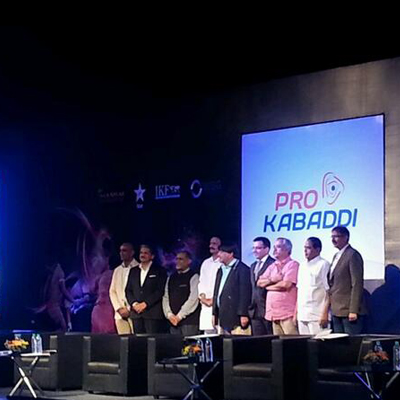
    MUMBAI: After various leagues around cricket, hockey, badminton, football and tennis, it was time for Kabbadi to make a foray. Not missing the opportunity to bring back the rustic Indian sport to the limelight, Mashal Sports and the International Kabaddi Federation (IKF) launched the Pro Kabaddi League at the National Sports Club of India today.


    The sport has progressed from being a loved Indian game to the international platform. The League aims to extend its reach further to the international arena by bringing Indian and international players along with acclaimed Indian personalities and sports authorities on the same platform.


    The official website www.prokabaddi.com will be a repository of information on all things related to Pro Kabaddi as well as Kabaddi in general while Star Sports will be the official broadcast partner for the League, the matches of which will be held on a ‘home and away’ format with daily, LIVE, prime-time coverage.


    Star India COO Sanjay Gupta said: “Our association with Kabaddi is in line with our stated objective of transforming the sports landscape and enabling the growth of a multi-sport culture in India. Pro Kabaddi will build an ecosystem that can potentially take this game to the next level. We plan to offer an immersive and engaging experience for the Kabaddi viewers.”


    Mashal Sports co-promoter Anand Mahindra, who will play a key role in taking Kabaddi to another level, tweeted: “Had asked you about supporting indigenous sport, specifically Kabaddi. Well proud to be a co-promoter of #ProKabaddi league we launched today.”


    During the launch of the league, he also stated: “A vibrant, professional sports league can bring about a transformational change for the sport and its players. Pro Kabaddi is our attempt at bringing this change to our very own, extremely popular sport of Kabaddi. The modern, international, competitive form of the quintessentially Indian sport is already extremely popular across the world and with good television coverage and passionate team owners; Kabaddi’s massive following has the potential to make it the next big thing in sport.”

    Mashal Sports MD and well known commentator, compere and quizmaster Charu Sharma, who is the force behind conceptualising and organising the league recalled how he was pleasantly shocked to see the power, passion and reach of Kabaddi while commentating during the 2006 Doha Asian Games. “I just knew, instinctively then, and more surely now, that modern, international Kabaddi has all the ingredients required to make it a major, visible force in the world of sport. I am truly grateful to the many visionaries who have made Pro Kabaddi possible,” he remarked.


    World Sport Group (WSG) is the official commercial and event partners of the Pro Kabaddi League that has seen significant franchisee interest. Already pledging their support as team owners are leading entrepreneurs such as Ronnie Screwvala, Rajesh Shah (Mukand Group) and Kishore Biyani. Advanced discussions are on with other corporate giants such as the GMR Group and Murugappa Group. Even Shah Rukh Khan is known to be interested in it.


    The league has been organised in association with International Kabaddi Federation, Asian Kabaddi Federation and Amateur Kabaddi Federation of India.


    All Pro Kabaddi League matches will be played on a specially developed mat in state of the art indoor stadiums across eight cities. Top Kabaddi players from across India and the globe will participate in a show of intense competition and sporting camaraderie. A 10-minute exhibition match between top players in an ‘arena-within-an-arena’ at the NSCI Indoor Stadium, Mumbai spectacularly showcased the fresh, exciting and international face of Kabaddi. 


    Ogilvy & Mather executive chairman and creative director South Asia Piyush Panday said: “Kabaddi is the ultimate combination of power, agility and tactics. It is one of India’s unique treasures and I am glad that we are able to present it an international stage in such an exciting format.”


    The matches will be preceded by a player auction, where each of the teams will get equal opportunity to build their squads. Almost 100 players will be auctioned, out of which 72 players will be Indian and the rest will be international players from Afghanistan, Bangladesh, Canada, England, Indonesia, Italy, Islamic Republic of Iran, Japan, Malaysia, Nepal, Pakistan, South Korea, Sri Lanka, Thailand, Turkmenistan, United States of America, Vietnam and Zimbabwe.


    The League is set to take the sport to a new level of prominence and ensure that stars such as Navneet Gautam, Rakesh Kumar, Ajay Thakur and Rajaguru are bound to become the new sporting heroes.


    Matches will be played as per the current international rules and regulations of the IKF. The Federation is also seriously considering making some small but significant changes to the game, to enhance its appeal on television. 


    Pro Kabaddi League, will have robust marketing strategies. Each franchisee will not only have their team colours and star players but also create their own fan following with innovative media outreach strategies. Sports enthusiasts, in India and across the world, can keep track of the matches, scores, and players as well as participate in the game through social media platforms such as the league’s website www.prokabaddi.com, Twitter handle @prokabaddi and Facebook page Pro Kabaddi.

  • World Sport Group partners ISM to represent Shiv Kapur in Asia

    World Sport Group partners ISM to represent Shiv Kapur in Asia

    MUMBAI: Indian golfer Shiv Kapur will now be represented in Asia by World Sport Group, a sports management company, which also manages the likes of Arjun Atwal and Daniel Chopra. WSG has inked an agreement with player management company ISM, the original rights holder to manage the 28-year-old former Asian Games gold medalist.

    ISM has partnered with WSG to oversee Kapur‘s affairs in Asia. Said Kapur, “I feel it is an appropriate time to work on the huge opportunities that exist in Asia and I think World Sport Group, with their vast experience in the region, are the ideal company to be associated with.” Apart from managing players like Jennifer Rosales and Marcus Both, WSG also promotes the Barclays Singapore Open, the Hero Honda Indian Open, the Thailand Open and the Australian PGA Championship among others.

    Averred World Sport Group vice president Golf Patrick Feizal Joyce, “Shiv Kapur is one of the most exciting Asian golfers in the game and has an extremely bright future. As his career goes from strength to strength, World Sport Group will work in tandem with ISM to ensure he has full support in Asia.” ISM‘s clientele includes Jeev Milkha Singh, Lee Westwood, Rory McIlroy, Ernie Els, and Louis Oosthuizen.

  • WSG to promote golf star Arjun Atwal

    WSG to promote golf star Arjun Atwal

    MUMBAI: World Sport Group (WSG) and Blue Giraffe Enterprises (BGE) have announced the creation of a relationship whereby the sports marketing company will exclusively promote and manage the affairs of Indian golf star Arjun Atwal in Asia.
     
    Atwal became the first player from India to win on the US PGA Tour this season when he triumphed in the Wyndham Championship and as his career goes from strength to strength, he is looking to solidify his support team.

    BGE CEO Bobby Kreusler said, “We feel that WSG is uniquely positioned within the Indian and Asian markets to exclusively assist us with promoting Arjun and effectively service these markets.”
     
    WSG VP golf Patrick Feizal Joyce said, “We are also really looking forward to working with Blue Giraffe Enterprises who are a new partner for us and one with which we hope to build a long and fruitful relationship.”
     
    Atwal finished equal fifth in the $1.25 million Hero Honda India Open yesterday at Delhi Golf Club and is looking forward to the new relationship.

    “I have played in many events promoted by World Sport Group over the years and have many friends there so I feel it is an exciting and sensible option to take. It is important for me to still play in Asia as much as I can as this is where it all started for me. World Sport Group have an enormous amount of experience here and I feel a lot can be achieved with such a strong partner,” said Atwal.

    The 37-year-old Indian’s last victory on the Asian Tour came in 2008 Malaysian Open, which was his seventh victory on the circuit. He topped the Asian Tour Order of Merit in 2003 before furthering his career in the US.

  • ‘One individual is not capable of running IPL’s complex business ecosystem’ : Brand Finance India managing director Unni Krishnan

    ‘One individual is not capable of running IPL’s complex business ecosystem’ : Brand Finance India managing director Unni Krishnan


    The Indian Premier League (IPL) is caught in the midst of a storm with dark clouds hovering over team ownership issues, sources of funding, corruption and match-fixing charges.


    Lalit Modi, the architect of the IPL, is being accused of holding hidden stakes in some of the franchises. Income-Tax sleuths have broadened their probe into the financial details of the IPL by conducting nationwide raids cut across Multi Screen Media (MSM), World Sport Group and the franchise owners.


    So how will these chain of events affect the brand value of the IPL pegged at $4.13 billion?


    In an interview with Indiantelevision.com‘s Sibabrata Das, Brand Finance India managing director Unni Krishnan says the risks for brand value erosion are significant if the IPL does not quickly put in place proper management systems and processes.


    Excerpts:


    With controversy swirling around the IPL, is there a need now to downgrade the brand?

    It is too early to take a call on this. The probe has started and we will have to wait for the government to come out with a final report on the investigations before we can comment on whether the IPL brand is fractured.


    But in our February report, we had cautioned that the IPL branded ecosystem is rapidly approaching an inflexion point. We had predicted this to happen in the next 6-10 months. This has come sooner than that.


    Surely, there are definite weaknesses regarding brand value governance and transparency, management systems and processes. But have we got a revised value of the IPL brand? Not yet.


    Does this mean that there is no brand erosion at this stage?

    The risks for brand value erosion are significant if things are not managed swiftly and the stakeholder relationships start weakening. But the truth is that the IPL is a very valuable brand created in a very short period of time. The wealth that can be created by the brand is going to be substantially significant for many stakeholders. A conducive ecosystem has to be created to move the brand to the next level.


    But will it be safe to say that the IPL brand has got tainted?

    The fault is not with the IPL brand. Some people are commenting that the property be nationalised. That is not how you run a global commercial property like the IPL. Iconic brands such as the IPL are national assets and a source of wealth creation. The question is whether we have the capability and determination to put systems and processes in place to manage one of the best brands we have produced. If we fail to do so, and all the allegations also turn out to be true, the brand will take a big knock.


    Enough dirt is thrown on Lalit Modi, the architect of the IPL. Now it looks like the man who created and built the IPL property would be thrown out. Will that not damage the IPL brand?

    Let us not confuse the individual called Modi with the business and the brand. One individual is not capable of running such a complex business ecosystem like the IPL. The need is to fix the weaknesses.


    Are you suggesting a proper balance of power system?

    As the architect of IPL, Modi has done a great job. But for such a large-scale property, we need 10-12 key members. We are not sure if the IPL governing council acts as a rubber stamp. We need to go through these questions urgently if are to create a sustainable brand property.


    The IPL brand is a set of complex relationships with fans, franchises, sponsors, business houses and players. This can create huge value in future if properly managed – not by one individual but by a system.

      
    ‘The IPL is a global commercial property produced from India. The unfortunate part is that if we don‘t do a clean-up action, we would be destroying it not due to any competition but because of our own action‘


    A fundamental problem being raised is that the revenues do not match the sudden flood of investments that have gone into the IPL. Are you worried about a possible nexus between the IPL organisers, the politicians, the big corporates and the Bollywood celebrities?

    There is an entry price to every business. Substantial investments are required and the revenue potential is huge. If there are misconducts like match-fixing and betting, then obviously the guy watching the game will turn off. So will sponsors. Years ago, when the first match-fixing charges were made, there was a brief period of lull. But that does not mean that cricket has died in India. The key question is governance and transparency.


    Is there inherent strength at the IPL franchise level?

    There has to be transparency at the ownership level too. Media reports are suggesting murkier deals. We don‘t know at this stage what is the truth. But sporting properties have to be run like proper businesses. Look at how the English Premiere League (EPL) has hurt itself. The club owners chased iconic players and made unrealistic purchases through a huge load of debt. Sports businesses can be lucrative but proper regulations have to be in place.
     

     Is the IPL an overheated economy?

    Is there value to be created? Yes. There are strong revenue and marketing opportunities.


    Most of the clubs, however, have not yet put the systems and processes in place to manage these opportunities. Take the licensing and merchandising (L&M) business which is pegged globally at $108 billion. This is not a Mickey Mouse number. Manchester United has 25-30 per cent of its revenues coming from L&M. But in India, this revenue stream is not visible in many of the clubs. We have to build the requisite bandwidth to monetise these opportunities.

     
    Is this a struggle between the old and the new India?

    As a country, we need to move away from intrigues and corrupt systems to a phase where we develop international properties. We can‘t run these properties with the same baggage as we move from a developing to a developed country. The tussle between the old and the new India will lead to pain and tribulations. But the fact is that we have created a positive property in the IPL which can provide sustainability in the long run for various stakeholders.


    People are seeing a new India through the IPL. This goes much more than cricketing business; it is about brand India. On a much broader level, IPL has demonstrated the coming of age of India‘s commercial prowess on a global stage.

     
    Does this remain as a dream at this stage?

    The developed world is looking at the IPL as a global property produced from India. The IPL has changed the very perception of India in the global stage. The unfortunate part is that if we don‘t do a clean-up action, we would be destroying IPL not due to any competition but because of our own action. The moment of truth has arrived for us. We have to face it with independence and courage. Can we live up to the expectations that we have created? It will be a sad essay if we don‘t deliver.

     
    How do we move the IPL up from one-third its value ($4.13 billion) to a level that it can sit along with the EPL ($12 billion)?


    That is only an indicative figure we have given to compare a property developed in one part of the world with another that has achieved maturity status. The IPL has hardly scratched the surface. It has a long way to go and a considerable value to realise before it lives up to its full revenue and brand potential.

     
    Brand Finance has more than doubled the brand value of the IPL from its first evaluation. What are the reasons for this?

    We are seeing a remarkable increase in revenues from broadcasting (as deal was renegotiated) and sponsorship. We have also considered the IPL‘s capability to draw in fans and viewership.

     
    Why have you upgraded Chennai Super Kings (CSK) to the top as the most valued IPL franchise (Rs 2.24 billion, up 35.5%)?

    There are 3-4 breakaway clubs. We have looked at teams who have managed cricket as a product and blended this with marketing and commercial excellence. The two performances have to be done simultaneously.


    CSK is beginning to put the various pieces together, synergising between their enterprise (India Cements) and their IPL business. We are also seeing Mumbai Indians show a remarkable revival this year, both in performance on the field and in their commercial activities.

     
     Why has Kolkata Knight Riders (KKR) slipped in your latest brand value estimate (Rs 2.13 billion, up 20.6%)?

    KKR topped in our first round as it has an iconic brand like Shah Rukh Khan. This gives it an undue advantage. But they are not able to exploit this to the maximum. Their performance as a cricket team has also been bad. If this trend continues over the next few seasons, then it will seriously erode the brand value of KKR.