Tag: World Cup

  • ‘Size of ready to eat market Rs 700 m.’ : Ravi Naware – ITC Foods Division CEO

    ‘Size of ready to eat market Rs 700 m.’ : Ravi Naware – ITC Foods Division CEO

    ITC Foods, the foods division of ITC Limited has built many brands and sub brands through aggressive advertising and marketing moves. This year the foods division is expected to add about Rs 10 billion to ITC’s annual turnover. ITC has recently announced the launch of their sub brand of biscuits – Sunfeast Sachin’s Fit Kit under their flagship and umbrella brand Sunfeast to coincide with the World Cup that will be played over the next few weeks in the West Indies.

    ITC Foods Division CEO Ravi Naware shared some insights into the various aspects of the business with Indian Television Dot Com’s Tarachand Wanvari. Excerpts from the interview.

    Excerpts:

    The promotion spends in the World Cup, what would be the proportion for them vis-?-vis your annual spends? You must have a separate budget for the World Cup. Could you share the figures?

    Of course, we have budgeted a specific amount for the World Cup. The World Cup is expensive so it’s a fairly decent percentage.

    You have said that a major portion of the World Cup spends budget will be towards promotion of Sachin’s Fit Kit, could you speak some more on this?

    I think if we don’t put money behind this brand, we’ll be doing a disservice to ourselves. We have launched the brand with Sachin’s name associated with it. On its own it’s going to be high profile from the reception point of view. I don’t mean that we are doing a razzmatazz kind of a launch. Sachin’s Fit Kit and the World Cup, the whole thing matches.

    How big is the ready to eat market?

    I really don’t have a number, because I find that the ready to eat market is not very well defined. You get tinned rasgollas. Will you include them in ready to eat? Some people do, because that is ready to eat, processed, cooked and packed. The definition is not very clear on that segment. If we stick to ‘so to say’ dinner table items, but then rasgollas can also be a part of the dinner table item, we’re talking primarily about vegetable curries, paneer, chicken, birayanis, dals, this is the kind of market we construct, then we have close to 48 per cent market share. But then you go and ask someone else, they are very likely to say that claim is too high.

    By your definition, who would be number two and three in the ready to eat market?

    No 2 would be MTR Foods, next would be Kohinoor. But then there could be disputes too, because I also make halwas like gajjar ka halwa, moong dal ka halwa, we include those. Comparatively, biscuits or soft drinks have become well defined markets. So you won’t include potato chips in the biscuit segment. You don’t include fruit juices with soft drinks. Its undefined, but not a huge category.

    What about your Kitchens of India brand of ready to eat? How does it compare with Aashirvaad ready to eat?

    Both would be about equal in size. Plus, we have a fairly large export market, which add a fairly large proportion to our sales. Only Kitchens of India are exported.

    So what is the size of the ready to eat market?
    It’s approximately Rs 600-700 million, the way we look at it.

    If you are building a branded business, the brand must acquire power, stature and then you can generate the consumer pool from that

    How are your Pastas doing?

    We’ve got some very, very loyal customers who are quite happy with the performance. We’ve launched Benne Vita. Many people know how to make good pasta sauce, but the pasta is difficult to make. Earlier one had to buy imported pasta, now they can buy our Benne Vita 400 gm pack.

    You are competing with Nestle’s Maggi in terms of noodles with your pasta? Has it reached anywhere near that stage?

    Well I suppose in terms of the mental space we are competing with Maggi. But we are small and Maggi is large. It is a different product, which by now is a fairly standard one. There are lots of unbranded noodles also available in the market, maybe a similar genre, because that’s become a very popular item. Others are also getting into it.

    Compared to the existing players, you are new, just four or five years into foods Aren’t you spreading yourself with so many products?

    In 2002, when we entered the food business, if you wanted to enter almost any food product you would have competition that had already established itself. Nestle had a fairly large range of products, they have been in India about 60 years, Parle is about 60-70 years old, Britannia has been around for almost a 100 years. Then take tea or coffee, you had Tata, HLL or instant mixes, there was MTR and Gitz.


    Pasta has been introduced by us for the first time in India. If you say that we compete with noodles, then noodles have been around for 25 years or more. We are late entrants which is a fact of life. And as a late entrant you don’t want to get into chocolates. Cadbury and Nestle are already there in that space. You name any category, dairy products – you have Amul and several others already there. In that sense, there was hardly any totally new “New category” where we could enter.


    We decided to enter into those categories where we felt that we had some inherent competitive advantage. For example, when we entered atta (wheat flour), we said that we’d leverage our entire e-choupal connection. Having entered into atta and this area, we thought that we would enter into the wheat vertical space. So we got into biscuits, we got into pastas, and there are other products ideas based on wheat which would be relevant.


    Through e-choupal we buy larger and larger quantities of wheat, and at that stage, there are scale economies which give us benefits, selectivity, we can choose the right kind of wheat for the right kind of product and so on. Secondly we got into confectionaries because India has 3 million cigarette selling shops. ITC was present in those shops for the last several decades. Most of these cigarette selling shops also sell candy. So we thought that we’d have that advantage in distribution.


    This is how we chose the broad categories that we would enter where we felt that we had some competence, some in-house capabilities.


    For Kitchens of India, we had all the great recipes from our hotels. So we could make a Dal Bukhara, we could make a Chicken Chettinad, we could make a Paneer dish and so on. That was how we selected the products, otherwise, for me it was impossible to find a completely new line that we could get into.

    Do you have advantages because of your e-choupal initiative?

    We do have some advantages, we are able to source wheat through e-choupal for our atta (wheat four). We are market leaders with 15 per cent market share in the branded atta segment, which is upwards of Rs 30 billion in India. The market size `is across all brands, not just the ones that advertise. This means regional brands too.

    So what about bread, that too is a wheat vertical, isn’t it?

    Bread is a very, very difficult industry. It also requires specialized distribution. Just having a distribution network is not enough. You need to have trucks that need to got out at 3 in the morning, then you go distribute the bread, on the return you collect money. There are spoilages in bread, maybe 10-12 per cent of the bread gets spoilt, the manufacturer has to take it back. It requires a completely different distribution channel and method.


    Pepsi and Coke were already into handling bottles and liquids, they have given out coolers to their retailers, for them it was a natural entry into drinking water. Their distribution and the storage at the retail end fitted in well with their existing setup so they could launch the Aqua Fina and the Kinleys drinking waters. We didn’t find that kind of synergy with what we had for bread. I think it’s a multi local industry or a national brand industry. Each locality has its own famous bakery.

    Over the five years that you have been here, are you satisfied with all genre’s of products, or do you feel that you could have done better somewhere?

    I am very happy and very satisfied with the progress. Of course some things move much faster, some move slower. I think in Sunfeast we have had a very good run so far. Today we’re clearly the number 3 player and there is a very apparent and a visible gap between no. 3 and no. 4. A year ago that gap wasn’t so very visible. Apart from a size of 8 per cent, I think Sunfeast as a brand has acquired a good standing, a good stature in the market and in the consumers mind. And that to me is a prerequisite for building a business. If you are building a branded business, the brand must acquire power, stature and then you can generate the consumer pool from that.

  • Raj TV in deal with Neo Sports for Bangladesh series

    Raj TV in deal with Neo Sports for Bangladesh series

    MUMBAI: In a first-ever deal, a sports broadcaster has tied up with a regional network to telecast live cricket in language feed.

    Neo Sports will supply Raj Television Network Ltd. feed in Tamil and Telugu for the India Bangladesh cricket series which kicks off on 10 May.

    The telecast will be on Raj TV and Vissa TV, the Tamil and Telugu channels. The cricket series comprises three one-dayers and two Test matches.

    The cricket feed will include the Neo Sports logo bug and will present an advertising opportunity for local advertisers and brands to ride on live India cricket.

    Says Neo Sports Broadcast CEO Shashi Kalathil, “Cricket viewership In Tamil Nadu & Andhra Pradesh is lesser than the Hindi Speaking markets while the overall consumption of local regional TV programmes is very high. It has always been our strategic intent to cater specifically to this large audience bringing value to both the viewer & advertiser.”

    Raj TV COO creative Raju Easwaran said, ” Cricket is the only true national passion which enjoys the same following across the length & breadth of the country. This innovation around cricket is sure to capture the imagination & fancy of the cricket lovers on Raj TV & Vissa TV. We expect unprecedented ratings on the back of our strong channel reach & penetration coupled with the viewer friendly regional commentary around what should be a very exciting series”

    “In what is now seen as a “fresh start” for Team India and in the backdrop of the World Cup result, the Bangladesh tour is also being billed as a revenge series of sorts, resulting in heightened interest nationally.”

    Meanhwhile the live coverage on Neo Sports will include a pre, mid and post match show specifically targetting the youth viewer, called Extra Cover. It features talent like Rohan Gavaskar and Hrishikesh Kanitkar for the first time on international cricket broadcast. Adding a further dimension to the coverage, Neo Sports has signed two well known TV anchors Archana Vijaya and Neha Sareen.

    While Archana would bring to the fore, the pulse of the Indian cricket fan via interviews, vox pops etc. Neha will demystify the statistical aspects of the game with her inherent flair for numbers, being an economics graduate from Ohio University. All this, in a first for Indian sports television, will be enhanced with cutting edge virtual graphics using the very latest that technology can offer, now available to Neo Sports at their new virtual studios at Malad, Mumbai.

  • Its ‘focus India’ for BBC World this March

    Its ‘focus India’ for BBC World this March

    MUMBAI: BBC World launched its first ever India focused brand advertising campaign on 16 January this year and has followed this up with a wide variety of India focused programmes this March.

    The news channel has constantly maintained that India is its first market for region specific programming and the channel continues to focus on this region through mini series, interviews and perspective stories- the latest being its coverage on the Indian Budget.

    Starting 6 March, BBC World will air its mini series Take Off on Indian civil aviation. The documentary series talks to leading industry experts about the recent developments in the aviation sector and analyses the trends.

    While the channel has in the past looked at Indian IT and auto sectors, we asked BBC World Commissioning Editor Narendhra Morar why the special focus on aviation sector.

    Says Morar, “The aviation industry in many ways symbolises globalisation, given that it’s all about connecting people and places the world over. And the aviation industry in India is a very good metaphor for India’s increasing integration into a globalised world economy. It is also a dynamic and rapidly expanding sector. For all these reasons, we felt India’s aviation industry was an important one that can shed light on many aspects of India’s growing economic importance in the world, a development that is being closely followed by businesses and governments the world over.”

    On choosing Miditech to present this documentary series, Morar explained that the comfort level was largely in place having worked with the production house on various other shows and series in the past.

    “We have worked on several series with Miditech, including another business series entitled Call Centre. Miditech have the requisite skills and resources to produce a series that meets BBC standards. The series has interviewed a vast variety of people including the Minister of Civil Aviation, the heads of private airlines such as Jet, Kingfisher and Spice as well as previous entrants who subsequently withdrew from the market such as Damania. This is probably the most comprehensive examination of India’s aviation industry,” he adds.

    He also explained that Take Off could well be one of the biggest series’ the channel has commissioned with a large number of teams in Delhi, Mumbai and Bangalore contributing to the making of it. “Given that there are continuing developments in the story of Indian aviation, filming has in fact not been completed. Additional filming has and will continue to be done to ensure that the story is as current as is possible. As BBC World’s commissioning editor, I take a very close interest in the content and am in constant dialogue with the producer on each episode of the series. It is a true collaborative process between BBC World and Miditech,” he says.

    Take Off is just the start of the channel’s India focus. Another show Peschardt’s People, which began airing from 3 March, sees Michael Peschardt touring the Asia Pacific region even as he catches up with people and issues that matter in the particular country. Peschardt’s stop in India will see him explore the appeal of Indian films and a conversation with Bollywood actor Preity Zinta. The actress was earlier roped in by BBC news online to write a regular column for their news website.

    But the flavour of the month is cricket with ICC World Cup Cricket on in full swing by the latter half of the month. And like other news channels, the BBC is also doing the cricket tango with shows like Sport Today and Extra Time.

    Morar also spoke about the other World Cup initiatives by the channel. “Following the success of the interactive programme My World Cup during the Football World Cup in 2006, BBC World will be launching My Cricket World Cup to run throughout the tournament. A twice-weekly show presented by Adnan Nawaz, it will feature regular cricket fans and armchair commentators from across the world. Those who wish to interact with Adnan can do so live via webcam, email or mobile, giving them a chance to have their say about the tournament, games, teams and players.”

    Morar admits that BBC World “has always had a strong affinity with the Indian market and Indian audiences and we also remain firmly committed to output covering India in all its myriad manifestations. There has always been a historic link between the BBC and India and in that sense what we are doing now is simply a continuation of this connection.”

    BBC World has maintained that outside Europe, India is the single most important market for the news channel. The competition from national news channels, especially the addition of English news channels and the CNN-factor, have made BBC World take a re-look at their programming and bring in a stronger Indian perspective. The channel can no longer use the garb of historical connections and will have to work aggressively to compete in this key growing market.

    But Morar brushes aside this fact by stating, “Competition from other broadcasters is not only a fact but is to be welcomed as it enables us to give off our best.”

  • Sony to offer interactive feed for World Cup in DTH, Cas homes

    Sony to offer interactive feed for World Cup in DTH, Cas homes

    MUMBAI: With the World Cup scheduled to kick off later this month, Sony is ready with a few plans up its sleeve. One of these involves adding a value added feed for direct-to-home (DTH) and Cas (conditional access system) subscribers.

    Addressing a media briefing this afternoon Sony Entertainment Television (SET) India CEO Kunal Dasgupta says that the channel is looking at having two angles – stumps and mid wicket. They are also looking at making this interactive feed available in Cas homes. “The coverage from different camera angles will help DTH. We are also in talks with multi-system operators (MSOs) to offer this to their set-top box subscribers,” Dasgupta adds.

    SET India has sold out its entire inventory for the World Cup and expects an all-time high audience for the big event with the matches favourably positioned for prime time viewing in India. The company had earlier indicated that it was targeting Rs 5 billion in ad revenues from the ICC Championship and World Cup.

    The matches will not be shown on flagship Hindi general entertainment channel Sony TV (they will be telecast on Max, Sab and Pix) as the cricket telecast will disrupt viewing of its tradional programming content. Instead, the movie list on the Sony channel will be enhanced during the World Cup.

    “We are in the process of rebuilding Sony TV which has slipped from its number two position. When we put up matches on the channel in the last World Cup, we suffered. We won’t make that mistake this time. We are getting Indian Idol back and in the coming three to four months we will be coming out with new shows that we are confident will see the channel move up,” says Dasgupta.

    Sab TV, which Sony acquired to have a two-channel strategy in the general entertainment space, will be relaunched after the World Cup.

    In terms of viewership, Dasgupta says that the number of C&S homes have more than doubled from 32 million when the previous World Cup took place in 2003 in South Africa. DTH platforms will also give a boost. “There is a strong lead in which was not the case in South Africa where matches started at 2:30 in the afternoon.”

    He adds that this time there will be a lot of out of home viewing as the match starts at 7 pm. Already 70 organisations have asked Sony for permission to air matches during parties. “Places like Goa will have a carnival atmosphere. The trend will be for people to watch matches till late in the night. The World Cup will really kick off from 23 March when India plays Sri Lanka.”

    Dasgupta, however, was critical of the high acquisition cost for cricket properties. “As a standalone, it is a loss leader in the portfolio. You take it to boost other areas of the network like distribution and weaker properties.”

    In terms of ad revenue Sony recently came out with a 12 match package for spots. This involves the India games, the semi finals and the final. The other spots package it offers to advertisers is for the final 27 matches.

    Doordarshan will get to telecast 19 (including the India contests, semi-finals and final) out of the 51 World Cup matches.

  • Tata Sky in marketing drive with Hrithik Roshan for World Cup

    MUMBAI: Oye Pappe, Watch the final with me!
    That is the message that actor Hrithik Roshan is conveying to cricket fans ahead of next month’s cricket World Cup. DTH service provider Tata Sky has tied up with the Bollywood heartthrob and is looking to spread the awarenes of its association.

    The DTH platform is running a contest that gives 50 people and their families a chance to watch the World Cup final with Hrithik on 28 April in Mumbai. This is open to those who have bought Tata Sky before 15 April 2007.

    In terms of the deal, Tata Sky MD Vikram Kaushik says that the firm is only using the star for the World Cup. Tata Sky would likely have shelled out around Rs 17 million to get him on board, industry sources indicate.

    Tata Sky is using radio, print, TV to create awareness among fans about this association. In the creatives Hrithik communicates directly to the fan.

    For instance, in the print ad, Hrithik talks about the advantages of Tata Sky’s Active Sports service. “Experience stadium like magic in the living room just like I do. Trust me. There is no better way of watching cricket.”

    One just has to answer the question of what Hrithik’s first film was as a lead actor. The choices are Krrish, Kaho Na Pyaar Hai and Yaadein. One can then send an SMS to 7827 along with the subscription id.

    In the ad Hrithik also talks about enjoying features like a choice of commentary languages, multiple camera angles, highlights and statistics.

    Tata Sky is also offering three months free subscription upto four television sets in a home.

  • ‘Higher price cap than Rs 5 would have allowed us to play within that float’ : Anuj Gandhi – SET Discovery president

    ‘Higher price cap than Rs 5 would have allowed us to play within that float’ : Anuj Gandhi – SET Discovery president

    SET Discovery has been riding high on the wave of ICC cricket for over four years. Having the ICC Championship and World Cup in a single year, the company is targeting a 40 per cent growth in turnover to end 2006-07 at Rs 4.5 billion.


    In an interview with Indiantelevision.com’s Sibabrata Das, SET Discovery president Anuj Gandhi talks of the challenges digital cable faces and how the distribution scenario would shape up in future to impact the pay-TV broadcasting business in India.


    Excerpts:

    Are you happy with the way Cas has rolled out so far?

    We are terribly disappointed. The multi-system operators (MSOs) were not fully prepared. Their systems were not in place and there weren’t enough set-top boxes (STBs). Some operators were even providing boxes without smart cards.

    MSOs say broadcasters created an uncertain environment till the end by approaching the courts. Isn’t it true that they got very little time for actual preparedness?

    There was enough indication that Cas would happen. We were challenging the pricing and not introduction of Cas. Broadcasters signed their contracts with the MSOs on time. Some local cable operators (LCOs) who were against Cas, moved the courts but could get nothing in their favour. If Cas has to take off, this blame game has to stop. All the stakeholders have to play their role.

    Is it a case of low consumer demand for boxes?

    That is a separate issue and, if need be, can be tackled with different marketing schemes. We are in a situation where the MSOs aren’t quite ready. There is lack of information flowing into us, the subscriber forms have not been filled up, and in some Cas markets analogue signals are available of popular general Hindi entertainment channels in prime time.

    Why then couldn’t this market substantially move to direct-to-home?

    DTH is more expensive. It has a higher entry price and there is no big subsidy on the STBs. Besides, DTH operators took time to service this market. With cable operators not capitalising heavily on Cas, we have lost an opportunity to create a build up for a massive ramp up in demand for STBs at the time of the World Cup.

    Will the World Cup drive a 40 per cent penetration in STBs as predicted by some positive analysts?

    We see the World Cup acting as a catalyst and expect the STB penetration to touch 45-50 per cent in the Cas markets. Only when we reach that level can all the stakeholders make money. Already DTH service providers Tata Sky and Dish TV have announced their schemes for the World Cup. MSOs should also be sorting out their issues and coming out with a plan for the big event.

    Is SET Discovery targeting a revenue of Rs 4.5 billion in 2006-07 on the back of the World Cup?

    We have set an aggressive target this year and are going to hit it. We will benefit from key cricketing events like the ICC Champions Trophy and the World Cup. Besides, we had cricket on Ten Sports. For the first time, we would be capturing revenues from DTH as we signed up Dish TV and Tata Sky during the year.

    Will Cas affect the business?

    In the overall scenario, Cas has a very limited number of cable and satellite homes. Besides, Cas has come into effect only in the last quarter of the fiscal.

    Do you see broadcasters dropping prices of their weaker channels in a bid to push sale of STBs?

    With a price cap on a la carte channels at Rs 5, it won’t make business sense to further drop rates. The whole justification for this is to have higher volumes. But we could have got the current levels of box penetration with a more liberal pricing.

    DTH growth for the last six months has been as we had expected. It is only digital cable numbers which have been disappointing

    Are you suggesting a price ceiling but at a higher rate?

    This would have allowed us to play within that float. We could have weighed the weaker channels, observed their relative strengths in the marketplace, and come up with a differential pricing while staying competitive. The whole subscription model at Rs 5 doesn’t give us scope for such pricing play and is unfair to niche channels. There is precious little that content providers can do and dropping prices would be bad for the MSOs as well. Besides, we haven’t yet got any billing data from the MSOs on the Cas subscribers to chalk out a strategy.

    Are you planning to take any action as the deadline has crossed?

    It should have come to us by 15 February, but we haven’t received any information from them yet. If we don’t get any feedback from them in the next few days, we will issue them notices as specified by the Telecom Regulatory Authority of India (Trai) in order to safeguard our interests.

    Trai is trying to push for voluntary Cas. How do you think this can speed up in other parts of the country?

    Digitisation is a reality but will take a while to happen. Cas has been a learning process and we have to evolve a phase-wise strategy for digitalisation. We have to fix a sunrise and a sunset date where we have to give adequate time taking into account availability of boxes, prices and investments by MSOs.

    MSOs are saying that broadcasters should be more understanding and not ask for more subscribers in voluntary digitalisation as the collection of money from the LCOs doesn’t improve. Isn’t entering into commercial agreements between MSOs and broadcasters crucial for the success of voluntary Cas?

    The analogue and the digital markets have to be distinguished. The MSOs can’t argue that they can’t recover money and so can’t pass it on to us. Then how will broadcasters make money from voluntary Cas? There has to be some incentive for broadcasters to push for digitalisation.

    In the newly notifuied Cas market, we are seeing a three-MSO play. Do broadcasters welcome such a strong wave of consolidation?

    There shouldn’t be a problem so long as the business is transparent. If there was one monopoly player emerging in the cable TV distribution arena, then it would have concerned us. Besides, the market is large enough for other players to emerge. And the independent operators who have aligned with the MSOs would continue to remain as franchisees. We don’t see them disappearing from the chain.

    Will carriage spread to new towns where Tam has expanded its reach?

    It is too soon to say how carriage will impact in Tam’s new panel. A lot will depend on how the channels are getting affected. The market has more or less stabilised. Broadly, however, as ratings towns get added, carriage will move there. But I don’t see budgets of broadcasters towards carriage really bloating. What would happen is that they would be picking and choosing the places where they want better placement and carriage.

    When do you see DTH significantly contributing to the kitty of the pay-TV broadcasters?

    It will take DTH a while for getting those numbers. But it has certainly started impacting the business because MSOs are having to think twice before blacking out channels so that they don’t upset their subscribers. And DTH growth for the last six months has been as we had expected. It is only digital cable numbers which have been disappointing, but we will soon see that changing too.

    SET Discovery will have no cricket to play with in the next fiscal while in the GEC space, Sony TV is dropping in ratings. How tough will it be for the company to post growth?

    Cricket, no doubt, is a big play in India. In a MSO market, you can still do with no big impact hitting us. But when you go down into the interiors, this is the only driver. We have grown rapidly for over four years on the back of cricket. We will try to maintain what we have and ask for realistic increases. But we have no channel as such that will make carriage on cable networks a problem; there is strength in our bouquet.

  • Maruti in $ 1 million sponsorship deal for cricket World Cup website

    Maruti in $ 1 million sponsorship deal for cricket World Cup website

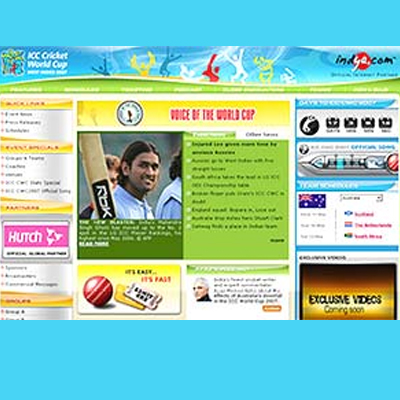
    MUMBAI: ICC internet partner Indya.com kicked off its campaign for the globe’s biggest cricketing carnival with the official launch today of its World Cup dedicated website cricketworldcup.com.

    The launch coincided with the confirmation that car major Maruti had come on board the site as presenting sponsor for cricket’s headline event. In what is being termed as the biggest online advertising deal negotiated in India in recent times, Maruti has committed somewhere in the region of $ 1 million (Rs 450 million) for the privilege of owning “most of the real estate” on the site, sources close to the developments say.

    Ajay Vidyasagar, Star India executive vice-president content and communications, while refusing to offer any comment on the size of the deal, said: “Maruti has made a significant investment in partnering with us and this is the only engagement we are announcing for the present.”

    “Maruti has always been at the cutting edge of technology and have always been open to explore and experiment with new ideas,” NDTV Media CEO Raj Nayak, whose company has been given the mandate to sell advertising for Indya.com for the World Cup, said. “I think this is a testimony to the power of the worldwide web,” Nayak added.

    It may be recalled that earlier, the sponsorship packages on offer involved one presenting sponsor and four associate sponsors. This has all changed because the size of the deal Indya has negotiated with Maruti. There will now be far less inventory available for other potential sponsors than had been originally envisaged, Vidyasagar explained.

    Speaking about cricketworldcup.com, Vidyasagar said, “We are committed to provide the most comprehensive and definitive website of the game during the tournament and assure our users an online experience that they will find unparalleled.

  • Dishtv, Tata Sky plan schemes for World Cup

    Dishtv, Tata Sky plan schemes for World Cup

    MUMBAI: DTH service providers Dishtv and Tata Sky will use the upcoming cricket World Cup to entice their viewers and increase subscription numbers.

    Dishtv has come out with a World Cup For Free offer. It has come out with a special world cup promotional pack at Rs 3990, all inclusive with six months subscription free. This also includes dishtv’s sports active services free for the same six-month period. The offer is being introduced by the dishtv mascot who entices the viewer with his histrionics and invites them to this unique experience only on dishtv.

    Dishtv is positioning itself as offering active services that enable a better than stadium experience for the viewer. Besides digital picture quality and stereophonic sound, viewers will have value added controls.

    The matches can be viewed with multi-camera angles. Subscribers can watch a match through three different camera angles – the main feed, the square leg and the third which will be a mix of stump cam/high wide shot.

    Language Feed: The dish subscriber will have the opportunity to hear the commentary from a choice of five languages – English, Hindi, Tamil, Telugu and Bengali along with a live stadium ambient sound.

    Highlights: Match highlights, i.e. all wickets and key shots like – 4’s, 6’s will be available to the dishtv viewers at the press of a button whenever they want

    Statistics: The dishtv subscriber will have access to a stupendous Amount of cricketing data like team line ups, score cards, in-depth history of the players, their past records and so on again on their TV screens merely at the touch of a button.

    The firm says that subscribers will get the Sports Active services at no extra cost that would otherwise cost Rs. 25 per month.

    Dishtv CEO Arun Kumar Kapoor says, “Cricket is like religion in our country and the Cricket World Cup being the biggest opportunity to delight the consumers. With the advent
    of active services and new consumer offers available in the market, the subscribers have a win win situation. dishtv has always worked towards maximising its viewer’s delight and will continue to do so”.

    Commenting on the caricature launched by, dishtv to flag off the World Cup campaign, dishtv VP marketing Anjali Malhotra says, “The mascot lends a face to the brand that is warm, consumer friendly and trustworthy. Moreover he seems to simplify an otherwise perceived technology product apart from adding an element of fun to our communication as we are but, an entertainment provider to Indian homes. We are sure that the consumers will warm up to him.”

    As far as Tata Sky is concerned the company’s MD and CEO Vikram Kaushik says, “Tata Sky is offering free subscription for three months and has roped in actor Hrithik Roshan for its new marketing campaign.”

    He explains that as part of this campaign select viewers who have subscribed before 15 April will get to watch the World Cup final match with him. In adition the company is extending the free pricing policy to the second, third and fourth television set within a consumer’s household.

    “The new marketing campaign is a step to reach one-million subscriber base by the end of this year. We expect phenomenal subscription during the World Cup.”

  • Indya.com gears up for cricket World Cup

    Indya.com gears up for cricket World Cup

    MUMBAI: Played with passion! Followed with obsession!

    With the cricket World Cup scheduled to kick off in less than a month’s time indya.com, which is running the official website www.cricketworldcup.com as the International Cricket Council’s (ICC) web partner, is starting to make a push.

    The site officially launches on Monday, 26 February.

    Information available with indiantelevision.com indicates that one presenting sponsor and four associate sponsors have been signed up so far for this year’s highlight cricket event.

    It was last year that Star inked a deal with the ICC to run its sites for the Champions Trophy and next month’s World Cup. Indya.com business head Sumant Kasliwal claims that its Champions Trophy site got three million unique users. In total there were over a billion hits, a lot of which, not surprisingly came from India. One million downloads took place and there were 100,000 registered users.

    For the Champions Trophy the site got 230 million page views. Kasliwal says that for the World Cup the site is expecting a billion page views during the event. “Our application Matchcast (which is a scorecard) has been expanded upon. It will be interactive. The aim is to give the consumer a complete experience. One can get match highlights, fall of wickets package, interactive contests. There will be live chat during the game. Users can comment on the state of the game. Our video content will include highlights from the previous World Cups. Other sites (as per the ICC diktat) are not allowed to show cricket videos.”

    Kasliwal also mentions another application – the Simulator. The visitor can view a graphical representation of what is happening ball by ball. He says that from a technological point of view it is a challenge. For each over two dozen parameters are taken into account. The recording takes place on the fly.

    There will also be expert analysis of each match. Prominent names are in the process of getting signed up. There will also be interviews with players and the captains. For the captains there is a section Captainspeak. Kasliwal says that it is in the process of tying up with speakers.

    It is also doing an interactive Voice Of the World Cup initiative. The contest kicks off next month. Here a clip of India’s match versus Pakistan in the previous World Cup is featured. Sachin basically hammers Shoaib. One can visit the section and provide a commentary recording. The winner who will be chosen by the public and a team of experts gets to do commentary for the semi finals and the final for the site.

    The site will also have a picture gallery courtesy gettyimages. For fun one can participate in games. One game that will shortly be launched is called Pick The Score. This is a prediction game and one has to guess scores. There will also be a fantasy game. Here one chooses a dream team for each match and one scores depending on how well the individual players are faring.

    The site will also have quizzes, an ICC contests suite. There will also be pages dedicated to teams and players, merchandise that can be ordered. In some countries like New Zealand, Hong Kong, Korea, Germany, France the site will offer for a fee live streaming of matches. In India highlights and the other earlier mentioned features will be given for free.

    GroupM COO South Asia Vikram Sakuja says that at first the agency was not sure how the product would turn out. However he is happy that for the Champions Trophy the site got a quarter of a billion page views. “I am glad that GroupM saw this potential and got some of our brands like Lufthansa to work with this exciting media offering.”
     

  • Radio One tickles the funny bone this World Cup

    Radio One tickles the funny bone this World Cup


    MUMBAI: As the World Cup draws closer, FM stations have gone ahead full throttle to grab a slice of the cricket pie with innovative non music programming and on gound activities.

    Radio One 94.3 and BBC also promise contests and laugh-a- minute segments and loads of entertainment in the run up to World Cup. The FM has produced a soundtrack for the Cricket World Cup called ”Dhoom Machale Cup Uthale’ composed by DJ Suketu with vocals rendered by Shaan.

    The FM which is a joint venture between Mid Day Multimedia and BBC World will also feature BBC updates on the match with expert analysis from former cricketer Mohinder Amarnath. Another feature BBC World Cup Golden Moments will air commentary from the past World Cup matches including the World Cup 1983 matches.

    Radio One’s World Cup coverage leans heavily towards spoof with Paaji on the Beach, Hey Azzar Bhai , Chalo West Indies and Tommy Singh.

    .As part of its on ground activity the FM will have a branded float taking the message of World Cup fever to the streets that will move around colleges, malls and other youth hangouts.

    An on air contest has the listeners predict who will win the toss and the lucky winner will win a gold coin daily.