Tag: workforce

  • The impact of the gig economy on the Indian workforce

    The impact of the gig economy on the Indian workforce

    The gig economy has emerged as a transformative force in India, fundamentally altering the way people work, how businesses operate, and the structure of employment itself. Characterized by short-term contracts, freelance work, and flexible working hours, the gig economy provides an alternative to traditional full-time employment, and it is reshaping the Indian workforce at an unprecedented scale.

    With the proliferation of digital platforms like Uber, Zomato, Swiggy, and Upwork, the gig economy is rapidly expanding, offering a range of opportunities across various industries. While it presents significant advantages like flexibility and income potential for workers, it also raises concerns about job security, benefits, and long-term financial stability. As India positions itself as a major player in the global economy, understanding the impact of the gig economy on its workforce is crucial for the country’s socio-economic development.

    Rise of the gig economy in India

    India, with its large and young labor force, has witnessed an exponential rise in gig work over the past decade. According to a report by the Boston Consulting Group, around 15 million people were engaged in gig work in India as of 2022. This number is expected to grow substantially as more individuals opt for freelance and contract-based work over conventional employment.

    Several factors have contributed to the growth of the gig economy in India. The rapid penetration of smartphones and internet connectivity has made it easier for people to access digital platforms that connect gig workers with employers. Moreover, changing attitudes toward work, especially among millennials and Gen Z, have led to a preference for flexibility, autonomy, and the ability to work on multiple projects rather than committing to a single employer.

    Additionally, the COVID-19 pandemic accelerated the gig economy’s growth, as many traditional businesses were forced to adapt to remote work and embrace a more flexible workforce. Companies, especially in sectors like food delivery, e-commerce, and IT services, turned to gig workers to meet demand surges, further driving the shift towards non-traditional employment.

    Benefits of the gig economy for workers

    One of the primary attractions of the gig economy is the flexibility it offers. Workers have the freedom to choose when, where, and how much they want to work, which is especially appealing to those who value work-life balance. This model also provides opportunities for individuals to explore diverse skill sets, take on multiple roles, and earn income from different sources, all without being tied to a full-time job.

    For many people, the gig economy serves as a means to earn supplemental income, whether they are students, homemakers, or professionals looking for extra work. In regions with limited full-time job opportunities, gig work allows individuals to tap into the global market and secure freelance projects, reducing regional employment disparities.

    Furthermore, the gig economy has been instrumental in promoting entrepreneurship, especially among the youth. Many young workers are now able to start their own businesses, offer specialised services, or work as consultants, thanks to the ease with which they can connect with clients through digital platforms.

    Challenges for gig workers

    Despite its advantages, the gig economy presents several challenges, particularly around income stability and job security. Gig workers often lack access to essential benefits such as health insurance, pensions, and paid leave, which are standard in traditional employment. The absence of a formal employment contract can leave gig workers vulnerable to exploitation, with low pay, irregular hours, and limited bargaining power.

    Income volatility is another significant concern. While some gig workers can earn a substantial income, many face unpredictable earnings due to fluctuations in demand or competition with other freelancers. This uncertainty can make it difficult for workers to plan for long-term financial goals or manage their expenses effectively.

    Additionally, the lack of social security benefits like provident fund contributions or access to unemployment insurance means that gig workers are left unprotected in times of crisis. This was evident during the COVID-19 pandemic, where many gig workers lost their income due to restrictions on movement, with limited government support to fall back on.

    Impact on the broader workforce

    The gig economy’s rise is also influencing traditional employment models in India. Companies are increasingly adopting hybrid workforce models, where they rely on a mix of full-time employees and gig workers to achieve greater operational flexibility. While this may lead to cost savings for businesses, it also raises concerns about the future of full-time jobs and the growing casualisation of labor.

    On a larger scale, the gig economy is contributing to changes in labor policies and regulations in India. The government has recognized the need to provide gig workers with some level of social security and has introduced schemes like the Code on Social Security, 2020, which includes provisions for gig and platform workers. However, the effective implementation of such policies remains a challenge.

    Conclusion

    The gig economy offers both opportunities and challenges for the Indian workforce. While it provides workers with flexibility, autonomy, and access to new income streams, it also raises concerns about job security, benefits, and income stability. As the gig economy continues to expand, it will be essential for policymakers, businesses, and workers to find a balance that ensures both flexibility and protection for gig workers. By addressing these challenges, India can harness the potential of the gig economy while safeguarding the rights and well-being of its workforce.

    The article has been authored by Judge India president and Judge Group, global delivery, Abhishek Agarwal.

  • The role of AI in shaping tomorrow’s workforce

    The role of AI in shaping tomorrow’s workforce

    The rapid advancement of AI technologies, particularly in recent years, has sparked both excitement and concern about their potential to replace human roles across various sectors. Tools like ChatGPT have demonstrated the ability to perform tasks that were once the exclusive domain of humans, such as writing, coding, and even creative endeavours like photography and editing. As AI continues to evolve, it raises a pressing question: Can AI truly take over human jobs, and if so, what does that mean for the future of work?

    The introduction of tools like Chat GPT, Sora, GitHub and others has given us a peek into how AI can change the way we live and work. The tasks that used to take hours or days can now be completed in minutes. And this is just the beginning. As AI evolves, we will enable humans to take over multiple roles across fields. In industries like customer service, technical writing, and content creation, AI is already making inroads by handling routine inquiries, drafting reports, and even brainstorming creative ideas. ChatGPT and its peers are reducing the need for human labour in some areas, demonstrating AI’s potential to take on roles that involve knowledge-based work.

    How well is AI doing our jobs?

    At this very moment, 57 per cent of content on the internet that exists is generated by AI, according to a study by Amazon Web Services. Another report by Forbes stated that 90 pet cent of content on the internet will be generated by AI by 2025. Automation in manufacturing has already replaced many manual jobs with robots capable of performing tasks faster and more efficiently than humans, reducing costs and increasing productivity.

    The field of programming, once seen as an impenetrable domain for AI, is now being influenced by it. Advanced AI tools can write code, assist in debugging, and automate repetitive tasks, making development cycles faster and more efficient. Companies are leveraging AI to handle everything from boilerplate code generation to automating the testing process, reducing reliance on entry-level programmers.

    AI is also making headway into creative areas like photography and editing, once thought to be immune to the impact of AI. In photography, AI-powered tools can automatically edit images, adjust lighting, and enhance photo quality, removing much of the manual labour involved in post-production. Video editing, too, is being streamlined by AI, which can cut and arrange footage based on pre-set preferences. AI is also creating music, providing voice assistance, teaching some of the hardest subjects and many more things across many industries. If we assume AI is going to take over every industry at the same rate, most of the jobs we have today will be taken over by AI sooner than expected.

    The reality of AI taking over our jobs

    While some jobs will inevitably be automated and taken over, AI is more likely to reshape roles rather than eliminate them entirely. The World Economic Forum’s Future of Jobs Report highlights that by 2025, AI could replace 85 million jobs, but it is also expected to create 97 million new ones. This shift shows that the focus will be on changing the types of jobs people do, rather than reducing the number of jobs overall.

    Moreover, no company can run entirely on AI. A recent incident of Microsoft’s “Blue Screen of Death” showed the dangers of over-reliance on technology. A faulty update from CrowdStrike caused a global outage, disrupting hundreds of planes, hospitals, trains, offices, and more. It was a clear reminder of the risks of depending too much on AI or any technology. To truly benefit from AI’s potential, we must combine its strengths with human oversight, ensuring a balanced approach as we move forward. From what we have seen so far, “AI won’t replace human jobs but the people who can use AI could replace them”. With evolving technology and workplaces continuously streamlining operations, we will need to adapt to the technology and upskill ourselves to become more efficient.

    Conclusion: Will AI take over?

    AI is undoubtedly transforming industries and changing the way we work, but a complete takeover of human roles remains unlikely—at least for now. While AI excels in automating tasks and replicating certain aspects of creativity, it cannot fully replace human ingenuity, empathy, and emotional understanding. The future of work will likely see a blend of AI and human collaboration, where AI handles repetitive and technical tasks, and humans focus on creative, strategic, and emotionally driven roles. As AI continues to advance, it’s crucial that employees and companies adapt, ensuring that the benefits of AI are harnessed while preserving the unique qualities that only humans can bring to the table.

    The article has been authored by Mudrex CEO & co-founder Edul Patel.
     

  • ZELIO Ebikes to strengthen team with 50 new hires by 2024 end

    ZELIO Ebikes to strengthen team with 50 new hires by 2024 end

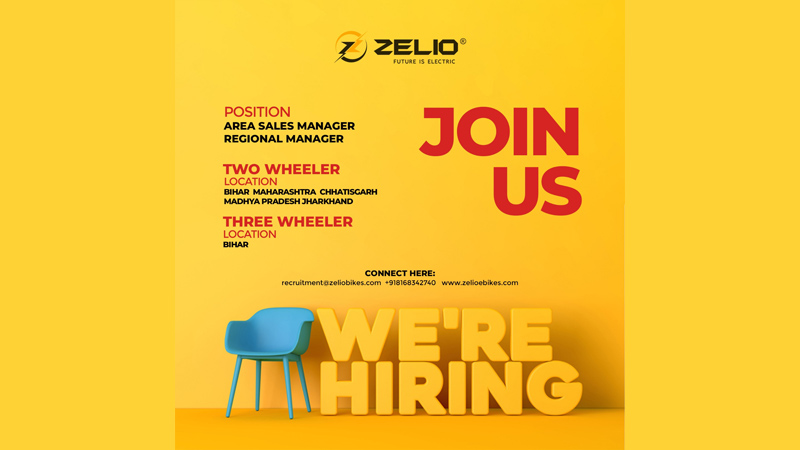
    Mumbai: ZELIO Ebikes, a leading EV two-wheeler startup, has announced an ambitious hiring initiative to expand its workforce by the end of 2024. Currently employing 125 team members, the company plans to add 50 more, bringing the total to an impressive 175. This strategic effort highlights ZELIO Ebikes’ dedication to enhancing market presence and boosting operational efficiency.

    The primary focus of this hiring drive will be on expanding the sales department and hiring receptionists, critical roles that will support ZELIO’s ambitious growth plans. The specific positions being targeted in this hiring spree include area sales manager and regional manager. These roles will be pivotal in driving the company’s market expansion, particularly across key regions. The hiring will cover multiple locations, with two-wheeler sales positions available in Bihar, Maharashtra, Chhattisgarh, Madhya Pradesh, and Jharkhand, and three-wheeler sales positions open in Bihar. As part of its commitment to fostering diversity and inclusion, the company is also keen to balance its gender ratio.

    Commenting on the hiring initiative, ZELIO Ebikes co-founder and MD Kunal Arya said, “We are thrilled to announce our plan to hire 50 new employees by the end of this year. This expansion of our team is a vital step in our journey towards becoming a leading player in the competitive EV market. By attracting fresh talent, we are not only augmenting our operational capabilities but also infusing our organisation with diverse expertise and perspectives, which will catalyse innovation and propel our growth trajectory.”

    He further emphasised, “We are unwavering in our commitment to cultivating a dynamic and inclusive work environment that empowers our employees to thrive and make invaluable contributions towards ZELIO’s mission of championing a sustainable future. We eagerly anticipate welcoming these new team members into the ZELIO family and are confident that their contributions will be instrumental in driving our collective success.”

    Notably, this hiring comes at a time when the EV two-wheeler brand recently launched the GRACY series, which includes the GRACYi, GRACY Pro, and GRACY+ models, with prices ranging from Rs 59,273 to 83,073 ex-showroom. Subsequently, ZELIO launched the X-Men scooters, priced from Rs 64,543 to Rs 87,573 ex-showroom to expand its product portfolio and cater to a wider audience. These recent product launches demonstrate ZELIO’s dedication to innovation and meeting the diverse needs of its valued customer base.

    ZELIO Ebikes invites interested candidates with relevant experience to apply for these exciting opportunities and contribute to the company’s mission of driving a sustainable future. Candidates can connect with the recruitment team at: recruitment@zelioebikes.com or 8168342740.

  • Amazon to hire 8,000 direct workforce in India this year

    Amazon to hire 8,000 direct workforce in India this year

    Mumbai: Amazon has announced its plans to hire more than 8,000 direct workforce across 35 cities in India this year, across corporate, technology, customer service and operations roles. 

    The global e-commerce giant has embarked on a hiring spree recently and this latest announcement comes on the back of its plans to hire 55,000 people worldwide, announced earlier.

    “We have more than 8,000 direct job openings across 35 cities in the country, including cities like Bengaluru, Hyderabad, Chennai, Gurgaon, Mumbai, Kolkata, Noida, Amritsar, Ahmedabad, Bhopal, Coimbatore, Jaipur, Kanpur, Ludhiana, Pune, Surat. These job opportunities are spread across corporate, technology, customer service, and operations roles,” Amazon HR leader – corporate, APAC, and MENA Deepti Varma told PTI.

    Varma added that the company is also hiring for machine learning applied sciences and roles in support functions like HR, finance, legal, among others.

    She said the e-tailer aims for 20 lakh job openings, both direct and indirect, by 2025, and has already created 10 lakh direct and indirect jobs in India. “Even during the pandemic, Amazon gave jobs to three lakh people, both direct and indirect, and made the entire hiring process virtual,” she stated.

    Meanwhile, as Amazon is growing in India and has plans to hire in big numbers, the company plans to showcase itself as an exciting place to work through its first-ever Career Day in India on 16 September.

    This virtual and interactive event will bring together Amazon leadership and employees to share what makes the company an exciting workplace, what it is like to work here and how the company is steadfast in its commitment to help India unleash its true potential in the 21st century, Varma said.

    Besides, she said, the multiple global and India-focused sessions in the event, 140 Amazon recruiters will conduct 2,000 free, one-on-one career coaching sessions with job seekers across the country.

    The recruiters will offer advice on how to approach the job search process effectively, resume-building skills, and interview tips that will help candidates in their search for the right jobs, she said.

    Currently, Amazon employs over one lakh professionals across diverse areas like engineering, applied sciences, business management, supply chain, operations, finance, HR to analytics, content creation and acquisition, marketing, real estate, corporate security, video, music and many more, Varma said.

    India is the second-largest technology hub for Amazon with Indian talent innovating for not just India, but also globally, noted Varma, while adding, “We are just getting started, and we are seeking passionate builders out there to join us in this once-in-a-lifetime opportunity to digitally transform India.

    “This Career Day, we look forward to sharing our long-term commitment to tapping into India’s potential in the 21st century, and career opportunities to empower and enable this legacy,” said Amazon India, global senior vice president and country head, Amit Agarwal in a statement.  

  • NDTV to reduce workforce by up to 25%

    NDTV to reduce workforce by up to 25%

    MUMBAI: NDTV Group is undertaking measures to prune its workforce by up to 25 per cent in a bid to bring down costs and improve profitability. The move is a part of turnaround plan that was tabled a few months ago. A part of this plan was implemented in the last  quarter  and  included the much-noted  move  to new  technologies,  including to  mobile journalism. 

    The media company has pointed out that reporters  across  the country are now using mobile phones for the most efficient delivery of breaking news.

    “The strategy we are adopting calls for a far leaner operation, which  will feed only  our core business: our English and Hindi  news  channels, and NDTV Convergence and its digital teams  that  run  our  news  and other  apps and websites,” NDTV’s release to the BSE stated.

    As a result, the company will minimise all ancillary businesses that NDTV  had  expanded  into   over   the   last  few years.  “Given our  reprioritisation, our  workforce has to be altered too. Over  the next  month, we are considering   reduction  of the  workforce by up to 25 per cent,” the release added.

    When we reached out to NDTV, they declined to comment on the release.

    Also Read:

    Hindi news channels alter programming for Gujarat elections

    NDTV Digital narrows NDTV loss in second quarter

    NDTV restructures biz & newsroom amidst reports of layoffs