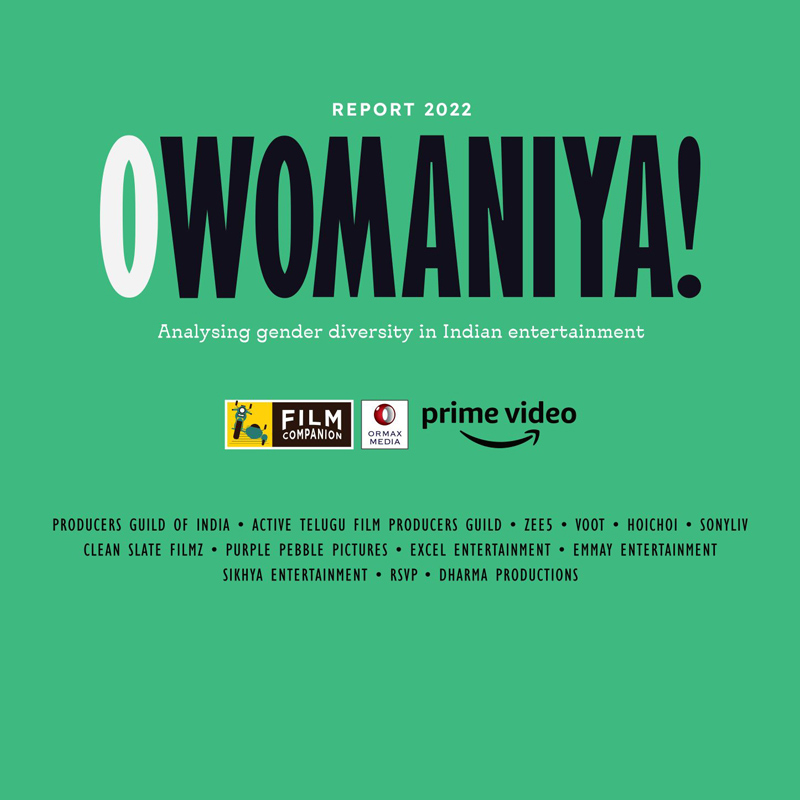
Mumbai: A recent report reveals that female representation in the film & entertainment sector is minimal currently. The report is conducted by Ormax Media and Film Companion and titled as O Womaniya! 2022. The report is supported by entertainment hub Prime Video.
The report highlights on-screen and off-screen representation of women by analysing over 150 theatrical films, streaming films and series released in 2021 across eight Indian languages, including Hindi, Telugu, Tamil, Malayalam, Kannada, Punjabi, Bengali, and Gujarati.
The report studied the representation and participation of women across three major categories—”content” which included female representation on-screen and behind the camera; “marketing” which studied female representation in promotional trailers of films and series; and “corporate” which analysed female representation in boardrooms of the top 25 media and entertainment firms. The key findings are:
Low – representation off-screen: Behind the camera, women are underrepresented, with only 10 per cent of the head of department (HOD) positions held by women across key divisions (production design, writing, editing, direction, and cinematography). Out of the 56 theatrical films analysed across languages, not even one was directed or edited by a woman. Women held only 10 per cent of senior leadership positions in decision-making media and entertainment corporations, resulting in a ripple effect on inclusivity throughout the production and execution chain.
Low – representation on-screen: Only 55 per cent of the movies and series passed the Bechdel Test. Even in promotional trailers analysed through the Trailer Talk Time Test, women had only 25 per cent of the talk time, with 48 titles even allocating 10 seconds or less to female characters.
Women hire more women: The percentage of female HODs doubled when a woman greenlit a series or a film. Similarly, a higher percentage of films passed the Bechdel Test (68 per cent) and women had higher trailer talk time (35 per cent) if the title was commissioned by a woman.
Streaming is driving the change: Streaming films and series performed better than theatrical films across all parameters, indicating the change the sector is ushering in representation on and off-screen. For instance, the representation of female HODs in streaming films and series was five times higher than in theatrical films. Similarly, 64 per cent of streaming series and 55 per cent of streaming films passed the Bechdel Test, as opposed to more than half of theatrical films failing it. Likewise, streaming films and series provided more talk time to female characters in trailers, leading theatrical films by 10 percentage points and 14 percentage points, respectively.
The report received collaboration from multiple entities within the media and entertainment industry. This includes industry bodies like the Producers Guild of India and the Active Telugu Film Producers Guild, streaming services like hoichoi, SonyLIV, Voot and ZEE5, along with leading film studios like Clean Slate Filmz, Dharma Productions, Emmay Entertainment, Excel Entertainment, Purple Pebble Pictures, RSVP and Sikhya Entertainment.
O Womaniya! 2022 was also supported by actor Vidya Balan, who, over the last seventeen years, has led and furthered the mandate for female-led stories across theatrical and streaming films.
Ormax Media founder and CEO Shailesh Kapoor said, “While it’s no surprise that female representation in mainstream entertainment is low, the degree of skew, such as 10:90 on some key parameters, should be a wake-up call. While streaming titles, especially series, are more women-inclusive in on and off-screen representation, theatrical films continue to perform very poorly, and in fact, have shown no positive growth at all since the previous report, which covered content released in 2019 & 2020. We hope that this report serves as a starting point for the industry to come together and discuss ways to address the evident imbalance.”
Sharing his thoughts on the findings, Film Companion founder and editor Anupama Chopra said, “Data is essential to understanding how drastically skewed the gender equation in the Indian film industry is. O Womaniya! provides us with the starting point for discussion and debate. Starting out as an effort by Ormax Media and Film Companion, the initiative has now found resonance with the entire industry. The support that we have received from film bodies, streaming services, and studios is heartening. We will continue to build on this momentum and hopefully lead the way to change.”
Talking about the significance of the report, Prime Video head of originals Aparna Purohit commented, “While there have been improvements in female representation in Indian entertainment, there hasn’t been any data-backed report in India that can hold a mirror up to the current reality. O Womaniya! 2022 fills the much-needed gap with its rich insights. We are thrilled to join hands with Ormax Media and Film Companion on an initiative that is in sync with our philosophy on equitable representation. The report serves as a good starting point to initiate discussions on the need to involve more women, particularly in decision-making roles, as that has a ripple effect on inclusivity in the entire ecosystem. Change has to be persistent and intentional, and we need to take constant steps to improve these numbers year after year.”
Elaborating on the role of streaming in improving female representation, she added, “Streaming services have certainly opened the doors for more inclusive storytelling that provides greater opportunities for women. Streaming has given voice to more female storytellers, resulting in an increase in stories that are driven by female characters with agency. At Prime Video, we have rolled out an inclusion policy playbook that has institutionalised certain guidelines to ensure equal female representation on and off-screen. These range from mandatory female representation in writers’ rooms to evaluating every script on specific parameters. I am certain that streaming is going to further lead the charge on diversity, equity and inclusivity in Indian entertainment.”
Reacting to the findings shared in the report, Vidya Balan said, “As an actor, I have noticed the change in female representation in films in the last decade and a half. From seeing just a handful of women on sets to now having women lead film-making by taking charge of direction, editing, and other key departments, we have come a long way. While this change has been underway for a while, it’s now become stronger with streaming services that have introduced the much-needed diversity in storytelling and on sets. However, the report indicates that we still have a lot of ground to cover. And this can only happen when we have more women in the boardrooms, prompting change right at the heart of decision-making.”
“As female actors in positions of influence, we need to push for more female representation behind the camera in order to have more sensitive, authentic and relatable representation in front of it too. I am glad to be associated with the report and commend Ormax Media, Film Companion, Prime Video, and all other entities for taking the step towards documenting female representation in Indian entertainment. We now need to move the needle from intention to action, and work towards minimising and disrupting biases,” she added.