Tag: Wired Broadband

  • OTT, broadband, and ARPU chase

    OTT, broadband, and ARPU chase

    Mumbai: The adoption of streaming in India has happened in stages driven by affordable handsets, cheap data, and most recently the pandemic. While the first two aspects set the stage for global streamers like Amazon Prime Video and Netflix to enter the country, the next few years saw both existing as well as new network and non-network players intensifying the scene.

    Despite Netflix’s admittedly ‘frustrated ambitions,’ India continues to be an attractive market for international OTT brands. NBC Universal’s hayu launched last December, AMC+ in March 2022, and the entry of HBO Max is on the cards. The ‘mainstreaming of streaming’ in India, however, depends in a big way on ‘Bharat’ which will power the next wave of OTT adoption through the ‘regional OTT-local ISP/wired broadband’ combine. And now is the time for it.

    What changed?

    The obvious increase in on-demand content consumption aside, what the pandemic changed at a more fundamental and universal level was that India seems to have reached the point of no return in the context of broadband adoption. Between 2016 and now, broadband has become a utility, and ‘2020’ is to be credited exactly for that.

    This also explains why despite the prepaid tariff hike in November 2021 that led to the gross loss in subscriptions, clean up of low paying, dormant users, and movement to postpaid resulted in higher ARPUs (average revenue per user) for telcos across. A look at the past 10 months of Telecom Regulatory Authority of India (Trai) data shows that wired broadband has grown consistently, while mobile and fixed broadband fluctuated.

    In fact, the sharp rise of 8.24 per cent last December was reminiscent of the increased demand for wired broadband fuelled by work from home, online education, e-commerce and other digital services, as well as online video during the pandemic.  The requirement for cheaper, faster and uninterrupted data, saw wired broadband subscriptions growing by 3.42 per cent post the second wave.

    Mutual advantage

    The shifting of broadband consumption from offices to homes, mobiles to CTVs and urban to rural is bound to create more regional prospects for VoD content providers, as well as smaller ISPs and MSOs that are struggling to maintain their individual existence. The OTT opportunity has contributed significantly to ensuring that players like OneOTT and ACT that thrive on a strong tier 2-3 play in addition to the metros are counted in the league of Reliance Jio, Bharti Airtel, and Vodafone Idea today.

    “We all know that wired broadband is more reliable in terms of speed and quality compared to wireless. But to wire, the whole country is Capex sensitive,” Microscan business head–ISP and director Playbox TV Samson Jesudas says. “The penetration of wired broadband is therefore just about 20 per cent in India. Hence we should appreciate big telcos who are investing huge amounts to wire up the whole country. At the same time, we should ensure the survival of other ISPs in the country.”

    Struggling on account of dropping ARPUs as a result of data prices going down, increased customer acquisition cost, high payback of over 12 months, as well as churn issues, ISPs are in greater need than ever to explore other value-added services as revenue options. In such a scenario, OTT can be the catalyst to promote wired broadband.

    “Today, all telcos and ISPs are bundling OTT content along with their broadband plans. Cable operators have upgraded themselves to ISPs or franchisees of ISPs. Logistically they are in best position to give quality and timely service to end subscribers,” observes Jesudas. “In fact, there has to be a major consolidation of these LCOs and ISPs by telcos and large ISPs,” Jesudas adds.

    In addition to tech and content, partnerships with ISPs are an integral part of ErosSTX’s OTT platform Eros Now’s B2B strategy.

    “Today, content makes up for over 82 per cent of internet consumption which also means more consumption of data and increased ARPUs for ISPs. In other words, ISPs have emerged as a medium for consumers to consume more data,” remarks Eros Now senior VP distribution and alliances Manpreet Bumrah. “We work together with ISPs on innovative modulation of engineered subscription plans with a win-all proposition for the entire ecosystem which includes OTT, ISPs and consumers.”

    Elaborating on the prospects for MSOs, Bumrah shares that there are over 750 million mobile internet consumers in the country today which establishes the fact that India is riding on the internet. However, only 25 million households have access to wired broadband. “With the cable connected to around 200 million houses, there is a huge opportunity for the entire digital media and entertainment ecosystem to grow at the household level,” he says. 

    According to Global Infocom Networks partner and director Harshal Dalal, local ISPs are moving ahead from being vanilla broadband service providers to becoming digital service providers today. “Along with OTT which is proving to be a major stepping stone, diversification is being carried out through other offerings such as insurance and travel & tourism,” he notes.

    Currently associated with over ten OTT platforms, the Global Infocom Networks has been providing quality and cost-effective solutions to ISPs. It aims to bring more awareness to them in terms of customising their offers and penetrating tier 2 and 3 cities in 2022.

    The promise of 100 million ‘TV Nevers’

    In a further boost to digital India, the recent budget promised great leaps in rural broadband connectivity through the government’s flagship programme – BharatNet. It aims to bring broadband to 361,000 villages across 16 states, including 1.37 lakh gram panchayats by 2025.  The new infra-sharing guidelines are also making it feasible for smaller MSO/ISPs to reach remote areas of the country. 

    Commenting on the possibility this creates, Bumrah says, “As internet bandwidth improves, the consumer experience will improve which will further accelerate the uptake of the internet in the country including by the 100 million ‘no TV households’.”

    According to the economic survey released on 31 January, 5.46 lakh km optical fiber cable (OFC) has been laid as of September 2021, a total of 1.73 lakh gram panchayats (GP) have been connected by OFC, and 1.59 lakh gram panchayats are service ready under BharatNet. Combined with the global push for affordable broadband led by the ITU, BharatNet has the potential to revolutionise the telecom sector much in the same way as Free Dish has transformed the broadcasting industry in recent years.

  • Jio maintains lead in wired broadband subscriber addition

    Jio maintains lead in wired broadband subscriber addition

    KOLKATA: The growth of home broadband users in India continues as it gains 3.8 lakh (0.38 million) subscribers in January 2021 to reach a base of 22.67 million. Among the top players, Mukesh Ambani-led Jio has maintained its lead in subscriber addition with 1.8 lakh new users, according to telecom subscription data published by the Telecom Regulatory Authority of India (TRAI).

    Currently, Jio has 2.25 million subscribers overall, narrowing the gap with rival Airtel. Considerably, Jio recently launched seven tariff plans for micro, small, medium enterprises (MSMEs). Its new tariff plans can address 15-20 million customer base among 50 million underserved small enterprises, the Bank of America (BofA) said earlier.

    Airtel has also expanded its subscriber base adding 90,000 (0.09 million) subscribers in the month to reach 2.90 million base.  “Home broadband category is at the cusp in terms of growth. Ever since the Covid2019 crisis and growth of work from home, study from home, there has been an explosion of home broadband. The increased penetration of streaming services has also resulted in acceleration of home broadband,” Bharti Airtel India and South Asia MD & CEO Gopal Vittal said in an earnings discussion.

    State-run BSNL has again lost subscribers, down to 7.69 million subscribers. Two other leading private players – Atria Convergence Limited (ACT) and Hathway – have also gained 20,000 and 10,000 new subscribers respectively.

    The wired broadband segment saw adequate growth in 2020 by adding 31.5 lakh new subscribers to reach an overall 22.29 million subscribers in December 2020.

  • Wired broadband sector adds 3.9 lakh users in October

    Wired broadband sector adds 3.9 lakh users in October

    KOLKATA: As the number of internet users in India is reaching new levels gradually, having crossed 700 million in 2020, the home broadband sector also continues to grow. The sector has reached 21.51 million subscribers in October, albeit accounting for a meagre share of the overall base yet. According to the Telecom Regulatory Authority of India (TRAI) report, the wired broadband segment has added 3.9 lakh new users in the month. But overall the  total number of broadband users has gone up from 726.32 million to 734.82 million subscribers in October; with mobile device users totting up  to 712.67 million, registering  1.15 per cent growth.

    The top five wired broadband service providers were BSNL, Bharti Airtel, Atria Convergence Technologies (ACT), Jio , Hathway. The state- run broadband service provider BSNL has lost 5 lakhs users.

    (Source: TRAI) 

    Among other services, Jio has added highest users in the month to reach 1.70 million by adding 1.8 lakh users. Jio Fiber added most wired broadband subscribers in September too. Bharti Airtel’s home broadband service also expanded its market share by adding 70,000 subscribers. While the deep-pocketedplayers keep expanding their footprints, other players like ACT, Hathway have not been able to add significant users in the month. However, ACT has witnessed decent growth in 2020.

    A recent report from Motilal Oswal highlighted that the  home broadband subscriber growth has been modest in the past five years, with annual CAGR of just five per cent. But the financial firm  added that the segment has a minuscule $2 billion market size, accounting for only nine per cent share of the country’s Rs 1.7 trillion wireless market.

    “It has largely been an urban product, with low penetration of seven per cent – due to limited network connectivity with just 80–100m estimated home passes – which has restricted subscriber growth. This has given way to increased wireless consumption in India, which has a far easier and convenient installation/activation,” it added.

  • Wired broadband subscribers up 1.72 per cent

    Wired broadband subscribers up 1.72 per cent

    MUMBAI: Although the wired internet subscriber base still represents a small portion of overall internet users in India, the sector is showing continuous growth in last three months. The total wired broadband subscriber base reached 20.47 million in August, up by 1.72 per cent compared to July.

    The Telecom Regulatory Authority of India (TRAI) has released the telecom subscription data as on 31 August 2020.  As per the report, the top five Wired Broadband Service providers were BSNL (7.85 million), Bharti  Airtel  (2.53 million), Atria Convergence Technologies (1.70 million), Reliance Jio Infocomm Ltd (1.25 million) and Hathway Cable and Datacom (1.03 million). Other than the state-run BSNL, all other players were able to add new subscribers to its existing base.

    Shaking off the Covid2019 effect on the telecom sector, the total number of broadband subscribers reached 716.19 million at the end of August with an overall growth of 1.53 per cent. In July, the report showed broadband subscribers at 705.40 million.

    The top five service providers constituted 98.89 per cent market share of the total broadband subscribers at the end of August. These service providers were Reliance Jio Infocomm Ltd (403.92 million), Bharti Airtel (158.98 million), Vodafone Idea (119.91 million), BSNL (23.75 million) and Atria Convergence (1.70 million).

    Overall broadband (wired+wireless) subscriber base was led by Jio with a 56.40 per cent share, followed by 22.20 per cent for Bharti Airtel, and 16.74 per cent for Vodafone Idea.

    As on 31st August, the top five wireless broadband Service providers were Reliance Jio Infocom Ltd (402.67 million), Bharti Airtel (156.45 million), Vodafone Idea (119.91 million), BSNL (15.90 million) and Tikona Infinet Ltd. (0.31 million).

  • Wired broadband subscriber base sees turnaround in May

    Wired broadband subscriber base sees turnaround in May

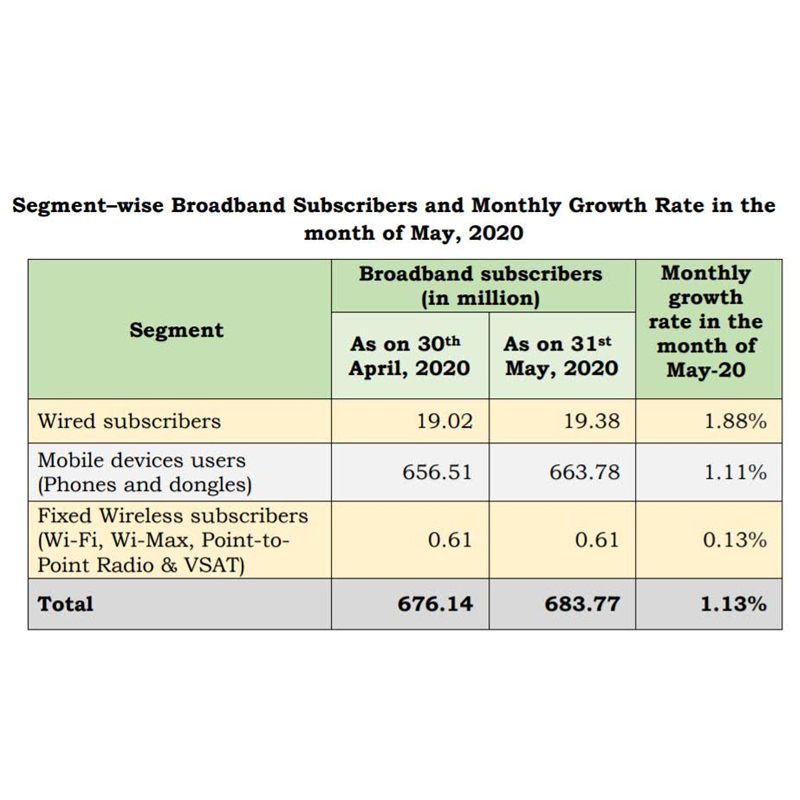
    KOLKATA: After seeing a dip in April, the number of broadband subscribers reached 683.77 million at the end of May with an overall growth of 1.13 per cent.

    The Telecom Regulatory Authority of India (TRAI) has released the telecom subscription data as on May 2020. As per the report, the top five service providers constituted 98.93 per cent market share of the total broadband subscribers at the end of May.  The wired broadband sector has emerged as the top gainer with a growth of 1.88 per cent. However, home broadband footprint growth remains sluggish in the country. As on 31st May, 2020, the top five Wireless Broadband Service providers were Reliance Jio Infocomm Ltd (392.75 million), Bharti Airtel (143.55 million), Vodafone Idea (113.05 million), BSNL (14.14 million) and MTNL (0.29 million).  

    Overall subscriber growth: 

    Reliance Jio has added 3.73 million subscribers reaching 393.72 million overall. Among the top five players, Atria Convergence remains one of the top gainers touching a subscriber base of 1.64 million. At the end of last December, its subscriber base was at 1.52 million. Among other players, Bharti Airtel has seen an addition of 1.2 million subscribers, standing at 145.96 million subscriber base. 1.68 million new users have subscribed to Vodafone Idea’s broadband network in the month. State-run BSNL has also gained 0.53 million new subscribers. 

    Segment-wise growth:

    Among the telecom providers, Jio has gained in the wired broadband sector also as it has added 0.07 million in May. On the other hand, Airtel has lost 0.03 million subscribers. The top five Wired Broadband Service providers were BSNL (7.93 million), Bharti Airtel (2.41 million), Atria Convergence Technologies (1.64 million), Hathway Cable & Datacom (0.97 million) and Reliance Jio (0.97 million).

  • Wired broadband subscriber base sees turnaround in March; ACT keeps expanding

    Wired broadband subscriber base sees turnaround in March; ACT keeps expanding

    KOLKATA: The number of broadband subscribers reached 687.44 million at the end of March with a monthly growth rate of 0.93 per cent, slower rate compared to February. While it stood at 681.11 million at the end of February, it grew at 1.15 per cent that month. Surprisingly, fixed wireless subscribers have jumped up by 2.48 per cent whereas it fell by 1.72 per cent in February. Wired subscriber base has also increased by 0.51 per cent in contrast to a negative trend in the previous month.  

    The Telecom Regulatory Authority of India (TRAI) has released the telecom subscription data as on March 2020. As per the report, the top five service providers constituted 98.99 per cent market share of the total broadband subscribers at the end of March. These service providers were Reliance Jio Infocomm Ltd (388.39 million), Bharti Airtel (148.57 million), Vodafone Idea (117.45 million), BSNL (24.50 million) and Atria Convergence (1.61 million).

    As on 31 March, the top five Wired Broadband Service providers were BSNL (8.08 million), Bharti Airtel (2.47 million), Atria Convergence Technologies I.e, ACT (1.61 million), Hathway Cable & Datacom (0.97 million) and Reliance Jio Infocomm Ltd (0.87 million). Notably, Atria has been on an upward ride until the beginning of this year. At the end of last December, its subscriber base was at 1.52 million.

    Source: TRAI

    While fixed-line broadband sector was struggling to get new subscribers for the last few years, especially due to surge of high-speed low-cost data offered by telco operators, a Crisil report spoke of a spike in fixed broadband subscriptions since 25 March. While the report has predicted a huge growth, TRAI’s April data will be able to show actual numbers based on reports from operators.

    As on 31 March 2020, the top five Wireless Broadband Service providers were Reliance Jio Infocom Ltd (387.52 million), Bharti Airtel (146.10 million), Vodafone Idea (117.43 million), BSNL (16.43 million) and MTNL (0.18 million). 

  • DEN Networks aims for 70,000 broadband subscribers by Q1 2020

    DEN Networks aims for 70,000 broadband subscribers by Q1 2020

    MUMBAI: Way before Jio’s announcement of its broadband GigaFiber venture, MSO DEN Networks revealed its plan to explore the opportunities in the market. Following the rollout of broadband service in 28 cities by end of Q1 of this fiscal year as a part of its 100 cities plan, it has also signed up the agreement with 48 more cities. In terms of rolling out the service, the company is adding 20 more cities in Q2.

    Talking to investors in an analyst call, DEN Networks CEO SN Sharma informed that cable partners are investing equally well with the same kind of enthusiasm. After the launch of Jio GigaFiber, the company mentioned it would be working with LCOs. Sharma was asked about the impact of this on the partners on ground to which he debunked the possibility of ant negative impact on LCOs. “The announcement of the telco has further brought in standards you see that has helped us in regularising this tenders and qualities to be followed by the gentlemen, i.e., our cable partners and that is helping the entire business environment,” he said. In addition to that, he also mentioned that hardly 6.7 per cent of the penetration level has been achieved in the market as of now.

    Emphasising on the enthusiasm in the industry, he also said, “I am also surprised with the kind of enthusiasm that I am coming across and very soon we will be signing up with another 40-50 odd partners and then followed by LCOs and in Q2 we are supposed to deliver another 20 cities and I am quite confident that my team will give and overdo whatsoever assigned to them but that will be it is better that we talk at the end of Q2.”

    As DEN Networks has recently rolled out its service, it will still now take time to pick up due to the lengthy process. Going through LCOs to approach subscribers and then the subscriber coming back for the wired service takes a long time. In that context, rather than giving a high prediction, Sharma said the company hopes to deliver close to 40,000 to 50,000 subscribers by March 2019 and by the end of Q1 of next year to touch close to 70,000 subscribers. He predicts a ramped growth in FY 2020 as then penetration level will reach to 10 per cent. MSOs enable the homes where cable fibre already exists.

    “In the 28 new cities we have actually enabled one million home passes which are already there with us on the cable front so we are already reaching there but how many of those would actually get converted would depend on the interest levels. The moment the interest level comes in we obviously hook them up. We have already hooked up 8500 customers till now so we should be able to ramp it up,” DEN Networks CFO Himanshu Jindal said. For the 100 cities under the plan, 5 million set top box installations will be done.

    DEN’s 100 cities model is based on Rs 500-550 ARPU while in the existing 28 cities, it is capturing an ARPU of Rs 562. Sharma denied commenting on the upcoming tariff war as the pricing model from telcos is still not revealed. But indicating the price could go down, he mentioned that DEN can easily sustain till Rs 500 ARPU. It is only in metropolitan cities like Mumbai and Delhi that consumers are already experiencing 100 MB data speed. There are cities where the speed being demanded is 5MB, 20MB, 50MB. So there’s a large chunk of broadband-deprived internet users across the country.

    “So in any case the ARPU of Rs 500 where you are delivering 50MB speed and unlimited data is not a very conservative figure, I would say it is a very aggressive ARPU that we have put across and we should be able to justify it as things unfold and as times will come, we will handle the situation. In any case, the LCO partner is quite confident and they are coming forward and investing so that also adds the positivity with us,” Sharma’s tone reflected the preparedness for upcoming battle.

    However, the company has claimed to undertake a very low capex based plan. In the current year, the company will not spend more than Rs 30 crore unless it experiences more than the expected rush of this subscriber base which could mean some minor changes in the network.

  • Wired Broadband: ACT, Airtel lead growth in Sep 2015; MSOs’broadband numbers increasing

    Wired Broadband: ACT, Airtel lead growth in Sep 2015; MSOs’broadband numbers increasing

    BENGALURU:  ACT continues to lead the wired broadband growth in calendar year 2015 with 1.9 lakh subscribers(or 23.46 percent of the total all India additions since December 31, 2014) additions fromDecember 31, 2014 until September 30, 2015. However, month-on-month, Bharati Airtel leads growth in subscription numbers by contributing 40,000 additions or 30.77 percent of the 130,000 broadband numbers added all India in the month of September 2015. ACT added 30,000 subscribers or 23.08 percent of the total broadband subscribers added in September 2015. BSNL added 10,000 or 7.69 percent of the total subscribersadded in September 2015. Both MTNL and You BB did not report any change from their August 2015 subscription numbers.

    Are the MSOs’ initiatives by carrying internet on their cable TV infrastructure beginning to show? Definitely yes! Will they surpass the numbers attained by the top 5 ISPs’? Maybe with a concentred effort, yes they may, but it will take plenty of doing and make take some time.Please read on.

    Note:(1) 100,00,000 = 100 Lakh = 10 million = 1 crore

    (2) Trai reports indicate data in millions of numbers up to 2 decimal places. Hence it is assumed in this report that a figure of 0.47 million (4.7 lakh) subscribers for You BB for July-2015 would be granular to the nearest 10,000. While percentages perforce have been mentioned up to two decimal places, the accuracy may vary, depending upon the exact number.

    (3) Industry sources say that Trai numbers in the case of ACT for May-2015 are incorrect at 0.66 million and the correct number would be 0.693 million. This paper considers the number as 6.93 lakh or 0.693 million.

    (4) MSOs’ have a number of subsidiaries and alliances, hence broadband numbers are split as applicable. The consolidated subscription numbers of these entities could be larger. Hathway is a case in point.

    (5) Ortel’s numbers for Q3-2015 have been estimated from the numbers released by it for Q1-2015, Q2-2015, Q4-2015 and FY-2015.

    (6)  The term ‘operating revenue’ in this paper indicates ‘total income from operations’.

    The Top 5 ISPs’

    The latest subscription numbers disclosed by The Telecom Regulatory Authority of India (Trai) as on September 30, 2015, reveal that the total number of wired broadband subscribers in India stood at 161.3 lakh. Hence 8.1 lakh subscribers were added between December 31, 2014 and September 30, 2015, and 1.3 lakh subscribers were added in September 2015. Please refer to figure 1 below

    The pecking order for the top 5 wireline internet service providers or ISPs’ remains the same with the top three – Bharat Sanchar Nigam Limited (BSNL), Bharati Airtel (Airtel) and Mahanagar Telecom Nigam Limited (MTNL) also providing voice (telephone) services and many of their wired internet customers use both services – voice and data. The big three are followed by ACT (Atria Convergence Technologies) and You Broadband India Private Limited (You BB).

    Please refer to figure 2 below. As mentioned above, ACT still continues to lead the growth in wired broadband subscriptions with a net addition of 30,000 subscribers in September 2015, taking its tally to 1.9 lakh subscribers (23.46 percent of the all India additions) added sinceDecember 31, 2014.Hence ACT’s market share in the wired internet space in India improved by 15 basis points to 4.96 percent in August 2015 as compared to 4.81 in Aug-2015. Since December 31, 2014, ACT’s market share has gone up 98 basis points (from 3.98 percent) based on a granularity of 10,000.

    However, telecom major Bharti Airtel is swiftly closing the gap. Like in August2015, the behemoth added 40,000 wiredinternet subscribers in September 2015, taking its tally to 1.7 lakh subscribers (20.99 percent of the all India additions) added between December 31, 2014 and September 30, 2015.  Airtel’s market share improved 17 basis points to 9.80 percent in Sep 2015 as compared to 9.63 percent in Aug 2015. Airtel had a market share of 9.20 percent on December 31, 2014.

    You BB did not report any subscriber additionsin September 2015, its tally remained the same at 4.8 lakh subscribers until September 30, 2015, and it had a net addition of 60,000 subscribers (7.41 percent of the all India additions) since December 31, 2014. Hence You BB’s market share has declined by 2 basis points to 2.98 percent in September 2015 as compared to the 3 percent in August 2015. You BB had a market share of 2.74 percent as on December 31, 2014.

    The public sector BSNL increased its subscription numbers by 10,000 to 99.3 lakh or 61.56 percent of the all India total. However, BSNL’s market share declined by 44 basis points as compared to 62 percent in August 2015.As on December 31, 2014, BSNL had a market share of 65.14 percent

     MTNL subscription numbers were the same as the numbers reported for June 2015, July 2015 and August 2015, and hence there appears to be no net growth in wired broadband subscribers on its part. However, since the overall market size is increasing,MTNL’s market share has also declined even further. MTNL lost 5 basis points to reach a market share of 7.01 percent as compared to 7.06 percent in August 2015. As on December 31, 2014MTNL had a market share of 7.38 percent.

    MSOs’ contribution to broadband

    The combined subscription number of the top five wired ISP’ as on September 30, 2015 was 139.2 lakh or 86.30 percent of the total number of the 161.3 lakh wireline broadband subscribers in India. On December 31, 2014, the corresponding combined number was 135.5 lakh or 88.45 percent of the total number of 153.2 lakh broadband wireline subscribers in the country. The combined share of overall wired internet subscribers of the top five companies is declining, with other players increasing their contribution to wireline broadband subscription numbers.

    The decline between December 31, 2014 and September 30, 2015 was 147 basis points. Other ISP’s share of subscribers has increased to the same extent. Among the ‘Others’ are included Cable TV MSOs’. MSOs’ in India are looking at broadband revenues to prop up their cable revenue numbers because of the comparatively higher ARPUs’ from broadband internet services.  Please refer to Fig 3 below.

    In the three month period starting July 1, 2015 until September 30, 2015 or Q2-2016 (current quarter), the wired internet subscriber base in the country has grown by 4.3 lakh. Of these, the top 5 ISPs added 2.3 lakh subscribers or 53.49 percent of total additions in Q2-2016. At the same time, MSOs’ have started reporting double digit increase in internet subscribers and revenue.  Four MSOs’ – Hathway, Siti Cable, Ortel and Den added 1.09lakh (25.34 percent of total additions in Q2-2016) subscribers during that period as per their financial reports filed at the bourses.QoQ, the combined broadband subscribers in Q2-2016 added by the four MSOs’ increased by 58.36 percent from 0.69 lakh added in Q1-2016.

    For Q1-2016, if the drop in broadband subscription numbers to the extent of 50,000 and 10,000 by BSNL and MTNL respectively is neglected, the other three players among top five wirelineISPs’ in India added 1.2 lakh (37.50 percent of total additions in Q1-2016) of the 3.2 lakh subscribers added in that period.If the drop in subscriber numbers by BSNL and MTNL is considered, the top 5 ISPs’ added just 0.6 lakh wireline broadband subscribers or 18.75 percent of the total subscribers added in Q1-2016. The four MSOs’ contribution to the subscriber base was approximately 0.69 lakh or 21.50 percent of the total additions in Q1-2016. Hence in Q1-2016, four MSOs’ actually added more subscribers than the combined number of subscribers added by the top 5 wired ISPs’ in India.

    Cable companies such as Hathway reported consolidated internet subscription numbers of 5.15 lakh with 2 lakh asDocsis 3.0at the end of the current quarter (Q2-2016). While ACT has laid separate optical fibre for internet and is exploring territories beyond which it has cable TV operations, for the other MSOs’ it is a lot cheaper to have the internet signal ride on their existing cable TV networks wires.

    Last quarter (Q1-2016), Ortel announced that it had introduced free broadband option for all Ortel Cable TV subscribers in the states of Odisha, West Bengal and Chhattisgarh as a complimentary special value added service in order to target to deeper penetrate into markets by making internet affordable. Ortel says that its offer includes a free data limit every month for a year. The subscriber will be charged a nominal amount after exceeding the free data usage for the month.

    Some MSOs’ broadband numbers

    Broadband contributes in double digit percentages to the total incomes or operating revenue of two of the four sample companies in this paper – Hathway (about 25 percent and growing) and Ortel (declined from 21.07 percent in Q1-2015 to 16.80 percent in Q2-2016). Please refer to Fig 4 below. In the case of Siti Cable and Den, revenue from broadband services contributed to less than 5 percent to their operating incomes.

    Hathway reported broadband revenue of Rs 71.9 crore (26.24 percent of operating revenue) in the current quarter, 58.4 percent higher YoY than the Rs 45.4 crore (17.23percent of operating revenue), and 10.4 percent more than the Rs 65.1 crore (24.62 percent of operating revenue)in the immediate trailing quarter.Last quarter, the company said that it had added 50,000 broadband subscribers in Q1-2016, and claimed a broadband subscriber base of 4.6 lakh, of which 1.7 lakh were under Docsis 3.0. Hathway says that broadband ARPU increased 6.8 percent QoQ to Rs 616 from Rs 577 and that its Docsis 3 consumer ARPU has reached Rs 750.

    Siti Cable says that it has added 16,950 broadband subscribers in Q2-2016, taking its broadband subscriber base to 91,450 from 74,500 in the previous quarter. Broadband revenue increased 50 percent YoY in Q2-2106 to Rs 9.30 crore (3.30 percent of operating revenue) from Rs 6.20 crore (3.95 percent of operating revenue) and increased 3.3 percent QoQ from Rs 9 crore (2.83 percent of operating revenue).

    Ortel’s broadband customers grew 8.9 percent to 63,663 in the current quarter from 57,528 in Q2-2015 and grew 4.5 percent from 60,900 in Q1-2016.Ortel’s broadband ARPU in Q2-2016 was Rs 395, in Q2-2015, it was Rs398 and in Q1-2016, it was Rs 393. Ortel reported 11.7 percent growth in YoY total broadband services revenue to Rs 8.1 (16.80 percent of operating revenue ) crore in the current quarter as compared to Rs 7.3 crore (19.89 percent of operating revenue ) and a 7.9 percent QoQ growth from Rs 7.5 crore(17.40percent of operating revenue).

    Den says that it has added 21,000 subscribers in the current quarter as compared to 12,000 in Q1-2016. Its total broadband subscriber base in Q2-2016 was 57,000 as compared to 35,000 in Q1-2016 and 16,000 in Q2-2015.Den’s broadband revenue increased 58 percent in the current quarter to Rs 8.23 crore(3.03 percent to operating revenue)  as compared to the Rs 5.21 crore (1.96 percent of operating revenue) in Q1-2016 and Rs 1.44 crore (0.49 percent of operating revenue) in the corresponding year ago quarter.

    End points

    The four ISPs’(other than ACT) in this report that use their MSO platform for internet service delivery currently are –Hathway, Siti Cable, Ortel and Den in that order in terms of number of broadband internet subscribers in Q2-2016. Three of the four have cable TV subscribers in excess of 100 lakhs each on a consolidated basis, while Ortel had around 5.72 lakh revenue generating units (RGUs)as on September 30, 2015.

    The largest cable TV ISP among them is Hathway with 5.15 lakh subscribers, or just around 5 percent of its total cable TV subscriber base. In the case of Siti Cable and Den, their own internet penetration within their respective cable TV subscriber bases is less than 100 basis points. Many of these MSOs’ subscribers must have opted for internet services from other ISPs’, and all must have some non-cable TV  broadbandinternet subscribers. For these MSOs’ (and other MSOs’) the potential for converting their cable TV subscribers to double play subscribers is huge. This is the low hanging fruit that the MSOs’ can easily pluck if they do it right and increase their revenues and profitability.

  • Wired Broadband: ACT continues to lead growth, Airtel adds 40K subscribers

    Wired Broadband: ACT continues to lead growth, Airtel adds 40K subscribers

    BENGALURU: ACT (Atria Convergence Technologies) continues to lead the wired broadband growth in calendar year 2015 with 1.6 lakh subscriber additions from 31 January, 2015 until 31 August, 2015. The latest numbers disclosed by The Telecom Regulatory Authority of India (TRAI) as on 31 August, 2015 reveal that the total number of wired broadband subscribers in India stood at 160 lakhs. Hence 6.8 lakh subscribers were added between 31 December, 2014 and 31 August, 2015, and 1.6 lakh subscribers were added in August 2015.

    Note: (1) 100,00,000 = 100 Lakh = 10 million = 1 crore

    (2) TRAI reports indicate data in millions of numbers. Hence it is assumed in this report that a figure of 0.47 million subscribers for You BB for July-2015 would be granular to the nearest 10,000. While percentages perforce have been mentioned up to the two decimal places, the accuracy may vary, depending upon the exact number

    (3) Industry sources say that TRAI numbers in the case of ACT for May-2015 are incorrect at 0.66 million and the correct number would be 0.693.

    While the pecking order remains the same with the top three – Bharat Sanchar Nigam Limited (BSNL), Bharati Airtel (Airtel) and Mahanagar Telecom Nigam Limited (MTNL) also providing voice (telephone) services and many of their wired internet customers use both services – voice and data. The big three are followed by ACT and You Broadband India.

    ACT still continues to lead the growth in wired broadband subscriptions with a net addition of 20,000 subscribers in August 2015, taking its tally to 1.6 lakh subscribers (23.53 per cent of the all India additions) added since 31 December, 2014. ACT’s contribution to the all India additions to subscriber numbers in August was therefore 12.5 per cent. Hence ACT’s market share in the wired internet space in India improved by eight basis points to 4.81 per cent in August 2015 as compared to 4.73 in July-2015

    However, telecom major Bharti Airtel is swiftly closing the gap. The behemoth added 40,000 wired internet subscribers or 25 per cent of the all India additions in August 2015, taking its tally to 1.3 lakh subscribers (19.12 per cent of the all India additions) added between 31 December, 2014 and 31 August, 2015.  Airtel’s market share improved 16 basis points to 9.63 per cent in August 2015 as compared to 9.47 per cent in July 2015.

    You Broadband added 10,000 or 6.25 per cent of the all India wired broadband subscribers added in August 2015, taking its tally to 4.8 lakh subscribers until 31 August, 2015, and a net addition of 60,000 subscribers (8.82 per cent of the all India additions) since 31 December, 2014. You Broadband’s market share has improved by three basis points to three per cent in August 2015 as compared to the 2.97 per cent in July 2015.

    The public sector BSNL and MTNL subscription numbers are same as the numbers reported for July 2015, and hence there appears to be no net growth in wired broadband subscribers on their part. However, since the overall market size is increasing, their market share has declined even further. BSNL had a market share of 62 per cent, down by 63 basis points as compared to July 2015, while MTNL lost seven basis points to reach a market share of 7.06 per cent as compared to 7.13 per cent in July 2015. As on 31 December, 2014, BSNL had a market share of 65.14 per cent, while MTNL had a market share of 7.38 per cent.

    Please refer to the figure below: