Tag: Western Europe

  • Zenith revises global ad spend growth forecast upwards

    Zenith revises global ad spend growth forecast upwards

    MUMBAI: Zenith Optimedia’s Advertising Expenditure Forecasts is a bellwether for the global ad industry. And the top notch media agency revised its earlier June forecasts for the rest year in an update posted today. Zenith says that global adex will grow by 4.4 per cent to reach $539 billion, much better than 4.1 per cent growth it forecast earlier.  It will expand by 4.5 per cent in 2017, and 4.6 per cent in 2018, better than the 4.3 per cent and 4.4 per cent it had earlier estimated. By 2018 global advertising expenditure will total  $589 billio,  $4 billion more than forecast in June.

    The US, the Philippines and Western Europe drive faster adspend growth

    This upgrade is mainly the result of stronger-than-expected growth in the US, where a strong labour market has encouraged consumers to increase their expenditure, and advertisers have fought harder for their share of the expanding market. The agency expects US network TV to return to growth this year (at one  per cent) after shrinking five  per cent last year, thanks to new spending by pharmaceutical and consumer packaged goods companies and a strong upfront. Zenith stated that it expects social media to accelerate from 32  per cent growth last year to 35  per cent growth this year, as advertisers take advantage of new formats, such as in-feed video, and the transition to mobile internet consumption continues. Overall the agency forecasts that US ad spend to grow 4.4  per cent this year, compared to the previous estimate of 3.8  per cent.

    Zenith has also made slight upgrades to its adspend forecasts for Asia Pacific and Western Europe. It has revised its estimate for APAC from 6.2 per cent to 6.3 per cent and for Western Europe from 3.5 per cent to 3.6 per cent. Its APAC optimism is based on  heavy political spending in the Philippines in the run-up to the May 2016 elections. Its bullishness about Western Europe is courtesy improved conditions in Belgium, Finland, Germany, Italy, Norway, Portugal and Sweden have compensated for the  slowdown in the UK.

    Mild weakening of UK ad market after Brexit vote

    Although the vote for ‘Brexit’ in the UK’s EU referendum came as a shock to many in the market, so far advertisers have reacted calmly, with no widespread budget reductions. Zenith has forecast a 5.4  per cent growth in ad spend this year, fractionally less than its  5.6  per cent forecast just before the vote. The agency says that its view is that most of the impact that Brexit will have on the UK ad market will happen in the long term.

    The UK’s new terms of trade with the EU and other countries – whatever they turn out to be – are likely to restrict flows of trade and investment in comparison with the pre-Brexit status quo, leading to slower economic growth and slower growth in advertising expenditure. In the short term, uncertainty about the consequences of the vote will make companies less likely to invest in new products, and consumers less likely to take on big spending commitments. This could lead to anything from disappointingly slow growth to outright recession. Zenith’s current forecasts assume that economic growth will slow but remain positive, in which case UK adspend will grow 3.4  per cent next year, down from its pre-vote forecast of four per cent growth.

    Mobile advertising taking over from desktop even faster than expected

    In June, Zenith had forecast that mobile advertising would overtake desktop in 2017.  And it says its position has not changed on this score, excepting that it has upgraded its forecasts for mobile growth for this year (from 46  per cent to 48  per cent) and next year (from 29  per cent to 33  per cent), and  it now expects mobile adspend to exceed desktop by $ 8billion in 2017, up from the $2billion it predicted in June. Zenith expects mobile to account for 60 per cent of all internet advertising by 2018, up from the earlier forecast of 58 per cent.

    Desktop to shrink by more than newspapers or magazines to 2018

    The agency’s view is that desktop advertising peaked in 2014 at $99 billion and shrank 0.1  per cent in 2015 to $98.9 billion as advertisers switched their budgets to mobile. It now expects desktop advertising’s decline to accelerate over the next few years with spends falling by 0.8  per cent in 2016, 2.9  per cent in 2017 and 7.4  per cent in 2018. Between 2015 and 2018 desktop adspend will have shrunk by $10.7billion, more than the other two declining media – newspapers (which will shrink by $9.6 billion) and magazines ($4.4 billion). Meanwhile mobile adspend will grow by $81.3 billion over the same period, seven times more than the combined growth of television ($7.3 billion), outdoor ($3 billion), radio ($0.9 billion) and cinema ($0.7 billion).

    “The global ad market has strengthened over the past few months, thanks mainly to the resilient US consumer,” said Zenith head of forecasting Jonathan Barnard. “So far any impact from the vote for Brexit has been limited, and confined to the UK. We expect the global ad market to strengthen further in 2017 and 2018.”

  • Zenith revises global ad spend growth forecast upwards

    Zenith revises global ad spend growth forecast upwards

    MUMBAI: Zenith Optimedia’s Advertising Expenditure Forecasts is a bellwether for the global ad industry. And the top notch media agency revised its earlier June forecasts for the rest year in an update posted today. Zenith says that global adex will grow by 4.4 per cent to reach $539 billion, much better than 4.1 per cent growth it forecast earlier.  It will expand by 4.5 per cent in 2017, and 4.6 per cent in 2018, better than the 4.3 per cent and 4.4 per cent it had earlier estimated. By 2018 global advertising expenditure will total  $589 billio,  $4 billion more than forecast in June.

    The US, the Philippines and Western Europe drive faster adspend growth

    This upgrade is mainly the result of stronger-than-expected growth in the US, where a strong labour market has encouraged consumers to increase their expenditure, and advertisers have fought harder for their share of the expanding market. The agency expects US network TV to return to growth this year (at one  per cent) after shrinking five  per cent last year, thanks to new spending by pharmaceutical and consumer packaged goods companies and a strong upfront. Zenith stated that it expects social media to accelerate from 32  per cent growth last year to 35  per cent growth this year, as advertisers take advantage of new formats, such as in-feed video, and the transition to mobile internet consumption continues. Overall the agency forecasts that US ad spend to grow 4.4  per cent this year, compared to the previous estimate of 3.8  per cent.

    Zenith has also made slight upgrades to its adspend forecasts for Asia Pacific and Western Europe. It has revised its estimate for APAC from 6.2 per cent to 6.3 per cent and for Western Europe from 3.5 per cent to 3.6 per cent. Its APAC optimism is based on  heavy political spending in the Philippines in the run-up to the May 2016 elections. Its bullishness about Western Europe is courtesy improved conditions in Belgium, Finland, Germany, Italy, Norway, Portugal and Sweden have compensated for the  slowdown in the UK.

    Mild weakening of UK ad market after Brexit vote

    Although the vote for ‘Brexit’ in the UK’s EU referendum came as a shock to many in the market, so far advertisers have reacted calmly, with no widespread budget reductions. Zenith has forecast a 5.4  per cent growth in ad spend this year, fractionally less than its  5.6  per cent forecast just before the vote. The agency says that its view is that most of the impact that Brexit will have on the UK ad market will happen in the long term.

    The UK’s new terms of trade with the EU and other countries – whatever they turn out to be – are likely to restrict flows of trade and investment in comparison with the pre-Brexit status quo, leading to slower economic growth and slower growth in advertising expenditure. In the short term, uncertainty about the consequences of the vote will make companies less likely to invest in new products, and consumers less likely to take on big spending commitments. This could lead to anything from disappointingly slow growth to outright recession. Zenith’s current forecasts assume that economic growth will slow but remain positive, in which case UK adspend will grow 3.4  per cent next year, down from its pre-vote forecast of four per cent growth.

    Mobile advertising taking over from desktop even faster than expected

    In June, Zenith had forecast that mobile advertising would overtake desktop in 2017.  And it says its position has not changed on this score, excepting that it has upgraded its forecasts for mobile growth for this year (from 46  per cent to 48  per cent) and next year (from 29  per cent to 33  per cent), and  it now expects mobile adspend to exceed desktop by $ 8billion in 2017, up from the $2billion it predicted in June. Zenith expects mobile to account for 60 per cent of all internet advertising by 2018, up from the earlier forecast of 58 per cent.

    Desktop to shrink by more than newspapers or magazines to 2018

    The agency’s view is that desktop advertising peaked in 2014 at $99 billion and shrank 0.1  per cent in 2015 to $98.9 billion as advertisers switched their budgets to mobile. It now expects desktop advertising’s decline to accelerate over the next few years with spends falling by 0.8  per cent in 2016, 2.9  per cent in 2017 and 7.4  per cent in 2018. Between 2015 and 2018 desktop adspend will have shrunk by $10.7billion, more than the other two declining media – newspapers (which will shrink by $9.6 billion) and magazines ($4.4 billion). Meanwhile mobile adspend will grow by $81.3 billion over the same period, seven times more than the combined growth of television ($7.3 billion), outdoor ($3 billion), radio ($0.9 billion) and cinema ($0.7 billion).

    “The global ad market has strengthened over the past few months, thanks mainly to the resilient US consumer,” said Zenith head of forecasting Jonathan Barnard. “So far any impact from the vote for Brexit has been limited, and confined to the UK. We expect the global ad market to strengthen further in 2017 and 2018.”

  • SVod outpacing pay TV in W. Europe’s consumption trends: Report

    SVod outpacing pay TV in W. Europe’s consumption trends: Report

    MUMBAI: Subscription video on-demand (SVoD) content is increasing more and more as compared to Pay TV.

    Several discussions have taken place in India with the growing number of digital platforms. Broadcasters such as Star India, Viacom18, Zee Media and Sony Television, etc have entered this space with their own OTT/VOD platforms. Debates not just confined to the emergence of VOD platforms but also the entry of various global players have been raging since.

    The fact that digitisation is at a nascent phase in India only paved the way for the players to experiment various models. This also raised a few eyebrows on the existence of cable and satellite television.

    While most follow an advertising-led model or a ‘freemium model’, the countable ones have taken the challenge of following a subscription-based model. As print has survived after the entry of broadcast, analog and digital cable network will also co-exist with the emergence of various digital platforms. With the robust penetration of internet in the US, Pay TV has remained powerful.

    But is it the same everywhere else? Certainly not. The scenario is completely different in Western Europe. SVoD subscription has been outstripping Pay TV since 2012. The subscription net addition of Pay TV in 2016 is 2 million which is estimated to see a downfall by 2021 to 1 million.

    On the other hand, SVoD in 2016 is 9 million only and evaluated to come down to 3 million by 2021. Both the services are currently at its peak but are substantially going to see some disruption. This clearly shows that currently the viewers are ready to pay for good quality content.

    These were some of the findings presented in a report at IBC by Ampere Analysis, a London based analyst firm, at Amsterdam yesterday.

    According to the Ampere report, SVoD is growing as a significant segment not just in the USA but also in other countries such as Poland, France, the Netherlands, Spain, Italy, Germany, the UK, Sweden and Denmark. The average SVoD-only homes in the second quarter of 2015 has been 5 per cent while, in the current scenario, it has grown by 2 per cent for the first quarter.

    US specifically has seen a growth from 9 per cent to 13 per cent whereas the UK has seen an increase of 2 per cent from 8 per cent to 10 per cent in just a year.
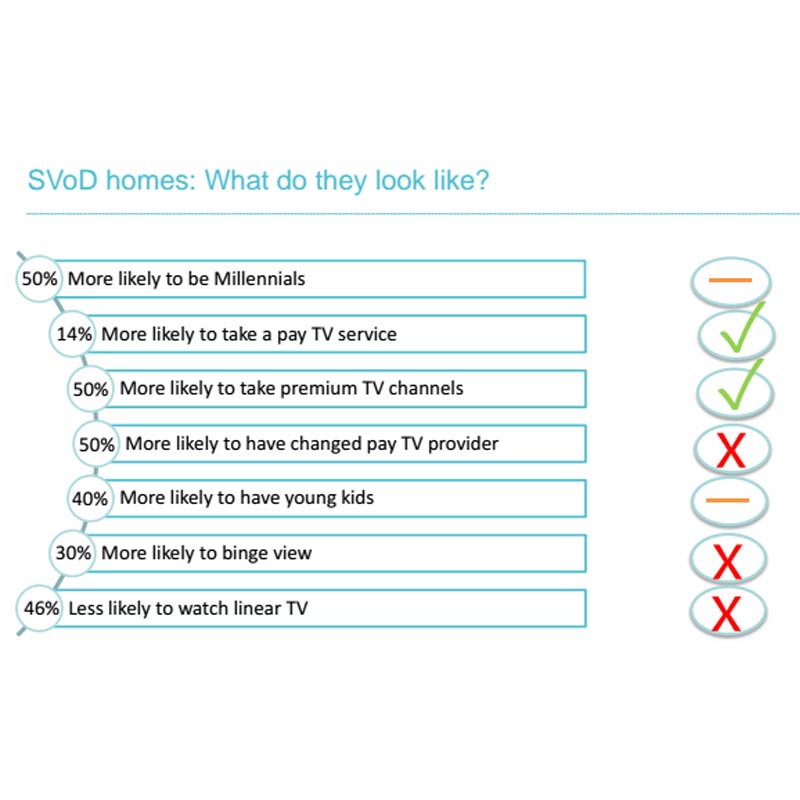
    So, what exactly do the SVoD homes constitute of? The three most relevant observations about who is consuming such massive content on digital platforms are — a big percentage comprise millennials, and the remainder people are more likely to take premium TV channels and some pertcentage have most likely changed their Pay TV provider.

    In all, 46 per cent are less likely to pay for linear TV, while 40 per cent of homes have kids. 30 per cent of the homes have shown an inclination to binge watching. Only 14 per cent of people have opted for a Pay TV service, according to Ampere.

    Business-wise, the concept of platform and channel is evolving though the producer and distributor remain unhampered. Earlier, content was distributed on platforms like Sky, Moviestar and Canalsat, etc which is now replaced by Facebook, Twitter, Snapchat, YouTube, etc. On the other hand, the channel from which content was ideally consumed has converted from Discovery, Fox, HBO, etc to digital platforms like Netflix, SeeSo, CuriosityStream, etc.

    Pay TV and new media products are segmenting, the report states.

    People with lower income are on-demand led whereas people with higher income are linear-led. Young millennials and teenagers can be appealed via services such as Whistle Sports, Soccer, Snapchat, Facebook,etc. Higher income traditional broadcast get pushed through Sky Q to protect high-end broadcast viewers. Direct To Consumers (DTC) cost to get a channel on air are considerably lower. So with a satellite you are going to take your yearly transponder, but with an OTT service you do not have that significant upfront cost. But, what you do have is a scaling cost, CDN delivery, that grows with your customer base.

    Ampere accepts that the latter factor makes OTT uneconomic for reaching very large audiences, estimating that for a single channel or service offering video in any definition from SD to UHD, a satellite feed works out cheaper beyond 10m viewers’ even if they watch on average just one minute of content per day. For a daily viewer base below 20,000, OTT always works out cheaper, even if all viewers watched five hours of content a day and all content was transmitted inUHD, Ampere found.

    With changing economics, channel groups are increasingly looking to Direct To Consumers (DTC) SVOD service. Viewers/advertising spends have shifted to online, operators are pushing back on channel carriage fee, content owners’ margins have squeezed and the DTC, SVoD launch have led to recoup margin. The millennials are already approaching two SVOD services per home. In the US, millennials have crossed the more than 2 number than the average. They are approaching to the number in Germany, Denmark, Poland and UK. Out of the 1002 sample survey, 255 are Netflix customers in UK which only means that the country is most likely to have more Netflix customers.

    It is not all about broadband penetration, because size is also important. And actually if we look at the size of the addressable market, emerging markets like Mexico, Brazil, Russia, China, Taiwan, Thailand, etc all have started to become interesting [DTC] markets when we talk about the total addressable size.

    Ampere’s research found that in the UK a Netflix customer is 1.5 times more likely than average to also take Sky’s Now TV OTT service; 1.8 times more likely to also take Amazon; 2.5 times more likely also to take Spotify’s streaming music services; and 1.5 times more likely to use the catch-up TV apps of the major broadcasters.

    To date, Netflix’s growth strategy has relied on geographic expansion. But, its set to run out of road by 2017. Central, South and Western Europe saw 6 customer additions on an average in 2015 which has reduced to 4 or 5 in 2017 further reducing in 2021. But in Asia Pacific region, the customer addition has gone up from 1 to 5 and is estimated to be 3. Even after this, the fact that Netflix has invested a huge amount of money on content cannot be ignored. Netflix is spending like a broadcast or premium channel group. It spends 60 per cent revenue on program followed by premium platforms contributing 40-70 per cent revenue. Pay multichannels are putting 30-40 per cent revenue on programs.

    Pay TV is still growing but OTT is growing faster – much faster. And that fact sums up both the threat and the opportunity that OTT video presents to platform operators. The survival of service providers depends on their ability to launch new services ahead of the competition.

  • SVod outpacing pay TV in W. Europe’s consumption trends: Report

    SVod outpacing pay TV in W. Europe’s consumption trends: Report

    MUMBAI: Subscription video on-demand (SVoD) content is increasing more and more as compared to Pay TV.

    Several discussions have taken place in India with the growing number of digital platforms. Broadcasters such as Star India, Viacom18, Zee Media and Sony Television, etc have entered this space with their own OTT/VOD platforms. Debates not just confined to the emergence of VOD platforms but also the entry of various global players have been raging since.

    The fact that digitisation is at a nascent phase in India only paved the way for the players to experiment various models. This also raised a few eyebrows on the existence of cable and satellite television.

    While most follow an advertising-led model or a ‘freemium model’, the countable ones have taken the challenge of following a subscription-based model. As print has survived after the entry of broadcast, analog and digital cable network will also co-exist with the emergence of various digital platforms. With the robust penetration of internet in the US, Pay TV has remained powerful.

    But is it the same everywhere else? Certainly not. The scenario is completely different in Western Europe. SVoD subscription has been outstripping Pay TV since 2012. The subscription net addition of Pay TV in 2016 is 2 million which is estimated to see a downfall by 2021 to 1 million.

    On the other hand, SVoD in 2016 is 9 million only and evaluated to come down to 3 million by 2021. Both the services are currently at its peak but are substantially going to see some disruption. This clearly shows that currently the viewers are ready to pay for good quality content.

    These were some of the findings presented in a report at IBC by Ampere Analysis, a London based analyst firm, at Amsterdam yesterday.

    According to the Ampere report, SVoD is growing as a significant segment not just in the USA but also in other countries such as Poland, France, the Netherlands, Spain, Italy, Germany, the UK, Sweden and Denmark. The average SVoD-only homes in the second quarter of 2015 has been 5 per cent while, in the current scenario, it has grown by 2 per cent for the first quarter.

    US specifically has seen a growth from 9 per cent to 13 per cent whereas the UK has seen an increase of 2 per cent from 8 per cent to 10 per cent in just a year.
    So, what exactly do the SVoD homes constitute of? The three most relevant observations about who is consuming such massive content on digital platforms are — a big percentage comprise millennials, and the remainder people are more likely to take premium TV channels and some pertcentage have most likely changed their Pay TV provider.

    In all, 46 per cent are less likely to pay for linear TV, while 40 per cent of homes have kids. 30 per cent of the homes have shown an inclination to binge watching. Only 14 per cent of people have opted for a Pay TV service, according to Ampere.

    Business-wise, the concept of platform and channel is evolving though the producer and distributor remain unhampered. Earlier, content was distributed on platforms like Sky, Moviestar and Canalsat, etc which is now replaced by Facebook, Twitter, Snapchat, YouTube, etc. On the other hand, the channel from which content was ideally consumed has converted from Discovery, Fox, HBO, etc to digital platforms like Netflix, SeeSo, CuriosityStream, etc.

    Pay TV and new media products are segmenting, the report states.

    People with lower income are on-demand led whereas people with higher income are linear-led. Young millennials and teenagers can be appealed via services such as Whistle Sports, Soccer, Snapchat, Facebook,etc. Higher income traditional broadcast get pushed through Sky Q to protect high-end broadcast viewers. Direct To Consumers (DTC) cost to get a channel on air are considerably lower. So with a satellite you are going to take your yearly transponder, but with an OTT service you do not have that significant upfront cost. But, what you do have is a scaling cost, CDN delivery, that grows with your customer base.

    Ampere accepts that the latter factor makes OTT uneconomic for reaching very large audiences, estimating that for a single channel or service offering video in any definition from SD to UHD, a satellite feed works out cheaper beyond 10m viewers’ even if they watch on average just one minute of content per day. For a daily viewer base below 20,000, OTT always works out cheaper, even if all viewers watched five hours of content a day and all content was transmitted inUHD, Ampere found.

    With changing economics, channel groups are increasingly looking to Direct To Consumers (DTC) SVOD service. Viewers/advertising spends have shifted to online, operators are pushing back on channel carriage fee, content owners’ margins have squeezed and the DTC, SVoD launch have led to recoup margin. The millennials are already approaching two SVOD services per home. In the US, millennials have crossed the more than 2 number than the average. They are approaching to the number in Germany, Denmark, Poland and UK. Out of the 1002 sample survey, 255 are Netflix customers in UK which only means that the country is most likely to have more Netflix customers.

    It is not all about broadband penetration, because size is also important. And actually if we look at the size of the addressable market, emerging markets like Mexico, Brazil, Russia, China, Taiwan, Thailand, etc all have started to become interesting [DTC] markets when we talk about the total addressable size.

    Ampere’s research found that in the UK a Netflix customer is 1.5 times more likely than average to also take Sky’s Now TV OTT service; 1.8 times more likely to also take Amazon; 2.5 times more likely also to take Spotify’s streaming music services; and 1.5 times more likely to use the catch-up TV apps of the major broadcasters.

    To date, Netflix’s growth strategy has relied on geographic expansion. But, its set to run out of road by 2017. Central, South and Western Europe saw 6 customer additions on an average in 2015 which has reduced to 4 or 5 in 2017 further reducing in 2021. But in Asia Pacific region, the customer addition has gone up from 1 to 5 and is estimated to be 3. Even after this, the fact that Netflix has invested a huge amount of money on content cannot be ignored. Netflix is spending like a broadcast or premium channel group. It spends 60 per cent revenue on program followed by premium platforms contributing 40-70 per cent revenue. Pay multichannels are putting 30-40 per cent revenue on programs.

    Pay TV is still growing but OTT is growing faster – much faster. And that fact sums up both the threat and the opportunity that OTT video presents to platform operators. The survival of service providers depends on their ability to launch new services ahead of the competition.

  • IPTV subscriptions in Western Europe to climb by 7 mn between 2015- 21, overtaking satellite TV

    IPTV subscriptions in Western Europe to climb by 7 mn between 2015- 21, overtaking satellite TV

    MUMBAI: The numbers of homes paying IPTV in Western Europe are expected to climb by nearly 7 million up by 27 per cent between 2015 and 2021, thus overtaking the pay satellite TV which is slated to fall by 300,000 between 2015 and 2021 for 18 countries in the region.  

    According to the Digital TV Western Europe Forecasts report, IPTV revenues will reach $5.77 billion in 2021 – up by $1.2 billion.

    The report indicates that this is due mainly to some operators, especially in Spain and Italy, converting their DTH subs to more lucrative bundles on their broadband networks.

    Satellite TV revenues will fall for every year from 2011 – and will decline by $1 billion between 2015 and 2021.

    Western European Pay TV is fast maturing, with penetration forecast to grow from 56.8% at end-2015 to 59.5 per cent in 2021. The number of pay TV subscribers will climb from 97.4 million in 2015 to 104.3 million in 2021.

    So, Pay TV subscriptions will only increase by 6.9 million which is 7 per cent between 2015 and 2021. However, the number of digital pay TV subs will increase by 19 per cent nearly 17 million over the same period. Digital cable subs will increase by almost 10 million.

    The 9.9 million analogue cable homes remaining at 2015-end will be the hardest to convert to digital as many of these subscribers pay for very basic packages as part of their rent.

    Digital TV Research principal analyst Simon Murray said, “The remaining analogue cable TV subs are the most obstinate. These homes have had several years to transfer to digital platforms – including those from their existing operators, but are still holding out. When conversion finally happens, these homes are more likely to convert to free-to-air platforms such as DTT or satellite than their predecessors.”

    In fact, only seven (Finland, France, Iceland, Italy, Norway, Spain and the United Kingdom) of the 18 countries covered in the report had fully converted to digital by 2015-end.

    By 2021, pay TV penetration will range from nearly 100 per cent in the Netherlands to 36 per cent in Italy. Eight countries will exceed 90 per cent pay TV penetration in 2021. However, pay TV penetration will fall in Germany, Netherlands, Norway, Sweden and Switzerland – countries with a large number of legacy analogue cable subscribers.

    Despite the number of pay TV homes increasing, pay TV revenues will remain flat at around $31 billion. The UK ($7,217 million) will remain the most lucrative pay TV market. Regardless of having the most pay TV subs by some distance, Germany’s pay TV revenues will remain a lot lower than the UK – at $4,183 million by 2021. In fact, France and Italy will not be too far behind Germany, despite having far fewer pay TV subscribers.

  • IPTV subscriptions in Western Europe to climb by 7 mn between 2015- 21, overtaking satellite TV

    IPTV subscriptions in Western Europe to climb by 7 mn between 2015- 21, overtaking satellite TV

    MUMBAI: The numbers of homes paying IPTV in Western Europe are expected to climb by nearly 7 million up by 27 per cent between 2015 and 2021, thus overtaking the pay satellite TV which is slated to fall by 300,000 between 2015 and 2021 for 18 countries in the region.  

    According to the Digital TV Western Europe Forecasts report, IPTV revenues will reach $5.77 billion in 2021 – up by $1.2 billion.

    The report indicates that this is due mainly to some operators, especially in Spain and Italy, converting their DTH subs to more lucrative bundles on their broadband networks.

    Satellite TV revenues will fall for every year from 2011 – and will decline by $1 billion between 2015 and 2021.

    Western European Pay TV is fast maturing, with penetration forecast to grow from 56.8% at end-2015 to 59.5 per cent in 2021. The number of pay TV subscribers will climb from 97.4 million in 2015 to 104.3 million in 2021.

    So, Pay TV subscriptions will only increase by 6.9 million which is 7 per cent between 2015 and 2021. However, the number of digital pay TV subs will increase by 19 per cent nearly 17 million over the same period. Digital cable subs will increase by almost 10 million.

    The 9.9 million analogue cable homes remaining at 2015-end will be the hardest to convert to digital as many of these subscribers pay for very basic packages as part of their rent.

    Digital TV Research principal analyst Simon Murray said, “The remaining analogue cable TV subs are the most obstinate. These homes have had several years to transfer to digital platforms – including those from their existing operators, but are still holding out. When conversion finally happens, these homes are more likely to convert to free-to-air platforms such as DTT or satellite than their predecessors.”

    In fact, only seven (Finland, France, Iceland, Italy, Norway, Spain and the United Kingdom) of the 18 countries covered in the report had fully converted to digital by 2015-end.

    By 2021, pay TV penetration will range from nearly 100 per cent in the Netherlands to 36 per cent in Italy. Eight countries will exceed 90 per cent pay TV penetration in 2021. However, pay TV penetration will fall in Germany, Netherlands, Norway, Sweden and Switzerland – countries with a large number of legacy analogue cable subscribers.

    Despite the number of pay TV homes increasing, pay TV revenues will remain flat at around $31 billion. The UK ($7,217 million) will remain the most lucrative pay TV market. Regardless of having the most pay TV subs by some distance, Germany’s pay TV revenues will remain a lot lower than the UK – at $4,183 million by 2021. In fact, France and Italy will not be too far behind Germany, despite having far fewer pay TV subscribers.

  • OTT revenues to reach nearly $8 billion in 2017

    OTT revenues to reach nearly $8 billion in 2017

    MUMBAI: SNL Kagan’s Multimedia Research Group (MRG) is predicting the OTT SVOD market to record significant growth worldwide in the coming years, with North America leading the pack, followed by Western Europe.

    MRG predicts that revenues will reach nearly $8 billion on more than 120 million subscribers globally by 2017. North America, which has more than 25 OTT SVOD service providers as of 2013, is the most developed market. Subs are estimated to have increased by more than 50 per cent in 2012, reaching nearly 50 million.

    North America is followed by Western Europe. Last year, Western Europe accounted for 11 per cent of the worldwide market with 7 million subscriptions and annual revenue of $575 million. Asia, which has the largest internet population in the world, accounted for nearly five million OTT SVOD subs in 2012 and $255 million in revenue.

    Eastern Europe had seven per cent of the market in 2012 and more than four million subscribers and revenue of $253 million. The OTT SVOD service markets in Latin America, Asia and Eastern Europe collectively comprised 20 per cent of the worldwide subscribers in 2012. These regions are poised for immense growth in the next five years, according to MRG. The Middle East and Africa had a negligible share of the market last year. Though it is expected to grow in the coming years, its contribution will only increase to one percent by 2017.

  • Over 70 per cent of pay-TV subscribers in Western Europe able to receive multiscreen services

    Over 70 per cent of pay-TV subscribers in Western Europe able to receive multiscreen services

    MUMBAI: Parks Associates research finds over 70 per cent of pay-TV subscribers in Western Europe are able to receive a TV Everywhere/multiscreen service.

    In Eastern Europe, multiscreen availability topped 25 per cent of pay-TV households in early 2013. However, average revenue per user (ARPU) remains low, pushing many operators to test new business models such as a la carte pricing.

    Parks Associates president Stuart Sikes said, “Connected CE and digital media usage continues to grow in Europe, and cloud-based services, including music, video games, and storage, will drive more data across broadband provider networks.”

    “However, several challenges unique to Europe, including low margins, competition, and regulatory and economic factors, create uncertainties on the best path to boost revenues.” Sikes concluded.

  • IPTV worldwide subscribers reach 3.6 million

    IPTV worldwide subscribers reach 3.6 million

    MUMBAI: The latest worldwide IPTV research from research firm Canalys shows how the number of commercial IPTV launches escalated in 2006, and suggests that IPTV services are now moving into the mainstream.

    Worldwide subscribers have reached 3.6 million Western Europe leads, with growth expected in emerging markets this year.

    Most major incumbent telecoms providers have launched commercial services and the market is becoming increasingly competitive with the entry of alternative operators, such as ISPs and energy companies.

    Canalys senior analyst Nadia Griffiths says, “2007 will see the competitive landscape become even fiercer as IPTV services from established service providers will be challenged by aggressively priced alternatives from Web TV, cable, satellite and content companies. These are all contenders for a share of the limited wallet of most consumers”.

    Western Europe has 2.4 million IPTV subscribers. The sheer number of operators in the region provides its IPTV scale, and major investments in backbone infrastructure are being made as providers rush to build substantial subscriber bases. The IPTV market is highly fragmented. The top five providers account for over 60 per cent of all subscribers, but the rush of service launches by new entrants in 2006 means that there are numerous companies with only a few thousand subscribers each.

    The top three providers globally according to Canalys are PCCW on 18.2 per cent share, France Telecom with 16.8 per cent and Free Telecom on 14 per cent. These are joined in the top five by Telefonica and Fastweb.

    Threats One of the major threats for many IPTV service providers is the quality of networking once IPTV services become fully fledged. Canalys VP Alessandra Fitzpatrick says, “IPTV networks will quickly become the most complex and bandwidth intensive that have ever existed. Many service providers have invested millions of euros on network upgrades, but it remains unproven whether IPTV networks can scale into the millions without performance degrading and response times slowing, or even collapsing altogether.

    “Another infrastructure challenge is that service providers will quickly have to learn how to manage multiple billing systems and content across large server farms and SANs, while maintaining the highest quality of service.”

    The future, however, looks promising. In 2007, Canalys predicts significant uptake of IPTV in the Asia Pacific region. Hong Kong is already a mature IPTV market, and growth will come from emerging markets such as India and China, following large investments into IPTV deployments there. Australia is also finally moving into the commercial phase of its IPTV offerings, which will lead to fast roll-outs of services in 2007. North America will be another major growth area, with AT&T and Verizon already pushing nationwide roll-outs of IPTV services. Western Europe though will continue to lead and set the pace globally for the IPTV industry in the year ahead.
     

  • VSNL plans cable link to India, Middle East, Western Europe

    VSNL plans cable link to India, Middle East, Western Europe

    MUMBAI: Tata group company Videsh Sanchar Nigam Ltd (VSNL) has inked an MoU with global telecom firms to construct a new submarine cable linking India, Middle East and Western Europe (IMEWE). 

    The company has joined hands with Etisalat, Saudi Telecom, Telecom Egypt, Telecom Italia Sparkle to work jointly on the new submarine cable.

    The cable will connect the major countries in the region including India, UAE, Kingdom of Saudi Arabia, Egypt, Italy and France to provide interconnection facilities with several existing and emerging systems in the regions.

    The telecom consortium expects to get the IMEWE cable ready for service by mid 2008. The construction contracts are expected to be being awarded by end 2006.

    The network, upon its commissioning, will provide high-speed connectivity to the Asian, Middle East, North & East Africa and Western Europe regions, and meet their exponentially growing bandwidth requirements.