
Tag: WATInsights

  • By 2022, hyperlocal commerce shoppers to grow by 52% to reach 214 mn: WATInsights

    By 2022, hyperlocal commerce shoppers to grow by 52% to reach 214 mn: WATInsights

    Mumbai: WATConsult, an Isobar Company and the globally awarded hybrid digital agency from dentsu India, has released the fifth report of WATInsights – digital commerce series. Titled ‘Digital Commerce in India – Hyperlocal Commerce’, the report is by WATConsult’s research division, Recogn. The report shares insights on the demand for hyperlocal delivery, the effects of the pandemic on the hyperlocal usage and captures the benefits & challenges of the model.

    The hyperlocal space has seen a rise in the number of niche brands across categories like home décor, home services, groceries, essentials and pharmaceutical sectors. Since the country has witnessed growth, traditional brands have shifted their focus towards hyperlocal and direct-to-consumer business models. This transition has been accelerated further due to increased internet usage and evolved consumer behaviour.

    It is pertinent to note here that the hyperlocal approach enables the brands to reach out to their target customers directly, removing the middlemen and retail stores as part of the traditional business model. This provides customers with a better shopping experience as it offers convenience and quick delivery, especially in the areas of logistics, food, pharmaceutical and groceries. Some examples of hyperlocal commerce include Dunzo, 1mg, UrbanCompany, BigBasket, to name a few.

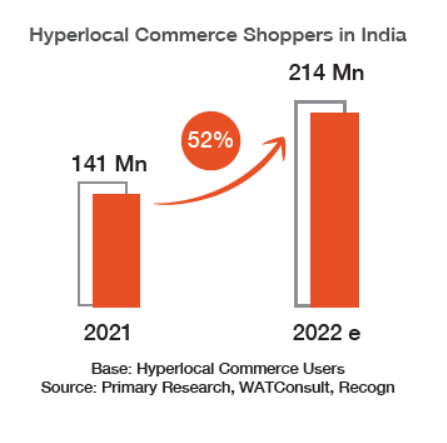
    According to the report, this format of e-commerce has seen a huge surge of customers in both metros and beyond. Currently, there are around 141 million hyperlocal commerce shoppers in India, which is 48 percent of all e-commerce users. This number of hyperlocal commerce shoppers will increase by 52 percent to reach 214 million by the end of 2022.
    The report further reveals that while Zomato tops the list of the most used hyperlocal apps, SwiggyGo, Amazon Fresh & BigBasket are some of the popular choices among consumers. This is followed by 1mg, Grofers and UberConnect.

    The report additionally sheds light on the consumer demographic of the hyperlocal commerce users. While most females have used services from Zomato, BigBasket and Grofers, some males have used services like Zomato, SwiggyGo, BigBasket and 1mg, highlighted the study. On the other hand, the majority of young customers belonging to the age groups of under 18 years, 18 years to 24 years and 25 years to 34 years, have been seen using Zomato, SwiggyGo, and Amazon Fresh.

    Commenting on the latest issue of WATInsights – Digital commerce in India – Hyperlocal commerce, Isobar India group CEO Heeru Dingra said, “Hyperlocal businesses have been rapidly growing with the potential of expanding exponentially. There has been an increase in the number of brands emerging in this space and it will consolidate even further, over the next few years. Hyperlocal’s collaboration with local stores and the connection they build with their customers digitally is benefitting all the stakeholders as now they are all connected to the supply chain model.”

    The hyperlocal space has seen a rise in the number of niche brands across categories like home décor, home services, groceries, essentials, and pharmaceutical sectors. Since the country has witnessed growth, traditional brands have shifted their focus towards hyperlocal and direct-to-consumer business models. This transition has been accelerated further due to increased internet usage and evolved consumer behaviour.

    WATConsult managing partner Sahil Shah added, “Businesses, more than ever, are leveraging digital channels to reach out to consumers with a faster go-to-market, controlled brand perception, and increased direct-to-consumer (D2C) interactions. The pandemic has impacted many sectors and as a result, India’s retail market has gone through many changes; the biggest change being the adoption of technology in enabling more digital touchpoints. Amidst this shift, hyperlocal has been one of the top priorities for all D2C brands as well as marketplace-heavy businesses. This new model of hyperlocal has enabled local retailers to increase their market share. Especially the FMCG brands have been able to push their inventories and effectively scale the business.”

    It is pertinent to note here that the hyperlocal approach enables the brands to reach out to their target customers directly, removing the middlemen and retail stores as part of the traditional business model. This provides customers with a better shopping experience as it offers convenience and quick delivery, especially in the areas of logistics, food, pharmaceutical, and groceries. Some examples of hyperlocal commerce include Dunzo, 1mg, UrbanCompany, BigBasket, to name a few.
  • The number of voice commerce shoppers in India poised to grow at a rate of 103%: WATInsights report

    The number of voice commerce shoppers in India poised to grow at a rate of 103%: WATInsights report

    MUMBAI: Voice Commerce is making its way into the Indian customers’ shopping habits faster than ever. The number of voice shoppers in India is poised to grow at an impressive rate of 103 per cent by the end of 2022 to reach 168 million voice shoppers, according to the latest report of WATInsights – Digital commerce series. For the record, there are 83 million voice shoppers in India presently, suggesting that it has already seen an uptick.  

    WATConsult, an Isobar Company & hybrid digital agency from dentsu India, has released its fourth report on the digital commerce series, titled ‘Digital Commerce in India – Voice Commerce’. The report by the agency’s research division, Recogn, shares insights on the ever-increasing adoption of Voice Commerce, the evolution of conversational AI solutions, challenges associated with voice-activated assistants and sentiments of consumers towards using this emerging branch of digital marketing.

    There is a paradigm shift in the way searches are performed as users turn to voice for searching and shopping for products online. As per the report, 42 per cent of the females have used voice assistants for online shopping, while most youngsters belonging to the age group of 18-24 years have frequently used the assistant enabled devices to shop online. Additionally, the majority of the working professionals residing in the top four metros and next five metros have also used voice assistants for online shopping.

    It is pertinent to note here that, in India, the use of voice technology for shopping is at a nascent stage and only one-third of the users have used voice assistants to purchase products online, as per the report.

    The report stated that most female voice commerce shoppers are concerned about the privacy and security of the financial data while shopping online using voice, withstanding the benefits of the platform. However, the challenge for older customers belonging to the age group of 65 years and above is the inability to break through the habit of typing and searching for products online.  

    Commenting on the latest issue of WATInsights, Isobar India group CEO Heeru Dingra said, “Voice integrated with online commerce is transforming the future of digital commerce and revolutionising the B2B and B2C e-commerce in India. With artificial intelligence and native language processing undergoing a massive transformation, voice commerce will help a great deal in increasing consumer confidence and improve conversion prospects for brands and businesses.”

    Voice simplifies the online shopping experience, enabling voice-enabled searches to be immensely popular and widely adopted. Voice commerce offers a natural user interface and experience, thus, making it appear as a game-changer for retail and e-commerce brands. To offer a personalised digital shopping experience, retailers are optimising their stores for voice commerce by further investing in upgrading their e-commerce capabilities, technology & platforms. Over time, voice shopping has influenced the way customers purchase online. It has also affected their shopping behaviour, making it even more crucial for businesses to include a voice in their marketing strategies.

    WATConsult managing partner Sahil Shah added, “I vividly remember ordering from Amazon Alexa device for the very first time. It was an extremely smooth and native experience, compared to what I had thought it would be. With the ecosystem developing at breakneck speed, including both hardware and software, voice commerce is here to stay and scale-up for sure. What is exciting to see is who wins the race and commands a significant pie of the voice commerce market; also, how brands scale up their voice-led experiences in a digital-first world? And no, it is not just the basic things one can order, it is everything from paying bills to buying groceries to booking a movie ticket to ordering for a hyperlocal delivery; all with the power of your voice.”

    WATInsights are periodically published reports based on primary research conducted by Recogn, the agency’s research division that provides consumer and business insights to its audience. WATInsights delve into the different aspects of the digital industry, consumer behaviour, and more. Additionally, the research also covers topics like Instagram in India – users’ perspective, voice technology in India, and the usage of the internet in the local language.


  • Video commerce to grow exponentially at 47% in 2022 over 2020: WATInsights report

    Video commerce to grow exponentially at 47% in 2022 over 2020: WATInsights report

    Mumbai: The e-commerce market in India has been witnessing an evolution in recent years with the emergence of newer formats like video and social commerce. The video commerce segment is already on its way to being the next big thing in digital commerce with video content consumption gaining traction on social media platforms. According to the latest report released by WATInsights in its digital commerce series, the number of video commerce users is expected to touch 216 million by the end of 2022 from 146 million users in 2020, indicating an exponential growth of 47 per cent.

    WATConsult, the Isobar India group digital agency from dentsu India has unveiled its third report of WATInsights  ‘Digital Commerce in India – Video Commerce.’ The report by Recogn, the agency’s research division, shares insights on the scope of the futuristic channel of advertising and captures consumer sentiments towards using this platform for shopping.

    According to the report, currently, there are around 146 million video commerce shoppers in India who have purchased and transacted on video commerce platforms. Today, the total is nearly 49 per cent of all e-commerce users in India. With the number of video commerce shoppers expected to reach 216 million this year, the format promises the immense potential for brands to connect directly with their consumers.

    As per the report, when it comes to the video content format, most customers prefer explainer content videos followed by customer testimonials and product demonstrations. While product videos add a different dimension to the online shopping experience, video content with a duration of 15 seconds to a minute can make users stay longer on the platform. Also, if they like the videos, they share them with their circle of friends and family, further increasing the reach of the content.

    Live streaming commerce in India is gaining traction and it can help brands, retailers, and marketplaces to accelerate conversion, improve the brand appeal and create differentiation, says the report. More than half of the customers state their affinity towards shopping online during live streaming on social media and shopping apps. Amongst the platforms used for video commerce, YouTube led the pack with 53 per cent of users, followed by Instagram and Facebook at 39 per cent and 38 per cent respectively.

    “Video commerce has become popular with more Indians moving online and discovering new ways of shopping through video platforms,” remarked Isobar India group CEO Heeru Dingra. “When it comes to buying products, customers are interested and want to see what they are getting. It offers businesses and marketers a higher rate of conversion and is the most powerful instrument in today’s age. 

    “There is a huge opportunity to capture the video-based social commerce market, especially live-stream-based e-commerce while the market matures. Consumers today are frequently looking out to streamline and enhance their experience, they prefer instantaneous results. Brands can use this format to streamline their sales. I believe this latest issue of WATInsights will be an invaluable resource for anyone who intends to demystify video commerce in India,” Dingra further said.

    “The world has moved towards dynamic content and is driving commerce through video,” stated WATConsult managing partner Sahil Shah. “The true power of video-led marketing on digital will come into play when it can have a direct impact on the bottom-funnel metrics as well. On top of that, if one can get creative with the many formats available then it is the ultimate icing on the cake.”

  • WATInsights launched under Recogn

    MUMBAI: WATConsult, a leading and most awarded digital and social media agency, part of the Dentsu Aegis Network, has launched a new property called WATInsights, under its market research division, Recogn.

    WATInsights will offer periodic reports which provide powerful insights and trends on the Indian digital landscape. Through these reports, WATConsult aims to help marketers understand the digital consumer better and translate the insights into actionable strategies.

    The first report released is based on the usage of brand apps and their impact on brand consideration. Below are the key findings of the study:

    · 81% of respondents are currently using or have used brand app(s), while 19% have never used them
    · Majority of the respondents use news related brand apps followed by over-the-top (OTT) apps and business / finance apps
    · 76% of respondents discovered brand apps through their friends and family and 66% were influenced by them to install
    o 46% discovered via ads featured on traditional media platforms (TV, radio, newspapers) and 48% were influenced by them
    o 58% discovered brand apps via in-built app stores and 40% were influenced. Surprisingly, 20% discovered brand apps at the point of purchase and installed them straightaway
    · Relevance, Usability and Entertainment are the factors essential for improving the satisfaction levels of brand app users
    · A large majority of users are more likely to purchase a brand product / service after using the brand app than watching the brand’s add on media

    WATConsult CEO Rajiv Dingra said, “The changing demographics and technologies have brought about a shift in the way consumers engage with brands, products and services. The customers’ purchase and consumption behaviour is in a state of constant flux and marketers need to keep pace with this to stay relevant. Keeping this is mind, we have launched WATInsights, which will showcase industry insights and help marketers take better decisions in creating campaigns.”

    The entire report can be viewed on – http://recogn.in/watinsights.php