Tag: WARC

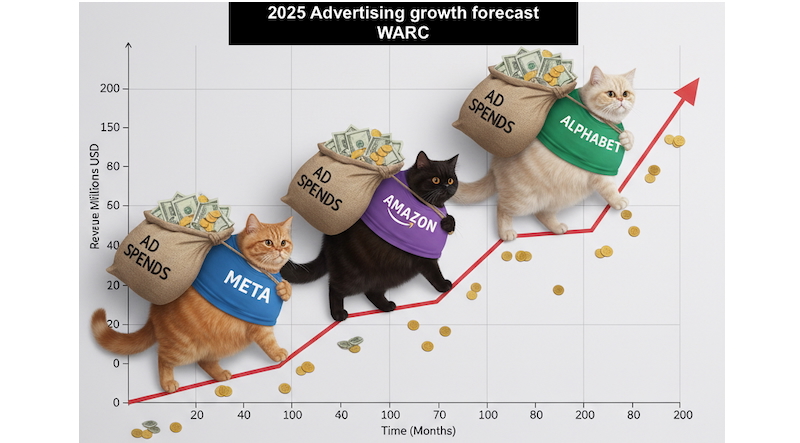
  • WARC ad forecast: Digital giants to gorge on global bonanza in 2025

    WARC ad forecast: Digital giants to gorge on global bonanza in 2025

    MUMBAI: Global advertising expenditure is set to surge by 7.4 per cent this year to $1.17trn, according to WARC’s latest forecast—the first upward revision in more than a year. The research firm has boosted its projection by 1.2 percentage points since June, driven by what it calls a “social media windfall” and frenetic pre-tariff spending.

    The bonanza is heavily skewed towards a handful of technology titans. Meta, Alphabet and Amazon are forecast to hoover up nearly two-thirds of all advertising growth in 2025, cementing their stranglehold on the global marketing purse strings. Outside China, the trio already commands 55.8 per cent of all advertising spend—a share set to exceed 60 per cent by 2030.

    Digital platforms are cannibalising traditional media with ruthless efficiency. Nine in every ten new advertising dollars are flowing to online-only platforms, leaving legacy media owners—even those with digital arms—to scrap over what WARC likens to “the equivalent of Facebook’s monthly revenue.”

    Social media has emerged as the single largest advertising medium globally, gobbling up 40.6 per cent of new marketing dollars. Spending on the channel is projected to rocket by 14.9 per cent to $306.4bn this year, representing more than a quarter of total global advertising expenditure. Meta remains the chief beneficiary, capturing 60 per cent of all social media advertising spend.

    The spending spree was particularly pronounced in the second quarter, when social media expenditure jumped 20.2 per cent year-on-year—well above WARC’s initial projection of 12.4 per cent growth. The surge was driven by retailers rushing to stockpile inventory and promote value ahead of expected price hikes, with retail now the largest category on both Instagram and TikTok.

    Search advertising is attracting around 22 per cent of new dollars, while retail media platforms are capturing another 21.5 per cent. Amazon is poised to claim over a third of the retail media pie, which is forecast to grow 13.7 per cent to $175bn in 2025.

    The momentum is expected to accelerate further, with global advertising spend projected to rise 8.1 per cent to $1.27trn in 2026 and 7.1 per cent to $1.36trn in 2027. The market is on track to nearly double in value since the pandemic, underscoring advertising’s remarkable resilience despite economic headwinds.

    “This includes disruption to global trade and reduced purchasing power among consumers, brands are doubling down on Meta, Alphabet and Amazon,” said WARC director of data, intelligence and forecasting James Mcdonald. “The global market is set to nearly double in value since the pandemic, underscoring the resilience of advertising in a tougher economic climate.”

    The rosy outlook contrasts sharply with some other industry forecasts. eMarketer recently slashed its projections for American digital advertising spending, citing the impact of trade wars on automotive and retail sectors. But WARC’s global perspective suggests the digital advertising juggernaut shows no signs of slowing.

  • Brand-time-performance wins the day as Warc unveil ‘Pace Principles’

    Brand-time-performance wins the day as Warc unveil ‘Pace Principles’

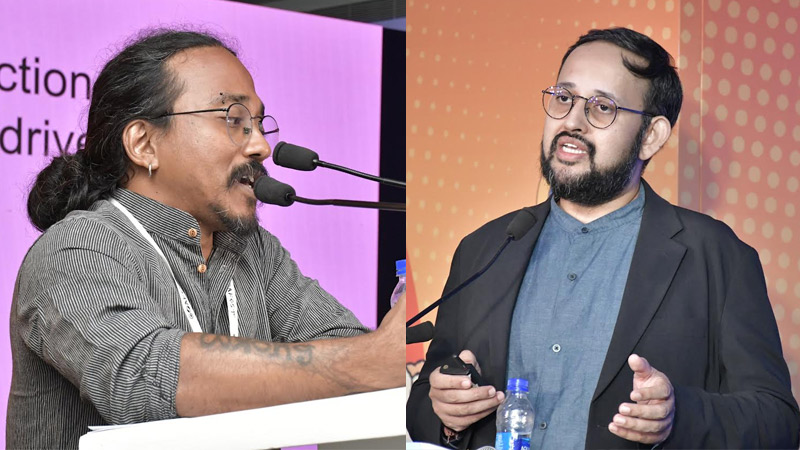
    MUMBAI: Speed met substance on day two of Goafest 2025 as Warc unveiled findings from the ‘Pace Principles’ report—a pioneering marketing effectiveness study rooted in Asian data. Amid the sun, strategy, and scribbles at Taj Cidade de Goa, two marketing heavyweights cut through the jargon to drive home a single truth: performance and branding aren’t rivals, they’re running mates.

    Sujeet Kulkarni – Global Advisory Consultant, Lions Advisory opened the session by underscoring that Warc’s insights are backed by the creative might of the Lions ecosystem. He dismissed the longstanding divide between brand-building and performance marketing. “Measuring brand and performance separately is a false premise”, he said. Instead, he urged marketers to view it through the lens of ‘brand-time-performance’, emphasising the role of time in cementing long-term success.

    According to Kulkarni, the sweet spot lies in marketing across six-and-a-half channels—a curious yet data-driven benchmark for campaign momentum. He stressed that marketers must “use time as an ally” to stay committed to sustained brand narratives.

    Warc India editor Biprorshee Das brought regional nuance into focus. He argued that speed has been wrongly cast as the enemy of brand investment. Citing Asian campaigns, he showed that a 50:50 split between conversion-focused and brand-building strategies yields the highest effectiveness. Das cautioned against treating long-term branding as a siloed initiative. Instead, he championed the “multiply effect”—a marketing phenomenon where cross-channel, time-sensitive integration drives better returns.

    The session didn’t shy away from bigger truths either. “Culture is not just about geography—it’s about the values we share”, Kulkarni concluded, suggesting that culturally relevant brands don’t just survive—they scale.

    The findings mark a turning point for marketers in Asia, urging a rethink on how success is measured—not just by short-term spikes, but by long-haul gains. With campaign tracking recommended beyond active periods, the call for better measurement frameworks grew louder through the day.


  • Global ad market to be hit by trade wars, tariffs, and turmoil, says Warc

    Global ad market to be hit by trade wars, tariffs, and turmoil, says Warc

    MUMBAI: The global advertising industry is set for a bumpier ride than expected thanks to Donald Trump’s recent trade pronouncements and the retaliatory measures by the countries  affected and the continuing conflicts in certain parts of the world. 

    With this background in mind, Warc has slashed its ad spend growth forecast for 2025 by almost a percentage point to 6.7 per cent. The revised estimate pegs global ad spend at $1.15 trillion, down $20 billion over the next two years, thanks to economic stagnation, trade tariffs, and regulatory upheaval. The outlook for 2026 has also taken a hit, with growth now expected at 6.3 per cent.

    Warc director of data, intelligence & forecasting James Mcdonald put it bluntly: “The ad market is feeling the squeeze from tariffs, economic stagnation, and regulatory crackdowns, prompting brands to rein in budgets. Despite the volatility, digital ad spend remains robust, with Alphabet, Amazon and Meta set to control over half the market by 2029.”

    Automakers are slamming the brakes on ad budgets, cutting spend by 7.4 per cent as manufacturing stalls and supply chain woes deepen. Key players like General Motors and Ford have already slashed marketing budgets, focusing more on digital and social channels over traditional TV spots. Meanwhile, tariffs on Mexican, Canadian, and Chinese car imports threaten to worsen the crunch, with 40.7 per cent of the industry at risk, per the European Automobile Manufacturers Association.

    Retailers, too, are tightening belts. The sector, the biggest spender in global advertising, is set to cut ad budgets by 5.3 per cent this year, as rising costs and trade barriers squeeze margins. Chinese disruptors like Temu and Shein, which fuelled a retail ad boom in 2024, are expected to dial back their spending due to new trade restrictions.

    Tech brands, once the ad market’s golden child, are now facing a slowdown. The sector’s projected growth has been halved, down to 6.2 per cent, as new tariffs on semiconductors hit supply chains. Warc had previously forecast a 13.9 per cent jump in tech ad spend—now it’s looking at a much cooler landscape.

    Despite the broader slowdown, digital advertising remains a money-spinner. Search advertising will grab 21.7 per cent of global ad spend this year, rising eight per cent to $250 billion. Social media, the biggest single advertising channel, will rake in $286.2 billion—almost a quarter of all ad spend—powered by TikTok (+23.6 per cent), Instagram (+17 per cent) and Facebook (+8.6 per cent).

    Retail media, the rising star, is set to be one of the fastest-growing advertising formats, with a 15.4 per cent surge this year. However, trade barriers could dent ad receipts from consumer goods brands that rely on global supply chains. 

    Yet, there are storm clouds ahead. The EU has slapped Apple and Google with Digital Markets Act violations, putting billions in ad revenues at risk. UK courts could soon allow consumers to opt out of personalised ads, threatening the backbone of search and social media advertising.

    The US remains a bright spot, with ad spend expected to rise 5.7 per cent to $451.9 billion. But that’s a far cry from the 13.1 per cent growth seen in 2024. Warc predicts a stronger 2026, with a 6.5 per cent uptick, thanks to the FIFA World Cup and US midterms.

    China’s ad market, however, is losing steam. Growth is slowing to 5.3 per cent this year to $205.5 billion – compared to growth of 7.1 per cent recorded in 2024 – as weak domestic demand takes its toll. This year’s growth rate equates to a 3.5 per cent rise in real terms.

    Europe’s major economies, meanwhile, are teetering. The UK’s ad market is still growing—up 7.1 per cent to $52.6 billion—but inflation-adjusted figures tell a less rosy story, with real growth at just 5 per cent. Germany, bogged down by economic sluggishness, is heading for a 2.1 per cent decline in ad spend, while Japan is bracing for a 2 per cent drop. Japan’s market is set to grow 3.3 per cent this year when measured in local currency, demonstrating the current strength of the greenback against the yen.

    Trade wars, tariffs, and economic turmoil are reshaping global ad spend, forcing brands to rethink strategies. The digital giants remain dominant, but regulatory pressures are mounting. In a market full of uncertainty, one thing’s clear—advertisers will need to stay agile to keep ahead of the curve.

  • Ajay Gupte’s Wavemaker tops Warc’s agency effectiveness list

    Ajay Gupte’s Wavemaker tops Warc’s agency effectiveness list

    MUMBAI: Wavemaker India is riding high, clinching the top spot in the WARC 100 Most Effective Global Ranking 2025—pulling off a victory with the swagger of a Madison Avenue maverick.

    As the advertising industry scrambles under the Competition Commission of India’s (CCI) watchful eye over alleged price-fixing allegations, Wavemaker has flipped a potential headwind into a jet stream of success.

    Ajay Gupte, chief executive for south Asia, isn’t just celebrating—he’s making a statement. “Creativity powered by insight and innovation.” That’s not just a corporate tagline—it’s a battle cry.

    The numbers tell a cracking story. Wavemaker Mumbai stormed to 115.3 points, blowing past global giants. More remarkably, it stands as the only Indian agency in the top 10—a statistical unicorn in a rankings table usually ruled by North American and European behemoths.

    The global podium: 

    1) Wavemaker Mumbai, India (115.3 points)
    2) Starcom Chicago, US (107.7 points)
    3) Mindhare New York, US (78.4 points)

    Even as the CCI probes alleged anti-competitive practices in the advertising world, Wavemaker has flipped the script—turning scrutiny into strategy. While some players glance nervously over their shoulders, Wavemaker is already sprinting ahead.

    Chief client officer and office head, west, north & east Shekhar Banerjee, calls it a journey of “consistency, evolution and relentless focus. No 1 in 2023 #2 in 2024. Back to #1 in 2025.”

    The WARC 100 isn’t just a list. It’s the Everest of media effectiveness rankings—stacked with the most impactful campaigns on the planet.

    A massive shoutout to GroupM and Wavemaker India’s leadership for pushing boundaries on tech, measurement, full-funnel strategies and creativity.

    While the industry introspects, Wavemaker accelerates.

  • Warc revises ad revenue growth estimates upwards for 2024

    Warc revises ad revenue growth estimates upwards for 2024

    MUMBAI: Bullish is the mood at marketing effectiveness specialist Warc. The  firm had forecast in August 2024 that global advertising spend is on course to grow 10.5 per cent this year to a total of $1.07 trillion. Now, it has revised that growth upwards by 0.2 percentage points; its latest projection is that ad spends globally will grow by 10.7 per cent to touch  $1.08 trillion – the strongest growth rate in six years and the largest absolute rise on record if the post-Covid recovery of 2021 (+27.9 per cent year-on-year) is disregarded. 

    Warc’s latest global projections are based on data aggregated from 100 markets worldwide. Online media is on course to drive the growth,  a good year for TV has also made a notable contribution. The good news is that spends on linear TV are rising and are expected to end the year higher by 1.9 per cent, at $153.6 billion, following two years of slippage. Political TV adverts (especially in the US), the Paris Olympics and Euro football in Q3 have buoyed the spends on TV. However, before you start apart applauding please note that  linear TV’s hold today stands at just 14.3 per cent of global advertising spend, much, much lower than the heady days of a 41.3 per cent share in 2013. 

    We have all heard it before: Alphabet, Amazon and Meta are Pacmen increasingly swallowing up ad dollars in large chunks of billions every year. Warc data supports that. It stated that pure play online internet businesses like that of the three big tech firms, will see ad revenue growths of 14.1 per cent reaching $741.4 billion – accounting for a total of 68.8 per cent of all spends. Gadzillions!

    Social media ad spends are expected to leap upwards by 19.3 per cent reaching $252.7 billion -equalling 23.5 per cent of the total ad market. This is mostly because the sales folks at Facebook, Instagram and TikTok have been selling hard leading to better than expected results at the three firms during the first nine months of this year. 

    Overall ad spend growth is also expected to be buoyant next year at 7.6 per cent in 2025, and seven per cent in 2026 taking the global ad market to $1.24 trillion. For all those who have been doomsayers predicting the slamming of brakes on advertising here’s some facts: global ad investments have more than doubled over  the past 10 years and have grown 2.8 times faster than global economic output since 2014.

    Warc director of data, intelligence and forecasting and author of the research James McDonald said: “Our latest forecast anticipates $104bn in incremental advertising spend worldwide this year, the largest rise in history if the post-pandemic recovery year of 2021 were discounted. Whether this boom will sustain remains unclear, however, as 2025 presents a sliding doors moment due to heightened regulatory pressures on Google and TikTok – together a quarter of the ad market outside of China. This, alongside an increasingly challenging geopolitical climate, may spell uncertain times ahead for the businesses that rely on advertising trade.”

    (The image for this report was created using OpenArt AI. No copyright infringement is intended)
     

  • L&K Saatchi & Saatchi appoints Balakrishna Gajelli as executive creative  director

    L&K Saatchi & Saatchi appoints Balakrishna Gajelli as executive creative director

    Mumbai: L&K Saatchi & Saatchi, part of Publicis Groupe India, has appointed Balakrishna Gajelli as its  executive creative director. He will be based in the agency’s Mumbai office and report to L&K Saatchi & Saatchi’s CCO Kartik Smetacek.  

    With over 17 years of experience encompassing art, design, branding & creative direction in  advertising, Gajelli has crafted creative communications for renowned brands such as P&G,  VISA, Bumble, Johnson’s Baby, Pillsbury, Amul, Tata Salt, Tata Indicom, Idea Mobile, ITC  Foods, Crompton, and many others.

    His outstanding contributions and wide-ranging expertise in the advertising and marketing  field earned him a place among top 5 creative directors globally in The Big Won report for  2016. Additionally, he has been recognized as the #1 Hottest Creative in India by the  Campaign Brief Asia Creative Ranking. Previously, Bala has worked with FCB Ulka, BBDO India  and Leo Burnett India.

    Commenting on his appointment, Smetaceki said, “This will be the second time I’m working with Bala. He’s a solid thinker, a  talented designer and a trustworthy individual. In recent years, he’s also gained a lot of  experience with non-traditional work, working on some on India’s most awarded campaigns.  It’s fantastic to have him be part of our team.”

    Gajelli added, “I have great respect for L&K Saatchi & Saatchi’s creative, authentic, and brand centric approach so I am thrilled to be part of this organisation. It’s great to work with Kartik  again, and the agency’s vibrant culture and uplifting environment are plus points. I’m  enthusiastic about becoming a valued member of this team and family, contributing to an  exhilarating new phase for L&K Saatchi & Saatchi, and nurturing my professional  development. I eagerly anticipate leveraging the insights gained from my previous stints and  experiences to craft meaningful and innovative advertising and marketing solutions for our  clients.”

    Bala’s work has won the highest honours at Cannes Lions, Cannes Lions, D&AD, One Show,  LIA, WARC, New York Festival, AdFest, SpikesAsia, APAC Effies & Abbys. 

  • OTTs are regarded as one of the most important aspects that influence consumer behaviours: MMA Report

    OTTs are regarded as one of the most important aspects that influence consumer behaviours: MMA Report

    Mumbai: In India, OTTs are regarded as one of the most important aspects that influence consumer behaviors. In a recently published report, in collaboration with Warc, MMA Asia Pacific examines how the industry is approaching these challenges, focusing on current trends and future opportunities. To drive growth in the digital age, marketing needs to modernise a specific set of capabilities and mindsets.

    Findings from this study suggest that over a third (36 per cent) of Indian marketers will spend more than 60 per cent of their budgets on digital marketing, compared to 25 per cent of Apac marketers overall.

    19 per cent of Indian marketers are investing in AR/VR in efforts to promote marketing advancements, the report added.

    A majority of marketers are using data analytics and collection to drive improvements in their digital marketing. While 69 per cent marketers expect the metaverse to significantly impact the space, a budget of 36 per cent identified it as the biggest barrier to digital marketing growth in India.

    To drive growth in the digital age, marketing needs to modernise a specific set of capabilities and mindsets. But as complexity grows, marketers face increasingly difficult choices about where to allocate their investments, what objectives and tactics to choose, and what capabilities to develop in order to drive future growth.

  • Global ad market to top $700 bn in 2022: WARC Data

    Global ad market to top $700 bn in 2022: WARC Data

    New Delhi: Global advertising spend is expected to rise 12.6 per cent during 2021 as a whole to reach $665bn, according to WARC Data’s report tracking global ad-spends. This is a sharp increase from the 6.7 per cent initially forecast, and would result in all of 2020’s losses being recouped, contrary to previous expectations.

    The new report signals renewed optimism in the situation getting better for the overall market as it recovers from the severe impacts of the pandemic. According to WARC Data, a further growth of 8.2 percent is predicted for next year, with the global advertising market to be worth more than $700 billion. While it took six years to move from $500bn to $600bn, it has now taken just four years to reach $700bn. This is in no small part due to rapid investment in online formats, which has doubled in the last five years, it stated.

    India, too, will see strong growth in advertising spend over the next two years, but 2021 investment will not fully recover 2020’s losses, said WARC Data in its latest report, tracking 100 markets worldwide. According to the report, India’s growth is up 16.1 percent to $8.2 billion in 2021.

    Regional advertising investment in the Asia Pacific is forecast to increase by 12.8 percent this year to top $200 billion for the first time. This will be driven by the Chinese ad market, which is expected to grow by 16.3 percent to exceed $100 billion for the first time.

    WARC’s quarterly research also finds that advertising spend in the second quarter rose 23.6 percent to $157.6 billion, marking a new high for a Q2 period and the strongest rise in over a decade. This growth was mainly driven by online formats, which collectively saw spend rise 31.2 per cent versus the previous year. eCommerce was the star performer with growth of 59.5 per cent, though offline media – most notably linear TV saw 11.5 per cent growth – also fared well.

    Linear TV to grow 7.1 per cent in 2021

    For linear TV, spend is projected to grow 7.1 percent to $168.1 billion this year, equal to a quarter (25.3 percent) of the global ad market. Investment is expected to rise by a further 2.7 percent in 2022, though this means just 60 percent of 2020’s losses will be recovered by 2022.

    “The 2020 downturn was felt disproportionately among legacy media owners. While online ad investment rose 9.4 per cent last year, mostly to the benefit of a few pure players, brand spend on legacy media such as print, TV, radio, outdoor and cinema fell by $63bn. Data show that this loss was on a par with the Great Recession,” as per WARC.

    The forecast suggests, legacy media will see two consecutive years of growth in 2021 (8.8 per cent) and 2022 (3.1 per cent) for the first time in a decade, but budgets will continue to move online. More than 60 per cent of spend is expected to be on digital media in 2022, an increase in share from 50 per cent before the pandemic in 2019.

    “New quarterly research, collated from 100 markets worldwide, shows for the first time the true extent of the digital shift in response to the coronavirus outbreak last year. Growth in online adspend has typically tracked some 20 percentage points ahead of offline media, but in the final quarter of 2020, this leaped to a remarkable 41 points—an absolute difference of $41 billion,” WARC Data, managing editor and author of the report, James McDonald.

    “Investment in offline media fell by $63 billion worldwide in 2020, marking the worst year in living memory for the majority of media owners. All media are forecast to record growth this year, with most sustaining this into 2022. Yet, as has been seen before, it is the online platforms that are set to benefit most from the ad market’s recovery.”

    All consumer-facing product sectors are expected to increase advertising spend this year. The travel sector, however, will take more than two years to lift spend back to pre- pandemic levels, it added.

  • Ariel’s #SonsShareTheLoad is WARC’s most awarded work for media excellence

    Ariel’s #SonsShareTheLoad is WARC’s most awarded work for media excellence

    Mumbai: Ariel India’s 2019 #ShareTheLoad campaign has made it to the most awarded work for Media excellence in the WARC list for the year 2020. World Advertising Research Centre (WARC) is an online marketing intelligence service that provides an independent benchmark for excellence in creativity, media, and effectiveness.

    Ariel started the #ShareTheLoad campaign in 2015 to address the inequality that exists within Indian households. As the social debate evolved, the brand continued to bring different perspectives and launched the third edition of the campaign in February 2019. The Sons #ShareTheLoad urged parents to raise the next generation as equals and teach their sons important life skills like laundry, cooking, etc. The TVC raised the pertinent question – “Are we teaching our sons what we are teaching our daughters?”

    P&G India CMO & VP – fabric care Sharat Verma said, “We started off by raising a pertinent question on 'Is laundry only a woman’s job?' back in 2015. We have kept the conversation alive all these years to continue to create awareness around the issue. With Sons #ShareTheLoad, we urged parents to teach our sons what we have been teaching our daughters over decades. We will continue to leverage our brand as a force for good and make laundry the face of the change we are trying to drive across the country.”

    The digital film garnered over 83 million views in partnership with Mediacom as the media partner. A mother-son fashion show was also organised in Chandigarh to drive home the message of teaching the sons of today basic household chores, where mothers sported clothes washed by their sons.

    Mediacom CEO south Asia Navin Khemka said, “It’s a moment of great pride to see our work getting recognised globally. We are proud to be an ally in this social change with Ariel and P&G India, not just now but since the start of #ShareTheLoad in 2015. Together, we aim to address the inequality that exists in Indian households and continue to work in that direction even now.”

    The Load Lockdown film- 

    Link season 4- 

    Link Season 3 – 

    Link Season 2- 

    Link- Season 1- 

  • The challenges and benefits facing martech in India

    The challenges and benefits facing martech in India

    NEW DELHI: Martech sounds like quite a jargonistic word to many. But, put simply, it is the tech stack run by backroom geeks in glasses who use software and web-based services to manage, automate, or execute marketing tasks and processes. Data and analytics lie at the heart of martech, giving companies better customer and market insights, helping them to respond accordingly. 

    Globally, it is a booming business touching Rs 739,200 crore ($121 billion) in 2019, according to a report by advisory and research firm BDO and WARC in conjunction with the University of Bristol. In India, it is coming out of  its infancy  with marketers just about waking up to its utility, though the software development  sector has bitten a sizable piece of the global pie.

    Earlier this year,  WPP group company  Mirum India released its Martech Survey 2020 report, which did not give any indications of the sector’s size and scale, but it revealed that  marketers across India are bullish, with as many as 80 per cent of those surveyed expecting their organisation’s spends on these technologies to increase over the next five years. 

    Xaxis India country lead Bharat Khatri told Indiantelevision.com that there has been a significant rise in the investments that Indian brands and marketers are making in the martech space. “Around one-fourth of the overall marketing pie is being directed towards martech right now and this shift has occurred within the past few years only. Earlier, we were getting a minuscule share in the marketing pie, and it is definitely bound to grow further.” 

    However, according to him, despite growth in adoption, the core challenge for the industry remains that most of the people who are investing in the technologies are not aware of how it is benefiting them. “Around 50 per cent of the marketers today don’t know the exact functions of martech. There is a great need to educate the industry.” 

    Business head of a leading insurance company acknowledges in the Mirum India report that the biggest challenge is that there are too many hands involved in the martech implementation broth, thus leading to delays. “Adding to this is the pressure caused by marketers evaluating solutions only after they identify a specific business need, which leaves them with little time to plan before arriving at a decision,” he adds. He also points out to problems of integrating the martech tools with existing technologies in an organization and the pushback from internal stakeholders towards adopting change. 

    Another issue stifling  the sector’s growth is marketing budgets, which are limited. 
    Khatri explains that martech’s limitation, in the Indian context, is that one cannot instantaneously get to know if the investment being poured into it is worth it.

    “It takes two to three  years to understand the kind of impact the martech tools have had and the ROI. Now, for some marketers, it gets difficult to get the budgets sanctioned, and with a pandemic like Covid-19, when everyone is holding back their budgets, it is creating a big problem,” he says. 

    However, the industry believes that Covid2019 pandemic has certainly opened up newer and exciting opportunities for martech, and it will be wiser for the brands to latch on to it. 

    “COVID2019 has impacted consumer behaviour a lot and accentuated some of the consumer trends too. In the past four months, we have seen how the adoption and usage of online channels have increased,” says Logicserve Digital founder &  CEO Prasad Shejale. “Consumer journeys have changed significantly and have also affected brand loyalty. This is actually a great opportunity, and smart marketers are investing in analytics tools to understand changing customer behaviour.” 

    Adds Khatri:  “What brands are using martech for most is understanding the consumer behaviour and their journeys –  what they like, where and when they shop, etc. This has resulted in marketing being market-driven instead of sales-driven. This has resulted in great demand for technologies like customer data platforms (CDMs), tools for customer relationship management (CRM), and mobile phone data.”

    Shejale agrees: “The most important tools right now are the combination of analytics-insights-CRM/CDP. These tools, along with a focused approach on the consolidation of consumer data to understand them better, are important to provide better service to the consumers across their journeys, whether online or offline. For a smooth and convenient journey across online and offline channels, CRM tools can be very effective. They can also assist in sending the right communication to your audience at the right time through the right channels.” 

    Another interesting trend that is, arguably, impacting the growth of martech in India is global domination in the arena. The Indian industry is currently dotted by a lot of foreign players who have been active in the space for a long time. Khatri suggests that platforms like Salesforce are quite popular. 

    In a e previous episode of the Media Minds  2, Zoo Media & FoxyMoron co-founders Suveer Bajaj and Pratik Gupta had said, “India, by virtue of the fact that we have been a tech hotspot so as to speak, with big boys at Infosys, Wipro  and TCS setting the agenda, is globally acting as a back office for a lot of martech and a lot of adtech companies for generations. It’s funny though, like for example, even if you look at programmatic, we are about 18 months behind and what the rest of the world is.” 

    But Indian players are also catching up fast. 

    “India has a big advantage in making technology in-house and there are a lot of independent firms and also companies like ours who are a part of big global networks investing great time and energy in creating tools and technologies here. For example, last year we launched Xaxis Places, a completely homegrown technology and now 30 plus  markets across the globe are using it,” Khatri shares.

    Adds Zoo Media’s Pratik Gupta:  “We are struggling as an agency to be able to wrap our heads around all of the marketing tech and adtech that exists pretty much out there (but) there are a lot of things that we are doing. For example, there is a marketing technology and ad technology platform that we are building inside of Instagram, which is a landing page solution providing first-party data on e-commerce.” 

    Ambient, C Lab, ROOH, Brandscope director Deepak Kumar, also sheds some light on the in house technologies that the agency is working on. “We created a tool called Star Metrics, which helps identify the geographical heat map indicating where the fanbase of a particular star is and where the consumers of a brand are. If those heat maps match, a darker hotspot is created indicating the perfect fitment of both, ensuring maximum engagement.”

    He also mentions that the team is about to launch another technology to complement this in the coming weeks. 

    According to Khatri,  many independent firms are also getting active in this space. Albeit one problem that these players might face in the coming few months is  the market sentiment that has been created due to the pandemic, but he is sure that this is temporary. 

    Indeed, with the tide now rising for martech in India, it won’t be too long before it washes over many more who have been playing a wait and watch game.