Tag: VSAT

  • India’s communication satellite GSAT-31 launched successfully from French Guiana

    India’s communication satellite GSAT-31 launched successfully from French Guiana

    MUMBAI: India’s latest communication satellite, GSAT-31 was successfully launched from the Spaceport in French Guiana during the early hours today.

    With a lift-off mass of 2536 kg, GSAT-31 will augment the Ku-band transponder capacity in Geostationary Orbit. The satellite will provide continuity to operational services on some of the in-orbit satellites. GSAT-31 derives its heritage from ISRO’s earlier INSAT/GSAT satellite series.

    ISRO Chairman Dr K Sivan said, “GSAT-31 has a unique configuration of providing flexible frequency segments and flexible coverage. The satellite will provide communication services to Indian mainland and islands.”

    Dr. Sivan also remarked that “GSAT-31 will provide DTH Television Services, connectivity to VSATs for ATM, Stock-exchange, Digital Satellite News Gathering (DSNG) and e-governance applications. The satellite will also be used for bulk data transfer for a host of emerging telecommunication applications.”

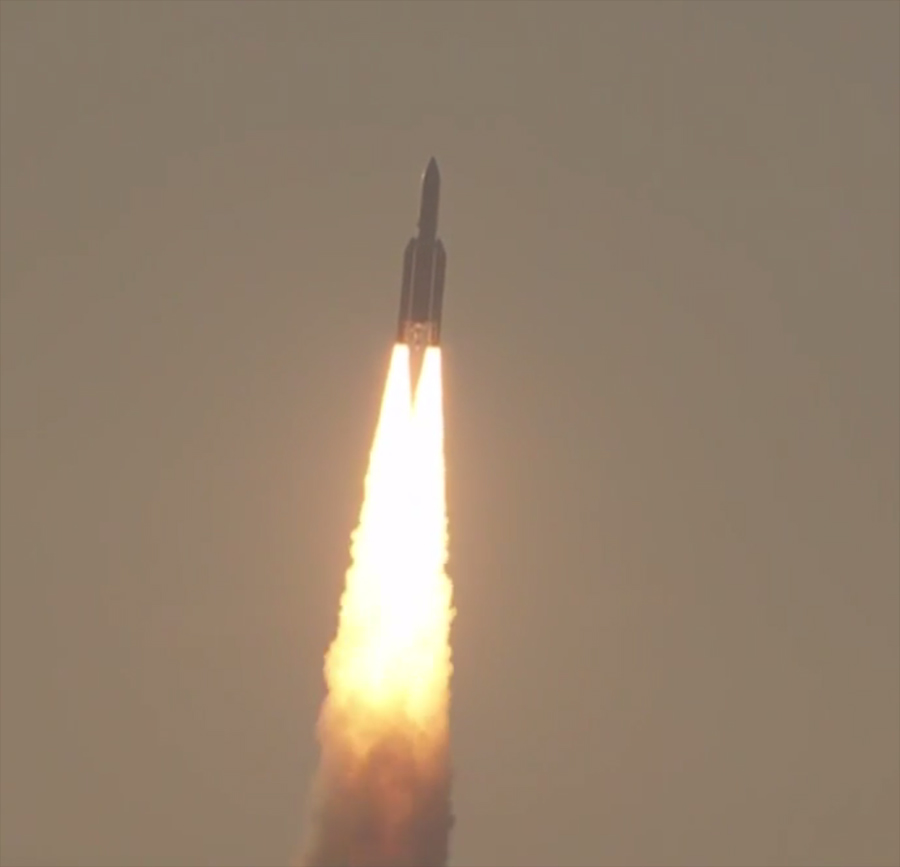
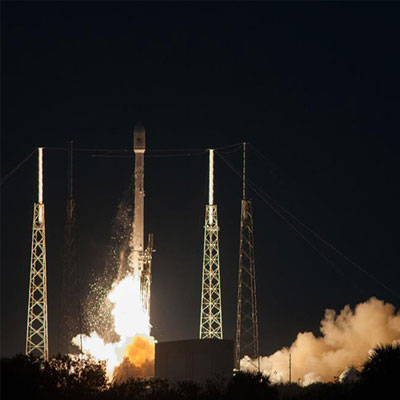
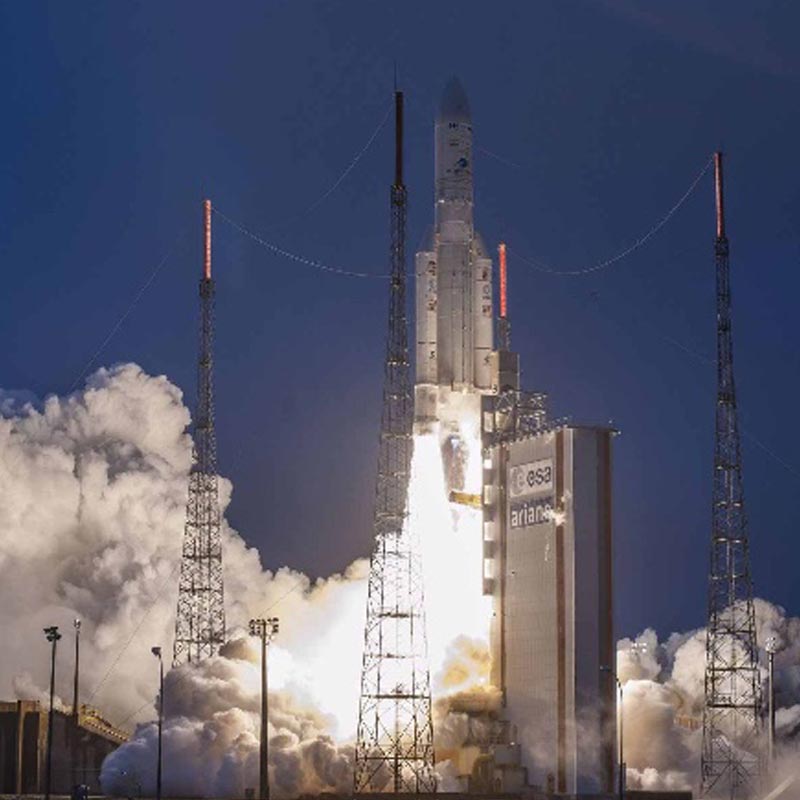
    The launch vehicle Ariane 5 VA-247 lifted off from Kourou Launch Base, French Guiana at 2:31 am (IST) carrying India’s GSAT-31 and Saudi Geostationary Satellite 1/Hellas Sat 4 satellites, as scheduled.

    After a 42-min flight, GSAT-31 separated from the Ariane 5 upper stage in an elliptical Geosynchronous Transfer Orbit with a perigee (nearest point to Earth) of 250 km and an apogee (farthest point to Earth) of 35,850 km, inclined at an angle of 3.0 degree to the equator.

    After separation from Ariane-5 upper stage, the two solar arrays of GSAT-31 were automatically deployed in quick succession and ISRO's Master Control Facility at Hassan in Karnataka took over the command and control of GSAT-31 and found its health parameters normal.

    In the days ahead, scientists will undertake phase-wise orbit-raising manoeuvres to place the satellite in Geostationary Orbit (36,000 km above the equator) using its on-board propulsion system.

    During the final stages of its orbit raising operations, the antenna reflector of GSAT-31 will be deployed. Following this, the satellite will be put in its final orbital configuration. The satellite will be operational after the successful completion of all in-orbit tests.

  • SES 15 launches successfully on 18 May

    MUMBAI: SES announced that the SES-15 satellite was successfully launched onboard a Soyuz rocket from the Guiana Space Center in Kourou, French Guiana at 08:54 local time. This is SES’s first satellite to launch on a Soyuz rocket for a geostationary transfer orbit mission.

    SES-15 carries a hybrid payload, comprising Ku-band wide beams and Ku-band High Throughput Satellite (HTS) capability, with connectivity to gateways in Ka-band. SES’s first hybrid satellite will be located at the orbital position of 129 degrees West and is equipped with 16 Ku-band transponders (36 MHz equivalent) as well as HTS capabilities to serve North America, Mexico, Central America and the Caribbean.

    SES-15’s high throughput payload will deliver optimised and flexible coverage for major global inflight connectivity and entertainment (IFC/IFE) service providers, such as Global Eagle Entertainment, Gogo and Panasonic Avionics. In addition, SES-15 has a dedicated wide beam that is designed to enable IFC/IFE providers to deliver live TV content on all flight routes across the US, including Hawaii and Alaska, as well as Canada, the Caribbean and Mexico. This unique combination of beams allows IFC/IFE providers to optimise HTS capacity use for internet traffic and wide beam coverage for broadcast content.

    The satellite will also enable VSAT networks and other traffic intensive data applications in the government and maritime sectors.

    SES-15 will also carry a Wide Area Augmentation System (WAAS) hosted payload, which will enable the US Federal Aviation Administration (FAA) to augment the Global Positioning Systems (GPS) with the goal of improving accuracy, integrity and availability of the system for the aviation industry.

    The satellite is equipped with an electric propulsion system for orbit-raising and in-orbit maneuvers.

    “The successful launch of SES-15 is the first of our three planned hybrid satellites, which have both wide beams and high throughput capability. SES-15, along with the soon-to-be launched SES-14 hybrid satellite, and our existing in-orbit satellites, offer the most resilient aeronautical connectivity platform in North America,” said Martin Halliwell, Chief Technology Officer at SES. “SES-15 will allow us to strengthen our ability to provide next generation services in data-intensive markets such as maritime and corporate broadband.”

    “SES is a long-standing partner, and we are delighted to be part of its important journey in serving the ever-growing aeronautical and data markets by successfully launching SES-15 on a Soyuz rocket,” said Stephane Israël, Chief Executive Officer at Arianespace.

  • ISRO’s ‘South Asia Satellite’ to carry 12 ku-band transponders

    MUMBAI: India has planned to launch the ‘South Asia Satellite’ on 5 May which will benefit all the neighbouring countries, except Pakistan, which is not a part of the project. Indian Space Research Organisation (ISRO) chairman A S Kiran Kumar told PTI that the launch would take place in the first week of May.

    ISRO scripted history in February 2017 by launching 104 satellites, including India’s weather observation Cartosat-2 Series, in a single mission onboard its dependable Polar rocket. So far, ISRO has launched 226 satellites, including 179 belonging to foreign countries.

    ISRO sources said that the launch of this communication satellite (GSAT-9) has been scheduled on board the space agency’s rocket GSLV-09 from Sriharikota spaceport. Kumar said, the satellite, with a lift-off mass of 2,195 kg, would carry 12 ku-band transponders. Sources said the satellite has been designed for a mission life of more than 12 years.

    The satellite is meant for providing communication and disaster support, connectivity among states (countries of South Asia region). It will provide a significant capability to each of these participating states in terms of DTH, certain VSAT capacity plus linking among the states for both disaster information transfer and also in terms of library type of things.

    “So, there is a significant amount of inter-linking possible among the states (countries),” Kumar added. According to ISRO officials, there is a potential for each participating country to use a dedicated transponder with a capacity of 36 to 54 Mhz for its own internal use. Each country would be responsible for content generation and its use, the officials said.

    Also Read:

    MIB: No DPO request for infra sharing, DTH ops’ transponder demand up

    ISRO ready for nexGen vehicle, GSLV can launch 2.2 tonne satellites to GTO

    ISRO world record in 104-satellite launches on a single flight    


  • TRAI reducing TSP/ISPs & VSAT service-providers’ burden: Broadband Forum

    NEW DELHI: Expressing satisfaction that many of its demands had been met in the latest recommendations by the Telecom Regulatory Authority of India, Broadband India Forum has said it is a small but significant step in the right direction to help reduce the burden of the TSP/ISPs as well as that of the VSAT service-providers thereby  paving the way for a more active engagement of the ISPs and TSPs offering Internet Access Services to increase broadband penetration in the country

    BIF president T V Ramachandran hoped that this would be the first of many such recommendations from the Regulator to expedite broadband penetration and the vision of the prime minister to fully realise the dream of ‘Digital India’.

    He said the recommendations for streamlining the procedure/process of allocation of satellite capacity and the frequency allocation subsequently by WPC for VSAT service providers and capping it to be provided in a time bound manner –within a span of  three months was indeed praiseworthy.

    He said further went on to mention that the idea of a single window clearance for all clearances/approvals/payments through a transparent online mechanism was a “wonderful and welcome idea in this age of digital payments and single point responsibility”.

    Ramachandran said BIF’s position stand vindicated on many of the points made by the Regulator stand vindicated. These include the given spectrum bands be charged administratively and on a link-by-link basis; P-AGR should not be prescribed either for ISP licenses or for Commercial VSAT Licenses; SUC calculation/determination should continue to be based on the existing formula instead of as a percentage of the AGR; and delayed payment in case of SUC should be charged on the basis of SBI PLR +2%.

    Also Read :

    Industry surprised on Deepak’s transfer from DoT, Jio connection refuted

    5G network: Huawei launches 5000 series station & microwave bearer solution

    Don’t levy spectrum usage charges as percentage of AGR: TRAI

  • Don’t levy spectrum usage charges as percentage of AGR: TRAI

    NEW DELHI/MUMBAI: The minimum presumptive Adjusted Gross Revenue should not be made applicable to ISP licensees, and the spectrum usage charges should not be levied as percentage of AGR and existing formula-based mechanism of charging SUC should continue as also the existing system of payment of SUC charges on an annual basis by ISP licensees.

    Following a request from the DoT, the Telecom Regulatory Authority of India (TRAI) had issued a consultation paper on “Spectrum Usage Charges (SUC) and Presumptive-Adjusted Gross Revenue for Internet Service Providers and Commercial Very Small Aperture Terminal Service Providers” on 19 August 2016.

    Apart from written comments and counter comments, an Open House Discussion was held on 19 January 2017 with the stakeholders. TRAI’s recommendations were based on the analysis of the comments received from the stakeholders and its own analysis.

    The interest for delayed payment of SUC by ISP licensees, TRAI recommends, should be two per cent above the SBI PLR rate existing on the beginning of the relevant financial year, and there should be no requirement of FBG for ISP licensee in respect of formula-based SUC payable.

    The minimum presumptive AGR should not be made applicable to commercial VSAT license and the SUC should not be more than one per cent of AGR irrespective of the data rate.

    The Department of Telecom should put in place a comprehensive, integrated on-line system that acts as a single window clearance for the allocation/ clearances/issuance for approval/ clearance / issue of No Objection Certificates and other permissions to the licensees of spectrum,

    In its Recommendations on “Spectrum Usage Charges and Presumptive Adjusted Gross Revenue for Internet Service Providers and Commercial Very Small Aperture Terminal Service Providers”, TRAI has said DoT should make arrangement to accept online payment of financial levies / dues such as Licence Fee, Spectrum Usage Charges and other fees that are paid by the licensees for obtaining licence/ approval/ clearance / issue of No Objection Certificates from DoT.

    The regulator has said that the existing system of spectrum assignment on location/link-by-link basis on administrative basis to ISP licensees in the specified bands (viz 2.7 GHz, 3.3 GHz, 5.7 GHz and 10.5 GHz) should continue.

    DoT may take up with the Department of Space to evolve a system where the VSAT licensees are not made to run from pillar to post to get their services activated.

    The clock should start from the day the bandwidth is allotted by DoS and DoT should allot frequency within three months of allotment of spectrum by DoS. The two departments may also explore the possibility of implementing an on-line application for automating the whole process to bring in transparency.

    DoT had sought TRAI’s recommendations in terms of clause 11(1) of TRAI Act 1997 (as amended), on :

    (A) ISP  license

    (i)    Rates for  SUC;
    (ii)   Percentage of AGR including minimum AGR;
    (iii)  Allied issues like schedule of payment, charging of interest, penalty and Financial Bank Guarantee (FBG)

    (B) Commercial VSAT license

    (i)  Floor level (minimum) AGR, based       on the amount of spectrum held by commercial VSAT operators.

  • Spectrum, VSAT licences AGR: TRAI discussion on 19 Jan

    Spectrum, VSAT licences AGR: TRAI discussion on 19 Jan

    NEW DELHI: An Open House Discussion will be organised by the Telecom Regulatory Authority of India on its consultation paper on minimum presumptive AGR for Spectrum and VSAT licenses.

    The OHD will be held in the capital on 19 January 2017. The paper was issued on 17 August 2016 after a query by the Department of Telecom on 25 June 2014 and 15 May 2015 to which TRAI had responded on 2 March 2016.

    TRAI had asked stakeholders if spectrum assignment on location basis/link-by-link basis on administrative basis to ISPs be continued in the specified bands. On 19 September 2016, TRAI extended the date for comments to 13 October.

    The regulator has discussed issues relating to minimum presumptive AGR for ISP licenses and VSAT licenses and other issues raised by DoT which had sought TRAI’s recommendations in terms of clause 11(1) of TRAI Act 1997 on:

    (A) ISP license (i) Rates for SUC; (ii) Percentage of AGR including minimum AGR; (iii) Allied issues like schedule of payment, charging of interest, penalty and Financial Bank Guarantee (FBG).

    (B) Commercial VSAT license (i) Floor level (minimum) AGR, based on the amount of spectrum held by commercial VSAT operators. The Authority said in 2014 it had suo motu undertaken the exercise of review of definition of revenue base (AGR) for the reckoning of licence fee (LF) and spectrum usage charges (SUC).

    Earlier, another Consultation Paper was issued on 31 July 2014 and Recommendations on 6 January 2015. The Recommendations, along with other issues, also contain recommendations on minimum presumptive AGR. In the Recommendations of 6 January 2015, the Authority had recommended that minimum presumptive AGR for the purpose of LF and SUC should not be made applicable for any licenses granted by the Government for providing telecom services. Paper is available on trai.gov.in

    Also read     

    TRAI issues consultation paper on AGR issues relating to Spectrum

    TRAI extends dates for views on AGR issues relating to Spectrum

  • Spectrum, VSAT licences AGR: TRAI discussion on 19 Jan

    Spectrum, VSAT licences AGR: TRAI discussion on 19 Jan

    NEW DELHI: An Open House Discussion will be organised by the Telecom Regulatory Authority of India on its consultation paper on minimum presumptive AGR for Spectrum and VSAT licenses.

    The OHD will be held in the capital on 19 January 2017. The paper was issued on 17 August 2016 after a query by the Department of Telecom on 25 June 2014 and 15 May 2015 to which TRAI had responded on 2 March 2016.

    TRAI had asked stakeholders if spectrum assignment on location basis/link-by-link basis on administrative basis to ISPs be continued in the specified bands. On 19 September 2016, TRAI extended the date for comments to 13 October.

    The regulator has discussed issues relating to minimum presumptive AGR for ISP licenses and VSAT licenses and other issues raised by DoT which had sought TRAI’s recommendations in terms of clause 11(1) of TRAI Act 1997 on:

    (A) ISP license (i) Rates for SUC; (ii) Percentage of AGR including minimum AGR; (iii) Allied issues like schedule of payment, charging of interest, penalty and Financial Bank Guarantee (FBG).

    (B) Commercial VSAT license (i) Floor level (minimum) AGR, based on the amount of spectrum held by commercial VSAT operators. The Authority said in 2014 it had suo motu undertaken the exercise of review of definition of revenue base (AGR) for the reckoning of licence fee (LF) and spectrum usage charges (SUC).

    Earlier, another Consultation Paper was issued on 31 July 2014 and Recommendations on 6 January 2015. The Recommendations, along with other issues, also contain recommendations on minimum presumptive AGR. In the Recommendations of 6 January 2015, the Authority had recommended that minimum presumptive AGR for the purpose of LF and SUC should not be made applicable for any licenses granted by the Government for providing telecom services. Paper is available on trai.gov.in

    Also read     

    TRAI issues consultation paper on AGR issues relating to Spectrum

    TRAI extends dates for views on AGR issues relating to Spectrum

  • TRAI to review terms for captive VSAT licences

    TRAI to review terms for captive VSAT licences

    MUMBAI: Telecom regulatory authority TRAI has started a comprehensive review of various fee and charges related to captive VSAT (very small aperture terminal) licences, including entry fee, licence fee, bank guarantee and royalty charges.

    VSAT, a satellite communication technology, is useful for remote and inaccessible locations which lack proper terrestrial connectivity, PTI has reported.

    The consultation paper “Captive VSAT CUG (Closed User Group) policy issues” also seeks to remove the difference in licence fee for operating two hubs (earth stations that control and monitor activities of remote terminals).

    “Is there a need to review some or all of the fee or charges viz. Entry fee, licence fee, royalty charges and bank guarantee etc. For captive VSAT CUG licenses…If yes, what should be the appropriate fee or charges,” TRAI asked in the consultation paper.

    ‘Captive VSAT Licence’ refers to licence for those networks in which the equipment and facilities are owned and operated by the licensee itself for its own use under one Closed User Group (CUG). The Captive VSATs are deployed by commercial organisations like National Thermal Power Corporation, Oil and Natural Gas Corporation, as well as government bodies to cater to their own requirement and applications.

    The TRAI paper has also sought industry views on whether licence fee for a second VSAT hub, (being used independently or for redundancy purposes) should be the same as the first VSAT hub, and also the quantum of per annum fee for the second hub. The deadline for sending written comments is November 25, 2016.

    At present, the licence fee stands at Rs 10,000 per annum per VSAT earth stations installed, in case of the first hub. But in case the licensee wants to put second hub for geographical redundancy or, say, operational diversity and if that second hub station remains commissioned, a minimum license fee of Rs 16 Lakh per annum for up to 100 captive VSATs is applicable in addition to the license fee payable for the first hub.

    “…Due to such a huge difference in the license fee, a licensee is discouraged in installing a second hub…Even though their operations demand so for maintaining a hot standby,” TRAI said.

    TRAI has also asked if the captive VSAT categories should be split into Government oganisations and departments handling important missions, and commercial organisations.

    It also sought industry’s opinion on the entry fee, licence fee and royalty charges for the two categories, if separated, and whether the proposed rates for not for profit government organizations should be at a discount compared to business organisations.

  • TRAI to review terms for captive VSAT licences

    TRAI to review terms for captive VSAT licences

    MUMBAI: Telecom regulatory authority TRAI has started a comprehensive review of various fee and charges related to captive VSAT (very small aperture terminal) licences, including entry fee, licence fee, bank guarantee and royalty charges.

    VSAT, a satellite communication technology, is useful for remote and inaccessible locations which lack proper terrestrial connectivity, PTI has reported.

    The consultation paper “Captive VSAT CUG (Closed User Group) policy issues” also seeks to remove the difference in licence fee for operating two hubs (earth stations that control and monitor activities of remote terminals).

    “Is there a need to review some or all of the fee or charges viz. Entry fee, licence fee, royalty charges and bank guarantee etc. For captive VSAT CUG licenses…If yes, what should be the appropriate fee or charges,” TRAI asked in the consultation paper.

    ‘Captive VSAT Licence’ refers to licence for those networks in which the equipment and facilities are owned and operated by the licensee itself for its own use under one Closed User Group (CUG). The Captive VSATs are deployed by commercial organisations like National Thermal Power Corporation, Oil and Natural Gas Corporation, as well as government bodies to cater to their own requirement and applications.

    The TRAI paper has also sought industry views on whether licence fee for a second VSAT hub, (being used independently or for redundancy purposes) should be the same as the first VSAT hub, and also the quantum of per annum fee for the second hub. The deadline for sending written comments is November 25, 2016.

    At present, the licence fee stands at Rs 10,000 per annum per VSAT earth stations installed, in case of the first hub. But in case the licensee wants to put second hub for geographical redundancy or, say, operational diversity and if that second hub station remains commissioned, a minimum license fee of Rs 16 Lakh per annum for up to 100 captive VSATs is applicable in addition to the license fee payable for the first hub.

    “…Due to such a huge difference in the license fee, a licensee is discouraged in installing a second hub…Even though their operations demand so for maintaining a hot standby,” TRAI said.

    TRAI has also asked if the captive VSAT categories should be split into Government oganisations and departments handling important missions, and commercial organisations.

    It also sought industry’s opinion on the entry fee, licence fee and royalty charges for the two categories, if separated, and whether the proposed rates for not for profit government organizations should be at a discount compared to business organisations.

  • GSAT-18 successfully launches, new capacity for DTH operators, TV channels

    GSAT-18 successfully launches, new capacity for DTH operators, TV channels

    MUMBAI: Indian DTH operators, television channels, VSAT and digital satellite news gathering providers are a happy lot because of a development in Kouro French Guiana this morning. The reason: the successful launch of Arianespace’s Ariane 5 VA 531 rocket with its passenger, the Indian Space Research Organisation’s GSAT-18 satellite. When the satellite starts ticking fully a few weeks later, its 48 transponders ranging from Ku-band, C-Band to extended C-Band will be beaming their signals over India to Indian TV viewers and companies.

    32:28 minutes after blasting off from the launch site, the 3,400 kg GSAT-18 was placed in geo-synchronous transfer orbit (GTO) this morning around 2:30 am. And, ISRO officials including the Indian ambassador in France Mohan Kumar leapt up, fisting the air in triumph.

    Following that, ISRO’s master control facility took charge of it and will perform operations which will result it being placed in a circular geo-stationary orbit. Following this, ISRO will deploy the solar panels – which will provide it power over its 15 year life – and antenna. The satellite will then be stabilized on three axis, placed at 74 degrees East longitude, and become part of ISRO’s 14 telecom fleet in space

    Later, it is planned to experimentally turn on the communication payloads of GSAT-18. After the successful completion of all the in-orbit tests, GSAT-18 will be ready for operational use.

    This was the Indian space organisation’s twentieth satellite mission through Arianespace. It will add to that count when it launches two more satellites – GSAT 11 and GSAT-11 – using Arianespace launchers in 2017.

    The VA 531 flight had another payload – Australia’s SkyMuster II satellite – which too was placed successfully in orbit. SkyMuster II aims to provide broadband facilities to remote locations in Australia.

    Prime minister Narendra Modi sent out his congratulatory message on Twitter to the scientists at ISRO.