Tag: VOOT

  • Audience is understanding importance of licensed merchandise: Saugato Bhowmik

    Audience is understanding importance of licensed merchandise: Saugato Bhowmik

    MUMBAI: You walk into a kids store and you see Sponge Bob backpacks, a sipper of Lightning McQueen from Cars, or a t-shirt with the word Barbie embossed on it. Licensed merchandises are everywhere today.

    The retail licensing business in India is estimated to be worth $1.26 billion where entertainment license is valued at $406 million, sports licensing at $30 million and fashion licensing at $594 million. However, Indian brands make up less than 10 per cent of licensing and merchandising activity in India. 

    The Indian licensing and merchandising market is primarily dominated by Disney followed by Viacom18 and Turner (Cartoon Network). While Disney merchandise has been available in India for over 30 years, Viacom entered the business only 8 years back and already has a large share in the segment. 

    Viacom18 Consumer Products is a significant player in the ever-growing consumer products space with its diverse portfolio. Viacom18 has channels including Colors, Nickelodeon, Comedy Central, Vh1 and MTV and sells licensed merchandises for its marquee characters including perfumes, jewellery, footwear, watches, bottles, tiffin boxes, apparel, backpacks, jackets, beauty products, etc. 

    The advancements in technology and expanding marketplaces have been key to successful licensing programmes in India in the last few years. But local trademark owners and licensees need to now follow in the footsteps of international brands and adopt licensing as a core revenue stream.

    While the licensing business is pretty fascinating, it has its own challenges. While you may be able to buy a licensed product in a store or a mall at Rs 200, you will find the same product being sold at street corners for Rs 100. Counterfeit is a huge challenge for the industry and though it can’t be completely eradicated, it can, however, be reduced by exercising raids and creating consumer awareness.

    License India recently concluded its trade show India Licensing Expo 2018 for the budding licensing fraternity to apprise themselves on the concept of licensing as a business module, and explore exhibited licensing opportunities in multiple product categories. The show gathers the potential of the industry to network and connect, to further explore possibilities to grow bigger and faster in the given peripheries. 

    Indiantelevision.com spoke exclusively to Voot Kids, INS and consumer products business head Saugato Bhowmik and Viacom International Media Networks London VP licensing and business development Dan Frugtniet where they discussed the licensing business in India, the scope and challenges, their target consumer and much more. Excerpts:

    Licensing is relatively new in India as an organised sector. How do you view the segment? 

    Saugato Bhowmik: Licensing is an exciting business where India has grown rapidly. It is a young industry and there are a lot of brands that have come to India which have been led by us and our friendly competitors but we still need more brands to come in.

    How big is the licensing sector in India? What is the market size?

    Saugato Bhowmik: As per our estimate, the licensing business today is around $1.4 billion of retail sales which includes all kinds of licensing — fashion, sports, entertainment and characters. Viacom18 operates in about 40 per cent of the licensing segment which is in entertainment and character licensing and some part of the sports licensing. It has been an exciting journey for the last 5-6 years for Viacom18 consumer products because we have grown rapidly. 

    What is Viacom18 Consumer Product’s market share in the licensing business?

    Saugato Bhowmik: There is no way to identify the market share of any player as there are no syndicated industry reports that suggest market share. Also, it’s difficult to identify the market share of a business that is a horizontal multi-category business. However, what we’ve learnt from our partners is that Viacom18 Consumer Products is the second largest consumer product business in India. The number one player has been in India for 30 years, whereas we have been here for only 6-7 years but we have grown aggressively in the last five years.

    But licensing as a business is still expensive in India…

    Saugato Bhowmik: If you are going to add the value to the brand to a product, that price incremental will happen. Yes, some licensed merchandises like toys, hard lines are important because a lot of the manufacturing base is not yet in India. The Indian government, on the contrary, wants the manufacturing to move to India because that is when the pricing will go down and the industry will grow further. It’s slow going on that front, but we expect that in the upcoming years, as more consumers move into this piece, the demand will grow and you will see manufacturing base growing further. 

    What are your most popular characters for licensing and merchandising?

    We are primarily structured around our brands SpongeBob, Teenage Mutant Ninja Turtle, Dora, Shimmer and Shine and others. We also have Viacom18’s own homegrown animation that has been tremendously successful. Motu Patlu, Gattu Battu, Shiva and Rudra have been some of our exciting properties. Motu Patlu is in the top three brands in India at any given time. We are also seeing spectacular results with Shivaas well.

    You are here at the India Licensing Expo 2018. What is Viacom18 looking at from this licensing expo?

    Dan Frugtniet: India Licensing Expo is a place where common shareholders, stakeholders, licensees, licensors get together to build the industry. We need much more of this. We are a huge believer in these trade shows and expect the footfall to increase over the years. These trade shows are for long term building and commitment on partnership and trust because we need to meet our partners in person. It’s important to have domestic market trade shows where we can help home grown stakeholders have a meeting place but also where all licensors can come and expand their business by meeting their partners.

    What are the key challenges in this sector? What’s your plan to overcome them?

    Saugato Bhowmik: There are a lot of challenges for licensing business in India in terms of infrastructure, retail fragmentation and depth of audience. But all the metrics are in the right direction and the economy is in the right direction. The e-commerce is headed in the right direction and the audience is now understanding the importance/worth of licensed merchandise. We are getting better at it with more licensees coming into the business, more distributors being added to the business, more manufacturers and retailers coming in. The industry is headed in the right direction but we have to continue investing as there is no easy growth. It’s still a long distance to go before licensing as an industry becomes massive yardstick business like it is in the UK and US.

    Today, there are several international brands present in the market that have become kids’ favourite. Is there a competition and challenge for you to create distinguished products?

    Saugato Bhowmik: There is no such theory to prove it and it’s all about brand love. Different people get attached to different brands. A fan of Motu Patlu who is five years old is obsessed with Motu Patlu. The concept of international and domestic doesn’t exist in kids’ head and it’s the characters that they fall in love with. This domestic v/s international characters may be the theory for adult audiences where they may view international brands as more premium. But I can’t really comment on it.

    What about Roadies merchandise? We don’t get to see them a lot. What are your sales points for them?

    Saugato Bhowmik: You can find Roadies collection on e-commerce sites. Earlier we had done several deals in the apparel and eyewear category. We have exited a lot of existing partnerships. We are going a little slow on youth space because we want the right partnership to happen for both MTV and Roadies. For youth, we don’t want to get a deal with smaller partners. While partnering with someone, we look at the product aesthetics, distribution, ability to market as it has to be at a different level altogether, which is why are taking it slow and selectively appointing partner.

    The time between your deciding on launching merchandise and it actually hitting the shop is huge! How do you strategise on what to launch and what to miss?

    Dan Frugtniet: There is nothing worse for a brand owner than its product launch not working because it reflects badly on us. There’s a lot of time, energy and money that goes behind it and that’s why it is best to invest cautiously on youth market as it’s very difficult to identify what is hot and what is not for the target demographic as it changes rapidly and our deals are not fast. It may take us 3-6 months to get the contract signed, followed by 3-9 months to get the product produced, shipped and listed on stores. You’re talking 12 months which is the quickest you can get a product out in the market. By that time, some of the trends have gone! We have to be extremely cautious about what we launch and select the properties with a detailed eye. 

    Where do you see most of your consumers coming from that want to buy merchandise?

    Saugato Bhowmik: At the moment, most of our consumers come in from six metros but over the next 3-4 years, I do predict that half of our audiences will come from beyond the metro cities because of e-commerce and a lot of local animation licensing taking off.

    What’s your distribution strength and how do you plan on penetrating rural India?

    Saugato Bhowmik: We want to tap into everyone from rural and urban equally. We want to tap into people from all kinds of economy strata and not just have one kind of consumers but have a wide portfolio. 

    What are your online sales like?

    Saugato Bhowmik: E-commerce definitely gives us a lot of access into cities and towns where we did not have any presence in. But, discoverability has always been a challenge on online platforms and we work with our partners to improve our discoverability. 

    How do you choose your partners?

    Saugato Bhowmik: For us to decide on a successful partnership, we ensure the partners have enough expertise and professionalism. Product quality is most important and ensuring the partner has good distribution is also needed.

    Do you think counterfeit is a challenge for the licensing industry or does it not bother you?

    Saugato Bhowmik: Imitation products only get sold if there’s a demand and it makes us happy to see that there is a demand. We do take actions from time to time to send the message out but today, license merchandising business is not yet equipped to address everyone in the Indian market and gradually over a period of time, counterfeiting will go away as our technology and reach gets better. It’s what happened to music streaming, where there was a point when nobody paid for music streaming but today music piracy has gone away. Technology changed the game for them and while it might not change the game completely for us but technology will change the industry.

    Dan Frugtniet: We have reduced counterfeit with direct action by raids and seizures. I think it’s important to educate the consumers about the health risks of giving imitated toys to their kids. If not today, these things will eventually stop.

    How do you view the licensing business in India going forward?

    Saugato Bhowmik: I think more and more players will keep coming in because the industry is going to grow. I think a lot of international players will come in and a lot of Indian brands will also start to understand the licensing business and they will get into it.

    What is your strategy and plan for Viacom18 Consumer Product growth? How do you want to take the business forward?

    Saugato Bhowmik: The plan is to just keep growing very aggressively in high double digits every year because we want to make it a large scale profitable business. We want to continuously grow our existing brand portfolio and bring in more brands, open new categories and new experiences categories. A lot of hard work ahead but an exciting time.


  • Corrigendum

    Corrigendum

    Earlier today one of our reporters erroneously reported that Viacom18 was hunting for a new executive for marketing consumer products as Saugato Bhowmik – executive vice president consumer products and integrated network solutions – was taking over as Voot Kids business head. The reality is that Bhowmik was given additionally responsibility of Voot Kids in February 2018 when Gaurav Gandhi was heading Viacom18 Digital Ventures as COO. The error is regretted – editor 

  • Nick to target 500 hrs of original content in next 12 months

    Nick to target 500 hrs of original content in next 12 months

    MUMBAI: Viacom18’s kids cluster, Nickelodeon, is all set to launch its fifth original show named Magictoon and Prince of Magic ‘Rudra – Boom Chik Boom’, a magic comedy series. The show is produced by green gold animation and will be aired on Rishtey and Voot as well. This half an hour, break free show will telecast from 11 June 2018 between Monday to Friday at 7.25 pm.

    The repeat telecast of the show, written by Niraj Vikram, will be aired during two slots – 10 am and 7 pm every Monday to Friday. Gulzaar has once again penned lyrics for the title track, which is sung by Arhaan Hussain to the high-octane music created by Simaap Sen.

    Viacom18 kids cluster senior VP and GM Nina Jaipuria said that the show will be available on Tamil, Telugu and Hindi language feeds. “We could also think of other languages such as Kannada and Bengali audio feeds,” she said.

    Delving more into the clusters’ pockets, the network has also plans to roll out movies for Shiva and Gattu Battu and has also started creating games for Rudra. Pointing out that that locally made shows like Pakdam Pakdai contribute 30 per cent to the viewership, Jaipuria added, “Going forward, in the next 12 months we target to offer 500 hours of local content.”    

    Speaking about the syndication plans, the cluster has rolled up its sleeves to syndicate local IP shows such as Shiva, Motu Patlu and Gattu Battu to countries like Bangladesh, Sri Lanka, Indonesia, Singapore, Nepal and Mauritius.

    The channel stands just next to genre leader Disney, which has 30 per cent market share, while Nick has 28 per cent share, followed by Turner with 20 per cent, others with 12 per cent and Sun Net with 10 per cent, the company said.

    Jaipuria said, “I had promised to overtake Turner at some point. With Turner at 20 per cent and Nick at 28 per cent (market share), we now have our eyes on making sure that we overtake Disney. We hope that we try and succeed in the next summer.”

    However, she added that being number one is not enough and the company’s decisions have to make business sense at the end of the day.

    What about ad sales? Patting her team on the back, Jaipuria said, “Despite all the (after effects of) GST and currency demonetization, we had an exciting sales team which pulled out a top line growth of 15 per cent out of nowhere.

    Apart from ad sales growth, subscription revenue and the ancillary revenue streams too had increased contributing to the top line, Jaipuria said, adding, “Over three years, we had 9x growth in our profitability. We have increased our ad rates and today we are dropping (ad) spots on air as we don’t have enough inventories to play out.”

    According to Jaipuria, in an effort to increase monetization of content, which was earlier one per cent and increased to three per cent, Nick is trying to go “beyond the 30 second vanilla spot that is typically what advertisers put on air.” In terms of revenues, 90 per cent of it comes from ad sales and subscriptions.

    Considering Nick’s impressive growth in terms of viewership and revenues, the year 2019 is likely to have a plethora of new plans for its young audiences.

    Also Read :

    Nick’s school programme curates memorable experiences for kids, says Nina Elavia Jaipuria

    Colors-Nick and KidZania to blend entertainment with reality

    ITV Network readies Punjabi music channel

    Enterr10 to launch two Bengali channels

    Industry optimistic about RPD technology for viewership

  • Hotstar rules as SonyLiv and Netflix witness doubling of installs

    Hotstar rules as SonyLiv and Netflix witness doubling of installs

    MUMBAI: Guess which video streaming app is seeing rapid growth in installs in India? Well, according to Jana, the largest provider of free internet in emerging markets, the two video streamers are Netflix and SonyLiv. This was revealed by it in its Mobile Majority report, which takes a close look at the latest payment  trends in emerging markets. The research was conducted in India from 1 January  2018 through 31 March 31 2018, during which data around streaming app installs and usage was anonymously observed from users of Jana’s mCent browser.

    http://www.indiantelevision.com/sites/drupal7.indiantelevision.co.in/files/styles/large/public/Screenshot%202018-05-30%2012.30.46_1.png?itok=CQFaz6gx

    According to the report, Netflix and SonyLiv accounted for 0.5 per cent and five per cent of the installs on 1 January 2018. By 31 March, their share of installs had gone up to 1.4 per cent and 13 per cent respectively. Amazon saw the install of its Prime Video service go up from four per cent to 5 per cent in the same period, even as the Viacom18 owned Voot watched as its share was shaved 13 per cent to 10.7 per cent.

    http://www.indiantelevision.com/sites/drupal7.indiantelevision.co.in/files/styles/large/public/Screenshot%202018-05-30%2012.30.37_1.png?itok=lLQuzJlY

    YuppTV which accounted for 0.6 per cent of the installs in January saw the number get whittled down to 0.5 per cent. Of course, the monster, which was ruling the app install marketshare sweepstakes was Hotstar which notched up a colossal 69.4 per cent. But this down almost 10 per cent as compared to the  76 per cent at the beginning of the year.

    However, these numbers probably will only skyrocket in  Jana’s next report – especially for Hotstar which saw heightened install activity during the Vivo Indian Premier League.  The finals saw the Star India-owned service serve more than  10.3 million concurrent streams, which was for it and its cloud services partner Akamai a new world record.


  • Fanmania Brings Back Kaisi Yeh Yaariyan Season 3 as a VOOT Original

    Fanmania Brings Back Kaisi Yeh Yaariyan Season 3 as a VOOT Original

    MUMBAI: It’s a “Summer of Love” on Viacom18’s Video-On-Demand Platform VOOT. Upping the heat is the much loved and much awaited series, Kaisi Yeh Yaarian Season 3, with entertainment’s one true pairing Parth Samthaan and Niti Taylor reprising their roles as Manik and Nandini. Deep diving into a slew of emotions, trendsetting the next level of swag and exploring love in all its new age glory, the rebooted Kaisi Yeh Yaariyan promises to be 3 times cooler, 3 times mushier and 3 times more romantic. Produced by BBC Studios and powered by Veet, the 13-part series will premiere on 15 May with new episodes releasing every Tuesday and Thursday only on VOOT.

    Elaborating on the launch of the show, VOOT – Content Head,  Monika Shergill said, “Kaisi Yeh Yaariyan has consistently been amongst the top performing shows on VOOT and we realised that no other youth show matches the appeal and connect that KYY has with the millennial audience. The return of KYY 3 as a VOOT Original is a testimony to the power of fandom and at VOOT, we believe that understanding these fans is the new superpower that we need to build as content creators and platforms.”

    Speaking about partnering with VOOT on Kaisi Yeh Yariyaan RB South Asia Health, Chief Marketing Officer,  Pankaj Duhan added saying, “Veet has always celebrated beauty and confidence. We have always encouraged women to shed their inhibitions and showcase their true self to the world. We are extremely proud to introduce our new campaign #Unpose – with which we aim to make every girl live without inhibitions; starting with posing for a photo without inhibitions. We are excited to partner with youth platforms VOOT and The Hauterfly in spreading the message. We are hopeful that we can inspire women to change how they feel about themselves and become even more confident.”

    Speaking about the show and its following (SVP and GM, South and South East Asia, BBC Studios), Myleeta Aga said “Kaisi Hai Yeh Yaariyan Sseason 3 has been much anticipated by fans and we are thrilled to announce the premiere on 15th May on VOOT. The story and characters, specially MaNan, are as compelling and engaging as ever and we have taken the production design to the next level – viewers will not be disappointed.”

    Of the fans and for the fans, Kaisi Yeh Yaariyan 3 delves into Manik and Nandini’s coming of age romance and the varied emotions of being young and in love. Joining the yaars this edition are many popular faces, Pranay Singh Pachauri, Kishwer Merchant, Charlie Chauhan, Barkha Singh, Radhika Bangia and Meherzan Mazda in pivotal roles that add to the unexpected twists in the show.

  • Three years down, YouTube Kids unable to make an impact

    Three years down, YouTube Kids unable to make an impact

    MUMBAI: Generation Z has grown up with mobile phones and even smartphones in their hands. What TV was to the older generations, the phone was to these kids who grow up with YouTube. In 2015, YouTube Kids was launched promising filtered content and parental control but Indian viewers seem to have given it a pass.

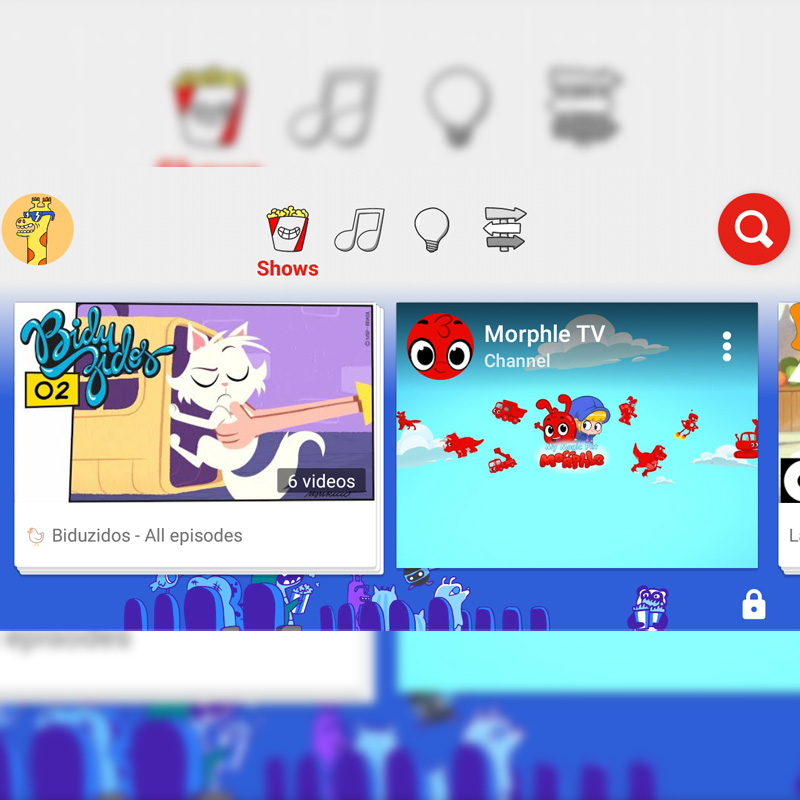
    “The app makes it safer and easier for children to find videos on topics they want to explore,” YouTube Kids group product manager Shimrit Ben-Yair said in a blogpost when the app was first unveiled. In 2016, the app was officially launched in India. Parents can keep a timer restricting the usage as well as limiting the content kids can search with a “turn off” option. There are four sections in the app offering different kinds of content- shows, music, learning, explore.

    YouTube along with other OTT platforms targeting kids has become a ‘digital babysitter’. Though, according to a recent survey, even in developed countries, big screens remain a favourite of kids, the trend of consuming content on portable screens is rising expediently. Turning away from linear TV content, kids are increasingly flocking towards digital content globally. In such a scenario, YouTube Kids definitely has a promising market but there are several factors stunting the growth, especially in India.

    In India, YouTube has not aggressively started any campaign till now for its standalone app. While YouTube itself offers a wide range of kids’ content, other OTT platforms such as Viacom18’s Voot have done extremely well in terms of views. It has popular shows such as The Powerpuff Girls, Ben 10, Roll No. 21 and Chotta Bheem alongside Dora, Spongebob, Motu Patlu, Shiva and Pokemon.  Amazon and Netflix also have rich content—both commissioned and original.

    In addition to that, YouTube itself is a competition to YouTube Kids with children having plenty of entertainment options. Sparky short form content channels like ChuChu TV, LittleBabyBum, ToyPudding TV, Marsha and the Bear, Ryan ToysReview have more than 13 million subscribers and are thriving. The numbers show how many kids flock to these channels. Whereas, YouTube Kids is restricted. It can be accessed only on mobile devices and smart TVs making it less accessible than the parent site.

    “From collections of channels from trusted partners to enabling parents to select each video and channel themselves, we’re putting parents in the driver’s seat like never before,” YouTube Kids product director James Beser said after the recent announcement of introducing several ways for parents to limit what can be watched on the popular app after receiving huge criticism. After three long years, at least YouTube has acknowledged it needs better policing for the kids app.

    While YouTube has marketed its kid-specific app as a safer place for children, it has to walk a long way to prove itself safer. With its main site being unbeatable in the competition, amidst outcries from child rights groups, the presence of several other players offering various range of kids’ content, YouTube Kids is still not a primary option for kids.

    One of the main reasons behind the launch of YouTube Kids was to make it a safer platform for parents, who didn’t want their children using the main site unsupervised. Since the launch of the app, advocacy groups listed several serious problems. Amidst cartoon animation, explicit sexual language was used, graphic adult discussions about family violence, pornography and child suicide were noticed, modelling of unsafe behaviours, even jokes about paedophilia and drug use were discovered. Along with that, through the commercials, there are enough potential risks for kids to watch inappropriate content.

    Despite not tasting the kind of success YouTube is accustomed to, especially in India, YouTube Kids finds itself to be under promoted. Though more kids are hopping on board digitally, the lack of success of YouTube Kids is a glaring anomaly. YouTube has to ramp up the offering and make the app a safer place for kids, thereby giving usage a shot in the arm in a cluttered market.

  • We are becoming more platform and screen agnostic: Sudhanshu Vats

    We are becoming more platform and screen agnostic: Sudhanshu Vats

    He heads the youngest Indian network engaged in general entertainment television. Sudhanshu Vats, group CEO, has, over the past six years, steered Viacom18 India into launching a clutch of new channels catering to the different regions of India as well as niche segments. He has built a rock-solid leadership team to run the services, which have been growing at a rapid clip.

    Vats, a former long-serving Hindustan Lever (Unilever India) executive, has also seen the company transition from being a joint venture with global media major Viacom to one which is now majority owned by Mukesh Ambani’s Reliance Industries.

    A thought leader in the industry, he is constantly propagating the message that India is rich with media and entertainment potential at both domestic and international confabs. Vats was at the Media Partners Asia-run APOS in Bali late last month. On stage having a conversation with Vivek Couto, Vats spoke freely on a range of topics right from Viacom18, the Reliance ownership, Voot and the pay TV ecosystem in India. Excerpts from the interview.

    Your views on the pay TV ecosystem in India?

    At one level, the pay TV ecosystem is not developing as well as it should. Partly, all of us, as part of the ecosystem, are to blame. There is lack of addressability. There is lack of customer centricity and customer service attitude with the distribution partners. India being a poor country there will also be a pressure on free to air up to a particular stage.

    My view of the country is that it will be a hybrid ecosystem of both pay and free to air. And, in my opinion, both can exist. But for pay to exist, pay will have to earn its right. And as content players, we are concerned because it’s not going the way we would like it to.

    Free to air is growing and will grow and we need to find models, largely advertising-led models, to make that happen–that piece is okay. But the pay subscription growths are not commensurate–the addressability is not there. Recognition of change of viewership; change of pattern is not there today.

    And I think no better than us, we have leading channels in almost all genres; but our ability to get subscription income is very little. Because it is all dependent on this. Pick up a genre and we have a leading channel. We are not recognising the changes; we are not addressing the customer and not being customer specific.

    How is the Indian television ecosystem faring overall?

    There were two events in India in the last couple of years—GST and demonetisation. They affected ad sales in my opinion. But the good news is that in the last two or three months, it is coming back. We are clearly seeing certain sectors performing very well—FMCG is back and very strongly. Automobile is back in a reasonably big way. Consolidation in telecom will lead to more telecom spends. Handsets are there, they have always been there. Rural economy is also doing quite well. We are seeing a surge in the regional rural pieces quite a lot within our portfolio.

    If you look at Viacom18 per se – I think we have had a pretty good year in FY18, which we closed. We delivered 20 per cent top line growth led by our performance in films as well with Toilet ek Prem Katha. But even in ad sales, we have delivered a mid-teen growth for the year.

    And interestingly this has come at a time when our leading channel Colors was slightly muted because of the impact properties on Colors that came in. It’s the portfolio, which we built that has helped us—its regional, it’s FTA, it’s niche. I personally feel, moving forward, the ad sales will rebound to the levels that India has been used to seeing.

    The ad market will go to mid-teens and some of the better companies may look at doing even high teens.

    How has the change of majority ownership impacted the organisation you head?

    The advantage for us with the consolidation with Reliance is two-fold. Ambition and the things we can do is one big thing today. The second big thing is the resources that can come in which could be of a different level. Because, as a joint venture, we were balancing some of those pieces. Now perhaps we can take concurrent bets as we go forward. So that’s fantastic news for Viacom18. We need to continue to motor on what we have built as a culture that is critical for us. So, if we retain that culture and we bring in that ambition and resources, it’s good news.

    Your digital piece, Voot, how is that faring?

    Voot has been primarily advertising led. The good news here is that we have been growing quite rapidly. We exited March of 2018 at 3X the number we were at March of 2017 on almost all parameters.  So, today, according to App Annie, we are number two in everything which you see after Hotstar. We are number two in downloads; we are number two in active users. We are actually number one sometimes in time spent. We are between one and two in time spent. We have about 35-40 million monthly actives and close to about 45 minutes of watch time.

    The Voot service is doing very well. Interestingly, there is a lot of work which we are doing which is tailored for it. If you look at our content: the breakup of our viewership – if I were to give you an order of magnitude – would be about 60 odd per cent of what you have on television – that’s catchup maybe 60 to 65 per cent. About 20-odd per cent or sometimes 20-22 or 25 per cent is what we call Voot exclusives or content around content. So it is content which is running on television, that is the theme is running on TV – especially non-fiction – and there is a lot of content which is not on television which is shown here. That’s gaining a lot of traction. And finally there are originals and kids. That stacks up the full piece.

    What plans do you have for Voot?

    Our thinking moving forward is that this is just the beginning. It’s an AVOD piece, again advertising is coming in reasonably well from a very small base – we are doubling every year. But what we also do is we’ve built in a freemium layer, for people who are at the higher end where we offer them an ad free environment, maybe additional services—that is the thinking that is there.

    The second thinking that is there is that we are going to do something for Voot Kids. That’s a space we are very bullish on. We want to go well beyond video, we want to well beyond watch, we will go into spaces of watch, learn, play and all that. We are looking at the edutainment piece. You will come into it for entertainment, but you will have light gaming, some number of e-books, some amount of learning or options available to you particularly at the pre-school stage. We are not getting into pedagogy or hard-core education. That’s not the space we want to be in.

    We are looking four to five million daily active users currently. The kind of data you are seeing now is pretty rich. And we are just about beginning to learn to mine that data.
    On the original front, it has been part of our journey. This year you will see us going into overdrive or at least accelerate our originals. You will see a lot more of them in Hindi, you will see them in regional. And as we speak, there is work happening on many of them. We may use some of them to go behind our freemium service as well.

    You seem to have changed your mind on sports as a piece of content? Will Viacom18 drive deeper into sports?

    We have dabbled a bit in sports. We piloted a few things. We actually did the Nidahas Trophy on our channel. We are looking to see if there is a way of putting sports together that may not have cricket. Cricket, as you may know, is with Uday now. We are continuously looking at areas that might be of interest to us.


  • Viacom18 issues denial about Saugato Bhowmik appointment at Voot

    Viacom18 issues denial about Saugato Bhowmik appointment at Voot

    MUMBAI: Earlier this morning, we broke a story stating that Viacom18 executive vice president and business head of consumer products and integrated network solutions Saugato Bhowmik might be roped in to replace industry veteran Gaurav Gandhi.  

    Gandhi was one of the key drivers of the Ambani majority owned network’s OTT service Voot.

    Senior sources within Viacom 18 had informed indiantelevision.com that Bhowmik was one of the front runners for the post. There are other names being bandied about, but we would not like to reveal them at this juncture.

    Now Viacom18 head of communications Sonia Huria  has issued a denial about this speculation saying: “Such erroneous conjecture is unfounded. We will issue a statement when we have something to announce.”

    Keep reading indiantelevision.com for further updates!

    Also Read :

    Gaurav Gandhi leaves Viacom18

    Gaurav Gandhi to head Amazon Prime Video India

    Voot sets its sights on regional & premium ad-free content

  • Saugato Bhowmik may replace Gandhi as Viacom18 Digital COO

    Saugato Bhowmik may replace Gandhi as Viacom18 Digital COO

    MUMBAI: Soon after the news of Gaurav Gandhi leaving Viacom18 was announced last week, speculation was rife about who would take the hot seat to lead the company’s digital arm Viacom18 Digital Ventures, under which Voot operates. 

    A source close to the development has told Indiatelevision.com that Saugato Bhowmik is the top choice among those gunning for the spot of COO.

    Although the company is still said to be considering various profiles, the management seems to have narrowed down its choice to Bhowmik.

    Bhowmik currently serves as the executive vice president and business head of consumer products and integrated network solutions at Viacom18 leading two key businesses, which are tasked to build the network’s brands outside the broadcast and movie studio space. 

    He joined Viacom18 in 2013 and has a rich experience and understanding of consumer behaviour and insights. Bhowmik began his career at Dabur India as the area sales manager in 2002 and moved to Hindustan Unilever in 2004 where he refined his consumer-marketing skills in strategic brand management roles for key brands for India as well as globally. 

    Gandhi quit Viacom18 after eight years. Launched in 2016, Voot is Viacom’s digital service that offers content in multiple languages, including English, Hindi, Tamil, Kannada and Bengali.

    Also Read :

    Gaurav Gandhi leaves Viacom18

    Gaurav Gandhi to head Amazon Prime Video India

    Voot sets its sights on regional & premium ad-free content

  • SonyLIV doubles MAUs to 15.6mn in Feb: App Annie report

    SonyLIV doubles MAUs to 15.6mn in Feb: App Annie report

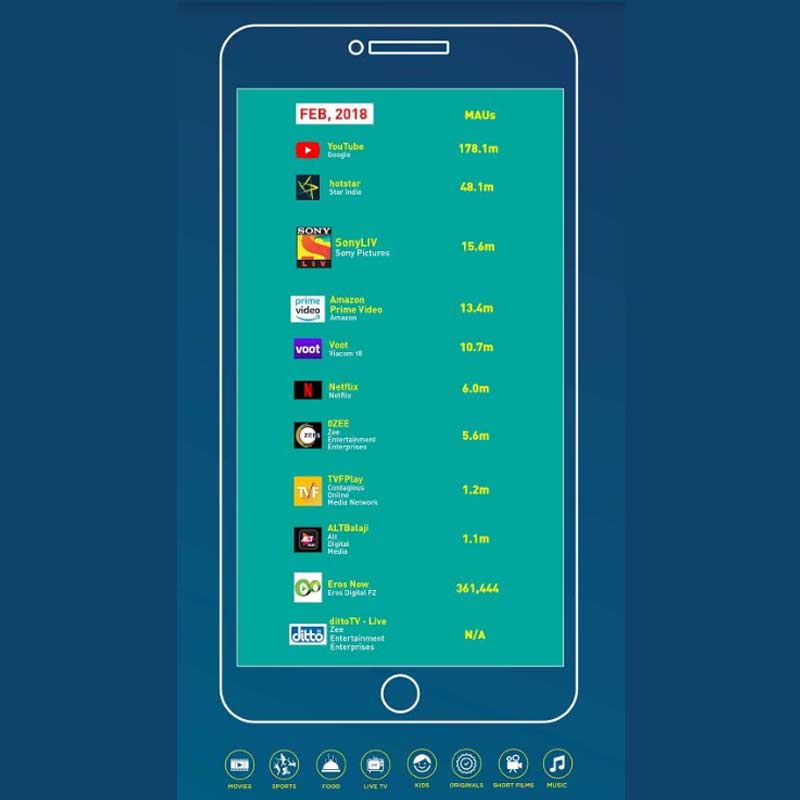
    MUMBAI: SonyLIV continued to reign the online pie by grabbing more eyeballs in the month of February. It added 7.9 million monthly active users (MAUs) in its kitty. The platform has doubled its base within a month from 7.7 million MAUs to 15.6 million MAUs and has stomped to the third position from fifth last month (January), according to App Annie data report. This ranking is a combination of iOS App Store and Google Play Store.

    According to the report, YouTube is on the top of all digital platforms with 178.1 million MAUs, followed by Hotstar at 48.1 million MAUs. Amazon Prime Video was in the fourth position with 13.4 million active users. Voot garnered the fifth position with a total of 10.7 million active users overall. The international giant Netflix had 6 million active users and stood at the sixth position. The latest OTT player, Zee5, has left a remarkable mark on the audience within a month of its launch by successfully engaging 5.6 million users on its platform.

    Though SonyLIV has an array of web series, movies, sports, catch up TV shows, music and more, the credit to increase in the viewership clearly goes to the recent India-South Africa cricket series streamed during February.

    App Annie is an app market data and insights company headquartered in San Francisco, California. App Annie focuses on the state of video streaming apps in Asia-Pacific region including emerging markets such as India, China and Thailand, among others.

    Also Read:

    Localised content the way forward for Netflix in India

    2017: The year OTTs went regional in India

    Regional OTT content more than just catch-up TV    

    Indians among top commute streamers for Netflix