Tag: Vodafone Idea

  • Apna appoints Kartik Narayan to lead its jobs marketplace vertical

    Apna appoints Kartik Narayan to lead its jobs marketplace vertical

    MUMBAI: Apna Group has appointed industry veteran Kartik Narayan as the chief executive officer of its jobs marketplace vertical, signalling a fresh chapter in the company’s growth story.

    Narayan, who most recently served as CEO of Teamlease’s staffing business, brings more than two decades of leadership experience across giants such as Vodafone Idea, Cisco, and Bharti Airtel. In his new role, he will report directly to Apna’s founder and group CEO, Nirmit Parikh.

    As Apna scales its rapidly growing jobs platform, Narayan will lead efforts to strengthen employer partnerships and drive adoption of AI-powered hiring tools. He also aims to make recruitment smarter, faster, and, quite literally, more conversational, thanks to Apna’s latest tech ventures.

    “We’re thrilled to welcome Kartik to our leadership team,” said Parikh. “With his decades of experience running large businesses, we’re confident he’ll help us empower millions of job seekers and employers who rely on Apna every day.”

    Narayan, clearly energised by the new challenge, added, “Apna has redefined how India hires at scale. What excites me most is seeing companies build their own AI recruiting agents on our platform, it’s like watching the future of hiring unfold in real time.”

    The appointment comes as Apna Group diversifies beyond jobs, with the launch of Blue Machines, an enterprise-grade Voice AI platform, and a new education vertical in the works: both designed to prepare India’s next-generation workforce for an increasingly digital world.

  • Calling the shots TCS and Vodafone Idea dial up AI for customer delight

    Calling the shots TCS and Vodafone Idea dial up AI for customer delight

    MUMBAI: Hello, future calling! Tata Consultancy Services (TCS) has struck a five year deal with Vodafone Idea (Vi) to rewire the telecom giant’s business support system (BSS) with an AI driven digital backbone designed for speed, smarts and seamless service.

    At the heart of this transformation are TCS’ flagship platforms Hobs and Twinx. While HOBS will serve as the agile, stable and integrated foundation for Vi’s customer touchpoints, TwinX will inject intelligence with AI/ML driven analytics and scenario simulations. Together, the duo aims to fast track product launches, personalise interactions and deliver resilient performance in an industry where milliseconds matter.

    For Vi, the stakes are high. The new platform promises to help the operator launch new products faster, adapt to evolving customer needs, and elevate service responsiveness. “With this partnership Vi is embarking on a transformative journey to redefine customer experience,” said Vodafone Idea Limited CTO Jagbir Singh adding that AI infused BSS will set a “new standard” in digital experiences.

    The partnership builds on a 15 year relationship between TCS and Vi, anchored in TCS’ 25 plus years of expertise in the communications, media and information services sector. Operating out of 105 delivery centres, TCS supports over one billion telecom subscribers across 45 countries, a scale that few IT majors can match.

    “By leveraging our advanced AI capabilities and flagship products, we are committed to transform customer engagement and operational efficiency for Vodafone Idea,” said TCS president & country head for India Business Ujjwal Mathur.

    Beyond customer delight, TCS has positioned the programme as part of its larger “Made in India, for India and ready for the world” vision, with sustainability, sovereignty and security woven in.

    As India’s telecom sector braces for the next digital leap, this tie up underscores how technology heavyweights and telcos are dialling up AI not just to connect millions, but to reimagine what a call, a click or a customer interaction should feel like.

  • Abhijit Kishore named Vodafone Idea’s new chief executive

    Abhijit Kishore named Vodafone Idea’s new chief executive

    MUMBAI: Vodafone Idea has appointed Abhijit Kishore as its new chief executive officer. A long-time company insider, Kishore has spent more than five years in senior roles at the struggling carrier, including chief operating officer and chief enterprise business officer.

    Before joining Vodafone Idea, he held leadership positions at Tata Teleservices and Reliance Communications, steering mobility, enterprise and circle operations across key markets. Over two decades in telecoms, Kishore has managed P&Ls from Kerala to Gujarat, notching up operational turnarounds and enterprise growth.

    An alumnus of Delhi University and the Fore School of Management, he has sharpened his management credentials with stints at IIM Ahmedabad and London Business School. His appointment comes as Vodafone Idea wrestles with heavy debt, a bruising price war and the need to raise capital for 5G roll-out.

  • Nameeta Saigal climbs the ranks at femtech startup Nua

    Nameeta Saigal climbs the ranks at femtech startup Nua

    MUMBAI: Nameeta Saigal has been elevated to senior vice-president and head of marketing at Nua, the Mumbai-based femtech startup, after nearly four years with the company building its direct-to-consumer presence.

    Saigal joined Nua in December 2021 as vice-president of marketing and has now been promoted internally, marking a vote of confidence in her stewardship of the brand’s growth trajectory. The promotion comes as femtech companies face increasing pressure to differentiate themselves in a crowded wellness market.

    Her career spans over two decades in consumer marketing, with notable stints at telecommunications giant Vodafone Idea Ltd, where she served as vice-president for consumer segments marketing and partnerships. Before that, she cut her teeth in brand management at Godrej Consumer Products, handling household names including Goodknight mosquito repellent and Kiwi shoe care products.

    Saigal’s expertise in building consumer segments and partnerships may prove crucial as Nua seeks to expand beyond its core feminine hygiene offerings. The company operates in India’s burgeoning femtech sector, which has attracted significant investor interest despite regulatory challenges and cultural sensitivities around women’s health products.

    The internal promotion suggests Nua is betting on continuity rather than external recruitment as it navigates the competitive landscape of health and wellness brands. For Saigal, the elevation represents the culmination of a marketing career that began in the spirits industry with Shaw Wallace Distilleries before progressing through pharmaceuticals and consumer goods.

    Whether her brand-building credentials can help Nua capture greater market share in India’s evolving femtech space remains to be seen.

  • India adds 2.7 million new telecom users in July, led by Jio

    India adds 2.7 million new telecom users in July, led by Jio

    MUMBAI: India’s telecom dial tone got a bit louder this July, as the country added a net 2.7 million new telephone connections, taking the total subscriber base to 1,180.87 million, according to TRAI’s latest figures. That’s a ring in the right direction especially with wireless connections doing the heavy lifting. Wireless subscriptions grew by 2.74 million, pushing the total to 1,172.57 million. On the other hand, wireline subscriptions held relatively steady, dipping slightly by 7,747 users, ending the month at 8.29 million.

    The urban-rural divide saw rural India catching up, with rural wireless users increasing to 526.27 million while urban counterparts stood at 646.30 million. Urban tele-density saw a slight decline to 126.62 per cent, while rural tele-density edged up to 58.66 per cent as reported by TRAI.

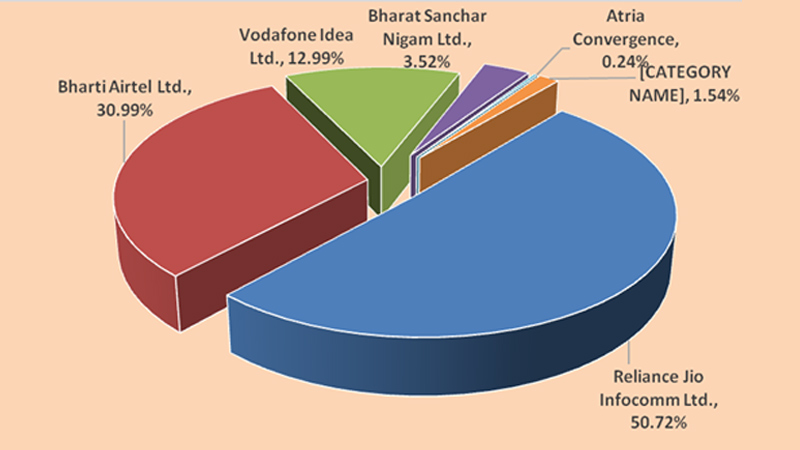
    Jio continued to be the star caller in town, adding a whopping 3.16 million wireless subscribers, cementing its lead with 458.95 million users. Bharti Airtel held strong in second with 383.57 million, gaining 1.11 million subscribers. Vodafone Idea continued its slow slide, losing 1.32 million subscribers, taking its count to 218.49 million.

    But not all subscribers are equal when it comes to active users, Jio again leads with a 104.08 per cent VLR (visitor location register), indicating some dual SIM overlap. Airtel boasted a healthy 99.21 per cent active base, while Vi clocked in at 87.17 per cent. BSNL trailed behind with only 50.64 per cent of its users actively using services.

    On the MNP (mobile number portability) front, Indians are still keeping their digits mobile with 12.94 million requests in July alone, bringing the all-time total to a staggering 921.94 million.

    In the wireline game, Jio added 0.25 million subscribers, now holding 33.11 per cent market share, while BSNL shed 0.20 million, dropping to 23.03 per cent. Airtel’s steady ship saw it maintain a 22.97 per cent slice.

    Meanwhile, broadband connections both wired and wireless stood strong at 940.52 million, led by Reliance Jio (487.59 million), Airtel (264.33 million), and Vodafone Idea (125.08 million).

    So, while some telcos may be dropping calls and customers India’s telecom sector as a whole is still very much in signal, especially as it tunes into deeper rural penetration and data-led digital expansion.

    (If you are an Anime fan and love Anime like Demon Slayer, Spy X Family, Hunter X Hunter, Tokyo Revengers, Dan Da Dan and Slime, Buy your favourite Anime merchandise on AnimeOriginals.com.)

  • India adds 3.2 million phone users in May, total hits 1.2 billion

    India adds 3.2 million phone users in May, total hits 1.2 billion

    MUMBAI: Dialling up its digital growth, India’s telecom sector added 3.24 million new telephone subscribers in May 2025, pushing the country’s total subscriber base to a staggering 1.207 billion. While urban India remained saturated with 131.76 per cent tele-density, rural areas rang in gains too, growing 0.14 per cent month-on-month to hit 537.39 million subscribers.

    The data, released by the Telecom Regulatory Authority of India (TRAI), also showed a strong wireline comeback with 1.25 million new connections pushing wireline growth to 3.34 per cent, led by aggressive additions from Jio and Airtel.

    India’s broadband base surged 3.37 per cent to reach 974.87 million subscribers, thanks largely to mobile broadband (up 2.92 per cent) and a 60 per cent spike in fixed wireless (5G FWA, Wi-Fi, satellite) subscriptions. However, 5G FWA itself dipped slightly from 7.50 million to 7.40 million users, indicating early volatility in the still-nascent category.

    Jio led the broadband brigade with 494.47 million subscribers, followed by Airtel (302.15 million) and Vodafone Idea (126.68 million), together accounting for a whopping 98.47 per cent of the market.

    Overall wireless subscriptions grew modestly by 0.17 per cent to 1.168 billion, with rural India contributing 0.38 million new users. Urban wireless teledensity climbed to 124.91 per cent, while rural teledensity inched up to 58.90 per cent. Wireline adoption in rural India saw a sharper surge of 10.44 per cent, albeit from a much smaller base.
    Who’s Winning the Race?

    .  Reliance Jio: 494.47 million broadband subs, 40.92 per cent mobile market share.

    .  Bharti Airtel: 302.15 million broadband subs, 33.61 per cent mobile market share.

    . Vodafone Idea: 126.68 million broadband subs, 17.61 per cent mobile market share.

    Jio also led wireline subscriber additions with 1.28 million new connections, while Vodafone Idea continued to see a decline of over 1.35 lakh users in the wireline segment.

    Indians are clearly still keen to keep their digits. 14.03 million MNP requests were made in May alone. Uttar Pradesh (East) topped the chart with 115.77 million cumulative porting requests, followed by Maharashtra at 92.72 million.

    Out of the total 1.161 billion mobile subscribers, 1.08 billion were active as per VLR (Visitor Location Register) data about 93 per cent. BSNL had the lowest active subscriber rate (63.73 per cent), while Reliance Communications registered a perfect 100 per cent, albeit on a very small base.

    With over 85.36per cent teledensity nationwide and close to a billion broadband users, India’s telecom story continues to evolve rapidly. But the future lies beyond just numbers, rural wireline expansion, M2M growth (now at 73.91 million connections), and the true test of 5G fixed wireless adoption could be the next chapters in this digital saga.

    So, whether it’s smartphones in metros or landlines in tier-3 towns, India’s telecom tune is still playing and the country’s clearly not hanging up any time soon.

    (If you are an Anime fan and love Anime like Demon Slayer, Spy X Family, Hunter X Hunter, Tokyo Revengers, Dan Da Dan and Slime, Buy your favourite Anime merchandise on AnimeOriginals.com.)

  • Vi for victory? spectrum swaps, ARPU hikes and 5G boost Vodafone Idea

    Vi for victory? spectrum swaps, ARPU hikes and 5G boost Vodafone Idea

    MUMBAI: The fourth quarter of FY25 brought a much-needed signal boost for Vodafone Idea (Vi), as the beleaguered telco dialled up its strongest financial performance in years powered by equity infusions, spectrum-to-stock swaps, and an aggressive push into 5G and rural expansion.

    For the fiscal year ended 31 March 2025, Vi reported revenue of Rs 435.7 billion, marking a 2.2 per cent year-on-year increase. More notably, its annual cash EBITDA (pre-Ind AS 116) rose 9.5 per cent to Rs 92 billion, a third straight year of growth. The company’s Q4FY25 revenue hit Rs 110.1 billion, its highest average daily revenue in five years.

    But it’s not just numbers that changed. In a game-changing spectrum-to-equity conversion, Vi allotted 36.95 billion shares worth Rs 369.5 billion to the Government of India, boosting GoI’s stake to 49 per cent. With an additional Rs 180 billion from a public offer, and Rs 40 billion via preferential issues to Vodafone and Aditya Birla Group, Vi raised a total of Rs 614 billion in equity this year. That’s more than a capital top-up, it’s a lifeline.

    The subscriber base stood at 198.2 million at the end of Q4, with average revenue per user (ARPU) rising to Rs 175 up 14.2 per cent YoY. Vi also added over 6,900 new 4G towers this quarter (a company record since the merger), expanded 4G coverage to 83 per cent of India’s population, and improved 4G speeds by 28 per cent.

    Capex for FY25 totalled Rs 95.7 billion, with Q4 alone accounting for Rs 42.3 billion, Vi’s highest in a quarter post-merger. The company also brought down its bank debt from Rs 40.4 billion to Rs 23.3 billion and closed FY25 with a cash and bank balance of Rs 99.3 billion.

    However, challenges remain. Vi reported a consolidated loss of Rs 273.8 billion for the year and still holds spectrum and AGR liabilities aggregating over Ts 1.9 trillion. It has another Rs 164.3 billion in AGR dues falling due in FY26, and is in talks with banks for additional debt funding.

    To offset these burdens, Vi is diversifying its offerings. It launched new “Limitless” postpaid plans and hero prepaid plans to woo consumers, expanded its retail footprint to over 500 flagship stores and 2,500 touchpoints, and introduced premium international roaming benefits and lost baggage insurance.

    Even its B2B wing is flexing muscle, signing an MoU with West Bengal for MSME digital skilling and partnering with HPE to deliver enterprise-grade network solutions.

    Vi’s signal to the market is clear: it’s not just staying alive, it’s aiming for a comeback. With spectrum dues now equity, ARPU trending upwards, and credit ratings upgraded to BBB- (Stable) by ICRA and CARE, FY25 could be the year Vi finally got its second wind.

    Now, all eyes are on August 2025, when the company plans to beam 5G across all 17 of its spectrum circles. Until then, the mantra is clear: invest, expand, and connect.

  • Punit Thakkar brushes off the sugar for colgate’s digital strategy

    Punit Thakkar brushes off the sugar for colgate’s digital strategy

    MUMBAI: Talk about brushing up your portfolio, literally. After over three years of crafting digital strategies for chocolates, biscuits and beverages at Mondelez, Punit Thakkar has made a minty-fresh move. He now steps into the role of business director for Digital (Colgate-Palmolive) at Wavemaker India, leading full-funnel digital media planning for one of the country’s most iconic personal care brands.

    Having officially taken the reins in November 2024, Thakkar is now going public with the news classic digital marketer style, a few months fashionably late. “From chocolates to toothpaste, same performance mindset, just fewer cavities,” he quipped in his announcement.

    In this role, Thakkar oversees the digital planning team handling brand and commerce campaigns across Colgate verticals. His key focus? Using first-party data from CRM, sampling, and website engagement to build precise audience frameworks and drive sharper ROI. With strategies including lookalike modelling, exclusions, and sequencing, the goal is to optimise both awareness and performance campaigns through smarter targeting and media mix alignment.

    Before this, Thakkar led digital for Mondelez India, managing a glittering portfolio that included Cadbury Dairy Milk, Oreo, 5 Star, Silk, and Bournvita. He championed 1P data integration into festive, IPL, and seasonal campaigns, setting benchmarks for eCommerce alignment and funnel mapping across consumer journeys. Prior stints include leading digital for Vodafone Idea and driving performance marketing during his early years at Wavemaker.

    With a decade-long track record, Thakkar brings sharp thinking and full-funnel finesse to the oral care giant’s digital playbook now armed with the morning routine of an entire nation. Whether it’s a 7am swish or a late-night scroll, you can bet Punit Thakkar’s campaigns are ready to pop up on your screen, toothbrush in hand.

  • Indian mobile count goes up as does broadband: TRAI data Jan 2025

    Indian mobile count goes up as does broadband: TRAI data Jan 2025

    MUMBAI: India’s telecom sector added a modest 2.1 million net subscribers in January 2025, nudging the total count to 1.19 billion, according to the Telecom Regulatory Authority of India’s monthly data release. But it wasn’t all smooth signal—wireline connections tanked, dropping over 10 per cent as TRAI shifted 5G Fixed Wireless Access (FWA) from wired to wireless accounting.

    Mobile still rules the roost, with 1.16 billion users riding the wireless wave, including 5.7 million FWA users. Urban India continued to drive growth, adding over 5 million new mobile connections. Meanwhile, rural areas quietly chipped in with just under a million more.

    Broadband subscriptions inched up 0.04 per cent to 945.16 million—an uninspiring climb, considering Reliance Jio and Bharti Airtel hold over 80 per cent of the market. Wireline broadband, meanwhile, shrank slightly as users cut the cord in favour of FWA.
    MARKETSHAREDATAMobile Number Portability (MNP) remained red-hot with 14.14 million requests in Jan alone—pushing the all-time tally past 1.09 billion. Uttar Pradesh (East) and Maharashtra topped the charts for most switched loyalties.
    The market remains firmly in private hands, with Jio and Airtel leading across broadband and mobile. 

    Government-owned players like BSNL and MTNL continue to struggle, holding just 8 per cent of wireless subscribers and less than a quarter of the wireline market.

    Tele-density stood at 84.54 per cent—Delhi being the most connected with an eye-popping 274 per cent, while Bihar lagged behind at 56.6 per cent.

    And while fixed lines may be flatlining, India’s telecom story continues to be a mostly wireless wonder.

  • Indian government to take nearly half of Vodafone Idea as debt converts to equity

    Indian government to take nearly half of Vodafone Idea as debt converts to equity

    MUMBAI: India’s beleaguered mobile operator Vodafone Idea is about to get a new sugar daddy—the government itself. The ministry of communications has decided to convert the firm’s towering spectrum auction dues of Rs 36,950 crore into equity shares, catapulting the state’s ownership from 22.6 per cent to a whopping 48.99 per cent, according to a company regulatory filing with the BSE.

    The move, communicated via an order dated 29 March and received by the company on Sunday, follows the Modi government’s 2021 telecom sector bailout package. Vodafone Idea, which has been gasping for financial breath against rivals Reliance Jio and Bharti Airtel, will issue 3,695 crore equity shares at Rs 10 each within 30 days after securing regulatory approvals.

    Despite the government now holding the largest slice of the pie, the existing promoters will remain at the controls—suggesting New Delhi prefers to play sleeping partner rather than backseat driver in this marriage of convenience.

    The pricing methodology wasn’t plucked from thin air but follows regulatory guidelines—taking the higher of the volume-weighted price over either 90 or 10 trading days preceding 26 February 2025.

    This fiscal lifeline throws Vodafone Idea a much-needed oxygen tank as it struggles to keep up in India’s brutally competitive telecom market, where rock-bottom tariffs have made profitability as rare as an uncapped data plan.