Tag: VOD

  • Microsoft, Cisco, Motorola announce next generation STB

    Microsoft, Cisco, Motorola announce next generation STB

    MUMBAI: Software major Microsoft and set-top box manufacturers Cisco Systems, Motorola, Philips and Tatung have announced that advanced system-on-a-chip (SoC) set-tops are available.

    This product will the companies state enhance the Internet Protocol television (IPTV) user experience and is now available to support Microsoft IPTV Edition software platform deployments with leading telecommunications carriers worldwide.

    An integral part of the IPTV ecosystem, SoC set-tops will enable service providers to begin delivering high-definition TV (HDTV), digital video recording (DVR) and picture-in-picture functionalities as well as other advanced features in the future, enhancing consumers’ television-viewing experience.

    This new generation of SoC-based, HD-capable, IPTV-ready receivers makes it easier for service providers to deploy IPTV Edition more broadly, quickly and cost-efficiently while supporting exciting new TV services. The availability of these devices illustrates the continued innovation of Microsoft and its IPTV Edition ecosystem partners in the telecommunications and digital television industries.

    Microsoft TV division GM marketing Christine Heckart says, “The advent of system-on-a-chip set-tops is a key milestone for the IPTV industry. As our service provider customers are beginning worldwide deployments of IPTV Edition, and set-top partners are unveiling these advanced devices, consumers will be able to experience television in a new, exciting way. This milestone is a testament to the remarkable progress our IPTV ecosystem has made in just a few years, and it will pave the way for service providers to deliver richer TV services at a lower cost.”

    Cisco says that its proven history of IP innovation gives it IP expertise and successful IPTV deployments, which it is able to share with its service provider partners. Cisco IP set-top models, which will be deployed by customers including AT&T, support experience-enhancing features such as high-definition TV, DVR, integrated home networking over coax and user-friendly displays. Models are available with appropriate connectors and features for markets around the globe. Cisco offers models that include silicon from both Sigma Designs Inc. and STMicroelectronics.

    Motorola says that its heritage of invention for the connected home has resulted in over 48 million video entertainment devices being shipped to service providers worldwide. The company’s VIP series of SoC-based set-tops are engineered to meet the needs of service providers deploying the Microsoft IPTV Edition system. These solutions seamlessly bring the advanced IP services into any room in the house, including on-demand services, DVR and support for HDTV codecs, as well as forthcoming IPTV Edition features such as multiroom streaming and home media networking. Motorola VIP series set-tops are currently shipping in volume to leading providers worldwide, and the company has announced that AT&T will be the first service provider to commercially deploy these products.

    Philips has introduced a hybrid IPTV-DTT set-top box supporting Microsoft IPTV Edition with HDTV and DVR functionality based on the Sigma Designs 8634 chipset. This product will be launched by British Telecom later this year. Tatung meanwhile will introduce its STB2000 series SoC-enabled set-top boxes based on the Sigma Designs 8634 chipset later this year.

    The new STB2300 model is an entry-level IP set-top box that not only supports two high-definition decoding engines for MPEG2, H.264 and VC-1, providing decoding flexibility, but also supports advanced features including HDTV, video on demand (VOD) and high-definition multimedia interface (HDMI).


  • Granada International looking at IPTV, Vod opportunities in India

    Granada International looking at IPTV, Vod opportunities in India

    MUMBAI: Television and film distributor Granada International is looking topwards building its presence in Asia.

    It has appointed Ting Wai Ho as senior sales executive based in its new Hong Kong office. The announcement was made by Granada International MD Nadine Nohr.

    He will also work closely with regional director in Asia James Ross on the media opportunities offered by the way of VOD and IPTV in India.

    Ho will also be responsible for sales of Granada International programming into South East Asian countries including Vietnam, Malaysia, Indonesia, Thailand and the Philippines.

    Ting Wai Ho was formerly BBC Worldwide senior sales executive, South East Asia. Based in Hong Kong he was in charge of TV programme distribution in Asian countries.

    Ross says, “I am very pleased to have Ting on board at the new Granada International office in Asia. As we continue to expand Granada International and ITV Worldwide’s presence in Asia, I am sure his wealth of experience in selling programming to the Asia region will be a great asset to us.”

  • Media Gateway acquires VOD distribution rights of A&E TV Networks across Middle East & North Africa

    Media Gateway acquires VOD distribution rights of A&E TV Networks across Middle East & North Africa

    MUMBAI: Media Gateway, the international content clearing house for premium content has signed an agreement with AETN International, a division of A&E Television Networks, to distribute the company’s award-winning video on demand (VOD) programming from The History Channel, The Biography Channel and Crime and Investigation Network throughout the Middle East and North Africa.

    Media Gateway will now be able to bring AETN International’s on-demand content to mobile operators, ISPs, telecommunications companies, cable operators, residential complexes, compounds, military bases and hotels across the region, informs an official release.

    “We are thrilled to be partnering with AETN International, whose channels have received multiple prestigious awards and reach more than 220 million TV households worldwide. This agreement further illustrates our commitment to provide the very best content to operators in the region so they can deliver services that drive greater enjoyment and usage among their subscribers,” said Media Gateway Chief Executive Officer Karri Zaremba.

    “Emerging media platforms – be it VOD, mobile, or broadband – are an important components in our international distribution strategy. Media Gateway is a leader in the delivery of broadcast media over digital platforms, and we are confident that with their expertise, people in the Middle East and North Africa will now have multiple access paths to our channels and programs,” said AETN International Vice President International Business Development and Digital Media Sean Cohan.

    The History Channel, the international television network devoted to historical programming, features compelling original, non-fiction specials and series that bring history to life in a powerful and entertaining manner across multiple platforms.

    The Biography Channel takes viewers into the world of fascinating people, from Hollywood stars to world leaders, artists, athletes and infamous villains. The network features programs that delve behind the scenes of the public lives of celebrities, revealing their private lives and exploring the ambition that drives them.

    While the Crime and Investigation Network focuses on crime, investigation and mystery programming. The channel opens the door to crime labs, police archives and the justice system, providing viewers a behind-the-scenes look at criminal investigations, unexplained mysteries and the lives of infamous murderers and outlaws, adds the release.

  • IPTV subscriber base set for explosive growth: iSuppli

    IPTV subscriber base set for explosive growth: iSuppli

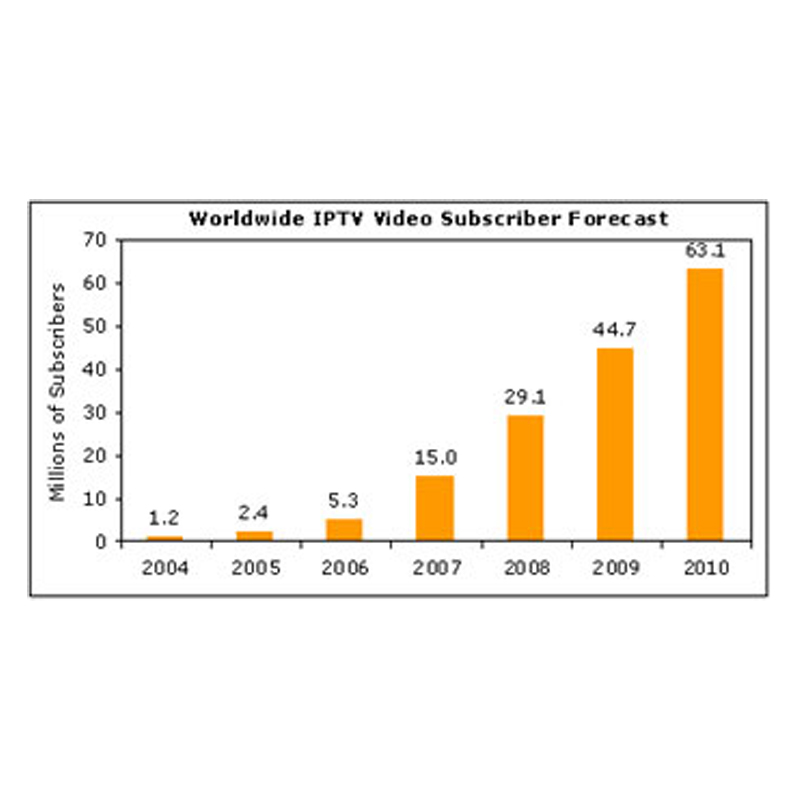
    MUMBAI: The worldwide subscriber base for Internet Protocol Television (IPTV) services is expected to expand by a factor of more than 26 from 2005 to 2010, spurring a competitive battle between video providers both old and new, iSuppli Corp. predicts.

    Global IPTV subscribers will grow to slightly more than 63 million in 2010, rising at a stunning Compound Annual Growth Rate (CAGR) of 92.1 per cent from 2.4 million in 2005, as presented in the figure below.

    The IPTV subscriber base will generate more than $27 billion in overall IPTV services revenue in 2010. While video services will account for the largest portion of these dollars, value-added media services and IPTV operator advertising will combine to represent more than 14 per cent of IPTV services revenue in 2010. Furthermore, across all IPTV services, the corresponding content licensing revenue will reach $11 billion in 2010.

    “The fight to capture the expanding base of IPTV subscribers will put telecom operators on a collision course with existing pay-TV market competitors and with a new class of broadband video portals as they roll-out progressively more sophisticated offerings,” said iSuppli vice president multimedia content and services Mark Kirstein.

    iSuppli categorises market deployment of IPTV services in three phases. The current global IPTV market is early in its first phase: basic service deployment. The second phase will add an array of value-added and interactive services. Phase three will bring dramatic improvements in integration and interactivity.

    Thus, in this pending battle for subscribers, providing a competitive video offering is merely the cost of entry for IPTV operators. Differentiation of IPTV services will be essential to bringing new capabilities to TV-based entertainment and attracting subscribers.

    Areas of differentiation will include:

    Interactivity, such as communication, community, voting, interactive advertising and television commerce (t-commerce).

    Integration across multiple platforms, across voice and data services and across content types, i.e. video, voice, music, gaming, data services and user content.
    Personalisation, including intelligent TV recommendations, individualised advertising and non-linear video programming, such as Video on Demand (VoD) and Digital Video Recording (DVR).

    Value-added services, including on-demand gaming, music, media applications, home networking management, security and data.

    Beyond the video service providers themselves, an array of companies will benefit from new opportunities arising from their roles as the “arms suppliers” for the battle over the next generation of television distribution. These companies include infrastructure gear manufacturers, set-top box makers, software vendors and semiconductor suppliers, iSuppli predicts.

    On a geographic basis, the European market has taken the early lead in the global IPTV market, both for subscribers and for revenue. However, Asia will generate faster growth than the other regions and will achieve the largest subscriber base by the end of this year. The Americas region will lead the world in terms of IPTV dollars starting this year because it will yield the highest Average Revenue Per User (ARPU).

  • Motorola to extend portfolio of ‘video anywhere’ solutions with acquisition

    Motorola to extend portfolio of ‘video anywhere’ solutions with acquisition

    MUMBAI: Motorola will acquire the American firm Broadbus Technologies. It provides technology solutions for Television On-Demand (TOD).

    Broadbus Technologies’ carrier-class technology solutions enable the distribution of on-demand content to consumers through multiple devices. The company’s innovative solid-state server architecture is based on the intelligent configuration and management of dynamic random-access memory (DRAM). As a result, the platform can use less space and power than traditional hard-disk based technology, while providing performance, reliability and scalability improvements for video ingest, streaming, and storage.

    With the acquisition, Motorola will extend its video delivery platform with new content management and distribution capabilities that address growing market opportunities such as mobile video, video-on-demand (VOD), time-shifted TV, network-based digital video recording (nDVR), on-demand ad insertion (ODAI) and switched digital video (SDV).

    Motorola connected home solutions president Dan Moloney says, “Today, consumers expect to access video entertainment on the different devices they have, inside and outside of their home, in varying formats – and to have it available upon request. The addition of Broadbus Technologies will bring Motorola’s video delivery platform one step closer to enabling this vision of seamless mobility by providing us with field-proven content management and delivery solutions.

    “Service providers will be able to take advantage of a complete end-to-end seamless video experience enabled by Motorola technology to extend their customer relationships.”

  • Vod users in the US tuning in to reality shows: Study

    Vod users in the US tuning in to reality shows: Study

    MUMBAI: US market research firm Scarborough Research, which works in the area of identifying the shopping, media and lifestyle patterns of Americans, has released an analysis of video-on-demand (VOD) users – those consumers who live in households that used VOD during the past month.

    The analysis found that VOD users are 27 per cent more likely than all consumers to cite reality programmes as a television genre that they typically watch.

    Across America seven per cent of consumers live in a household that used VOD during the past month. VOD users are 24 per cent more likely to tune in to music videos. 22 per cent more likely than all consumers to watch news magazine shows, science fiction (21 per cent more likely) and dramas (18 per cent more likely), round out the top television genres among VOD users as compared to the general population.

    Today’s VOD users hail from upscale, young families. According to the Scarborough analysis, VOD users are 27 per cent more likely than all consumers to be between the ages 18-24; 20 per cent more likely to have two or more children in the household; and more than twice as likely as all consumers to have an annual household income of more than $150,000. VOD users are 27 per cent more likely than all consumers to be African-American.

    VOD users are avid consumers of entertainment and information technologies. VOD users are 50 per cent more likely than all consumers to spend 20 or more hours online weekly. They have high-speed Internet connections, and are more likely than all consumers to have a cable modem, DSL or wireless Internet connection. VOD users are 38 per cent more likely than all consumers nationally to have purchased something on the Internet in the past year. 39 per cent of VOD users use online services for travel reservations and 47 per cent of VOD users use on-line services for news. VOD users are almost three times as likely as all consumers to have purchased pay-per-view (PPV) five or more times during the past year.

    When it comes to advertising categories, home improvement is a top category among VOD users. 73 per cent of VOD users live in a household that has bought hardware, building, paint, or lawn and garden items in the past year. They are 15 per cent more likely than all consumers across the US to have spent $3,000 or more on all home improvements in the past year.

  • British Telecom inks VoD deal with Momentum Pictures

    British Telecom inks VoD deal with Momentum Pictures

    MUMBAI: British Telecom has inked a new video-on-demand (VoD) film agreement with independent film distributor, Momentum Pictures, for its next-generation TV service – BT Vision, which is scheduled to launch in August to September 2006.

    Momentum Pictures is one of the UK’s largest independent film distributors. This agreement will provide access to Momentum Pictures’ catalogue including titles such as – Lost in Translation, Racing Stripes, Where the Truth Lies, O, Brother Where Art Thou?, Vera Drake, Lord of War and Broken Flowers, amongst others.

    BT Vision customers will be able to enjoy a vast range of film, music and television programming all available on-demand as well as all the Freeview channels, plus interactive and communications and all available on the TV, with no compulsory subscription.

    BT Vision CEO Dan Marks said, “We are delighted to have concluded this agreement with Momentum Pictures, which has been responsible for distributing some of the most successful and most interesting independent cinema of the past few years. Our agreement with Momentum represents our commitment to bring the best and most varied selection of movies to our customers.”

    Momentum managing director Xavier Marchand added, “We are very pleased that BT’s broadband customers will have access to many of Momentum Pictures’ titles. BT Vision and interactive access to movies are extremely exciting concepts and we eagerly anticipate the launch of the service.”

  • Amaru inks deal with Sony Pics TV International for VOD rights in Singapore

    Amaru inks deal with Sony Pics TV International for VOD rights in Singapore

    MUMBAI: The US-headquartered Amaru Inc., a global player in broadband media entertainment business, has secured a multi-year deal with Sony Pictures Television International (SPTI) for video-on-demand rights on film titles from both Sony Pictures Entertainment and Metro-Goldwyn-Mayer for M2B viewers. The agreement has been done through Amaru’s Hollywood-based company M2B World Inc.

    The distribution deal, initiated at the National Association of Television Program Executives (NATPE) conference held in Las Vegas in January 2006, allows for first-run films to be available, on-demand, to subscribers of Amaru’s Global Broadband TV service (M2BTV), accessible through the company’s soon to be launched Set-Top Box, informs an official release.

    In addition, a selection of films will be available via pay-per-view on Dimension88 — a Singaporean premium movie channel offered at www.Dimension88.com that can be accessed via a broadband Internet connection. This deal will give M2B viewers access to SPTI product in the window after local video release.

    The deal reflects the rapidly developing interest by consumers worldwide in the at-home on-demand entertainment market. An independent study commissioned last month by the M2B brand on consumer attitudes towards broadband entertainment found that 72 per cent of domestic respondents alone were interested in accessing first-run Hollywood films online. Through distinctive content and distribution agreements over the last few years, including this agreement with SPTI, the M2B brand has been a visionary leader at the forefront of the transforming entertainment market, the release adds.

    “This agreement is a result of the unique synergy that traditional Hollywood entertainment companies are looking towards. It is essentially the melding of the highly recognizable content that viewers are looking for with easily accessible distribution vehicles, such as our broadband channels, that offer consumers the highest quality feeds in a way that fits within their limited schedules,” says Amaru Inc. CEO Colin Binny. “Our philosophy has always been to offer wide-ranging content as our viewing demographic continues to broaden — and partnering with Sony Pictures Television International is reflective of that intention. We look forward to working with SPTI, and expect that the addition of these titles will be extremely well-received by our viewers.”

    “Viewers worldwide have been receptive to VOD and we’re pleased to make our extensive library available to M2B viewers”, adds SPTI’s vice president pay television Paul Littmann.

  • Playboy reports first quarter profit

    Playboy reports first quarter profit

    MUMBAI: Adult entertainment brand Playboy has reported net income for the first quarter ended 31 March, 2006, of $0.8 million.

    This compares to a net loss in the prior year quarter of $13.1 million. First quarter 2006 operating income totalled $3.5 million.

    Playboy posted an $800,000 profit on revenues of $82.1 million, two per cent down on this time last year.

    Playboy chairman and CEO Christie Hefner said, “The continued strong performance of the Licensing Group and growth of the newer digital media businesses of international TV, online and mobile validate not only the appeal of the brand but of our multi-platform business model. However, these promising and fast-growing businesses cannot yet offset the negative trends in our larger domestic TV business.”

    “Given the changing dynamics of the domestic TV business combined with the challenges in the publishing industry, it is clear that we need to realign our cost structure to perform satisfactorily in this new environment. We are confident that we can make the changes necessary to improve our performance and position ourselves not just for the second half but for 2007 and beyond,” Hefner added.

    “We expect the weakness in publishing and domestic TV results to continue. These trends, together with the expense of reducing our cost structure, will likely result in a substantial second quarter loss, making it clear that we will not meet our initial earnings projection of $0.67 to $0.70 per share for the year. However, we expect a number of positive developments in the second half including VOD product launches, the opening of Playboy at the Palms and improved advertising sales,” Hefner said.

    “With these initiatives and a realigned cost structure, we believe that we can deliver a 50 per cent improvement in second half 2006 earnings per share compared to the $0.24 EPS we reported in the second half of last year.”

    The Entertainment Group reported first quarter 2006 segment income of $7.9 million compared to $11.9 million last year, primarily reflecting weaker performance in domestic TV. Increases in online, international and other business revenues were nearly offset by lower domestic TV revenues, resulting in a one per cent increase in the Group’s first quarter 2006 revenue to $51.2 million.

    Lower cable pay-per-view revenues for both Playboy TV and the movie networks reflected the continued migration of programming from linear networks to VOD platforms where the company is not yet fully represented and its programming faces more competition. The company said that it also expects future domestic TV revenues to be unfavorably affected by the reduction of channel space on the DirecTV platform. In the international businesses, expansion of the company’s UK package of TV networks was primarily responsible for the revenue growth. Online benefited from the acquisition made last fall, which was responsible for the increase in first quarter subscription revenues.

    For the first quarter, the Publishing Group reported a segment loss of $2.3 million in 2006, versus a loss of $0.4 million in the prior year. Lower advertising and news stand revenues for Playboy magazine were primarily responsible for the 13 per cent decline in first quarter 2006 revenues to $23.5 million from $27 million last year. The company said that it expects to report a 16 per cent decline in advertising revenues for the second quarter as compared to the year earlier period.

    First quarter 2006 segment income for the Licensing Group rose 18 per cent to $4.3 million from $3.6 million in 2005 on a 25 per cent increase in revenues from $6.0 million to $7.4 million. Increased royalty income from European licensees was the primary contributor to the revenue and profit growth.

  • Discovery acquires British tour firm to build new travel media group

    Discovery acquires British tour firm to build new travel media group

    MUMBAI: Discovery Communications has acquired the U.K.-based Antenna Audio as part of its efforts to build the newly formed Discovery Travel Media group. Antenna Audio is a specialist in audio tours and multimedia interpretation for museums, historical sites and cultural attractions around the globe.

    Discovery Communications the president and CEO Judith A. McHale said, “The acquisition of Antenna Audio immediately gives Discovery a major presence in the growing audio and multimedia market around the world. The company’s global assets nicely complement Discovery’s television and digital services as we continue to aggressively pursue business opportunities that extend our trusted brands, increase revenue, and allow Discovery to package top quality content to consumers wherever they are and however they want it.”

    Antenna Audio provides audio and multimedia tours in more than 20 countries and offers translations in multiple languages at more than 350 museums and cultural sites worldwide. Discovery plans to draw on Antenna’s resources to expand into the market for downloadable travel guides, as well as destination, city and walking tours. Antenna Audio sold more than 20 million audio and multimedia tours last year.

    “Culture travelers are a coveted segment of the travelling public, and the power and reach of Discovery’s assets will allow us to strengthen and expand Antenna Audio’s position even further in the growing consumer travel market,” said head of Discovery Travel Media and the EVP and GM of Travel Channel Patrick Younge.

    Discovery Travel Media includes the Travel Channel, available in more than 84 million U.S. homes, online assets including www.travelchannel.com and a broadband offering, Travel Channel Beyond (www.travelchannelbeyond.com) as well as travel related content for VOD and mobile platforms.