
Tag: VOD

  • Eleventh IDOS to commence in Goa today

    Eleventh IDOS to commence in Goa today

    GOA: The 11th Indian Digital Operators Summit (IDOS 2016) is slated to be flagged off today evening – 30 September — at south Goa’s prestigious Hotel Leela. India’s largest gathering of India’s broadcast, distribution, investment, technology players and the regulators is happening at a time when the industry is grappling with issues related to the government mandated digital addressable system (DAS) which seeks to digitize India’s 100-million viewer strong cable TV ecosystem.

    While two phases of DAS have been progressing gradually, the third phase has been stalled awaiting a decision from the Delhi high court. The logjam despite, the countdown to the fourth phase deadline of 31 December 2016, has commenced.

    It’s challenging times for the whole video distribution ecosystem. OTT live streaming and VOD platforms, telco companies are all marching into what was traditionally a broadcaster, cable TV operator’s or DTH or HITS operator’s turf. And, though they are yet to come up with robust business models, some of them have deep pockets. DTH players, on the other hand, are beginning to bear the fruits of their early investments in delivering quality, transparent services across India.

    Churn rates are stable, and, in fact, the subscriber numbers for many of these players are rising.

    A large part of the smaller cable TV community — especially in phase III and phase IV – is fragmented, undercapitalised and is fearful for its future and, in some areas, is resisting digitisation. Larger MSOs have brought in some organization to the ground in phase I and phase II over the past few years and will continue doing so as the years pass by, even in the interiors. Niggling issues such as interconnection and tariff agreements, carriage fees with broadcasters continue to seek resolution.

    Free to air DTH services such as DD FreeDish serve the needs of some of the viewers in the heartlands. And HITs platforms are waiting on the sidelines and are hoping to plug the infrastructure gap for delivering video signals to the undercapitalized cable operators in the phase III and phase IV areas.

    The regulators, the Telecom Regulatory Authority of India and the ministry of information and broadcasting, are seeking to put in place a regulatory framework which would fuel DAS nationally, keeping everyone’s interests in mind.

    “It is against this backdrop that IDOS 2016 is being held,” says Indiantelevision.com founder, CEO & editor in chief Anil Wanvari.

    “Over the years it has proved to be a fertile ground for moving the needle on distribution further. We hope this year’s DAS will also help in supporting the progress.”

    Among the major speakers at IDOS are: DEN Networks CEO SN Sharma, Prasar Bharati CEO Jawahar Sircar, Hathway Cable CEO Jagdish Kumar, Times Television Network CEO M.K. Anand, Sony Pictures Networks India executive vice president and head – digital business, Uday Sodhi, Indusind Media CEO Tony D’Silva, Walt Disney Co India vice president Nikhil Gandhi, Asianet Satellite Communications president & COO G.

    Sankaranarayana, India Cast EVP Amit Arora, Ortel Communication CEO Bhibhu Rath, CastleMedia executive director Vynsley Fernandes, Reliance BIG TV business head Vivek Garg, GTPL COO Shaji Matthews, Akamai head of mobile strategy Vijay Kolli and regional vice president, media sales Sid Pisharoti, Chrome Data CEO Pankaj Krishna, and TRAI adviser Sunil Kumar Gupta.

    The conference will end on 1 October late evening.

    Among the partners who have come forward to support IDOS 2016 are:
    Walt Disney Co India (Title Partner); Discovery India (Summit Partner), Elemental and Hathway (Associate Partner), Akamai Technologies (CDN Partner), Friends MTS, Sony Pictures Network and Zee Distribution Networks (Support Partners), SES (Name Badge Partner), and IndiaCast (LanYard Partner).

  • Deloitte: Indian film industry to touch Rs 23,800 crore by 2020

    Deloitte: Indian film industry to touch Rs 23,800 crore by 2020

    MUMBAI: Can the Indian film industry come up to scale and rival the US and Canadian box offices? Yes, it can. The potential is huge, says a new report on the Indian cinema industry released by Deloitte Touche Tohmatsu India at the Indywood Film Carnival taking place during 24-27 September in Ramoji Film City, Hyderabad.

    Both, the US and Canada, have a box office of $11 billion annually though they produce less films (700). India, with 1,500 to 2,000 films in more than 20 languages, is the world’s largest film producer and it also has the second highest footfalls at 2.1 billion, just behind China (2.2 billion).

    It is growing at a rapid clip of 10 per cent and its gross realisations are at Rs 13,800 crore ($2.1 billion). “This is mainly due to low ticket realizations and occupancy levels, lack of quality content, and rampant piracy,” says the report titled “IndyWood: The Indian Film Industry.”

    This growth is set to accelerate further to 11.5 per cent CAGR and by 2020 the Indian film industry will gross revenues of Rs 23,800 crore ($3.7 billion). Yes, that’s still not measuring up to the US and Canadian revenues, but given time, the Indian film industry will grow even further.

    Says the Deloitte report: “The key growth drivers are rising income levels and a swelling middle class, expansion of multiplexes in smaller cities, investments by foreign studios in domestic and regional productions, growing popularity of niche movies, and the emergence of digital and ancillary revenue streams.”

    The report points out that “By 2020, the Indian average household income is expected to reach $18,500 from $8,000 currently with a corresponding middle class of over 90 million people. This level of median household income will drive discretionary spending on leisure and entertainment. The proliferation of internet and smart phone usage has opened up a new platform for film distribution and viewing.”

    In all, 43 per cent of revenues for Indian cinema are accounted for by the Hindi film industry with regional and international cinema contributing 50 and seven per cent respectively. Tamil and Telugu movies account for 36 per cent, with other regional languages contributing 14 per cent. The south Indian film industry accounts for Rs 4200 crore, and is growing at 12 per cent CAGR. The Marathi film industry has ballooned to gross revenues of Rs 150 crore and it grew at 40-45 per cent in 2015, even as the Gujarati film business expanded to Rs 55 crore in 2015.

    The report says that “cable and satellite rights and online/ digital aggregation revenues are the fastest growing segments, and are expected to grow at a CAGR of about 15 per cent over the period FY6-FY20, driven by rising demand for movies on TV and increasing smartphone penetration across the country respectively. On the other hand, home videos have been shrinking due to increasing piracy and growing popularity of digital platforms. Home video has lost share to video on demand (VOD) through direct-to-home (DTH) operators and over-the-top (OTT) platforms.”

    What’s helping contribute to the Indian film industry’s revenues is in-cinema advertising which stood at Rs 630 crore in 2015 and is expected to grow 18-20 per cent annually over the next four years. Demand is expected to rise from Tier 2 and Tier 3 cities where retail malls and multiplexes are slated to come up — which obviously will lead to more screens.

    Says the report: “Multiplexes have shown a growth rate of 15 per cent in Indian cities, increasing from 925 in 2009 to 2,100 in 2015. Over 2,000 single screen cinemas have been shut down or converted to multiplexes in the last year mainly due to greater cost of operations (higher entertainment taxes, increase in distributors’ share, and lower ticket prices), non-viability of running on a standalone basis and low occupancy rate. Multiplexes currently account for approximately 26 per cent market share of the screens; however, they contribute more than 40 per cent of box office collections. Wider content and programming flexibility result in higher occupancy and hence profitability of multiplexes. With comparison to growing economies, India has a low penetration of multiplexes with a potential to have almost 7,500-10,000 multiplex screens across the nation.”

    Also, film studios will have to start looking at international markets for revenues. Only 15 per cent of Indian cinema makers revenues comes from outside India, while Hollywood earns two-thirds of its revenues outside the US. The report also states that the producers and distributors should start looking at the potential of merchandising, licensing for mobile and games, delivering movies directly to the consumers via the internet or on their smart phones.

    Piracy if controlled could also help the Indian film industry which loses nearly Rs 19,000 crore annually to pirate sites. “Over 150 sites thrive on piracy where content is stolen from Indian movies, quick copies are made and distributed globally. Nearly half of the 150 are from the US, followed by 11 from Canada, nine from Panama and six from Pakistan. The top 100 sites make Rs 35 billion ($510 million) highlighting the extent of the issue,” the report highlights.

  • Deloitte: Indian film industry to touch Rs 23,800 crore by 2020

    Deloitte: Indian film industry to touch Rs 23,800 crore by 2020

    MUMBAI: Can the Indian film industry come up to scale and rival the US and Canadian box offices? Yes, it can. The potential is huge, says a new report on the Indian cinema industry released by Deloitte Touche Tohmatsu India at the Indywood Film Carnival taking place during 24-27 September in Ramoji Film City, Hyderabad.

    Both, the US and Canada, have a box office of $11 billion annually though they produce less films (700). India, with 1,500 to 2,000 films in more than 20 languages, is the world’s largest film producer and it also has the second highest footfalls at 2.1 billion, just behind China (2.2 billion).

    It is growing at a rapid clip of 10 per cent and its gross realisations are at Rs 13,800 crore ($2.1 billion). “This is mainly due to low ticket realizations and occupancy levels, lack of quality content, and rampant piracy,” says the report titled “IndyWood: The Indian Film Industry.”

    This growth is set to accelerate further to 11.5 per cent CAGR and by 2020 the Indian film industry will gross revenues of Rs 23,800 crore ($3.7 billion). Yes, that’s still not measuring up to the US and Canadian revenues, but given time, the Indian film industry will grow even further.

    Says the Deloitte report: “The key growth drivers are rising income levels and a swelling middle class, expansion of multiplexes in smaller cities, investments by foreign studios in domestic and regional productions, growing popularity of niche movies, and the emergence of digital and ancillary revenue streams.”

    The report points out that “By 2020, the Indian average household income is expected to reach $18,500 from $8,000 currently with a corresponding middle class of over 90 million people. This level of median household income will drive discretionary spending on leisure and entertainment. The proliferation of internet and smart phone usage has opened up a new platform for film distribution and viewing.”

    In all, 43 per cent of revenues for Indian cinema are accounted for by the Hindi film industry with regional and international cinema contributing 50 and seven per cent respectively. Tamil and Telugu movies account for 36 per cent, with other regional languages contributing 14 per cent. The south Indian film industry accounts for Rs 4200 crore, and is growing at 12 per cent CAGR. The Marathi film industry has ballooned to gross revenues of Rs 150 crore and it grew at 40-45 per cent in 2015, even as the Gujarati film business expanded to Rs 55 crore in 2015.

    The report says that “cable and satellite rights and online/ digital aggregation revenues are the fastest growing segments, and are expected to grow at a CAGR of about 15 per cent over the period FY6-FY20, driven by rising demand for movies on TV and increasing smartphone penetration across the country respectively. On the other hand, home videos have been shrinking due to increasing piracy and growing popularity of digital platforms. Home video has lost share to video on demand (VOD) through direct-to-home (DTH) operators and over-the-top (OTT) platforms.”

    What’s helping contribute to the Indian film industry’s revenues is in-cinema advertising which stood at Rs 630 crore in 2015 and is expected to grow 18-20 per cent annually over the next four years. Demand is expected to rise from Tier 2 and Tier 3 cities where retail malls and multiplexes are slated to come up — which obviously will lead to more screens.

    Says the report: “Multiplexes have shown a growth rate of 15 per cent in Indian cities, increasing from 925 in 2009 to 2,100 in 2015. Over 2,000 single screen cinemas have been shut down or converted to multiplexes in the last year mainly due to greater cost of operations (higher entertainment taxes, increase in distributors’ share, and lower ticket prices), non-viability of running on a standalone basis and low occupancy rate. Multiplexes currently account for approximately 26 per cent market share of the screens; however, they contribute more than 40 per cent of box office collections. Wider content and programming flexibility result in higher occupancy and hence profitability of multiplexes. With comparison to growing economies, India has a low penetration of multiplexes with a potential to have almost 7,500-10,000 multiplex screens across the nation.”

    Also, film studios will have to start looking at international markets for revenues. Only 15 per cent of Indian cinema makers revenues comes from outside India, while Hollywood earns two-thirds of its revenues outside the US. The report also states that the producers and distributors should start looking at the potential of merchandising, licensing for mobile and games, delivering movies directly to the consumers via the internet or on their smart phones.

    Piracy if controlled could also help the Indian film industry which loses nearly Rs 19,000 crore annually to pirate sites. “Over 150 sites thrive on piracy where content is stolen from Indian movies, quick copies are made and distributed globally. Nearly half of the 150 are from the US, followed by 11 from Canada, nine from Panama and six from Pakistan. The top 100 sites make Rs 35 billion ($510 million) highlighting the extent of the issue,” the report highlights.

  • SVod outpacing pay TV in W. Europe’s consumption trends: Report

    SVod outpacing pay TV in W. Europe’s consumption trends: Report

    MUMBAI: Subscription video on-demand (SVoD) content is increasing more and more as compared to Pay TV.

    Several discussions have taken place in India with the growing number of digital platforms. Broadcasters such as Star India, Viacom18, Zee Media and Sony Television, etc have entered this space with their own OTT/VOD platforms. Debates not just confined to the emergence of VOD platforms but also the entry of various global players have been raging since.

    The fact that digitisation is at a nascent phase in India only paved the way for the players to experiment various models. This also raised a few eyebrows on the existence of cable and satellite television.

    While most follow an advertising-led model or a ‘freemium model’, the countable ones have taken the challenge of following a subscription-based model. As print has survived after the entry of broadcast, analog and digital cable network will also co-exist with the emergence of various digital platforms. With the robust penetration of internet in the US, Pay TV has remained powerful.

    But is it the same everywhere else? Certainly not. The scenario is completely different in Western Europe. SVoD subscription has been outstripping Pay TV since 2012. The subscription net addition of Pay TV in 2016 is 2 million which is estimated to see a downfall by 2021 to 1 million.

    On the other hand, SVoD in 2016 is 9 million only and evaluated to come down to 3 million by 2021. Both the services are currently at its peak but are substantially going to see some disruption. This clearly shows that currently the viewers are ready to pay for good quality content.

    These were some of the findings presented in a report at IBC by Ampere Analysis, a London based analyst firm, at Amsterdam yesterday.

    According to the Ampere report, SVoD is growing as a significant segment not just in the USA but also in other countries such as Poland, France, the Netherlands, Spain, Italy, Germany, the UK, Sweden and Denmark. The average SVoD-only homes in the second quarter of 2015 has been 5 per cent while, in the current scenario, it has grown by 2 per cent for the first quarter.

    US specifically has seen a growth from 9 per cent to 13 per cent whereas the UK has seen an increase of 2 per cent from 8 per cent to 10 per cent in just a year.
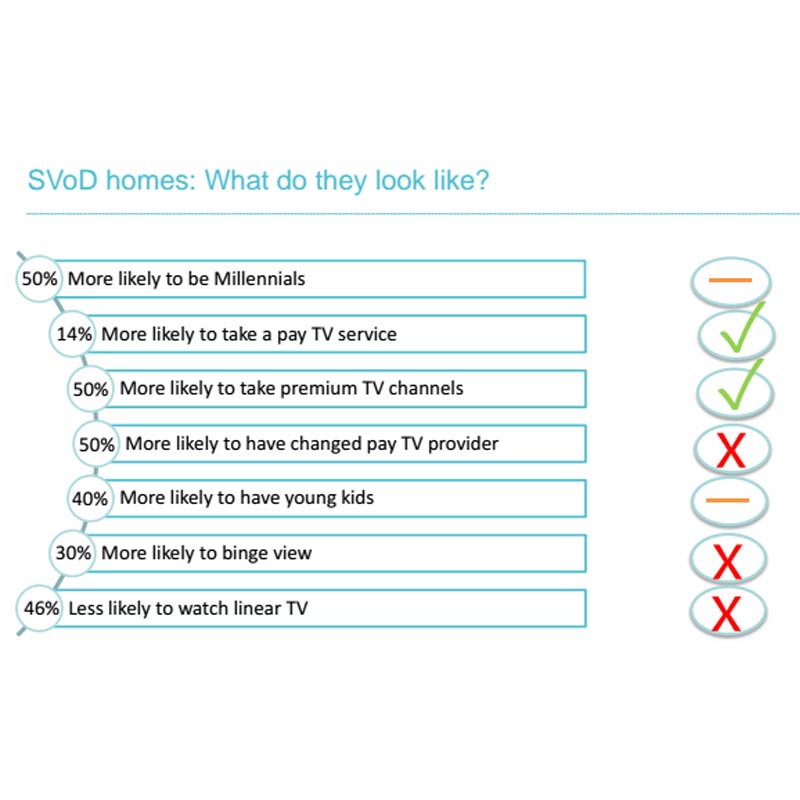
    So, what exactly do the SVoD homes constitute of? The three most relevant observations about who is consuming such massive content on digital platforms are — a big percentage comprise millennials, and the remainder people are more likely to take premium TV channels and some pertcentage have most likely changed their Pay TV provider.

    In all, 46 per cent are less likely to pay for linear TV, while 40 per cent of homes have kids. 30 per cent of the homes have shown an inclination to binge watching. Only 14 per cent of people have opted for a Pay TV service, according to Ampere.

    Business-wise, the concept of platform and channel is evolving though the producer and distributor remain unhampered. Earlier, content was distributed on platforms like Sky, Moviestar and Canalsat, etc which is now replaced by Facebook, Twitter, Snapchat, YouTube, etc. On the other hand, the channel from which content was ideally consumed has converted from Discovery, Fox, HBO, etc to digital platforms like Netflix, SeeSo, CuriosityStream, etc.

    Pay TV and new media products are segmenting, the report states.

    People with lower income are on-demand led whereas people with higher income are linear-led. Young millennials and teenagers can be appealed via services such as Whistle Sports, Soccer, Snapchat, Facebook,etc. Higher income traditional broadcast get pushed through Sky Q to protect high-end broadcast viewers. Direct To Consumers (DTC) cost to get a channel on air are considerably lower. So with a satellite you are going to take your yearly transponder, but with an OTT service you do not have that significant upfront cost. But, what you do have is a scaling cost, CDN delivery, that grows with your customer base.

    Ampere accepts that the latter factor makes OTT uneconomic for reaching very large audiences, estimating that for a single channel or service offering video in any definition from SD to UHD, a satellite feed works out cheaper beyond 10m viewers’ even if they watch on average just one minute of content per day. For a daily viewer base below 20,000, OTT always works out cheaper, even if all viewers watched five hours of content a day and all content was transmitted inUHD, Ampere found.

    With changing economics, channel groups are increasingly looking to Direct To Consumers (DTC) SVOD service. Viewers/advertising spends have shifted to online, operators are pushing back on channel carriage fee, content owners’ margins have squeezed and the DTC, SVoD launch have led to recoup margin. The millennials are already approaching two SVOD services per home. In the US, millennials have crossed the more than 2 number than the average. They are approaching to the number in Germany, Denmark, Poland and UK. Out of the 1002 sample survey, 255 are Netflix customers in UK which only means that the country is most likely to have more Netflix customers.

    It is not all about broadband penetration, because size is also important. And actually if we look at the size of the addressable market, emerging markets like Mexico, Brazil, Russia, China, Taiwan, Thailand, etc all have started to become interesting [DTC] markets when we talk about the total addressable size.

    Ampere’s research found that in the UK a Netflix customer is 1.5 times more likely than average to also take Sky’s Now TV OTT service; 1.8 times more likely to also take Amazon; 2.5 times more likely also to take Spotify’s streaming music services; and 1.5 times more likely to use the catch-up TV apps of the major broadcasters.

    To date, Netflix’s growth strategy has relied on geographic expansion. But, its set to run out of road by 2017. Central, South and Western Europe saw 6 customer additions on an average in 2015 which has reduced to 4 or 5 in 2017 further reducing in 2021. But in Asia Pacific region, the customer addition has gone up from 1 to 5 and is estimated to be 3. Even after this, the fact that Netflix has invested a huge amount of money on content cannot be ignored. Netflix is spending like a broadcast or premium channel group. It spends 60 per cent revenue on program followed by premium platforms contributing 40-70 per cent revenue. Pay multichannels are putting 30-40 per cent revenue on programs.

    Pay TV is still growing but OTT is growing faster – much faster. And that fact sums up both the threat and the opportunity that OTT video presents to platform operators. The survival of service providers depends on their ability to launch new services ahead of the competition.

  • SVod outpacing pay TV in W. Europe’s consumption trends: Report

    SVod outpacing pay TV in W. Europe’s consumption trends: Report

    MUMBAI: Subscription video on-demand (SVoD) content is increasing more and more as compared to Pay TV.

    Several discussions have taken place in India with the growing number of digital platforms. Broadcasters such as Star India, Viacom18, Zee Media and Sony Television, etc have entered this space with their own OTT/VOD platforms. Debates not just confined to the emergence of VOD platforms but also the entry of various global players have been raging since.

    The fact that digitisation is at a nascent phase in India only paved the way for the players to experiment various models. This also raised a few eyebrows on the existence of cable and satellite television.

    While most follow an advertising-led model or a ‘freemium model’, the countable ones have taken the challenge of following a subscription-based model. As print has survived after the entry of broadcast, analog and digital cable network will also co-exist with the emergence of various digital platforms. With the robust penetration of internet in the US, Pay TV has remained powerful.

    But is it the same everywhere else? Certainly not. The scenario is completely different in Western Europe. SVoD subscription has been outstripping Pay TV since 2012. The subscription net addition of Pay TV in 2016 is 2 million which is estimated to see a downfall by 2021 to 1 million.

    On the other hand, SVoD in 2016 is 9 million only and evaluated to come down to 3 million by 2021. Both the services are currently at its peak but are substantially going to see some disruption. This clearly shows that currently the viewers are ready to pay for good quality content.

    These were some of the findings presented in a report at IBC by Ampere Analysis, a London based analyst firm, at Amsterdam yesterday.

    According to the Ampere report, SVoD is growing as a significant segment not just in the USA but also in other countries such as Poland, France, the Netherlands, Spain, Italy, Germany, the UK, Sweden and Denmark. The average SVoD-only homes in the second quarter of 2015 has been 5 per cent while, in the current scenario, it has grown by 2 per cent for the first quarter.

    US specifically has seen a growth from 9 per cent to 13 per cent whereas the UK has seen an increase of 2 per cent from 8 per cent to 10 per cent in just a year.
    So, what exactly do the SVoD homes constitute of? The three most relevant observations about who is consuming such massive content on digital platforms are — a big percentage comprise millennials, and the remainder people are more likely to take premium TV channels and some pertcentage have most likely changed their Pay TV provider.

    In all, 46 per cent are less likely to pay for linear TV, while 40 per cent of homes have kids. 30 per cent of the homes have shown an inclination to binge watching. Only 14 per cent of people have opted for a Pay TV service, according to Ampere.

    Business-wise, the concept of platform and channel is evolving though the producer and distributor remain unhampered. Earlier, content was distributed on platforms like Sky, Moviestar and Canalsat, etc which is now replaced by Facebook, Twitter, Snapchat, YouTube, etc. On the other hand, the channel from which content was ideally consumed has converted from Discovery, Fox, HBO, etc to digital platforms like Netflix, SeeSo, CuriosityStream, etc.

    Pay TV and new media products are segmenting, the report states.

    People with lower income are on-demand led whereas people with higher income are linear-led. Young millennials and teenagers can be appealed via services such as Whistle Sports, Soccer, Snapchat, Facebook,etc. Higher income traditional broadcast get pushed through Sky Q to protect high-end broadcast viewers. Direct To Consumers (DTC) cost to get a channel on air are considerably lower. So with a satellite you are going to take your yearly transponder, but with an OTT service you do not have that significant upfront cost. But, what you do have is a scaling cost, CDN delivery, that grows with your customer base.

    Ampere accepts that the latter factor makes OTT uneconomic for reaching very large audiences, estimating that for a single channel or service offering video in any definition from SD to UHD, a satellite feed works out cheaper beyond 10m viewers’ even if they watch on average just one minute of content per day. For a daily viewer base below 20,000, OTT always works out cheaper, even if all viewers watched five hours of content a day and all content was transmitted inUHD, Ampere found.

    With changing economics, channel groups are increasingly looking to Direct To Consumers (DTC) SVOD service. Viewers/advertising spends have shifted to online, operators are pushing back on channel carriage fee, content owners’ margins have squeezed and the DTC, SVoD launch have led to recoup margin. The millennials are already approaching two SVOD services per home. In the US, millennials have crossed the more than 2 number than the average. They are approaching to the number in Germany, Denmark, Poland and UK. Out of the 1002 sample survey, 255 are Netflix customers in UK which only means that the country is most likely to have more Netflix customers.

    It is not all about broadband penetration, because size is also important. And actually if we look at the size of the addressable market, emerging markets like Mexico, Brazil, Russia, China, Taiwan, Thailand, etc all have started to become interesting [DTC] markets when we talk about the total addressable size.

    Ampere’s research found that in the UK a Netflix customer is 1.5 times more likely than average to also take Sky’s Now TV OTT service; 1.8 times more likely to also take Amazon; 2.5 times more likely also to take Spotify’s streaming music services; and 1.5 times more likely to use the catch-up TV apps of the major broadcasters.

    To date, Netflix’s growth strategy has relied on geographic expansion. But, its set to run out of road by 2017. Central, South and Western Europe saw 6 customer additions on an average in 2015 which has reduced to 4 or 5 in 2017 further reducing in 2021. But in Asia Pacific region, the customer addition has gone up from 1 to 5 and is estimated to be 3. Even after this, the fact that Netflix has invested a huge amount of money on content cannot be ignored. Netflix is spending like a broadcast or premium channel group. It spends 60 per cent revenue on program followed by premium platforms contributing 40-70 per cent revenue. Pay multichannels are putting 30-40 per cent revenue on programs.

    Pay TV is still growing but OTT is growing faster – much faster. And that fact sums up both the threat and the opportunity that OTT video presents to platform operators. The survival of service providers depends on their ability to launch new services ahead of the competition.

  • Hooq plans to invest $2 million on original Indian content

    Hooq plans to invest $2 million on original Indian content

    MUMBAI: Hooq plans to invest $ 2 million in Indian original content in India. This is part of its APAC strategy to start sourcing local original content in Asian countries.

    A joint venture of SingTel, Sony Pictures TV and Warner Bros., Hooq entered the Indian market back in May this year with a catalogue of over 10,000 movies and TV series.

    “We are in talks with a few other (production) studios in India but nothing finalised yet. As we are still in an observation phase, we are seeing a gap in local language content available on broadcasters’ apps. Such content or programming is not available on other neutral platforms too. That is the gap we are looking (at filling),” said Hooq India managing director Salil Kapoor.

    Though Kapoor refused to comment on investment plans, entertainment industry sources indicated that in the first phase Hooq is likely to spend up to $ 2 million in Indian original content, a plan that’s similar to what the company proposes to do in some other Asian countries too.

    Apart from Hollywood content, Hooq has presently sourced Indian films and shows from studios like Rajshri Productions, Reliance Entertainment, Shemaroo Entertainment, Balaji Telefilms and Whacked Out Studios. With the cost of making original English language shows high, the platform is considering Hindi and other Indian language content.

    For the OTT platform, consumption of its service in the four south Indian states of Kerala, Andhra Pradesh, Tamil Nadu and Karnataka is high and an area of focus in terms of content and expanding subscriber base.

    Though the Indian OTT market is still in an early stage in terms of revenue generation and subscriber base, Hooq has priced its monthly subscription at Rs 199 in a price sensitive market where high data charges and indifferent bandwidth are also major challenges for an OTT player. New subscribers are offered a seven-day trial package for free.

    Interestingly, all the investors of Hooq have other investments too in India. SingTel is a major investor in telco Bharti Airtel, while both Sony Pictures TV and Warner Bros. have separate businesses running in India. Hooq presently operates in the Philippines, Thailand and India with a population footprint of over 1.4 billion people.

    India, which as per a Media Partners Asia report could gain in APAC online video segment owing to China’s restrictive policies, has seen some global digital players setting up shop with significant initial investments in the OTT/VOD eco-system.

    Netflix, for example, has earmarked $5 billion for content creation and acquisition for 2016 calendar period. Chinese Internet conglomerate LeEco is likely to invest nearly $1.5 billion in media-entertainment industry for content aggregation. Amazon Prime, according to media reports, plans to invest $300 million in funding movies and television series in India and is in talks with Bollywood studios.

    Apart from global players, local players too have lined up significant investments in content for online video services. This includes Star India, Viacom18, Sony India, Savvn, Zee, Times of India group and Arre. Mukesh Ambani-controlled Reliance Industries has plans to pump in $17 billion in the Reliance Jio eco-system to build a platform that is aimed at taking Indians to live the digital life with cutting-edge services and quality content.

  • Hooq plans to invest $2 million on original Indian content

    Hooq plans to invest $2 million on original Indian content

    MUMBAI: Hooq plans to invest $ 2 million in Indian original content in India. This is part of its APAC strategy to start sourcing local original content in Asian countries.

    A joint venture of SingTel, Sony Pictures TV and Warner Bros., Hooq entered the Indian market back in May this year with a catalogue of over 10,000 movies and TV series.

    “We are in talks with a few other (production) studios in India but nothing finalised yet. As we are still in an observation phase, we are seeing a gap in local language content available on broadcasters’ apps. Such content or programming is not available on other neutral platforms too. That is the gap we are looking (at filling),” said Hooq India managing director Salil Kapoor.

    Though Kapoor refused to comment on investment plans, entertainment industry sources indicated that in the first phase Hooq is likely to spend up to $ 2 million in Indian original content, a plan that’s similar to what the company proposes to do in some other Asian countries too.

    Apart from Hollywood content, Hooq has presently sourced Indian films and shows from studios like Rajshri Productions, Reliance Entertainment, Shemaroo Entertainment, Balaji Telefilms and Whacked Out Studios. With the cost of making original English language shows high, the platform is considering Hindi and other Indian language content.

    For the OTT platform, consumption of its service in the four south Indian states of Kerala, Andhra Pradesh, Tamil Nadu and Karnataka is high and an area of focus in terms of content and expanding subscriber base.

    Though the Indian OTT market is still in an early stage in terms of revenue generation and subscriber base, Hooq has priced its monthly subscription at Rs 199 in a price sensitive market where high data charges and indifferent bandwidth are also major challenges for an OTT player. New subscribers are offered a seven-day trial package for free.

    Interestingly, all the investors of Hooq have other investments too in India. SingTel is a major investor in telco Bharti Airtel, while both Sony Pictures TV and Warner Bros. have separate businesses running in India. Hooq presently operates in the Philippines, Thailand and India with a population footprint of over 1.4 billion people.

    India, which as per a Media Partners Asia report could gain in APAC online video segment owing to China’s restrictive policies, has seen some global digital players setting up shop with significant initial investments in the OTT/VOD eco-system.

    Netflix, for example, has earmarked $5 billion for content creation and acquisition for 2016 calendar period. Chinese Internet conglomerate LeEco is likely to invest nearly $1.5 billion in media-entertainment industry for content aggregation. Amazon Prime, according to media reports, plans to invest $300 million in funding movies and television series in India and is in talks with Bollywood studios.

    Apart from global players, local players too have lined up significant investments in content for online video services. This includes Star India, Viacom18, Sony India, Savvn, Zee, Times of India group and Arre. Mukesh Ambani-controlled Reliance Industries has plans to pump in $17 billion in the Reliance Jio eco-system to build a platform that is aimed at taking Indians to live the digital life with cutting-edge services and quality content.

  • Amagi launches live linear OTT playout platform  on cloudport

    Amagi launches live linear OTT playout platform on cloudport

    MUMBAI: Amagi announced TV networks and content owners can now launch live and linear OTT channels on the cloud and operate a unified platform for linear, catch up and video-on-demand (VOD) TV without any hardware.

    Cloudport OTT supports advanced graphics functions including dynamic graphics, digital video effects, and real-time social media integration capability in addition to switching to live feeds.

    The platform is equipped with a live MCR capability on the cloud and the entire OTT playout workflow can be managed remotely using a web-based UI.

    “Cloudport has all the features that traditional TV networks need. It is built on a secure, reliable, and scalable Amazon AWS cloud infrastructure, complete with an in-built feature to block geo-specific content to manage content rights obligations,” Amagi co-founder K. A. Srinivasan was quoted in a company statement.

    “The platform seamlessly integrates with Amagi’s server-side OTT ad insertion solution, thunderstorm, to monetize content effectively. This way TV networks and content owners have access to an integrated platform for OTT playout and monetization, simplifying overall operations,” aacording to Srinivasan.

  • Amagi launches live linear OTT playout platform  on cloudport

    Amagi launches live linear OTT playout platform on cloudport

    MUMBAI: Amagi announced TV networks and content owners can now launch live and linear OTT channels on the cloud and operate a unified platform for linear, catch up and video-on-demand (VOD) TV without any hardware.

    Cloudport OTT supports advanced graphics functions including dynamic graphics, digital video effects, and real-time social media integration capability in addition to switching to live feeds.

    The platform is equipped with a live MCR capability on the cloud and the entire OTT playout workflow can be managed remotely using a web-based UI.

    “Cloudport has all the features that traditional TV networks need. It is built on a secure, reliable, and scalable Amazon AWS cloud infrastructure, complete with an in-built feature to block geo-specific content to manage content rights obligations,” Amagi co-founder K. A. Srinivasan was quoted in a company statement.

    “The platform seamlessly integrates with Amagi’s server-side OTT ad insertion solution, thunderstorm, to monetize content effectively. This way TV networks and content owners have access to an integrated platform for OTT playout and monetization, simplifying overall operations,” aacording to Srinivasan.

  • Zee gets aggressive with dittoTV relaunch

    Zee gets aggressive with dittoTV relaunch

    MUMBAI: Media watchers have been speculating for some time about what Zee Entertainment Enterprises Ltd (ZEEL) would do in the live and linear OTT and VOD space with its dittoTV service. The reason: even as rivals Hotstar, Voot and others such as Hooq, YuppTV seemed to be having strategic direction, dittoTV seemed to be going adrift.

    The riposte came from the Zee management yesterday with its announcement that it would be launching dittoTV with a bouquet of 100 plus channels at a price point of just Rs 20 per month.  As part of the relaunch Zee Digital Convergence Ltd (ZDCL) has re-positioned dittoTV as desh kaTV with a promise to make live television available to every Indian via any device – viz phones, tablet or PC. The price gets even more lip smacking for users subscribing for three months (Rs 50), six months (Rs 90) and annually (Rs 170). 

    The platform has tied up with major Indian broadcasters with the exception of the SunTV group and Star India giving it a portfolio of 100 plus Hindi, English and regional language channels, encompassing general entertainment, sports, movies, news and lifestyle on board.

    “With the new avatar of dittoTV, we aim to change the media landscape to suit the evolving media consumption preferences of consumers. It will allow users to control where they watch television in a way that has not been possible before. We are proud to present a platform that will help scale up this transformation by making it affordable for people across a wide economic spectrum,” opines Zeel MD and CEO Punit Goenka.

    dittoTV business head Archana Anand gives the rational for the competitive and low pricing. Says she: “We really wanted to go mass and affordable with this pricing.  We see it serving as your first and only screen, as your second screen or just your TV on the go! Keeping the Indian landscape in the mind, dittoTV will soon be available in all regional languages. A huge aspirational audience of ours is college students who we believe will use this especially given the Wifi in the colleges. They are the specific TGs that we are chasing. We have found that there is a huge need gap in hostels and we intend to be at youth festivals and various events to make sure that ditto is their one stop entertainment destination.”

    She points out to dittoTV’s adaptive technology which will adjust to a range of internet speeds in order to deliver a seamless viewing experience, making it suitable for both urban and rural markets. A broad marketing campaign – which observers say will include TVCs on the Zee network, Siticable and dishTV – has been drawn out to push the #deshkatv and #beeskaTV to the potential target audience.  

    In a bid to encourage sampling of dittoTV, ZEEL has partnered with Birla group owned telecom provider Idea Cellular. Under this, a promotional offer has been drawn up which allows customers in Idea 3G and 4G provider circles to subscribe to dittoTV free of cost, along with select monthly data packs until 31 July 2016.

    “With the rapid rollout of our 4G services and increased penetration of smartphones in the country, we are providing our customers an array of rich digital services to meet their demand for engaging apps and content,” explains Idea Cellular chief marketing officer Sashi Shankar. “TV being synonymous with entertainment for the Indian masses, we are excited to partner with dittoTV to enable consumers to carry their entertainment wherever they go.”

    Anand adds that dittoTV has sewn up carrier billing deals with almost all the telecom providers. Says she: “It’s not just with Idea. But we are glad to have them on board to bundle dittoTV with their data cards.  We have reached out to a wonderful telecom partner for our distribution. They also see this as valid proposition for them because there is nothing more massy which consumes data than TV. They see it as a good service for their subscribers and in the process getting data consumed. So, there is an increased synergy between the two.”

    dittoTV has also reached out to other service providers within the Essel group – Siti Cable and ITZ Cash – to give it a retail push and make it available to subscribers. 

    Will the low rates of dittoTV spark off a price war in this segment? The jury is out. A media observer states that it is quite possible that rivals such as YuppTV, Airtel’s PocketTV may have to reduce what they charge to consumers.  While YuppTV’s larger offering of 200 plus channels (it also offers SunTV channels) is priced at Rs 99 a month, Airtel’s PocketTV is priced at Rs 45 a month for a bouquet of 150 plus channels.  And then there is the Reliance Jio juggernaut which is set to roll with its much larger channel portfolio JioPlay. The pricing for JioPlay has not yet been revealed but observers expect it to bring about a paradigm shift.

    Anand, on her part, is not letting the competitive noise frazzle her. “Reliance is going to disrupt everything in the broadband ecosystem. So I don’t let that worry me at all,” says she. “We are focused on offering our customer a service that’s good and that’s ditto for television, which means, offering television to them wherever they go.” 

    Amen to that!