Tag: Vivek Couto

  • MPA report values Asia Pacific online video revenue opportunity at $12 billion by 2020

    MPA report values Asia Pacific online video revenue opportunity at $12 billion by 2020

    MUMBAI: A research report published by Media Partners Asia (MPA) indicates that the total market for online video services across 13 countries in Asia Pacific will grow from $3.5 billion in net revenues in 2014 to reach $12.4 billion by 2020, representing an average annual growth of 23.5 per cent. Advertising will contribute more than 80 per cent to the online video pie by 2020 with the subscription revenue opportunity, largely driven by subscription video-on-demand (SVOD) platforms, growing from less than $700 million in 2014 to more than $2.3 billion by 2020.

    The report, entitled ‘Asia Pacific Online Video Distribution 2015’, evaluates  the commercial distribution of legal over-the-top (OTT) video services in 13 markets with historical data and forecasts plus profiles of key OTT platforms.

    Commenting on the report, MPA executive director Vivek Couto said, “The market for the legal consumption of OTT services in Asia Pacific is at an early stage with monetisation models nascent in most countries. As barriers to entry reduce and broadband penetration increases, more disruptors are emerging and host of new platforms are proliferating, though business models are not always scalable and issues such as piracy; content; and platform operation remain problematic. This is especially true in a number of Asian markets where piracy is significant and the limited scale of OTT video revenues are not commensurate with content costs.”

    “Meanwhile, large scale global digital brands (from YouTube to Netflix) are expanding rapidly in a number of Asian markets or readying to launch in key territories over 2015 and 2016. Major local and regional television companies are also in the early stages of launching a number of large scale advertising and subscription based OTT platforms, anchored to local, Asian and Hollywood content while telecom operators are either moving upstream into content and OTT services or providing a crucial link for the ecosystem,” he added.

    Key takeouts from the report include:

    •    Infrastructure. Fixed broadband subscribers reached 325.3 million in 2014 across Asia Pacific, equivalent to an average household penetration rate of 36 per cent. By 2020, MPA projections indicate that this penetration level will reach 40 per cent as fixed broadband subs grow to 403.5 million mobile broadband will grow rapidly, expanding at CAGR of 15 per cent over 2014 and 2020 to reach almost 2 billion subs by 2020 (58 per cent penetration of population) versus 866 million (26 per cent penetration) in 2014.


    •    OTT Video Consumption. Active Asia Pacific OTT video subscribers reached 594 million in 2014, according to MPA. China accounted for more 85 per cent of the market size in 2014 and will represent 80 per cent by 2020. Ex-China, the largest markets in 2014 were Korea; India; Japan; and Hong Kong. By 2020, MPA projections indicate that active OTT video customers will reach 977 million. By 2020, in Asia ex-China, India will emerge as the second largest market, followed by Korea, Japan and Hong Kong. In Southeast Asia, Malaysia will be joined by Indonesia and the Philippines as market leaders.  

    The market for subscription-based OTT video reached 75.3 million active subscribers in 2014 and is expected to reach 225 million by 2020. China will be the largest contributor, driven by internet-enabled TV and set-top box platforms and online video companies offering premium services. Japan, Korea, India and Australia will emerge as material opportunities, powered by SVOD but India will trend towards more a freemium-oriented model.

    •    Industry economics. MPA divides industry monetization models into distinct segments:

    o    SVOD.  In terms of SVOD revenue across OTT platforms, the largest markets in Asia Pacific by 2020 will be Japan; China; Korea; and Australia. New Zealand and India will lead the next best placed group of geographies. MPA projections indicate that total SVOD-based OTT revenues in Asia Pacific will grow at a CAGR of 16 per cent between 2014 and 2020, growing from $953 million in 2014 to more than $2.3 billion by 2020.

    o    Online video and OTT advertising. Asia Pacific online video advertising exceeded US$3.7 billion in net terms in 2014, up 35 per cent year-on-year. The largest markets for online video advertising in 2014 were, by far, China and Japan, followed by Australia, India and Korea. By 2020, the total Asia Pacific online vide advertising pie is expected to grow to $10 billion, a CAGR of 18 per cent from 2014, with China dominant, followed by Japan and Australia. India will gain increasing scale and overtake Korea while Indonesia will be the clear leader in Southeast Asia.

    OTT video advertising revenue, a subset of the online video advertising pie, reached $2.1 billion in 2014, up 43 per cent year-on-year from a low base, and almost entirely driven by China. This pie, is projected by MPA to expand to $5.5 billion by 2020 at a CAGR of ~18 per cent. China will be the largest contributor with India, Korea and Indonesia starting to become gradually significant over time.


  • Asia PAC advertising to grow 5% in 2014, 5.7% in 2015, 4.5%CAGR for 2014-19: MPA study

    Asia PAC advertising to grow 5% in 2014, 5.7% in 2015, 4.5%CAGR for 2014-19: MPA study

    MUMBAI: A new report published by Media Partners Asia (MPA) indicates that net advertising revenues, measured after discounts across 14 markets, will grow at 5.0 per cent this year to top US$121 billion. Next year, MPA projects a re-acceleration in growth with the advertising market to expand at 5.7 per cent. Between 2014 and 2019, MPA forecasts indicate that net advertising in Asia will climb at an average annual growth rate of 4.5 per cent.


    Commenting on the findings of the report, entitled Asia Pacific Advertising Trends & Database 2014 – 15, MPA executive director Vivek Couto said: “The macro landscape is uneven and there are headwinds to economic growth across Asia Pacific. Encouragingly, governments and policymakers across the region have implemented reforms to address structural issues and this trend is likely to accelerate in markets where positive political change has occurred. Ad spends from large multinational advertisers softened through much of 2014, partially offset by spends from domestic advertisers but this has dampened growth across Southeast Asia and other key markets. Multinational advertising demand may return but weakness across global emerging and developed ad markets may exert downward pressure on Asia.”             


    Key highlights from the report include:  


    o    Southeast Asia rebound. Contraction in advertising across Malaysia, Singapore and Thailand, partially offset by robust though slower growth in Indonesia, Philippines and Vietnam, means that net advertising revenues will grow at only 1.2 per cent in Southeast Asia in 2014, the lowest in five years. A rebound is expected in 2015 with 7.2 per cent growth.


    o    Market rankings. China will overtake Japan as Asia’s largest advertising market by 2016 while India will overtake Korea in 2017. By 2019, the six largest ad markets in Asia will be China; Japan; Australia; India; Korea and Indonesia.              


    o    TV. TV’s share of the advertising market peaked in 2011 at 42.9 per cent and while still resilient, market share has been edging downwards, reaching 41.6 per cent in 2014 with MPA projecting 40.7 per cent share by 2019. In mature markets, TV will remain a growth media in Hong Kong and to a smaller extent, Australia but the future will be more challenging in Japan and Singapore. In Korea, terrestrial TV also faces a challenging future. In growth markets, TV’s best performers, from a relatively high base, will be Indonesia, India, Philippines, Thailand and Vietnam.


    o    Digital. Total digital advertising revenue (including search, display and mobile) is expected to climb at a CAGR of 11.1 per cent over 2014-19 with aggregate market share growing from 23 per cent in 2014 to 31 per cent by 2019. Digital has overtaken TV to be the largest media in terms of advertising on Australia; by 2019, it will also be the largest media by advertising in China, Korea and New Zealand. In more developing online markets such as India, Indonesia, Malaysia and Thailand, digital will have a 10-20 per cent advertising market share by 2019 versus 6-8 per cent in 2014. Mobile advertising will become increasingly significant in China, Japan, Korea and Taiwan while the online video ad pie will continue to expand in China, Japan, Korea and Taiwan and grow rapidly from a low base in markets such as India.   

  • IDOS 2014: Industry solutions to distribution dynamics gain momentum

    IDOS 2014: Industry solutions to distribution dynamics gain momentum

    GOA: The India Digital Operators Summit (IDOS) 2014, the largest TV distribution summit in India ended with significant progress and a level of stakeholder unity on the way forward for digitisation in India, embracing voluntary and mandatory DAS, ground level pricing, interconnect and revenue sharing between LCOs, LMOs and MSOs and broadcaster support for standard, uniform pricing based on addressable deployment. Key stakeholders also agreed that it’s critical to further improve hygiene in Phase I and II of DAS while various ecosystem entities, including DTH pay-TV operators, domestic STB manufacturers, alternative TV distribution  platforms (HITS, Free Dish) along with the cable fraternity agreed that ahead of the delayed DAS mandate, voluntary DAS has legs in Phase III and Phase IV.


    IDOS 2014 had a full attendance of the who’s who of the industry with more than 300 professionals from the digital TV landscape making their way to the beautiful picturesque resort of Hotel Leela in south Goa.


    The summit which kickstarted with the biggest opening night party organised by HBO on 25 September, saw some eye opener facts presented by Media Partners Asia executive director Vivek Couto on the current status of Indian cable TV industry. He said, “Out of the 262 million households in the country only 162 million houses have a TV. Of this, 27 million is taken up by the free to air service providers such as Freedish via satellite and 7 million by terrestrial DD, while the rest comes under cable and satellite.”


    He also informed the gathering that over Rs 32000 crore has been invested in digitisation since 2005 with a bulk of the investment coming from the DTH operators followed by the MSOs and LCOs since 2011. Out of this, over Rs 11000 crore in the last 24 to 30 months has been invested by MSOs and LCOs.


    He pointed out that while the cost of all the pay channels on a wholesale basis is Rs 922 to digital platforms, the highest pack price is Rs 550 which is an anomaly and needs correction. “Wholesale channel rates should be reflective of retail  prices,” he highlighted. “The sector needs to move towards retail pricing to foster trust between broadcasters, cable TV operators, and LCOs. Retail pricing will make rates transparent. Competition amongst six DTH, two HITS, five national MSOs and several regional ones and the local cable ops will keep retail rates in check.”


    Another important point that came out during the session was that carriage fees which were declining before the digitisation mandate have now reversed their path following completion of phase of phase I and phase II .  “The carriage fee has gone up by 14 per cent on Q1 of FY15 over the previous corresponding quarter,” he informed.


    Indian Television Dot Com founder CEO Anil Wanvari suggested the way forward for the cable TV fraternity. He said, “The first thing is to look at digitisation and pay TV with a changed mindset that it will be beneficial to all. The government could look at setting up a digitisation transition fund that will help educate, train, provide seed capital to go digital – this is specially relevant in phase III and phase IV areas. The fund could be discontinued once the transition is completed successfully, say in the next four to five years. A mechanism needs to be put in place to reward people who follow the rules and ensure strict penalties for those who don’t.”


    Apart from this, Wanvari also suggested that Subscriber Management System (SMS) should be set up with correct KYC  details and bills be issued to consumers. The government or regulator could also look at laying down standards and tech specifications for set top boxes (STBs) which were in keeping in making the customer technology-future-proofed for at least three to four years and to ensure quality control. That’s if the mandate of made in India set top boxes is to become a reality. “The first wave of digitisation has seen low end zapper boxes being shipped in from China – of maybe not the best quality – and being dumped on to the Indian customer to meet the so-called deadlines in phase I and phase II,” he said. “Which is not fair on the lay customer who may have to go in for a new one in the not to distant future.”


    “On the pricing front, industry could be allowed to price their content based on market demand,” Wanvari added. “The prepaid model as followed by DTH with recharges being made available from your kiranawala (neighbourhood store) or paanwala will allow for more transparent collection from the ground for MSOs and the cable sector. The base pack price could rise; and content costs on cable could be brought on a parity with DTH.  On the other hand, different packages could be made available to the consumer.”


    One key take away from the three day summit was the fact that right from the broadcaster, to the MSOs, DTH operators and also a few local cable operators, no one is happy with the delayed digitisation. The captains of the industry expressed similar opinion  to what the Telecom Regulatory Authority of India chairman Rahul Khullar has been airing on several occasions, that ‘delayed digitisation sends out a wrong message to the world and helps no one.’


    Many also felt that the Average Revenue Per User (ARPU) needs to go up from the current Rs 150 to Rs 250-Rs 300. “ARPUs can see an upward trend only if there is trust amongst the various stakeholders,” said IndiaCast CEO Anuj Gandhi.


    Star India president and general counsel Deepak Jacob during a session suggested putting together a commercial model which is uniform. While Siti Cable CEO VD Wadhwa opined to opt for voluntary digitisation, if the broadcasters and LCOs support the MSOs.


    “IDOS is a great platform for the industry to express their point of view, which for this year was delayed digitisation. I am very pleased with the discussions and the quality turnout at IDOS,” said Wadhwa.


    “As a first timer, I got to learn a lot through all the sessions that were conducted. Given a chance, I will keep coming back,” said Scripps Networks Asia Pacific managing director Derek Chang.


    “The session on STB was very informative and there is no other platform where all the stakeholders can meet and discuss the issues related to the cable TV industry,” said Times Television Network MD and CEO MK Anand.


    The highlight of IDOS 2014 was the closed door interaction with TRAI chairman Dr Khullar via videoconference with the various industry stakeholders.

  • IDOS 2014: How can the pay TV industry be made better?

    IDOS 2014: How can the pay TV industry be made better?

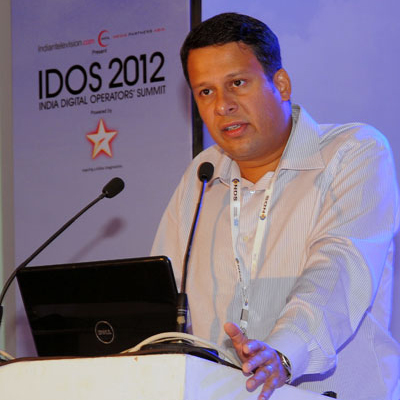
    GOA: India Digital Operators’ Summit 2014 kicked off at The Leela in Goa on 25 September. Opening the conference, Indiantelevision.com CEO and editor in chief Anil Wanvari and Media Partners Asia (MPA) executive director Vivek Couto gave a brief on the state of the TV nation and transition to the broadband digital economy.


    Wanvari highlights how the state of the industry was a few years ago and what it has become now after the advent of conditional access system (CAS) and digital addressable system (DAS). Content makers aka broadcasters have been demanding more revenue from the pay TV industry. While the capex and opex for them has been high, the return continues to be low. The MSOs and DTH operators have been investing to expand their headends and build subscriber base respectively. “While it is a good business now, the real question is if each one of us is willing to make it a great business?” he asks.


    In order to strengthen the business, Wanvari recommends a few suggestions that could help grow the industry. The first thing is to look at digitisation and pay TV with a changed mindset that it will be beneficial to all. The government could look at setting up a digitisation transition fund that will help educate, train, seed capital and reward people who follow the rules and ensure strict penalties for those who don’t.


    Subscriber management system (SMS) should be set up with correct details and billing of the services provided to customers. The government could also look at laying down minimum standard rules for set top boxes (STBs) to ensure quality control. His final suggestion is to leave pricing to the market rather than initiate 10 to 15 per cent price rise every now and then.


    Providing a glimpse into MPA’s study on the pay TV industry in India, Couto says that out of the 262 million households in the country only 162 million houses have a TV. In this, 27 million is taken up by the free to air service providers such as Doordarshan and Freedish while the rest comes under cable and satellite.


    Couto highlights that over Rs 32000 crore has been invested in digitisation since 2005 with a bulk of the investment coming from the DTH operators followed by the MSOs and LCOs since 2011. Out of this, over Rs 11000 crore in the last 24 to 30 months has been invested by MSOs and LCOs. “India offers scale but limited monetisation,” he says. What digitisation will do primarily is increase transparency, addressability, tax collection and employment. Over 120 million STBs are needed over 10 years and nearly 47 per cent share of the total market will come through broadband.


    The tiff between the three stakeholders continues with the LCOs fighting for revenue share, MSOs facing crash crunch and broadcasters worried about increasing carriage fees which the MPA report stated as having increased by nearly 14 per cent in Q1 FY2015.


    In terms of scale, India struggles as the country with the lowest average revenue per user (ARPU) but it has one of the best channel services. Couto says that it is time for the industry to move to retail pricing than stick to wholesale tariff because the competition will keep the prices low. The need of the hour is for MSOs and broadcasters to come together and design packages, incentivise upselling, indentify opportunities for sub segmenting and create new genres. The key to which lies in raising prices to consumers.

  • IDOS 2014: A must, say industry stalwarts

    IDOS 2014: A must, say industry stalwarts

    MUMBAI: The broadcast, cable, DTH industry and the regulatory body is all set for the biggest confab of the year.  To be held in Goa, starting 25 September with a big bang opening night party organised by HBO Hits and Defined, all the heads of India’s pay TV market, distribution, broadcast, cable and DTH industry are gathering to brainstorm and suggest the way forward for the already delayed digitisation at the Indian Digital Operators Summit (IDOS) 2014. 


    The extension in the deadline as announced by the Information and Broadcasting Minister Prakash Javadekar has somewhat delayed the plans of many in the pay TV circuit. While the biggest concern currently is smooth rollout of the phase III and phase IV of digitisation, industry biggies will also ideate on how, with consumers moving to other screens apart of television, can be monetised.


    The tenth edition of IDOS, is themed around, ‘Digitisation: The Next Big Push.’ Organised by Indian Television Dot Com and Media Partners Asia, the conference unites stakeholders across the value chain to drive meaningful dialogue and facilitate practical solutions to drive the content and distribution markets forward.


    “The forum provides opportunity for interaction with all key people involved in the broadcasting sector, not only digital operators but others as well,” says Dish TV CEO RC Venkateish.


    According to Venkateish, the theme is very relevant given digitisation is an ongoing process. “That process is something we all hope will take the industry to the next level,” he adds.  The Dish CEO expects the conclave to be a platform for exchange of news, information and opportunity to share some of their view points with the regulator.


    For Maharashtra Cable Operators Foundation president Arvind Prabhoo, IDOS’ concept is most pertinent in today’s market scenario. “Once digitisation was announced, all the players in the ecosystem needed to come together and voice their opinion to benefit from it,” says Prabhoo adding that Indiantelevision.com was the first to identify this need and organise such a conference.


    “It is a really good one and is only going to get bigger,” he opines.


    On the theme for this year’s IDOS, Prabhoo says, “Everyone needs a push, after all the struggle that happened in phase I and phase II. There had to be some kind of out-of-the-box thinking. And this is what will come out in the next two days of the conference.”


    Prabhoo is looking forward to Telecom Regulatory Authority of India chairman Rahul Khullar, Hathway director Viren Raheja and Tata Sky MD and CEO Harit Nagpal amongst others to come up with the kind of impetus that can be given by large corporate houses.


    BBC Global News India COO Naveen Jhunjhunwala is another industry stalwart who is looking forward to some meaningful sessions and interactions at IDOS, this year. “The TV industry is progressing rapidly and the theme for this year’s conference is a positive step towards bringing together the stakeholders and tapping into opportunities that exist in digitisation,” he concludes.   

  • IDOS 2014: India’s broadcast, DTH & cable television industry’s captain congregate

    IDOS 2014: India’s broadcast, DTH & cable television industry’s captain congregate

    MUMBAI: Heads of India’s pay TV, distribution and broadcast sector are headed for Goa between 25 and 27 September 2014 for the industry’s annual confab – The India Digital Operators Summit (IDOS) – 2014. In its third edition, IDOS 2014’s theme is ‘Digitisation: The Next Big Push.’ 

     
    Organised by IndianTelevision.com and Media Partners Asia (MPA), it unites stakeholders across the value chain to drive meaningful dialogue and facilitate practical solutions to drive the content and distribution markets forward.


    The three day summit will kickstart with HBO hosting the most awaited party of the season on 25 September at The Leela in south Goa. 


    The highlight for the three day conference is TRAI chairman Rahul Khullar who will address the gathering on ‘Policy, practices and the way forward – The Next Five Years for Indian Television.’

    Day two of the summit will commence with a keynote on the ‘State of the TV Nation’ by Indiantelevision.com founder, CEO and editor in chief Anil Wanvari and MPA executive director Vivek Couto. 


    A panel comprising leading investment analysts and investors will next discuss the key drivers of industry economics and value creation and if digitisation extension dates will cause concerns for investors and ROI.


    ‘Unity and The Way Forward for the Next Five Years’ will be another topic for discussion at the upcoming summit. During the session, industry leaders will be seen discussing on how there is a need to converge upon and the urgency of proper execution in the coming months. The other sessions will see brainstorming on ‘Specialized content and channels in the digital ecosystem’, ‘Broadband and the digital economy – A focus on ground deployments’, ‘In focus: The growth of alternative video platforms’ and ‘Technology shifts in Indian Pay-TV’ among others.


    Amongst the headline names who are slated to attend and speak include: Star India CEO Uday Shankar, Zee TV CEO Punit Goenka, TRAI principal advisor N Parmeswaran, FoodFood promoter Sanjiv Kapoor, Dish TV CEO RC Venkateish, Videocon d2H CEO Anil Khera, Hathway Cable & Datacom MD and CEO Jagdish Kumar, Siti Cable CEO VD Wadhwa, DEN Networks CEO SN Sharma, Mybox CEO Amit Kharbanda, Scripps Networks Asia Pacific head Derek Chang,  Ortel CEO BP Rath, among others. 


    Says Indiantelevision.com founder, CEO, and editor in chief Anil Wanvari: “For decades, it has been seen as a land of promise. But India’s $7.5 billion television industry has somehow or the other belied that potential. Forced by the government to digitise, India’s TV distribution ecosystem has been struggling to get its act together. While set top boxes (STBs) have been rolled out, transparent customer billing, pricing deals between content owners and distributors, and conditional access have yet to occur seamlessly. This has left industry precisely at the same spot it was at before digitisation was mandated.”


    Adds Media Partners Asia executive director Vivek Couto:  “Revenue leakages continue, and industry discord has only heightened, amongst broadcasters, cable and DTH satellite operators. Clearly, key changes are required with the Government recently calling for an extension to the digitisation deadline to December 2015 for phase III and December 2016 for phase IV. It is in this perspective we expect IDOS to play a key role in getting likeminded  professionals from industry to come together to analyse the just completed phase I and phase II of digitisation and brainstorm for a better phase III and phase IV.”


    The title partner for the event executed by ITV 2.0 Productions is Star India. The summit partners are BBC World News, Cisco, Discovery Channel, HBO Defined HBO Hits, SES, Surewaves and Videocon D2H. The associate partners are Akamai, Asiasat, CSG International, DEN, Hathway and Scripps Network. Broadband India Forum is the support partner, while 24 Frames Digital is the webcast partner. The media partners for the event are Avishkar, Cable Quest, Radioandmusic.com, Satellite @ Internet India and Tellychakkar.com


    IDOS is to be held at the Hotel Leela in south Goa between 25-27 September 2014.

  • APAC digital subscribers to reach 503 million by 2018: MPA

    APAC digital subscribers to reach 503 million by 2018: MPA

    MUMBAI: Media Partners Asia (MPA) has come out with its report on the Asia Pacific pay-TV and broadband market for the next five years. It predicts that DTH satellite pay-TV customers in Asia are expected to grow from 56.3 million in 2013 to more than 110 million by 2018, a CAGR of 14 per cent.


    The report titled ‘Asia Pacific Pay-TV and Broadband Markets 2014’ states that by 2023, DTH’s share of the total pay-TV market will nearly double to 24 per cent as the customer base reaches 150.4 million. Meanwhile, HD DTH subscribers will increase from 10.4 million in 2013 to 37.3 million by 2023, driven by high growth in India and China as well as steady growth in Japan, Korea and Southeast Asia.


    DTH subscription revenue is expected to grow at a five year CAGR of 9 per cent to $ 12.3 billion by 2018 and $ 15.2 billion by 2023. It also predicts that the market for DTH pay-TV will further consolidate as growth converges across fewer operators in markets such as India and Indonesia. In markets such as Thailand, DTH pay-TV is struggling as free DTH services have started to breed, penetrating 60 per cent TV homes. One such is Free Dish that will prove to be important to digitisation in rural and smaller towns.


    The APAC pay-TV market will grow at a 10 per cent CAGR between 2013 and 2018. This will be enhanced by the subscriber jump from 312 million in 2013 to 503 million by 2018 while digital penetration of pay-TV homes expands from 62 per cent to 83 per cent.


    Commenting on the findings, MPA executive director Vivek Couto said, “We see operating leverage growing for market leaders in India, Indonesia and Malaysia in particular as well as long-term upside from strategic recalibration in Australia and New Zealand. Better monetisation in the Philippines should help the market leader properly scale its DTH business and take it to the next level. We also predict incremental growth and value in Vietnam.”


    The report states that among maturing markets, Malaysia is a leader with Astro as one of the most innovative operators in the world, good at increasing both subscriber growth and ARPUs as well as investing in product innovation. DTH ops in Australia and Japan continue to face headwinds. Hybrid DTH-IPTV distribution has helped sustain KT SkyLife’s proposition in Korea.


    In India, broadband is a long term consideration even though all the top four DTH operators are looking at mobile partnerships and wireless broadband strategies.


    IP-based distribution and broadband delivery is a challenge for DTH networks which are adapting to these realities to reduce long-term challenges. In Korea, the KT SkyLife combination retails triple play services. In Indonesia, MNC group that owns MNC Sky Vision (MNCSV) plans to rollout a bundle of IPTV and fiber-based broadband services and merge them with MNCSV.  In Malaysia, Astro has adapted to IPTV partnerships but with slow progress. In Philippines, Cignal has also embraced hybrid IP delivery.

  • MPA issues Asia Pacific pay TV slowdown warning

    MPA issues Asia Pacific pay TV slowdown warning

    MUMBAI:  Digital pay TV is slowing down in Asia. That was the key takeaway from Media Partners Asia (MPA) executive director Vivek Couto’s annual report on the Asia Pacific market during the Asia Pacific Operators Summit in Bali, last week.


    MPA estimates are that entire Asia Pacific pay television ecosystem added 26 million net new customers in 2013, the lowest annual growth since 2007. This reflects a marked deceleration in China and India as well as softer growth in Southeast Asia, especially Thailand, which was the weak link in the region.


    MPA which was until this year bullish on the digital pay-TV universe in Asia Pacific seems to have turned cautious if not bearish. It says that net new additions will accelerate in APAC over 2015-16, largely due to some gains in India associated with next, delayed phase of digitisation but the general trend is one of deceleration. Overall, MPA has downgraded pay TV growth for the region at 9 per cent CAGR until 2018.  Adjusted for multiple subscriptions, the data firm indicates that pay-TV penetration will increase from 52 per cent market share in 2013 to 60 per cent by 2018. 


    In India, phase I and II of digitisation boosted growth in 2012 but with that done and amidst various structural factors plus the macro environment along with currency depreciation, growth slowed in 2013. “Now we see the next delayed phase of digitisation that is phase III, boosting net new subscribers to 8 million a year in 2015 and 7 million in 2016 before decelerating again by 2018,” informed Couto.


    He estimates that on an active paying basis, India has more than 60 million paying digital subscribers. Of this, while 37 million come from DTH, 23 million is from cable. 


    “Over the last 24 months, it’s been a transitionary process for the cable industry in India. While in the analogue regime, the multi system operators were at Rs 11 per subscriber, in the digital era, the MSOs are now getting anywhere between Rs 50-70 in Mumbai and Delhi. They will now need to get to Rs 100-110 to start breaking even on video excluding carriage,” said Couto.


    Net additions in southeast Asia slowed by almost half last year from 3.7 million to 1.9 million and the two big DTH platforms in Indonesia in particular and Malaysia contributed more than 45 per cent to that growth.  According to MPA, the net additions will reaccelerate in southeast Asia to about 2 – 2.5 million a year driven largely by Indonesia, steady growth in Malaysia and the Philippines but the expectation is that disruption to continue in Thailand and only incremental growth to show up in Vietnam while Singapore will remain somewhat flat.


    The brakes have been slammed on cable TV growth in China – the other large TV market globally – courtesy direct competition from IPTV, internet TV (the most popular of which are services provided by Wasu, LeTV, XiaoMi and BesTV’s own OTT service platform), and to some extent, online video. Couto said that IPTV in China saw a steady growth of 5.6 million net additions in 2013, driven by content and increasing broadband reach.


    North Asia, consisting of Hong Kong, Taiwan, Japan and Korea, saw a rise last year only because of Korea, which contributed 80 per cent to growth due to new customers on IPTV and DTH in a market where penetration exceeds 100 per cent.


    “Looking at the macro landscape, you can see pay-TV penetration marginally improve in China over the next five years and this will deliver real pay models, driven largely by IPTV. It might improve further as operators become challenged by the new regulatory policy that establishes a set-top box internet-TV model. A number of online video operators have formed partnerships to enter into the internet TV space,” informed Couto.


    In China, India and Indonesia too, the growth in TV houses and wireless broadband users will drive increases in consumption of content. Fixed broadband subscribers across the APAC region will increase too, from 310 million in 2013 to 400 million by 2018 – driven by China, India, Thailand, Philippines and Australia.


    For Couto, the growth of video on demand (VOD) is now starting to take shape.  “Our metrics just cover pay-TV but this 13 per cent average annual growth to almost US$ 4 billion is driven by China, Korea and Japan while in southeast Asia, Malaysia is the clear market leader with Astro being the best,” he said.

  • Television…. will remain eternal

    Television…. will remain eternal

    MUMBAI: Television will continue to be a dominant medium notwithstanding the emergence of new means of consuming content. New mediums of content delivery are likely to change viewing habits, but more importantly are likely to increase the time spent on watching the stories that are delivered and also provide more opportunities to content creators.


    Rather than fragment television viewership, new mediums of content delivery would open up new opportunities for content creators as well as platform providers.


    To drive home this message, India’s largest broadcaster Star India COO Sanjay Gupta pointed out that 10 years ago the topic of discussion was that newspapers are dead. The fact is that in the last 10 years the size of the newspaper industry has doubled.


    The topic now is ‘Television is Dead’ but like the newspaper industry television will continue to grow, said Gupta, participating in a panel discussion on “Television is Dead – Long Live Television” on the second day of FICCI Frames 2014.


    Fundamentally, new mediums provide new avenues to carry content and to tell stories, Gupta said underlining that there will be greater opportunities with the digital medium opening up.


    IndiaCast Media Distribution Group CEO Anuj Gandhi said, “Fundamentally, we as a nation are a daily soap market. In India daily soaps sell.”


    IndiaCast distributes a multitude of content but in the global markets it has found demand for its serial 24, based on an American thriller series in a real-time format, and not for the Indian staple daily soaps. IndiaCast is mandated to drive domestic and international channel distribution, placement services and content syndication for TV18 Broadcast, Viacom18 and A+E Networks I TV18.


    Celestial Tiger Entertainment CEO Todd Miller echoed the prevalent view. He said, “It is still the living room that is the bulk of our business.” Celestial Tiger is a Hong Kong-based diversified media company that focuses on Asian consumers.


    TELEVISION TO TRANSFORM


    Television as a medium is expected to undergo a transformation from being a linear gadget to a multi-functional smart device. The reinvention of television will allow it to not only survive but blossom despite the onslaught of new mediums of content delivery.


    Effective use of the mobile as a means of content delivery is still a distant given the bandwidth constraints. “For me the biggest challenge is bandwidth. 3G and 4G will change consuming patterns. It will still be sports and news that will be largely consumed on mobiles,” said IndiaCast’s Gandhi.


    There have been so far no serious efforts at making differentiated content. With 3G and 4G, there would be real efforts at making meaningful content.


    Star India’s Gupta said Star Sports’ tie-up with Vodafone has shown there is deep desire among consumers to view content on mobile, even though not at huge costs but by spending smaller amounts.


     “Millions are coming in to check content on Vodafone. They may not want to spend in small amounts,” Gupta said.


    Consumers will seek more and more stories, different stories with the rise of the digital medium of content delivery.  The broadcasters as they now exist and the new means of content delivery and the new content creators would be collaborating rather than working at cross-purposes.


    IndiCast’s Gandhi reiterated that TV Everywhere in the digital era will still remain largely confined to shorter duration content.


    CHANGING DYNAMICS


    Almost 50 per cent of Olympics was watched on mobile. This suggests there is great opportunity to deliver what the consumer wants.


    “We can’t wish it away. Dynamics are changing fast. The distinction between the content creators and platforms is blurring,” said Gupta.


    Industry players expect disruptions to happen but are wary as history shows an outsider has most of the time been the disruptive force.


    New mediums will provide new platforms for content. The broadcasters may go downstream to business to consumer model and the distributors may move up the chain to be the content producers.


    In the US, the average time spent watching television is six hours. In India the average time spent is three hours and the new mediums are seeing an increase in the time spent watching television content.


    Celestial Tiger’s Miller said, “Most of the innovation that comes is from Telcos and DTH.”


    Media Partners Asia executive director Vivek Couto, anchoring the panel discussion, said, “Precedents have already been set for digital deals in the US.”


    Gupta, however, said the cap on prices of television content is hindering creation of quality content. “People are willing to spend. We have 2.5 million HD customers, which is likely to rise to 8 million by the end of this year,” he said.


    The whole ecosystem of story-telling is set for a transformation aided by improved delivery platforms and more creative content creation, and a dominant part of the viewership would still be on television.

  • Consolidation & cooperation, the way forward

    Consolidation & cooperation, the way forward

    India’s cable TV industry is about to enter into a pivotal year, probably the most important in its 20-year old year history. As it does so, it needs to take a leaf out of the US cable industry playbook, a 60-year old franchise that’s been through rate regulation, digitalization, broadband and now, as it stares down the barrel at Netflix and Google, comes together to embrace consolidation and co-operation.

    At a recent investor day, industry godfather and arch value creator, John Malone, chairman of Liberty Media, urged cable MSOs to unite and create a national internet streaming platform as well as cooperate to drive technical moves, new content plays and more homogeneity in product innovation. 

    “The history of the cable business is replete with the industry solving its balkanization and scale problem through joint efforts,” said Malone.  “That can be done again. I see no reason why a vehicle, whether it’s Xfinity [from Comcast] or the equivalent, can’t be syndicated. Whether Hulu could be bought and syndicated. Or whether you’ve got some entrepreneur who’s going to come in and start something that the industry at large could get behind and give it the ability to purchase content on a ubiquitous basis.”


    It’s a critical movement for cable operators in particular. High levels of receivables and low levels of liquidity amongst MSOs is not encouraging for investors and promoters and sends out poor signals for Phase III and IV of digitalization

    Taking a leaf out of Dr Malone’s book and in the spirit of consolidation and co-operation, here are the key moves India’s cable TV operators must drive across the value chain in 2014 and beyond:

    Billing and monetization

    MSOs are coming together and slowly working with LCOs to implement gross billing but it needs to be accelerated in Q1 2014. While close to 21 million households in Phase I and Phase II have been seeded with cable STBs, monetization and ROI has been painfully slow, making the Rs 50 billion plus invested in capital expenditure appear to be an extremely expensive cost of capital. Without the comfort of carriage and placement fees, MSOs need at least Rs 100 per sub per month to breakeven on the digital cable business line – in general, the industry is well short of that at present.

    Den, Hathway and SitiCable appear to be making the right moves but each of the national MSOs need to join together with LCOs to drive billing to consumers and ensure pass through of revenues across the value chain. It’s a critical movement for cable operators in particular. High levels of receivables and low levels of liquidity amongst MSOs is not encouraging for investors and promoters and sends out poor signals for Phase III and IV of digitalization.

    Product, technology and the B2C ecosystem

    More MSOs must come together to ensure that there is homogeneity and innovation across product and technology. Scale through alliances ensures better economies to invest in STBs, CAS, middleware and more advanced functionality. Hathway and DEN appear to be the best positioned to do this with a combined base of 13 million gross digital subs. This is a good start but to seriously challenge DTH and lower capital costs and drive improved product functionality, more MSOs need to come to the table.

    Negotiating capital costs and driving a product roadmap for the next 30 million households will start becoming easier with consolidation. Phase I and Phase II did not require much consolidation and as a result, 90 per cent of STBs seeded came from the top five MSOs. However, Phase III and IV require alliances, consolidation and cooperation as the markets are fragmented and sub scale. 

    It’s also important to note that the first big chunks of cable digitalization in the US, Taiwan and Korea occurred as cable operators banded together to drive down costs, improve functionality and better the consumer experience. To be sure, multiple vendors were used for STBs but across CAS, middleware, compression and billing, often technology solutions were sourced from single vendors.

    Furthermore, the main cable TV players in India must band together to offer an innovative, simple, and functional product set with consistent, strong user interfaces. Digitalization means that all operators will reclaim analogue bandwidth and with superior capacity, this should just mean more channels but more HD channels and broadband.

    Billing systems and the creation of a robust B2C cable TV ecosystem is also important but doing this together rather than apart is important for large and small cable TV MSOs across India. The situation that the US finds itself in today – “Snow white and the seven dwarfs” (Malone’s acerbic reference to the product evolution and functionality at Comcast and its fellow cable MSOs) – is where India is heading at present with only a few MSOs driving digitalization and B2C decision making.

    Broadband and network evolution

    Cable TV broadband remains in its infancy. In spite of the spectre / threat of 4G broadband after 2014-15, cable still has headroom to grow through DOCSIS 2.0 and 3.0 technologies. Hathway has recently deployed DOCSIS 3.0 across selected markets; a strong broadband product with or without a bundle is critical for cable operators’ value creation story as it helps generate margins. New license fees are a concern but broadband with scale still offers plenty of returns.

    Longer-term, larger cable TV operators also need to start transitioning networks to (internet Protocol) IP and ensure cloud-based delivery of services and content to all devices. This will help drive TVE (TV everywhere)-type offerings in the future and ensure cable has a competitive advantage over DTH – the same issue is playing out in the US.

    Content

    Locality is always the cable operators’ last preserve and locality anchored to local content is a strong competitive advantage. While some regional MSOs have developed local content,the national ones have yet to get into the game though both Hathway and Den may have plans to do so in the future, in what may become an important differentiator over time.

    Depth over width

    The cable TV story has thus far been mostly about width and will remain so for some time as operators focus on digitalizing their entire footprint before acquiring more of the last mile. However, the long-term game has to be about acquiring and consolidating the last mile where feasible and at the right valuation as well as potential consolidation and M&A amongst other national MSOs. 

    This provides a level playing field and competitive advantage to programming and technological discussions and allows cable operators to start inheriting some telecom-type muscle and work on ramping up real talent into its ecosystem.

    Note that there is limited value creation across aggregators over the long–term in the history of global media; most of are usually displaced and made obsolete over time due to changes in consumption, delivery and technology. Ownership of assets, especially in the cable TV business, is crucial and in cable TV, the last mile and network remains everything along with consolidation and scale.

    Just ask Dr Malone.  

    (Vivek Couto is Media PartnersAsia executive director and co-founder. The views expressed in the above article are the author’s personal views)