Tag: Viu

  • Fillipino network Cignal goes Super with OTT service, courtesy Tata Play Binge

    Fillipino network Cignal goes Super with OTT service, courtesy Tata Play Binge

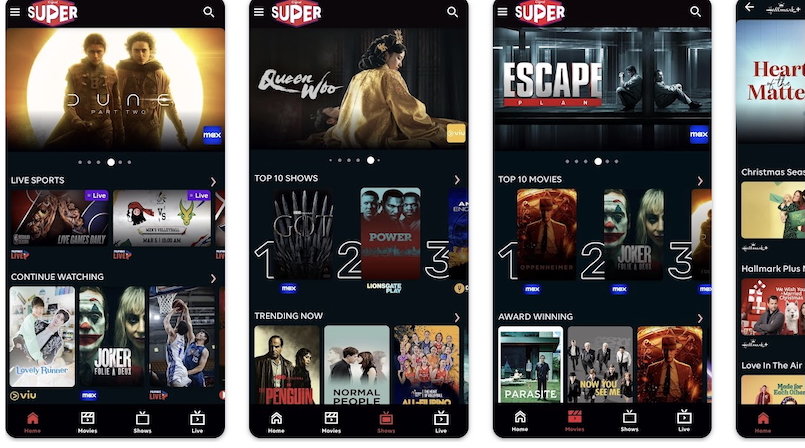
    MUMBAI: Cignal has just hit the play button on a game-changer. The Filipino broadcast giant has officially launched Cignal Super, a slick, all-in-one OTT streaming app powered by Tata Play Binge’s white-label tech—and it’s already turning heads.

    After a successful pilot, Cignal Super is now live and ready to supercharge screen time across the Philippines. The app bundles at least eight popular streaming services—including MAX, Viu, Lionsgate Play, Hallmark+, Curiosity Stream, Fuse+, Pilipinas Live, and Cignal Play—into one seamless platform, under a single subscription, one login, and unified search.

    Users of Cignal Super can dive into over 100 live TV channels via Cignal Play, catch the action with Pilipinas Live sports, explore the world with Curiosity Stream docs, binge on pop culture gems from Fuse+, or unwind with feel-good favourites on Hallmark+.

    Cignal Super offers two wallet-friendly plans:

    – Premium Plus at Php799/month unlocks the full OTT buffet across all partner platforms.
    – Premium at Php499/month serves up a curated mix—ideal for variety seekers on a budget.

    And here’s the kicker: new users can grab an intro offer valid till 31 May, with Premium Plus slashed to Php399/month and Premium down to just Php249/month. Stream more, spend less. 

    Cignal superThis marks the country’s first OTT aggregator of its kind, and it’s all running on Tata Play Binge’s robust cloud infrastructure—a global-grade PaaS (platform-as-a-service) built to scale fast across digital economies. Already making waves in Bangladesh, this Philippine launch cements Tata Play Binge’s place in the OTT aggregation big league.

    Tata Play MD & CEO Harit Nagpal was pleased as punched. “ “The launch of Cignal Super is a proud moment for Tata Play Binge white label solution,” said he. “Our PaaS model is helping leading broadcasters and telecom providers to go digital with speed, efficiency and scale. After a successful partnership in Bangladesh and now with Cignal in the Philippines, it’s exciting to see Indian technology enabling local champions to elevate entertainment experiences in their markets.”

    Cignal president & CEO Jane Jimenez-Basas was equally upbeat: “”Cignal is happy to partner with Tata Play for the launch of Cignal Super, the Philippines’ pioneering streaming aggregator. This collaboration allows Cignal to deliver a world-class entertainment experience to Filipino viewers, at home and on the go. With over 70 million smartphone users in the Philippines, Cignal Super is set to revolutionize how Filipinos enjoy their favorite content,” she said. 

    She added, “This partnership with Tata Play represents a significant step in Cignal’s continuing evolution and reaffirms our commitment to bringing joy, providing the best value, and creating shared experiences for Filipinos everywhere by delivering the content that they love.”

    For Tata Play Binge, this is more than just another rollout. It’s a bold play in its local going global” vision—arming regional partners with future-ready tech to leapfrog into the OTT stratosphere.

  • Revenues up 11 per cent in 1H 2024 for Southeast Asia’s premium VOD sector

    Revenues up 11 per cent in 1H 2024 for Southeast Asia’s premium VOD sector

    Mumbai: The premium video-on-demand (VOD) landscape in Southeast Asia continues to grow revenues at a double-digit pace with viewership relatively robust, as revealed by the latest analysis conducted by ampd, the digital measurement platform owned and operated by Media Partners Asia (MPA).

    Southeast Asia’s premium VOD category generated more than 230 billion minutes in viewership over 1H 2024, up four per cent Y/Y, driven by growth in the Philippines and Indonesia. Category revenues, including subscription fees and advertising sales, grew 11 per cent Y/Y to US$895 million with gains across the region’s five main markets, Indonesia, Thailand, Malaysia, Philippines and Singapore. Indonesia continues to retain the first position in terms of revenues. The region added one million net new SVOD subscriptions over 1H 2024 to reach 48.8 million, representing Y/Y growth of 5 per cent. Philippines, Thailand and Malaysia led customer growth.

    MPA executive director Vivek Couto said: “While price increases have moderated customer growth, growing penetration beyond the major urban centers in Indonesia, Philippines and Thailand remains a major opportunity as premium sports, local, Asian and US content moves online. Korean, US, Chinese & Japanese content captured 80 per cent of premium VOD viewership in Southeast Asia in 1H 2024. While Korean content remains the major driver, Chinese dramas are increasing freemium viewership. US content remains the leading acquisition funnel across global services. Local content maintains strong reach, with acquisition impact.”

    Netflix and Viu both grew revenues at a significant double-digit pace in 1H 2024. Netflix’s share of category viewership reached 50 per cent in 1H 2024 overall, dominating viewership in Malaysia, Philippines and Singapore but facing strong local competition and more complex category dynamics in Indonesia and Thailand. Netflix’s category revenue share, including ads, reached 40 per cent in 1H 2024. Viu had 10 per cent viewership and category revenue share in 1H 2024. In spite of shedding subs, Disney+ revenues continue to grow as the service focuses on a higher ARPU customer funnel. WeTV retained a robust category engagement share in SEA at eight per cent in 1H 2024. Amongst local players, Vidio leads in Indonesia with 20 per cent category revenue share in 1H 2024 and 17 per cent viewership share, driven by heartland local dramas and sports. Thailand’s True ID led Thailand with 27 per cent premium VOD category viewership share though it remains second to Netflix in revenue share.

    Premium VOD viewership in Southeast Asia (1H 2024)

    Source: ampd

  • Online Video remains the growth engine of content investment with local content still key to acquiring subscribers: AVIA OTT Summit

    Online Video remains the growth engine of content investment with local content still key to acquiring subscribers: AVIA OTT Summit

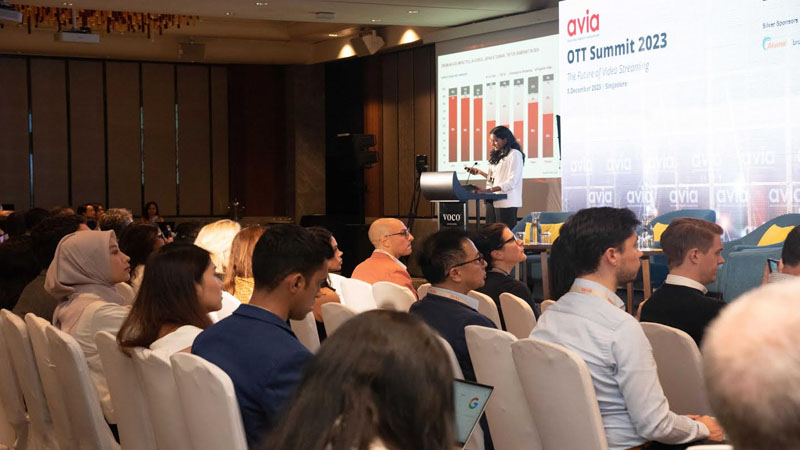
    Mumbai: The Asia Video Industry Association (AVIA), held its annual OTT Summit in Singapore on 5 December, where over 90 per cent of the speakers were senior female executives from across the video industry in Asia Pacific. This year’s summit was designed to try and redress the gender imbalance seen in many industry conferences.

    The Summit opened with Media Partners Asia head of content & platform insights, lead analyst Dhivya T, presenting an overview of the state of streaming in Asia, a market where competition was very much driven by a battle for share of time, with premium video on demand (VOD) fighting with social media and user-generated content (UGC).  

    Competition was also giving rise to new business models and strategies beyond the traditional AVOD and SVOD models, including mobile gaming, ecommerce and bundle subscriptions becoming more common. And with a higher focus in increasing ARPUs, price increases have also become prevalent.

    Ex-China, online video revenues in Asia Pacific were expected to hit US$46 billion in 2028, up from US$29 billion this year. While SVOD was expected to have a CAGR of 6.4 percent, premium AVOD will see a growth rate of almost 18 percent, led by Japan, India, and Korea. In Southeast Asia, Indonesia was emerging as the leading market for AVOD, with Thailand for SVOD.

    In terms of content trends and investment, although pay TV remained the largest vertical, online video was the growth engine of video content investment, with local and Asian content leading premium VOD viewership with the highest reach. Hence local content remained key to acquiring subscribers in the region, and constantly over-indexing with new users.

    In the world of streaming, Free Ad-Supported Streaming TV (FAST) was also much talked about at the Summit as the new kid on the block, as it mimicked the experience of linear TV, delivering scheduled content, with advertising included. Driving the growth of FAST in Asia was the penetration of Smart TVs in the region, with 80 per cent of OTT viewers in APAC using Connected TV (CTV), and with one-third of OTT viewing on CTV, shared Samsung Ads APAC head of product marketing Samantha Cooke. But FAST channels were not always about making money, as FAST was also used for marketing, outreach and brand building, added Brightcove senior product marketing manager Roberta Cambio.

    Senior marketeers from the major platforms too chimed in on the importance of brand building, as the mantra was no longer acquiring subscribers at all costs but focus on keeping the ones you have. For Shemaroo Entertainment CMO Anuja Trivedi, marketing was now more aligned to the business, as consumers who saw campaigns engaged better as well. And partnerships which built more value can only build more excitement for the product and engagement for the platform, said Trivedi. Akamai Technologies senior solutions engineer Sarah Lim, also added that people, platform and the technology were what will help drive your strategy forward for the future. “Marketing is greater than the sum of its parts,” said Lim.

    With 71 per cent of viewers in APAC watching advertising supported streaming on top of linear TV viewing, OMG Singapore chair for media & measurement, AAMS & CEO Chloe Neo, was also seeing growth from regional clients with a greater inclination to look at branding, with the reallocation of budgets into OTT tending to be from the big brands, due to their expectations on quality content. While investment was coming from the linear TV side, more clients were now embracing CTV and addressability for strategic benefit, and not just for incremental reach, added GroupM CIO Southeast & North Asia, Chair, APAC Investment Committee Anita Munro.

    A strong focus on content closed off the Summit, with panellists agreeing that Asian content could not be lumped together. There was huge variety within what is labelled Chinese or Indian content. ZEE5 CCO Hindi Originals Nimisha Pandey emphasised that storytelling trumped investment. “Audiences don’t care how much money has gone into content, if it connects, it connects,” she said.

    Viu content acquisition and development chief Marianne Lee  noted, “Each local market has their own strategy which complements the regional strategy. While it is important for the content to travel outside, the content must also do well locally,” said Lee. In agreement, Agnes content director Agnes Rozario added, “There will always be certain types of content that travel better than others. But it has to work in the home market first.”

    One market which saw things a little differently was Thailand where True Corporation deputy director, planning & business development, strategic content group Kirana Cheewachuen, saw huge potential in the overseas growth and popularity of Thai content, and international success was her primary goal.

    Sharing her strategy for the Pacific Rim in the closing session, Paramount ANZ EVP, chief content officer & head Beverley McGarvey said that Australia was a mature market at a pivotal point now as audiences were adjusting between more traditional legacy media and streaming. Hence accelerating growth in streaming while maintaining linear businesses and making content that can work across platforms was what was needed in order to remain viable.

  • AVIA releases Indonesia study on the untapped opportunity of premium OTT services for advertisers

    AVIA releases Indonesia study on the untapped opportunity of premium OTT services for advertisers

    Mumbai: The Asia Video Industry Association (AVIA) has released a study to understand the usage of different video services in Indonesia and consumer attitudes towards  them. The study looked at video across social media, user-generated content (UGC), linear TV, messaging  services and premium OTT. This is a follow-up to its study on Premium OTT – Building its Rightful Place in  the Digital Market, which was first released in September 2022 and focused on the Singapore market.

    Amongst Indonesian consumers, premium OTT is viewed as having the highest quality content. 75 per cent of  users of premium OTT services (such as Netflix, Vidio, Viu and WeTV) said it offered the best quality  content, higher than users of any other category of video. Of all 24 video platforms studied, five of the  top seven services ranked as offering the highest quality content were premium OTT.  

    Usage of premium OTT is also associated with the most positive emotions. When asked about feelings after watching an hour of different types of content, TV series and movies significantly outscored user generated content and social media in eliciting happiness and amusement.  

    While premium OTT is still at an earlier stage of development in Indonesia than free UGC and social media  services like YouTube and TikTok, it is clear that those who use premium OTT value it more. When asked  what video services they would first be prepared to forego, only one in the top ten services was premium  OTT, and the top 4 were all social media or UGC services.

    “We believe the power and opportunity of premium OTT is hugely significant and offers a real and  relatively untapped opportunity for advertisers in Indonesia. The proven quality of the environment, the  stickiness of the content and the positive emotions created by it are critical for advertisers, and this study  clearly demonstrates that. Given the dominance and high penetration of UGC and social media video  services in Indonesia, the fact that this smaller but growing category of premium OTT performed so well  in these categories is quite remarkable. We believe advertisers need to sit up and take note,” said AVIA CEO Louis Boswell.

    The full Indonesia study research deck and methodology can be found here. This study continues to build  on a regional research project started with a two part study conducted in Singapore in 2022 and 2023.  

    AVIA thanks its members Magnite, PubMatic and The Trade Desk for supporting the Indonesia research. 

  • Is it all gloomy for independent OTT players?

    Is it all gloomy for independent OTT players?

    MUMBAI: Though everyone is ravenous to take a bite out of India's rich streaming phenomenon, it's not all hunky dory for independent players. Consumer acquisition, retention and chalking out a sustainable monetisation plan are tougher than they seem. While deep-pocketed giants may survive, the road is rocky for independent platforms. 

    The downfall of two ambitious players

    Towards the end of 2019, Hong Kong-based over-the-top (OTT) platform Viu shut down its India business. The company cited highly competitive nature and the requirement of heavy investment without a path to sustained monetisation. Viu’s downfall was followed by Singapore-based telecom company, Singtel-backed, Singapore-based HOOQ. The service, available across Singapore, the Philippines, Thailand, Indonesia and India, which was also backed by Warner and Sony, filed for liquidation last month in Singapore. HOOQ said in a statement that it had been unable to grow fast enough to keep up with global and regional rivals and also noted “significant structural changes” in the OTT video market in the five years since its launch.

    The statements of both Viu and HOOQ show the inability to grow a viable business model amid stiff competition. While the wave of online content started with small independent creators in the country, it's time for them to either join hands with bigger players or exit. Especially, when players like Netflix and Disney+Hotstar are earmarking billions for this market. Homegrown players are also investing highly. The sheer amount of content library, production quality along with smart UIs speak in their favour. 

    What lies ahead for independent players?

    “There is a global recession right now and these OTTs are vouching on a lot of these global fundings, private equity fundings. COVID-19 has a big impact and there will be a recession in many countries and lot of the funding activities will slow down. Because of the current crisis, if their mtrics like success rate, viewership, time spent etc., are not good, many OTTs will also shut down in near to medium term despite being well-funded. India is an extremely fragmented market. We have 35 plus OTTs causing all the more chances of many more shutting down,” Elara Capital VP – research analyst (Media) Karan Taurani says.

    SBICap Securities institutional equity research head Rajiv Sharma brings up three aspects. He talks about customer acquisition which is becoming an expensive exercise for independent OTT platforms with more serious players coming into the picture. He also adds that Netflix can amortise content produced in India in 130 markets. Broadcasters have catch-up TV content, the movies which they had acquired for the broadcasting business as a source of basic traffic for engagement.

    “Independent platforms have a small library, no access to other content or market and moreover, they are working on a small budget. Their mortality rate is high because users will watch something and delete it. So low stickiness means higher customer acquisition cost and whatever they are producing, they are not able to amortise it over a higher set of users. So per unit content cost or production cost is higher. These are the reasons we are seeing independent platforms struggling,” Sharma explains.

    Is it all gloomy for smaller and independent players?

    Platforms like ALTBalaji, Hoichoi are thriving without funding from any big network, broadcaster or tech giant. These two platforms have witnessed good uptake in users with an attractive content slate. Moreover, they have collaborated with existing rivals also to increase their reach and find an alternative source of revenue. While we tried to find what are the factors that help them to survive, both of the platforms cited the parent company’s long-term experience of producing content, hence understanding of consumer preference.

    “I think understanding of the customers is very important and having control over content is very important. Twenty five years of understanding consumers is very important because as we make a show or acquire a  movie, we exactly know what a consumer might want. We have been in the business long. It's not a question of money only. Another thing what works well for SVF is that we  have made 150 plus movies till now. We have relationships with all the producers of the business. So, when we wanted to license a movie, we could do it from every person in the industry. We had production experience, key understanding of content, relation with the industry and talents,” Hoichoi co-founder Vishnu Mohta says.

    “Being from the house of Balaji Telefilms, who have been catering to the audiences ever-changing preferences for over 25 years now, ALTBalaji has an advantage unlike no other of having a deep understanding and familiarity with the viewer’s consumption preferences. With content being our biggest differentiator, we have been catering to all kinds of audiences through our diverse content offerings spanning multiple languages. Moreover, Indian originals have picked up pace in the past few days as audiences are on the lookout for local relatable content and are spending more time online. With content being king, there is a growing acceptance amongst consumers to pay for unique narratives and good story telling which keeps them hooked to their screens,” Balaji Telefilms group COO and ALTBalaji CEO Nachiket Pantvaidya states.

    Yupp TV, another OTT platform which is tuning its business towards ed-tech direction in India, thinks that being an early mover, consolidation has helped it.YuppTV and YuppMaster founder and CEO Uday Reddy acknowledges, “ All the players who are in space are big broadcasters. They are already in the content space. They are just evolving from linear to digital. I don’t think many independent players are left now. If they don’t invest in capital, they won’t be able to sustain.”

    With the COVID-19 crisis, things are bound to change once the situation normalise.

  • OTT India 2019 – key trends and crystal ball gazing for 2020

    OTT India 2019 – key trends and crystal ball gazing for 2020

    While  creating this write up on something that’s as wide and far as India OTT we decided to be as objective as possible and use data to establish and talk about some key trends that we see both unique as well as interesting on how the sector is evolving.

    App Annie is a third-party app analytics tool that provides the starting point to map the market within the limitation of the methodology that they use. While it cannot be a gospel of truth, its a good indication of trends. Hope you find this useful high-level dynamics.

    Some caveats and assumptions that we have made:

    • Data is App Annie for Jan-Dec 2018 and Jan-Oct 2019 extrapolated for Jan-Dec 2019

    • SVOD classification: including Telco, International and few independent apps

    • AVOD/Freemium classification: including Broadcast and other independent apps

    1. How does the India OTT market compare with some of the countries emerging OTT markets?

    • In terms of the # of OTT players India continues to be the most competitive in the world.

    • In India, while a few players seem to have stopped reported by App Annie they have been replaced by another set of new players keeping the total number of players to 33 as reported the same vis-a-vis 2018

    • The India market continues to be represented uniquely by all 4 segments of players – Broadcasters who have risen well to the challenge, International players with deep pockets like Netfilx, APV and Apple TV, the telcos and finally a large number of independents like VIU, Balaji Alt, Eros Now, HoiChoi.

    • Other territories are less competitive (or benign?) vs India OTT with the International players dominating in most markets. With exception of the MENA region, hardly any broadcasters participating as vigorously as in India

    • Crystal Ball Gazing: It will be interesting to see how much consolidation accelerates in 2020 with Disney Plus and more activity from the defenders?

    2. How has the India OTT market progressed vs 2018 on downloads and on consumption?

    • The number of downloads has remained flat vs 2018 but the Minutes Consumed increased by 64%. Is there some sign of maturity and loyalty setting into the behaviour of the consumer now?

    • Indians are consuming on an average 118 billion minutes per month consuming on OTT apps in the country. Clearly that’s coming at the cost of more traditional video sources.

    • We don’t think OTT will kill TV but the challenge is now very real and visible. Is potential finally turning to reality?

    3. The most polarising part of the OTT business. What is the interplay between the SVOD and the AVOD services?

    • Downloads growth is flat between the two segments. On Minutes growth, the SVOD services seem to have made gains although they still lag the AVOD / Freemium in terms of absolutes.

    • Clearly the paying or free trial customer is making full use of the SVOD access. Depth of content, highly visible shows in terms of promotions by the SVOD players like Netflix and APV seem to be winning customers.

    App Annie data also indicates how skewed the market is towards the top cluster. In terms of minutes share, 90% of the total minutes is contributed by 6 apps with the remaining 27 players giving 10% of minutes share. These top OTT apps by minutes share are:

    While 2018 was a year of making a splash with never before seen production mounting on the OTT space, heavy marketing spends to support these launches 2019 did come across to be a year of and consolidating. Focus on revenue and recovery of investments (real profitability is still some time away) was high.

    Some bets on 2020:

    • Original content launches will be the flavour of the season with all the effort and our suspicion is that the hours of content here will rival that of a GEC channel producing and releasing first run content.

    • Regional will continue to grow. More regional OTT launches – be it from broadcasters or from International players will be seen and there will also be a few independents like in the case of Telugu launching services.

    • The “for whom” will assume a stronger accent on content productions. More TG focused web originals will emerge instead of GEC style of content catering to a wider base

    • Technology driven by personalization, AI powered discoverability to unearth content specific to viewers will take on a deeper play.

    • SVOD players will innovate on pricing or payment mechanisms to deepen penetration, AVOD players will push for innovation on monetization beyond inventory to realise their reach potential

    2020 promises to be a tough year for the players but an exciting one for consumers who will continue to be spoilt for choice.

    (Vishal Maheshwari is country manager, and DS Ramakant Raju is associate director, growth marketing at Viu India. The views expressed are their own and Indiantelevision.com may not subscribe to them.)


  • HBO Asia and Viu announce second season of Endemol Shine Group’s The Bridge

    HBO Asia and Viu announce second season of Endemol Shine Group’s The Bridge

    MUMBAI: Viu, a leading pan-regional OTT video service from PCCW Media Group, and HBO Asia jointly announce their partnership in the second season of Viu Original’s The Bridge, which will begin shooting its second 10-episode season this year and will be simulcast on Viu and HBO Asia’s channels and services in early 2020.

    Loosely based on the second season of the original series, season two will pick up one year after where the story ended in season one.  A yacht registered in Singapore drifts ashore in Johor with a deceased Indonesian family on board. Investigating the slew of serial killings that ensue, the characters become mired in a web of treachery, deceit and personal tragedy.

    Mr. Jonathan Spink, Chief Executive Officer of HBO Asia, said, “HBO Asia is delighted to once again partner with Viu and PCCW Media Group on the second season of The Bridge. This series, an Asian adaptation of the successful licensed format, which is produced in association with Viu, will complement our growing slate of HBO Asia Original productions that are available to a global audience.”

    Ms. Janice Lee, Managing Director of PCCW Media Group, said, “Our partnership with Endemol Shine and HBO Asia on the second season of The Bridge is taking our collaboration to a higher level. We are excited to extend on the success of the first season with a storyline that resonates with audiences in Asia and take it even further by adding new elements.”

    Ms. Rashmi Bajpai, Executive Director Asia of Endemol Shine International, said, “We are thrilled about Viu's faith in renewing The Bridge. It has been a stellar example of knitting together the nuances – culturally, creatively and commercially to produce a drama that has worked in a diverse region. The commissioning of the second season reinforces our belief in the potential of scripted formats in Asia and we hope this will pave the way for many more co-productions.”

    The Bridge is licensed from global producer and distributor Endemol Shine Group. Viu is also working with longtime partner Double Vision to produce season two, as it did with the first season.

    The second season will be available on Viu in all its markets as well as on HBO Asia’s network of channels and services, including HBO, HBO GO and HBO ON DEMAND, across 24 territories.

    The Bridge was originally created and written by Hans Rosenfeldt as a joint production of Sweden's Filmlance International, part of Endemol Shine Group and Denmark's Nimbus Film. The Bridge (Bron/Broen) was produced in co-production with Sveriges Television, DR, ZDF German Television network, ZDF Enterprises Gmbh, Film i Skåne, NRK, Copenhagen Film Fund, Lumiere Group, Stiftelsen Ystad Österlen Filmfond, Norvision and in co-operation with Malmö Stad. It has aired in more than 188 territories/countries and spawned localized remakes in the U.K/France, the United States/Mexico, Germany/Austria, Russia/Estonia and Serbia/Croatia.

  • Viu collaborates with Warner Bros. (WBITVP) to remake Pretty Little Liars in Asia

    Viu collaborates with Warner Bros. (WBITVP) to remake Pretty Little Liars in Asia

    MUMBAI: Viu, a leading pan-regional OTT video service from PCCW Media Group, has teamed up with Warner Bros. International Television Production (WBITVP) to produce the latest international adaptation of the global phenomenon Pretty Little Liars. Localized in Bahasa and filmed in Bali, the series follows a group of four estranged undergrads whose group had fallen apart when their former leader went missing. The girls come back together in the face of danger, when they begin receiving messages from a mysterious figure known as "A", who threatens to expose their darkest secrets.

    Viu’s strategy is to produce compelling regional content with international production quality. In line with this, it will take Pretty Little Liars, which ran for seven seasons on ABC Family/Freeform in the United States and garnered 36 Teen Choice Awards during its run, and adapt it for Southeast Asia. This follows Viu’s success with the Viu Original, Endemol Shine’s The Bridge, which was also an adaptation set in Southeast Asia.

    Ms. Janice Lee, Managing Director of PCCW Media Group, said, "We engage local audiences by creating and adapting stories that have strong relevance. Pretty Little Liars is a proven show that resonates with younger viewers with similar profiles to our Viu audience, and we are pleased to begin our journey with WBITVP and bring it to our audience and platform. In line with our strategy to invest in creating content assets, in 2019 we will have a mix of Viu Original productions and will work with international partners on local adaptations that resonate with audiences in Asia."

    Mr. Andrew Zein, Senior Vice President, Creative, Format Development and Sales, WBITVP, said, "Viu is one of the market leaders in local storytelling, and we are excited to partner with them in transforming Pretty Little Liars into a Southeast Asian show that builds on the original, yet is also uniquely its own story, entertaining millions of people."

    The series is expected to begin airing late this year. Keeping with the tradition of multi-market, globally appealing shows, Pretty Little Liars is an Indonesia and Malaysia Viu co-production and will be available in all 17 of Viu’s worldwide markets simultaneously. Set in the fictional town of Amerta, the series will be filmed entirely on site in Indonesia’s crown jewel of Bali, and directed by award-winning filmmaker Emil Heradi (The Night Bus, Sagarmatha).

    The cast represents the true diversity and talent of the region, headlined by Anya Geraldine as Hanna, Eyka Farhana as Ema, Valerie Thomas as Sabrina, Shindy Huang as Aria, and Yuki Kato as Alissa, as the famed lead quintet. 

  • Viu’s ‘Love, Lust and Confusion’ is back with season 2

    Viu’s ‘Love, Lust and Confusion’ is back with season 2

    MUMBAI: Expanding its popular ‘Love, Lust and Confusion’ franchise, Viu announces the launch of the highly-awaited second season of the series on March 8th, 2019. The fresh and relatable storyline of the first season led to a surge in viewership. This second outing gears up to bring double the drama and confusion to these love stories.

    While season one chronicled the character Paroma Sarkar's journey through her to-do list, including indecision, physical explorations and confusion, that every millennial can relate to, this upcoming season will see her deal with her ‘don’t do list’. Paroma will be seen working on a graphic novel based on her relationship escapades creating even more confusion between love and lust.

    Commenting on the launch Country Head of Viu India, Mr. Vishal Maheshwari said, “At Viu,we strive to tell stories that appeal to the youth of today. We created characters and a story that millennials can relate to and are glad that the show struck the right chord with them. Season 2 of Love, Lust and Confusion is our way of thanking the fans of the show for all the support. We aim to continue to expand our originals catalogue with innovative and refreshing content.”  

    The 13-episode light-hearted, realistic romantic dramedy is directed by Victor Mukherjee and produced by Mango People Media. Catch Love, Lust and Confusion Season 2 starting 8thMarch, 2019.Lead characters are played by Tara Alisha Berry, Shiv Pandit and Gaurav Chopra, along with the rest of the gang that includes a mix of new and old faces such as Meiyang Chang, Swati Vatssa, Diksha Juneja, Sanjay Suri and Rajat Barmecha.

    Viu originals can be streamed on www.viu.com and the Viu App. And for regular updates and show announcements, you can follow Viu on Facebook, Twitter and Instagram.

  • Viu forays into South African market

    Viu forays into South African market

    MUMBAI: The over-the-top(OTT) platform Viu has officially entered South African market. Following this launch, Viu is now available in 17 countries. While Viu’s programming strategy always focuses on locally relevant premium content, South Africa is not an exception.

    The OTT platform which has entered partnerships with Etv, SABC will operate in freemium model and will offer local and original content also. Viu has already licensed South Africa’s most watched local shows and users can watch the country’s leading productions such as Imbewu, Uzalo, Scandal, SkeemSaam.

    “We are excited to be bringing a truly ‘freemium’ video streaming service anchored on local content to South Africa. Through our partnerships with Etv, SABC, and Vodacom, we have built an ecosystem that makes it easier for audiences to engage with our platform. The app is available in the IOS app store, Google Play and in the Huawei app gallery,” Viu SA country manager Ryan Solovei said.

    Viu has also partnered with Vodacom to provide greater access to customers with innovative products. The Viu Premium subscription is available at R69 per month, R20 a week or R5 per day.  

    “Vodacom entered into a strategic partnership with Vuclip over three years ago with the aim of providing a wide range of quality entertainment across various customer segments. Based on the success of Vuclip short form content as well as our Video Play service, we have made the strategic decision to enhance our video portfolio though the launch of Viu, to continue providing local and international premium content to our South African market,” Vodacom group digital and fixed services officer Zunaid Mahomed said.