Tag: Vishnu Som

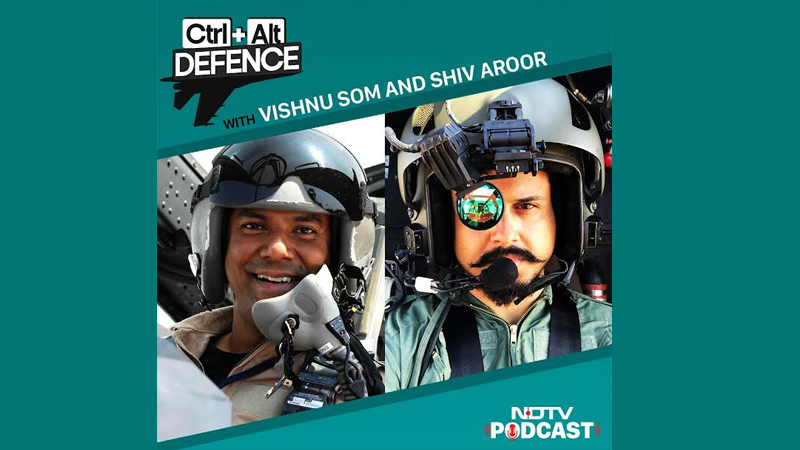
  • NDTV launches defence podcast ‘CTRL + ALT DEFENCE’ with Vishnu Som and Shiv Aroor

    NDTV launches defence podcast ‘CTRL + ALT DEFENCE’ with Vishnu Som and Shiv Aroor

    MUMBAI: India’s military machinery is finally getting a voice in the podcast space—and it comes with the firepower of two veteran journalists. On 22 May 2025, NDTV unveiled CTRL + ALT DEFENCE, its first-ever dedicated defence podcast hosted by Vishnu Som and Shiv Aroor. New episodes drop every Saturday at 6 pm across Apple Podcasts, Spotify, Youtube, and NDTV.com.

    The inaugural episode, aired on 17 May and titled Drones, Airstrikes, Media Narratives: Weapons of Operation Sindoor, dissected India’s calculated response to the Pahalgam terror attack. From drones and airstrikes to border defence systems and battlefront PR strategy, the episode laid the groundwork for a series promising deep insight with zero jargon.

    Between them, Som and Aroor boast over 50 years of field reporting. Som has covered conflict zones from Siachen to Iraq and Ukraine, specialising in military tech and satellite defence intel. Aroor brings 21 years of on-ground reporting from war fronts in Sri Lanka, Libya, and beyond. Together, they combine real-world combat insight with storytelling precision, offering listeners more than just the news cycle.

    “War is never just about headlines and breaking news; it’s a multidimensional subject that demands context, technical understanding, and lived experience to truly interpret”, the hosts emphasised.

    The podcast appeals to a broad base—from defence analysts to curious citizens. It covers missile systems, drone warfare, strategy, and the moral calculus behind conflict. Its tone is crisp, conversational, and informed by first-hand exposure to battlefields like Kargil, Pahalgam, Congo, and Kyiv.

    As India’s defence conversation gets more mainstream, CTRL + ALT DEFENCE fills a glaring void with both rigour and relatability.

    Watch the podcast here: ndtv.com/podcast/ctrl-alt-defence-1018

  • Election 2014 through the eyes of NDTV 24X7

    Election 2014 through the eyes of NDTV 24X7

    MUMBAI: It’s being called a watershed election – the most important in three decades – and NDTV, the pioneer of election programming and analysis is pulling out all the stops for alpha-coverage led by Prannoy Roy, whose understanding and reportage of Indian politics and polls remains unchallenged 34 years after he anchored the country’s first televised election.


    NDTV has innovated to provide the fastest and most comprehensive programming on results with landmark technology and forecasts that are already being cited around the world. Veteran journalists such as Prannoy Roy, Dorab Sopariwala, Vikram Chandra, Barkha Dutt, Sreenivasan Jain, Nidhi Razdan and Vishnu Som will be seen taking viewers out of the studio to real India giving them a ring side view of all the action.


    Programming Details

    · THE FINAL WORD – Prannoy Roy and Dorab Sopariwala, acknowledged as the country’s lead psephology team, have commissioned the largest series of opinion polls and exit polls ever – over 200,000 interviews – aimed at greater accuracy and precision (this reduces the sampling error to only +/- 2%, which is unprecedented for India and comparable with global standards). Moreover, the sampling design involves randomized selection from electoral rolls – which ensures that voters in even the most remote and backward areas are not excluded and are interviewed in-depth.


    · Based on this rigorous methodology, “The Final Word” will forecast who’s winning each state and who will form the next Government at the Centre. The number of seats each party wins will be tracked over the weeks – and reasons for the changes, as campaigning progresses, will be analysed for viewers along with clear and detailed explanations for the swing that’s been identified.   


    · The Battleground with Prannoy Roy – For India, for over a decade, this has been the gold standard of election programming. Battleground is the original and now much-imitated political analysis show, with the biggest politicians in the country appearing on it to respond to the findings of hard-core on-the-ground reportage and polling data. The series of 6-8 programmes (of one hour each), set the trend of broadcasting not from the studio, but from outdoor locations in the heart of each state i.e. the true Battlegrounds of these elections. This show focuses on the key issues behind the opinion poll and exit poll data and trends. Prannoy Roy interacts with a panel of leading experts who discuss election survey data in the context of the amalgam of the politics and contradictions of each major state. The Battleground is the blue-chip analysis show.  


    · The Biggest-Ever Exit Polls: Conducted on a sweeping scale that seamlessly fuses more than two decades of unbeatable experience, world-class graphics and micro & macro analysis, this is the unmissable TV finale of these elections. Prannoy Roy and Dorab Sopariwala will forecast the winners and losers in the next Lok Sabha. Trusted as the most accurate of all, these exit polls will be based on a random sample of names chosen from voter electoral rolls, ensuring far greater accuracy than what other polls can command. NDTV’s exit polls, led by Prannoy Roy, who is acknowledged as the real-time source of credible forecasts, ensure that any differentials are eliminated on account of turnout – since exit polls only question electors that have already voted. Moreover the larger sample sizes associated with NDTV’s exit polls reduce the sampling error to a minimum. The on-air analysis and presentation have, in election after election, drawn top politicians as guests and the widest audiences.  


    · INDIA DECIDES – the Final Countdown with Prannoy Roy- (Starts May 16 at 7 am) on counting day, NDTV’s show-stopper will be anchored by Prannoy Roy, whose expertise will ensure NDTV is the first to offer a national forecast based on early numbers. Prannoy Roy’s widely-acknowledged strengths in spotting and decoding trends and explaining their impact on the result, and his projections and his sharp analysis, based on decades of experience, will pivot a show that will also leverage new technology to guarantee the first and most credible look at who India has voted for. During the day, Prannoy Roy will be joined by some of the country’s finest anchors – Barkha Dutt, Vikram Chandra and Sreenivasan Jain, as well as by NDTV’s award-winning network of reporters, who have, through years of election coverage, established their credentials as the absolute A-team of political journalists.


    · ‘On The Road 2014’ with Barkha Dutt takes viewers out of the studio to real India…giving them a ring side view of all the action


    She travels across the country…reporting from a different city, interviewing a different news maker every day


    Its perhaps the only with Exclusive interviews and in depth ground reports every day


    But On the Road is more …it’s about the people …it’s about Chai stops


    Sip in the local flavour and the mood of the nation with Chai Stops  …


    As we talk to people …discussing what matters to them most


    Come with us for the best and most extensive coverage of Election 2014


    Join us on the Road to 2014 with Barkha Dutt every night only on 24×7


    · Stepping aside from petty politics and shrill campaigns Vikram Chandra focuses on real issues.


    From the falling rupee and rising unemployment to issues of governance and challenges of communalism, he gets political parties to chart the roadmap which will help turn the India story around


    ‘What’s Your Solution’  


    From corruption and security to the safety of women, get to know who suggests what and vote for the solution you believe is the best fit.


    The Big Fight continues the debate, not just political agendas, but also key factors that play a crucial role ..as India votes in Elections 2014


    ‘What’s Your Solution and ‘The Big Fight’ with Vikram Chandra are more than just talk.


    · Truth vs Hype: Contenders – Anchored and presented by Sreenivasan Jain, Truth vs Hype travels every week to ground zero to answer the questions that lie at the heart of every big story of our time – from politics, to corruption, to conflict zones and now Elections 2014. Shot and edited as a cutting edge news documentary, each episode is backed by solid research, hard facts and a clear-eyed sifting through evidence. Every week, an insightful profile of the key players and the potential Prime Ministerial candidates in this election, reported from the ground and on the campaign trail.


    · Left Right and Centre takes daily political debates to a new level for Lok Sabha 2014, where Nidhi Razdan and a panel of experts look at the real issues of this election and why they matter to people. LRC travels to the big cities to get a sense of what India’s urban voters are thinking, and what the agendas are of the main political players. Join Nidhi on Left, Right and Centre every night at 8pm for the day’s political discourse, simply explained


    · The Buck Stops Here Weekend Edition with Vishnu Som focusses extensively on the election campaign. Based on studio discussions and live, on-location reporting, The Buck Stops Here, Weekend Edition, takes the viewer to the heart of major political developments, featuring  exclusive interviews with major players on the election trail, including Naveen Patnaik, the Odisha Chief Minister’s first interview to an English news channel during campaigning; and anchoring live from outside the Aam Admi Party office in Delhi when Arvind Kejriwal dramatically resigned as Delhi Chief Minister after just 49 days.


    For years, NDTV has always been the fastest with the results and the first to forecast the final outcome based on early numbers. In 2014, the lead gets far wider and NDTV’s non-stop 18-hour election results show INDIA DECIDES – The Final Countdown will reflect the pace, colour, adrenalin and expanse of this election, with uncompromising commitment to making sure viewers have the results first.

  • You can’t kill a million flies with a hammer

    You can’t kill a million flies with a hammer

    MUMBAI: The session on intellectual property, piracy and the creative industries with the economic forum held much promise for the various industry stakeholders at FICCI FRAMES 2014 on the final day.


    The panel anchored by NDTV editor Vishnu Som saw Government of India’s registrar of copyrights G R Raghavender, World Economic Forum’s Annie Luo, FIAPF director general Benoit Ginisty, Star India president & general counsel Deepak Jacob, Saikrishna & Associates’ managing partner Saikrishna Rajagopal and Copyright Integrity International’s Nandan Kamath give their views on the issue of piracy and how to avoid it.


    The panel discussion kicked off with the Copyright Act of 1957 – the law safeguarding the creators of literary, dramatic, musical and artistic works and producers of cinematograph films and sound recordings – and moved into how the rights need to be amended with the emergence of new mediums.


    Star India president & general counsel Deepak Jacob rightly pointed out, “The copyright act needs to go through amendments keeping in mind the presence and emergence of new media. The act safeguards the key stakeholders of the industry from losing out on their IPs (intellectual properties) but the act is tilted towards a certain set of individuals or groups and not for all the stakeholders and that needs to change.”


    Jacob also made a valid point when he said that if the IP is being used by someone and that individual wants to use it legally, whom should the royalties be paid to.


    Government of India’s registrar of copyrights G R Raghavender said: “The Copyright Act has been put in place keeping in mind the benefit of all stakeholders and the rights clearly mention that it doesn’t consider future mediums under its purview.”


    Saikrishna & Associates’ managing partner Saikrishna Rajagopal brought up the issue of torrentz and similar rogue websites that encourage piracy, but more disappointing is the fact that big brands can be seen advertising on such sites and generating revenue for them, more so encourage piracy. “I think it’s time to haul up these bigger players rather than chase a million flies with a hammer. We need to take a careful look at these payment gateways which are supporting piracy and encouraging this monstrous industry.”


    The registrar of copyrights also mentioned that the government is doing a lot to prevent the act of piracy but there are shortcomings to this. Copyright Integrity International’s Nandan Kamath said: “Just sending a legal notice to pull down an illegal content is not a victory, but if we manage to get the IP holder his lost revenue from the pirate, that will be a victory.”


    Kamat also mentioned that the industry needs to come together to end the illegal downloaders and pirates from gaining from someone else’s loss.


    On an concluding note, Jacob made a strong statement when he said that it would be best suited if IP and piracy issues are dealt by the information and broadcasting ministry (MIB) or department of industry policy and promotion (DIPP) as they are more in tune with the needs of all the stakeholders suffering from piracy.

  • Media’s love-hate relation with politicians won’t change

    Media’s love-hate relation with politicians won’t change

    MUMBAI: Earlier in the day the comment about the “media being sold” by Aam Aadmi Party chief Arvind Kejriwal hit the headlines. And it was just apt for NDTV editor Vishnu Som to kick off the session – Media as Opinion-Maker – which he was anchoring at the recently concluded FICCI Frames 2014 by posing the first question to the AAP representative Shazia Ilmi, who was in the panel along with Minister of state, IT and communications and shipping, government of India Milind Deora, BJP Maharashtra state unit president Devendra Phadnavis, Reliance entertainment chairman and FICCI convergence committee chairman Amit Khanna and All India Trinamool Congress representative and member of parliament Derek O’Brien.


    So, Ilmi was asked if it was right on Kejriwal’s part to shun the media as it was the media who made AAP. While she agreed that the media had been friendly to AAP, she also pointed out that it was left with no choice than to cover AAP as many others were doing it and the interest also lied there.


    Deora, however, presented quite a friendly take about media as he remarked, “When someone chooses to be a politician you are placing yourself under scrutiny. It is extremely immature to talk about media being fair or unfair.”


    As the discussion continued, many topics from the importance of “social media” in the general elections to the issue of BJP Prime Ministerial candidate avoiding an “one-on-one” talk with media came up.


    In fact Modi took a fair share of the time during the discussion. From his style of promoting himself to his recently devised campaign “Chai Pe Charcha” formed a major part of the conversation.


    “Modi believes in one way communication,” was the remark made by O’Brien to which Phadnavis retaliated by stating that Modi may not be talking to media but he is talking to the people through ‘Chai pe Charcha’.


    O’Brien didn’t miss an opportunity to take a potshot at the Congress also when he wittily remarked to Deora that it was the Congress’ Mani Shankar Aiyer, who gave Modi the lollypop by calling him a ‘chaiwala’.


    Even Ilmi thinks that Modi must come out and answer crucial questions as to what are his views on important policy decisions that need to be taken rather than just show his ‘model of Gujarat’.


    The discussion turned towards censorship when Khanna said that our country lacked a concrete form of a regulator such as the Federal Communications Commission (FCC) in the US. “We have the Telecom Regulatory Authority of India (TRAI) which does not actually have the mandate to regulate broadcast or content,” he said.


    We are standing at the brink of a media convergence occurring right in front of eyes but O’Brien says that it won’t be just social media that will be impactful in the future. “The mobile will be an important tool in the hands of every person in this country,” he said while also highlighting the fact that the real action was happening in regional media.


    Media in the country is no longer a form of public service. It is a combination of that and a business, which Som admitted himself. “If one is looking to the media as the sole repository of honest investigation of truth then unfortunately it does not exist currently,” he said.


    The one point that all politicians agreed was that they needed the media as much as media needed them and both the media as well as politicians were seeking to increase the level of engagement.

  • Arnab Goswami’s brand of journalism is infotainment, says NDTV’s Vishnu Som

    Arnab Goswami’s brand of journalism is infotainment, says NDTV’s Vishnu Som

    MUMBAI: Sensationalism vs old style journalism: The debate on highly opinionated journalism vs plain reporting of events as a journalist can be unending. But when it comes to highly capital intensive television journalism, the debate boils down to viewership and its monetisation.
     
     
    Times Now Editor-in-Chief Arnab Goswami’s brand of aggressive journalism, some call it sensationalism while the man himself describes it as passionate journalism, was the subject of a panel discussion on ‘The Big Fight For Primetime’ at FICCI Frames 2014.
     
     
    NDTV Editor Vishnu Som, when prodded by BBC Global News Senior Anchor Jon Sopel, said “An editor’s job is to provide news. I believe Arnab does infotainment.”
     
     
    Som though admitted that the issues taken up by Goswami are valid but his style and way of presenting is different. “We cannot be aggressive beyond a point. I don’t think it is for journalists to define news. You just report it,” said Som.
     
     
    News that does not get the eyeballs is not good enough content from the monetisation point of view. “If it does not get good ratings, it is not good content. It is all about viewers. That connect has to be there. If not, it cannot be monetised,” said Zee Media group CEO Bhaskar Das, claiming Goswami’s primetime show advertisement slots sell for Rs 25,000 per 10 seconds, while it could be Rs 20,000 for NDTV and is barely Rs 2,000 for Zee News.
     
     
    Arnab has made himself a brand and he has been rewarded for it, said Das, who was with the Times of India group when Times Now was launched.


    MCCS India CEO Ashok Venkataramani said brand building is equal to the charge of your slots and once you have built a brand, the ad slot charge can be higher than what the ratings demand. “The best way to get advertising revenue is by stopping TRPs. My Hindi and Marathi and Bangla channels don’t get high revenue because of ratings but because they are premium channels.” MCSS owns ABP group of news channels.


    NDTV’s Som said, “We dont believe in TAM. We have done five studies to know that we are the number one channel and people may disagree. What the advertisers are looking at right now is corrupted data  (in the form of TAM ratings).”
     
     
    The news television industry is heavily dependent on advertising revenues and the quality of journalism is directly impacted by the revenue flow. “If advertisers cut rates, we can’t do good journalism,” Som said.