Tag: Vishal Maheshwari

  • OTT India 2019 – key trends and crystal ball gazing for 2020

    OTT India 2019 – key trends and crystal ball gazing for 2020

    While  creating this write up on something that’s as wide and far as India OTT we decided to be as objective as possible and use data to establish and talk about some key trends that we see both unique as well as interesting on how the sector is evolving.

    App Annie is a third-party app analytics tool that provides the starting point to map the market within the limitation of the methodology that they use. While it cannot be a gospel of truth, its a good indication of trends. Hope you find this useful high-level dynamics.

    Some caveats and assumptions that we have made:

    • Data is App Annie for Jan-Dec 2018 and Jan-Oct 2019 extrapolated for Jan-Dec 2019

    • SVOD classification: including Telco, International and few independent apps

    • AVOD/Freemium classification: including Broadcast and other independent apps

    1. How does the India OTT market compare with some of the countries emerging OTT markets?

    • In terms of the # of OTT players India continues to be the most competitive in the world.

    • In India, while a few players seem to have stopped reported by App Annie they have been replaced by another set of new players keeping the total number of players to 33 as reported the same vis-a-vis 2018

    • The India market continues to be represented uniquely by all 4 segments of players – Broadcasters who have risen well to the challenge, International players with deep pockets like Netfilx, APV and Apple TV, the telcos and finally a large number of independents like VIU, Balaji Alt, Eros Now, HoiChoi.

    • Other territories are less competitive (or benign?) vs India OTT with the International players dominating in most markets. With exception of the MENA region, hardly any broadcasters participating as vigorously as in India

    • Crystal Ball Gazing: It will be interesting to see how much consolidation accelerates in 2020 with Disney Plus and more activity from the defenders?

    2. How has the India OTT market progressed vs 2018 on downloads and on consumption?

    • The number of downloads has remained flat vs 2018 but the Minutes Consumed increased by 64%. Is there some sign of maturity and loyalty setting into the behaviour of the consumer now?

    • Indians are consuming on an average 118 billion minutes per month consuming on OTT apps in the country. Clearly that’s coming at the cost of more traditional video sources.

    • We don’t think OTT will kill TV but the challenge is now very real and visible. Is potential finally turning to reality?

    3. The most polarising part of the OTT business. What is the interplay between the SVOD and the AVOD services?

    • Downloads growth is flat between the two segments. On Minutes growth, the SVOD services seem to have made gains although they still lag the AVOD / Freemium in terms of absolutes.

    • Clearly the paying or free trial customer is making full use of the SVOD access. Depth of content, highly visible shows in terms of promotions by the SVOD players like Netflix and APV seem to be winning customers.

    App Annie data also indicates how skewed the market is towards the top cluster. In terms of minutes share, 90% of the total minutes is contributed by 6 apps with the remaining 27 players giving 10% of minutes share. These top OTT apps by minutes share are:

    While 2018 was a year of making a splash with never before seen production mounting on the OTT space, heavy marketing spends to support these launches 2019 did come across to be a year of and consolidating. Focus on revenue and recovery of investments (real profitability is still some time away) was high.

    Some bets on 2020:

    • Original content launches will be the flavour of the season with all the effort and our suspicion is that the hours of content here will rival that of a GEC channel producing and releasing first run content.

    • Regional will continue to grow. More regional OTT launches – be it from broadcasters or from International players will be seen and there will also be a few independents like in the case of Telugu launching services.

    • The “for whom” will assume a stronger accent on content productions. More TG focused web originals will emerge instead of GEC style of content catering to a wider base

    • Technology driven by personalization, AI powered discoverability to unearth content specific to viewers will take on a deeper play.

    • SVOD players will innovate on pricing or payment mechanisms to deepen penetration, AVOD players will push for innovation on monetization beyond inventory to realise their reach potential

    2020 promises to be a tough year for the players but an exciting one for consumers who will continue to be spoilt for choice.

    (Vishal Maheshwari is country manager, and DS Ramakant Raju is associate director, growth marketing at Viu India. The views expressed are their own and Indiantelevision.com may not subscribe to them.)


  • Viu’s What The Duck- Season 3

    Viu’s What The Duck- Season 3

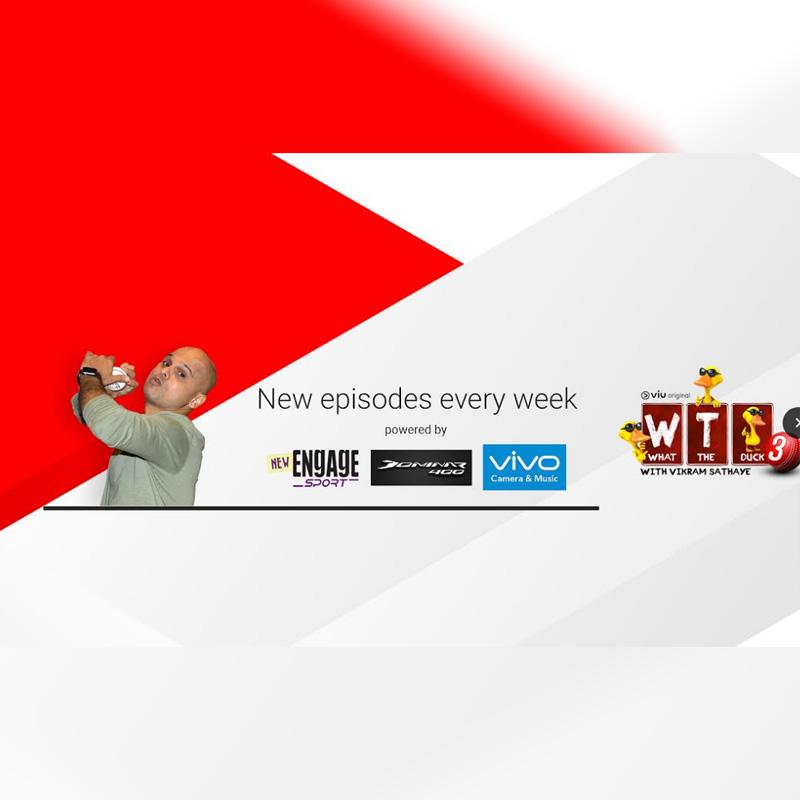
    MUMBAI: With cricket fever gripping the nation this season, premium video-on-demand service Viu is back with its marquee cricket-gone-crazy property ‘What the Duck’. For the past 2 seasons, the property has received rave reviews and gained a large following amongst both men and women. Today the platform announces the launch of its hatrick season, promising to bring back the madness and fun for all cricket enthusiasts.

    This third season will see Vikram Sathaye host 20 legendary cricketers on the show spanning 10 episodes. On each 15-minute episode, two cricketers will be seen together, engaging in a playful banter with Vikram Sathaye. The cricket duos on the show are Shikhar Dhawan & Bhuvneshwar Kumar, Michael Clarke & Brad Hogg, Mohammad Kaif & Harbhajan Singh, AB Devilliers & Jonty Rhodes, Ravichandran Ashwin & KL Rahul, Rohit Sharma & Ajinkya Rahane and many more, to share fun moments and interesting trivia on and off the field.

    Viu will also release unique short form comedy content on cricket titled ‘What The Duck Googlies’. The show will revolve around four popular stand-up comedians – Vikram Sathaye, Anirban Dasgupta, Saurav Mehta, and Sidharth Dudeja giving their comic spin on all the current and trending topics in cricket. The 35-episode show will be live on both Viu and YouTube starting May.

    Commenting on the launch of the What The Duck 3, Vishal Maheshwari, Country Head – Viu, India said, “Cricket and comedy are two things that connect most Indians together. Riding on the success of the first two seasons, we have decided to double the madness and triple the fun with season 3. We are also happy to partner with YouTube, who will help us increase the reach of our popular show to a larger audience”

     The digital premium show can be streamed exclusively on www.viu.com, the Viu App and Viu’s YouTube channel. And for regular updates and show announcements, you can follow Viu on Facebook, Twitter and Instagram.

  • Viu India plans to expand in Tamil market

    Viu India plans to expand in Tamil market

    MUMBAI: As over-the-top (OTT) service Viu completed its two-year journey, it launched its latest digital series Kaushiki which is set to release on 27 April. Going forward, the platform plans to deliver more than 20 originals this year along with entering the Tamil market very soon.

    The platform promises more regional content like this exciting thriller Kaushiki, comedy film High Jack, new seasons of already popular shows like What the Duck and adaptations of popular international entertainment formats such as Tollywood Squares.

    For Kaushiki, Viu will release four episodes in a go and then one a week. “When we launched Pelli Gola and PillA in last year in Telugu, we had extremely high number of viewers coming back repeatedly week on week, when we were releasing episodes,” Viu India CMO Shantanu Gangane said.

    Viu has already launched seven new originals in Q1 2018 and has lined up 20 originals from now until the end of the year in Hindi, Telugu and Tamil. Viu plans to launch into the Tamil market by this year with the six new originals. For the new content, both syndicated and original content is on offer. Other than Indian content, Korean content also has also got a niche following across India.

    “Since day one, Viu has emphasised global expertise coupled with local execution, as you can clearly see from our track record. We’re doubling down on that for 2018, ramping up our offering of quality originals at an exciting pace and engaging viewers in new ways, including bringing fresh content to the Tamil market. I couldn’t be prouder of what our team has accomplished in India and I’m certain that our best years are ahead,” Viu India country head Vishal Maheshwari said.

    While cross-platform partnership has been one of the best options to surge users, Viu is not an exception. It has made content available to digital and non-digital audiences through partnerships with TV channels like Gemini, Star Maa and digital platforms such as Dailyhunt. The highly-rated No.1 Yaari is one example of Viu’s cross-platform content association.

    In addition to that, Viu has had success with advertising partners such as with Hong Kong tourism for It Happened in Hong Kong, a romantic comedy that redefined wanderlust. It has many other strategic partners including Samsung, Amazon Pay TV, Amazon Fire TV Stick, Daily Hunt and Xiaomi.

    While the channel owns IPs of all the originals, syndication has been one of the revenue streams for the platform. To stand out in the crowd, the platform has got tech as a strong backbone. Moreover, the company has massive set up in Pune which after the technical aspect. Along with an in-house team, the company also relies on partners to remain agile.

    The OTT platform has some unique strategies to attract consumers. Rather than putting original premium content behind pay-wall, it has kept it in front of the wall. The company wants to go forward in the future with fresh content as well as entering into a new market.

    Also Read :

    Viu Original ‘It Happened in Hong-Kong’ Redefines Wanderlust

    Viu announces the launch of its latest Original, ‘Love, Lust and Confusion’

  • Viu and Phantom films join hands for its upcoming movie ‘High Jack’

    Viu and Phantom films join hands for its upcoming movie ‘High Jack’

    MUMBAI: The premium video-on-demand service Viu, by Vuclip and PCCW, is teaming up with Bollywood’s ace production house Phantom Films to produce their upcoming movie HIGH JACK, further fortifying its strength as a pioneer in original content. Adding to its repertoire of insights driven content, Viu is taking the plunge into Bollywood. Today’s news is another step in the direction of its brand philosophy to create compelling and engaging content for millennials.

    Directed by Akarsh Khurana, the film will feature digital sensation Sumeet Vyas, Pyaar ka Punchnama fame Sonnalli Seygall, RJ Mantra, Kumud Mishra along with Nipun Dharmadhikari and Amey Wagh. The story of HIGH JACK is about a group of first time hijackers who get themselves into hilarious situations, following a comedy of errors. The plot takes interesting twists and turns and is interspersed with new age screwball comedy. The film is slated to hit cinemas on the 20th of April.

    Viu India – Country Head, Vishal Maheshwari said, “Being in the content creation business, Viu is focused on innovating and providing an enriched experience for its Viu-ers. With the evolution of OTT and consumers’ tastes, quality content rules and that’s why collaborating on a film like HIGH JACK is apt for us. Like Viu, Phantom Films is known for exceptional audience experiences, and it gives us great pleasure to partner with them. This film is another step towards showcasing the best content on our platform.”

    Says Phantom Films , Producer, Madhu Mantena, “Associating with Viu gives us great insight into the online content watching audience’s mindset, and thus we partnered with them on HIGH JACK, which brings some of the best web content talent together for the first time. It’s been a great experience, and we are confident that the audience will love this madcap film.”

  • Viu announces the launch of its latest Original, ‘Love, Lust and Confusion’

    Viu announces the launch of its latest Original, ‘Love, Lust and Confusion’

    MUMBAI: Strengthening its Originals content offering in India, Viu announces the launch of its upcoming digital series, Love, Lust and Confusion. With a concept that should resonate well with today’s youth, the series is about couples and the ongoing confusion in their love lives. Featuring the Udaan famed actor Rajat Barmecha and the supremely talented Tara Alisha Berry in the lead, the series is slated to premiere on Viu, both app and web, on 17 March 2018. 

    Revolving around the life of a young girl, Poroma Sarkar, Love, Lust and Confusion will depict the age of indecisiveness, physical exploration and confusion. The series also explores polyamory and the perspective of youngsters on the topic. Actors 

    ​​Meiyang Chang, Gaurav Chopra, Samir Kochhar will play pivotal roles in the series. 

    Speaking on the launch of its new show, Viu India, Country Head, Vishal Maheshwari said, “At Viu our endeavor is to bring content that resonates with the youth, and we are expanding our catalogue of intriguing yet relatable content with ‘Love, Lust and Confusion’.”

    About the concept of the show, Director & Writer – Victor Mukherjee said, “Ask any millennial today, and the biggest confusion in their personal lives is between love and lust. This is an unforgettable journey of a girl, who is on a path to fulfill her wishes and is totally unapologetic about it. The idea was to capture the realistic essence of a phase that comes at least once in everyone’s life. I think every millennial will relate to the story.”

    The 13-episode series will engage its audience every Saturday. The light-hearted, realistic romantic dramedy is directed by Victor Mukherjee and produced by Mango People Media.

    Watch the confusion between Love and Lust starting 17th March on www.viu.com and on the Viu App.

  • Branded content drives Viu

    Branded content drives Viu

    MUMBAI: Within two years of launch, over-the-top (OTT) service Viu has created a unique value proposition of fresh and localised regional and local premium TV shows, movies and originals for its consumers every day.

    While digital shows are becoming increasingly popular among the masses, brand marketers are exploring innovative ways in which they can garner interest for their brand by strategically incorporating branded content. In 2017, a number of brands jumped on to the AFP bandwagon, making it a wonderful year for branded content.

    Viu India head monetisation & distribution Sameer Gogate said, “Our constant focus is to ensure that there is a strong story, and content becomes the hero along with seamless integration of the brand. We have been able to make content a surrogate for advertising, and we believe this model is here to stay. McDowells No.1 Yaari and Nicotex presents I Can You Can were win-win AFP partnerships which saw the delivery of great original content by integrating the essence of the partner brands in a creative and frictionless way. It reinforced our belief in AFP being a viable revenue stream as part of our overall monetisation model. I think it sets the tone for us to explore more such successful branded content partnerships in the coming year.”

    Viu India country manager Vishal Maheshwari said, “Our strategy is deeply anchored in technology and consumer insights. Research affirms that regional content on OTT will command close to 30 per cent of the overall share in the years to come. Indian language internet users will drive the next phase of internet adoption in India. This new generation of users will come on board from tier 2 and tier 3 cities and with this potential increase in consumer base, there will be an immense demand for intriguing regional content. With Viu, we have always been about global expertise and local execution and that’s why we are focused on entertaining this new generation with content in languages with which they are familiar.”

    Year 2017 was full of colors for Viu. It launched the first bilingual digital show in Hindi and Telugu – Social. It started with cricket comedy chat shows like What the Duck and Virender Sehwag’s micro-original Viru ke Funde, which has now evolved to a roster of nearly 12 premium shows and more in the pipeline (a combination of long form and short form). It tied up with Vikram Bhatt for multiple long form shows in Hindi such as Gehraiyaan and Spotlight. Spotlight 2 and Memories are also in the pipeline, which have roped in best talents for the show. In association with Annapurna Studios, the platform launched two long form shows titled Pill-A and Pelli Gola. Viu is catering to the growing demand for regional content by creating intriguing and contemporary digital shows such as No 1 Yaari and Munching with Mahathalli.

    A key strength of Viu’s global strategy is to form strong partnerships, whether they be Samsung, Micromax, Vikram Bhatt’s Loneranger Productions or Annapurna Studios. Content house Shemaroo Entertainment has inked a licensing deal with Viu. Through this deal, a handpicked catalogue of Shemaroo’s full length Hindi movies can be accessed by its subscribers.

    Viu’s primary focus for the year 2018 is ramping up content library by three times. The OTT platform is planning to foray in the Tamil market by associating with content creators. Similar to the expansion plans in India, Viu will also be expanding its content base internationally. It is planning to launch multiple bilingual shows as the next step and additionally looking to explore other regions as well. This year, Viu will be launching Spotlight 2, Memories, Trysexual (yet to be titled), Kaushiki, Unafraid and many more small and big format web series.

    Today Viu reaches more than 26 million total monthly active users across markets with 3,000 hours of compelling original content in Asia.

    As of October 2017, its India downloads were 9.5 million. Its monthly active users graph goes up to six million and the global average hours per user for the month was 14 hours whereas in India the average hours per user was 34.5 hours. However, the reach of Viu is wide globally, which reached to 150 million video views, whereas total video views in India was 18 million.

    Also Read :

    Regional OTT content more than just catch-up TV   

    Viu brings best of korean shows to india

    Viu’s unique Asian content attracts six million active users, claims 50% growth in four months


  • Viu brings best of korean shows to india

    Viu brings best of korean shows to india

    MUMBAI: Viu, the premium video-on-demand service by Vuclip and PCCW today has launched popular Korean dramas for their viewers in India. After successfully rolling out Korean TV Shows in other Asian markets, Viu has now expanded its Korean content library to the young digital consumer in India. Viu continues to be a trendsetter in offering digital entertainment that popularizes the global phenomenon of Hallyu among the Indian millennials.

    Shows available on the service include hits like ‘Come Back Alive’, ‘Heirs’, ‘My Love From Another Star’, ‘Descendants of the Sun’, ‘Sweet Stranger and M’, ‘Doctors’, ‘Poet Warrior Youth’. The plan is to launch 20 more shows by March 2018. The entire library can be accessed at https://www.viu.com/ott/in/korean-en/korean_dramas.

    Speaking on the launch, Viu India, Country Head – Vishal Maheshwari said, “We have witnessed a very healthy uptake by young viewers, aged 18 to 24 years, who are watching Korean TV shows with English subtitles. The youth of India today are looking for world class TV shows. Korean TV shows deliver on all aspects from story to production which makes it such a success. The trend of watching Korean content is picking up rapidly across the country.“

    Viu has approximately 4,000 hours of the latest Korean drama and variety shows telecast from SBS, KBS, MBC and CJ E&M for all regions. All of this content can be accessed at https://www.viu.com or by downloading the Android app from Google Play or the iOS app from the Apple App Store.

  • Regional OTT content more than just catch-up TV

    Regional OTT content more than just catch-up TV

    MUMBAI: The rise of digital content platforms has forever changed television viewing in India. The revolution in the over-the-top content (OTT) and video-on-demand (VOD) industry in the country is reminiscent of the growth of satellite television during the 1990s. Due to the rollout of 4G services and exponential growth in the smart phones, the OTT industry expanded widely in 2017 in India.

     In the past two years, the competitive landscape has evolved quickly with the entry of 25 to 30 OTT service providers in India. There were nearly 10 investments in OTT and OTT technology companies during 2016 and competition is heating up in terms of who is acquiring the exclusive rights of TV shows as well as in terms of launching originals. Millions of rupees are being invested in content production and acquisition by all major players. According to the Accenture 2017 Digital Consumer Survey, the surge in VOD in India is pegged at 78 per cent, which is growth in the number of consumers of VOD services in India.

    When a brand addresses a regional demographic in its language, it builds an emotional connect with it. Likewise, when video content players such as OTTs serve content in vernacular mediums, people tend to associate better with them. And 2017 has seen almost every player dive into the regional language pond.

    The entertainment sector has woken up to the huge potential of the regional OTT language content with platforms like ViuClip, YuppTV, Amazon, ALTBalaji, SonyLIV, Voot, Hotstar, and Netflix providing exclusive regional content.

    In an interaction with Indiantelevision.com’s Kirti Chauhan, Viu country head (India) Vishal Maheshwari, ALTBalaji CMO Manav Sethi, Voot COO Gaurav Gandhi, Amazon Prime Video content director India Vijay Subramaniam, SonyLIV EVP and head digital Business Uday Sodhi, YuppTV CEO Uday Reddy, and Amagi Media Labs co-founder Baskar Subramanian spoke about the current scenario of regional content language on various digital platforms. The inputs by media experts of the industry from Stratagem Media MD Sundeep Nagpal and Lodestar Media GM Deepak Netram overviewed the role and the potential of regional content in the OTT space.

    Among the trends that emerged, include: the current OTT ecosystem is geared towards serving the youth. Said Netram, “Maximum users are in the age group of 18 to 34 years spending 15 minutes plus on average on consuming content via apps and more than 55 minutes overall in a day.”

    Defining regional content

    “Content available in languages catering beyond the Hindi and English-speaking masses in India would be categorised as regional content. The focus of the content is shifting from what is popular across India to what is popular in a select region. At Viu, we are creating relevant and contemporary entertainment to cater to these masses,” commented Maheshwari.

    Gandhi said that besides Hindi, the VOD’s focus on regional languages like Marathi, Kannada, Bangla, Gujarati, and Tamil.

    Amazon Prime’s Subramaniam thinks that their content mix is significantly local. “We have a line up of multiple new Hindi originals coming up that would also be dubbed in multiple languages. We already offer the latest movies in Marathi, Tamil, Telugu and Bengali,” he said. In Bengali, we have tied up with Shree Venkatesh Films, in Tamil, we have partnerships with Dream Warrior Pictures, V Creations and Studio Green; in Telugu, we have tied up with Lakshmi Narasimha Productions, DVV Entertainments, and in Marathi we have tied up with Everest.”

    Amazon Prime Video availed some of the blockbusters of 2017 like Arjun Reddy, VIP2, Nene Raju Nene Mantri, Dhananjoy, and Bhikari soon after their theatrical release.

    The new player in town, ALTBalaji, has added another angle. “Regional content cannot be defined under state boundaries. The democratisation of labour and movement in jobs have showed that language travels across the region from where it originates. So, it will be wrong to look at regional content from location stand point, it has to be looked at from language stand point,” said Sethi.

    The early entrant, YuppTV, shared plans to have Telugu content. For now, it is launching content in Tamil and, going forward, it will feature content in Malayalam, Marathi, and Bengali, too.

    SonyLIV’s Uday Sodhi is gung-ho about regional content. “Besides Hindi, we have a strong catalogue of Bengali content. We are now aggressively looking at adding other languages on our platform as we have created original shows in Marathi and Gujarati. We are looking for acquiring content in south Indian languages to make our regional language portfolio strong,” he said.

    According to Netram, 25 to 30 per cent of the audience visiting the OTT platforms consume regional content and it is expected to reach around 50% by 2018. Maharashtra and the South are the two dominant markets in India at the moment.

    Beyond catch-up TV

    While discussing the restrictions of regional content, Amagi’s Baskar Subramanian said, “I feel that regional OTT is largely driven by television content like what they call catch-up TV.”

    Sodhi, however, believes that catch-up TV is the starting point for consumers because they are familiar with it. SonyLIV is witnessing significant consumption of films, short films and original shows on the platform.

    Sethi offers a different perspective. “Not many investments are being made in creating shows or narratives or stories that have the propensity to be consumed by 10 to 20 million people outside TV. But now ALT is investing a lot in creating shows outside TV.”

    Added Maheshwari, “Video on demand around the country has moved beyond catch up TV. While there is a sizable amount of regular television content consumption on these platforms, the growing effort to create locally relevant originals is establishing the demand for experimental and fresh content created for the digital-first audience.”

    YuppTV, which already has a big basket of TV content to watch on-demand, now has a small basket of originals for binge watching. Reddy said that they have created their own linear TV playout so people can watch it like a typical TV format as well. “We have created epic engagement of audience with our own and syndicated content. Our goal is to have 20 per cent of our own YuppTV content. We will be announcing four more shows soon.”

    Besides making Viacom18’s TV shows available as catch-up TV, Voot is providing exclusive content around the TV shows. Gandhi said that they are now starting to create original series for Voot in regional languages.

    Working with language experts

    Viu works with creative minds from the particular region they are catering to. This builds a content base for them that the millennial audience can resonate with. Said Maheshwari, “We are consistently working with creative talent that has the knowledge and expertise to create content in specific regional languages. We have an in-house team of researchers who dive deep into market and consumer insights. We work with studios big and small, independent producers as well as creative folks.”

    Reddy said that they have content team experts who had been in the industry and going forth, they will be hiring more experts for other regional languages.
    Gandhi added, “We work with our TV networks in each of the regional markets to create and curate the content in the respective language. We also have a regional content team at Voot, which focuses on shows for their respective language.”

    SonyLiv, meanwhile, has a team that looks at the content and understands the content beyond languages.

    Even Amazon’s Subramaniam said that the platform has dedicated teams that assess content demand amongst customers in each region based on various factors.  “A combination of these factors decides our content strategy.”

    Sethi too agreed on having a language expert on board, giving the example of the soon-to-be released Bose and Dhimaner Dinkal series, which have a Bengali expert. “Our choice of the production house is also guided by the person’s understanding of the nuances of that particular region’s language, traditions, culture, and many more things.”

    “The benefit of taking OTT players to regional sectors is that they give them a platform to talk to the local audiences in their language, helping advertisers to engage more efficiently,” pointed out Netram. Nagpal, however, thinks that the benefits for OTT players is just to capture eyeballs from a different screen and different audiences, while they are young, with fresh content and win them over from TV.

    Market research

    According to Sethi, both primary as well as secondary research needs to be done before undertaking a new language sector. “Our secondary research is all about the shows, which have come live, sources of data that have guidance, whether the show worked in particular region, how did it work, what was the monetisation opportunity in that show and many more. From the stand point of primary research, it is largely based on picking up the focus group. While doing our Bengali show research, we spoke to a group of Bengali people to identify the kinds of stories and drama they would like to consume. In our secondary research, we looked at the data consumed on Facebook and Youtube along with the growth in consumption.”

    Baskar Subramanian believes that there are two things to consider for regional content creation. First is the economics of production and second is the cultural nuisances of those regions that can be captured exclusive to the TV content.

    Maheshwari said, “Our strategy is deeply anchored in technology and consumer insights. Research affirms that regional content on OTT will command close to 30 per cent of the overall share in the years to come. Indian language internet users will drive the next phase of internet adoption in India. This new generation of users will come on board from tier 2 and tier 3 cities. With this potential increase in consumer base, there will be immense demand for intriguing regional content.”

    Sodhi said that they have we looked at the original content in language while doing Marathi and Gujarati shows. He said, “We found that both are underserved markets and, besides the television content, there is very little digital only content is available but a lot of our consumers come from these regions, which made it a perfect combination to serve content in these languages.”

    “At Amazon, we keep customers as our prime focus. The best way we customise and select our content is by giving our consumers what they want. We invest a lot of time and effort in market research to understand what customers want in order to deliver it to them,” said Subramaniam.

    Voot is currently open only to those languages on that have a strong TV network content. Based on internet penetration, digital video penetration, content availability, and preference of the native language over Hindi, Voot is looking at opening other markets, too.

    Said Nagpal, “Given the rapid penetration of mobile and growth rates of internet services in the hinterland, as well as the reducing tariff rates of bandwidth and downloads, the biggest challenge can well be to produce compelling content.”

    Content creation and marketing strategies

    For promotion, Voot uses its TV networks and other digital media assets as well. ALTBalaji, however,  focusses largely on digital for marketing. “On digital, it becomes easier for us to target in terms of reach and frequency,” added Sethi.

    At Viu, the content ecosystem is driven by consumer demand and their anticipated entertainment needs. This includes a mix of licensed and originally created content. The platform is focussed on locally relevant content in every market and does not believe that one size fits all. “We knew Korean dramas did well in Malaysia and Indonesia, and decided to put the content on our Indian app as well. Since then, we have witnessed a lot of consumption by a small group of people,” said Maheshwari

    Sodhi’s team is capable of targetting the right content to the right user with the help of analytics, which tells them which audience is coming from which spoken language region. And, similarly, based on the content engagement matrix of YuppTV, Reddy and the team designs the content strategies. YuppTV has its own platform intelligence to build the content strategy. For marketing, they use social media platforms.
     
    Revenue potential

    As the audiences grow across regional language content, monetisation will grow as well. “While this was small so far, it is beginning to become interesting,” Gandhi believes. “It is an early evolving market. We are still at early stage when revenue started coming in. However, we are confident that over the next 12-18 months, we will see significant numbers in revenues,” said Sodhi.

    “With urban markets saturating with content, the regional content demand will be the next thing that OTT platforms are likely to tap into. This will command close to 30 percent share in overall revenue,” Maheshwari added.

    “After Hindi, regional has acquired the maximum share in terms of viewership and monetization ability. From monetization and ROI stand point, largely Tamil language has the highest potential because it has far invite, they are higher on payment curve, they are affluent, they are educated and the mobile uptake is more,” said Sethi.

    While sharing the current regional content on their platforms Sethi said, “15 per cent of our total number of hours of shows will come from regional content. We are investing a lot in regional talent across genres because they have tremendous appeal in terms of following. However, SonyLIV currently have regional content of around 10 per cent, besides Hindi and English, said Sodhi.

    Nagpal commented that OTT content can be made available for advertising almost immediately, but it would take about 2 years to reach a critical mass for advertisers to recognize its value. But the options to market can be many more than just airtime. Wherein, Netram thinks that this is an active aspect, monetization has already started and is expected to further ramp up looking at the consumption pattern. He said, “OTT Platforms like Ozee are centered on the regional content and are monetizing it well.”

    Regional programming

    Maheshwari said that there is an immense scope for original content in regional language. “For Viu, we are focused on creating and providing a mix of regional content beginning with Hindi and Telugu. Currently, we are focusing on Telugu as a region with shows such as Cinema Pichollu, Pelli Gola and PillA. We aim to provide undubbed shows. Instead, we are creating bilingual content in Telugu and Hindi that has universal appeal.”

    Gandhi agreed and said, “We are already working on digital original series across 3 regional languages already.”

    Subramaniam believes that homegrown and original content are significant drivers of viewership and box office collections already. Local stories help them to remain relevant, relatable and eventually widen audience reach.

    Sethi, Reddy and Sodhi accepted that the market has tremendous scope. And the regional content growth will only come from original shows made in various regional languages.

    Where Nagpal thinks that Regional advertisers are still not enthusiast about digital regional content, Netram believes they are.
    Nagpal said, “Not yet, but this will not take time, once the content starts flowing out. There are enough regional success stories to go by. However, “Netram said, “Yes the OTT Platforms are very kicked about the regional content and the same is shown by the way it’s been consumed, special web series in the regional language have also been created.”

    Growth potential

    Gandhi said “Our biggest regional language on Voot is Kannada. We are also seeing good growth in Marathi. We are extremely bullish on our Tamil language play as well, especially as we launch our TV network in that market soon.”

    Sethi believes that Tamil, Bengali, Kannada and Telugu languages has the biggest scope for growth.

    Sodhi said that they have seen significant adoption for South Indian languages which includes Tamil, Telugu, Kannada & Malayalam and then Marathi, Gujarati, Bengali and Punjabi by audience.

    Because YuppTV have started a little early in Telugu, the platform has higher audience numbers in it. Reddy firmly believes that Telugu, Hindi and Tamil, other regional languages like Malayalam, Marathi and Bengali have a big scope for growth.

    Maheshwari said, “We have launched Telugu and Hindi, we are contemplating other language content to get added to our regional repertoire.”
    Netram said, “Identify content that is working well on TV, get the same content in the regional language, for example if a big reality show on TV gets the highest viewership. South being the second highest region to consume regional content, the same could is also been leveraged on OTT.” However, Nagpal only suggests to just watch the growth of technology.

    While talking about the investment in regional content language, Maheshwari said, “Content investment is required to seed adoption. This investment partly goes towards licensing content and partly towards producing originals. In a market like India where there are many OTT players, differentiation is the key. When we do originals, we let the script, production quality required for the script to reach its full potential and audience reach and monetization expectations define the budget for a show. Sometimes, it is well below TV production scale and sometimes it is much bigger.”

  • “We have a multi-headed monetization approach for Viu”- Vishal Maheshwari

    In January 2016, emerging markets OTT service Vuclip – operated by Hong Kong based PCCW –  appointed former Yahoo executive Vishal Maheshwari as country manager, India, close to the launch date of its Indian product. The Viu launch went through successfully three months later under his supervision. Since then the FMCG, telco and digital veteran has stealthily steered the service towards an enviable subscriber base of four million plus.

    Viu’s has been a no-nonsense-back-to-basics roll out in the country; it had none of the frills and bells and whistles that are associated with launches.

    Maheshwari has his task cut out for him. The OTT market is getting crowded with every one including his uncle, aunt and cousin believing that they could make a success of their streaming entertainment apps.

    But Maheswari believes that  Viu  is being built bit by bit, content piece by content piece, and customer by customer. And that it is on the right track.

    Maheshwari was part of Indiantelevision.com’s second edition  OTT conference Vident 2017 and he took part in a one on one conversation with founder, CEO and editor in chief Anil Wanvari. Excerpts:

    What is your view of India as a VOD market?

    We believe that this market is not a single homogeneous market, as a lot of people like to believe. We believe this a three tiered market. There is a bottom of the pyramid market which is called the mass market. There is a mid-market, which is being typically being catered to by mobile consumption and by apps.  And then there is the top end of the pyramid, that we have yet to see evolve over here. We think that eventually will happen. We are here to participate in the broad spectrum of the market. Currently we have offerings in the bottom of the pyramid in terms of the  B2B mass market offering . We have been so far been in the mid-market as we like to call It for a year and a half.  – the B2B offering

    I believe you have got a massive war chest. Apparently, Nickhil was quoted saying that he spent about 100 million dollars so far since PCCW came in. So how big is the war chest in India, if you would like to disclose that. If you don’t want to talk about the initiative in terms of local content, making sure you’ve distributed well across different devices whether it’s handsets or being inbuilt into Telco, apps etc.

    I think it is futile trying to talk about numbers in terms of millions of dollars of investments in so and so. It i suffices to say that this is a game of really deep pockets. I have always maintained that OTT is a very easy market to get into. Because I think the common understanding is that all you need is a little bit of content, slap on some technology, some vendors lurking around in Hyderabad and Bangalore who you can hire and get for cheap and you can get into the market.

    But OTT is a very very difficult market to stay in. And a lot of players who were there in this market are beginning to  sort of understand that. The key and the bottom line over here is you need very deep pockets to fundamentally stay in this game. I wish I new how long you need to sustain it; I wish I was a clairvoyant.

    Needless to say, I maintain that this is not a P&L business. It’s a balance sheet business. And you really got to have deep pockets and a very entrepreneurial attitude in terms of trying to win this market. If you try to play by the known rules of how these businesses are built, then there’s only one thing going to happen – you are gonna lose! Given that, we have our own game plan in terms of this market.

    I believe in terms of content, people expect a very different set of content from a premium OTT player. So there is UGC and the YouTube type content at one side and then there is TV broadcasting and cinema on the other side. What consumers expect of an OTT play is really something in the middle. They want content that is high quality, that is potentially cinematographic, in terms of finish, look and feel. And more importantly for the target audience that we are after, which is frankly the millennials, they want content which is real. They want content which reflects their aims, aspirations etc. So, I think you got to be very very careful in terms of how you go about executing your content game. I would say the mantra is being fresh and contemporary. Secondly, we believe regional is really an important play. We were actually the first ones to launch Telugu regional content a couple of months back and that I think pretty much took the industry by storm. That’s because the content put in over there was very high quality. The content that we produced along with Annapurna Studios, was original – Pilla and Pelli Gola.

    And what sort of traction did you get for those shows?

    I am not going to drop numbers again but let me tell you what we did. It was really interesting. Our entire philosophy towards this game of OTT is that it isn’t like a ‘one night stand.’ It is a hare and a tortoise game, but with a little bit of a difference. We don’t believe that ‘slow and steady’ is going to make us win. We believe ‘smart and calibrated’ is going to make you win.

    So when we actually launched our first suite of originals in the month of April, people were surprised, there was no brand campaign? There was  no full page in The Times of India?

    What we actually did over here was very simply put the content into the market, used all organic means to sort of see what the traction on the content was, ran that content frankly for a 10 week period, which is when we actually released our content and came back absolutely beaming in terms of  the results. The traction numbers that we were seeing over there were completely mind boggling as far as we were actually concerned. And if this year proof of the pudding is in the eating, we’ve actually come in and post that have commissioned another eight originals.

    When do we see these eight originals rolling out? Are they with the same production studios or are they with new studios?

    If it ain’t broke, why fix it? Yes, Vikram Bhatt did a couple of products with us. After Gehraiyaan and Spotlight, we have commissioned him again for another two products that will be out in the fourth quarter of this year. And you will see this new suite rolling out from the month of September onwards. We will continue to sharpen our focus on the regional market, we will be adding regional markets to our suite, we will continue our focus on Telugu and you will see some really high quality content coming for those regional markets.

    You were mentioning that you were actually going to do dual language production? Is it going to go beyond dual language, while doing a Hindi show?

    It is part of our overall DNA of experimenting. In our first round, what we actually did was create content specifically for Telugu, create content for Hindi, we have done dubs, we have done crossovers, we are actually studying how that market reacts, what their uptake on that sort of content is. And in the next phase what we are getting into is doing bilingual productions. It could make sense from an advertiser point of view.  It could make sense from a marketing economics point of view. So I think like any good old internet company we are really open to lot of experimentation and bilingual production is one of them. I don’t think the die is set as yet, we are still sort of in discovery mode on these types of things.

    Some numbers on your (monthly active users) MAUs and (daily active users)  DAUs? Downloads?

    We hate downloads because downloads is a bought number. Actually anyone can go out and buy those numbers. As company we are very focused on the metrics that can not be bought and the type of metrics we really focused on UVs (unique viewers), minutes per UV and returning users.

    I think these are the three sets we are absolutely concerned about. Those metrics you can not buy and you have to earn those metrics from the consumers.

    I think with all these three we are on top of the chart in terms of these numbers.

    We have minutes of usages in excess of 100 minutes a month. We have people coming back to us at least six to seven times in a month to view content and that is with the limited suite of the kind of content we have right now.

    Those are some very important numbers we look at and we think that, as content depth fundamentally expands, those numbers are actually going to go up. I think all indicators we are currently capped  on these two consumption metrics by the volume of depth we have available with us on our platform. So that’s the reason we are looking at large volumes of content getting commissioned because once that goes up we know the guy is going to come back to us.  

    You mentioned there are four and half million active users a month?

    Yes, that’s the number we had in the month of April in India.

    So the number has gone up?

    The number has moved up very significantly because April was when we started out with the original content. Those numbers are significantly north.

    Somebody who has visited once month is your active user?

    Everybody has got their own definition. We sort of tried to stick to the most acceptable definition that somebody at least consumed the video once a month and somebody who has  come in and just opened your app. We are sort of pretty clear in terms of the type of standard apply to us in terms of measurement. Honestly BARC coming in is going to be really very interesting.

    What lessons have you learnt in terms of distribution, the customer’s propensity to pay, content creation, technology. Sometimes acquiring a customer is not worth it that what some players are discovering. So the acquisition cost can go haywire and set your entire gameplan haywire.

    Our philosophy in terms of distribution is to go with where the customer is and therefore what we really followed has been a really multi-headed distribution strategy where we had content housed on our apps, we had content housed on our browser. We incidentally believed that the browser still have a very important role to play especially for certain types of content and specifically for certain types of devices. We have also got the Viu video audience network where we collaborated with a bunch of like minded sites who ingest our player. For instance, we have What the duck 2 today which is a cricketing product which runs on Cricbuzz also. We have a strategy in terms of YouTube, Facebook where we don’t hesitate to put our full form of original content. Therefore the strategy for distribution is very clear  – go where the customer is.

    In terms of relationship, we have a very deep relationship with Samsung, where every Samsung device that has been shipped out since November 2016, the Viu SDK ingested in every device as part and parcel of the my Galaxy 2.0 product. So, it’s a bit of a Trojan strategy that we are present on the best Android device that is out there. The underlying philosophy is don’t pull them in,  go also where they are that is the strategy we are going to continue.

    Coming to your questions of acquisition and acquisition cost, it’s a fairly bloody game at this particular point of time. Let’s face it,  your economics are going to tend to infinity and the only way any OTT player can counter that is frankly focus on the depth of engagement that he actually got.

    So there are two philosophies that drive us over there. Either I get you here and make sure that you stay with me for a prolonged period of time and you keep coming back to me. So the strategy of a  sustained-content-release calendar works really well. Or I  get you in and make you consume as much you can within a short period of time because I really can’t stop you from going. And I think that’s where a binge consumption strategy works really well.

    So from us what you will really see is a combination of sustained content release and binge watching strategy and that’s going to be very powerful in terms of trying to maximize the lifetime value of the customer as he comes in. And in terms of recouping your acquisition cost over there. Obviously, I think as we get a lot more brand visible, as brand Viu becomes known, and we expect those costs to move southwards. I think a combination of these two strategies will help us to turn the corner in terms of starting to break even at a unit economics.

    So what is the sweet spot for the price that customer can pay? You’re charging Rs99 apart from the free content that you are giving out to a premium subscriber. So is that a sweet spot  or is the Amazon price a sweet spot, Rs 40-45 when they announced.  What’s the sweet spot?

    Sweet spot is like saccharine, if you have too much of it is going to be very bitter. Our belief over here is customer are going to  pay you for value.

    Indians paid Rs 350 crore a few months back to watch a man beat up his daughters to make them wrestlers. And that’s Dangal.  People do pay for content.

    We think the fundamental point is it’s not about whether customer is willing to pay or not, it’s about the value he is seeing from what you are actually giving to him and we want to keep that power  to choose and decide in the hands of the customer.

    Our strategy is out and out a freemium pricing strategy. We believe that we will continue to give the customer the best possible value in terms of content. He can come and continue it without any barriers, as long as he does not have a problem to get somebody else to pay for him doing it via advertising. We believe we have to make advertising as non-obstrusive as possible. A bunch of initiatives we have taken over there. We collaborate extensively with Facebook and Google to ensure that advertising delveries should be non- obstrusive as possible. We are innovating in terms of ad monetization models. Native is a much abused word but we have taken it very seriously in terms of what are we doing while building our entire ad ecosystem and ad model around.

    At the end of it if we able to give enough value to that customer and he decides  that he actually doesn’t want to see your advertising, he will come and pay us. So we have the patience to sort of wait for customer to graduate from a free service to a paid service.

    Is that happening, the graduation?

    Honestly, at this point of time I don’t care. The one number I don’t look at is what is my free to paid conversion. I think it’s too early and anybody trying to build a castle on subscriptions from day one I think you are walking on  broken glass and it’s going to be very tough.

    On advertising side you have done some deals with DBS and you got some other partners on board?

    We got success with What The Duck 2 where we got DBS Yes we have DBS and Hike coming in as sponsors on the content. I think that’s a very good example of what the philosophy has been in terms of  getting the advertisers to participate as natively as possible in your content. We have recently done a show with McDowell’s known as Yaari No 1 which has Rana Dagubatti over there. It is like a Koffee with Karan kind of a show in Telugu which runs on Gemini TV. A very interesting  product where we actually have gone OTT plus TV simulcast at the  same time with an advertiser like McDowell’s actually coming in and sponsoring that particular product.  And you will see a lot more disruption over here in terms of the type of models we are looking at, they could be ad inventory based, those could be sponsorship based, branded content based or TV to OTT. So it’s going to be multi headed in terms of the monetization approach.  

  • Exponential OTT growth: Shemaroo inks licensing deal with Viu

    MUMBAI: Shemaroo Entertainment Ltd, one of the leading content houses in the country, has inked a content licensing deal with Vuclip’s premium OTT video on demand service, Viu.

    Through this deal, Shemaroo Entertainment’s catalogue of contemporary full length Hindi movies like Sarkar, Black, Ishqiya, Traffic Signal, Bheja Fry 2, and The Dirty Picture can be enjoyed by subscribers of Viu which can be accessed from www.viu.com or by downloading Viu’s Android and iOS apps.

    Shemaroo director Jai Maroo said, “OTT services are growing exponentially in India. Given the dynamics of the OTT space, content has become the key driver for subscriber acquisition and growth. We are pleased to join hands with Vuclip’s premium OTT video on demand service. Viu in our ongoing efforts to reach out to the digital consumer.”

    Commenting on the partnership, Vuclip India head Vishal Maheshwari said, “Our subscribers see great value in content that is high in quality and freshness. Our content partnership with Shemaroo plays a part in delivering this value to our highly engaged viewers.”

    Shemaroo Entertainment is an established Filmed Entertainment “Content House” in the country, active in Content Ownership, Creation, Aggregation and Distribution with a large content library of over 3000 titles. Shemaroo is engaged in the distribution of content for satellite channels, physical formats and emerging digital technologies like the Mobile, Internet, Broadband, IPTV and DTH among others. Vuclip, a PCCW Media Company, is a leading premium video-on-demand service for emerging markets with 10 million subscribers per quarter. The company’s premium OTT service Viu is currently enjoyed by consumers in Hong Kong, Singapore, Malaysia, Indonesia, Egypt and India.

    Also Read:

    http://www.indiantelevision.com/cable-tv/multi-system-operators/premium-vas-shemaroo-hathway-tie-up-170216

    http://www.indiantelevision.com/dth/dth-services/powered-by-shemaroo-ptc-videocon-d2h-adds-two-vas-services-170117