Tag: Virtual Fireside Chat

  • India Ahead’s Bhupendra Chaubey bets big on regional news

    India Ahead’s Bhupendra Chaubey bets big on regional news

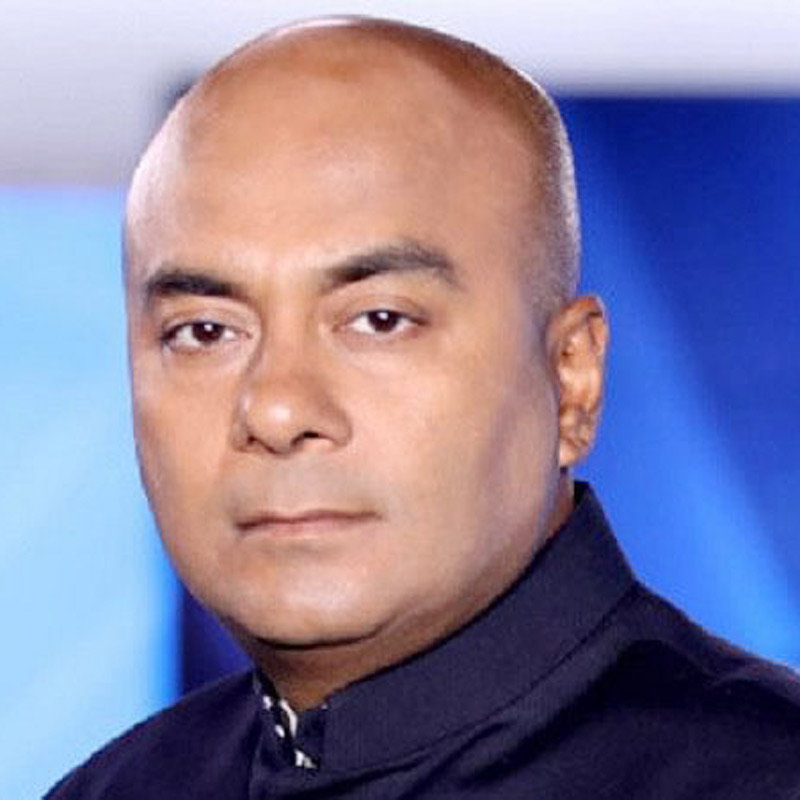
    MUMBAI: Senior journalist and former main man of CNN News18, Bhupendra Chaubey is a very busy man. He is juggling the affairs of 12 editions of Telugu daily Andhra Prabha as well as running English news channel India Ahead. Since joining the national news channel as owner & co-promoter in June 2020, Chaubey has been leading its foray into the regional space.

    At Indiantelevision.com’s News Television Awards 2020 Summit, co-powered by TVU Networks, Chaubey spoke at length about his vision for the company going forward. In a virtual fireside chat with Indiantelevision.com founder, CEO, and editor-in-chief Anil Wanvari, Chaubey revealed that the company is in process of doing a collaboration with a large scale broadcaster in Goa.

    Chaubey further mentioned that in the course of a month the organisation will have a dedicated show about Goa news. He is aiming to reach audiences across India through digital campaigns and cross promotion on various other platforms. Said he: “I think it is the best time to re-imagine the media landscape and I am glad to say that our organisation is not backed by some big corporate entity, but we are still trying to do something different.”

    The India Ahead editor-in-chief is looking to delve deeper into Indian states in terms of specific coverage. "We are picking stories from the areas which are not even heard of," he claimed.

    Wanvari asked Chaubey why prime time shows are not tackling enough issues and giving adequate representation of what is happening in India. The senior reporter explained that over the last ten years, broadcasting platforms are operating on the credo that talk is cheap and content creation is expensive. “Over this period, talk shows started replacing the entire existence of TV news itself. There used to be debate shows during morning, afternoon and evening. At India Ahead we are attempting to focus on collaboration and not just metro cities. Every Indian state has regional media houses, so there is no dearth of news, but the only challenge is nobody has attempted to delve deep into regional stories.”

    Chaubey pointed out that contrary to the popular view propped up by rating organisations and marketing agencies, regional news fetches better ratings. According to him, at the end it’s the consumer who is benefited the most. When it comes to India Ahead, the news is dedicated to southern states every day from 1 pm to 5 pm. Later in the evening, the channel telecasts a show called People’s Editor, which again caters to different parts of the country.

    The 2020 edition of the event will culminate with the grand News Television Awards, which will honour the best performers in the Indian news television space across more than 40 categories. The results will be declared virtually on 6 November 2020.
  • The world of Indian e-sports, according to Nodwin Gaming’s Akshat Rathee

    The world of Indian e-sports, according to Nodwin Gaming’s Akshat Rathee

    MUMBAI: Perhaps because people have been stuck in their homes due to the Covid2019 pandemic, the e-sports industry is bigger and bolder than ever before. For many gaming platforms, user engagement was at an all-time high during the lockdown and even now, the revenues are continuing to pour in.

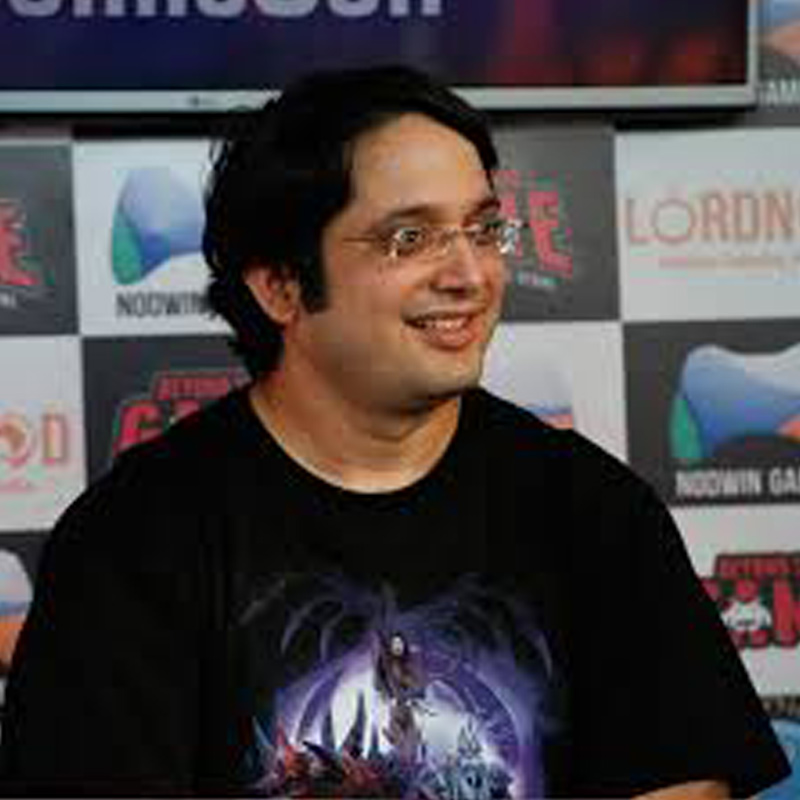
    Nodwin Gaming MD Akshat Rathee, an avid e-athlete himself has revolutionized the e-sports industry in India and has almost single-handedly expanded the company to the middle east and south Africa. In a virtual fireside chat with indiantelevision.com founder, CEO and editor-in-chief Anil Wanvari, Rathee spoke at length about e-sports in India and the international market and the challenges faced by the industry.

    Online games have three key segments: casual games, e-sports, and real money games (RMG) that are basically skill-based online games played for stakes. However, Rathee said that there is no clear bifurcation between games in India, anything that is digital and has competition is termed as e-sports by people. This is not the case in the US or UK.

    He also highlighted that outside India, the law is clearer on what constitutes gambling, skill-based games and real money gaming. He explained: “In terms of practical implications, an American or European customer is worth far more than the Indian one. But during the pandemic, physical events were cancelled and that impacted the value of sponsorship more in the western world.”

    In India online viewership counts for a lot, said Rathee, citing PUBG live streams that millions tune into. “Even after the ban, the entire segment has grown… In the 45 days since the downfall of PUBG in India, a lot of other games have cropped up,” he observed.

    According to Rathee, game publishers did really well during the Covid2019 pandemic. “New games were being discovered, games like The Fall Guy started becoming very popular. Apart from this, game casters benefited a lot but the algorithms did not favour the smaller players in the market,” he added.

    Read more news on Gaming Industry

    Answering Wanvari’s question on how to clear the clutter and mess that has mucked up the e-sports and gaming ecosystem, Rathee opined that bringing in clear and well-defined regulatory measures is the only option.

    “Having a differentiated definition of the word e-sports that is as per Indian regulation and doesn’t apply to the rest of the world will not work. E-sports is a speed competition. Just because a person has more money doesn’t mean he can play twice. The e-sports game needs to be fair as well so that everyone gets equal opportunity to win the competition,” he explained.

    Rathee defined e-sports as something that has physicality of results. It is the physicality of moves and actions that is the differentiator between the results of the participants. For instance, chess.com clearly mentions that chess is not a sport but a game. He further added, 

    “E-sports are and need to be dependent on publishers. We are the world’s first sports category that is owned by someone from the very beginning. Owner of Kings belongs to Tencent, Bluehole owns PUBG, while Call of Duty is an Activision entity. So it is someone’s property – everything about the game, from the IP, data, rules, players and to the systems belongs to them,” he clarifies.

    Rathee went on to say: “Another important thing is to understand the business of sports. The question arises – is e-sports a B2C business anywhere in the world without the publisher?” In his opinion, e-sports has always been a B2B business, for the simple reason that a sports organization is making money from sponsorship and media rights.

    The gaming industry is at a watershed moment where the youth, information and technology, finance and IT ministry are actively making plans to regulate the sector. But there exists the roadblock of censorship and data privacy. The gaming industry is also stuck between the state and central government over GST issues. Rathee asserted that while the gaming industry is valued at less than Rs 10,000 crores, it’s like the goose with the golden egg for the government – precisely because it holds sway over the millennials and Gen Z, as well as the future of social media.  

    Rathee argued that it is not easy to remove one country from the ecosystem. China also has a regulatory body that makes it mandatory for companies to license the games.

    “China is in a position to ban many e-sports and games because they run the ecosystem. China already has a regulatory body which could say that you have to license games through us without which we won’t let you do it. Due to the fragmentation of the internet, the Middle East is raising concern over their cultural sensibilities. So, it is a very thin line if you put a regulatory framework in place that can be exploitative,” he shared.

    At the end, the question raised is whose interest you are working for. “It is important to have a proper regulatory body in place so that the industry grows,” he emphasised.

    It is high time the industry developed a strident voice of its own, declared Rathee, because most of the world outside India often looks at mobile gaming and mobile e-sports as second-class citizens to the e-sports ecosystem.   

  • Virtual Fireside Series: Catch Eros STX Global’s Pradeep Dwivedi live on 18 Sep

    Virtual Fireside Series: Catch Eros STX Global’s Pradeep Dwivedi live on 18 Sep

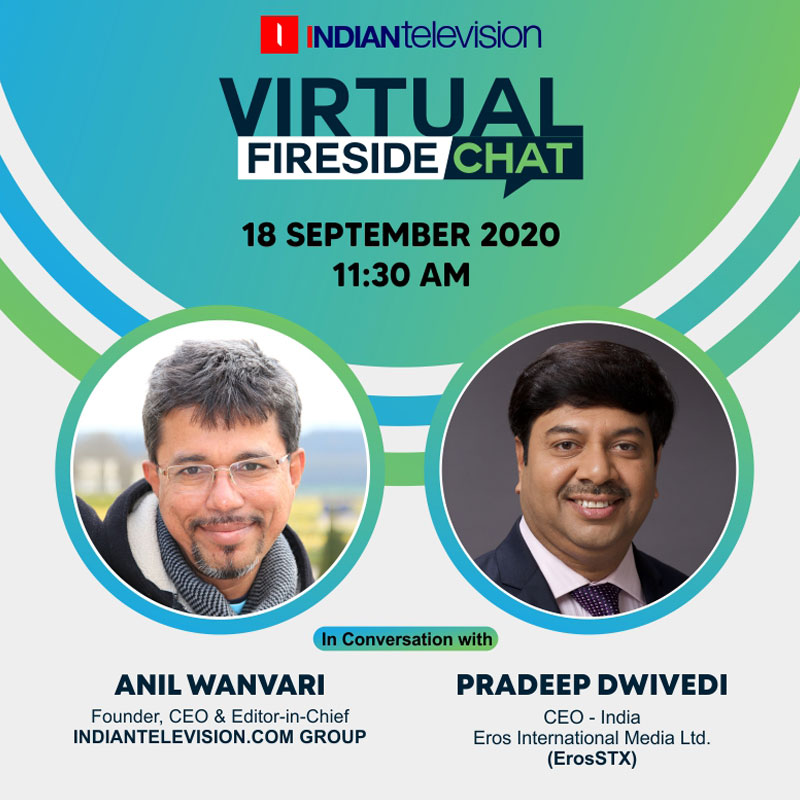
    KOLKATA: Taking ahead its virtual fireside series with eminent professionals of the media and advertising industry in India, Indiantelevision.com will be hosting Eros STX Global CEO-India Pradeep Dwivedi on Friday 18 September at 11.30 am. The session will be helmed by our founder, CEO, and editor-in-chief Anil Wanvari.

    Dwivedi is an industry veteran with nearly three decades of experience across media, marketing, publishing and advertising. He has worked at multiple brands and publishing houses in different capacities and played a key role in the growth. Dwivedi started his career with Eicher Motors, and went on to work with GE Capitals, Standard Chartered Bank, and American Express. His longest stint has been with Tata Tele Services which extended just a little over eight years. Post that he served with Dainik Bhaskar Group as chief corporate sales and marketing officer and later served in the capacity of chief executive officer with Sakal Group.   

    Watch more Virtual Fireside Chats

    Eros International recently changed its corporate name to Eros STX Global Corporation recently following the completion of rare Bollywood-Hollywood merger. The opportunities are flaring up for both sides of the business – OTT and studio segment. At this crucial juncture of the business, Pradeep Dwivedi is spearheading the Indian market of the newly merged entity.

    Read more news on Eros

    Dwivedi will be sharing his experiences of sailing through the times of pandemic, the changing landscape of the media environment, new trends and developments in the content space, merging of Bollywood and Hollywood at Eros STX Global and leadership & life lessons.

  • The accidental producer: Siddharth Kumar Tewary gets candid on his journey

    The accidental producer: Siddharth Kumar Tewary gets candid on his journey

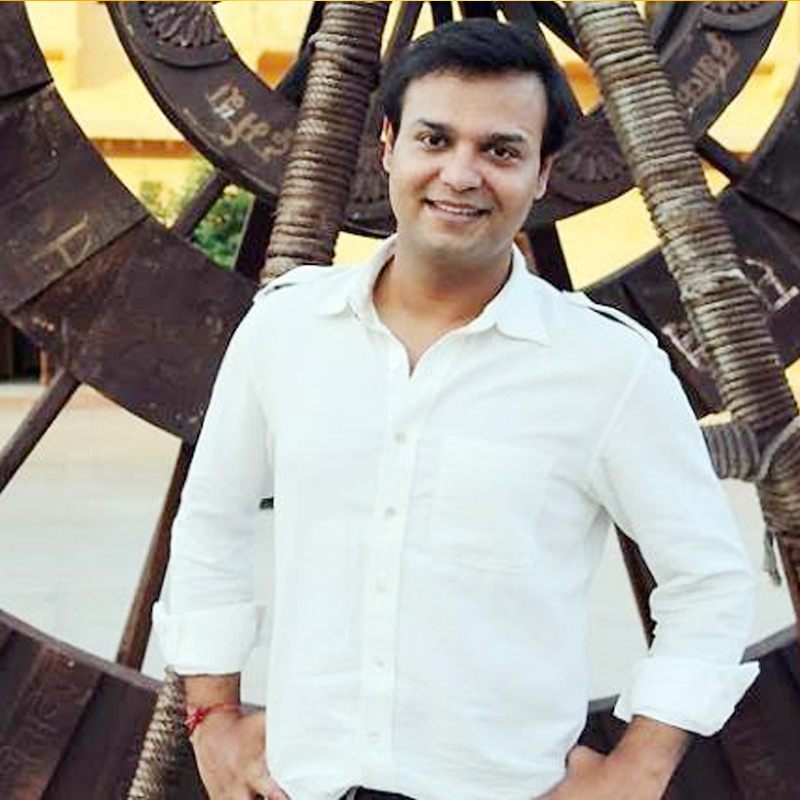
    MUMBAI: Most popularly known for creating magnum-opus shows like Mahabharat, Karmaphal Daata Shani, Porus, Ram Siya Ke Luv Kush and RadhaKrishn Swastik Productions has successfully managed to win our hearts over the years.  In a virtual fireside chat with Indian Television Group founder, CEO and editor in chief Anil Wanvari, on ‘The evolution of a creator – The maker of the new Mahabharat,’, Swastik Productions and One Life Studios founder and chief creative officer Siddharth Kumar Tewary gets candid about his journey and much more.

    Tewary, who was born and raised in Kolkata, always had a dream of making it big in the city of dreams Mumbai. After quitting his job in advertising, he started working in the marketing department of Sony Entertainment Television. His sheer love for storytelling and writing unique stories inspired him to make Amber Dhara for Sony Entertainment Television. 

    About the idea behind creating Amber Dhara, Tewary said: “A news article about two conjoined twins gave me the idea to speak to Sony Entertainment who I thought believed in unique and progressive shows rather than daily soap operas. Amber means sky and Dhara means earth so they are two distinct characters. The story was about how they are the same but still think differently.”

    Tewary says that he never thought of becoming a producer. The initial idea was to create a story that will be backed by a production house. But later, after figuring out different ways, he and his previous partner Vikas Seth decided to do it themselves, and that gave birth to Swastik Productions in 2007.

    Amber Dhara was a show with a beautiful concept but failed to make money. So, after this show, Tewary went on to make Mata ki Chowki which was aired on Sahara One. The show became a huge success and created new avenues for Tewary. He didn’t have to look back after that; he created another show named Agle Janam Mohe Bitiya Hi Kijo, a story that showcased the issues prevailing in rural India. The show was quite successful. Since then, he has created more than 30 shows.

    On his most favourite television shows Amber Dhara and Mahabharat, Tewary says: “Amber Dhara will always remain close to my heart. We have not even created a set. Because I wanted to write a series where just like human lives you are not stuck in one place. It is a story of two characters that kept moving. My second most favourite will be Mahabharat. In 2009 Vivek Behl from Star Plus called me and said he liked my show Agle Janam Mohe Bitiya Hi Kijo and he wanted me to make a Mahabharat. It took me five years to make that show. Mahabharat has taught me a lot and it has changed me as a person. Porus was the first Indian show that was showcased on the digital platform Hulu in Japan. It taught me to invest more in what you are creating and going around the world to sell your content. We have sold it in more than 14 countries now.”

    Tewary is ecstatic about re-running his show Mahabharat which was made seven years back.

    On parting ways with long-time friend and Swastik Productions managing partner Vikas Seth, he said it was a difficult time. Due to Mahabharat they were in huge debt. But after Mahabharat was launched it did well. “Initially we decided to make 128 episodes, but I was unable to tell the story in those particular episodes so we decided to extend it. Because of the extension Mahabharat did well for us on all fronts. It helped us get back on our feet,” he explained.

    According to Tewary, the formula for being a successful production house is going ahead with your team who share similar ideology. “The sheer passion of the entire team at Swastik Productions kept us going despite the challenges. Me and my elder brother Rahul always dreamt of creating a set, how we will provide shooting facilities. So, slowly we started acquiring land, building set on our own properties. Today we have more than 25 shooting floors which are spread across 25 acres. We have a huge mythological setup in western India. One thing led to the other and we started on investing in infrastructure while we were doing a lot of work on the visual effect front. Where we can have control over the delivery of our own product. That is how One Life VFX came into existence.”

    Elaborating more on One Life, Tewary said that Swastik Productions is a parent company and One Life Studios is a subsidiary of that where they do most of the digital work, syndication, distribution and visual effect work.

    Tewary is currently working on the animation front, where he is busy making a few promos and developing some animation stories. In the near future he wishes to create characters that sustain for much more time. He is also focussing on syndication and distribution where he is taking Indian content overseas and similarly wishes to bring international content in India.

    He adds, “We have acquired some international series that we will be distributing to OTT platforms in India for them to stream. I am also working on an original series called Escape Life for Hostar. I finished the writing; we were about to begin the shoot but due to lockdown things are at halt.”

    He revealed that he has no plans to lay off workers in the wake of the Covid2019 pandemic. "We have deducted salary from April onwards. But there are no plans of furlough or layoffs. Infact, we are taking care of 250 people who are staying at our Umbergaon set in Gujarat," he said. 


  • TV industry needs to come out of old ways: Sanjeev Kapoor

    TV industry needs to come out of old ways: Sanjeev Kapoor

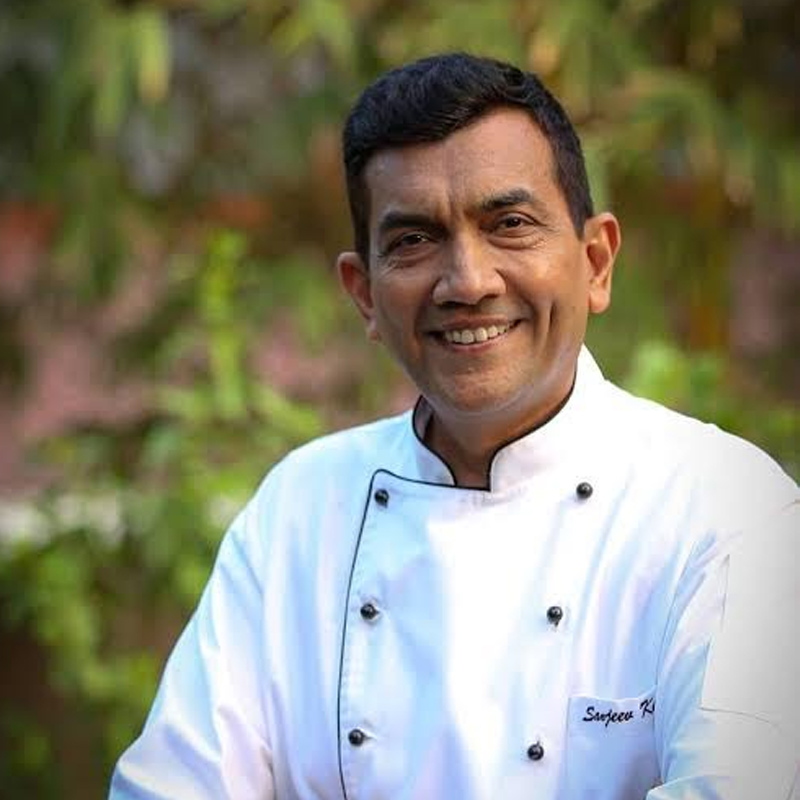
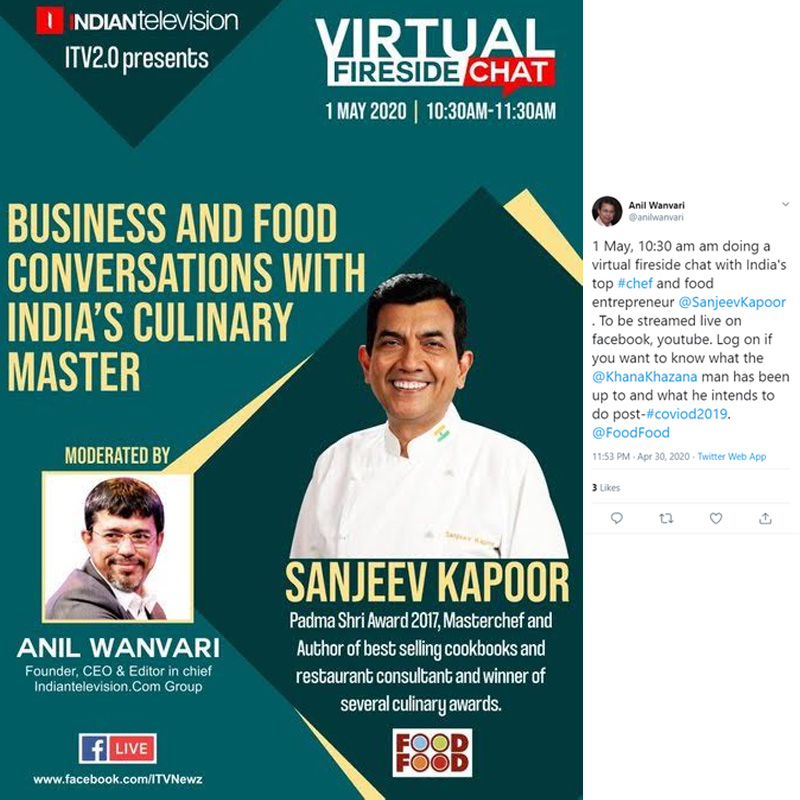
    MUMBAI: A number of brands often advertise on speciality TV channels to reach a specific target audience. But, with the lockdown, advertisers have nearly stopped ad spends on niche channels. Celebrity chef and food entrepreneur, Sanjeev Kapoor, in a virtual fireside chat with indiantelevision.com founder, CEO and editor-in-chief Anil Wanvari spoke at length about his speciality channel Food Food, his company Wonderchef and life after NTO 2.0.

    Kapoor said that in the upcoming times, speciality is going to bring more premium. It is easier to understand target audience in social media. There is more data available to provide brand and advertisers. Whereas on TV, a specialised channel is asked many questions. 

    Kapoor highlights that the premiumisation of speciality channels has already started on digital and all the creamy digital assets are being taken and TV has not understood this concept yet.

    He also gives a warning to TV channels. “I have said this three years ago that the death of TV is coming and I don’t think so it is about consumption. According to data, the consumption of content on digital assets in the last month has doubled which is not the case with TV. The CPMs are also good on YouTube which is not the case with TV. And look at how the world is still living in the old ways."

    According to Kapoor nothing has changed post NTO 2.0 whether you are a paid channel or free. No matter what, you have to pay carriage fees. He feels that if you are a smaller channel there is more arm twisting. 

    India's most-loved chef seems to be upset with the situation for his channel during lockdown. He said, "Even in the lockdown when everyone says be compassionate, there is a ticker that says Food Food channel is not available.  As far as carriage fee is concerned, I am not in that position to pay. Do you think when people want to see content on food this is how television should act? We still believe in the power of content. So, we will partner with distribution mechanisms who are fair."
    He added, "Tata Sky understands speciality. They are our partners for quite a long time. With Jio coming in I see a hope for speciality channels. But the people who think old school have not changed."

    Food Food is currently available on Tata Sky and Airtel. On the cable side it is available on Siticable, GTPL Hathway and small cable networks.

    He also felt that there is a need to change the way advertising works on TV.

    He said, “There should be a mechanism where people will feel benefited from advertising; it should not be shot in the dark. People say that a GEC channel's and a specialty channel like FOOD FOOD’s rate should be the same. That's like saying a general physician and a heart surgeon should charge the same. It doesn’t work like that. Our media has not understood this yet. I think this is the time to change, to respect each and every person and all specialties.”

    Kapoor, who runs a company named Wonderchef and is also the brand ambassador of the same company, believes in spending wisely.

    "If money cannot be converted into sales then it is money not spent well. This is my approach since the beginning.That is why I say variable cost model is important. I am ambassador for many brands. I tell them that I will not take the money if I cannot give you better sales. You can do a percentage sales with me; a royalty kind deal." 

    In the future he looks at investing in artificial intelligence, ML platforms and Google Home. "I would invest more on solutions for bringing better content and better quality in food," he concluded.

  • Restaurant industry can introspect and reinvent during Covid2019: Sanjeev Kapoor

    Restaurant industry can introspect and reinvent during Covid2019: Sanjeev Kapoor

    MUMBAI: The restaurant industry, just like any other industry in the country, has suffered huge losses since the Covid2019 outbreak. India’s culinary master and food entrepreneur, Sanjeev Kapoor, in a virtual fireside chat with indiantelevision.com founder, CEO and editor-in-chief Anil Wanvari talks about the spirit of generosity, lessons learnt during Covid2019 and his personal evolution. He also explains how the restaurant industry needs to reinvent itself in order to grow ahead.  

    Explaining about his work during the pandemic, Kapoor said, “In Mumbai we have partnered with Taj Group to distribute food to 45,000 people every day and same is the case in Delhi and Bangalore.”

    As people will not stop eating food, there is a significant growth in the consumption of digital content where audiences are looking up their favourite chefs to acquire cooking skills. Hence, Kapoor is keeping himself busy looking after his specialised channel Food Food and also creating content for his digital platforms where he is creating content and live shows with the help of his family members who have turned into sound and camera persons.
    According to Kapoor, reviving restaurants during this pandemic is very essential. Because people's need to eat is still there. What they will eat or where they eat may change. Which means that skills are still required. He added, “If you want to eat a rumali roti you cannot eat at home.You need skilled people to do that. I have been advising people in the restaurant industry to bring in new concepts, new thoughts to sustain and grow.  Also, this is the time to look at what was going wrong in the industry.”

    Kapoor is of the opinion that the fixed cost in the restaurant industry is very high. He notes businesses should look into compensation based on the work being done. They should create work that functions on a variable cost model in order to survive.

    The one positive outcome of the pandemic will be a chance for the restaurant business to refurbish itself.

    Kapoor feels that the restaurant industry will have to go in for some major modification in the coming future. When the business starts, it is important to let go of outdated business practices and develop new concepts, thoughts and more innovative ways to feed people.

    According to Kapoor, the hospitality industry is a very resilient sector, but going forward, will they change their traditional model of doing business? He said, “Meal kits are going to be the next big thing in the industry. We have already started our meal kits. I will include primary ingredients, a recipe card along with a cook along with Alexa, where you scan the QR code and the cook will guide you. It is about changing the model and creating opportunities.”

    Kapoor, who closely works with Akshay Patra, serves 18 lakh meals every day. The food is prepared at 50 large kitchens. According to Kapoor, the restaurant industry was not looking at sectors like that as an opportunity. Institutions like Akshay Patra have interns from top universities including Harvard and Stanford whereas top Indian colleges do not even go there. He thinks that a food service solution needs people who understand processes and taste.

    He says, “If today you want to eat Thai food at home and if you are vegetarian, you don’t want something with fish oil and shrimp paste. You want an Indian solution for that. There are many such opportunities in the market like I closely work with, such as pharma companies. Has anyone thought if medicine tasted good what miracles it would create? There are nutritional and functional foods which need to be healthy and tasty. So, many companies need that intervention. This is the time for specialists and there are many opportunities. We just have to keep our ears and eyes open. I have always advised people to look beyond the standard option.”

    About the options available for a corner-side restaurant, Kapoor said, “They are way better warriors than us. I know many people who are supplying food to a hospital chain. There will be two kinds of people: one who will fight and another who will wait. The ones who are fighting will survive and those who are waiting will also survive but they will need much more time.”