Tag: Virtual

  • NFTICally unveils Comearth to drive e-commerce in the Metaverse

    NFTICally unveils Comearth to drive e-commerce in the Metaverse

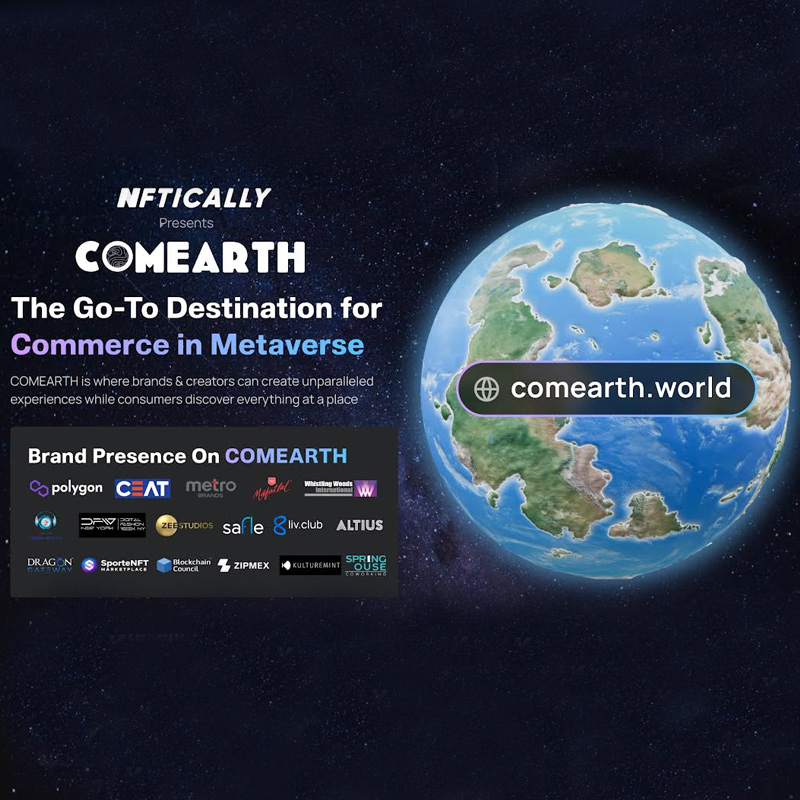
    MUMBAI: Global Web3 E-Commerce SaaS platform NFTically has launched  Comearth. This is a destination for commerce in the Metaverse. Comearth, a 3D immersive virtual environment, will be powered by NFTically’s “Web3 E-Commerce Engine ” & backed by the trust and decentralization of the Polygon Blockchain. In Comearth, brands, enterprises, content creators, and celebrities will be able to purchase their virtual spaces / virtual real estate as Comearth’s “Citizens” and launch the e-commerce experiences for their customers, consumers and followers.

     The metaverse has the potential to be a $13 trillion ecosystem within a decade. The e-commerce industry also is expected to expand at a CAGR of 22.9 percent between the years 2020-2027 to size over $16.2 trillion. Exploring the intersection of two burgeoning markets, Polygon co-founders Sandeep Nailwal & Jaynti Kanani, Coinbase CPO Surojit Chatterjee, Unacademy co-founders Gaurav Munjal, and Roman Saini, Indian film-maker Subhash Ghai, Actor Kunal Kapoor, Capital X’s Cindy Bi, Nazara’s Nitish Mittersain have invested in NFTICALLY to build a 3D immersive metaverse ecosystem that would power e-commerce for 100,000 brands & individuals by 2025.

    NFTically founder & CEO Toshendra Sharma said, “Web3 is the next generation of the internet, which will profoundly impact e-commerce solutions. Comearth will bring a fully-immersive DIY layer to e-commerce and enable immersive hyper-personalisation for everyone. We intend to democratise and facilitate mass Web3 adoption & bridge the gap between web3 and web2 E-Commerce.”

     The launch was graced by NFTICALLY’s advisors and partners including film writer-director, producer, Subhash Ghai, Mafatlal Group vice-chairman Priyavrata Mafatlal, Kulturemint director Govind Singh Sandhu and The Blockchain Council CEO Pradeep Aswal. They reflected upon the perspectives of brands getting empowered with Comearth for augmenting retail and consumer experiences.

     Comearth comprises different sizes of land parcels that cater to businesses and industries ranging from large to small enterprises, celebrities, and individuals. It will act as a global marketplace for goods (digital, physical, and phygital) and services (within and outside of the Metaverse) & facilitate e-commerce and lead generation. The land parcels can be purchased as NFTs and are governed by the smart contracts deployed on top of Polygon Blockchain. The comprehensive DIY tools empower the landowners to start their metaverse venture in minutes and will be accessible by mobile, laptops, and VR devices.

     Polygon Studios Metaverse lead Brian Trunzo said, “Polygon Studios is pleased to welcome Comearth as a valued partner into the ecosystem. Their easy-to-use and powerful suite of tooling brings brands and rights holders closer to their audiences — a key aspect of facilitating broader Web3 adoption”.

  • Guest column: How brands can negotiate the ‘work-from-home’ & ‘virtual’ reality of PR

    Guest column: How brands can negotiate the ‘work-from-home’ & ‘virtual’ reality of PR

    NEW DELHI: John Wooden, a renowned American ex-basketball player, coach and author, once famously said, “If we fail to adapt, we fail to move forward.” True to his saying, every change that mankind has faced has forced us to adapt and evolve, and the current Covid2019 pandemic is no different. Not only has it altered the way we take care of ourselves at a personal level to avoid contracting the ailment, but it has also impacted us financially, professionally and socially, among others.

    One of the most common adaption at a professional level, unequivocally, has been implementing the practice of work from home (WFH) by organisations across geographies and scale. This is particularly true for the IT, FMCG, pharmaceutical, electronics, online retail platforms, digital lenders, start-ups, and BPO/ KPO sector. A recent report by a leading search engine company (Naukri.com) notes that the hiring of employees for a WFH job role has increased by a whopping 300 per cent since the lockdown. The enthusiasm for this ‘new normal’ has been equally reflected at employees’ end, with WFH being one of the top keywords searched.

    Advantages of WFH

    Aside from the safety factor, there are several other advantages of WFH. It has been observed that a significant amount of time is saved, that would otherwise be spent on travelling to work and meetings. Instead, it can, now, be used more productively and to incubate innovative solutions and ideas. WFH can also help organisations blur geographical boundaries by connecting all its stakeholders through common virtual communication and transactional platforms. Additionally, it is beneficial financially. In WFH, lower overheads, especially fixed, would be incurred and this would, eventually, prompt organisations to offer products and services at lower costs and make them more profitable and affable to its customers. Hence, post the pandemic, these factors are going to continue to encourage a multitude of organisations across sectors to reconsider a permanent WFH for some or all of its employees.

    Changing dynamics of the PR landscape

    Given that organisations are increasingly getting accustomed to WFH, public relations (PR), being a service-led industry, has also adopted the new norm of WFH to be on the same page as its stakeholders. The dynamic PR industry has redefined itself and has reinvented its objectives, strategies and tools to transcend to the world of ‘virtual reality’, seamlessly. Virtual models and methods are, at times, replacing and in other times, going hand in hand with traditional approaches to client servicing, media relations and other stakeholder engagements.

    At a time, when client engagements can no longer happen via in-person meetings, it has to be conducted virtually. PR consultants need to maintain effective engagement with clients by sharing daily updates and various status reports in a timely manner, and schedule regular phone and video calls so that the client does not feel alienated.  Key documents could be updated on shared drives to enable real-time reviewing and discussion on the way forward. It is, of course, imperative to use encrypted and trustworthy platforms to avoid leakage of confidential information or data. Time management is of key essence in WFH. It is ideal to synchronise work timings with those of the clients, to the maximum extent possible, so as to be available when the client requires your assistance and ensure that neither is eating into each other’s personal time. Virtual working has also led to merging geographical boundaries. Consultancies can now cater to existing clients, as well as onboard new ones in any location and engage virtually.

    The media catches on too

    It has been noted that in times of Covid, consumers are heavily relying on online and social media forums for information. This is true not just for consumers but also for the media where press conferences are now being replaced by video calls. Product launches and key announcements are taking place through social media handles of organisations. There is an even greater need for brands to post various ‘updates’ so as to maintain the brand recall in this age of information overload. It could be easy for consumers to lose interest in virtual engagement. Hence, the content to be driven on such platforms needs to be brief, relatable and highly engaging. Crisis resolution also has been redefined, since every social media participant could be a potential influencer for the brand. In the wake of this, there is a pressing need to reshape the crisis manual, timely engagement with the client, its customer or media, and address concerns promptly. All in all, a PR professional has to be well versed with digital engagement as well as the measurement metrics for gauging interest and evaluating strategies.

    In the media domain, engagement has also become virtual since media rounds and meetings, one of the key relationship-building approaches are no longer feasible. There is a need to constantly engage with the media to share updates about clients, but avoid calling journalists at odd hours or expect them to check emails instantly, since WFH is a new setup for them, as well. The bottom line is to maintain a fair balance of engagement without overwhelming them.

    So, how to turn this into a success story?

    Last, but far from the least, WFH requires PR consultants to work in a more collaborative manner with all stakeholders, including their teams. It is vital for leaders to stay connected with teams and keep them engaged, motivated, and maintain a personal connect, beyond work. Using positive reinforcement, rather than negative, will help keep up the morale. Small gestures like celebrating achievements, occasions or simply connecting at regular frequencies, will go a long way in retaining team bonding whilst working remotely.

    In a nutshell, since the end of the pandemic is indefinite, many organisations and sectors have declared, or atleast considered, WFH for its employees for at least a year. It has been observed through the passage of time that every working environment requires its own strategy to succeed. Leveraging this ‘virtual reality’ to maintain healthy relationships with all stakeholders, will enable PR consultants to assist clients to respond to new age challenges more effectively and lead the overall PR and communication industry to its growth and evolution.

    (The author is founder of Value360 Communications. Indiantelevision.com may not subscribe to his views.)

  • Share of news channels in total AdEx is encouraging: CVL Srinivas

    Share of news channels in total AdEx is encouraging: CVL Srinivas

    NOIDA: “Indian news industry is as vibrant as the different cultures of India,” said GroupM south Asia CVL Srinivas as he presented the keynote on Innovations in news selling at the 7th Indian News Television Summit.


    Srinivas, sharing a media agency’s perspective on news and brands, added that the news industry today needs a lot of balance especially in terms of reportage, content for different audiences across platforms. 


    As for the AdEx, he informed that in the country the advertising expenditure for television stood at Rs 16,000 crore. “The news channels take 13 per cent share of the pie which is encouraging as the viewership of news channels stood at 10 per cent,” he stressed upon.


    Talking about the ad spend growth in the country, he informed that the television medium was growing at a rate of 14 per cent overall. The Hindi news genre was growing at 15 per cent, closely followed by regional news at 10 per cent while English news genre stood at seven per cent.


    Moving then onto brand research, Srinivas felt that today brand research is undergoing a radical change and old measurement methods are being questioned. Throwing some light on GroupM’s one such initiative, Social Command Centre, he said, “It is a virtual conference room that monitors the digital space and provides rich insights about consumers and brands.” And stated the example of Nestle which uses the tool to monitor chatter and gather buzz around the brand digitally. 


    Honda using the popular comedian Kapil Sharma to launch a series of campaign online, which garnered 1.5 million hits, was another example, he highlighted upon. He went on to say that cause-based marketing should be initiated and brands should ask themselves, how do we evolve ourselves to become more meaningful entities?  “Once brands are able to answer the same, there will be a lot of headroom for improvement and growth,” he opined. Providing another example, he said an agency called Crayon Data was able to come up with tastegraphs that showed the purchasing and behavioural pattern of different audiences in well-segmented clusters.


    He further went on to add that the evolving Indian digital space sees 220 million Indians active on the digital front spending  almost 200 minutes a day online either checking mails or watching videos. “This implies that the new medium cannot be ignored,” he informed.


    According to Srinivas, news broadcasters need to keep in mind a few things for the future such as co creating socially responsible agendas with brands, invest more in digital, adopt new metrics such as consumer sentiment, social buzz, social impact, viewers’ profile and lastly getting into big data.


    In his closing remarks, he said that while the upcoming digital environment has caused a big disruption to some it will provide a huge opportunity to the news industry and sky is the limit.

  • Immortalize your lovers name on ‘Virtual’ monuments

    Immortalize your lovers name on ‘Virtual’ monuments

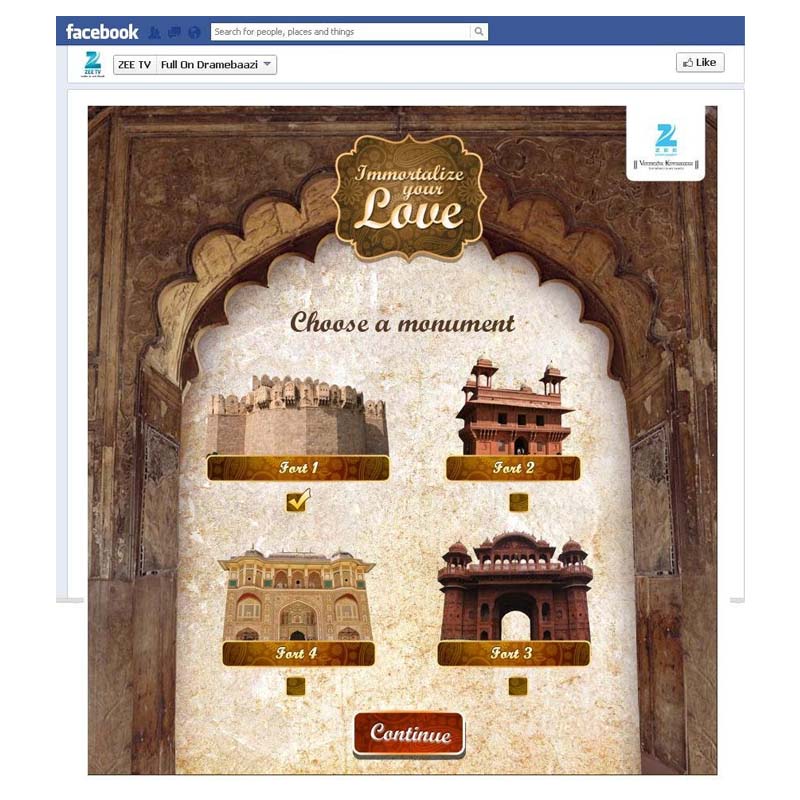
    MUMBAI: Love birds can now stop inscribing their names on heritage monuments. Instead, use the ‘virtual‘ heritage monuments to immortalize your love. Jodha Akbar, the historical magnum opus aired on Zee TV has launched a Facebook app that allows couples to do just that.

    The show through the app will support the preservation of the vast Indian heritage. The app gives users a choice between four different monuments where they would like to have their names inscribed.

    Once the user has typed their name and the name of their partner, the app gives them a choice between posting an image of their ‘immortal space‘ on their Facebook page and sending their significant other a more detailed love note via a message.

    The app provides lovers with an interesting space to express their love in the virtual arena

    “Very often, one finds people in India using the facades of national monuments to engrave their names alongside their lover‘s as a sign of eternal love. However, it is important that India takes adequate and timely measures to conserve its national heritage rather than allow its own citizens to deface historically significant monuments with graffiti. This is what prompted us to come up with a unique solution whereby we provide lovers with an interesting space to express their love in the virtual arena,” says Zeel head-marketing, national channels Akash Chawla.

    Besides the app, Zee TV‘s marketing campaign for ‘Jodha Akbar‘ has seen several innovative initiatives. In the pre-launch phase, the channel created boards on Pinterest to familiarize viewers with the architecture, monuments, artifacts, clothes and jewellery from the Mughal era.

    The channel also plans to organise edutainment excursions for school children where they will watch the shoot of the show and be taken on a guided tour of the ‘Jodha Akbar‘ sets that resemble Jodha and Akbar‘s palaces, showcasing replicas of the costumes, jewellery, weapons used in the Mughal era that are currently being used in the show.

    The app can be accessed on Zee TV‘s official Facebook homepage https://www.facebook.com/ZeeTvIndia