Tag: viewership

  • Pre-school kids content’s monetisation and viewership challenges

    Pre-school kids content’s monetisation and viewership challenges

    MUMBAI: Animators have long contemplated the complexity of producing pre-school content for the ages of two to four years. On the third day of FICCI Frames 2019, executives from the industry spoke about ‘Catching youngest viewers: Powering the kids network and advertisers ecosystem through data’. It had panellists BARC India senior VP business development partnerships Elbert D’silva, Sony Yay head programming Ronojoy Chakraborty, DDB Mudra Group executive director Sathyamurthy Namakkal, GroupM business head entertainment, sports and live events Vinit Karnik, Viacom18 head content kids TV network Anu Sikka and Graphiti multimedia co-founder Mujal Shroff. The session was moderated by Punaryug Artvision founder Ashish Kulkarni.

    Sikka threw the limelight over the issue that the industry had been facing since the start and the reason why the kids genre is under-indexed. She said that at first it was a question of finance and so the industry depended on acquired content and later realised the need to produce home-grown content. Parents also exert some control over what the kid watches. A kid may have no issue with Dora being Indian or not, but it is the parents who demand local content. They would want their kids to watch localised content. “Kids from age five demand local content, but in case of kids from the age group of 0-2, the parents are the gatekeepers,” she concluded.  

    She further added that now is the time that we need to cater to specialised content. “If you look at our Nick Jr. channel, it has grown three to four times this year. But unfortunately, if you look at the overall programming, we don’t get viewership of the two to fourteen years age group. And that is why there is a lack of pre-schooling content,” she said.

    On the other hand, Shroff said that there is also a placement issue. He said, “If you look at the viewing pattern, as the child evolves these days, it is on multiple devices. But some age groups still prefer TV.” Kids aged 5-6 or 9-10 tend to consume content on their parents mobile phones or any other device but a 2-year-old kid still watches TV.

    Chakraborty explained that pre-school programming is only justified if it can be monetised. “If you look at our category, one-fourth share is GECs but the revenue share for kids category is one-tenth. Hence the revenue here is very less and therefore, broadcasters are not creating content,” he said. If BARC were to provide some viewership cuts for the pre-school audience rather than keep it as a part of the entire kids genre, broadcasters will be able to curate better content.

    Agreeing with him, Karnik said that it would be difficult to strategise programming for the pre-schooling kids as the category as a whole is under-indexed in terms of advertising. Despite witnessing a hike in ratings, revenues are increasing at a snail’s pace.

    Namakkal chipped in with a different standpoint. He said that the industry shouldn’t get greedy about data because there is already information overload. “One-third of kids consume one and a half hours of video on TV screens. But while we talk about advertising revenue, it will never be equal to viewership share,” he explained.

  • Most watched Hindi news channels in 2018

    Most watched Hindi news channels in 2018

    BENGALURU: News is event driven – that is a fact that is known and repeated a dozen times and more by all publications, newsletters, and whatnots.  As per a Broadcast Audience Research Council of India (BARC) report presented at FICCI-Frames 2018, Hindi content still rules the Indian television landscape in terms of viewership. After Hindi GEC, Hindi movies and Hindi music, Hindi news is the most watched genre in the country. The report also says that contrary to popular perception, TV viewership is highest amongst youth (15-30 years) even in the digital age.
    The BARC report says that news events cannot escape the lure of drama. And drama includes elections and election results, deaths of celebrities, high court and supreme court verdicts on celebrities and sensitive issues, major changes such as demonetisation announced by the central government, major public holidays such as Independence and Republic days and events that pertain to terrorist attacks and counter-attacks, etc.

    Data from the past few days have not been announced due to the migration to the new TRAI tariff regime from 1 February. BARC is giving the industry time to settle.

    So how did Hindi television news fare in 2018?

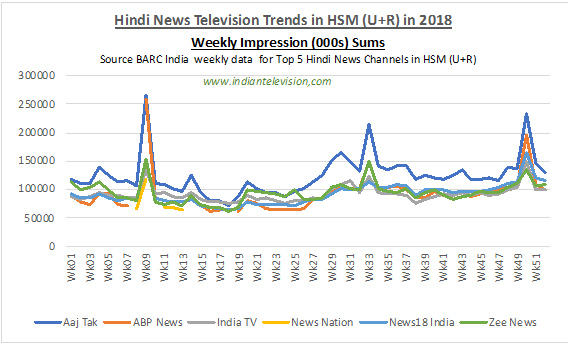
    Until recently, BARC had been releasing three sets of weekly viewership data for Hindi news in the Hindi speaking markets (HSM). The first was the combined viewership of the 5 top Hindi news channels in urban and rural Hindi speaking market – HSM (U+R). Besides, BARC also provided weekly viewership data of the 5 top Hindi news channels in the Hindi Speaking rural market – HSM (R) and the Hindi speaking urban market – HSM (U). The demographics for the three sets of data were: HSM (U+R) NCCS All : 15+ individuals; HSM (R) NCCS All : 15+ individuals and HSM (U) NCCS All : 15+ individuals.

    Like English news, Hindi news also peaked during elections that happened in central and the eastern part of India in calendar year 2018. Comparatively, the elections and elections results week in Karnataka managed just a small upward blip in overall Hindi viewership ratings in HSM (U+R), HSM (R) and HSM (U) as compared to English news channels.

    The most watched Hindi news channel in the Hindi speaking market (HSM) – be it urban (U), rural (R) or combined (U+R) was India Today TV Network’s Aaj Tak during the 52 weeks of 2018. The channel was present during all the 52 weeks of 2018 according to Broadcast Audience Research Council of India (BARC) data for weeks 1 to 52 of 2018 (Saturday, 30 December 2017 to Friday, 28 December 2018) in all the three weekly lists for HSM (U+R), HSM (U) and HSM (R).

    Viewership of the top 5 Hindi news channels in HSM (U+R) peaked in week 49 of 2018 – election results week of five states in the Hindi heartland and the north eastern part of the country – the top 5 channels scored a massive 931.068 million weekly impressions – 89 percent more than the 52 week weekly average of 492.539 million weekly impressions. The nadir was in week 19 of 2018 – a 34 percent dip at 324.188 million weekly impressions from the above mentioned 52 week average. Like their English counterparts, Hindi news channels also peaked during Independence Day week – the major events in these weeks being Independence day celebrations on 15 August 2018 and the demise of former Indian premier Atal Bihari Vajpayee the very next day -16 August 2018.

    Aaj Tak topped BARC’s weekly lists for HSM (U+R) during the 52 weeks of 2018 in terms of overall viewership. In HSM (U+R), Zee News was the second most watched Hindi news channel during the 52 weeks of 2018, followed by India TV. Only three channels appeared in BARC’s weekly list of top 5 Hindi news channels in HSM (U+R) during all the 52 weeks of 2018. Aaj Tak was ranked first for 50 of the 52 weeks of 2018, followed by Zee News and India TV which were ranked first for one week each in BARC’s weekly lists of top 5 Hindi news channels in HSM (U+R). Please refer to the figure below.

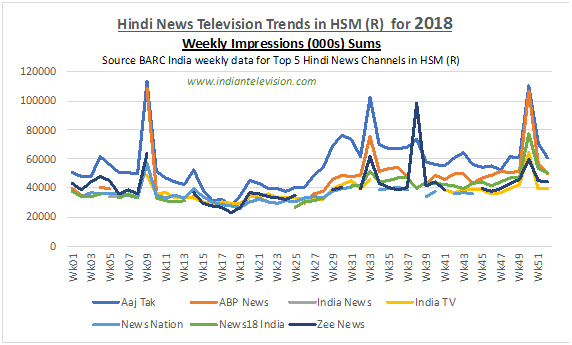
    In the HSM (R) market also, Aaj Tak topped ratings – it was ranked first for 51 of the 52 weeks of 2018. The one week where it was ranked third in terms of viewership was week 18 of 2018. Aaj Tak was the only channel that was present in BARC’s weekly list of top 5 Hindi news channels in HSM (R) during all the 52 weeks of 2018.
    Rural audiences also reacted like the overall Hindi speaking market – viewership peaked during the election results week of north-eastern India, Independence Day/Vajpayee week and the elections in the eastern part and Hindi heartlands towards the closing month of 2018. The elections and election results weeks for Karnataka did not mar the charts too much. 
    In HSM (R), the combined weekly ratings of the top 5 Hindi news channels were highest in week 50 of 2018 at 418.124 million weekly impressions, 94 percent more than the 52 week average of 215.162 million weekly impressions in 2018. The lowest combined impressions of the top 5 Hindi news channels in HSM (R) in 2018 were in week 2 of 2018 at 190.280 million weekly impressions.  Please refer to the graph below.

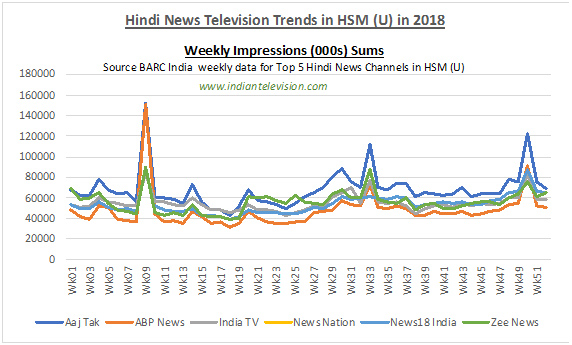
    HSM (U) also behaved in practically the same way that HSM (U+R) did in terms of viewership peaks and dips. Election results in the beginning of year and towards the fag end of the year in north-eastern and the Hindi heartland as well as Independence Day week saw viewership peaks. HSM (U) viewership ratings peaked in week13 of 2018 with combined weekly impressions of the top 5 Hindi news channels at 541.398 million weekly impressions, which were 93 percent more than the 52 week combined weekly impressions average of 280.285 million. The lowest combined weekly impressions happened in week 2 of 2019, at 264.155 million weekly impressions, 5.8 percent lower than the combined 52 week average for HSM (U).

    Aaj Tak, ABP News, India TV and Zee News were present in BARC’s weekly lists of top 5 Hindi News channels in HSM (U) during all the 52 weeks of 2018. Aaj Tak was the most watched Hindi News channel in HSM urban also. Please refer to the figure below.


  • Sanjay Gupta on executing the new tariff regime, Star India’s strategy and channel pricing

    Sanjay Gupta on executing the new tariff regime, Star India’s strategy and channel pricing

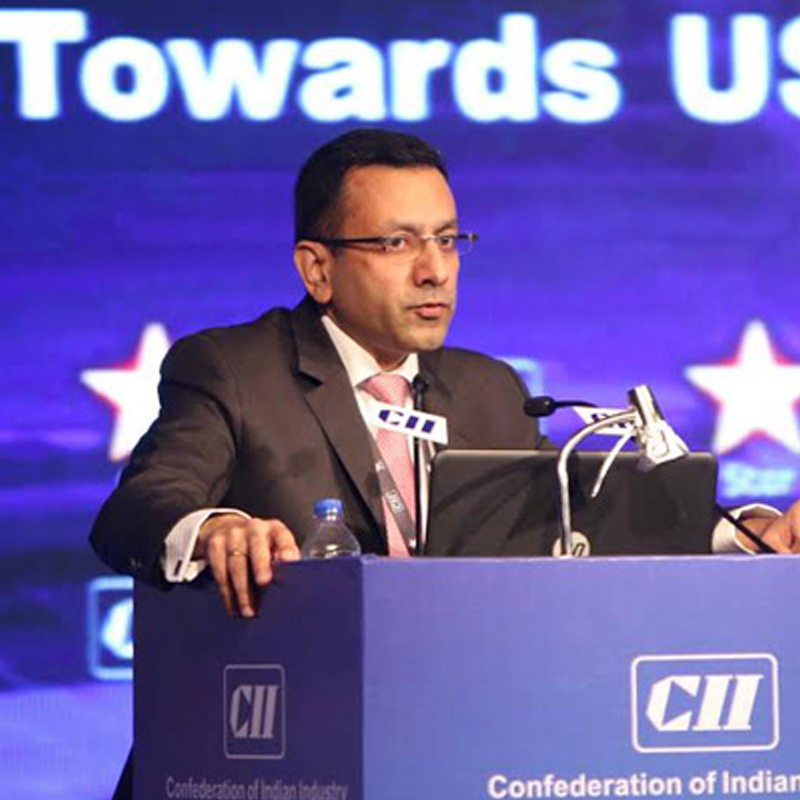
    MUMBAI: Star India MD Sanjay Gupta is a veteran of many high-stake battles. The one he’s currently involved in could be long drawn, unpredictable, unlike anything he’s encountered before and potentially his toughest in a while. However, as India’s broadcast bosses put their heads down to implement TRAI’s new tariff regime, Gupta and Star seem to be first off the blocks. Over the weekend, the network unleashed a nation-wide, multi-media and multi-starrer campaign to educate the consumers across about the radical changes.

    While Star fought the TRAI order tooth and nail in India’s top court, Gupta and team deserve full marks for the sheer scale and speed at which they seem to have got things moving after an unfavourable ruling on 30 October. Gupta says his team at Star is ‘excited’ and sees the new tariff regime as an ‘opportunity’. More power in the hands of the consumer and transparency in the value are the two major highlights as India’s broadcast sector undergoes a facelift, he feels.

    That’s not all. Gupta also articulated his views on Star India’s strategy, channel pricing, disruption in the value chain, the SLP filed by the TRAI in the SC, its implications and more as he fielded wide-ranging questions on a balmy Monday morning on the 37thfloor of Star House.

    On the tariff order’s impact

    The biggest change the tariff order is making is bringing transparency into the whole system of how content gets created to how content gets bought. The biggest change you’re going to see is the transparency, which is existent in almost every industry. It is the biggest shift this industry could have asked for and is great value from a consumer point of view. 

    On preparedness of the system 

    I think people will learn. Over the next two-four weeks, it’ll be an intense learning experience. The good thing in this country is people learn very well quickly. The biggest change in this tariff order is the transparency and power to the consumer.

    On Star India’s strategy

    Our strategy has been in delivering great value to consumers. You know that we invest in making marquee content. Be it our channels in drama, movie, sports, National Geographic or any other content that we deal with. And the question that we ask ourselves is how do we ensure that we provide great value to our consumer through our pricing. We offer content in every geography – be the drama we create with Star Plus and Star Bharat in Hindi, Asianet in Malayalam, Star Vijay in Tamil, we add movies to it in each of the markets, National Geographic – which has some of the best infotainment content to consumers – and on top of it sports. What we are trying to do is make the price affordable to ensure that every consumer has access to this content. Not only do they have power but it is power at a great value from a Star bouquet point of view.

    On channel pricing

    The reason we started the communication early, at Star and IBF, is to let the consumers know that a change is happening. I think it requires a lot of education and communication for people to talk to. To my mind, it’s critical and important. And we wanted to begin early, as early as practically possible. Our price is not led by sports but it is also regionally decided. So, we have a different price in Tamil Nadu as compared to Bengal. Depending on what we think is the strength of our bouquet and the quality of content we are offering. So there is differential pricing like in any business that you decide it regionally and locally. We have a strong channel in Asianet, we have a much weaker channel in Vijay. So we are trying to ensure that consumers get dramatic value in each geography.

    For content with mass requirement, we have tried to make it as cheap as possible within the constraints of the investment we make in each of the businesses.

    On weaker channels

    As I said, the real big change is the power to consumers. They have a choice to decide. Less performing channels cannot come to consumers if they don’t like it. The business will be forced to perform better and better to meet consumer expectations.

    On viewership and ad revenue

    If the channels are powerful and the consumers want you, they will take that option. I think the real question is – Are the channels and content powerful enough? Great content will get viewership. It will force everyone to up their game in terms of the kind of content they offer.

    On TRAI’s SLP in SC

    It is up to the court to decide that. I think now as an SLP is in SC, whenever it gets picked up, the courts will decide. I don’t have a view beyond that. But at this moment, the current ruling is that there is no discount cap. It may change going forward depending on the SC ruling.

    In case the court has a new ruling that discounts have changed, pricing needs to change, both a-la-carte and bouquet pricing in that case, because the distance between them has to be only 15 per cent. I think we are still awaiting the court’s decision and if we need to adapt to it, then we’ll adapt to it. But there will be a shift again in pricing if that comes through.

    On whether distribution chain is ready

    I think we will know closer to time. It is possible that they are all not ready at one time and at that point in time TRAI will have to take a view whether they’ll give more time for people to transit. For now, 29 December is the deadline and we are following the TRAI deadline fully in our intent, in our communication and our effort on ground. In the last few months, we have invested aggressively both in putting together our communication, putting up our pricing on the website, training our teams internally because this is such a massive change. All our internal teams need to get prepared too because this has never been done before. It requires a complete re-understanding within the organisation and briefing our partners.

    On potential change in pricing

    Pricing once defined will remain the same. This is the pricing we have published. People can change their pricing but once consumers pick it up, it applies for the next one year. You can’t change it then. This will also bring about discipline in the industry.

    On the impact on advertisers

    I don’t have a firsthand view on it. But I think this will mean some challenges in implementation. A massive shift of this kind brings out a bit of chaos in the beginning. But I think when I look back – when we went from analogue to digital there were similar concerns, and personally, I carry that worry more than anyone else. But if you look back, it happened more smoothly than what all of us anticipated. Given the enterprise of our partners and consumers, we find solutions to difficult problems quickly. So I think this transition will be a little chaotic but hopefully, it will settle down in a few weeks.

    On disruption in distribution chain

    Consumers are used to buying everything else on MRP and choosing. So, they are used to it across business and categories. It is a big shift for people who deliver content to them, i.e., all of us and distributors – both DTH and cable. I think I personally feel all of them have been working hard over the last few months to prepare.

    On readiness of DPOs

    I think DTH is ready in any case because they do this for a living. DTH covers around 60 million homes. They are fully ready. I think cable is ready from a technology point of view. I think from a people point of view they are getting ready. They have been working hard to get ready. I do hope that given the value this is going to unleash, given the power to consumer this is going to provide, our consumers will really come forward and adopt it and force the transition to happen quickly and smoothly.

    On nature of agreements with DPOs

    Now the nature of agreements is simple – there is no long term agreement. You offer your RIO, which is offered by all content owners on the website. People can download and sign it. Basis the number of consumers that you get every month and the price that you set, you get paid. So it’s a fully transparent way of working for everyone. There is nothing like a long-term agreement anymore.

    On how content will be offered to consumers 

    I think DPOs will decide that. But we are offering to every DPO a-la-carte content and bouquet content both. It’s the same price to DTH and cable. It’s a transparent price to all. They can now choose to make their own bouquets by using a-la-carte channels or they can combine bouquets of different broadcasters. I think that’s the strategy each distributor will define on its own. The interesting thing will be from a consumer point of view, you’ll know everything – what’s the a-la-carte price for a channel, what’s the DPO bouquet and what’s the content bouquet. This kind of transparency has never existed in content business ever before.

    On impact on content offering

    Low performing channels will be under pressure. It will put pressure on content to be better and better. Hence, everybody will have to invest in quality to ensure your channels become better. Content has to work well.

    On consumer awareness

    We have launched a big campaign across eight languages. We are doing a big digital push led by Hotstar and digital assets outside. We are trying to make a very simple communication, at both IBF and Star, to simply explain to consumers what is the change. I’m sure all DPOs and channels are investing equally. The amount of communication consumers will see on this front will be quite significant. So I think communication will be a big draw for both the distribution industry and the content industry in the next few weeks.

    On the relationship between broadcasters and distributors

    One big change that is happening is (and that is the power of the TRAI ruling) that pricing is the same for all distribution partners. There is no difference. It’s equitable and it’s transparent, which means more trust. I think this should help drive a much better and a deeper partnership with the distributors.

    On measuring viewership

    As consumers shift, each of them won’t behave the same way. Each distributor won’t behave the same way. Some of the challenges on measurement would be the sampling, which is an important backbone of any measurement, might go for a toss. Because there are 180 million homes measured through 40 thousand boxes. So if there is chaos in 10 thousand boxes, the ratings may not reflect. Hence the IBF made a request (to not release viewership data for two months) to BARC. Now the BARC board has to decide what the next step should be.

  • News18 India commands 13.5% of overall Hindi news market: Prabal Pratap Singh

    News18 India commands 13.5% of overall Hindi news market: Prabal Pratap Singh

    MUMBAI: The Hindi news genre is going to enter its peak time with five assembly elections coming up followed by general elections in 2019. With 22 channels in the genre, the audience can expect a deeper coverage from all the channels as well as tough competition to gain their attention. In 2018, the genre has contributed 5 per cent to the total TV viewership from week 1 to week 39. Election coverage is crucial for news channels to increase viewer loyalty.

    Indiantelevision.com caught up with News18 India managing editor Prabal Pratap Singh to talk about the channel’s plan for the upcoming election and the challenges faced by the Hindi news channels.

    If we look at the BARC rating of week 41, News18 India sits comfortably on second position in both Hindi news (urban+rural) and Hindi news urban market. If we talk about the rural market, the channel is at the third position behind Aaj Tak and ABP News, respectively.

    Excerpts:

    Q: After the channel revamp in 2016, how has the channel performed in terms of viewership and the overall performance?

    For some time now, we are there in the top slot of Hindi news ranking. When the channel was re-launched, our total ratings were floating between 5-6.5 per cent. Now, we are at 13.9 per cent, which is more than a 100 per cent growth, if you look it from the point of view of ratings and market share.

    Additionally, our prime time shows are doing very well. If we talk about evening prime time, the 7-11 pm time band, it has been doing extremely well for a long time now; the performance has been consistent.

    Morning shows, from 7-10 am are also doing very good. At times, we are number one in the morning time bands also. So, that speaks for itself. Overall, our performance has been stellar

    Q: Any new show launches in the pipeline and which time slot and which show is getting the highest viewership?

    I’ll answer the second question first. Sau Baat Ki Ek Baat is doing really well. It is one of the most popular shows across HSM market and it has been consistent with almost 15-16 per cent of market share. If you look at the competition, we are facing tough competition, it is the nature of the industry, yet this show is doing really well.

    As for new show launches, we have certain plans but it’s not proper to reveal it at the moment.

    Q: How do you see the competition from other players in the Hindi news genre?

    The other players have a history and legacy. They have been into the news genre from almost over a decade and hence, they have brand recall value – they are an old hand, in a way.

    Having said that, we launched News18 India afresh and with no legacy of IBN7. So, it was a completely new product but despite that, we have been able to get ahead of our competition. Our ratings speak for us – they have been growing consistently.

    Q: According to you, what are the challenges faced by the Hindi news broadcasters in this industry?

    I won’t put them as problems, but, yes, the challenge is there. The challenge is that the viewer wants something new every day and that is the one challenge which we encounter while planning our show flow. Second is that there is no appointment viewership in the sense that the viewer will definitely come to you and watch your channel. The viewers’ commitment to a particular channel, I think, is missing. So, that is one challenge on which we are working – how do we handle this and ensure loyalty for News18 India.

    Q: How are you planning to cover the upcoming assembly elections at the year end?

    We have great plans for the elections. Without going into the details of those plans, I can share some overview. There will be more of the popular shows on News 18 India even as we step up outdoor coverage on the elections. We are planning to take the debates out of the studio. We have plans to re-do Lapete Mei Netaji – one of our most popular shows. We will also see how even with our current shows and those that we are planning specifically for the elections we can engage the viewers more and more.

    Q: What are the content and marketing strategies of the channel going forward?

    To put it in one line, it is to outsmart our competition.

    Our primary aim is to push our shows and channel’s faces in the markets which contribute most to the Hindi news genre. We always reach out to viewers whenever the channel introduces a new element in its line-up. The idea is to keep our viewers updated with what News18 India has in store for them.

    Editorial has planned various election based shows including on-ground shows for upcoming state elections. Our strategy will be to reach out to maximum number of people of these states by doing various branding-cum-engagement activities. This is a key element of our strategy wherein content and marketing will go hand in hand to create greater affinity amongst the viewers.

    We are also keen on building the perception of the channel as a category leader. This, in our opinion, will further drive viewership. Viewers typically depend more and more on channels that they think are the leaders in the category. To that end, we had even done a tactical campaign titled Aaj Ka No. 1 asserting News18 India’s leadership. It directly took on the competition and asserted that News18 India has altered the pecking order in the category. This will be a recurring theme in our marketing communication wherein we would like to position the channel clearly as the leader in the category.

    Q: What is the total reach of News18 India? Which region is contributing to the highest viewership?

    Our cumulative reach is 206.2 million* and major Hindi speaking markets (HSMs) like UP/UK, Mah/Goa & MP/Chhattisgarh contribute maximum to News18 India’s viewership

    (Source: BARC, NCCS All 2+, Wk 36-39'18, 24 Hrs, All Days, All India)

    Q: On the back of the significant growth, how are you planning to keep the growth momentum going to be the leader in the category?

    Our channel is already appreciated by the viewers and our numbers are a testimony to our claim. While we have witnessed more than a 100 per cent growth since the channel’s relaunch, we already command a market share of 13.5 per cent (Source: BARC, NCCS All 15+, Wk 36-39'18, HSM)

    We are the leaders in the evening primetime with a market share of 17.3 per cent (Source: BARC India Market: India Urban TG: 15+ Time Period: Wk 36 2018 -40 2018 Mon-Fri 1900-2300)

    Our differentiated content is another growth driver. We have always come out with new concepts of news telling. We are continuously setting new benchmarks in the Hindi television news. We were the first channel which launched two back-to-back debates and no other channel was doing it. Then, a third debate which was out of the studio. Our shows are performing really well and now everybody is imitating us.

    We plan to keep on doing what we are doing best and improve upon the rest to consolidate our position as the leader in the category.

  • Most watched Hindi GECs in 2018

    Most watched Hindi GECs in 2018

    BENGALURU: Zee Entertainment Enterprises Ltd (Zeel) free to air (FTA) Hindi GEC Zee Anmol was the most watched Hindi GEC during the first 31 weeks of 2018 according to Broadcast Audience Research Council (BARC) weekly data for weeks 1 to 31 of 2018 (Saturday 29 December 2017 to Friday 3 August 2018) of the top 10 Hindi GEC channels. Its older sibling and Zeel’s flagship Hindi GEC Zee TV was the most watched Pay TV Hindi GEC during the same period.

    The only parameter for ranking considered in this report is limited (Refer Note 1 below) to BARC ratings. Reach, viewership share, have not been considered here. BARC weekly data for the top 10 Hindi GEC channels available in the public data is for viewership in the combined urban and rural Hindi Speaking market or HSM (U+R); Rural Hindi Speaking market or HSM (R); and Urban Hindi Speaking market or HSM (U).

    According to BARC sources, the HSM market comprises of all the states and Union Territories in India EXCLUDING the states and Union Territories in which the four South Indian languages – Tamil, Telugu, Kannada and Malayalam are spoken – these are Tamil Nadu/ Puducherry, Andhra Pradesh, Karnataka and Kerala.

    Further this report tries to bring down publically available data to the lowest denominator – viewership per individual in the Hindi speaking urban and rural markets. It does not mean that each individual or household in that market watched only so much of a channel. Some people may have watched a lot of television, some none at all.

    Based on BARC data for the first 31 weeks of 2018, rural audiences watch more Hindi GECs’ on television that urban audiences. Rural HSM prefers FTA channels, while urban HSM prefers pay TV.  Also, rural markets tend to watch more of the first three ranked channels – the difference in viewership between the first three channels and channels of other ranks is bigger than in the case of HSM (U) as is obvious from the brown line in the figure below. HSM (U+R) – is the ratings of the overall market.

    [[{“fid”:”835986″,”view_mode”:”default”,”fields”:{“format”:”default”,”alignment”:””,”field_file_image_alt_text[und][0][value]”:false,”field_file_image_title_text[und][0][value]”:false},”link_text”:null,”type”:”media”,”field_deltas”:{“1”:{“format”:”default”,”alignment”:””,”field_file_image_alt_text[und][0][value]”:false,”field_file_image_title_text[und][0][value]”:false}},”attributes”:{“height”:423,”width”:700,”class”:”media-element file-default”,”data-delta”:”1″}}]]

    HSM (U+R) Trends during the first 31 weeks of 2018

    There are ten channels that appeared in BARC’s lists of top 10 Hindi GECs’ in HSM (U+R) during all the first 31 weeks of 2018. Zee Anmol has been mentioned above as the most watched Hindi GEC in the combined urban and rural Hindi speaking markets or HSM (U+R) during the period under review. Two FTA channels followed Zee Anmol before Zee TV, the first pay TV Hindi GEC, entered our list of top Hindi GECs in HSM (U+R) at fourth rank.

    Zee Anmol’s average weekly impressions in HSM (U+R) household were 6.2312 and 1.3853 per individual during the period under review. Of the 31 weeks of 2018 until the writing of this paper, Zee Anmol was ranked first for 23 weeks, second for six weeks and third for two weeks in BARC’s list of top 10 Hindi GEC channels in HSM (U+R).

    The second most watched Hindi GEC channel in HSM (U+R) during the first 31 weeks of 2018 was Star India’s Hindi GEC Star Bharat. HSM (U+R) households each contributed an average of 5.4350 impressions each a week and each HSM (U+R) Individual contributed an average of 1.2083 impressions per week to Star Bharat’s ratings. During the first 31 weeks of 2018, Star Bharat was ranked first for six weeks, ranked second nine times, ranked third for five weeks, ranked fourth for eight weeks and ranked fifth for three weeks.

    The third most watched Hindi GEC in HSM (U+R) was Sony Pictures Network India (SPN) women focused FTA Hindi GEC Sony Pal. Each HSM (U+R) household contributed a weekly average of 5.2100 impressions while each HSM (U+R) individual contributed a weekly average of 1.1583 impressions to Sony Pal’s viewership. The channel was ranked first in BARC’s weekly list of top 10 Hindi GECs in HSM (U+R) for one week, was ranked second for four weeks, was ranked third for 15 weeks, was ranked fourth for five weeks, was ranked fifth for four weeks, and ranked sixth and seventh for one week each. Please refer to the list of the top 10 Hindi GECs HSM (U+R) during weeks 1 to 31 of 2018.

    [[{“fid”:”835987″,”view_mode”:”default”,”fields”:{“format”:”default”,”alignment”:””,”field_file_image_alt_text[und][0][value]”:false,”field_file_image_title_text[und][0][value]”:false},”link_text”:null,”type”:”media”,”field_deltas”:{“2”:{“format”:”default”,”alignment”:””,”field_file_image_alt_text[und][0][value]”:false,”field_file_image_title_text[und][0][value]”:false}},”attributes”:{“height”:385,”width”:700,”class”:”media-element file-default”,”data-delta”:”2″}}]]

    HSM – Rural preferences of Hindi GECs’ during the first 31 weeks of 2018

    Eleven channels were present, each at least once, in BARC’s weekly list of top 10 Hindi GECs’ in HSM (R) during the first 31 weeks of 2018. Of these, 9 were present during all the 31 weeks of 2018, one was present for 30 of the first 31 weeks of 2018 and one Hindi GEC was present in the list for one week. The most watched pay TV flagship Hindi GEC, Zee TV was ranked seven and another pay TV channel – Vaicom18’s flagship Hindi GEC Colors ranked nine in HSM (R).  Only the nine channels that appeared in all the first 31 weeks of 2018 in HSM (R) have been given ranks in the chart below. The numbers mentioned in the chart for channels after rank 9 are just an indication of their performance when they were present in BARC’s Top 10 Hindi GECs in HSM (R) lists and DON’T indicate their overall performance during the period under consideration here.

    The average ratings for each channel have been calculated by adding the ratings of each week for each channel that is was present in BARC’s weekly list of top 10 channels in Hindi GECs, dividing the sum by the number of weeks the channel was present in BARC’s weekly list and further dividing the result by the number of HSM (R) households/individuals to arrive at the viewership per household or individual respectively.

    Zee Anmol was also the most watched Hindi GEC in HSM(R) during the first 31 weeks of 2018. Zee Anmol’s average viewership per household per week in HSM (R) was 8.9823 impressions, while weekly average viewership per individual was 1.9891 impressions. Zee Anmol was ranked first during all the first 31 weeks of 2018.

    After Zee Anmol, HSM (R) preferred SPN’s Sony Pal – the channel scored a weekly average of 6.6119 impressions per household and 1.4642 impressions per individual during the period under review. The channel was ranked second for eighteen weeks and was ranked third for thirteen of the first 31 weeks of 2018 in HSM (R).

    Star India’s Star Utsav was the third most watched Hindi GEC by HSM (R). Star Utsav’s average weekly impressions per household were 5.9685 per household and 1.3217 per individual in HSM (R). The channel was ranked second for six weeks, third for fourteen weeks and fourth for eleven weeks during the first 31 weeks of 2018.

    Channels such as Dangal TV and Big Magic found a place in BARC’s weekly lists of top 10 Hindi GECs’ in HSM (R).They were not present in HSM (U+R) or HSM (U) weekly lists during the first 31 weeks of 2018. Please refer to the figure below for the Trends of the Hindi GEC channels when they were present in BARC’s weekly lists of top 10 Hindi GECs’ in HSM (R).

    [[{“fid”:”835988″,”view_mode”:”default”,”fields”:{“format”:”default”,”alignment”:””,”field_file_image_alt_text[und][0][value]”:false,”field_file_image_title_text[und][0][value]”:false},”link_text”:null,”type”:”media”,”field_deltas”:{“3”:{“format”:”default”,”alignment”:””,”field_file_image_alt_text[und][0][value]”:false,”field_file_image_title_text[und][0][value]”:false}},”attributes”:{“height”:361,”width”:700,”class”:”media-element file-default”,”data-delta”:”3″}}]]

    HSM – Urban preferences of Hindi GECs’ during the first 31 weeks of 2018

    Urban HSM audiences seem to prefer pay TV channels. Eleven channels found a place in BARC’s weekly lists of top 10 Hindi GECs in HSM (U) during the period under review.  There were three channels each from Star India, SPN and Zeel and two channels from Viacom 18. Only nine of the eleven consistently appeared in BARC’s HSM (U) lists during the first 31 weeks of 2018 and hence the author had ranked only these 9. Rishtey (24 weeks) and Zeel’s &TV (7) weeks have not been ranked. The same method has been used for obtaining the average ratings per person or household for HSM (U) as was for HSM (R). Average ratings for Rishtey and &TV have been obtained by adding their respective weekly ratings and dividing them by the number of weeks they were present in BARC’s HSM (U) lists and by the number of HSM (U) households or individuals.

    Viacom18’s flagship Hindi GEC Colors was the most watched Hindi GEC in HSM (U) during the first 31 weeks of 2018, followed by Zee TV and Star Plus at second and third rank respectively. Star Bharat, has been ranked fourth, while the overall first channel in HSM (U+R) and HSM (R), Zee Anmol has been ranked eighth in HSM (U) in the list below.

    Colors had average weekly viewership of 6.7908 impressions per household and 1.5166 per individual during the first 31 weeks of 2018 in HSM (U). The channel was ranked first for 22 weeks, second for 2 weeks, third for four weeks and fourth for three weeks in BARC’s list of top 10 Hindi GECs in HSM (U) during the period under review.

    Zee TV was ranked second in HSM (U) during the first 31 weeks of 2018 with average weekly impressions of 6.2203 per household and 1.3892 per individual. Zee TV was ranked first for six weeks, second for seven weeks, third for eleven weeks, fourth for six weeks and fifth for one week during the first 31 weeks of 2018.

    At third place in HSM (U) was Star Plus with weekly average impressions of 6.0673 per household and 1.3550 per individual. Star Plus was ranked first for one week, was ranked second for 13 weeks, was ranked third for nine week, was ranked fourth for six weeks and was ranked fifth and sixth for one week each during the first 31 weeks of 2018.

    Please refer to the figure below for Hindi GEC Trends in HSM (U) for weeks 1 to 31 of 2018.

    [[{“fid”:”835989″,”view_mode”:”default”,”fields”:{“format”:”default”,”alignment”:””,”field_file_image_alt_text[und][0][value]”:false,”field_file_image_title_text[und][0][value]”:false},”link_text”:null,”type”:”media”,”field_deltas”:{“4”:{“format”:”default”,”alignment”:””,”field_file_image_alt_text[und][0][value]”:false,”field_file_image_title_text[und][0][value]”:false}},”attributes”:{“height”:367,”width”:700,”class”:”media-element file-default”,”data-delta”:”4″}}]]

    Note (1) The conclusions in this report are limited to the extent that only publically available BARC data has been referred to – BARC’s weekly lists of top 10 Hindi GEC channels in HSM (U+R); urban HSM or HSM (U); rural or HSM (R).

    (2) The household and population numbers used in this report have been obtained/ calculated from BARC India Universe Estimate 2017. HSM (U+R), HSM (R) and HSM (U) household and population numbers have been calculated by deducting the like numbers for the four South Indian languages from the all India numbers, rural numbers and urban numbers.

    (3) The average time spent per person per week is just an indicative number of the popularity of the channel in the respective market. It does not mean that each and every household or individual in that market perforce watched the channel or programme.
  • Vivo IPL 2018 final breaks multiple viewership records

    Vivo IPL 2018 final breaks multiple viewership records

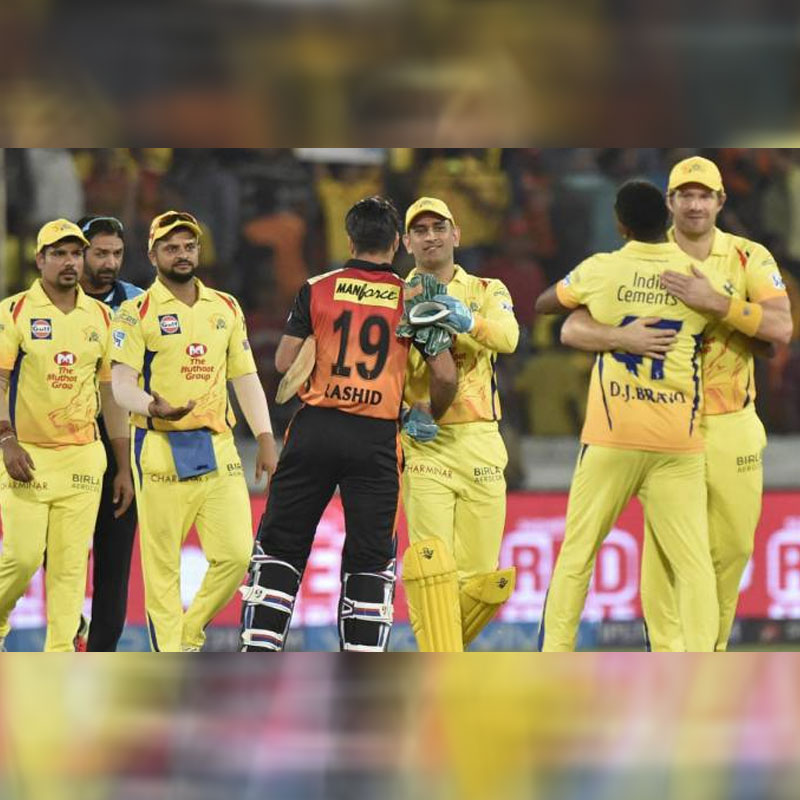
    MUMBAI:  The VIVO IPL final on 27 May 2018 garnered a record viewership on both digital and TV, as per figures released by the broadcaster Star. The final, which was aired live on 17 channels across eight different languages, powered the network’s growth by 34 per cent with 52.9 million average impressions.

    The final between Chennai Super Kings and Sunrisers Hyderabad was produced with 11 live feeds across the TV network and Hotstar. The match had the highest reach (211 million across screens) in the history of the cash-rich league.

    Hotstar hit a world record for concurrent online viewing with 10.7 million viewers for the final. The contest that saw CSK’s Shane Watson score a century to hand the yellow brigade its third IPL trophy helped Hotstar create a new record of over 10 million concurrent users.

    The match witnessed a sudden hike from eight million to 9.1 million and then to 9.7 million before hitting the 10.7 million mark.

    The Grand Finale on television was watched by a historic 160 million fans across Star TV network (not including DD) versus last year’s figure of 121 million, recording a 32 per cent growth in reach. This is the highest television reach recorded for any match in the history of the tournament.

    The television viewership for the tournament as measured by average half hourly time-weighted impressions was 1.4 billion impressions (U+R 2+) with a growth of 15 per cent. The viewership growth in urban audiences was 26 per cent.

    The total television viewership for the tournament as measured by gross impressions was 9.985 billion impressions with a growth of 19 per cent across urban + rural and 30 per cent in urban audiences.

    Also Read:

    Star spending up to Rs 2 cr on production per IPL match

    Hotstar creates record of 10 mn plus concurrent viewers for IPL finale 

  • The World of TV according to BARC

    The World of TV according to BARC

    MUMBAI: Numerous soothsayers have time and again been saying that linear TV worldwide – and in India – is dying.

    But shush, the Broadcast Audience Research Council (BARC) has come out with a report entitled The Changing Face of TV in India that clearly states that the good old idiot box is doing very well – thank you.

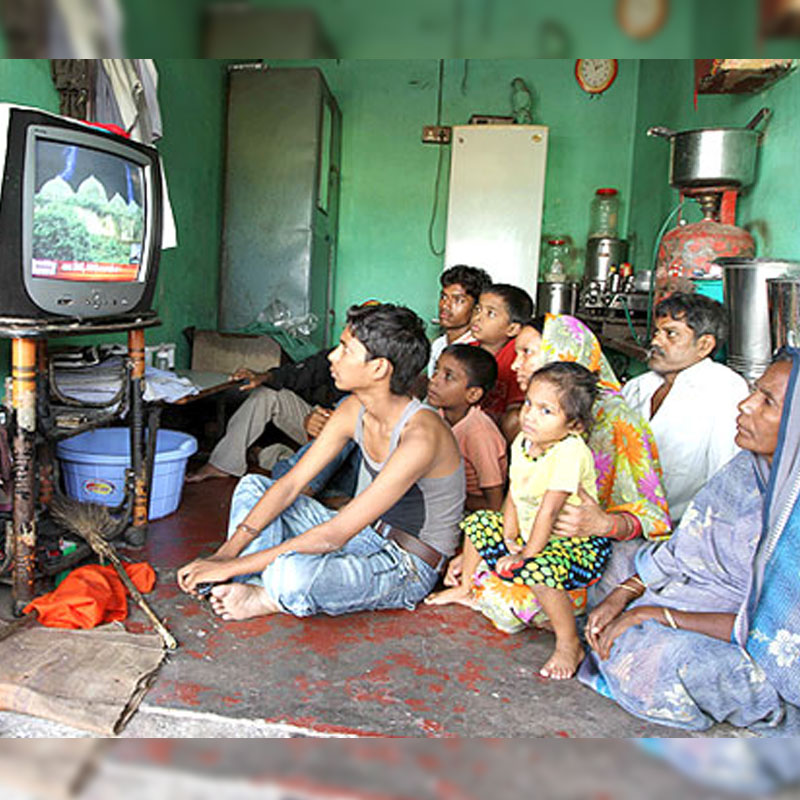
    Some of the reasons TV is flourishing, JIO juggernaut or not, is because of the improving state of electricity, digitisation, increasing nuclear families, better distribution, growth of free to air (FTA) channels, increasing migration, an increase in the middle class bulge and the continued sustenance of single TV homes.

    The BARC report points out that in 2015 there were 162 channels, in 2017 they had risen 74 per cent to 282, while pay channels grew only 14 per cent from 210 to 240 in the same period. This has resulted in pay TV viewership falling from 77 per cent to 69 per cent, while FTA viewing has gone up from 23 per cent to 31 per cent. Channels have been delivering content in various languages that has led to a spurt in viewing. For instance, Gujarati programming viewing has grown 146 per cent in 2017 over 2016; Assamese 123 per cent, Marathi 74 per cent and Bangla 68 per cent.

    What has been remarkable, says the BARC report, is that between 2005 and 2018 the number of channels launched skyrocketed from 130 to 800 plus. Most of these were delivered by DTH or cable TV, which saw terrestrial TV – read Doordarshan – viewership getting eroded from 50 per cent to two per cent in the same period while total DTH’s and cable TV’s shares jumped from 50 per cent to 98 per cent.

    BARC has estimated that the TV universe size in India is 183 million households (99 million in rural and 84 million in urban) representing 780 million individuals. But the sad – or rather the good – news is that 87 per cent of urban India has been penetrated by TV while the figure for rural is 52 per cent. This number should delight any broadcaster as there are many homes that are yet to be reached by television.

    The viewership monitoring firm has revealed that almost 86 per cent of India has the old world fat cathode ray tube TV; flat screen/LED/LCD TVs are there in only 14 per cent of the national population (20 per cent in urban and eight per cent in rural).

    Plus there is the fact that the number of multi TV households is 5.1 per cent in urban India and 1.9 per cent in rural India. Almost 97 per cent of Indian homes have just a single TV set. Has the TV revolution really hit India, one may pause and ask, keeping in mind these numbers?

    What’s more, only 23 per cent of rich large joint families belonging to NCS A+ have multiple TVs, the majority are happy with their single television. So money is not a criterion for buying a second TV set –  big fat Gujarati or Sindhi or Tamil or Punjabi families seem to be happy watching their TV in their living rooms together. The family that watches TV together stays together, it seems.

    BARC has stated in its report that altogether there were 560 million tune ins daily leading to an overall national consumption of three hours 44 minutes and 28 seconds of TV daily. What was remarkable is that even though the southern markets have only 191 million tune-ins, it led to a lot more gorging on TV as compared to the tune-ins in Hindi speaking market (HSM) which numbered 375 million. As a whole, southern viewers tuned into TV for four hours nine minutes and 25 seconds; while their Hindi speaking cousins stayed glued for three hours 31 minutes and 36 seconds daily.

    Viewers in Maharashtra watched good old TV for four hours one minute and 36 seconds while viewers in Andhra Pradesh/Telangana tuned in for four hours 12 minutes and 56 seconds. BARC says there is a lot of headroom for growth as Punjab/Haryana/Himachal Pradesh and JK watched about three hours and 28 minutes of TV daily as compared to the Portugal TV viewing public whose consumption crossed fours and 36 minutes every day.

    http://www.indiantelevision.com/sites/drupal7.indiantelevision.co.in/files/styles/large/public/tvsets111.gif?itok=diHt-dPS
    TV consumption is changing in India

    Even as naysayers have been saying that the youth of India have forsaken their living room TV viewing for personal viewing on portable devices, BARC says that this is all humbug. In fact, it says that viewership in the 15 to 30 age group has increased in just a year and that demographic consumes the most amount of TV daily.

    The BARC report has come up with some interesting bite-sized nuggets about TV viewing habits:

    • Rising temperatures (read: the onset of summer) led to a fall in viewership in both 2016 and 2017 from week 14 to week 30.

    • Viewers in the south tend to watch more TV during festival holidays while those in the Hindi speaking markets don’t make any extra efforts to reach for their remotes. For instance, viewing in the south went up 16 per cent on 30 September 2017, namely Dussera, while it went up one per cent in HSM. This trend was starker in the case of Diwali between 18 and 20 October 2017. Viewing in Tamil Nadu rose 30 per cent; in Kerala 30 per cent; in Andhra Pradesh 19 per cent and in Karnataka 21 per cent. The HSM folks – well they watched just one per cent more TV.

    • Public holidays are the time when both the HSM and south market viewers tend to stay glued to their living room TV sets. On Independence Day in 2017 viewership in both HSM and south went up 19 per cent.

    • Migration is impacting consumption of language content in different states. Bhojpuri TV, for instance, gets 44 per cent of its viewing share from Bihar/Jaharkand and 15 per cent from Uttar Pradesh/Uttarakhand. However, 41 per cent of its consumption is coming from other states with Gujarat/Daman & Diu and Dadra Nagar Haveli accounting for 6.5 per cent of this; Delhi for 4.9 per cent and Assam, Northeast Sikkim for 4.1 per cent. Tamil is the second most popular language in Bengaluru accounting for 16 per cent viewership while Telugu accounts for seven per cent and Hindi three per cent. Kannada, of course, is the main language at 74 per cent.

    • States that are more literate are watching more TV. Maharashtra/Delhi, Tamil Nadu, Gujarat/Daman & Diu and Dadra & Nagar Haveli, Karnataka, Andhra Pradesh and Telangana figure among the high TV watching states and they also have literacy rates in the range of 68 per cent to almost 90 per cent.

    • Cricket’s viewership is getting chipped away. Where once almost all of India huddled around cricket games on TV, in 2017, the game with the willow accounted for 69 per cent of viewing; kabaddi for 15 per cent; wrestling and soccer for five per cent each while other sports accounted for the remainder viewer. What is noteworthy is the 83 per cent growth in viewership for kabaddi in the year.

    • Salman Khan, yes the man India loves, ruled among the top Hindi movies watched since 2015. Four of his films figure in the top 15 list with Bajrangi Bhaijaan at an eye-popping 7.82; Prem Ratan Dhan Payo at 7.66; Sultan at 3.49 and Tubelight at 2.87.

    • Women are increasingly watching news; demonetisation week on 8 November 2016  saw overall news viewership rise 56 per cent between the previous four week’s viewership and week 45 of 2016. Women kept glued to TV, showing an increase of 37 per cent in their viewership in that period. In week 1 of 2017 during Rashtra ke Naam Sandesh, 3.6 times more women tuned into the show as compared to the previous four weeks, while the figure for men was 3.5 times.

    • Hindi content is being watched by 500 million people weekly (read GEC); with the Hindi movie genre being tuned into by 471 million viewers every week. Most of the genres grew in their weekly reach between 2016 and 2017 with Hindi music, Hindi news, kids, Hindi youth, sports, Bhojpuri GEC, Hindi news regional, Bhojpuri movies, Telugu GECs, and infotainment notching up 319 million, 309 million, 255 million, 176 million, 159 million, 141 million, 139 million, 128 million, 107 million and 107 million respectively. The only three genres which de-grew in the period were: sports at 200 million, Tamil GEC at 106 million and English movies at 82 million in their weekly reach.

    • Urban India loves watching reality TV shows/talent searches; drama and soaps; mythologicals and costume dramas, horror serials, game shows, cartoons/animation and feature films in that order.

    • The genre wise breakup for rural India is dramas/soaps, mythological dramas, talent searches and reality shows, children’s programme, game shows/quiz, feature films and finally cartoons and animation.

    Dramas on TV also see very stark trends according to BARC. For instance, marriage tracks seem to boost ratings 13 per cent as compared to the previous weeks, says BARC. Jail tracks see eyeballs go up 15 per cent as compared to previous weeks. The coming together of casts of different shows helps boost ratings by 20 per cent, it has revealed in its study. Drama rules even in news since July 2016 with consistent developments and events all the time leading to the genre seeing some increases in viewing, ditto with sports – a gripping match with ups and downs, preferable ups for India sends TV audiences into a frenzy.

  • Hotstar Trends 2017: Women, small town, cross-language consumption rises

    Hotstar Trends 2017: Women, small town, cross-language consumption rises

    MUMBAI: Want to get a handle on what kind of traction that India’s answer to Amazon and Netflix –  Hotstar from Star India – is getting? Well, the OTT service has come out with an India Watch Report 2018 (IWR 2018) – just as the IPL is around the corner in a bid to pique brands’ and ad agencies’ curiosity and jiggle their memories.

    Says Novi Digital Entertainment (Hotstar)  CEO Ajit Mohan in a preface to the report: “The biggest change (between 2017 and 2016) has been how consumers are responding to the explosion in access to affordable data. Three years ago, most new data users would start with messaging, do text search, move on to social platforms and a few brave ones would watch video on the mobile network. This pyramid has been completely inverted. In a world that does not fear data charges, video is very often the first port of call for new data users. Familiar stories, whether TV shows, movies or sports, unconstrained by any language limitation, are acting as powerful triggers to light up their smartphones and their data connections.”

    The study says that Hotstar was the most downloaded video app for 2017 with a total of 325 downloads per minute totting up to an incredible 170 million downloads cumulatively. Hotstar users gobbled 3 GB data per month as compared to the average user who consumes 1.6 GB a month. Almost 90 per cent users logged on to the Hotstar app on their handsets even as there was a 6X growth in those consuming it on their connected TVs. What were they watching? 96 per cent of them gulped down videos longer than 20 minutes, thus rubbishing the long held notion that OTT users snack on short form content.

    According to IWR 2018, ViVO IPL 2017 saw a jump of 6.6 times in watch time as compared to 2016. And 70 per cent of men who consume video online were on Hotstar watching the T20 journey during its 2017 edition.

    The good news is that women are also coming online in a big way, says Hotstar. Consumption by women from smaller towns (between one and 10 lakh population) grew by three times in 2017, even as that by women in one million plus population towns and in metros doubled. The consumption growth is pretty rapid when it comes to women from places like New Barrackpore (5X), Siliguri (6.5X), Kanchipuram (5X) and Ranchi (4.7X).

    Overall watchtime is growing at an astounding clip, says the IWR in the non-metros.  In cities like Moradabad the growth was 22 times, Allahabad (13X), Hubli (12X) and Sonipat (12X).

    Hotstar notched up some other records, says  IWR 2018 – it crossed a billion minutes of watch time in a single day several times in 2017.

    Viewers cannot seem to be getting enough of the content IWR 2018 says: In 2017, cities like Delhi, Mumbai, and Pune switched off their phones at 2:37 am, 2 am and 2:35 am respectively. In Gurugram, Amritsar and Kolkata, the curfew time came out as 2:08 am, 2:15 am and 2:05 am respectively while for Bengaluru, Chennai and Hyderbad, the cutoff time was 1:59 am, 1:38 am and 1:54 am respectively. Not unexpectedly, the largest share of watchtime came from Mumbai.

    What were Hostar subs watching?

    Unsurprisingly, the nation’s most-watched genre is drama, and while West Bengal and Maharashtra can’t get enough of romance, Tamil Nadu and Delhi revel in comedy! And doing away with set notions that only women watch drama, IWR 2018 says that 50 per cent of watch time for shows such as Yeh Rishta kya Kehlata Hai was accounted for by men. Youngsters too are turning into drama with their tribe accounting for 63 per cent of watchtime of Ishqbaaaz. To add to that, Indian women accounted  for 18 per cent of watchtime of  Bahubaali 2: The Conclusion.

    The report points out that 70 per cent of premium users who watched English shows and movies also viewed other programming genres and languages. 26 per cent of Modern Family watchers tuned into cricket; 26 per cent of Game of Thrones viewers watched Hindi TV shows, and 14 per cent of premier league watchers popped up the app’s Bengali TV shows.

    The Champions Trophy final between India and Pakistan 2017 resulted in it – at 113 million views – emerging as one of the most globally watched online videos in the shortest span, that is eight hours.  That same nail-biting final saw 4.8 million simultaneous viewers making it the event with the highest concurrency seen in APAC.

    And the viewing of one day internationals saw a spurt of five times in 2017 vs 2016.

    Which sports are gaining popularity in India?

    The IWR 2018 says football is India’s second most loved sport and grew massively with watch time for the ISL rising 3.5 times and for the Premier League by 10 times. The Vivo Pro Kabaddi League saw its watch time skyrocketing nine times over 2016.

    The crown of the most watched show in 2017, according to IWR 2018, goes to the Rajan Shahi produced Yeh Rishta Kya Kehalata Hai. No surprises in the English show category with Game of Thrones emerging on top, and Big Boss Tamil and Telugu reigning in their respective languages.

    Also Read :

    Video Lighting up Data and Smartphones, Says Hotstar

    Hotstar announces partnership with awesomeness

    Leaving a Job is never easy, Hotstar gives you the best ways to #QuitInStyle

  • Regional news’ online viewership is billion-plus every month: Vidooly

    Regional news’ online viewership is billion-plus every month: Vidooly

    MUMBAI: News genre is emerging in popularity across leading online video platforms in India and crossing a billion-plus online viewership every month.

    Vidooly Media Tech conducted a study across top Facebook pages from India and YouTube channels from India, two of the most popular video platforms to understand viewership habits of Indian internet users.

    Vidooly CEO Subrat Kar says: “Interestingly, we are seeing a rising trend of regional content dominating English or ‘Hinglish’ content. This points to the larger overall trend of increasing viewership and internet growth in non-urban areas. This presents an exciting opportunity for brands and content creators to create multilingual content to reach out to the millions of users to are accessing internet for the first time.”

    The study was conducted across a total of 16 categories of Indian video content in the genres of automobile, comedy, kids, education, entertainment, film and animation, science and technology, health, gaming, how-to and style, food, music, news and politics, people, pets and animals, sports and travel.

    With over 180 million users on YouTube and 241 million users on Facebook in India, they are the two of the most popular online video platforms in India. Both the platforms with its massive reach and ubiquity allow content creators, brands and anyone to reach millions of viewers who consume this content across desktop and mobile devices.

    YouTube findings (across top 10 channels)

    Music genre with 3.2 billion views and entertainment genre with 2.7 billion views attracted maximum Indian viewership. Video content targeted towards kids especially nursery rhymes were also extremely popular with 1.4 billion views.

    Regional news is extremely popular on YouTube with nine out of the top 10 news channels publishing news in regional languages. Collectively, the top 10 news channels pulled in 701 million views. Most other viewed videos were across the categories of comedy, film and animation and food.

    public://55555555555555.jpg

    Facebook findings (across top 10 pages)

    Unlike YouTube, news pips other genres to emerge the most popular category with Indian viewers with the top 10 pages pulling in collectively 1.4 billion in viewership. Here, the top spots are taken by Hindi and Marathi news channels. Followed closely are entertainment videos with 919 million views across the top 10 Facebook pages. In entertainment category, regional content again takes the top spot with content in Tamil, Kannada, Telugu and Hindi being extremely popular with viewers.

    public://66666666666_0.jpg

    Regional trends

    Across Facebook and YouTube, regional news across the languages of Telugu, Hindi, Tamil, Kannada and Marathi are extremely popular with Indian viewers collectively amassing 2.1 billion views in August across YouTube and Facebook.

    Overall rankings

    Across the top 100 channels in India on YouTube, content around music entertainment, news and kids’ genres took the top spots.

    Across the top 100 Facebook pages, the top seven spots are dominated by news channels, followed by cooking and entertainment genres.

  • Republic TV has 51.9% viewership in debut week: BARC gives data to paid subs despite NBA’s request

    MUMBAI/BENGALURU: It’s a coup of sorts. The leader in the English news genre has been surprised by the newcomer — Republic TV. According to BARC India viewership data for week 19, Republic TV has got 2117 weekly impressions and Times Now lags with 1148. NDTV 24×7  (352), India Today Television  (350) and CNN News18  (315) have respectively bagged the third, fourth and fifth positions.

    The controversy-ridden Arnab Goswami-headed English News channel claims on its channel a 52 percent viewership in the very first week of operations which started on 6 May 2017 – this would be Broadcast Audience Research Council of India (BARC) week 19 (Saturday, 6 May 2017 to Friday 12 May 2017). The channel started mentioning this news around 11am today. BARC in normal course gives data to paid subcribers at 11am. It has done it is this time too despite NBA’s caution.

    public://barc_001.jpg

    The channel says that the English News genre leader until week 18, Times Now could garner only 25 percent viewership. Comparative numbers for other channels mentioned by Republic TV are: CNN News 18  and NDTV 24 X 7 – 7 percent each and India Today Television 8 percent.

    As reported by us earlier, the News Broadcaster Association (NBA) had written to BARC on 17 May urging it not to release Republic TV’s viewership data until Republic TV completely stopped the NBA alleged malpractice of being on multiple LCNs’/genres on several DPOs’ and MSOs’. 

    The channel has been running a special show  – at the time of writing –  on which it celebrated its leadership position, bringing in its representatives of its 14-odd news partners who could not praise Arnab, his style of journalism, and his achievement enough. As well as journalists, editors from its team in different parts of the country.  Most of them talked about the fact that the channel was put together in a matter of three to five months, and that its pole position was attained in  English news in just its first week. And they also patted each other on their back for the stories that the channel has been reporting on for the past 10-11 days. 

    “They have raised him to demi-god status,” says a media observer. “Or maybe God status. What will the establishment do now? And what will Arnab and his team do?”