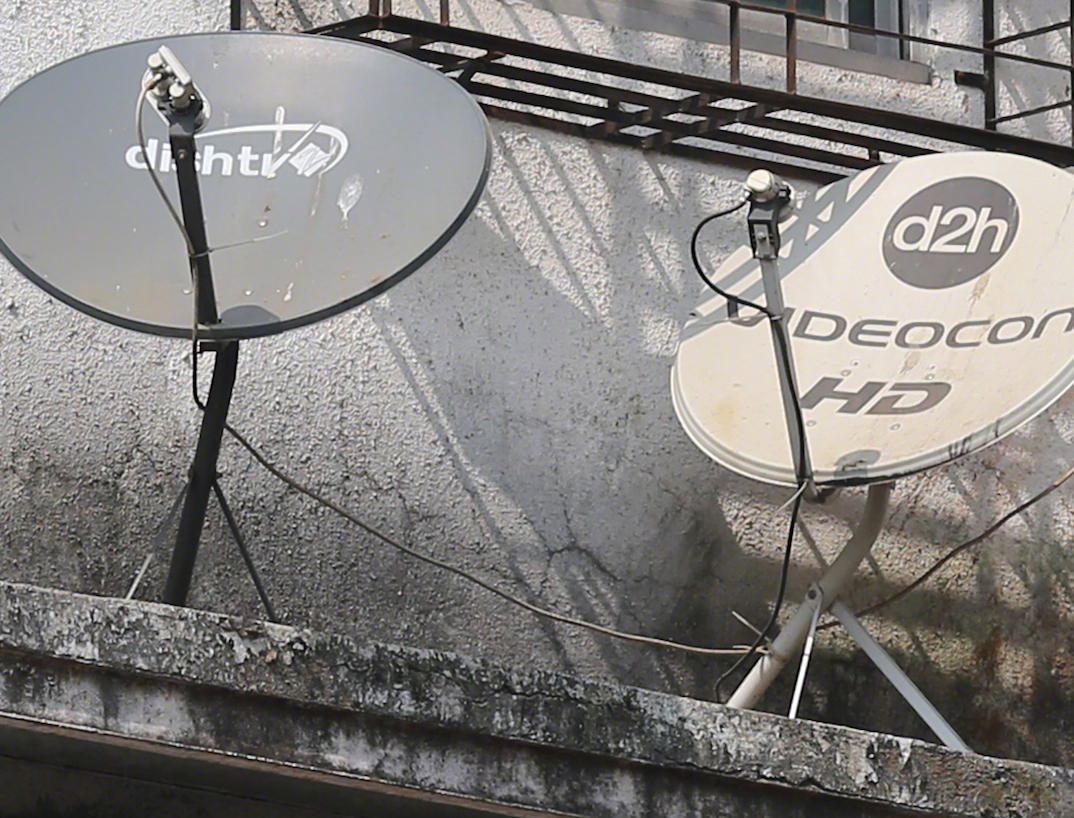
Tag: Videocond2h

  • Dish TV-Videocon d2h lists GDRs on London stock exchange

    Dish TV-Videocon d2h lists GDRs on London stock exchange

    MUMBAI: When Dish TV-Videocon d2h Ltd announced their merger, a presentation to investors had stated that the merged entity would issue global depository receipts (GDRs) on the Luxembourg exchange. However, probably what it meant was the London stock exchange. Which is what happened last week.

    The world’s second largest pay TV company in terms of subscribers announced on 13 April that 277,095,615 GDRs (each representing a fully paid equity share) have been listed and permitted to trade on the professional securities Market of the London Stock Exchange. These have an approximate value of $315 million while DishTV Videocon d2h has a market cap of $2.2 billion, based on the ordinary shares listed in India.

    This followed the ingestion of Videocon d2h into Dish TV India on 22 March 2018. The former had American depository shares listed on Nasdaq; these stand delisted and have been exchanged for Dish TV’s GDRs.

    Said Dish TV India chairman & managing director Jawahar Goel: “The amalgamation of Videocon d2h and Dish TV has put the new entity on the road to exceptional future growth and profitability. Having London Stock Exchange as a partner in that journey will make it much more rewarding. We now look forward to leading the DTH industry in India to the next level.”

    Dish TV India group chief executive officer Anil Dua added: “We are extremely pleased to start trading on London Stock Exchange today and increase our visibility to international investors, following the successful completion of the merger between Videocon d2h and Dish TV. The merger and the eventual listing has been long awaited news for many. I wish to put on record here, our commitment to make the new entity reach unprecedented levels of growth and success in the coming years.”

  • Cable TV, DTH and OTT distribution

    MUMBAI: Having an OTT service is not enough; you’ve got to get it out on every outlet possible, is something we all know. But are traditional TV distributors like DTH and cable TV open to giving them carriage? That was the topic of discussion on one of the panels at Indiantelevision.com’s second VIDNET – Content on the Go powered by Viu conference in Mumbai’s Hotel Westin.

    On stage were Shemaroo CEO Jai Maroo, DEN CEO SN. Sharma and outgoing Videocond2h COO Himanshu Patil.

    Maroo said Shemaroo was interested in getting its content on every service – DTH, cable TV, OTT, traditional linear channels, or even YouTube.

    “We have done content supply deals with all the four major DTH operators and are about to do some with cable TV as well,” said Maroo. “Our content has to be on every screen.”

    He added that the company is constantly mulling over the idea of setting up its own OTT but has not gone ahead on it. “Every six months we visit the thought of doing our own app,” he shared. “But I see what’s going on with our other VOD partners and we drop it. We may do it when we think the time is right. Currently, we are curating and packaging our large content catalogue to them”

    Patil stated that the DTH provider had partnered with Shemaroo for several VAS services that Videocon d2H was offering to its subscribers. “And mind you they are willing to pay as much as Rs 30-40 for the service like Darshan, And its not only high end HD or 4K customers who are at the premium pack end who are willing to subscriber to our BAS service. Even the basic pack customers are” disclosed Patil. “So OTT players should take heart from our experiences – the willingness to pay is there as long as you provide her with the content she wants.”

    He added that Videocon2h is ready to embed any OTT app into an user interface on the DTH service. “We are currently integrating Netflix with our connected box, and are talking to almost every OTT player in India to do the same,” he said.” I’d rather have my customer stay with me for my DTH service and offer him the entire bouquet so he can move out into VOD when he wants and come back into linear television when he wants. We will be working on voice activated search and discovery which will enable to him find every piece of content related to that search.”

    He revealed that the operator had dropped the idea of serving an on-the-go app to its subscribers. “All the broadcasters are coming up with their own apps. It did not make sense for us to have our own,” he explained.

    DEN’s Sharma disclosed that the MSO had, on the other hand, unveiled its own OTT on which it was offering traditional linear channels as subscribers had expressed the need to watch these on their hand held devices or on the go. “But it’s early days for us and we are learning along the way,” he said. “We know we have to aggregate content, apart from our normal linear fare. We have 2,500 movie titles, and other video on demand fare. ”

    He highlighted that he was open to integrating any app or OTT service into the DEN network. “Yes, we are willing to partner, possibly, initially to provide customer service and get the apps or OTT players traction, but we would like to see revenue coming our way at some stage,” he elaborated.

    The fact that this would benefit his Boomband broadband services was not lost on him. “It will be a win-win for all of us,” he expressed.

    He said DEN was working on getting boxes into homes which would enable regular TVs to become smart. “Very soon,” he said.

    He was not worried about the impending launch of Jio Fibre or Jio DTH wherein rumours are that it will disrupt the wired broadband market just as it did in the wireless space.

    “If it goes the free way like it went for its 4G mobile service, I am sure no one will be able to stand up against it,” he stated. “But the fact is that it is going to take time to be available nationally. So lets’s wait and watch.”

  • Arnab’s Republic ready for news battle

    MUMBAI: It seems to be one of those rare media projects that is launching with a battery of advertisers and sponsors. Also, it is an exceptional new television channel that had little or no difficulty in reaching out to the right audience through myriad platforms — linear TV, through cable and MSOs, and OTT.

    Arnab Goswami’s Republic TV, which is being launched at 10am on 6 May as www.indiantelevision.com reported weeks ago, will have a strong digital presence through Reliance Jio‘s over-the-top (OTT) platform Jio TV and Star India’s video-on-demand (VoD) platform Hotstar.

    Star and Jio happen to be among the eight original sponsors of Republic TV. Others advertisers include Renault, Vivo, Hike Messenger, Ola, Yes Bank, Microsoft and Future Group. Vivo is also the presenting sponsor of the 9-pm show, while Microsoft is the technology partner. 

    It appears as if it is having a near-perfect launch. With a high decibel marketing campaign – online, outdoors, on ground – which has made almost everyone in the major metros sit up and take note.

    Republic TV will be available  on cable TV, direct-to-home (DTH) and OTT platforms, its digital avataar being republicworld.com. Amongst the DTH platforms which have given it carriage, according to reports,  include: Videocon2h, Tata Sky and some say even Airtel has hopped on board. The MSOs which have reportedly signed on the dotted line include: DEN, Hathway, Manthan, and Ortel. However, some cable and DTH operators may not offer the channel for free or it would be made a part of a bouquet.

    Goswami’s ‘pro-military and nationalistic’ and may be pro-establishment, will have the biggest OTT advantage with Hotstar 135 million downloads. The free-to-air (FTA) channel will bridge the Indian national news vacuum in Hotstar’s portfolio. Hotstar, which offers premium, free and original content across genres, live-streams Sky News and Fox News owned by 21st Century Fox, its parent company. Star earlier exited from the news business as regulation does not allow foreign holding of 51% in television news franchises.

    Goswami believes (being on Hotstar) was the first step as news produced in India goes digital, and then global, since the non-FTA paid VoD platform would take news to  90 million-plus viewers every month. 

    The former Times Now editor had teamed up with Kerala NDA vice-chairman and Rajya Sabha MP Rajeev Chandrasekhar in launching Republic TV. Other investors in ARG Outlier include DEN Networks promoter Sameer Manchanda, senior investment banker Hemendra Kothari, Aarin Capital’s Ranjan Ramdas Pai, Asian Heart Institute’s Ramakanta Panda and TVS Tyres’ R Naresh etc.

    Headed by an idealistic journalist and master-presenter, a near-perfect launch of a nationalistic channel in  times of nationalist dispensation notwithstanding, it remains to be seen how it performs in the jungle of warring news channels. As a senior executive  of a long standing English news broadcaster says: “Republic TV has made the right kind of noises at launch phase. Its key challenge will be sustainibility and that too over the long run. Rivals have deeper pockets and clout; they have not really reacted aggressively against it. When they do, it will have to put up its best, and that will determine its road ahead.”

    Also Read:

    Of Arnab’s Republic, nationalism, need for opinionated media & ‘outdated’ BBC

    Republic TV buzzing with pre-launch teasers featuring ‘soft’ targets, issues

  • What the Netflix, Vodafone, Videocon d2h and Airtel tieups mean

    MUMBAI: It clearly is looking at spreading its net far and wide, at least on the availability front. Global video on demand service Netflix has announced the signing of partnerships with three of India’s leading players in the DTH and mobile telephony space: Airtel, Videocon d2h and Vodafone.  

    CEO Reed Hastings was in Delhi yesterday and is expected to be in Mumbai over the next few days to probably make a few more announcements.  Said Hastings at the conference: “India is one of the top 3 markets for Netflix in terms of mobile usage. We’ve had strong growth here; it’s stronger than all of the other Asian nations. It’s a larger market. In terms of investments, we are investing heavily into content. The watch time of our shows has gone up significantly since the launch of Jio.”

    He added: “India is one of the most important and vibrant countries in the world, and we are delighted to be teaming up with three of its leading companies to make it much easier for consumers to enjoy Netflix. In the months and years to come, we look forward to bringing our Indian members more compelling stories from all over the world, and ever-improving viewing experience, and incredible joy.”

    Details of the Videocon d2h tieup were made available through a press release yesterday. It said that Videocon d2h consumers will be able to enjoy Netflix on a large screen by simply clicking a dedicated Netflix button on the remote control of HD Smart Connect set top box (STB).

     Netflix will be available through a dedicated app available on the connected Set top box, HD SMART STB  which converts any existing TV into a Smart TV besides showing more than 600 channels and services in high definition and standard definition. The HD Smart Connect set top box allows viewing in SD and HD, using the satellite feed like any other Videocon d2h set top box. It can be connected to the Internet through any Wifi or Ethernet connection in the home for accessing a curated set of applications available through the Internet. The minimum Internet speed needed is 2 Mbps. These apps, both free and paid cover a range of content genres and utility apps. By connecting the HD Smart Connect STB to any TV, the TV would become smart.

    The Airtel partnership is expected to be in the same vein. Hastings told journalists that “we are focussed on the set top box with them so that the device attached to the television has Netflix on it, so they can stream directly to the television. In case of Vodafone, it is a mobile partnership wherein payment for Netflix will be integrated via mobile billing or through pre-paid schemes.

    With more than 94 million members (read subscribers) worldwide, the tieups will give Netlflix access to  humungous potential audience numbers.

    Says a media observer: “It’s a master stroke of sorts.  Depending on whether the Airtel DTH partnership extends to the mobile parent;  whether the partnership with Videocon d2h extends to Dish TV when they merge, and to Idea when it partners with Vodafone, the potential member base could extend the Netflix service to around 500-600 million potential viewers. And around 300 million smart phone and DTH viewers. Clearly Netflix means business in India.”

    The media observer who was unwilling to be quoted stated that what Netflix will have to look at pricing in India if it wants to become a mass brand.

    “We will get to know over time whether it is playing the volume game or the premium niche game. Currently it is the latter. Rs 550 to Rs 700 per month is limiting its subscriber base. But the advantage of Netflix’s higher pricing is that it can share more with its partners on the other hand, apart from the data consumption revenue that will accrue to the telco,” she said. “Our estimates are that its paid subscriber base in India is sub-500,000. All the other players are priced much lower and are yet to take off. Even Hotstar is struggling despite having a great content offering. And Amazon is almost giving away its content for free with its 499 per year package. Netflix will  have to decide which route it is taking.”

    Hastings acknowledged this to the media saying that Netflix  could come up with other payment plans – like a weeky one or daily, keeping in mind the purchasing power in India. But the current model is working well with the top 10 per cent, he disclosed. ” Our main focus is on adding more content. What we really want to be is a content solution, where you can get almost all you want to view in one place on Netflix.”

    Media observers expect other announcements soon – possibly a partnership with Jio? An office is likely to be set up in Mumbai by 2018. Hastings is slated to meet some production biggies in Mumbai in the coming days apart from following up on the progress of Sacred Games Phanton Films is producing for it.

    Watch this space!

    (Updated on 7 March at 1:15 pm)

    Also Read :

    Netflix: 46% of streaming couples cheat & watch ahead of partners

    Videocon d2h partners Netflix for HD Smart Connect

  • Indigenous STBs, courtesy ABS Productions

    Indigenous STBs, courtesy ABS Productions

    MUMBAI: Efforts have been on to spur Indian companies to manufacture cable TV set top boxes (STB) domestically – the government has been encouraging and nudging the private sector to do so.  The Mumbai-based ABS Seven Star group – which runs a health channel and a cable TV network in Mumbai – seems to have taken the bait. It has set up a new company called ABS Productions Pvt Ltd which has designed standard definition (SD), high definition (HD) and hybrid STBS – both MPEG2 and MPEG4 – and contracted Videocon group company Trend Electronics to manufacture them at its Aurangabad plant.


    “Trend Electronics also makes STBs for Videocond2h and it has very good experience doing so. Hence we have struck up a manufacturing alliance with it,” says ABS Seven Star CMD Atul Saraf.


    Saraf has hired a 20 member team for the STB manufacturing initiative – 14 of these are working on the software while the rest will be looking after the hardware. While the manufacturing unit has a 30,000 STBs per day capacity,  its first order will roll out of the assembly lines by 15 May.  “The first order is for our cable TV network ABS Seven Star, which is close to 50,000 boxes,” he says.


    Saraf points out that close to $1 million has been pumped into R&D while designing the STBs locally.


    Saraf is a firm believer of indigenous manufacturing of STBs. “When the government mandated implementation of digitisation, it was since then, that I was against importing boxes from abroad. These plain vanilla Chinese boxes are of poor quality and need to be replaced every couple of years. Also, a big disadvantage is that there are no service centers,” he says.


    He reveals that local manufacturing will ensure better service standards apart from generating employment.  “Phase III and IV markets will need approximately 100 million STBs.I hope to capture about 5 per cent of this by next year” he says.


    Based on the Broadcom chipset – ensuring better video quality – the higher end boxes will have a recording facility as well, apart from being able to deliver internet.  The Hybrid STB will also deliver a video on demand service. “We are not tying up with any OTT platform for this, but will create our own platform to facilitate the VOD service,” says he.


    In order to ensure better service, 200 Videocon d2h service centers, across India, have been roped in to bandage and spruce up the STBs should they face any problems in close proximity to their installation.


    ABS Productions has priced the  MPEG2 SD box at  Rs 1200-1300, the MPEG4 SD box at Rs 1400-1600, the MPEG4 HD box at  Rs 2,300-2,400 while Hybrid Box is priced at  Rs 3,500-3,800.