Tag: Videocon d2h

  • The DTH industry’s big developments in 2014

    The DTH industry’s big developments in 2014

    MUMBAI: 2014 was the year of mixed fortunes for the direct to home television industry in India. The seven players in the industry continued to burn cash as customer acquisition costs continued to stay at high levels, at least one of the players spent a large part of the year looking for a white knight, all the players pushed ahead with their HD offerings in phase I, and II digitisation areas, leading to attractive rises in average revenues per user. The total number of registered subscribers and active subscribers, for all the six DTH players, as per the Telecom Regulatory Authority of India (TRAI) report, as on 30 June 2014 was 67.57 million and 38.24 million respectively. Close to 43.41 per cent of DTH subscribers were inactive till June 2014.

    At least two of the players have started generating positive cash flows during the year, even as new spectacular announcements of preparing launches of Ultra HD or 4K services were made during the year. Fresh debt and equity infusions, efforts to introduce new subscriber packages, and an announcement of new policy directions for licensing DTH by TRAI were the hallmark of the year.

    The DTH industry in the country saw some big innovative changes being made over the year 2014. These helped the industry in adding more subscribers while marginally increasing the average revenue per user (ARPU).

    The year began with three DTH operators, Tata Sky, Sun Direct and Reliance Digital TV being issued notices by the Information and Broadcasting Ministry (I&B) for not showing the mandatory 24 Doordarshan channels. Later on the Ministry also pulled the entire DTH industry for not paying licence fee worth Rs 2066 crore.

    The DTH ops resisted the amount stating that they had been paying the fees on the gross revenue (GR) basis while the government was extracting it on the adjusted gross revenue (AGR). A court case on the same had been pending from nearly four years and is still ongoing. However, Tata Sky and Reliance decided to challenge the same in the Telecom Disputes Settlement Appellate Tribunal (TDSAT) while Sun Direct made an application on its 2009 petition regarding AGR.

    The licence fee case was put in the backburner by the TDSAT stating that since it is relative to the telecom case on licence fee issue, it would hear that case first and then come to the DTH case. By the end of the year, however, the TDSAT agreed to hear the DTH ops separately rather than wait in line, the case is still on. Tata Sky in the meanwhile has already paid a sum of Rs 383 crore to the I&B Ministry, while Dish TV awaits court orders.

    The budget 2014 got some relief to the set top box (STB) manufacturers by reducing the excise duty from 12 per cent to 10 per cent from February to June 2014. However, they continued to fight the entertainment and service tax that was being levied on them since several years while cable operators go without paying it. Dish TV raised the issue with the finance minister Arun Jaitley and then I&B Minister Prakash Javadekar to discuss the multi layered taxes, which however didn’t lead to any conclusive solution on the same. DTH ops are subjected to licence fee, 12. 3 per cent service tax and also entertainment tax at the state level.

    The DTH Operators Association also saw a change of head with Dish TV CEO RC Venkateish replacing Tata Sky MD and CEO Harit Nagpal. Doordarshan ADG Ranjan Thakur who also headed Freedish moved out due to the expiry of his term.

    Freedish has been working on adding several Indian as well as international channels through its auctions while also setting up MPEG-4 boxes alongside MPEG-2 for the interior parts of the country.

    Several new innovations came across last year. Tata Sky introduced a new feature of Karaoke on TV while Videocon d2h came out with a headphone attached to the remote for watching TV without disturbing others. Both of them also were the first ones to introduce 4K HD TV set top boxes in the country. However, the official commercial rollout for both has yet to happen. Tata Sky even did a live telecast of one of the FIFA world cup matches on its 4K TV as a demo.

    Dish TV on the other hand, chose to go local, by introducing customised packs for regional India. A sub-brand ‘Zing’ was launched that would give localised packages in the states of West Bengal, Odisha, Tripura, Seemandhra, Telangana and Maharashtra. The oldest DTH operator also heaved a sigh of relief when after months, it received the nod from the Sri Lanka government to commence operations for its DTH project in the neighbouring country.

    With markets being more receptive, Videocon d2h, which has been planning on launching its IPO since long, went ahead with its filing to SEBI for Rs 700 crore with seven banks managing the share sale. Much of what it can raise will go towards acquiring STBs and outdoor units. Dish TV is also contemplating on starting its own manufacturing unit, though it hasn’t laid any concrete plans on it yet.

    TRAI played a big role when it came out with its DTH licencing recommendation paper which is now pending before the I&B Ministry. The paper restricted broadcasters from owning more than one DPO which is likely to affect Dish TV/Siti Cable under Zee and Sumangli Cable/Sun Direct under Sun Network.

    The paper however extended the 10 year licence period to 20 years while the one time entry has been retained at Rs 10 crore. DTH operators whose licence term expires after 10 years will be allowed to apply for a 10 year extension. The licence fee has been reduced from 10 per cent of GR to 8 per cent of AGR.

    The earlier norm of providing a bank guarantee (BG) of Rs 40 crore was change to the amount payable as a licence fee for two quarters and will have to be renewed year on year till the end of the licence period. New entrants will however have to provide a BG of Rs 5 crore for two quarters and then progress as above.

    The year ended with the Comptroller and Auditor General (CAG) of India coming out with a scathing report on the management of satellite capacity for DTH service by the Department of Space (DoS). In it, it stated that over the years the DoS has been lagging in its satellite launches that were required by DTH operators, leading to them migrating to foreign operators and loss of revenue to the government. The DoS had also goofed up on charging Sun Direct and Prasar Bharati leading to a loss. On the other hand, its commitment to Tata Sky for first right of refusal for using its Ku band transponders, led to its transponder space remaining idle for years.
  • Tata Sky gets ID in its basic pack

    Tata Sky gets ID in its basic pack

    MUMBAI: Even though many niche channels fear that people don’t consume them as they don’t fall into the base pack offered by the platform operators, the newly-launched ID-Investigation Discovery from Discovery Network’s stable has now hopped onto the basic pack of direct to home (DTH) operator Tata Sky on channel number 135.


    The channel was launched about three months ago and currently reaches about 30 million houses. ID is also available on Dish TV, Airtel Digital TV, Videocon d2h, Siti Cable, Hathway, Den Networks, GTPL, InDigital and Digi Cable.


    The channel provides shows on crime and investigation that are dubbed in Hindi. Speaking on this development, Discovery Networks APAC EVP and GM South Asia and South East Asia Rahul Johri said, “ID has been recognised for its distinct appeal, refreshing programming and unique positioning. We are delighted to have Tata Sky as our distribution partner and its viewers can enjoy the best investigative programmes in Hindi in the comfort of their homes.”


    Series that will air on ID include Disappeared, Who the (Bleep) Did I Marry?, I was Murdered, Evil,I, I Married a Mobster, Blood Relatives etc.

  • How DTH got digitisation right

    How DTH got digitisation right

    MUMBAI: Two years gone, two more in hand. But the cable TV industry is still grappling with getting its act right for digitisation. It was 10 years ago when the direct to home (DTH) players entered the Indian market with huge tasks in hand: introduce and convert people from the analogue regime into the digital ecosystem.

    Currently, the DTH sector commands about 36 million active subscribers (as per the recent TRAI report). While Dish TV was first to enter, it was soon followed by Tata Sky, Sun Direct, Airtel Digital TV, Videocon d2h and Reliance Digital. Not to forget, Prasar Bharati’s DD Freedish.

    How did the DTH industry manage to cultivate the business model which the MSOs are still finding cumbersome? Ask the DTH players and they say, it is because of their direct contact with the customer. “We were able to deal directly with the customer and provide a business model the way we wanted to. There isn’t any intermediary,” says Dish TV CEO RC Venkateish.

    Agrees Sun Direct CEO Mahesh Kumar, “DTH adopted the retail distribution model akin to aggressive FMCG/ telecom companies which is purely B2C. Majority of the employees at the senior and middle level are from the retail background.”

    The MSOs on the other hand had been running the analogue business, handled mostly by the local cable operators (LCOs). It was only after being pressurized by the government and regulator that they finally took up digitisation and started work on creating a proper business model. Tata Sky CEO Harit Nagpal feels that MSOs are working like puppets. “Cable operators are looking at digitisation as forced upon them. Digitisation is not about putting a box; this is inconvenient for the customer. It has to be sold to the customer as empowerment and not as a curse. DTH has done that.”

    While initially convincing the customer to switch from analogue to digital DTH wasn’t easy, what went in their favour was superior product offering with better quality sound and picture and selection of channels and packaging. “When DTH first came, it was the only digital offering. The country was largely analogue. That was the big advantage we had. We started from zero and had the opportunity to build the billing system and packaging,” says Venkateish.

    The claims made by DTH ops were supported by setting up call centres, backend and investment in brand building. However, what all executives agree as the best tool is the prepaid mode of payment. “The biggest success factor of the DTH model is the prepaid model which is a very transparent business model,” says Kumar.

    Nagpal feels that the crux of their model is the consumer centric approach, which MSOs don’t have. “You can activate and deactivate channels and packages whenever you want. Go on a holiday and don’t recharge. This is not yet possible in cable. The benefits of flexibility and empowerment in the case of DTH are in the customers’ hands,” he says.

    The only difference in the two is the pricing models for packages. While DTH starts its base pack at around Rs 200 to Rs 220, cable gives the entire channel list for approximately Rs 250. But Nagpal disagrees, stating that MSOs are not subject to taxes and also gets carriage fees from broadcasters. Whereas DTH, despite paying taxes and also paying for content, gives channels at a decently low cost with options of adding more.

    Kumar points out that DTH community has been able to segment the market and the customer which has helped the industry to do up-selling and consistently improve average revenue per user. Though the initial uptake of dishes was slow, over the years it has picked up speed. The choice of packages, HD channels, addition of newer channels and easy payment methods have put them on the better side of digitisation.  

    While DTH did have the upper hand in entering the market with a fixed plan of action, it is about time the MSOs come to terms with getting addressable digitisation done rather than just fixing boxes in homes. “DTH got digitisation right because we looked at it from what benefits it has to customer and not what the regulator is asking me to do,” points out Nagpal.


  • Epic ties-up with Tata Sky, Airtel Digital and Videocon d2h

    Epic ties-up with Tata Sky, Airtel Digital and Videocon d2h

    MUMBAI: Starting 19 November 2014, Epic channel, distributed by Indiacast, will be available on some of India’s leading DTH service providers; Tata Sky on SD channel 133, Airtel Digital on SD at 125 and HD at 126 and Videocon d2h on SD at 117. The channel is likely to be on Reliance Big TV as well. The channel will also be available across leading digital cable platforms i.e. Hathway, Den Networks, GTPL, IMCL and all leading independent cable platforms. At launch, the channel is likely to be in close to 35 million households.
     
    Epic will have action, drama, comedy, supernatural and narrative non-fiction content, set against Indian history and mythology. The stories will be innovative with high production quality and a distinct look and feel that will appeal to both men and women. Most of the content is shot at real locations with HD cameras. The programming line-up has a mix of fiction shows, narrative non-fiction shows, short form content as well as films at launch. The channel is all set to go on-air by 19 November 2014.


  • Videocon d2h taps into the Star-MSO feud

    Videocon d2h taps into the Star-MSO feud

    MUMBAI: Star India’s incentives on its various channels on RIO has not gone down well with several MSOs in the country, who feel that this will actually raise consumer bills rather than make it easier, despite being on a-la-carte. However, the DTH industry sees a prized opportunity in the whole matter.


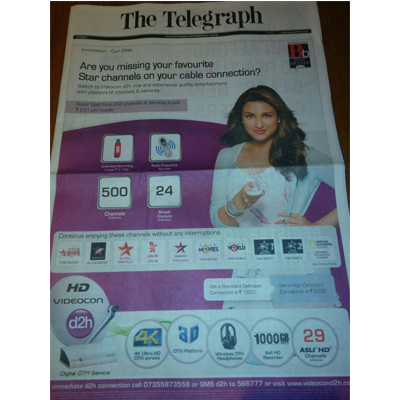
    Videocon d2h has taken out ads in several markets, concentrating in the east of the country, asking consumers to shift from cable to DTH. The ad asks consumers if they are ‘missing their favourite Star channels on your cable connection’ and if so then they should switch to Videocon d2h. The ad also lists the channels that the viewers can watch uninterrupted – Star Jalsha, Jalsha Movies, Star Plus, Life Ok, Star Sports, Star Gold, NGC, Star Movies, Star World etc.


    The ad also points out that viewers can avail 24 Bengali channels on the platform.


    Last week, Star India had come up with a new RIO agreement that it will be enforcing with MSOs across the country. According to Telecom Disputes Settlement Appellate Tribunal (TDSAT), the last date for undertaking the RIO will be 10 November after which the broadcaster can disconnect signals to MSOs.


    The network claims that up to now, nearly 33 per cent of independent MSOs have come forward to sign the RIO.


  • Videocon d2h wins ‘The Economic Times Best Brands’ award

    Videocon d2h wins ‘The Economic Times Best Brands’ award

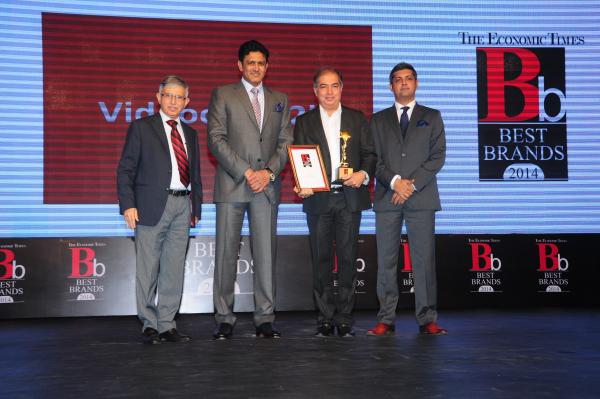
    MUMBAI: Videocon d2h has bagged ‘The Economic Times Best Brands’ award in recognition of its vision to be a DTH category innovator. The DTH operator strives to provide the most advanced products and services as well as to have highest brand recall of Videocon d2h in the category. It also claims to have the strongest brand equity and the most satisfied customer base.

    Videocon d2h was chosen on the basis of its sales, retail presence, media visibility and other such parameters like best in the market, brand innovation and consistent delivery of good quality of services.

    Speaking on the achievement, Videocon d2h director Saurabh Dhoot said, “It’s a matter of tremendous pride that Videocon d2h has been chosen as ET Best Brands this year. The award is a reflection of our commitment to our customers, and the values followed by Videocon d2h. The recognition further motivates us to constantly innovate and bring new products in the market.”

    Videocon d2h CEO Anil Khera CEO added, “We take this opportunity to thank our customers for reaffirming their faith in us. Videocon d2h has been preferred by consumers for its wide range of channels and services offered.  The core values of our brand: innovation, customer centric approach has been recognised by everyone.”


  • MIPCOM 2014: What do buyers want in 4K?

    MIPCOM 2014: What do buyers want in 4K?

    MUMBAI: 4K is on everyone’s mind. Even when Indian direct to home (DTH) players, Videocon d2h and Tata Sky launched their 4K set top boxes (STBs), everyone questioned if there was enough content available in 4K. The same was discussed even at the just concluded MIPCOM 2014 at Cannes in the session ‘What do buyers want in 4K?’


    The session which saw Sky Deutschland EVP programming Gary Davey, France Télévisions director of future media Eric Scherer, Atlantic Productions director of operations Ruth Sessions and Red Bull Media House head of commercial distribution Bernhard Hafenscher speaking on the issue which was moderated by journalist & industry consultant Chris Forrester.


    Talking about the general prospect for 4K in the world, Davey said that a platform like Sky Deutschland is excited about the sea change that content is set to witness. “We will be very active on 4K. While we haven’t decided a launch date as yet, we are committed to it,” said Davey.


    What is interesting is that the take-up for 4K has outperformed even high definition (HD). So, is it the broadcasting push, the industry push or the consumer pull? Said Davey, “According to me, people just love the idea of big screen viewing with higher resolution.”


    For Sessions, content creators today are telling stories for multiple platforms and so a lot of them are filming it in 4K. Atlantic Productions has been filming in 4K for the past four years. “We have always been hungry for resolution and I believe in future proofing. So for the right projects, where we thought that stories that we are saying today will be relevant for the next 10-15 years, we film in 4K,” said Sessions adding that stories benefit when told in 4K.


    Television today has the risk of being over passed by new barbarians-Netflix and by millennial kids. “France TV too, have decided to test with 4K,” added Scherer.


    During the discussion, one thing which came out clearly was that it is sports and sports events which will be most important in 4K. “People can become a part of the sport, when they watch it in 4K. Once the market grows, we will have a lot of content in 4K,” said Hafenscher.


    The other content created in 4K will include high end documentary movies and arts content. “You have to pick the projects for 4K. It needs to mean something and add value,” informed Davey.

    In 3D and 4K quality, there is a lot of information in every shot. “There is so much going on in the image, because of the depth,” said Sessions.


    While content creators are excited about filming in 4K, the extremely high production cost is what keeps them on their toes. “The cost depends on the category of the content. It is expensive, but not multiple of costs. The cost increases also because of multiple use of cameras,” informed Scherer.


    So will 4K percolate to broadcasters? “It will take a little longer than people expect. For a long time, we will be cherry picking the content in 4K. In fact all the promise that ultra HD had made has not been realised as yet,” informed Davey.


    According to the panel, in the next five years, the world could see two-three 4K channels, which would start as special events and then move to a full-fledged channel.


  • Videocon d2h plans to launch IPO by Feb 2015

    Videocon d2h plans to launch IPO by Feb 2015

    MUMBAI: A few days ago, Videocon d2h files paper with the Securities and Exchange Board of India (SEBI) to raise Rs 700 crore through an initial public offering (IPO).
    Rs 350 crore will be used to acquire STBs, outdoor units and accessories from TEL, a Videocon Group entity and Rs 175 crore to repay debt.


    In a recent interview to CNBC TV18, Videocon Industries CMD Venugopal Dhoot has said that it will launch the IPO in the first quarter of 2015.


    “We hope to launch it in January or February maximum, market is good and Videocon d2h has been number one since beginning in customer acquisition from where it started and now it has become number one in customer acquisition,” he said adding that it is looking at doubling its subscriber base within five years. Dhoot highlighted that it currently has 9 million subscribers but will soon become a ‘super profitable company’.


    Dhoot also said that the average revenue per user (ARPU) of Videocon d2h was the same as Dish TV, but a little less than Tata Sky. While speaking at a session at indiantelevision.com’s IDOS 2014, Videocon d2h CEO Anil Khera had said that its ARPU in phase III and phase IV cities have touched Rs 220.


    This is Videocon’s second attempt at the IPO. It had got SEBI’s approval in 2012 but didn’t go ahead with it due to unfavourable market conditions. Seven banks including UBS, Axis Capital, ICICI Securities, SBI Capital Markets, Yes Bank, IDBI Capital are managing the share sale.


    The company is also considering a preferential issue of up to 5,000,000 equity shares, aggregating up to Rs 50 crore with certain investors.

  • Videocon d2h files for IPO to raise Rs 700 crore

    Videocon d2h files for IPO to raise Rs 700 crore

    MUMBAI: For the past couple of years, the stockmarkets have been going through rough weather dampening an entrepreneur’s desire to raise funds through the initial public offering (IPO) route. With a new government in place, and optimism returning, the queue has once again started being formed outside the Securities Exchange Board of India (Sebi) of those going in for IPOs. Shemaroo Entertainment earlier this month approached the public and now it is the turn of the  direct to home (DTH) service provider Videocon d2h which has finally made its filing with Sebi to raise Rs 700 crore.


    This is the second time the firm has proposed to go public. It had previously filed documents in December 2012 and had received a go ahead from SEBI but did not go ahead with the public float.


    Seven banks – including UBS, Axis Capital, ICICI Securities, SBI Capital Markets, Yes Bank, IDBI Capital will manage the share sale.


    As per the statement issued by the company, “The price band and the minimum bid lot will be decided by our company in consultation with the joint global coordinators and book running lead managers.”


    The company is also considering a preferential issue of up to 5,000,000 Equity Shares, aggregating up to Rs 50 crore with certain investors.


    “Our Company will complete the issuance and allotment of Equity Shares pursuant to the Pre-IPO Placement, if any, prior to the filing of the Red Herring Prospectus with the RoC. If the Pre-IPO Placement is completed, the Issue size will be reduced to the extent of such Pre-IPO Placement, subject to the issue size constituting at least 10 per cent of the post-Issue paid-up Equity Share capital of our Company,” the notice also stated.


    The company plans to spend a portion of the Net Proceeds of the issue towards acquisition of set-top boxes, outdoor units and accessories thereof from TEL, a Videocon Group entity.


    “We propose to utilise Rs 350.83 crore of the Net Proceeds towards acquisition of set-top boxes and outdoor units from TEL,” the statement added.


    The company is also looking to spend Rs 175 crore of the net proceeds to repay loans. “We may utilise a part of the Net Proceeds to repay/prepay certain term loan facilities availed from IDBI Bank Limited and ICICI Bank Limited, which are associates of the JGCBRLMs, IDBI Capital and I-Sec, respectively, and YES Bank, one of our JGCBRLMs.”  The amount left will be used for other general corporate purposes.


    The company commenced DTH operations in July 2009 and has grown its subscriber base from 0.44 million gross subscribers as of 31 March 2010, to 11.21 million gross subscribers, as of 30 June 2014, which represents approximately 16.2 per cent of the total DTH subscriber base in India.


    For the first quarter of 2015 the company has approximately 27 per cent incremental market share of the DTH subscriber base in India.


    The total income of the organisation for the three months ended 30 June 2014 was Rs 537.7 crore, during which time it generated net loss of Rs 78.15 crore. The firm has clocked a net loss of Rs 2,126 crore over the last five years.

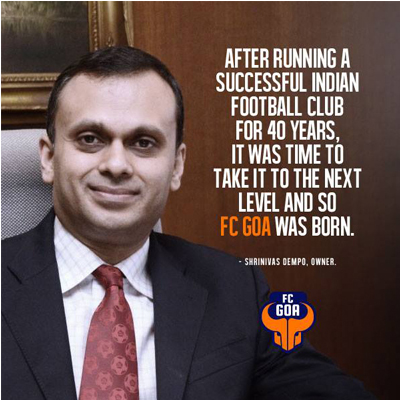
  • We will break even in 2-4 years, says FC Goa’s Shrinivas Dempo

    We will break even in 2-4 years, says FC Goa’s Shrinivas Dempo

    MUMBAI:  Think Goa, and the imagery that one gets is that of sun kissed beaches and churches. Well, Goa is much more. While Sunday afternoons are a  siesta time for many, villages here come alive with sports fans coming together to organise and participate in what seems to be Goa’s first love – football.


    Local clubs like the Dempo’s, Salgaocar’s and Churchill Brothers are known names, which through years of play and support from their respective owners, have become a household name in the state. However, now the fan base is set to expand, thanks to the upcoming Hero Indian super League. With eight teams from across the country gearing up, it doesn’t come as a surprise that Goa too has a franchise called FC Goa.


    Owned by Dempo Group of Companies chairman Shrinivas Dempo, VM Salgaocar and Brothers managing director Dattaraj V Salgaocar, Videocon Group chairman Venugopal Dhoot and cricketer Virat Kohli, FC Goa is geared up for the tournament.


    The club has global football legends as part of its team. Arthur Antunes Coimbra better known as Zico is their marquee coach. Zico has been a part of three world cups playing for his national team Brazil. Former Arsenal star Robert Pires is the team’s marquee player.


    Dempo, a well known businessman, is a massive football fan and is also the vice president of the All India Football Federation (AIFF). He is of the opinion that the league promoted by Star, IMG-Reliance and AIFF has come at the right time. He explains with an example, “Youngsters today, do not wear cricket jerseys. They wear jerseys of Arsenal and Chelsea. We need to convert these youngsters to home grown players.”


    When asked why the football fever hasn’t caught up in the country despite a format like the I-League already existing, he explains, “We were always in a dilemma why people were not taking to the I-League.  And we felt it was the egg and chicken story.  It was quality and marketing that was required and I think the ISL has provided that platform.”


    At the international draft of the ISL, FC Goa proved to be the most generous as it spent Rs 2.46 crore on seven players. “It’s a high cost game. We are ready to invest money and in a few years see the returns. We will break even in three to four years” he adds.


    In terms of infrastructure Dempo feels that Goa has the best infrastructure in the country but still there is a lot to be done.  The club wants to have a stadium of its own but currently will be utilising the government-owned Fatorda stadium in south Goa.


    Speaking about Kohli acquiring a stake in the team, he informs that it was the cricketer who had approached them a few months back. He says that the cricketer will be an asset to them as he represents sports passion and is a youth icon.


    Dempo says “We have got professional people to run the team. We will be there from a policy perspective and advisory role.”


    Speaking further on Stars role to telecast the ISL matches in five languages, he finds it a very good move which will help the game to penetrate the market. “The quality of coverage of the I-League is really not up to the mark, but here we will get the best of coverage” he adds. He also feels that the I-League will not become what the Ranji trophy has become because of the IPL. The 45 year old says, “The I-League is the core competition and we will continue with it.”


    The team will be investing money to widen and enlarge the reach of the game in Goa. For this, it will be targeting more schools and under the guidance of Zico and assistant coach Arthur Papas, a scientific programme and high-pitched grassroots programme targeting youngsters from nine years onwards is being sketched out.


    FC Goa had announced its principal sponsor as Videocon D2H and kit partner as Adidas. It is also looking at local sponsorships ahead of the kickoff on 12 October. Videocon d2h will also be launching a new channel on its direct-to-home platform centering on the team. A magazine for fans too is slated to be launched.