Tag: Videocon d2h

  • Videocon d2h appoints Saurabh Dhoot as executive chairman

    Videocon d2h appoints Saurabh Dhoot as executive chairman

    MUMBAI: Direct to home (DTH) company Videocon d2h has named Saurabh Dhoot as executive chairman.


    In this newly created position as executive chairman, Dhoot will continue to build the Videocon d2h brand and business model, overseeing all operations and strategic direction for the satellite Pay-TV provider, which has amassed more than 13 million digital subscribers since it launched in 2009.


    Based in Mumbai, Dhoot joined Videocon d2h at its inception, serving as executive director.


    In this position, he was responsible for overseeing the launch of the Pay-TV service and the initial $650 million investment. Through Dhoot’s leadership, Videocon d2h has achieved many “firsts” in the Indian DTH industry like the launch of 4K Ultra HD channel, the 1000 GB High Definition Digital Video Recorder, Wireless DTH headphones and Radio Frequency DTH Remote amongst others.


    “I take great pride in all the success we’ve enjoyed at Videocon d2h, and I feel even more excited about what our terrific team and I will accomplish going forward. With 100 million homes expected to be digitalized in the next five years, Videocon d2h will play a leading role in the ‘Digital India’ campaign. We will continue to bring unique content, new mediums of delivery and innovative services to our consumers. With our new capital infusion from the US, it is time to begin the next wave of exciting growth and expansion,” said Dhoot


    In April 2015, Videocon d2h became the first Indian communications and media company to be listed on the NASDAQ stock market. With this IPO, Videocon d2h is now the most valued Indian company on NASDAQ at a market capitalization of $1.2 billion.


    Media investors Harry Sloan and Jeff Sagansky of Silver Eagle Acquisition Corp engineered the IPO. Silver Eagle contributed its $325 million cash, before payment for transaction expenses and warrant repurchases, and the Silver Eagle shareholders now own approximately 38 per cent of the equity in Videocon d2h.


    “We have been impressed with both Videocon d2h’s rise in India’s DTH market and Saurabh’s talent, energy and vision in leading that charge,” Sloan said.


    Sagansky added, “Videocon d2h is poised for growth, whether launching new dedicated channels and Services or increasing the level of advertising revenues. Under Saurabh’s guidance, the company is well positioned to maintain and expand its commanding market share.”

  • Vserv to offer solutions to telcos & DTH operators

    Vserv to offer solutions to telcos & DTH operators

    MUMBAI: Smart data platform for mobile marketing in India and Southeast Asia – Vserv has forayed into the burgeoning commerce space.


    In an industry-first move, Vserv will now provide an end-to-end solution for telcos and DTH operators, right from the discovery of customers to the transaction of services. This step will empower consumer-facing companies to utilize the combined power of Vserv Smart Data platform and commerce solution.


    With this added capability, Vserv will enable telcos to promote segmented offers across data and voice. By driving these transactions, Vserv enhances average revenue per user (ARPU) for telcos. For DTH operators, this translates into selling segmented channel packs leading to a major jump in subscriptions and higher revenue.


    Vserv co-founder and CEO Dippak Khurana said, “We saw the opportunity to redefine the relevance, simplicity and convenience of these services for the customer. Vserv’s massive reach of 120 million unique users in India combined with this commerce solution creates a disruptive development in the mobile Internet ecosystem. While our Smart Data platform is a revolutionary offering for mobile marketing, with our commerce solution, we now complete a user’s journey from intent to purchase. This unique proposition provides a powerful opportunity for consumer-facing companies, which are seeking to tap into the growing mobile Internet user base. We have always challenged the status quo and this offering is a gigantic leap towards bringing about a radical shift in the ecosystem.”


    The Vserv commerce solution delivering relevance, simplicity and convenience works on a four- pronged approach of: discovery (identifying the right user with Vserv Smart Data), promotion (engaging the user with segmented offers), payment (enabling seamless transaction for the user) and activation (quick and easy activation of the service).


    The total revenue of telco and DTH services in India stood at around $31 billion in 2014, and is currently growing at a rate of 10 per cent per annum. Within this, the share of digital commerce is close to 10 per cent and is expected to grow by 300 per cent in the next four years. This growth will be fuelled by the rapidly expanding Internet user base, which is expected to reach 500 million users by 2018, 80 per cent of which will be contributed by mobile users. With the largest mobile Internet user base in India and its unique proposition of enabling commerce for consumer-facing companies, Vserv is strategically positioned to capture a sizeable market share.

  • “Disorganisation of analogue cable in Phase III & IV will help DTH”: Harit Nagpal

    “Disorganisation of analogue cable in Phase III & IV will help DTH”: Harit Nagpal

    MUMBAI: While India has witnessed Phase I and Phase II of digitisation, the remaining two phases (i.e Phase III and IV) will go a long way in aiding more transparency. Direct to Home (DTH) platforms too are an enthused lot, hoping it will help them gain additional subscribers. 


    Speaking about the expected development Tata Sky CEO Harit Nagpal said, “As digitisation rolls out, we are hopeful that a large number of consumers will move to DTH because analogue cable is little less organised in Phase III and IV of digitisation.”


    Nagpal said that the first two phases impacted approximately 15 per cent of the TV population. According to him, when it came to the process of conversion from analogue cable to digital, about 40 per cent of the analogue subscribers picked up DTH.  Nagpal was speaking at the Asia Pacific Operators Summit (APOS) held in Balli recently.


    Speaking about net additions, he said that the pace had not slowed down. “Even when we were acquiring close to 10 million subscribers as gross, we were getting three to four net additions. Today, the industry picks six to seven million gross, it still makes three to four million net.” Nagpal further added that this would be facilitated by digitisation in places where the first two phases were complete.


    Nagpal believes that the top four DTH players will become cash positive very soon. “It’s on the horizon now. We have already been covering our operational costs. The investment that is really going into the business is going to fund the growth,” he said.


    According to Nagpal, an investor wouldn’t mind finding the growth because on a 10-12 per cent churn, the life of a customer is seven to eight years. As such if the pay back is three years, then an operator has about six to seven years cash life with the customer.


    “Thus an investor is happy to invest and add the gross adds faster and does not mind paying for the investment,” he added.


    While on the one hand, Videocon d2h CEO Anil Khera expressed his displeasure over premium content being distributed for free by Over The Top (OTT) platforms, Nagpal explained his point of view. “I treat myself, i.e. a content access provider, as a grocer. We buy soaps and cereals in bulk and sell them in small packets. If three generations in a single family want to consume bread, rice and pasta we have it stocked. Secondly, if these three generations ordered the food respectively via in shop, over the phone or placed an order online, I have to cater to that and make it convenient for customers.” 


    He further said that he would not go about cursing people as to why content is being given out for free. “I have to make it convenient for the customer to find everything at one place,” he stressed.


    On the added service of video on demand (VOD), Nagpal said that four years ago when Tata Sky launched VOD, it had seen an investment of close to $10 million. Currently the operator was just breaking even on operating costs. “But we know it’s a long term play. It’s not necessarily a play of premium content. In fact, on our first VOD we made available Hindi movies and not English. The reason being English movies’ rights holders were sceptical and insisted on minimum guarantees.”


    On the issue of broadband bandwidth, Nagpal stated that going by the current world wide web phenomenon it was obvious that  video cannot be carried by over the air as the last mile has to be connected by at least some form of wire. He hoped a new entity would cater to this business very soon. 


    “Currently there are a lot of entrepreneurs who provide broadband very well in some areas. They have just been constrained by expansion. We are hoping that in a year’s time the landscape will change. Some funding will come in and then they will expand,” he concluded.

  • Videocon d2h to phase out SD STB manufacturing by 2016

    Videocon d2h to phase out SD STB manufacturing by 2016

    MUMBAI: Sensing a strong business opportunity, Indian direct to home (DTH) operator Videocon d2h is augmenting a new strategy. With the number of High Definition (HD) channels set to increase in the coming years, Videocon d2h, which also manufactures set top boxes (STBs), will be phasing out its Standard Definition (SD) STBs over the next year or so. 


    Videocon d2h is looking at 50 to 60 per cent acquisitions in HD STB space from the current 30 per cent. 


    Speaking at the Asia Pacific Video Operators Summit (APOS) held in Bali, Videocon d2h CEO Anil Khera said, “The cost of difference between SD and HD set top boxes for us is only one and half dollar.”


    It may be recalled that as per the 2013-2014 annual report of the Telecom Regulatory Authority of India (TRAI), the number of HD Pay TV channels has shot up to 34 in 2014 as compared to three in 2010. Indeed the HD feed is a precious value added service for broadcasters and DTH operators. 


    Khera also shared some insights and trends that he has been witnessing in the Indian DTH sector. “In terms of gross adds, the market has been consistently growing and we have seen a growth of eight to nine million new additions in a year. Net additions has been a challenge, and the industry has been able to get net addition of five to six million. As far as the rotation churn is concerned how one retains customers and provides additional services, is a big challenge,” shared Khera.


    Highlighting the biggest hurdle for the sector, he opined that carrying HD channels with a limited satellite bandwidth posed a grave challenge. Projecting that there would be at least a hundred HD channels over the next one and a half year, Khera said, “All the Hindi and English general entertainment channels and movie channels will have a HD and SD feed.”


    A sizeable growth of electronic HD TV sets would compliment this trend further, he said.


    Speaking on Over the Top (OTT) platforms, Khera said that they were not to be seen as a threat but rather as something that can compliment TV services. “However, one disturbing fact is that premium content is available free of cost to customers. If it becomes pay, then it will definitely help the industry because we pay a premium to buy the same content,” Khera opined.


    He also said that the platform, which currently offers Bollywood movie channels on its video on demand (VOD) service is also in talks with Hollywood studios to offer English movies. However, he said that after rolling out its first 4K channel, it will now add Hollywood movies in 4K on the channel soon.

  • Videocon d2h rings opening bell at Nasdaq

    Videocon d2h rings opening bell at Nasdaq

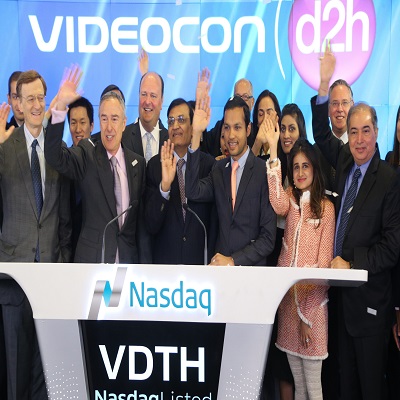
    MUMBAI: Direct to home (DTH) operator Videocon d2h has become the first Indian media company to ring the opening bell at Nasdaq stock market in New York on 7 April.


    The DTH operator has with this become the first Indian private company since 2000 to list overseas, issuing ADR worth $325 million to the public.


    To mark the celebrations, member of parliament, India Rajkumar Dhoot and Videocon d2h managing director Saurabh Dhoot visited the Nasdaq market site at Times Square and rang the symbolic opening bell.


    At an approx market cap of $1.15 billion, Videocon d2h has become the most valued Indian company at Nasdaq.


    Saurabh Dhoot said, “Our listing on the Nasdaq Stock Exchange is a major corporate milestone for the entire Indian media industry not just Videocon d2h and a testament to the tremendous progress we have made under the Digital India vision of our Prime Minister. This is the success of thousands of Videocon d2h employees working tirelessly and our customers who believed in our brand, product and services. We have just begun…”


    As reported earlier by indiantelevision.com, the DTH operator had decided to withdraw its Rs 700 crore Initial Public Offer (IPO) proposal since the company is looking to start the process afresh.

  • Videocon d2h withdraws IPO application; Dhoot to visit Nasdaq

    Videocon d2h withdraws IPO application; Dhoot to visit Nasdaq

    MUMBAI: The direct to home (DTH) arm of Videocon group, Videocon d2h has decided to withdraw its Rs 700 crore Initial Public Offer (IPO) proposal since the company is looking to start the process afresh.


    In September 2014, the company had decided to file draft offer documents with the Securities and Exchange Board of India (SEBI). However, Videocon d2h, through its lead banker Axis Capital, withdrew the documents on 27 March.


    Meanwhile, Videocon d2h executive director Saurabh Dhoot along with Silver Eagle chairman and CEO Harry Sloan will visit the Nasdaq Market Site in Times Square and will ring the Opening Bell 7 April at 9:15 am to 9:30 am ET (6:45 pm IST).


    The operator had completed its initial listing on the Nasdaq Global Select Market through a business combination transaction with Silver Eagle Acquisition Corp, which is founded by Harry Sloan and Jeff Sagansky, pursuant to which Silver Eagle contributed approximately $273.3 million to Videocon d2h in exchange for equity shares of the operator which was represented by American Depositary Shares (ADSs), which were distributed to Silver Eagle’s stockholders. Public trading of the Videocon d2h ADSs on Nasdaq under the ticker ‘VDTH’ commenced at the opening of trading on 1 April this year.


    On the day of the opening, the approximately $37.75 million Videocon d2h ADSs issued to Silver Eagle stockholders were valued at approximately $453 million based on the opening price of $12 per ADS on Nasdaq. Silver Eagle’s capital infusion in the operator represents one of the largest platform investment deals in Indian media by US investors.


    Sloan based on reports had stated that US investor interest in the transaction has been strong as it affords US investors the opportunity to participate early in the US listing of Videocon d2h. “It is the fastest growing DTH Pay-TV operator in India and the fastest growing pay TV market in the world. Beyond this very significant organic growth, we will be exploring numerous possibilities for the company to expand as a force in India’s developing media business,” Sloan had remarked.


    The regulator SEBI in February, had decided to keep the processing of the company’s offer document in “abeyance” following a request made by Videocon d2h in this regard. The company was looking at garnering Rs 50 crore through a pre-IPO placement of its shares to institutional investors, according to media reports. The funds were to be used for acquiring set-top boxes (STBs), outdoor units and accessories thereof, repayment/prepayment of certain indebtedness and general corporate purposes. In December 2012 too it had filed draft documents under the name ‘Bharat Business Channel’ with Sebi to raise Rs 700 crore through an IPO. But the company did not launch the same due to bad market conditions.


  • HD, premium channels, VAS help increase ARPUs for DTH: FICCI-KPMG

    HD, premium channels, VAS help increase ARPUs for DTH: FICCI-KPMG

    The growth of average revenue per user (ARPU) in the Direct To Home (DTH) sector continues, even as digital cable is still struggling to roll out channel packages. As per the FICCI- KPMG 2015 report, due to sustained increase in ARPU, the sector had a healthy revenue growth despite a muted subscriber addition in 2014.


    In 2014, DTH operators saw an increase of around 12 to 15 per cent in ARPUs. While some of the ARPU increase was driven by DTH operators’ ability to continue to push price hikes (there was a price increase in April 2014 of an approximate eight to nine per cent), the more promising trend is that DTH operators were able to increase collections from customers by providing additional services such as High Definition (HD) channels, premium channels and other value added services (VAS).


    As phase III and IV of digitisation draws near, the battle will be closely contested by MSOs and DTH operators. In phase I and II, DTH operators managed to gain 20 to 30 per cent of the subscriber base converting to digital. Two factors, namely an inherent technology advantage and stronger balance sheets, will give DTH players the bonus advantage to take on MSOs, especially the smaller players, in the year ahead. However, in order to gain a bigger piece of the pie, they will have to re-jig their channel packages, in sparsely populated areas so that it becomes affordable for subscribers in Phase III and IV.


    Dish TV’s sub-brand Zing is all set to tackle digital cable players at the regional level. The brand addresses various linguistic needs of subscribers and offers regional specific channels as part of all available packs, while the other channels can be added based on the customer’s choice. It has been launched West Bengal, Tripura, Odisha, Maharashtra, Telangana and Andhra Pradesh.


    When one compares Zing’s package prices, they are cheaper than those of digital cable. For example, the base package of Zing costs Rs 99 per month versus Rs 220 per month for digital cable. Its mid level package carries a price tag of Rs 249 versus Rs 270 per month for digital cable. Besides the content, even the advertising and other marketing activities are done in the regional languages, while customer support services will be at the local level through trade partners, similar to the cable TV model.


    While digital cable operators are still grappling with securing their business model right, DTH operators have focused on increasing monetisation by providing additional value to their subscribers either through innovative services or STBs, such as those with unlimited recording and technology revolution like 4K.


    According to the report, there are four million HD subscribers, accounting for 10 per cent of all DTH subscribers, while 15 to 20 per cent of incremental subscribers in 2014 were HD subscribers. HD adoption continues to drive ARPU growth for DTH players with the average ARPU of a HD subscriber at an approximate 1.5 to 2x the ARPU of a non-HD subscriber.


    Compared to 6.5 million units of panel television sets (LCD, LED and plasma TVs) sold in 2013 in India, eight million units were expected to be sold in 2014, of which 55 per cent was expected to have been HD panel TV sales. The share of HD and 4K TV sales is expected to further increase over the next five years, reaching 80 per cent by 2019. While HD adoption will continue to be a key growth driver for DTH ARPUs over the next few years, adoption of 4K STBs is expected to pick up in India, though lack of 4K content can be a major problem.


    Currently only Videocon d2h and Tata Sky offer 4K services. Live sports action is expected to be one of the enablers of HD adoption, with the recently concluded ICC Cricket World Cup 2015, likely to be a key trigger in 2015.


    All major DTH operators namely Tata Sky, Dish TV, Videocon D2H and Airtel Digital have launched ‘TV Everywhere’ apps on mobiles and tablets through, which subscribers can watch live TV, catch up TV and video on demand (VoD) for an additional monthly fee. While there are several players along the media value chain who have launched online platforms for on-demand content to capture the surging viewer base, DTH operators have a key advantage in monetising these viewers through their ‘TV Everywhere’ apps, given their already existing payment relationships with subscribers.

  • Videocon d2h with $1.15 bn market cap set to become most valued Indian co. on NASDAQ

    Videocon d2h with $1.15 bn market cap set to become most valued Indian co. on NASDAQ

    MUMBAI: Videocon d2h has closed the IPO process and is getting listed on NASDAQ, issuing American Depositary Receipt (ADR) worth $325 million to the public with current market cap of $1.15 billion.


    Videocon d2h IPO has created several milestones by becoming the first Indian private company since the year 2000 to list overseas, largest Indian IPO in US since 2007 and first sizeable Indian listing on US exchanges since 2010, clearly indicating the renewed global focus on India. The IPO has caught the attention of Top US funds with several multi billion dollar funds investing into the IPO.


    At expected market cap of $1.15 billion, Videocon d2h will become the most valued Indian company on Nasdaq.


    Videocon d2h managing director Saurabh Dhoot said, “Our listing on the NASDAQ Stock Exchange is a major corporate milestone for the entire Indian media industry not just Videocon d2h and a testament to the tremendous progress we have made under the Digital India vision of our Hon’ble Prime Minister. This is the success of thousands of Videocon d2h employees working tirelessly and our customers who believed in our brand, product and services. We have just begun.”


    Videocon d2h has launched many firsts in the Indian DTH industry like the first to launch the 4K Ultra HD Channel, 1000 GB High Definition Digital Video Recorder, Radio Frequency Remote for DTH, Wireless DTH Headphones, 500 channels and services.

  • OTT, video apps can work progressively with cable & satellite platforms

    OTT, video apps can work progressively with cable & satellite platforms

    MUMBAI: The market for Over The Top (OTT) services has been rapidly growing in the United States. However, can the same model be adopted for the Indian market? That was the key question asked at a discussion at FICCI Frames 2015 on the topic – ‘Clash of the Walled Gardens: OTT and Video apps versus cable and satellite.’


    Joining the panel were Zenga TV founder and CEO Shabbir Momin, DGive director and CEO GD Singh, IndiaCast group COO Gaurav Gandhi, Videocon d2h CEO Anil Khera, Eros Digital COO Karan Bedi, Hungama.com CEO and Hungama Digital COO Siddhartha Roy and Hinduja Ventures whole time director Ashok Mansukhani. The session was moderated by Whats ON chief executive officer Atul Phadnis.


    Sharing some insights from the US market, Gracenote general manager – video Richard Cusick said that according to a study conducted by the company, nearly 50 per cent of the US broadband households used OTT video services. Young viewers were particularly driving the change as 18 to 24 year olds watched less than half as much traditional TV as 50 to 64 year olds. “Netflix for example has 57 million subscribers worldwide and is a top OTT service provider,” he said.


    Cusick said the study increasingly found that networks and studios were resorting to unbundling to single channels as well as live TV bundles. “In such a scenario, consumers benefit the most as great content is served to them,” he said.


    The question posed to panelists was whether the US implications were similar to that of India and if cable and DTH operators were changing the landscape? Gandhi felt that the implications were not similar to the Indian market because channel specific models like HBO were not available in India. “As a content broadcaster or distributor, the US markets are very clear that they will follow a proper pay model. Here it is still very disruptive,” he opined.


    Moving to the experience of launching an OTT in India, DGive’s Singh said that while they still struggled to generate the right revenues, they did in fact receive 25 million downloads. He said when his company approached someone from the US for guidance for the company’s growth charter in India, the executive told him, “If you’re buying content, you cannot give it for free to audiences.” That was a major learning from the US market.


    On the content front, Singh said that currently the company had 30 per cent of its content set under the pay wall, which was premium content. “We sell our service for $1 per month per subscriber. We have a million users paying us since we are screen, operator and consumer agnostic. We are looking at breaking even in the next seven to 10 months.”


    Sharing his experience, Momin said that Zenga TV had started in 2009 and he was happy with the response from users. “What was surprising in the initial stages was that we saw response patterns coming in from Tier II cities. We now have 20 to 22 million active users per month and have been profitable for the last three years,” he informed. The company also launched a show called India’s Digital Super Star on its platform, which sold sponsorship slots.


    Bedi opined that Eros Digital had 14 million active users, wherein the company followed a transactional as well free model that catered to Indian audiences as well as NRIs. “Some key points for our industry is that we will take a leap; a steroid growth will be seen. Two, revenue models like ad dependent, subscription based, free as well as paid will have to work in tandem,” he said.


    The true value of the customer in the coming years will move towards mobile screen consumption, informed Roy.


    Speaking from the perspective of a direct to home (DTH) operator, Khera was of the opinion that while OTT players may have a million plus subscribers, the content from OTT was for second screen consumption. Technology like 4K is only for television. On a lighter note, he added, “India gets entertained heads up and not heads down.”


    Mansukhani too had a similar opinion. According to him, being an old cable company didn’t mean being out of date. He said that they too provided pay channels on a pre-paid model. “Most Indian homes today use multiple screens. It doesn’t matter who wins. There is space for all as content is being consumed via tablets, mobiles as well as television.”


    Mansukhani went on to compliment Star India’s Hotstar app saying that it was a fantastic proposition.


    “As a businessman, I am interested in exploring various opportunities but I’m worried about providing free content as high content cost is not justified in providing the content without a price tag. I am against giving free content on OTT,” Khera opined. He also hinted at Videocon d2h entering the OTT space but refused to give any details.


    Speaking on the challenges of the OTT space, Roy said that for them to benefit from the digital advertising pie, the pie itself should grow in order for profits to trickle in.


    The notion that OTT platforms are for free should be broken. “OTT is about the bundle and there is no choice if one has to pay or not. Cable companies are our allies as they provide us pipes for distribution,” Bedi said.


    Having the last word, Mansukhani said that all stakeholders should come together and ask customers on the kind of content and pricing for platforms. The profits could then be shared, he suggested.


    In conclusion, the panelists agreed that the three key challenges were cash flow, content windowing and specific business models.

  • Bhojpuri channel Anjan TV hops on to Videocon d2h platform

    Bhojpuri channel Anjan TV hops on to Videocon d2h platform

    MUMBAI: Bhojpuri entertainment channel Anjan TV is looking at increasing its viewership and as part of this has signed a deal with direct to home (DTH) operator Videocon d2h.


    The channel will be available on channel number 861 on the platform. Anjan TV is also available on Airtel Digital TV and all the multi system operator (MSO) platforms in Bihar and Jharkhand. 


    With this, the channel will be available to 12.8 million households across India as a free-to-air channel. The channel is currently in talks with other DTH operators such as Tata Sky, Reliance DTH, etc.


    Carving a niche for itself, the channel offers a programming mix of movies, music, daily soaps, reality, crime, cookery, comedy, travel and lifestyle shows.


    “We are delighted to be associated with Videocon d2h and are looking forward to cater to the needs of its subscriber’s base across India. I would like to take this opportunity to welcome and promise a wholesome entertainment to all our new viewers through this platform,” said Anjan TV channel head Anshuman Tripathi.


    Videocon d2h CEO Anil Khera added, “We continue to add more variety and value through our offerings. We want to offer the whole gamut of channels and services empowering the consumer to opt for his preferred choice of language. We believe in delivering the best for our customers and are hopeful of achieving better penetration, through the addition of this channel.”