Mumbai: Over-regulation could impede the pay-TV industry’s growth in the near term, especially amid rising competition from the OTT platforms, and DD Free Dish’s expanding territories, highlighted industry stakeholders at the Video and Broadband Summit (VBS) 2022 on Wednesday.
The day-long virtual event organised by Indiantelevision.com and co-powered by broadpeak concluded its 18th edition. Disney Star came on board as the presenting partner, while NxtDigital was the summit partner.
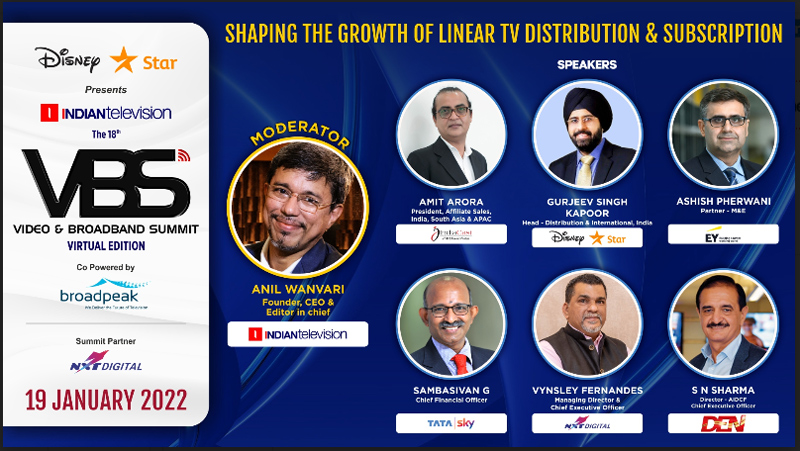
The event witnessed an engaging panel discussion among experts from the broadcast and DTH industry as well as other stakeholders as they examined the challenges faced by the pay-TV industry and deliberated on the opportunities that lay ahead. The session was moderated by Indiantelevision.com founder CEO and editor-in-chief Anil Wanvari.
Overview of pay-TV industry
TV penetration in India is currently estimated at 60 per cent which means that a third of the households are yet to own a TV set. There are around 210 million TV households, growing at seven per cent year-on-year and adding six-to-seven million new homes. The data also suggests that about 12-14 million TV sets are sold every year.
While markets like Tamil Nadu and Kerala have a strong TV presence with 98 per cent and 92 per cent penetration, respectively, other markets like Bihar, Jharkhand, Orissa have a huge headroom for growth. In some markets such as Uttar Pradesh, Uttarakhand, Madhya Pradesh, and Chhattisgarh TV penetration is as low as ~40 per cent.
The Telecom Regulatory Authority of India (Trai) and Federation of Indian Chambers of Commerce and Industry (FICCI) estimated that there are 130 million pay-TV homes in the country. Linear pay-TV business average revenue per user is ~Rs 240 which is less than $3.5.
“The data shows that there are 300 million homes with 4.5 people on average. While the population may remain the same going forward, the number of households will increase owing to nuclearisation of families,” observed Tata Sky chief financial officer Sambasivan G highlighting the headroom for growth in the coming years. “More households will mean more opportunity for pay-TV to grow.”
Migration to DD Free Dish
According to the panellists, free DTH platforms like DD Free Dish are also invading the pay-TV territories and expanding their share. According to the latest data, DD Free Dish run by public broadcaster Prasar Bharati has doubled its base from 20 million to 40 million in the last five years.
“In the last two years, we have seen the migration to Free Dish gaining momentum,” said Star and Disney India head – distribution and international (India) Gurjeev Singh Kapoor. Drawing attention to the impact of the pandemic, Kapoor said, pay-TV homes had tumbled down by two to three million as consumers moved to free TV because they did not have disposable incomes.
Ernst and Young media and entertainment advisory services partner Ashish Pherwani noted that the upcoming FICCI report in March will show a further decline of six million households in the pay-TV universe. The report will also indicate a big growth in the number of connected TV (CTV) households. “If you look at pay-TV plus CTV then there’s a growth that will continue in the future,” he said.
Den Networks CEO SN Sharma maintained that while Free Dish was a noble service that provided entertainment to lakhs of viewers, the challenge emerged when broadcasters charged distributed platform operators (DPOs) money for offering pay channels but gave it free of cost on Free Dish. “There must be a level playing field in terms of regulation,” he said.
Serving the FTA audience
Broadcasters and distributors agreed that the TV consumer in India exists on a spectrum where at the top of the pyramid there’s a customer who watches linear TV, broadband video, and OTT whereas at the bottom of the pyramid there’s a customer who prefers to watch only free TV. “For any product and not just TV, you’ll have a market where there will be a free, a pay, and a premium offering,” said Pherwani.
“Free TV exists even in mature markets such as the US, Europe, Australia, and the Indian consumer always wants more for less,” commented Indiacast president- affiliate sales- India, South Asia, and APAC Amit Arora. “The bulk of DAS 3 and DAS 4 markets are going to remain connected to the TV, however, growth remains a bigger challenge.”
According to the panellists, broadcasters have discovered that being available on Free Dish and serving the FTA audience makes more business sense than moving away from the platform. “Somewhere in 2019, when broadcasters went off Free Dish it was estimated to have a base of 30 million. That audience segment remained there,” observed Amit Arora. “We should look at a different solution and attack the market where free TV is present, rather than wishing this problem will go away if we knock off our channels from Free Dish.”
Star and Disney India’s Gurjeev Singh Kapoor also agreed. “When we vacated that platform (Free Dish) we saw other channels emerging as number one, therefore not being present on Free Dish is not a sensible proposition. You need to have content to entertain people who have less disposable income,” he contended.
According to Nxtdigital CEO Vynsley Fernandes, free TV audiences can be wooed back to pay-TV by offering them a better product. “A Free Dish customer watches 100 channels for free by paying a one-time nominal fee for the set-top-box (STB),” he said. “We created a lifetime-free product that bundled 300 free channels where the customer had to pay a one-time fee for a digital STB. This allowed them to watch any free channel and upgrade their service to access pay channels if they wanted.”
He added, “broadcasters and DPOs need to work together to develop products that cater to different socio-economic classes. Today, we’re struggling to figure out what those step-up products can be because you can’t create a thousand different products.”
NTO 2.0 regulation
After the first tariff order was implemented in February 2019, it took six months for TV viewership to stabilise and consumers to successfully migrate to the new tariff regime. Pay-TV subscribers declined by 12-15 million according to industry estimates which were compounded by the pandemic which struck in March 2020. Experts on the panel believe that the implementation of the new tariff order (NTO) 2.0 during this period of economic recovery would only disturb the whole ecosystem.
“This black swan event has changed the consumption patterns on TV, meanwhile, 20-30 million subscribers have dropped from linear TV due to transitioning from one tariff regime to another,” said Amit Arora. “A lot of economies have shown that restrictive policies do not lead to fundamental growth of the sector. What we need right now is a broad paradigm and notover-regulation”
Highlighting that India has immense competition in the broadcasting sector with 900+ channels and pressure from OTT and Free Dish platforms as well, Gurjeev Singh Kapoor said, in such a market, “the regulator should treat broadcasters with forbearance and let market forces prevail.”
Adding further, he said, “The average ARPUs for satellite and cable TV and DTH providers is Rs 240. But if you look at what broadcasters walk away with, it is not even one dollar. Is that kind of business model sustainable? We have to look at what the consumer can pay best.”
Tata Sky chief financial officer Sambasivan G said, said, there was no to flinch from any price increase as a result of NTO 2.0. “We are charging the customer 50 per cent of what we were charging them 20 years ago for double the content. That means the customer is getting four times the value. Even with a price increase we will still be the cheapest pay TV market in the world,” he asserted.
“The status quo should be maintained for some time,” believed SN Sharma. “Broadcasters have hiked their channel prices by as much as 80 per cent but DPOs are not in a position to handle these kind of price hikes. This kind of disruption will disturb the whole pay TV ecosystem.”
Parity in regulation of OTT and pay TV platforms
SN Sharma observed that all major broadcasters are operating their own OTT platforms and offering their pay channels for relatively low cost compared to pay TV. “There must be parity in pricing on cable TV and on OTT,” he stated.
Commenting on the issue, Gurjeev Singh Kapoor said, “OTT in India is still a second screen phenomenon where a large portion of OTT content is consumed on mobile. It is still not a living room experience. So, I don’t think it is fair to compare linear TV and OTT pricing.”
He added, “In a market like India with 300 million homes, there are 10 million homes that watch TV content on OTT which is not a big number. So, we’re missing the forest for the trees.”
“All our linear TV channels are behind the paywall on OTT and not on AVOD. I believe we should be talking about deregulation of linear TV rather than regulating OTT,” remarked Amit Arora.