Tag: Video and Broadband Summit 2024

  • VBS 2024: Driving distribution success with NexC

    VBS 2024: Driving distribution success with NexC

    Mumbai: India is in the grips of seismic changes as far as video and broadband consumption is concerned. Pay TV cord-cutting is rampant even as free TV subscriptions are on the rise and OTT buy-ins are churning with the signs up for certain platforms stagnating even as others are seeing rapid increases and some are seeing cataclysmic drops. Aggregators of OTTs are popping up on the horizon promising cheap bundles along with value-added services for cable TV and DTH. There’s a rush to set up free advertising-supported TV channels by TV set manufacturers and smart TV device makers. There’s the Jio factor where it is seeking to convert most pay TV customers to free streaming of video content by offering access to consumers at no cost. The consumer continues to demand bandwidths higher than ever imagined even as prices are dropping. Margins are under pressure as every player goes one-up on each other to acquire and retain customers.

    Clearly, the video and broadband distribution landscape has not been as vibrant as it is now… How long will this pot-boiling continue? What will the magic potion of video and broadband look and taste like? And what’s the end game? Indiantelevision.com held its 20th edition of Video and Broadband Summit better known as VBS at Sahara Star Hotel, Mumbai.

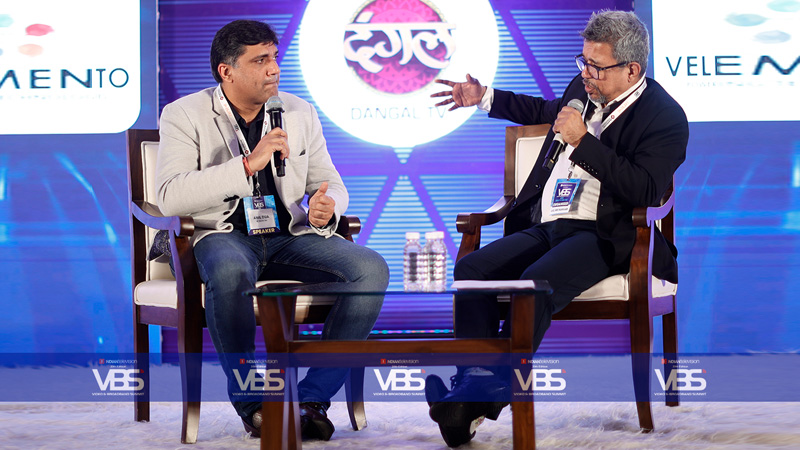
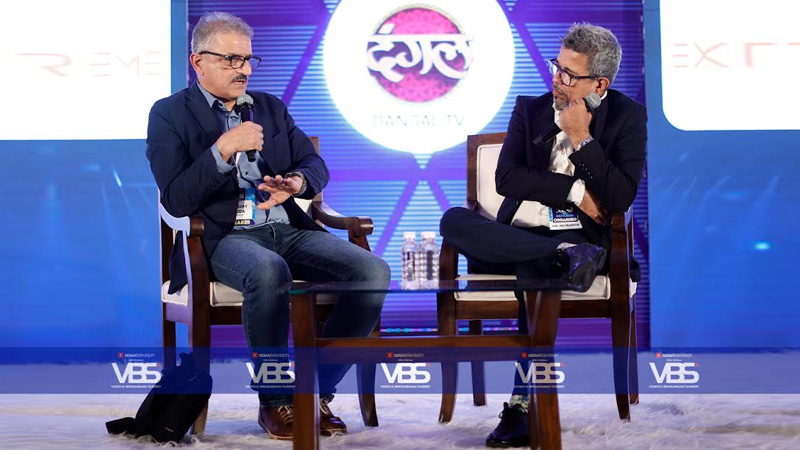
    The fireside chat on the topic: ‘Driving Distribution Success with NexC’ had Planetcast CEO Sanjay Duda in conversation with Indian Television.com group founder, chairman & editor-in-chief Anil NM Wanvari.

    Wanvari began the conversation by asking, “What are the major trends that you all see in terms of the workflows that are going on in production, acquisition, creation, and distribution?”

    Duda answered, “Largely what we’ve seen in the last 25 years and more so in the last seven years, most of the trends are being driven by the fact that on both sides, production and consumption, the creation environment is exploding. There are large, medium, and very small content creators, and they need to deliver ever-increasing profiles of people, and viewers who are viewing across multiple devices. So there are multiple options for delivery and there are multiple creators on this side. This actually is what is creating most of the pressure, it’s creating most of the direction to development. Clearly, content will always be king. It will always be the most important determinant of success. The stress right now is, how do you get your content to the right cohorts of viewers? How do you monetise your content? How do you get your money for the content that you’ve created in the most effective and efficient way? And how do you retain your viewers time after time? Slowly earlier, this whole pipeline had multiple stages, multiple players, there were three or four middlemen, so to speak. There were content creators used to provide the content to a large broadcaster and aggregator. Then they used to process that and then deliver it to the next stage for maybe creating linear channels for playout and slowly creating VOD assets. It then used to go to the next digital platform or cable platform, cable head-end or DTH head-end from where it was then distributed to final consumers who were managed by local cable operators or a DTH operator. This whole pipeline was well-oiled. There were clear business models, people were making money. But now what has happened is everything has been disrupted by the fact that the entire environment has become digital. And we are seeing that the content creator is increasingly able to see who’s viewing the content. Everything is getting driven by data. Information on who is viewing the content, how long they’ve been viewing the content, and that has created avenues for many technologies to come in. Like advertising or targeted advertising, so that you can even earn more for every viewer that you’re reaching. So this is how the overall ecosystem has changed.”

    He added, “From a production perspective, how this has now forced people, forced creators to think, innovate on how to produce your content. Content is of two to three types. One is the live content, which is actually driving this pipeline. Then there is the episodic content, user-generated content. The UGC content technologies are driven by the fact that users should be very easily able to create, curate, and deliver the content. The GECs or the episodic content or the movies, which is the library content, has its own non-linear production behaviour. There too technologies have changed. There’s a lot of VFX, a lot of virtual productions. The world is changing so that you don’t have to create one studio and then break it down and then create it for the next show. And in-between this, is the live. In the live content aggregation, there are a lot more changes. There’s a lot immersive content coming in. Now people get 360 degree cameras at the venue, creating a kind of remote viewer or an e-viewer kind of situation. Also now, data regarding the content that’s going in is also traveling with it. So there’s for sports, for example, all the information about the players is traveling along with it. A lot of the time, you can create a game. Already it’s happening, based on the performance of the players, the rating is determined on a daily basis. There’s a whole gaming industry. So these are the things that are driving the production technology at this end.”

    Wanvari then asked, “Where does your company come into play?”

    Doda replied saying, “I think all the players in this industry have seen change. Initially, there was some amount of denial and then acceptance, innovation, and then change. So we started our journey, providing essentially, distribution over satellite, bringing live videos from the arenas, be it news or sports. But largely satellite driven. We created a huge infrastructure for uplinking, DSNG services. We set up the first commercial teleport in the country and then as the media industry was growing rapidly in the country, our only thought was how do we create more teleports? How do we set up more facilities at that point of time? Then we saw that there are two things that are happening. A: people were going into a zone where they were not too sure. Earlier, most of our services were, because we needed to invest a lot of money to set up this infrastructure to provide services to our four or five customers, we used to always say five-year agreements or 10-year agreements. But as we all have stepped into a world where people have to keep trying. The viewers or the consumers have become very choice-oriented. They don’t want to watch a particular channel or a particular platform all the time. They need the right to stop the subscription and go somewhere else. Similarly, all the broadcasters, therefore, they would also like to experiment, but if they have to be tied down with three-year, five-year contracts, they won’t go there. Therefore, we also realised that we need to create solutions, which are flexible in terms of commitment from customers. And eventually, as some of these services have become robust and they’re accepted, then you’ll automatically see long-term commitments.”

    Doda added, “What we did was we expanded from very infrastructure-heavy services to a set of platform-driven services. We are moving from our on-prem to cloud. What that has done is, on cloud, there are two things you can do. One is that even your services can be flexible in terms of commitments from the customer and you can even deliver services globally anywhere. It connects the entire world and opens it up to you. Whereas infrastructure-based services are you need to set up something and they’re very regional in their influence. What NexC does is, as we have seen over the years, the content journey has four individual stages. One stage is the creation, where you’re creating the content, once you’ve created the content, the content needs to be made addressable. There is a lot of data that has to be attached, meta tagging has to be done, content has to be prepared for consumption, you’ve to check it for quality, technical quality, and SNP, to make sure it meets the content rules and regulations based on where you want to sell the content. You also then create another layer of it, which is localisation. If I’m creating content in India, and the broadcaster or the other publisher wants to deliver it in Korea, or Middle East, or Malaysia. So there’s a requirement for subtitling, dubbing, and SNP. So these are the localisation inputs that go into the client. So that part is essentially content management. Then when you’ve made the content, there is a need to create promos around it so that you’re able to market your content. Then we have the post-production, where you do on-air promotion, creating OEPs or teasers. That’s the second part of the stage that the content goes through these days.”

    Duda further added, “Once that is done, your content is essentially ready for consumption. Either it will go as a VOD asset, which is then delivered to an OTT platform or it could be archived for later use or it will be sent to a playout solution where it is converted into a linear stream. So, that is the third stage. Once it’s created into a linear stream, it is then delivered either directly to customers, or it can be delivered to a cable operator or a digital head end, or a FAST TV channel or FAST digital head end. Delivery is the other aspect of it. So essentially, the content once it’s created, moves from one stage to the other and then the to final destination, which could be your handsets where you’re watching it either on Instagram, YouTube, or Meta. So every platform has its own, technical specs, and you need to create the content for each spec, or it can be delivered to a teleport from where it can be uplinked, or it can be delivered to a digital head-end from where it is delivered through an OTT platform. These three main solutions or you can say modules. We have been involved with all of these three modules over a period of time. First, we started with essentially, delivery, then we did playouts. Maybe six to seven years ago, we got into the post-production domain. Now since we realised that we need to go global, we need to go on cloud, the need was to put it all together under a single umbrella, so to speak. What we found was that it missed only the last stage, which is the OTT. Why we did not go very aggressively initially for OTT because everybody wanted to set up their own OTTs. But we have seen over the years now and we know that it’s going to happen sooner, people will eventually want to outsource the OTT function as well. Right now every OTT has different feature sets. Every OTT player believes that their OTT is something very special, that only they know, they have created. Eventually, all OTT technology will become quite standard, and all features offered will be quite standard. That is where everybody will want to outsource it. It is just a technical platform and that’s what it is. So we therefore put together the entire set of solutions, right from acquisition to delivery to consumption, and this we’ve named NexC, where C stands for comprehensive. Incidentally, it rhymes with sexy.”

    Moving on to his next question, Wanvari asked, “Have you found customers for it so far within India and overseas?”

    Duda replied, “Yes, in fact, we had customers who were using each of these modules, anyway. So as we have started evangelizing the NexC concept, it becomes automatically an upgrade for them. We are able to upsell the other stages, and other services on either side of what they’re using. A playout or customer is ready to utilise the content aggregation. A content aggregation customer is happy to do post-production with us. So that we find a very easy-to-sell, easy-to-manage platform. In almost everything, in all these technologies, what you’ve seen is, that you think of all the problems that you’re solving, and you create a product, and once the product is used, it starts generating its own workflows, its own advantages, and it creates another set of development requirements on top of it. We are already seeing that, because everything is on a single platform, you’re saving a lot of multiple functions, be it a single sign-on, or a common database. We are able to pull a lot of metadata from various stages and eventually, it’s a part of our development plan. We will enable AI-based analytics based on all the data that we’re collecting, and that will automatically give you reports or give you advice on which content is selling better, and which content needs to be sent to which platform, and you can get literally get a real-time feedback on what is happening here.”

    Adding on to that, Duda said, “The idea is that it saves money because you are cutting out a lot of repetition of processes and at the end of the day, it is a solution you can use as long as you want. It takes in all formats. The input formats can range from MXF to MOV to any movie to any. In fact, we are using it for one of our customers, who brings in live feeds from outside. They sometimes bring the worst quality feeds and we are able to stabilise those feeds and put them back into the system. The fact is that this is nothing new. It is well tested, well used by our customers. So it’s nothing new. It’s just putting things together so that people can make better sense of what they’re doing. You’ve seen that there’s so many more questions than answers that are coming up these days. The least that you can do is make things easier and simpler.”

  • VBS 2024: OTT aggregation and beyond

    VBS 2024: OTT aggregation and beyond

    Mumbai: India is in the grips of seismic changes as far as video and broadband consumption is concerned. Pay TV cord-cutting is rampant even as free TV subscriptions are on the rise and OTT buy-ins are churning with the signs up for certain platforms stagnating even as others are seeing rapid increases and some are seeing cataclysmic drops. Aggregators of OTTs are popping up on the horizon promising cheap bundles along with value-added services for cable TV and DTH. There’s a rush to set up free advertising-supported TV channels by TV set manufacturers and smart TV device makers. There’s the Jio factor where it is seeking to convert most pay TV customers to free streaming of video content by offering access to consumers at no cost. The consumer continues to demand bandwidths higher than ever imagined even as prices are dropping. Margins are under pressure as every player goes one-up on each other to acquire and retain customers.

    Clearly, the video and broadband distribution landscape has not been as vibrant as it is now… How long will this pot-boiling continue? What will the magic potion of video and broadband look and taste like? And what’s the end game? Indiantelevision.com held its 20th edition of Video and Broadband Summit better known as VBS at Sahara Star Hotel, Mumbai.

    The fireside chat on the topic: ‘OTT Aggregation And Beyond’ had HT Media Ltd chief revenue officer (HT Labs) Anil Dua in conversation with Indian Television.com group founder, chairman & editor-in-chief Anil NM Wanvari.

    Beginning the conversation, Wanvari asked, “How is OTTplay overcoming the challenge faced by consumers who seek ease of use?”

    Dua replied, “Now you don’t need to go to different apps. we have possibly the largest OTT aggregator platform in India called OTTplay, which covers more than 35 apps containing live TV channels. Gone are the days when you have to worry about the hassle of going from one platform to another to check what exactly you want to watch. So we have solved the problem of what to watch, through our recommendation engine, and also the proper way to stream it because in one app, you will get all the apps together. So that’s OTTplay. Maybe this is a good time for us to show you what our platform looks like.”

    After an AV of OTTplay was played on the screen, Wanvari asked, “You’re aggregating and you’re serving to telcos, you’re servicing to ISPs, cable. So what’s the percentage distribution between them?”

    To which, Dua replied saying, “So we have a very good mix of the internet service providers with whom we do the bundling with the broadband plans. We also have cable operators, through whom we reach out to our customers. We also have a direct-to-customer channel through our digital landscape, which helps us reach out to our clients.”

    He added, “If you look at our content, we have a very good balance across regions. That’s one of the big USPs that we bring to the table. Let’s start with the South. If you go to Coimbatore, their number one OTT Sun NXT is with us. If you come to AP or Telangana, their number one and two OTT and TV, aha are with us. When you go to a Hindi heartland, we have Bhojpuri, for Ludiana we have Punjabi, We have, of course, the large Hindi OTTs, i.e., ZEE, Sony, Lionsgate, etc. We have most of these OTTs. So we are relevant across a spectrum of customers. I believe we are relevant to everyone”

    Wanvari interjected, “I’m not talking about relevance. I’m talking about penetration so far. My understanding is, that you’ll have been pushed so aggressively in the west. You’ll have been more aggressive up north, and possibly down south, rather than the west and the east.”

    Dua answered, “You’re right! So far, south is obviously the leading market for us, followed by the north, west, and then the east.”

    Wanvari then asked, “What’s the kind of watch time that people are spending across your apps?”

    Dua replied, “By DNA, we are a tech company. We have customers at the middle of everything that we do. We track watch hours, average time per user, and average time that each user spends. I won’t be able to share the exact numbers, but it’s pretty good. We have seen that in tier two and three cities, our average time per user goes up significantly. So that’s one of the insights that we have got with focus on the regional content that we have done.”

    Wanvari said, “What is that? Are those areas TV dark?”

    Dua answered, “Things are changing in this pandemic industry. I believe that so far the OTT penetration has largely happened in the larger towns, and there’s a lot of scope in tier two and tier three for both OTT platforms as well as aggregators like us.”

    Moving on to the next question, Wanvari asked, “Are the other lower tier of society picking up your app because of your long package with all 35 plus all the 400-500 TV channels? That’s pretty affordable at Rs 3000/year. But people can pick up regional packs at 100 rupees, etc. So what is finding the most takers and where is it finding, in tier two, and tier three? Is it the upscaled customers or is it the lower ones? Is it mobile or is it Smart TV?

    Dua answered, “So first of all, by design, we are a TV-first app. We want more and more customers to be watching us on television., When I say, TV, it is TV and mobile by default. That’s the first thing. The second thing as you talked about the packs. We have packs ranging from, as high but like you rightly said you said, as affordable as 250 rupees a month for 32 OTTs and 350 plus five TV channels a month. If you come to the regional packs like the Hindi heartland pack or a north pack or an east pack, that starts from as low as Rs 100 a month. So they’re very affordable. The high-income strata in tier two are the most takers. The metros are more around the larger packs.”

    Wanvari further asked, “Do you have specials coming up from time to time, special promotions? Secondly, do you also have special price promotions for the content that has been put out there by your partners?”

    Dua said, “We belong to the HT Media group. We are a media company ourselves. We have our reach through our newspapers, through our digital landscape that we have. One is that we use our own media to reach out to the customers. And we have the content nudges that go to the customers who subscribe to us.”

    He added, “The answer to both your question is yes! If you look at our digital reach across our basic platforms, hindustantimes.com or live mint or live Hindustan, we have 300 million plus, on a monthly basis and use. So we use that, to reach out to our prospective customers to start with and to the subscribers who are already with us. There are time-to-time content nudges that go to them, the new arrivals coming in and reaching out to them to not only continue to be with us but also watch and use us, so that we can offer value to our customers.”

    Wanvari immediately asked, “ Are you EBIDTA positive or are you bleeding?”

    Dua answered, “We are right now in the start-up mode. We are in our third year running. We are now very close to coming to a place where we can start generating revenue.”

    Wanveri further asked, “Is the capacity full or do you see more partners coming in? How do OTT players partner with you all?”

    Dua replied, “Today, we are 32 OTTs. Very soon, by June, we should roughly be at about 43 to 45 and we clearly see that in the short term. In the short to medium term we should be at 50 plus OTTs. So there is no limitation with respect to the capacity. Partnering is simple. If the content is relevant to our customers, we are willing to discuss and partner. There is obviously a different discussion with each of our content partners that we have.”

    Wanvari quickly asked, “So, how long does it take to come up with a partner, to conclude a partnership? Is the process quick or prolonged?”

    Dua answered “My experience has been that gently the closure of the commercial discussion in this kind of business takes about 30 days and then another about 30 to 45 days. In about two and a half months we are GTM ready.”

    Asking a question about their subscriber base, Wanvari asked, “Where do you all see yourselves two to three years down the line? Do you think the appetite will continue in the space when it gets competitive?”

    Dua replied saying, “If you look at the growth of broadband, today we have roughly 50 per cent plus penetration in rural India. The smartphone penetration itself is growing into tier two and tier three by more than 25 per cent every year. So growth is not going to be an issue. Talking about the large telcos, remember that still one-third of the market is with non-telco broadband providers. That market is not only there today but it is also growing. We clearly see that as the market for us. And with bundling with their proposition is how to we want to reach out to the customers. On top of that, we have our D2C channel, which caters to the first two-thirds part of the customer base. A lot of customers of large telcos who have not used the content that is provided by them. So they keep looking for the right platform, and the right value proposition. So that’s how we’re building this whole mix.”

    Wanvari then asked, “You said discoverability is very easy for your customer. How different are you all from Netflix, which is supposed to be the gold standard, in terms of recommendation, search, discovery, and all of that?”

    Dua answered, “We talk about the four pillars of our business. The first pillar of our business clearly is the user experience and the user interface that we bring in. We have single sign-on for most of the apps. If you have, for example, OTTplay with you, and you want to watch Scam 2003 on Sony LIV, because you don’t need to have a Sony LIV app. So it’s deep integration. You can just move from one platform to another within OTTplay without having those apps. That’s the first thing. The second thing that we bring to the table. You talked about Netflix recommendations. If you are a customer or a subscriber of OTTplay, you get AI-based recommendations from all 32 platforms and not just one. So if you’ve watched an action movie or content on one of the platform, the next time you come to OTTplay player you will get recommendations across. The third thing is we are extremely regional in the content that we bring in. Fourthly, of course, is the affordability. We want to reach out, we want to be affordable to the masses of India.”

  • VBS 2024: Perspectives on the advertising economy & the role of video

    VBS 2024: Perspectives on the advertising economy & the role of video

    Mumbai: India is in the grips of seisnic changes regarding video and broadband consumption. Pay TV cord-cutting is rampant even as free TV subscriptions are on the rise and OTT buy-ins are churning with the signs up for certain platforms stagnating even as others are seeing rapid increases and some are seeing cataclysmic drops. Aggregators of OTTs are popping up on the horizon promising cheap bundles along with value-added services for cable TV and DTH. There’s a rush to set up free advertising-supported TV channels by TV set manufacturers and smart TV device makers. There’s the Jio factor where it seeks to convert most pay TV customers to free streaming of video content by offering free access to consumers at no cost. The consumer continues to demand bandwidth higher than ever imagined even as prices drop. Margins are under pressure as every player goes one-up on each other to acquire and retain customers.

    The video and broadband distribution landscape has not been as vibrant as it is now.. How long will this pot-boiling continue? What will the magic potion of video and broadband look and taste like? And what’s the end game? Indiantelevision.com has held the 20th edition of Video and Broadband Summit better known as VBS at Sahara Star Hotel, Mumbai.

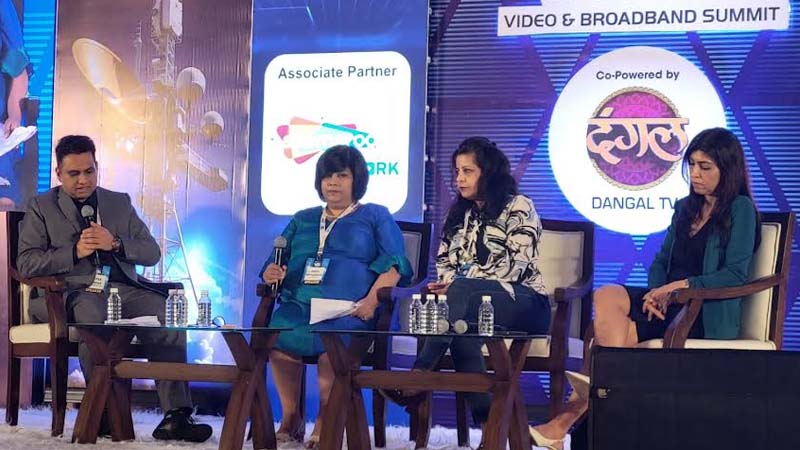
    The session chair for this panel was EssenceMediacom India managing partner Deepak Sonpar along with the panelists: Colgate-Palmolive (India) Ltd director – integrated brand experience lead Priyanka Khaneja Gandhi, ICICI Lombard head- marketing, corporate communications & CSR Sheena Kapoor, and Carat India VP- West Amita Srivastava.

    Sonpar kicked off the session by asking Srivastava of what is the latest ongoing trend which she is witnessing currently in the landscape.

    She said, “ I will be talking about the advertising landscape right now by saying the first thing over here is that there is so much fragmentation right now that it’s an era of choices for the consumers. TV continues to be a very important medium for everybody. But digital is something which has been jumping and leaping its way to the top largely because of the exponential growth of the internet. Mobile smartphones, have given us this option of targeting our audiences. Mobile content is something which is growing very strongly, in fact, a lot of websites now need to be mobile compliant.”

    She also briefly touched upon programmatic advertising because from an advertisers perspective, it is content which is speaking well from the agency perspective, programmatic becomes really important because that helps us deliver efficiencies the best find which is possible to reach out to the kind of audiences which they are looking at.

    She also talked about native advertising, “While we have a lot of content, which is going on, which is a little brash in terms of you’re exposing our brand and talking very specifically about random use pointers, there are some brands which prefer the approach of slightly more seamless integration. And I think they are the ones who are going into this middle of advertising space and utilizing it very well to speak to their audiences.”

    Sonpar then turned towards Kapoor on the question of notable changes in the new age programmatic and artificial intelligence to which she replied, “ In terms of trends overall and how it is changing, when we are talking about proliferation and disintegration of devices because earlier we used to sit around with the family in front of the idiot box when there was certain program where everybody in the household were consuming and therefore was forced to consume the advertising that was being played.”

    She continues, “Today in the same household there are multiple devices not only TV but mobile, laptops etc. The other change is everybody is heading towards content. I will consume what I want to consume, any genre that I like, which makes the task for brands a lot tougher because a) You’re talking about buying the same kind of attention span to the consumers and 2) Social media and the influencers space. “

    She also talked on her recent campain which was completely Gen AI driven and also talked on how personalization is also the new ongoing trend.

    Sonpar then asked Gandhi on how brands have impacted the video content and marketing strategy to which she said, “Let me break it into three parts. One is the narrative of video storytelling, what you want to tell the consumers and when we talked to urban audiences with benefits which are premium, all the way down to rural audiences and then we look at states. Second part is the multiplicity of format and video. The bigger challenge is how you tell a story and what story you tell in a 30-60 second format. The third part of video creation is also you looking at the consumer journey and as a brand what’s the funnel that you really target.

    At the end, Sonpar summed up briefly the key talk points of the session to the audience, “Three words to take away are that the world is getting more and more impatient. We need to plan for smaller, shorter content. Second is brands need to tie up a bit of trust which is the influencers which the people like us look up to. The essence of all innovation and new content is between the attention and engagement which would be the third point. Anything that drives attention and engagement will work and that we need to chase.”
     

  • VBS 2024: Evolving content distribution landscape

    VBS 2024: Evolving content distribution landscape

    Mumbai: India is in the grips of seismic changes as far as video and broadband consumption is concerned. Pay TV cord-cutting is rampant even as free TV subscriptions are on the rise and OTT buy-ins are churning with the signs up for certain platforms stagnating even as others are seeing rapid increases and some are seeing cataclysmic drops. Aggregators of OTTs are popping up on the horizon promising cheap bundles along with value-added services for cable TV and DTH. There’s a rush to set up free advertising-supported TV channels by TV set manufacturers and smart TV device makers. There’s the Jio factor where it is seeking to convert most pay TV customers to free streaming of video content by offering access to consumers at no cost. The consumer continues to demand bandwidths higher than ever imagined even as prices are dropping. Margins are under pressure as every player goes one-up on each other to acquire and retain customers.

    Clearly, the video and broadband distribution landscape has not been as vibrant as it is now… How long will this pot-boiling continue? What will the magic potion of video and broadband look and taste like? And what’s the end game? Indiantelevision.com held its 20th edition of Video and Broadband Summit better known as VBS at Sahara Star Hotel, Mumbai.

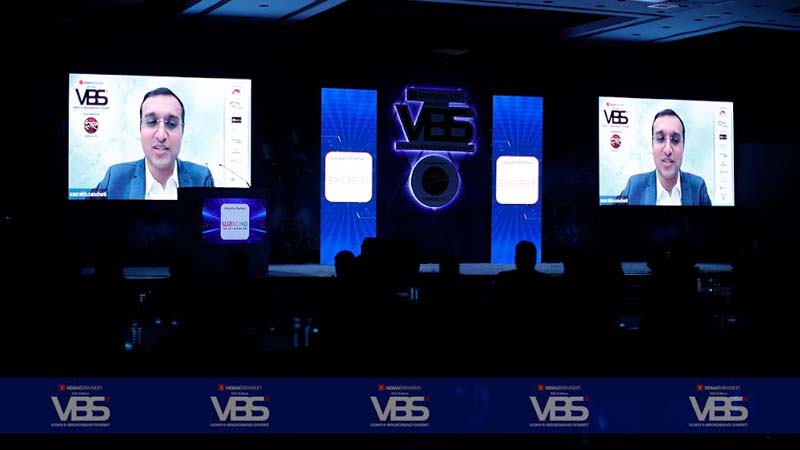
    The very first fireside chat of the event, on the topic: ‘Evolving Content Distribution Landscape’ had Jio Platforms group CFO Saurabh Sancheti as the speaker in conversation with Indian Television.com group founder, chairman & editor-in-chief Anil NM Wanvari.

    Wanvari began the chat by asking Sacheti, how he has seen the content distribution landscape evolve over the past few years.

    Sacheti answered, “I think India is a very exciting market, and content distribution and media is like a market no other. Definitely, the last five years have been a big revolution on all fronts. So let me tell by seeing how the market is today and versus what it will be tomorrow. So today, yes, largely, even today, whatever people may say cable and DTH are very prominent platforms, they have the highest reach, they reach more than 100 million households and there’s a very big proportion, which they are serving directly as a pay TV. There’s a big business, which obviously, the free dish is having and the whole revolution on connectivity, which has changed not just the mobile, but the whole technology around, i.e., connected TVs, and large screens is there. There, we are just scratching the surface. So if I look, actually India had 350 million households, the last bottom 100 and 250 million don’t have a TV, and their only access is low-cost smartphones, for the content. If I look at the top tier, the top 50 million homes have connected TV, and many of them have a pay TV as well, which is where there are two products to the same segment, about 100 million pay-TV homes. So, the distribution landscape is changing very fast, because the numbers are not consumer time and attention is. That is what is leading to a lot of change in the mix of more choices, the customer time, definitely is now getting into multiple channels. So it’s an exciting time. I think the future is exciting for all the mediums of content distribution. Overall as the economy grows more prosperous, definitely the number of users and consumption is there to rise.”

    Moving on to the next question, Wanvari asked, “What are some of the key factors that have driven these changes in content distribution?”

    Sancheti replied, “One good thing that has happened is, definitely a lot of ecosystems are coming together. The access which was earlier very difficult is something which has been made easy. So earlier, we had it in mobility where, as a mobile subscriber, you had to pay 250 rupees a GB and therefore it was criminal to watch video on your mobile phone to now having very affordable tariffs that are less than 10 rupees a GB and everybody can afford a mobile phone with content and that opens up a huge audience. The same revolution, by the way, is also happening in phones, now almost touching 40 million internet users. It’s a very big market which is happening. What connectivity does is because it’s like the baseline infra but what it does is, it definitely changes the overall proposition. At the same time, with this opening up of the market, people are able to take exciting bets and make it really large. I mean, for example, just look at JioCinema and what has happened with digital watching on IPL, it’s like the whole model is pivoted, the whole attention has gone there. Therefore a lot of interesting experiments are happening, which is a very good thing to happen for the overall industry, because that is what maximises the consumer surplus and that really generates a lot of value for everybody in the ecosystem, not just the content producers, distributors, but the consumers as well. So it’s really exciting.”

    Wanvari then asked, “In your experience, what role do the new and emerging platforms play in reaching diverse audiences? How do you identify such platforms?”

    Sancheti then answered, “I’ll break the question into two parts. One is obviously as a content producer and then as a distribution channel. As a content producer, the good thing as I said, in India is there is no one India, there are many Indias, and overall, India is so big that even in the three Indias that I was discussing earlier, you have an opportunity of a global scale. Now, coming to the content producer angle, which is very interesting in India. So, D2C is the buzzword, that everybody’s trying to grapple with it, but the Indian consumer is kind of a high-touch consumer. So, existing relationships definitely prevail and across industries our learning is, that is definitely a winning point. Therefore, wherever you have a distribution channel, whether it be wire, a local cable operator, or a telco distribution, or any other distribution, where you have some touchpoint with the user, you have a lot of chance of getting him converted, and at least sample and if the content is of quality, definitely consume it. So, as a content producer and distributor, like I said, India is moving very fast, shifting fast, the market is growing, and it’s quite an exciting time to see how things are evolving. And if you have a great product, there is no dearth of consumers that clearly this market is showing.”

    Wanvari then added, “These days, we don’t look at a customer, we look at the lifetime value of a customer, how is that? What kind of role is that playing in terms of customer acquisition?”

    Sancheti commented saying. “I think that’s a very relevant question. The good thing is that consumers today have choices, and the bad thing is consumers ‘have’ choices. So if you are not able to take her attention at the right time with the right content, you’re lost. And that’s where I think, affordability, access, and the size of the market is a given, which everybody talks about. But content personalisation is the real secret sauce, which very few people talk about, and are working towards. I think one very important thing is unlike a lot of other categories, where the consumer is very involved in the purchase, and likes to go through the process of making the decision, entertainment is always a lean-back experience. The consumer may like to play around a bit, but the consumer doesn’t want to do a bit of big research to find the right piece of content. That’s where if you have the right content dished out at the right time, to the right consumer, the consumption obviously goes up. What I always try to remind my team is that choice is not actually a boon, it’s not certainly a gift, it’s a tax to the consumer. So the more you are making the consumer choose, you’re making them want variety. So in that sense, your variety of platforms is required but don’t expect the consumer to put a lot of effort in discovery. It should be seamless, the right content should surface and clearly, the who’s who of the world, the best people globally have this as the secret sauce. I think this is what in the whole Jio ecosystem, we have been able to do well. We have been able to segment the users, understand their needs, know what kind of content they need, and give them at the right time and price. And I think one more thing, which, I was talking to a large global techfin a couple of days back over dinner. One of the common pain points that came to them was, that digital is the sexy thing, everybody talks about it. But it’s really painful as a user because I don’t know what piece of content will appeal me where. Even if I have something in mind, I don’t know what platform it is available. It’s a lot of research. That’s I think, when we were just discussing what we have done in India, they were really blown away apart from that. So to summarise, I think the whole personalisation aspect is the aspect that is changing and which will differentiate, which will make the winners from the losers.”

    After that, Wanvari asked, “How important is the lifetime value?”

    To which Sancheti answered, “Let me explain it in a two-part equation. One part of the equation is the value derived from the users. But our principle in the business, and what I’ve learned through my own experiences here is that you should focus on the other part, which is what value you give to the user. If your product is valuable enough, and value is not only in monetary terms, it’s value in terms of giving the right thing, without the consumer having to put effort, giving it at the right price, giving it to the right user. What it does is, it adds a lot of value to the user. So the way businesses should look at it is to go beyond the LTV. That’s the internal control metric they should use, but focus more on giving and acquiring the right kinds of customer metrics. A lot of times what I’ve seen, a lot of people do is the whole process is more on vanity metrics of acquisition, and just trying to get the consumer in, and not figuring out what his or her needs are. So focusing more on the extracting part from the consumer, and focusing less on the giving part. And over a longer term, usually, the giving part is what makes the consumer stick around and, generate value. So focus on adding consumer surplus as I began with.”

    Wanvari then asked Sancheti about the challenges they have faced so far, as they’re not just looking at one port of distribution but at multi-channel distribution.

    Replying to this, Sancheti said, “I think the challenge, as I said, is that there is a large set of users today who have access to multiple channels. So it’s because a lot of things are in motion, like I explained. So it’s not like there’s only one channel, there’s only one way in which the consumer was. So if I zoom or go past 10 years back, life was very simple, because most of the consumers are either or. It’s either this kind of consumer or that kind of consumer, and when the choices are limited, it’s easier to get and retain the attention of the consumer to make him or her happy. But when there are too many choices, it’s important to first get the attention of the user and then make him or her happy. So I think what we have been trying to do is, figuring out what consumers need and at the same time, enable multiple products across the value chain for each of them. That is something that is working well for us because we have realised that rather than trying to compartmentalise the user that ‘okay, she is X kind of person, and they would need only Y kind of thing’. We are trying to give them a combination and figure out how to just serve what they want. So their attention is our currency, which we deeply track across businesses.”

    Wanvari then asked the next question “The consumer is more used to using mobile internet rather than internet at home. Is that true? Also, the fact that connected TVs are growing. Then apart from that, there’s a lot of competition amongst cable and DTH right now. There’s also free-to-air television. So what does this all mean for you? What kind of challenges do these factors pose to you?”

    Sacheti answered, “As I said, the part where we focus most on is delivering value to the user. And value is definitely dependent a lot on figuring out what the consumer wants. So at the end of the day, what you want is, the basic currency is attention of the consumer. Is the consumer spending more time with you, more attention to you, or staying with you longer, that’s all. That is the basic currency, everything else is the resultant. Therefore that is the lead indicator that we work on and analytics plays a very big part in it. So what analytics does is, in all our businesses, it plays a very important role. It helps us identify the right content for the right consumer and hypothesis testing and combine it with our tech capabilities. A lot of personalization and the whole consumer cohort strategy and dynamic cohorts are being created all by AI now. There are no longer a product manager who is standing up and saying, ‘Hey, I have five ideas, let’s test it out’, it’s the machines who are driving it, and which is helping us understand the customer better and serve it better. So if I go back to the previous one when I was talking about a multi-channel distribution strategy, a consumer has many choices. Getting their attention today is not easy. We are adapting for the new world by deeper analytics and serving them better.”

    Sancheti added, “I’ll tell you the fundamentals of business, which I have learnt. I think only one part in which people realise how to increase demand. So demand is what consumers demand. There is one part that people are overly fixated on, which is that if you make something cheaper, it increases the demand. But one thing, which is very rarely appreciated, is if you make something easier, that also increases demand. It’s not only the price thing, it’s easier and what is easier, personalised content, personalised product, something which understands me, I’ll be happy to lap it up. So that second part of the equation is often underappreciated. I’ve seen that by multiple people. That is what we focus a lot on.”

    Wanvari then asked, “In terms of content, what trends have you found that have been particularly effective in the current landscape?”

    Sachetio replied, “I’ll start with a global trend, and that is not unique to India. But what I realised is that people call some extrapolate two points and try to call it a trend. A trend is an underlying phenomenon, everything else is a resultant. So if I look at, just the underlying phenomena, for example, one thing which is given is what social media has done over the past 20 years is people’s attention spans are becoming shorter. There’s a whole boom of content and choices available. Therefore the need for gripping storytelling, something that captures attention is there. Now everything is just vying for attention. So attention span is smaller and the important or a different storyline is important. If I just extrapolate that to India, how I see things happening, I think, 10 years, if you talk about a concept, which was in the US, but you talk about in India, i.e., one season 24 or 30 episodes, the story ends and something else begins, was unheard of, and unthinkable, and it’s working very well. Or, say I think there’s a big digital audience, let me do a movie premiere on OTT people would laugh, it was not even thinkable. So all those kinds of things are definitely bringing new types of products, varieties to bring people in. I also think that, all the new formats, that have come in, and some of them are global formats, and all the new content formats, in a gripping storytelling way, which just captures the attention and imagination is there. This generates a lot of consumer surplus, because the whole consumer, which was posed to only a limited genre of content today has at least 100x more choices, if you just explore by types of subcategories. So the whole choice has exploded, the format has become shorter, and the storytelling is better and more gripping. So these are the trends and these are going to continue for the next 10 years as well.”

    Adding on to what Sancheti’s response, Wanvari said, “The audience has started participating a lot more and they’ve almost become a part of the content themselves. A lot more, as compared to if I watch what you do on JioCinema during the cricket tournament during the cricket tournaments that are going on, if I’ve watched what’s going on on Shark Tank, if I watch that the audience can actually also invest in, in those in the startup or whatever offerings they have.”

    After which, Sancheti said, “If you look at the overall piece, today audience is much more connected much more wanting to identify themselves personally with the content. And they are also very conscious about what they are about. So therefore, again, a larger variety of audience and more important, therefore to serve the right content to the right person, otherwise you end up taking away the attention or at least upsetting the consumer.”

    Wanvari then asked, “How is the entire Reliance Jio Group making sure that it stays ahead of the trends and it also stays relevant?”

    Sancheti replied, “This is something like we always remind ourselves, every day in the morning when we walk in. It’s not about what we have accomplished, but what is yet to be done. It’s still day zero. There’s a good saying which which we have in our team, that the best teacher in the universe is consumer, because especially when we are product managers, business folks, we think that we know the consumer, but consumer is the one who teaches us. Usually, those teachings come very late because we don’t realise it. So one thing which we do very rigorously is take the feedback and listen to consumer very, very intently, and look for signals where we are wrong. It’s important to know that consumer is right, and you will be wrong in multiple places. That is what we always look as a signal. We humbly accept it wherever it’s not working and we change our strategy and go ahead with that learning. So learning is is an integral part, it has always been important, but never as much as now, given the pace at which the whole industry is shifting. If you don’t learn, if you rest on your laurels, this is such a fast changing world, it will soon become mainstream. So we just keep reminding this to ourselves, and keep on putting ourselves the promise that consumer is right, maybe we are not getting it right and look for signs where we can improve.”

    Wanvari further asked, “Do we see pay TV and cable TV as well as DTH having legs because of the disruption that you’ll have been putting forth in the industry as a whole.”

    Sancheti answered, “Typically what happens is, a lot of times, people are quite pessimistic about things, but don’t see the overall opportunity and the size. So like I said, let me again, zoom into 10 years later, how do I see the market and what is going to happen in the market. 10 years later, India would have 400 million households and India would reach a per capita income of average of $5,000. That kind of per capita income, there would be a 90% penetration of TV, that’s like globally proven macroeconomic fact, which means that about 360 million households should own a TV at that point of time. Now, where are these people today? Today, those homes in contrast, are close to 350 million and 200 million only on TV. This means the overall homes which can be serviced by entertainment is going to expand significantly. I think there will be a top tier which is significantly large, which will be like about 120-150 million range, which will be fully digital, because at the end of the day, the choice and the personalisation, which can be delivered on digital will be unmatched. However, I still believe that out of the bottom 250 million left after that, or 210 million to be precise, left after that, pay TV universe would still be 100 million. The only challenge that pay TV will have will be the users who don’t have any touchpoint with the consumer. I think cable has a fantastic opportunity because you have a guy who has known the consumer for not just years, but decades. And therefore the kind of personalisation, adaptation, listening to consumer that you can do, is like nothing else. So cable definitely has a very bright future. DTH will have to reinvent itself a bit. At the end, obviously, there’s a big bottom tier about 50 to 100 million at least which will be on free dish or pay TV kind of offering. The beauty about Indian market is, it’s so big that any fun business you pick up, it’s still 100 million kind of scale, which is what you don’t even get in large countries. So the relevance definitely I see. The need for reinvention is also there. What I keep on reminding, across businesses to all our teams that, our past laurels are past laurels, but the way in which industry is changing, we need to reinvent ourselves. But I’m sure Indian organisations, our competition, or lot of people, especially Indian businesses are very smart. They will move and adapt quite quickly and we see a big market in it.”

    Wanvari then asked a question on forecasting the future, “How do we see the world of media and entertainment being aligned? Do we see three or four large players who are integrated like they are in the US, but the US has a lot more players now, because the tech giants are really driving the agenda. So what do we see happening in the marketplace as far as media and entertainment is concerned? We see a similar kind of play happening are we see telcos or do we see a software giant tech solution providers like like in the US?”

    Sacheti replied, “Out of 400 million households, 360 owning TV, I see three large markets. One is the digital-first market, which will be connected largely by telcos, who are obviously putting in a lot of money in fixed investments as well. That revolution is about to happen because even at 120 million out of 400 million, we’re at barely at 30 per cent penetration. Today, any country, of $5,000 per capita income goes higher, so that is bound to happen. Telcos will lead the distribution and digital companies, both the OTTs as well as the Internet giants, would be the media engines to them. I think the media engines of pay TV and free TV will serve the other 200 that will be there. The opportunity is so big, I do see a lot of space for everybody. That’s the beauty about India. Even if you pick up a niche, it’s 10s of millions. So the addressable market is large. The market is up for grabs and I’m extremely bullish on the future.”

    Adding on to Sancheti, Wanveri added, “India is this kind of a market, which is leapfrog a lot of things now. It’s very fertile, it’s very virginal. It’s very fertile for companies like Amazon, Microsoft, and Google to come in and make up a strong play and with the larger market that we have to come in, try to read up on acquisition strategy going forward. Do you see that happening?”

    Sancheti said, “All the global Internet giants will definitely make a mark. They have already made a mark. So it’s nothing like that. But having said that, isn’t there enough and more for Indian companies? I think the opportunity is so big that no one player, no one set of industry can take it over. It’s so big that everybody has a huge opportunity. Everybody has an opportunity to grow multi-fold from where we are.”

    Wanvari then asked, “Do you have anything to tell the cable TV or the pay TV fraternity as well as operators? Should they focus on broadband? Should they deliver video?”

    Sancheti answered, “What has been happening is, there has been a lot of pessimism and that happens in any inflection point. Anytime when things are not going as well as things are getting shaken up. A lot of self-confidence loss happens, whether it be cable fraternity or the pay TV. I think this is short-lived. This is an inflection point, this is where we can really build on our strengths. So the only thing which I’m working towards myself and my advice would be to reinvent ourselves be closer to the consumer, because there is a very big opportunity.”

    Wanvari commented saying, “But do we see the pipe or do we see wireless?”

    Sancheti said, “Everything will coexist. Look at the kind of consumption levels in India, you still are talking about a very little penetration even in wireless, the penetration levels are not the level that similar countries per capita will have when when we reach $5,000. So even wireless consumption, wired and I’ll even say the one-way medium also has a lot of flex because India has all the tiers available. When you think of yourself as a consumer, you also try to think that you are the only archetype. We are only one small portion of the archetype, there are many multiple archetypes. I have traveled to households in 75 villages and their outlook on how they consume media. That is what has opened my eyes. I found all sorts of contrast, people who move from one medium to the other. So yeah, it’s quite exciting.”

    Wanvari then wrapped up the conversation with his final question, “I think hyper localisation of content is what’s going to keep cable TV very relevant going forward apart from the bundle offerings and also even OTT is relevant at the same time. Whoever delivers more hyper localisation will also benefit apart from offering a wide diverse content offering.”

    Sancheti answered, “I couldn’t agree with you more. At the end of the day, the trend is that human beings are social animals and anything you get to them, which can correlate with their communities is going to help you. Communities are smaller, communities communities are local, they will be able to relate more they will be able to know more. I think what has not been cracked so far is a kind of economic model in which low-cost production can happen and be also telecasted or broadcasted locally, and regionally. But local and regional events is one of the key things which which will happen because that is where technology is going. It’s again a trend that is going to happen. So that suddenly will change the fortunes of cable.

  • VBS 2024: The OTT Aggregation game

    VBS 2024: The OTT Aggregation game

    Mumbai: India is in the grips of seisnic changes regarding video and broadband consumption. Pay TV cord-cutting is rampant even as free TV subscriptions are on the rise and OTT buy-ins are churning with the signs up for certain platforms stagnating even as others are seeing rapid increases and some are seeing cataclysmic drops. 

    Aggregators of OTTs are popping up on the horizon promising cheap bundles along with value-added services for cable TV and DTH. There’s a rush to set up free advertising-supported TV channels by TV set manufacturers and smart TV device makers. There’s the Jio factor where it seeks to convert most pay TV customers to free streaming of video content by offering free access to consumers at no cost. The consumer continues to demand bandwidth higher than ever imagined even as prices drop. Margins are under pressure as every player goes one-up on each other to acquire and retain customers.

    The video and broadband distribution landscape has not been as vibrant as it is now.. How long will this pot-boiling continue? What will the magic potion of video and broadband look and taste like? And what’s the end game? Indiantelevision.com has held the 20th edition of Video and Broadband Summit better known as VBS at Sahara Star Hotel, Mumbai.

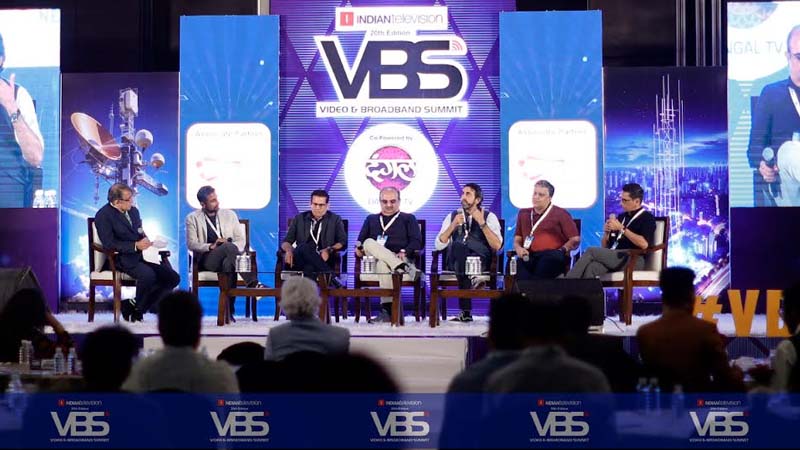
    The session chair for this panel was media consultant Anuj Gandhi along with the panelists: Arha Media & Broadcasting CEO Ravikant Sabnavis, GTPL Hathway Ltd senior VP Yatin Gupta, Dangal Play head Akshat Singhal, Playbox TV founder & CEO Aamir Mulani and OTT-Chana Jor, VHunt Digital Media COO Archita Jasani

    To light up the atmosphere, Gandhi asked the audience how many hours on average people spend on their mobile phones. He also dropped another question while spending time looking at phones, how much time is spent on watching SVOD OTT? The response was quite positive as an overwhelming number of people in the audience watched content on their mobile phones for a longer duration.

    As there was a considerable amount of audience who watched other lots of content besides OTT, Gandhi asked a broader question to all the panelists, “There is a belief and everybody says that aggregation is what went above consecutive recession, people said people subscribed to two and a half entities, but individual OTS there is a belief that beyond the point from D to C perspective or direct to consumer, you cannot cross the customer acquisition costs. There is another cost that is there.

    Sabnavis said, “If I look at it from the consumer perspective, Most perspective, there’s a lot of entertainment. Right? Be it a YouTube video, or simply chatting with somebody on the phone. I’m probably oversimplifying to make the point. There are limits to my time when whether it be five hours or three hours and in that time, I’m trying to watch OTTs as well, besides doing whatever I am for entertainment. So therefore you’re possibly right that there comes a time when growth when you look at it from our perspective around the consumer’s approach slows down. They’re gonna find it increasingly difficult to a) reach out to consumers and b) convince them to subscribe to a platform.”

    Jasani said, “There is a stagnation which is happening especially in metro cities. When we see that people, there is a capacity on how many hours can be on the mobile phones. Beyond that, I feel a lot of growth that can happen in tier-two and tier-three cities. Because these are the consumers who are town-tasting in the OTT  and entertainment segments. So here we see that there is a glass ceiling, probably happening towards the metros, but there is a use of potentiality in tier two and tier three cities. So hence the aggregation makes sense in a way that there is a d2c and b2c as well, which helps us to get the hang of the consumers.

    Amir Mulani commented that 90% of the time, consumers know what they want to watch, they will come to search, click the movie, and just start watching it. So I think my responsibility as a platform or as an aggregator, is beyond me to give him something that he wants to, and trying to keep it so easy, that it’s not confusing for them to decide.”

    Singhal said, “Earlier, people used to go to OTT platforms and search for content because the OTT platforms were very messy. Now, with so many OTT platforms, we need to go to the users, and see what they have. So that’s why like it’s important.”

    Gupta opined, “ We already have a cable product, which is an aggregation of channels. We have broadband as a service to augment this along with OTT. Looking at the consumer and saying that from this household. He’s already got cable, he’s already got broadband, and we may be able to give him OTT services as an aggregation.

    Whether it makes economic sense or not, of course, is a big question mark, because the OTT players are expecting a certain amount of guarantees, which may or may not. So we’ve been looking at all of that while deciding whether to go ahead with it and what to do.”

  • VBS 2024: The FAST TV Phenomenon: The Next Growth Phase

    VBS 2024: The FAST TV Phenomenon: The Next Growth Phase

    Mumbai: India is in the grips of seisnic changes regarding video and broadband consumption. Pay TV cord-cutting is rampant even as free TV subscriptions are on the rise and OTT buy-ins are churning with the signs up for certain platforms stagnating even as others are seeing rapid increases and some are seeing cataclysmic drops. Aggregators of OTTs are popping up on the horizon promising cheap bundles along with value-added services for cable TV and DTH. There’s a rush to set up free advertising-supported TV channels by TV set manufacturers and smart TV device makers. There’s the Jio factor where it seeks to convert most pay TV customers to free streaming of video content by offering free access to consumers at no cost. The consumer continues to demand bandwidth higher than ever imagined even as prices drop. Margins are under pressure as every player goes one-up on each other to acquire and retain customers.

    The video and broadband distribution landscape has not been as vibrant as it is now.. How long will this pot-boiling continue? What will the magic potion of video and broadband look and taste like? And what’s the end game? Indiantelevision.com has held the 20th edition of Video and Broadband Summit better known as VBS at Sahara Star Hotel, Mumbai.

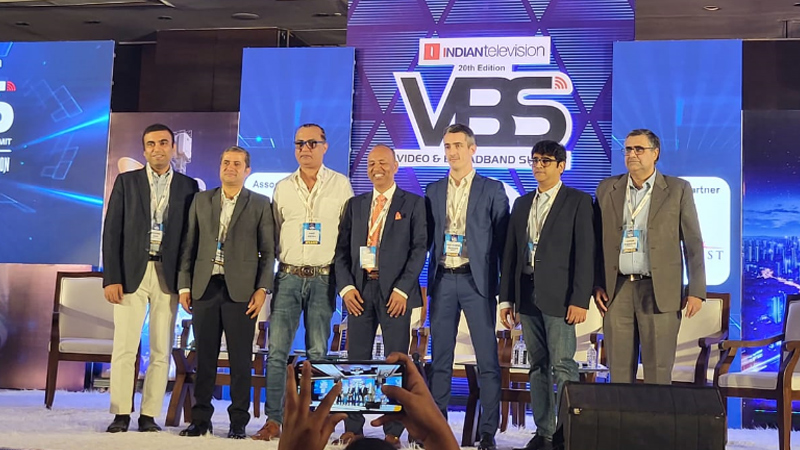
    The session chair for this panel was The Linus Adventures founder & chief evangelist Sunil Lulla along with the panelists: Travelxp co-founder  & CEO Prashant Chothani, DistroScale APAC head Vikas Khanchandani, Jioads CEO Gulshan Verma, Samsung Plus TV head of partnerships Kunal Mehta, Planetcast digital COO Venugopal Iyengar, Amagi SVP (Sales) Jay Ganeson

    Lulla began the session by saying how the marketplace is being built, how highly competitive it has been over the years, and also the emergence of FAST TV.

    To which Iyengar replied, “ The distribution landscape has been changed which we talked about on the morning session options. For media owners, there are hundreds of options which is great news but there is a complexity of how to manage not only distributing your content without too much conflict of interest or conflict of revenue. Secondly, also, how do you create a differentiated proposition for the viewer there’s no point doing a live channel and then you know, which is paid. So those two challenges are, of course, being dealt with by the media owners and the distributors like I was talking about, is really about figuring out how to manage this experience for the user, personalizing it and making it important.”

    Verma said, “ So I think the short answer right now is people want to watch a lot of content, and they want the variety that and they are willing to watch as in exchange for a more variety. And this is not just an Indian phenomenon, because we’re in India, if you look at the US, for example, you take something like Hulu TV, you know, they have two plans.1299 a month with no ads and 799 a month with ads. 95% of users taking seminar time without space. So, they will always be interested in FAST.”

    Khanchandani replied, “A lot of genres are getting pushed out of traditional distribution. So if you look at categories like English movies, and English entertainment, many other categories are feeling the heat. These guys are getting pushed out of traditional distribution. FAST is becoming a great place for them to land. Just allowing them to reach the right audience and build viewership.”

    Chothani said, “Fast helped us to graduate people to go on to pay TV and then get into the spot. So fast is when you say what is fast? It’s DD Free Dish on steroids. Because you can monetize it better. And it’s not that the television advertising budget is going down, the growth has slowed down. So nobody’s going away, everything is going to be there, we need to be a leader. That the key takeaway we understood when in the West when they entered FAST and it’s not that it took away from our pay TV audience or into coming from our OTT offering. So consumer is also consuming as part of certain transitions that the consumer is watching everything everywhere. So it’s not this or that. It’s this and that, and that.”

    Mehta said, “There is a need for other genres also to start, you know, investing in the content investing in FAST. About 80% of my consumers today watch some ad-supported streaming content on our FAST TV. So that just shows you how powerful the medium is whether it be TV plus or YouTube or any other VR OTT application on the platform.”

    Ganesan at the end summed up the by saying, “There are going to be four key players in any strategy from the consumer who’s eventually watching, who’s ready to watch an ad for getting the free content, they see value in FAST because on AVOD there is so much content, you just end up when you have what I have a lean back experience, you just don’t know what to watch what you want to watch.”

  • VBS 2024: The Churning Video Distribution Ecosystem – What’s next?

    VBS 2024: The Churning Video Distribution Ecosystem – What’s next?

    Mumbai: India is in the grips of seisnic changes regarding video and broadband consumption. Pay TV cord-cutting is rampant even as free TV subscriptions are on the rise and OTT buy-ins are churning with the signs up for certain platforms stagnating even as others are seeing rapid increases and some are seeing cataclysmic drops. Aggregators of OTTs are popping up on the horizon promising cheap bundles along with value-added services for cable TV and DTH. There’s a rush to set up free advertising-supported TV channels by TV set manufacturers and smart TV device makers. There’s the Jio factor where it seeks to convert most pay TV customers to free streaming of video content by offering free access to consumers at no cost. The consumer continues to demand bandwidth higher than ever imagined even as prices drop. Margins are under pressure as every player goes one-up on each other acquire and retain customers.

    The video and broadband distribution landscape has not been as vibrant as it is now.. How long will this pot-boiling continue? What will the magic potion of video and broadband look and taste like? And what’s the end game? Indiantelevision.com has held the 20th edition of Video and Broadband Summit better known as VBS at Sahara Star Hotel, Mumbai.

    The session chair for this panel was Ernst and Young LLP partner, media & entertainment advisory services Ashish Pherwani along with panelists: Fastway group CEO Prem Ojha, IndiaCast president Amit Arora, Dish TV CEO Manoj Dobhal, Warner Bros. Discovery & Eurosport South Asia head of distribution Ruchir Jain, Shemaroo Entertainment COO-broadcasting business Sandeep Gupta and Harmonic EMEA-APAC streaming market development director Alexandre Paugam

    Pherwani started off by saying by 2028, the TV world be breaking up into three largely equal partners and will have about 70 to 80 million pay TV and 65 to 70 million free-to-air services.

    Jain said, “We are very hopeful about the future right now. If you look at this, what’s going to happen is one is that the entire set of consumers are increasing in number. So I’m talking about how pay TV is gonna grow, connected TVs, and also about the free-to-air services, etc, so it’s the number of people coming into the media, who is going to invest. So that’s one big factor, the second big factor is the time scale

    Ojha opined that, “Our job is to keep the ground ready so that all this beautiful content and all these absorbing content can reach out to consumers the way they want it today.”

    Arora said, “So it is select all 3 platforms to seem to be consuming a lot of common content assets and that is going to change in the future formats will change may be the price point. I agree with that.”

    Dobhai said, “ We are brands with long-run legacies. And new ones coming up. Fortunately, unfortunately, I’m on the receiving end of it because we are the ones who showed the word of it all the country that you know what experience it brings when you watch an immersive content technology, upgraded version of it, satellite, and all that.”

    Gupta added that for Shemaroo, Gujarati is like building our own Prime Video. Because we are devoted ourselves to Gujrati. We are trying to expand on more areas as well. Other than that Shemaroo and ShemarooMe are mostly devoted to Gujarati.

    Lastly, Paugam replied, “Coming from the technology, part of things, especially the broadcast infrastructure, I think we see a big trend, and DTH cable stays strong. And for us, it stays at a huge part of our business helping protesters and operators distribute their content through those networks and optimize it. But the big growth is in streaming. And we’ve seen a tipping point globally, the number of subscribers from pay TV subscribers, being outpaced by the number of streaming subscribers. We’re moving from sending a unified feed and broke it down to everyone to sending unique guests and a unique feed to the end user. That gives us the ability to customize this unique feed. I think a lot of innovation and new technology that are emerging are around how do we leverage that streaming vessel to have the experience as personalized as possible.”