Tag: Video and Broadband Summit

  • VBS 2021: The way forward for linear TV ecosystem

    VBS 2021: The way forward for linear TV ecosystem

    KOLKATA: The debate of over-the-top (OTT) platforms versus pay TV has been centre stage in media and entertainment conversations over the last couple of years. More recently, the subject has died down as the industry reached the conclusion that both linear TV and on-demand TV will co-exist in India for a long time, unlike the markets in the west. But the change in technology and consumer behaviour have definitely thrown challenges at the traditional TV ecosystem. At the Video and Broadband Summit (VBS) 2021, the industry discussed how to stay resilient even amid the flux.

    The summit started with a welcome note by Indiantelevision.com founder, CEO and editor-in-chief Anil Wanvari as the prestigious conference marked its seventeenth edition this year. Back in 2003, when the summit (earlier IDOS) was held for the first time, the industry was much more disorganised. Over the passage of nearly two decades, the industry has gone through multiple changes like digitisation, new price regime etc.

    India has escaped cord-cutting, TV viewing is growing but the industry cannot afford to lean back, Wanvari said. He also cautioned alarm that despite the projections of the Indian pay-TV ecosystem reaching $15-16 billion revenue, it still stands at around $11 billion.

    “Only about 800 million are being served by linear TV. Another 500 million are yet to be served. Traditional TV is definitely strong here but it has come under attack. Broadcasters have to find ways of combating the surge of edgy and almost meaningful content which has recently been brought under the regulation of I&B ministry that is being put out by OTT platforms to hook and retain customers. Now DTH operators, HITS providers, Cable TV players have to find ways of making their operations even more scalable, provide additional services,” Wanvari commented.

    Post the welcome note, VBS 2021 hosted its first panel discussion, moderated by Wanvari, bringing together top executives from broadcasters and distribution platform operators (DPOs). In ‘The leaders speak laying out a profitable future’ session, Indiacast Media Distribution president Amit Arora, Siti Networks CEO Anil Malhotra, Star & Disney India- India & International TV distribution president Gurjeev Singh Kapoor, Travelxp 4K founder & CEO Prashant Chothani, Fastway Transmission & Netplus Broadband group CEO Prem Ojha, and NXTDigital MD & CEO Vynsley Fernandes discussed the industry’s recovery post-Covid2019 and the way beyond.

    The leaders agreed that the industry has come out of the Covid2019 impact and is bouncing back gradually, although there are still some hiccups. “We all had to recast our business models, there were a lot of learnings that happened. One was that the government ensured that cable TV and broadband were treated as essential services,” Fernandes stated. Fastway’s Ojha added that technology took a big leap catalysed by the pandemic situation.

    “Majority of content consumption still happens on DPO level. They were keeping up the service level in the pandemic. I am really amazed to see how all of them were able to put up that spirit to their team that let’s not get frightened, let’s get the connectivity going. DPOs are the real media Covid warriors. This is my learning from the pandemic – that there has to be cross-dependency and there has to be faith between the entire ecosystem, then we are going to have much bigger recovery, much bigger growth going forward,” Chothani said. While the subscription count went down during the crisis due to migration, MN Vyas asserted that the numbers are bouncing back. “We’re looking forward to the good fiscal year 2022,” Arora said.

    Other than a dip in subscriber addition due to the Covid crisis, the broadcasters and DPOs could not undertake any price revision due to the lack of clarity on NTO 2.0. Kapoor said there is now competition in every genre reducing the risk of monopoly, both for broadcasters and MSOs. Hence, the pricing of content should be left with market forces rather than implementing heavy regulations.

    Talking about future opportunities, the leaders agreed that the conversion from SD to HD can be one potential area if communicated properly to consumers. Along with that, wired broadband is another potential growth driver for MSOs as the penetration is very low currently. Even if deep-pocketed players like Jio starts aggressive acquisition, there will still be enough opportunities left for other players given the fact there are only 22 million home broadband subscribers currently, Malhotra noted.

    Along with a robust business model, technology acts as the deciding factor in today’s fast-moving era. The second session discussed ‘Future proofing DPOs on video delivery solutions’ in the presence of NXTDigital group CTO Ru Ediriwira, Asianet Satellite Communications Ltd vice president & technology head Salil Thomas, Broadpeak Business Development vice president  Xavier Leclercq, and Planetcast Media Services founder director MN Vyas.

    Ediriwira said it is important to focus on future proof technology but new technology can come anytime and disrupt the industry despite the precautions. According to her, it is important to keep abreast of current developments and be open to new opportunities. Thomas echoed a similar sentiment, saying every organisation should be ready to adapt to changes, no matter what.

    “I think futureproof is something which is never possible. We have to really look at what is needed –at least what is needed in the next five years. We have to make a sea change in our distribution system. TV has to be more intelligent,” Vyas added.

    The panel also discussed the possibility of IPTV as a solution to simplify the network. Although it needs long-term investment and has not been considered widely, it could be the right direction to look at. Leclercq said, “Everywhere in the cable network, efficiency is reducing, complexity is moving everything to IP based delivery. I think one of the encouraging steps in this direction is seeing some big scale MSO in Europe, US launching IP only set top boxes.”

    The summit rounded off with a session focusing on ‘Customer First’ moderated by PwC India’s partner and leader – media, entertainment & sports advisory Raman Kalra. The panelists included some of the top names from the broadband and cable industry, such as JioFiber president Anuj Jain, Siti Networks ‘ DGM Strategy Anurag Nigam, UCN Cable Network operations head Debashis Mohanty, GTPL Hathway vice president Yatin Gupta and Shemaroo Entertainment broadcasting business COO Sandeep Gupta.

    Kalra opened the session by mentioning how customers today are spoilt for choice when it comes to choosing content to consume, what with video on demand and OTT platforms mushrooming with ever increasing channels of entertainment. Despite demands for content and internet broadband having skyrocketed during the pandemic, the challenge of remaining relevant is a concern for both the service and content provider, as well, in the highly competitive market. So the question arises on how to acquire and retain a customer base with the constantly changing customer demands and behaviour.

    The panel debated the pros and cons of the pandemic and the post-Covid market scenario. Everyone agreed that the period was a huge shot in the arm to the industry as people were confined to their homes with increasing digital requirements for their work, study and entertainment. It resulted in a major spike in cable TV and broadband consumption in the initial months of the pandemic, which flattened out towards the latter half of the lockdown.

    Strategies were discussed on how best to meet consumer needs and ensure customer stickiness. The session concluded by summarising that there’s a need for businesses to invest deeply in knowing and engaging with their customers. Analysing customers’ content consumption data can also lead to rich dividends.

  • Economic slowdown impacted ad spend in H2 2019

    Economic slowdown impacted ad spend in H2 2019

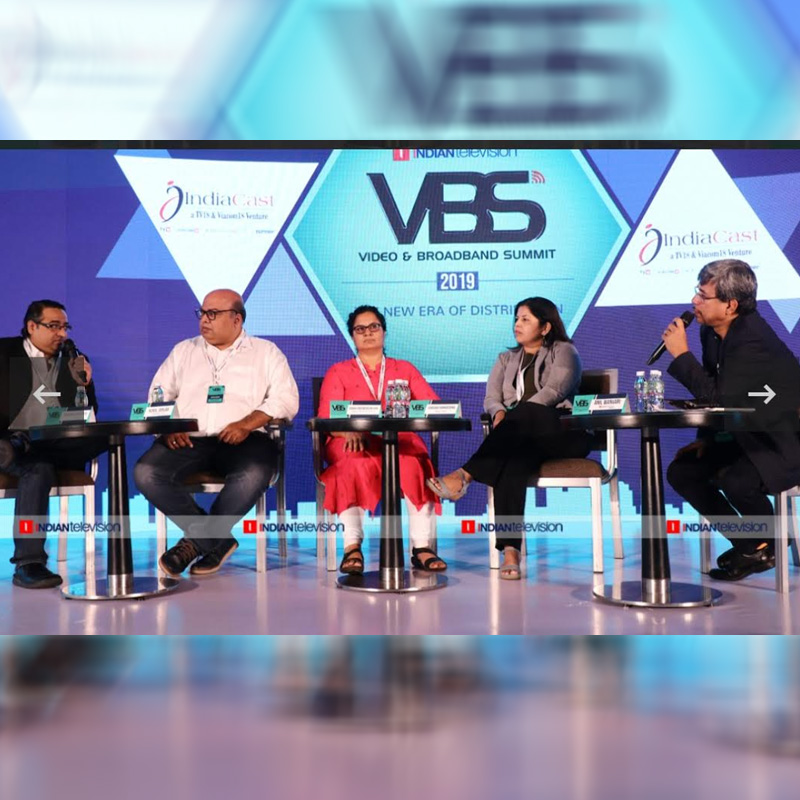
    MUMBAI: Economic slowdown in 2019 brought the country, as well as the media industry, to a standstill. It visibly impacted advertising spends. This view was shared by advertisers present during the sixteenth edition of the Video and Broadband Summit 2019 that took place on 11 December in Mumbai.

    The panel was moderated by indiantelevision.com founder, CEO and editor-in-chief Anil Wanvari, with panellists ITC Ltd head media and PR Jaikishin Chhaproo, Havas Media Group managing partner west and south Kunal Jamuar, Godrej Consumers Pvt Ltd VP and head of media services Subha Sreenivasan Iyer and Madison Media vice president Vandana Ramkrishna.

    Chhaproo, in his opening statement, said, “There has been a yo-yo syndrome since January 2019 and the only two media-mela events (Indian Premier League and World Cup) in the first half of the financial year saw some advertisement growth.”

    He further added that since June people have been quite cautious about advertisement spend.

    Agreeing to Chhaproo’s perspective, Jamuar said, “2019 has been something like that of 2008 double dip. And, with respect to advertisement spend on television is as similar as of last year.” Many of Havas Media Group’s clients are from the auto and finance sectors.

    All of the four panellists were of the view that along with other sectors, the advertisement spends on television has also been slow and has hardly seen any growth this year.

    Accepting the slowdown in the market, Iyer said, “This year had made us re-look at all our advertising plans due to lack of resources and we have been far more prudent in terms of evaluating the need for further spend with quantifiable ROI."

    Meanwhile, Ramkrishna believes that one of the reasons for the slowdown could be because of the poor performance of world economies.

    According to Ramkrishna, her agency being associated with retail brands, the festive season has not turned up to be a happening one. Adding further, she said people are very cautious on spends and there’s a fear that the economy is going to crash.

    However, despite facing a slowdown, Iyer said that in terms of volume, the company’s growth is very strong, which is a positive sign. This goes with competitors as well, especially, in the FMCG sector.

    She added, “Consumers are not completely cutting down on their basic essentials, especially in segments where value for money is core.”

    In the same context, ITC’s PR head said, “Consumers seek value for money and this is what is happening in the current economic situation. Moreover, there have been steady volumes all over.”

    Ramkrishna, talking about NTO’s impact on advertising spend, said, “GEC and movie channels continue to be there and the new order has hardly affected the brands' television spends.” However, she pointed out that the smaller set of channels will certainly have an adverse effect.

    GPCL’s media head said there has been a vast difference between DTH and cable networks in data capturing granularity and that helps brands to decide on advertising spends on television.

    Havas Media’s managing partner questioned the importance of a proper measurement of audiences’ rating that has seen improvement after DTH’s existence. He said, “Today, niche channels are offering niche content, making the existing eco-system a bit difficult.”

    Iyer said that companies are ready to test any medium, just that accurate third party data is needed.

  • TRAI assuages broadcaster fears of NTO review consultation paper at VBS 2019

    TRAI assuages broadcaster fears of NTO review consultation paper at VBS 2019

    MUMBAI: Assuaging fears of  media broadcasters, TRAI advisor (Broadcasting and Cable) Arvind Kumar today said at the Video and Broadband Summit (VBS) 2019 that the new consultation paper on broadcast tariffs is only seeking to address some infirmities in the earlier New Tariff Order (NTO) and will not bring any fundamental changes  to the regulatory framework.

    “Broadcasters should rest assured that the new consultation paper will not seek to decide their channel prices. The only objective of the new consultation paper is to open a debate on how the NTO is impacting the industry and to address some of the infirmities in the NTO,” Kumar said.

    Rejecting industry criticism of floating a consultation paper within months of February NTO, described by many as one of the most fundamental reform in Indian media broadcast industry, Kumar said that serving the interests of the consumers is at the heart of new consultation paper.

    “Consumer interest cannot be ignored in the name of regulatory certainties,” he said, adding as a regulatory body maximization of revenues is not the only objective of TRAI and serving the interests of consumers comes first to TRAI.

    Commending the fundamental changes brought forward by the NTO, Kumar said that the order has brough transparency to the media broadcast industry.

    “Main objective of the industry was transparency and to create a level-playing field for everyone. NTO has empowered the consumer by giving him choice,” he said at VBS 2019, being held today at Hyatt Regency.

    Further, the new system has harmonized the business processes, Kumar said as he commended the industry leaders for successfully transiting to post NTO environment.

    The much-anticipated VBS 2019 will is being held today in Mumbai with participation from prominent media networks, broadcast distributors, media and advertising agencies, consultancy services, OTT platforms, media monitoring firms, as well as government regulatory bodies.

    Among the prominent media networks who will be participating in the summit are Sony Pictures Network, Star India, 9x Media, Enterr10 TV, BBC Global News, IN10 Media, Shemaroo and Zee. From the distributors side DEN Network, Maharashtra Cable Operators Federation, Fastway Transmissions, GTPL Hathway, Tata Sky, SITI Networks, UCN Cable and Ashwini Cable will be participating in the one-day summit at Hyatt Regency, Mumbai.

    Representatives of India’s prominent media agencies like IndiaCast Media, MediaKind, The Remediation Company, IndusInd Media and Communication, One Take Media, Madison Media will be participating in the event held in the shadows of TRAI’s February 2019 New Tariff Order (NTO) and amidst expectations and fears of further changes to the months-old act, described by many as one of the most significant reform in Indian media broadcast industry.

    There will be representation from auditing firms like PwC and KPMG as well. Since broadband service providers are now key to video distribution, there will also be representation from Google, Reliance Jio Fiber, Reliance Jio and Win Broadband.

  • VBS 2019: Media industry leaders to discuss challenges facing the industry

    VBS 2019: Media industry leaders to discuss challenges facing the industry

    MUMBAI: The much-anticipated Video and Broadband Summit (VBS) 2019 will be held today in Mumbai with participation from prominent media networks, broadcast distributors, media and advertising agencies, consultancy services, OTT platforms, media monitoring firms, as well as government regulatory bodies.

    Among the prominent media networks who will be participating in the summit are Sony Pictures Network, Star India, 9x Media, Enterr10 TV, BBC Global News, IN10 Media, Shemaroo and Zee. From the distributors side DEN Network, Maharashtra Cable Operators Federation, Fastway Transmissions, GTPL Hathway, Tata Sky, SITI Networks, UCN Cable and Ashwini Cable will be participating in the one-day summit at Hyatt Regency, Mumbai.

    Representatives of India’s prominent media agencies like IndiaCast Media, MediaKind, The Remediation Company, IndusInd Media and Communication, One Take Media, Madison Media will be participating in the event held in the shadows of TRAI’s February 2019 New Tariff Order (NTO) and amidst expectations and fears of further changes to the months-old act, described by many as one of the most significant reform in Indian media broadcast industry.

    There will be representation from auditing firms like PwC and KPMG as well. Since broadband service providers are now key to video distribution, there will be representation from Google, Reliance Jio Fiber, Reliance Jio and Win Broadband.

    TRAI advisor (broadcasting and cable services) Arvind Kumar will also address the gathering of industry leaders and there will also be a special presentation from BARC India COO Romil Ramgarhia.

    Bringing together industry leaders from all sectors of the media industry, the summit will discuss various issues at the heart of the NTO, how it’s impacting broadcasters and distributors, changes proposed to it and why broadcasters are unhappy with TRAI for floating a new consultation paper within six months of NTO.

    After a keynote address by Anil Wanvari, founder Indiantelevision.com, IndiaCast Media Distribution president Amit Arora, Star India Distribution president Gurjeev Singh Kapoor, IndusInd Media and Communications CEO Vynsley Fernandes, GTPL Hathway VP Yatin Gupta, The Remediation Company founder Shyamala Venkatachalam and Bhima Riddhi Digital Services promoter Nagesh Narayandas Chhabria will debate the TRAI consultation paper on tariffs in a panel discussion to be moderated by Elara Capital VP Karan Taurani.

    To give the perspective of distributors on how the NTO, and the expected amendments to it, affects their businesses, there will be a panel discussion in which SITI Networks CEO Anil Malhotra, GC member of SCTE India Shaji Mathews, Fastway Transmissions Consultant Peeush Mahajan and Bhima Riddhi Digital Services Promoter Nagesh Narayandas Chhabria will participate.

    Advertising industry is at the other end of the spectrum, the other big sector that had to adjust to post NTO environment. To discuss the advertisers' view and their take on the dynamic pay-TV landscape, there will be Godrej head media services Subha Sreenivasan Iyer, ITC PR and media head Jaikishin Chhaproo and Havas Media Group managing partner West & South Kunal Jamaur. They will participate in a panel discussion to be moderated by Castle Media CEO Ru Ediriwira.

    There will be a presentation from BROADPEAK business development manager HervĂ© Creff, on "Keeping control of HDMI1 with Android TV Operator Tier – the "super-aggregator" approach."

    This will be followed by a panel discussion on how to transform the TV broadcast sector to fuel growth – what are the key issues facing the industry and how can more transparency and discipline be injected into it? PwC partner and leader Raman Kalra, Elara Capital VP – research analyst (media) Karan Taurani, KPMG India partner Girish Menon and BBC News head of distribution – South Asia Sunil Joshi will participate in a panel discussion to be moderated by SBICAP Securities head of equity research Rajiv Sharma.

    Local cable operators also constitute an important link in the TV broadcast value chain in India. Despite the presence of strong DTH players like Tata and Bharti Airtel and the rise of OTT, as much as 65 per cent of TV homes in India are still connected through these local cable operators, as per TRAI estimates. Maharashtra Cable Operators Federation (MCOF) president Arvind Ramesh Prabhoo and IndusInd Media and Communication COO Rouse Koshy will participate in a panel discussion on how has the role of the LCO changed under the new regulatory framework and its significance going forward.

    The rise of some of the Free to Air (FTA) channels in the post NTO environment has been another prominent feature of 2019. To discuss the roadmap ahead for FTA channels, there will be a panel discussion in which SAB Group CEO Manav Dhanda, Enterr10 TV MD – Fakt Marathi Shirish Pattanshetty, IN10 Media COO Akul Tripathi, 9X Media chief revenue officer Pawan Jailkhani and Shemaroo Entertainment COO Kranti Gada will participate.

    To discuss the role of the internet in the broadcast industry, there will be a fireside chat between Anil Wanvari and Jio Fiber president Anuj Jain. The summit will end with a panel discussion on the role of the internet in video distribution in which Google Industry head media and entertainment Sandeep Ramesh, Jio VP – advertising and strategy Mohit Kapoor, COAI Director General Rajan S Mathews, ZEE5 chief revenue officer and business head Taranjeet Singh and MediaKind head of marketing – APAC Chiranjeev Singh will participate.

  • VBS 2018: New tariff regime dominates discussion on Day 2

    VBS 2018: New tariff regime dominates discussion on Day 2

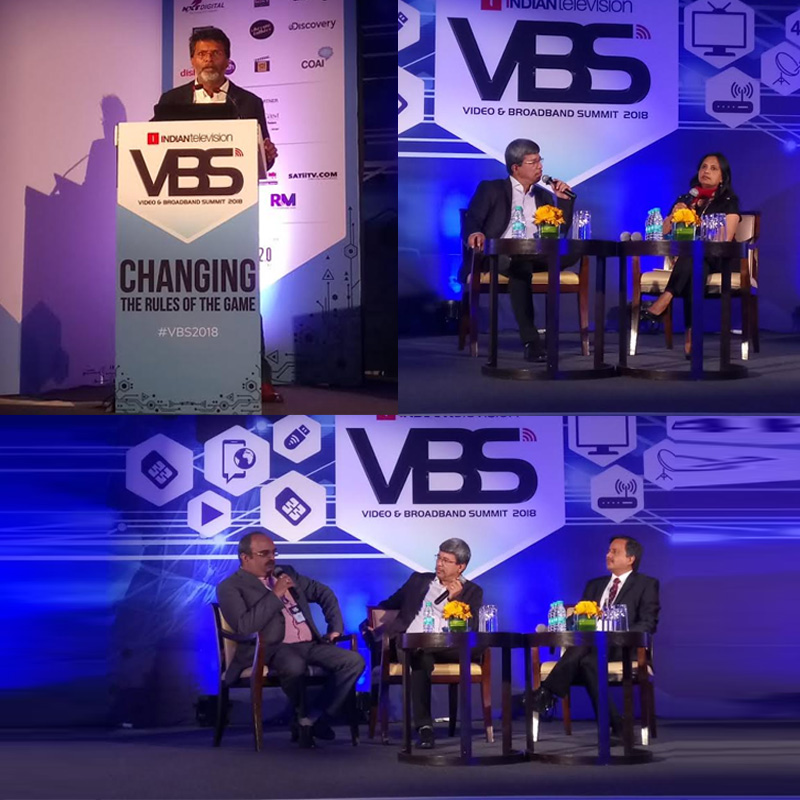
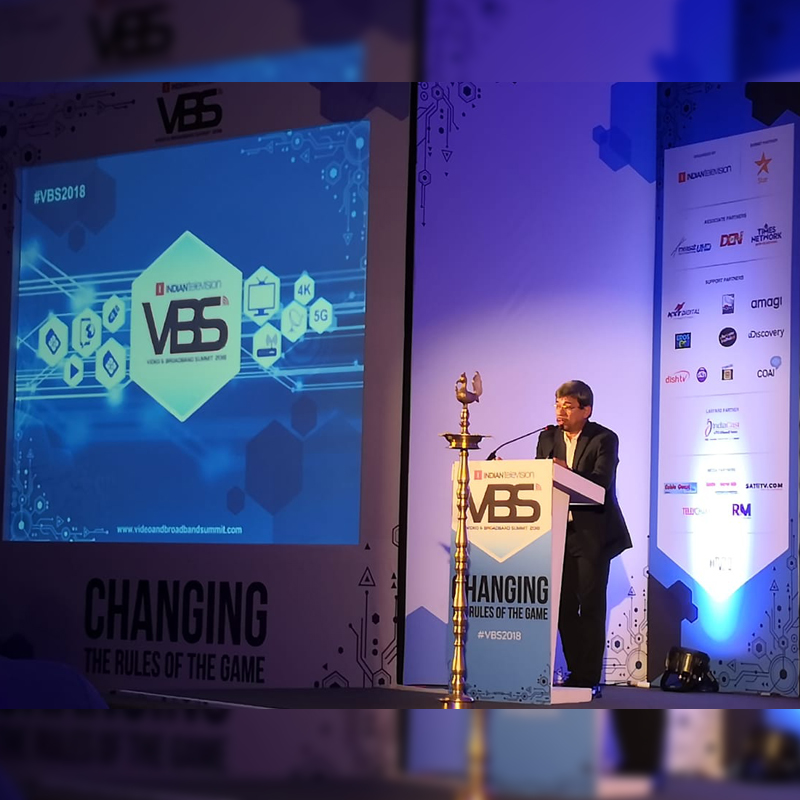
    GOA: The second day of the Video and Broadband Summit started with a keynote speech from Times Network MD and CEO MK Anand where the media veteran shared his insights on how to keep playing when the game itself changes.

    “Media Business is primarily about distribution of content to serve consumers needs profitability. If that remains the core purpose, the why to keep playing becomes clear,” Anand said in the beginning. While everyone is talking about disruptive forces, he said coping in the media business is highly dependent on keeping up with changes in distribution technology. He also spoke about how Times Network dealt with such issues.

    Anand’s visionary speech was followed by a fireside chat between Indiantelevision.com founder and CEO Anil Wanvari and Sony Pictures Networks monetization strategy and consumer insights head Saurabh Yagnik. Analytics, big data and content were the focus of the session.

    Doordarshan additional director general Mr.Sunil talked about DD Free Dish, the major force in distribution of satellite television in a presentation. While a huge number of consumers across India use Free Dish, he said its user base is expected to grow by 40 million by 2020. He was also part of a fruitful discussion on the future of pay-TV with Travelxp CEO Prashant Chothani in a session moderated by Anil Wanvari.

    Following that engaging session, Doordarshan director general Supriya Sahu highlighted the evolving role of the public service broadcaster in a fireside chat with Anil Wanvari. She said there should not be comparison between a private broadcaster and pubcaster as the latter’s mandate is totally different.

    While the first evening witnessed a lively discussion on monetization of TV, the second day dealt with the ‘big advertising hangover’. Viacom18 Hindi mass Entertainment Ad Sales head Simran Hoon, TAM India CEO LV Krishnan, Prashant Chothani were part in the panel.

    The second half of the day focused on the new tariff order, the next biggest disruptor in the complex industry, and evolving models in the cable industry. Talking about the disruptors in the distribution industry, KCCL CEO Shaji Mathews said technology has been the enabler, not the driver. In another session, IMCL CEO Vynsley Fernandes said on a positive note that if LCOs, MSOs come together magic can be made.

    More interestingly, TRAI secretary Sunil K Gupta interacted with audience via Skype. Gupta answered questions of local cable operators who seemed to be really concerned about the new regime. He informed the audience of how TRAI is taking initiatives to make consumers aware of the upcoming change.

    BARC India CEO Partho Dasgupta, another media veteran who has witnessed the ups and downs of the industry spoke about the digital matrix measurement in India. “Data protection is of utmost importance in the age of GDPR policy compliance and Srikrishna (SPDI) committee regulations. BARC is keen to ensure the consumer data is protected in our suite of products,” said Dasgupta.

    The last session of the day focused on the e-gaming scene in the country as Nodwin Gaming content head Gautam Virk explored the possibilities about how e-gaming could usher in the next wave of content consumption. Talking about possible potential partners he said, “It is easier to work with OTT platforms because they are more updated with the technology.” He also reaffirmed e-gaming is to stay here and is not a short term trend.
     

  • VBS 2018: Media & entertainment industry leaders address pressing issues on Day 1

    VBS 2018: Media & entertainment industry leaders address pressing issues on Day 1

    GOA: Rapid advance in technology and infrastructure, entry of disruptive forces and changes in consumption habits have led the Indian media and entertainment industry to major conversion. The interesting developments are attracting international players to invest in the market, with traditional domestic players adopting new strategies for growth. Where the industry is heading in the next few years is something everyone wants to know.

    To seek answers for several concerning questions, Indiantelevision.com brought together industry doyens on the first day of the Video and Broadband Summit. The conference dedicated to industry issues has been supported by esteemed broadcasters, technology companies as well industry bodies. All the speakers agreed that the VBS platform is the perfect stage to discuss relevant issues as well as to gain new insights while sharing their experience.

    Indiantelevision.com founder and CEO Anil Wanvari set the tone for the day with his welcome speech. He spoke about how demonetisation and GST put pressure on business in last couple of years. He also highlighted how the burgeoning OTT industry is throwing new challenges to traditional TV, cable and DTH operators along with the new tariff order that is likely to reshape the trajectory of the sector. He also added how a disruptive force like Jio FTTH is fueling the transformation.

    The first session moderated by Anil Wanvari was about the future of digital delivery platforms where Tata Sky chief content officer Arun Unni, PwC India partner Raman Kalra and One Take Media founder and CEO Anil Khera participated. As the influence of video and broadband has become unmistakable now, Tata Sky recently rolled out a broadband service. While he was asked about how it stands out, Unni said customer centric nature of the business makes their service different. While broadband and telco players are throwing a challenge for distribution, Khera thinks India still has potential for DTH and cable growth owing to almost  90 mn households still unpenetrated by TV. Kalra said while pay-TV and OTT platforms will stay together, there will be a constant battle among players to stay relevant to consumers with proper content.

    In a fireside chat with Anil Wanvari, COAI director general Rajan Mathews spoke about various issues in the telecom industry. He said consumer choices are changing rapidly today, hence the model which is working at present, may get disrupted in future. He also spoke about the high cost of utilizing satellites in the country despite them being produced and launched at very low cost. Talking about 5G, he said it will take a while to be rolled out and added that it would be focusing on education, health, traffic management, smart cities and agriculture.

    Anil Khera who has now ventured into the value-added service space after spending considerable time in the DTH industry, explained the importance of this vertical and how DTH players are utilizing it.

    Another engaging session where audience also took an active part in the discussion, was about monetising TV in times of transition. ZEEL chief growth officer Ashish Sehgal, KMPG India media and entertainment partner and head  Girish Menon and TAM India CEO LV Krishnan spoke on the issue. “Only thing TV can't do is engagement which digital platforms allow but you cannot build your brand without TV,” Sehgal made a very important comment.

    The eventful day ended with a fireside chat between Viacom18 COO Raj Nayak and Anil Wanvari. Nayak shared glimpses of his inspirational journey in the industry and Viacom18 where he was the brainchild of several successful endeavors. Talking about the future, he said it will belong to those who can create content which is compelling. Moreover, he also said content cost is not going down but it's going up across broadcasters. Giving the example of Netflix’s change of fortune with House of Cards, he added that for changing the trajectory of the business, delivering two-three golden nuggets every year are enough.

    For more insights stay tuned for the updates from the second day of video and broadband summit 2018!