Tag: Viacom18

  • Comedy Central sets pace for ultimate celebration with over 100 hours of non-stop FRIENDS ultra marathon for its 6th birthday

    Comedy Central sets pace for ultimate celebration with over 100 hours of non-stop FRIENDS ultra marathon for its 6th birthday

    MUMBAI: Birthdays and New Years are great occasions to make resolutions for participating in marathons. However, this is one marathon which calls for hanging up your running shoes and grabbing the best spot in front of the telly with a bowl of munchies to keep you going because, for the first time ever in the world, Comedy Central is presenting a 5 day long, F.R.I.E.N.D.S Ultra Marathon from January 19 to 23, 11 AM onwards!

    Aiming for a totally different kind of world record where marathons are concerned, Comedy Central ensures over 100 hours of non-stop entertainment, as it gets ready to celebrate its birthday with the world’s best friends ever Joey, Rachel, Monica, Chandler, Phoebe and Ross.

    Bringing in its 6th birthday, the brand is doing a variety of fun activities like hosting the biggest F.R.I.E.N.D.S parties Mumbai, Delhi, Chennai, Pune and Kolkata, Watch & Win contest with official F.R.I.E.N.D.S Merchandise rewarding the longest binge sessions through 5 days. Comedy Central, in partnership with Airbnb, is hosting the Longest Slumber Party and many more engaging activities on their social media pages. After all, what’s a birthday without F.R.I.E.N.D.S.?

    Commenting on this one of a kind campaign, Viacom18, Head- Youth, Music and English Entertainment, Ferzad Palia shared, “When we launched Comedy Central 6 years ago, our goal was simple – we wanted to give India a place for quality English Comedy Entertainment. And within months of its launch, we realized that the audience and the advertisers were not only lapping our content up but wanted more of it. Over the years, Comedy Central has been loved for showcasing the best in quality entertainment such as The Mindy Project, The Graham Norton Show, SNL, Suits and Young Sheldon. But F.R.I.E.N.D.S. is the one show that refuses to lose its hold over the audience no matter what. It’s a show that holds the same appeal that an old friend does – it’s comforting, it’s relatable, and it makes you feel good. Thus, today, when we are celebrating our 6th Birthday, it was but natural for us to celebrate it with F.R.I.E.N.D.S. Also, this is just the beginning. The never been done before, 100-hour binge for F.R.I.E.N.D.S is just a small peek of the disruptive programming that we have planned for our viewers in 2018.”

    Launched in India on January 23, 2012, Comedy Central enjoys a viewership share of 30% and has remained a steady/consecutive No.1 in viewership last year. With 4.5+mn social media followers, that is growing each week, the brand has persistently worked towards engaging content for consumers with specially curated show categories, consumer products and pro-socio campaigns. Source (BARC: 15-40 Mega cities AB)

    Comedy Central has created its distinct place in consumers’ hearts with special offers across multiple platforms such as Watch With The World – bringing to India world class shows such as Suits, Young Sheldon, Will & Grace, Brooklyn Nine-Nine and more, in real time; Spread The Cheer – pro-socio campaign offering joy and happiness; Comedy Central LOL Club Cards – gifting specially curated offers for it fans. The unique initiatives undertaken by the brand has also won 40+ awards over the past 6 years across India, Asia and the World, making it the number 1 in English Entertainment industry.

    Comedy Central boasts of partnerships with marquee brands like Café Coffee Day, Mad Over Donuts, Gold’s Gym, Kidzania, Radio One to maximize reach amongst its consumers across age groups and personalities. The brand also strives to bring on more smiles through its annual CSR initiative – Spread The Cheer. The latest edition, in association with several NGOs such as Give India, Bhumi, Deepalaya to name a few, has spread the cheer amongst many deserving but less fortunate children. With such innovative initiatives, Comedy Central will strive to remain India’s Happiest Place.

  • Viacom18 kicks off the international award season in 2018 with the 75th Golden Globe Awards

    Viacom18 kicks off the international award season in 2018 with the 75th Golden Globe Awards

    MUMBAI: As the New Year brings about a new season of International awards; Viacom18 is all set to bring the best of them on their channels. Viacom18 commences the year with the 75th Golden Globe Awards; where viewers will see the best of American Film & Television compete for the most coveted award in the industry. The star-studded evening, along with superbly impressive and power packed performances will air on channels across the English Entertainment cluster under Viacom18’s banner, on January 8, 2018.

    The 75th year of the awards will also witness a special celebration, as Will & Grace stars Eric McCormack and Debra Messing host a two-hour long, star studded Golden Globes: 75th Anniversary Special a day prior to the grand awards night. A nostalgic walk down memory lane; the special will relive the best moments across the last 74 years of the Golden Globe Awards, and will feature Amy Adams, Jake Gyllenhaal, Julia Roberts, Nicole Kidman and many more. Viacom18’s English Entertainment channels will simulcast the anniversary special for Indian viewers, on January 7, 2018. 

    This year, leading the pack with seven nominations is The Shape Of Water, closely followed by The Post and Three Billboards Outside Ebbing in the movie category. The Shape Of Water dominates the nominations with contenders across three categories- Best Picture, Director and Best Actress. While in the TV category, Big Little Lies leads with 6 nominations, shows from COLORS INFINITY like The Good Doctor, Fargo, Better Call Saul, Mr. Robot; and Comedy Central hit series, Will & Grace, are also in race for the coveted title.  Crediting her incredible impact on the world of entertainment, philanthropist, producer and actress, Oprah Winfrey will receive the coveted Cecil B. DeMille Award.

    Following the legacy of Jimmy Fallon, Ricky Gervais, Amy Poehler, and Tina Fey, the renowned comedian and commentator, Seth Meyers, will host the awards.

    Commenting on the simulcast of the Golden Globe Awards, Viacom18, Programming Head – English Entertainment, Hashim D’Souza shared, “In our continuous effort to bring the best of English content on our channels this year, we are thrilled to kick start January with one of the most prestigious awards, airing simultaneously across all our English Entertainment channels. With a delightful mix of acclaimed TV shows, movies and music, the excitement generated by the Golden Globe Awards is unparalleled. We aim to make the experience even more exhilarating through on-ground integrations planned for our consumers”

    To make the experience more gratifying for viewers, Vh1 is celebrating the glamour of the night with special red-carpet nights & split trivia nights at nightspots across 15+ cities. In addition, specially curated playlists, gym workouts and styling sessions at salons with bloggers are being curated to get the audience ready to kick off the awards season.

  • Sudhanshu Vats on Viacom18’s growth strategy and why data analytics is key

    Sudhanshu Vats on Viacom18’s growth strategy and why data analytics is key

    He goes by many names. The Laundry Man and The Marathon Man being two of the more popular monikers. The second one is self-explanatory given his passion for running, especially marathons of many hues all over the globe. It’s the former one that makes people, sometimes, stop and give a quizzical look. Its origins, according to Unilever folklore, can be traced back to his days at the global FMCG company where he was at the helm of the laundry division in South Asia. But Sudhanshu Vats, group CEO of Viacom18, doesn’t mind the aliases; rather, he refers to them himself, at times—like he did in November at CASBAA Convention 2017 in Macau,where he was featured as a keynote speaker. At the time,Vats explained that running a marathon and running a company had lots in common as they taught one about the importance of planning and breaking down longer plans or goals into shorter milestones.

    Five and a half years into his new role in one of the top media companies of India that is an equal JV between US’ Viacom and Reliance Industries-controlled Network18, Vats is considered a thought-leader within the complex maze of the Indian media and entertainment industryand in government circles. His social media savviness makes him articulate on a range of subjects from media to women empowerment to an individual’s role in the Clean India campaignto the importance of health and fitness.

    In a free-wheeling chat with Indiantelevision.com’s consulting editor AnjanMitra and deputy managing editor Satyam Nagwekar, Vats speaks on a number of issues related to the M&E sector, including the necessity of regulation in India (he sometimes holds contrarian views to the general sectoral outlook of his peers) and why it’s important for a media company to be equally alive to data analytics to derivestrategies.

    Edited excerpts from an interview that took place when he was few days away from completing hisannual tenure as the chairman of BARC India, a joint industry body entrusted with collating audience data in a highly fragmented and, at times, quirky Indian broadcast sector, wherein competition is cut-throat:

    Q: What would be the three major changes in the industry that you have witnessed over the years in the complex M&E industry of India after your switch to the media sector from FMCG?

    A: The first significant development is the entire digitisation of the cable. While digitisation of the signal has happened, allowing (the pipe) to carry more content, addressability needs to improve. Overall cable digitisation has enabled the pipe to carry more content and to improve the viewer experience. The second development is the rise of OTT services; delivering content on demand in addition to the existing linear delivery of content. The third development would be the increasing importance of live and experiential entertainment. The advent of quality multiplexes has certainly made a difference in viewing experience in cinemas. Similarly, in the sphere of live entertainment, experimentation with modern technology has dialed up consumer experience. We have also experimented with theatricals. What happens is that as kids develop a relationship with characters, it allows you to bring those characters alive in different forms outside of television. One can take them outside of television into theatricals, into experiential zones and merchandising.

    I would add a fourth important development and that is the evolution of BARC India. I think the joint industry body that we formed to measure ‘what India watches’ is a significant development. It’s a unique feature that industry bodies have come together for audience measurement in India.

    Q:Are Hindi general entertainment channels (GECs) the largest contributors to the Viacom18 revenue pie?

    A: Yes, they are.

    “About 59-60 per cent of India communicates in regional languages, about 39-40 percent in Hindi, and the balance one per cent in English. This 59 per cent is still under-indexed in viewership. As the viewership catches up with actual consumption, so would monetisation opportunities.

    Q: Keeping in mind what you said, how do you see the market for Viacom18 going forward over the next couple of years?

    A: The GECs will remain an important block (from the point of view of revenues), but I am very bullish on the regional piece, too. I personally feel that regional businesses are gaining traction and will continue to get dialed up significantly in the future. The reason for that is that in television, and arguably in all mediums of television, digital and films, the regional languages have been under-indexed from the point of viewership and monetisation.

    In my opinion,the genesis of this lies in the fact that the erstwhile measurement system was a bit skewed towards the Hindi-speaking urban audiences; perhaps as it too developed along with the cable movement in India in the 1990s, which started with the Hindi-speaking regions. However, in the last decade, language programming in other parts of India, especially South India, has developed considerably. With BARC’s arrival, these markets are being better represented. As we go deeper into India, the regional language play will keep getting dialed up. About 59-60 per cent of India communicates in regional languages, about 39-40 percent in Hindi, and the balance one per cent in English. This 59 per cent is still under-indexed in viewership. As the viewership catches up with actual consumption, so would monetisation opportunities.

    Why do I say this? There is an intuitive understanding — not entirely always incorrect — that the English consuming audience has a higher propensity to spend and that amongst the other language markets, Hindi-speaking markets (HSM), perhaps, have the highest propensity to spend. Equally importantly, regional markets like Tamil Nadu, Karnataka, Andhra Pradesh/ Telengana, Kerala, Maharashtra and Gujarat have higher per capita income (compared to India average) and would therefore have a higher propensity to consume advertising and brands. My hypothesis is that the affinity to one’s mother tongue will remain and India will continue to remain a multi lingual country (most Indians speak at least two languages and in some cases three or more). All three clusters of English, Hindi and regional will grow with regional leading the rate of growth for viewership and monetisation.

    At Viacom18, we will continue to build our portfolio of services in all the three language-clusters mentioned above, while significantly dialing up our regional language clusters. To illustrate this, let me share how our dependence on our flagship Hindi channel Colors is systematically coming down. When I joined Viacom18, we used to get 80 per cent of our ad sales from Colors standard definition channel. That number now is 50 per cent or may be a little lower.

    About 59-60 per cent of India communicates in regional languages, about 39-40 percent in Hindi, and the balance one per cent in English. This 59 per cent is still under-indexed in viewership. As the viewership catches up with actual consumption, so would monetisation opportunities.

    Q: As Colors is the biggest revenue earner, a lot of strategising must be done forprogramming. How do you slice and dice programming for appointment viewing for different parts of India and the HSM?

    A: Not just Colors, but for all our content engines we marry insight to gut in the way we strategise and develop content. At Viacom18, we started an ambitious data science project called Project Pi with the objective to provide information and insights to the users and establish one single version of truth in the company.

    The second leg to this is a free-flowing discussion that we have recently started`Content PeCharcha’ (discussion over content), inspired by PM Modi’s now famous `Chai PeCharcha’ (discussion over tea), primarily with Raj (Nayak, COO, Viacom18), Manisha (Sharma, content head, Colors) and some more team members. These are open sessions where we have a qualitative and free-flowing discussion on both macro content trends and specific current and future programme story arcs.

    Let me give you a couple of examples of how this works. When I joined people said mythologicals/historical dramas don’t work on Colors. But our research suggested that competitors were successfully running them and it was a white space that hadn’t been explored properly at our end. We came up with Ashoka and proved the naysayers wrong. In one of our early meetings, we figured comedy was a white space for us and we should actively explore it. While our first attempt didn’t work, the next one (Comedy Nights with Kapil) created history as it was based on our learning. We then experimented with the crime genre with shows like Code Red and Dev. A Hindi GEC is like a `thali’ (an Indian plate with a variety of food offerings): it needs to have a spread of flavor and taste. Balance, however, is the key to how your audiences perceive the spread to be.

    Q: Has the rise of mythological and historical shows on Viacom18 channels, as well as on other TV channels, increased after 2014 or are we reading too much into it?

    A: I am a firm believer—and I am keep saying it often—that the richness of the Indian culture is reflected a lot in some of our mythological and historical stories. Brilliant evergreen tales like `Ramayan’ and `Mahabharat’ can be told over and over again but there are so many other stories that need to be taken to the audiences. If you look at some of our mythological stories, India has long been telling superhero stories—both of superwomen and supermen. But to answer your question, yes there has been a definite rise in these stories (on TV channels) post 2014.

    “My assumption is that over the next five years, India will follow China’s example and 10 per cent of all internet video consumers will move behind a pay wall. Once this happens, it will create both advertising and subscription economies at scale.

    Q: Hanuman probably was the first super hero and remains till day one. Agree?

    A: Precisely. I personally feel that these are stories that lend themselves well to a variety of interpretations. Moving forward, production quality can make our stories richer and give the consumers a better experience.

    Q. Is the digital venture VOOT making money?

    A: If you are asking if we are monetising VOOT, then yes we do have a fair number of advertising brands on VOOT. But having said that, I’d say we, like most consumer digital businesses, have substantial distance to cover in our monetisation journey. 

    The digital VoD space is one that requires an extended gestation period for investment. Today there are300 million Indians consuming video on the internet. That number is poised to touch 600-700 million in the next three to five years time.Further, my assumption is that over the next five years, India will follow China’s example and 10 per cent of all internet video consumers will move behind a pay wall. Once this happens, it will create both advertising and subscription economies at scale.

    Q: So, is VOOT targeting 10 per cent of subs behind a pay wall in, say, three years’ time?

    A: Absolutely. Maybe, even more. We are planning to launch the subscription service of VOOT early next fiscal.

    India is a price sensitive market and, unlike the West, we do not have the price arbitrage advantage between cable and VoD. In the US, Netflix disrupted the market with its offering at USD8-10 versus a monthly cable bill of USD80-100. In India, we still get 300 channels at Rs 200-250 making linear television the economical entertainment option. But having said that, I believe the right pricing for data and content will continue to drive VoD in India. I think, it is fair to assume that the range of pricing for subscription VoDin India lies between USD 1-3 to begin with.

    Q: So you are working on a price model that is between USD 1-3/sub/month in India?

    A: Yes. If you want to look at large numbers, you need to keep prices competitive in India.USD 3 is approximately Rs 200, but it will also depend on how many people you want at what price and that will be determined on the price volume elasticity study underway.

    public://Sudhanshu V1.jpg

    Q: Does it help for a content owner and producer like Viacom18 to also have a group company like Reliance Jio, which is a platform that is practically giving data free to consumers?

    A: There are clear synergies and we complement each other.

    Q: Have you ruled out sports altogether?

    A: The business of sports,particularly cricket,is a high-investment and long-gestation game. In our current scheme of things,such an investment can be better utilised in a host of other opportunities and, hence, we are not looking at sports as of now.

    Q: What are your views on the evolution of BARC India and that some of the audience data and methodology has been questioned by some industry players?

    A: BARC has made a promising start. The measurement is clearly more robust, transparent and objective. The sample size has already been dialed up to 32k (almost four times the size of the erstwhile measurement system). We plan to further grow the sample size to 40k by next year and even further in the years to come.

    The sample has also become broader,holistic and reflects more accurately what India watches. Even rural consumption and regional languages are getting represented in a better way. The fidelity of data has improved considerably and tent-pole events on television — from a big TV channel launch to a new program introduction and all the way to an important news break event in an hour — are captured and show up with a very prominent spike. The areas where more work needs to be done by all stakeholders are the measurement of niche channels by BARC and management of volatility as high fidelity brings high volatility.

    The initiatives like return path data and premium panel will help improve the measurement of niche channels.

    Q: When is BARC likely to rollout digital measurement?

    A: BARC is in the process of getting all stakeholders aligned for rollout of digital measurement. There are debates around all digital players being a part of the measurement, equitable methods/process used for data capturing from all players and the more holistic India stack/dmp for representation and publishing of the data. All the stakeholders at BARC are debating these issues and the timeframe of publishing digital data will depend on the speed of alignment and approach taken by the stakeholders. Until these issues are resolved, it would be premature to commit to a timeline.

    Q: What is your take on net neutrality?

    A: It is quite a nuanced subject. My broad take is that NN is essential and net should be as neutral as possible because that’s in the best interest of a functional democracy. Essential services, depending upon the evolution of our society, will need to be looked at differently. In years to come, the internet would be a basic requirement for day to day life and therefore net neutrality is an imperative to offer equal opportunity to everybody.

    Q: What about legal and illegal content as the latter results in revenue losses for content owners like Viacom18?

    A: The issue of piracy is entirely different, and another elaborate subject on its own. Illegal content is a big challenge for any content owner. Piracy is a complex topic where different stakeholders need to play a part. My view is clear: illegal content should not be made available, but then enforcement is not always that easy. Having said that, consumers too are not clear on legal and illegal content when it comes to the digital world, at times. In my view piracy should be tackled through a three-pronged approach of legislation, enforcement and consumer awareness. In addition, if content is made available to consumers at competitive price points, it would be a big deterrent to piracy and, business models permitting, arguably the most effective way to tackle this menace.

    “Technology is causing disruptions almost daily and resultantly the very definition of a media company is changing. For any regulator anywhere in the world or any government, it is a challenge to keep abreast or even keep pace with such changes. As we move forward, we will need to evolve a mechanism where there is greater participation from all stakeholders.

    Q. Do you think powerful lobbies like global video-streaming services can have a bearing on legislations relating to NN? How do you see that playing out?

    A: I would not like to specifically comment on this. But there are two fundamental considerations here. The first is that every player will have its point of view and arguments on the subject. Second is that considering the width and complexity of these arguments, the government is best placed to examine in detail and take an overarching view after wide-ranging discussions with every stakeholder.

    Q: You are head of the CII entertainment committee, part of the IBF board, associated with BARC and also head one of the largest media networks in the country. What are your views on the regulatory regime in India as it’s considered a challenging market?

    A: I think the tricky piece, or rather the interesting piece, is that media and entertainment as an industry, both in India and globally, is evolving at a rapid pace. Technology is causing disruptions almost daily and resultantly the very definition of a media company is changing. For any regulator anywhere in the world or any government, it is a challenge to keep abreast or even keep pace with such changes. As we move forward, we will need to evolve a mechanism where there is greater participation from all stakeholders. As one cannot operate in isolation, there is a need for some regulatory framework that is akin to the ground rules of a game, if one wishes the industry to flourish. So, yes, in my opinion, light touch regulation always works well.

    What are your views on FTA vs pay TV considering many popular TV channels are on DD’s free-to-air DTH service FreeDish, taking advantage of DD’s reach and making money on advertising?

    A: I am a firm believer that India is an ‘and’ market. So, I don’t think it’s an `and’ ‘or’ equation between FTA and pay TV. Both will continue to flourish as there is significant headroom for growth for both. Now, coming to DD FreeDish, you’re right in identifying it as a platform as it is a means to carry content to the consumer and represents a very affordable option. Admittedly, it is a rapidly growing platform where many private channels are also present. However, all other platforms are cognizant of the opportunity that a low priced FTA channel bouquet provides. It is quite likely that alternate platform options will emerge if DD FreeDish decides to bar privately owned channels.

    ALSO READ:

    Viacom18 celebrations: Mukesh Ambani sets the roadmap for next 10 years

    Viacom18’s Sudhanshu Vats: Indian media’s growth will be similar to China

    Viacom18 showcases strong women characters content: Ajit Andhare, buys Mithali biopic rights

    Viacom18 & govt announce anti-piracy partnership

  • Nakul Chopra is new BARC chairman

    Nakul Chopra is new BARC chairman

    MUMBAI: Nakul Chopra, currently president of Advertising Agencies Association of India (AAAI) and senior advisor of Publicis Communications, has been elected as the next chairman of BARC India. Chopra succeeds Viacom18 group CEO Sudhanshu Vats, who has completed his one-year tenure as chairman.

    Chopra will be the third chairman of BARC India. He joined the BARC India Board in September 2016 and since then has been an integral part of the various decisions taken by the Board.

    “BARC India has been very busy in the past one year, as it further consolidated its TV measurement business. 2017 has also been the year when groundwork was done for key future projects, and in the year ahead I am looking forward to oversee their implementation. Top on that list is the rollout of EKAM – our digital measurement products. Expansion of TV sample using Return Path Data will be the other big piece to watch out for. We are all thankful to Sudhanshu for his leadership over the past year and I very much look forward to working closely with Partho and his excellent team over the coming year,” said Nakul Chopra on being elected as BARC India Chairman.

    Under chairmanship of Vats, BARC India expanded its sample panel homes from 20,000 to 30,000. Under his tenure, BARC India also announced its partnership with multi-system operator DEN Networks for return path data and announced the digital measurement partner.

    “BARC is a bold, paradigm-changing initiative that has already started to redefine our industry. Since inception, BARC has tackled several challenges while several remain. Going forward, I would urge all stakeholders to continue to take cognizance of the pace of change in our sector and the urgent need for us to adapt. A few years out, the next generation of industry leaders needs to look back and admire our shared legacy. This means creating a future-ready, sustainable organization with each of us making some concessions for the greater good. I wish Nakul the very best as he takes on the reins of a hard-working, industry-critical operation in a fast-changing operating landscape,” said Vats.

    Vats has been on the board of BARC India since its inception and will continue in his capacity as a board member.

    Said BARC India CEO Partho Dasgupta, “I am thankful to Sudhanshu for his guidance and support to the team. Our focus now is to establish ourselves as an insights company. Nakul in his new role as BARC India chairman will be a great driving force in launching our digital-measurement products, expanding sample homes via RPD, and launching a suite of new products.”

  • Govt extends support to M&E sector in fighting digital piracy

    Govt extends support to M&E sector in fighting digital piracy

    NEW DELHI: The government of India yesterday stressed that it stood alongside the media and entertainment (M&E) industry in fighting digital piracy to safeguard loss of revenue and ease norms for doing business, while CII entertainment committee head and Viacom18 group CEO Sudhanshu Vats, on behalf of the industry, admitted that automation could result in loss of jobs leading to challenging times, but said the core of the industry will be ‘automation-proof’.

    “The government will stand with you on the issue of digital piracy,” department of industrial policy & promotion (DIPP) joint secretary Rajiv Aggarwal told the audience on Tuesday at the CII-organised Big Picture Summit here, adding that they were exploring a national anti-piracy regulation or regime and there was no need to get further into enacting complicated laws but finding solutions based on global experiences.

    Digital or online piracy is not only a big global challenge for the M&E industry, but has awakened stakeholders in India too who are feeling the heat of heavy loss of revenue due to rampant piracy of Indian content worldwide.

    Pointing out that the Indian government is alive to the issue of digital piracy and the potential of the M&E industry in being able to generate revenues and employment in the country, Aggarwal said that they were looking at how global and some local bodies (like PIPCU of the UK, TIPCU in Telangana and Maharashtra’s online anti-piracy unit) were addressing this challenge.

    Dwelling further on this issue, he exhorted the industry stakeholders to give feedback that will help India in forming a strong case and point of view for submission at WIPO where discussions are on to formulate standards for a global broadcast treaty.

    This year’s Big Picture Summit, an annual two-day conference on issues related to M&E industry, has been themed `The Digital Takeover’, which lays emphasis on the creeping digitisation in general and of delivery services like cable, HITS and OTT, and an impending automation (egged on by the likes of AI) of the various industry sectors.

    TRAI non-committal on exploring auctioning of TV licences

    SK Gupta, telecom regulatory authority of India (TRAI) secretary, which is the telecoms and broadcast regulator, while dwelling on various issues of the recently issued recommendations on net neutrality said the organisation’s efforts have always laid emphasis on consumer interest, while creating a level playing field for all players.

    Incidentally, at a time when the FCC has dismantled net neutrality norms in the US, put in place by the Obama regime earlier, favouring walled gardens of content and premium tiered pricing of various services, India’s TRAI has upheld net neutrality stating that all content should be made available to all distribution platforms on a non-discriminatory basis, apart from other level playing initiatives.

    Later, asked by journalists on the sidelines whether TRAI was exploring a consultation paper on auctioning of TV licences or permissions on the advice of the ministry of information and broadcasting (MIB), Gupta said he at least was not aware of any such move. He was non-committal when pressed on the issue.

    Asian Age newspaper a week back had reported that the government was exploring auctioning of television channel frequencies on the lines of telecoms spectrum, coal blocks and FM radio licences. Reason: bid to increase government revenues as presently permission to uplink and/or downlink TV channels cost a fixed amount with the applicant fulfilling certain set out financial norms, apart from getting clearances for satellite space and internal security. The newspaper report had added that MIB had sought advice from TRAI in this regard. What the report did not clarify was whether the auctioning was of TV licences pertained to DTT (digital terrestrial transmission) or satellite-delivered TV channels later distributed by cable and online.

    M&E industry holds key to creating future-proof, dynamic workforce: Vats

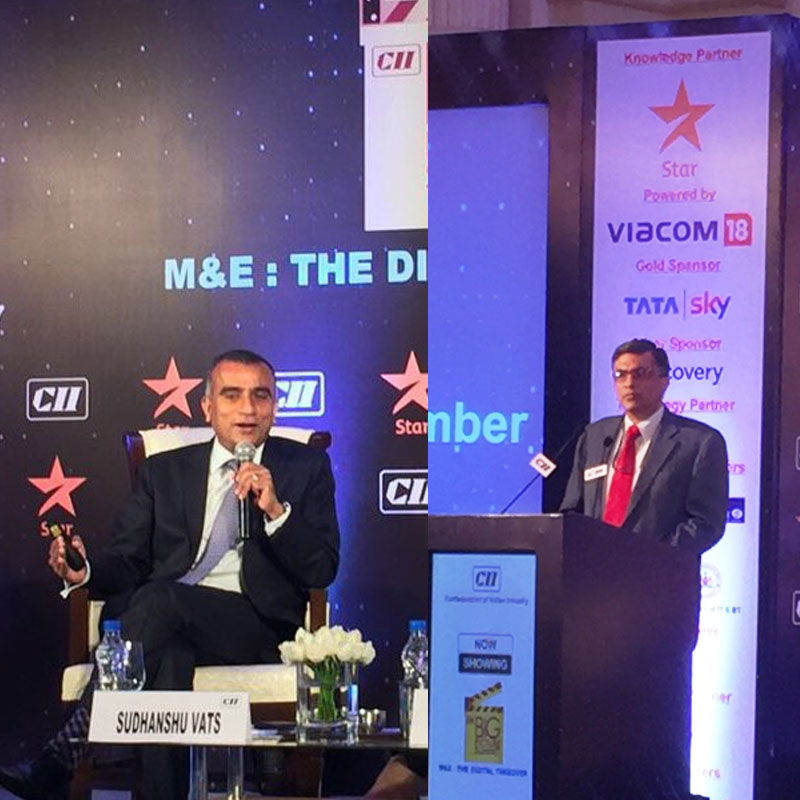
    Earlier in the morning, setting the agenda for the two-day conference, CII entertainment committee head and Viacom18 group CEO Sudhanshu Vats in his opening address said that the theme of ‘Digital Takeover’ was a topic that had “loads of nuances” that needed to be addressed in a proper perspective.

    “In my honest assessment, this is an extremely provocative theme – and one that can mean different things to different people. I can imagine some of my colleagues from the broadcast sector feeling upset. I can also imagine what some of my younger colleagues, who are already social media influencers thinking – this theme is passé, the takeover was complete a few years ago. I don’t want to pick a side at this stage and I’m certain that no definitive side can be picked,” Vats said, adding that he hoped the theme would help delegates form their own distinctive understanding of the future of the Indian industry in general.

    Pointing out that digital takeover could mean greater automation and fewer human jobs, a trend that could is likely to play out slowly in India because of availability of cheap labour, Vats said the Indian M&E sector directly employs between 1.1-1.2 million Indians and in the next five years one million more jobs would be added, thereby playing a role in “assuaging the challenge”. He added: “If we achieve breakout growth, that number can also touch five million. However, I would like to draw your attention not to the number of jobs but to their quality.”

    Explaining that skills, like creativity, story-telling, emotional intelligence and cognitive ability, in M&E sector were most ‘non-routine’ jobs, Vats said, “These are also the skills that can be transferred to other sectors, making us a part of the solution. Of course, we too will face our share of the burden. Some roles will be automated, and the media organisation might look very different in 2027, but our core will still be automation-proof.”

    Vats also pointed out that the private sector needed to be more ‘creator-friendly’ or ‘freelancer-friendly’, which also meant that the M&E sector could hold the key to “creating a future-proof, agile, dynamic workforce” that can take its skills and drive impact across industries even as the government continued to create a better business environment.

     ALSO READ:

    M&E industry to hit Rs8 trillion revenue by 2022: report


  • Indranil SenGupta leaves Viacom18

    Indranil SenGupta leaves Viacom18

    Mumbai: Indranil SenGupta, associate vice president, business head – Non Music IPs, brand and B2B marketing, Viacom18, has recently left Viacom18. He had joined the company in May 2013.

    Prior to Viacom 18, SenGupta has worked with Hungama as general manager and head – marketing. Before that, he worked with Zee Entertainment Enterprises as assistant vice president, marketing head. He has also worked with Baaya Design, Rediffusion Y&R and Good Relations in the course of his 17-year career.

    SenGupta will take up his next assignment in January.

  • Debate on for digital India stack consensus: Sudhanshu Vats

    Debate on for digital India stack consensus: Sudhanshu Vats

    MUMBAI: Viacom18 group CEO Sudhanshu Vats is of the opinion that net neutrality is essential for the evolution of society but firmly believes that illegal and pirated content can’t be made available to all in the name of net neutrality.

    Vats, who also happens to be the present chairman of BARC India, said that the ratings organisation has made a solid beginning but will have to iron out some glitches (like niche channels’ measurements) as it continues to evolve and that the rollout of digital measurement would depend on how soon the industry stakeholders bring themselves on the same page on issues under debate, including formation of an Indian stack for benchmarking digital data.

    “Net neutrality is essential and the net should be as neutral as possible because that’s in the best interest of a functional democracy,” Vats told indiantelevision.com in an interview, adding, “My view is clear: illegal content should not be made available but then enforcement is not always that easy.”

    Viacom18, which spans businesses such as film production and distribution of content on TV and digital space, has been working extensively and intensively on anti-piracy issues along with the Indian government and other media companies in recent times.

    Elaborating on his views on tackling the menace of video and content piracy, which is becoming a headache for content owners globally, Vats said, “At times, consumers too are not clear on legal and illegal content… (and) in my view piracy should be tackled through a three-pronged approach of legislation, enforcement and consumer awareness.”

    Making a case for introducing economic disincentives for arresting flourishing piracy, Vats added that if content was made available to consumers at “competitive price points”, it would be a “big deterrent to piracy” and such business models.

    Speaking on BARC India, Vats highlighted fidelity of data has improved considerably and tent-pole events on television — from a big channel launch to a new program introduction and all the way to an important news break event in an hour — are captured and show up with a very prominent spike. “The areas where more work needs to be done are the measurement of niche channels by BARC and management of volatility (high fidelity brings high volatility) by all stakeholders,” he explained.

    The initiatives like return path data (RPD) and premium panel will help improve the measurement of niche channels, Vats said. BARC has announced one partnership with DEN Networks for collecting additional viewership data via RPD from the MSO’s consumer-premises STBs, and negotiations are on with some other DTH platforms and MSOs.

    Vats lauded the measurement agency’s role saying data is more robust, transparent and objective (compared to an earlier system). The sample size, which has already been dialed up to 32,000 (almost four times the size of the erstwhile measurement system), will be further bumped up to 40,000 by next year and even further in the years to come.

    Asked about the much-awaited rollout of digital data by BARC, Vats explained, “There are debates (happening presently) around all digital players being a part of the measurement, equitable methods /process used for data capturing from all players and the more holistic India stack/dmp for representation and publishing of the data. All the stakeholders at BARC are debating these issues and the time-frame of publishing digital data will depend on the speed of alignment and approach taken by the stakeholders.”

    Keep tuned in and watch this space for the full text of the interview with Vats where he speaks on a wide range of subjects, including the evolution of the Indian media and entertainment sector, regulations, Viacom18’s businesses, how programming strategies are conceptualized with the help of data crunchers, why it is important for media companies to have their own data analytics centers and much more.

    ALSO READ:

    TRAI releases recommendations on net neutrality 

    Comment: War on online video piracy, which matters, is here for India to fight

    BARC India to solve digital puzzle with ‘EKAM’ 

    Global digital platforms adapting locally for BARC’s EKAM 

  • Viacom18 promises to #OpenNewWorlds in new corporate film

    Viacom18 promises to #OpenNewWorlds in new corporate film

    MUMBAI: Viacom18 has launched a corporate brand film titled ‘Open New Worlds’. Conceptualised by Leo Burnett Orchard, the film commemorates the entertainment conglomerate’s completion of 10 years in India. The film will have an integrated reach and will be activated on touch points like outdoor, digital, in addition to the Viacom18 network.

    The montage film portrays the impact Viacom18’s lines of business have had on Indians across geographies, different ages, backgrounds, platforms, cultures and interests through its properties on air, online, on ground, in shop and through cinema. The narrative of the film is held together by an inspiring rendition of the brand philosophy in the title track sung by singer Jubin Nautiyal.

    Video Link: http://bit.ly/2hLk3l1

    Viacom18 head of communications and CSR Sonia Huria says, “While deliberating on the singular theme that would best describe the corporate brand salience, the one thought that kept resurfacing throughout our varied businesses and brands was how Viacom18 has been encouraging everyday Indians to explore possibilities, push their own boundaries, embrace opportunities and challenge norms. This was the genesis of the brand promise of ‘Open New Worlds’.”

    Leo Burnett Orchard executive creative director Amod Dani adds, “This project has been an interesting challenge right from the start. How do you introduce a decade-old media company, with immensely famous brands in its fold, that defines entertainment across genres, platforms and cultures, with a film that is more than just a corporate statement? The inspiring brand ethos that reflects the belief of the company helped us outline how each of Viacom18’s individual brands change lives of Indians every day. And how unlikely audiences connect with content, merchandise and derive inspiration and joy. Creating ‘Open New Worlds’ has been a highlight of our journey with the group, one that will live with us for a long time.”

  • Rahul Mishra Shemaroo’s new general manager marketing

    Rahul Mishra Shemaroo’s new general manager marketing

    MUMBAI: Shemaroo Entertainment (Shemaroo) has appointed Rahul Mishra as general manager marketing. He will be reporting to the company’s director, Hiren Gada. Mishra’s new role has been specially created to spearhead the brand in its current transitional phase.

    Mishra comes with experience of over 14 years, demonstrating strong leadership in helping brands excel in the media and entertainment sector. Prior to Shemaroo, he has had a successful stint with BBC Global News, wherein he was the marketing manager APAC for eight years and has also worked with IndiaCast (a viacom18 & TV18 venture) and a start-up digital film studio CinePlay. Mishra is an alumnus of INSEAD and IMI and is an expert in marketing management, channel launches, digital strategy and partnerships.

    Gada said, “At Shemaroo, we take pride in our people and consider them our biggest asset. We are pleased to welcome Rahul on board at this exciting juncture where we gearing up for innovative opportunities. We look forward to the positive impact of his leadership, dynamism and proven abilities in scaling our brand in the industry.”

    On his new role Mishra added, “Shemaroo is an iconic 55-year-old brand and I am extremely delighted to join the family. I am looking forward to working with the teams and leading the journey of making Shemaroo the most preferred brand in the media and entertainment space not only in India but also globally.”

  • Viacom18 awards media mandate to Madison Media

    Viacom18 awards media mandate to Madison Media

    MUMBAI: Madison Media has been appointed as the agency-on-record for Viacom18 and will now handle the media planning and buying duties for its entire gamut of brands. It won the account after a multi-agency pitch.

    Viacom18 Group CEO Sudhanshu Vats says, “We have constantly endeavored to build a portfolio of iconic, distinctive brands and leverage synergies wherever possible. As we step into our next decade, the consolidation of our media duties under one agency will allow us to drive economies of scale and dial up synergies within the network. In Madison, we found a passionate, confident and committed partner with a varied body of work that cuts across industries.”

    Madison group CEO of media and OOH Vikram Sakhuja adds, “It is particularly exciting to be chosen as Viacom18’s consolidated media AOR at a point in time when it has successfully celebrated its first decade and is poised to develop segmented offerings for 1.3 billion Indians. Viacom18 is the country’s foremost storyteller with leading brands in almost every broadcast genre it operates in. Add to that the allied businesses the network has invested in–merchandising and live events and for an agency nothing can be headier and more dynamic than being a partner in the marketing of such varied content.”

    Madison Media has been in the news recently for winning key accounts of Titan, Sri Sri Tatva and Xiaomi in Bangalore, Uber in Delhi and Bandhan Bank in Kolkata, apart from winning a host of other accounts across its office in the country.

    Viacom18 recently celebrated its 10th anniversary.