Tag: VCR

  • Analog Terrestrial TV Homes to decline 24 per cent by 2008

    Analog Terrestrial TV Homes to decline 24 per cent by 2008

    LONDON : New research from Strategy Analytics, the global analyst and consulting firm, quantifies the steady decline of analog television broadcasting and the progress towards so-called ‘Analog Switch-Off’.
     

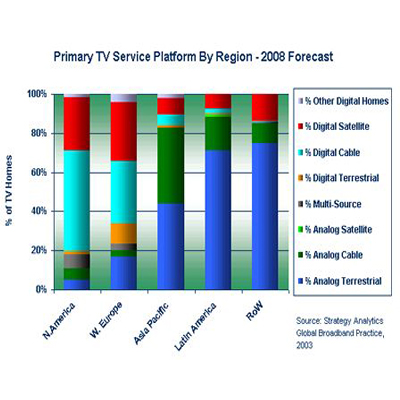
    The report, published to subscribers to the Broadband Entertainment Strategies service, shows that 597 million homes worldwide used analog terrestrial broadcasting as their primary TV service in 2002. With the growth of digital television services offered by satellite, cable and terrestrial operators, this number is forecast to decline by 24 per cent to 455 million by 2008.

    North America and Europe will be the most advanced markets in the digital TV transition by 2008, but the majority of homes in the rest of the world will still use analog terrestrial TV as their primary service. Even in the most advanced markets, however, a realistic analog switch-off strategy will have to account for the additional costs of converting hundreds of millions of secondary TV sets and VCRs.

    Analog switch-off is seen as a key policy goal by most governments. Releasing this valuable spectrum could ultimately lead to major new commercial and public revenue opportunities. The report suggests that few, if any, countries will be 100 per cent digital until well into the next decade. Some countries, such as Germany, will instead seek to use analog platforms such as cable as an alternative to terrestrial broadcasting. The report recommends that broadcasters relying strongly or wholly on analog terrestrial broadcasting for access to viewers must consider implementing alternative strategies and distribution partnerships in order to safeguard their long term position.

  • Disruptions are a necessary evil

    Disruptions are a necessary evil

    CANNES: We live in times of fast changing technology where more often than not, the only way to keep pace is to unlearn what we’ve just learnt and re-adapt ourselves to the transformation.

    Exactly the point Deluxe Media Europe senior director, sales and business development Darren Baker was trying to drive home when he said: “Every time you think you have learnt everything, you have to adapt and learn again. The need is to adapt quickly and learn again.”

    Baker was addressing a gathering at Verriere Grand Audi Level one at the Palais on day two of Mipcom.

    “The important thing is to learn quickly and react to the disruption,” he further stressed.  
    Referring to cinema, TV, VCR, DVD, BluRay and now VOD as techniques used for disruptions, Baker said that while the disruptive nature of some technological shifts was immediately evident, in other cases, it became clear only through tracking the patterns of adoption.

    Speaking of one too many portals in the content supply chain, he said: “The consumer wants the content, the content provider wants to provide the content and the portals are ready to carry them. But then there are too many contracts. There needs to be a disruption here.”

    Not just portals, he also pointed out that there are just too many schemes and updates. “By the time the consumer is happy that they have got all the programmes, the portal updates its software and the consumer has to change the entire system yet again,” he said.

    In his view, the proliferation of vendors too posed a problem. “If you have a large number of vendors, you should reduce them,” he advised buyers.

    Offering his take on successful disruptions, he said: “There is a need for constant improvement in every company. A fresh approach is always welcome and refreshing the digital policy every few months also helps,” adding that with every four year old ignoring television and moving towards mobile and social media, “companies need to be open to disruptions”.

  • FCC to allow new low power devices on vacant TV spectrum

    FCC to allow new low power devices on vacant TV spectrum

    MUMBAI: US media regulatory body the Federal Communications Commission (FCC) has adopted a First Report and Order and Further Notice of Proposed Rulemaking.

    This marks the first step towards allowing new low power devices to operate in the broadcast television spectrum at locations where channels in that spectrum are not in use by television stations or other authourised services.

    This action will enable the development of new and innovative types of devices and services for businesses and consumers in the US.

    The FCC has concluded that fixed low power devices can be allowed to operate on TV channels in areas where those frequencies are not being used for TV or other incumbent licensed services.

    The marketing of such devices may commence on 18 February, 2009, after the digital television (DTV) transition is complete and all TV stations are in operation on their permanent DTV channels.

    The FCC has also invited further comment on a number of issues that were raised in response to the Notice of Proposed Rule Making. It has solicited additional information that is needed to determine whether personal/portable devices can operate in any of the TV channels without causing harmful interference. It also invited comment to explore whether low power devices should be permitted on TV channels 2-4, which are used by TV interface devices such as VCRs, and whether fixed low power devices can be permitted on TV channels 14-20.

    The FCC has made technical proposals to facilitate use of a dynamic frequency selection (DFS) mechanism to ensure that TV band devices operate only on vacant TV channels. In addition, it sought further comment on implementation details for the geo-location and control signal interference avoidance approaches.

    The FCC says that it has reaffirmed its commitment to developing a complete record to ensure that the final rules will protect TV broadcasting and other service against harmful interference. In particular, it has invited parties to submit test results showing that TV band devices will not cause harmful interference. In addition, the FCC plans to conduct extensive testing itself to assess the potential interference from low power devices operating in the TV bands before adopting final rules.

  • 71 per cent of tweens will be online by 2010: eMarketer study

    71 per cent of tweens will be online by 2010: eMarketer study

    MUMBAI: The latest eMarketer’s report suggests that among tweens and young teens some 20 million of them use the Internet and by 2010, 71 per cent of kids ages 8-11 will be online.

    Tweens online may well be marketers’ next big coveted demographic. Children between the ages of 8 and 14 — are not only strong in number but interestingly, in purchasing power, informs an official release.

    It is estimated that over half of boys and girls own and use a computer, VCR, DVD player and mobile phone. In one survey quoted by eMarketer, tweens report that they love watching TV. But another study points out that children 8 to 18 spend fully one-quarter of their media time multi-tasking among media.

    “Tweens and young teens may be the first generation that will come into adulthood fully expecting to obtain their media on a variety of platforms,” says eMarketer’s senior analyst and author of the report Debra Aho Williamson.

    The younger group plays more games, everyone prefers instant messaging to e-mail, and as tweens pass into their teenage years they devote more time to downloading music. More than one-third of teens ages 12 to 14 frequent MySpace, according to one study. And, the hot growth opportunity for wireless carriers is the tween market. Harris Interactive data from 2006 shows that 23 per cent of children ages 8 to 12 own a mobile phone, up from 12 per cent the previous year.