Tag: Vanita Kohli-Khandekar

  • From print to AI how news keeps up with times

    From print to AI how news keeps up with times

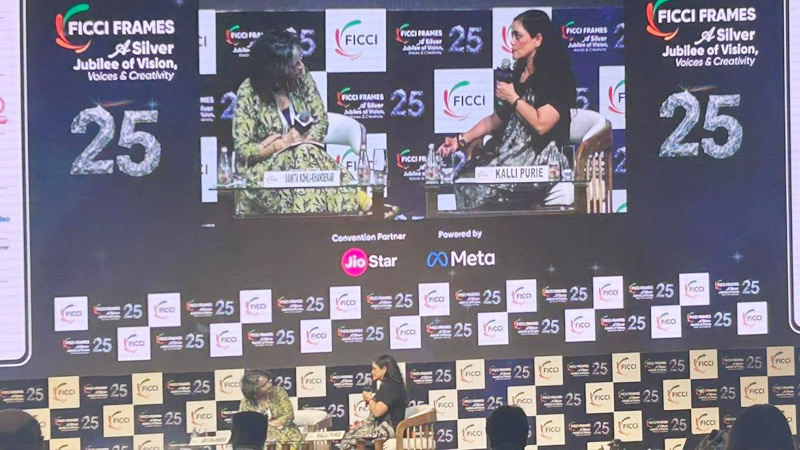
    MUMBAI: Wake up, check your phone, catch a podcast, scroll a story, news never sleeps. At a lively session on “Credibility in the Age of Chaos & Media’s Role in Shaping India’s Identity,” India Today Group vice chairperson and editor-in-chief Kalli Purie joined Business Standard columnist and author Vanita Kohli-Khandekar, to explore how a 50-year-old brand stays relevant in a 24 by 7 media whirlwind.

    Purie reflected on longevity and adaptation. “Fifty is the new 25. Men age, magazines don’t,” she said, highlighting how India Today has evolved from a fortnightly publication to producing over 120,000 content pieces every month across print, video, podcasts, social media, and live events.

    Kohli-Khandekar added a sharp perspective on the challenge of capturing audience attention in a saturated media environment. “Where does news lie in this era of short stories, micro dramas, and podcasts? How does it stay relevant and profitable?” she asked, emphasising the need for integration across platforms to maintain trust and impact.

    The discussion turned to technology and AI, where Purie revealed some pioneering initiatives. From AI anchors covering Bihar elections to AI-assisted translations and folk music storytelling, India Today has been embracing innovation to increase efficiency, reduce monotony, and explore new revenue streams. “AI is like a sandwich,” she quipped. “Human bread with AI in between. The human touch has to remain.”

    Purie stressed that technology alone cannot replace credibility. “You are a primary source. People want news from a human perspective, on the ground. AI cannot tell that story… yet,” she said, hinting at a future where robots might cover hazardous assignments while humans oversee the narrative.

    The session also highlighted India’s media identity in a global context. Purie noted, “People want sources from their own country. Digital imperialism is real, but Indian media has to assert its relevance.” Kohli-Khandekar added that 24 by 7 connectivity requires news organisations to adapt fast, integrate teams across platforms, and keep audiences engaged with stories that matter locally and globally.

    The conversation showcased how a legacy brand like India Today balances tradition and innovation, human insight and artificial intelligence, local identity and global perspective. Purie’s parting thought summed it up perfectly: staying credible, creative, and connected is the ultimate headline.

  • FICCI Frames: The roadmap for success in broadcasting

    FICCI Frames: The roadmap for success in broadcasting

    MUMBAI: In its three decades of existence, the promising broadcast narrative in India continues to be challenged on issues such as transparency, pricing, taxation, consumer choice and lack of a coherent regulatory and policy framework.


    To find a solution to these and similar questions, a panel anchored by media analyst, author and columnist Vanita Kohli Khandekar highlighted a session on the Future of Vision 2020 – laying a transformative roadmap for Indian broadcasting. The panelists stressed issues for unlocking value in Indian broadcasting on the first day of the FICCI Frames convention held on 25 March in Mumbai.


    Speakers who shared their opinion and views were I&B Ministry additional secretary JS Mathur, TRAI principal advisor SK Gupta, BBC Global News CEO Jim Egan, Siti Cable CEO VD Wadhwa, Star India COO Sanjay Gupta, Tata Sky CEO Harit Nagpal, Viacom 18 Group CEO Sudhanshu Vats and Discovery Networks Asia-Pacific south Asia and southeast Asia GM and executive VP Rahul Johri.


    According to Wadhwa, in order for the media and entertainment sector to grow, digitisation should be completed. “Digitisation must be completed and that will bring in transparency. Secondly, we need to work together to see how can we monetise the business far better.”


    It may be recalled that in phase I and II of digitisation, average revenue per user (ARPU) had witnessed a significant jump in places where people were consuming cable broadband. In response to that, Nagpal said, “We can either have monopolies or regulations but one has regulation where there are monopolies. I believe that I am digging my own grave if I am not serving my customers and as a regulator, we need to make sure that he is getting adequate infrastructure to do his job well.”


    Sharing his views on the media and entertainment sector, Star’s Gupta said that today the industry size is close to Rs 30,000 crore and the big challenge going forward will be on how to make it a Rs 300,000 crore industry. Gupta opined that the one fundamental issue that plagues the industry is that they have regulated the industry from a wrong perspective. “You need to get the capital to invest high, while creating innovation for consumers. That’s how industries have grown. However, that is the challenge for the M&E industry.”


    When on the one hand broadcasters believe that regulation is not required, on the other hand TRAI’s Gupta had a different opinion. “If regulation is not required then what is required? Is it that we are required to keep quiet on the customer front if they are not getting any choice?” he questioned.


    He went on to add that the country has 30 million DTH customers, 30 million DAS customers and 10 million addressable systems. However, the question was how many consumers have the choice of individual channels? “If I ask a consumer if he/she is watching all the channels given to them, the answer will be a big no. Therefore the price can be deregulated and total selection of the channel should be given to the consumer at the desired price. And for this to happen certain broad guidelines should be created and this should be done soon.”


    Picking up points from Sanjay and S K Gupta, Vats said that in order to drive the size of the pie, pricing is the difficult thing. “If we focus on the price of the analogue cable, in some way, we are constraining the ‘X’ to increase and my request is that if we become open to it, we will allow the ‘Y’ to increase. The moment we allow the ‘Y’ to increase, I think we will define the problem collectively better between LMOs, MSOs, broadcasters etc.”


    Vats was of the view that competition needs to be encouraged, even though there is enough competition in the media and entertainment industry. “Competition itself will ensure that we are reaching out to every possible Indian, outside India as well. It happens in every industry, why has it not happened here?”  A firm believer of  a free market, Vats is confident that it will drive the industry and take it to the next level.

  • The Indian Media Business gets a new edition

    The Indian Media Business gets a new edition

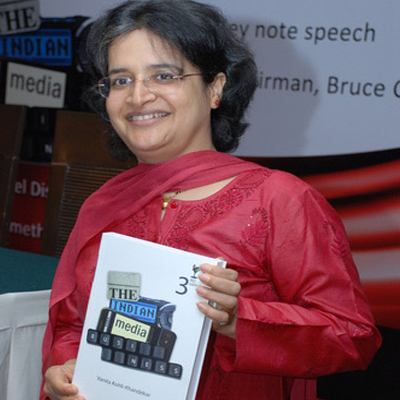
    MUMBAI: Her tome has become a reference book for students of Indian media courses. Media watcher Vanita Kohli-Khandekar released the fourth edition to her book on the Indian media business earlier this month. It has been titled matter of factly The Indian Media Business (TIMB) like in the past.

    She, however, reveals that things are different this time around in the book. Says she: “This edition has three major changes. One, there is a completely new chapter on digital media and I have dropped the chapters on telecom and internet. Two, I have focused a lot on regulation since it is very critical at this stage of the industry’s growth. And three, I have tackled a whole lot of the textural issues whether it is falling standards in news or the rising quality of Indian cinema in more detail.”

    TIMB gives a perspective and information to readers on eight segments: print, TV, film, radio, music, digital, outdoor, and events. It presents business history, current dynamics, regulation, economics, technology, valuations, case studies, trends (Indian and global) and a clear sense of how the business operates.

    The outstanding feature of the fourth edition is the chapter on digital media – arguably, the first ever serious and in-depth look at digital media from a comprehensive business perspective.  
    “This is the first time that anyone has focused on the progress of digital media in such detail, as there is no conceptual framework for the same. This chapter took a lot of effort and research,” adds Vanita.

    TIMB’s fourth edition tackles regulation in more detail than any of the previous ones. There is one large case study on the quality of regulation in India and several case-lets such as the ones on copyright law, defamation law and how it works for social media. Additionally, there are case-lets on the changes in readership methodology, on the trouble with news broadcasting and on the rising power of Hindi newspapers and the impact of digital on both print and TV among others.

    “At this stage of the growth in the industry the focus on good regulation is critical, and that can be seen in television where digitisation has finally been mandated and will have a huge impact on the top-line of the industry. So this time, this edition has a lot of focus on regulation as against earlier editions,” Vanita expounds.

    Sage Publications has been publishing TIMB for the past 11 years now. The book is also available on Flipkart.com, Amazon.com and Infibeam.com at a tab of Rs 650.   “I believe that this book will do better online as it is not in the realm of fiction. It is non-fiction and for a very specific audience,” says Vanita.

    In all 10,000 copies of the previous three editions have been sold thus far.

    Journalist, columnist and writer for Business Standard and Mid-Day, Vanita has been tracking the Indian media and entertainment business for over a decade now. Her earlier stints include one at Businessworld and Ernst & Young. A Cambridge University fellow (2000), Vanita teaches at some of the top communication schools in India as well.

    “For me professionally, it brings a lot of rigor to my work. Since I do the book every two years it forces me to sit back and read a lot of material which I would not have been able to read on the job, and this enables me to build phenomenal perspective. I ended up getting many story and column ideas while doing the research and analysis so it feels good,” Vanita exults.

    Vanita highlights that writing the book disciplines her as far as research and analysis go, and for her the whole idea of the book was that it helps those in the periphery of the media world – whether foreigner or student – get an understanding of it. A noble intent, and which many would agree has helped this generation of media professionals.