Tag: V. Vaidyanathan

  • Outlook Expo sets new benchmark for Indian retirement planning

    Outlook Expo sets new benchmark for Indian retirement planning

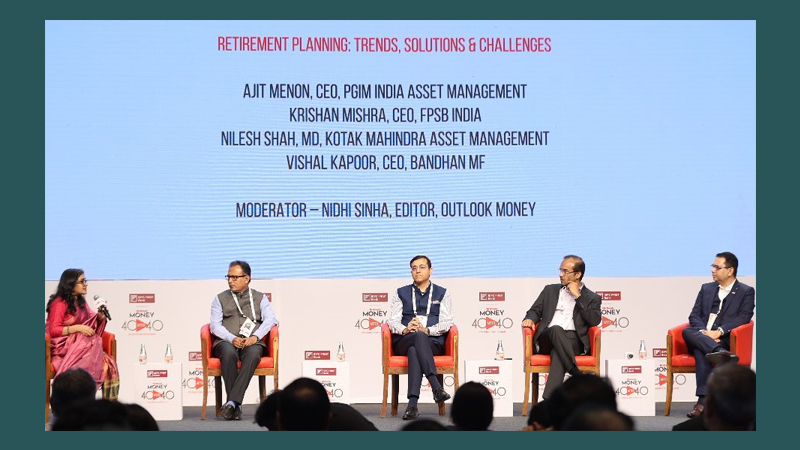
    Mumbai:  Pioneering a new era in post-retirement planning, an expo has set the stage for transformation for individuals and their families by addressing critical issues with a comprehensive and holistic approach. The event featuring an impressive lineup of over 40 distinguished speakers, attracting more than 4000 attendees and hosting over 50 exhibitors offered insights and opportunities to help redefine how one can approach financial considerations to make the right lifestyle choices in the context of retirement.

    Outlook Money’s ‘40After40’ premier retirement planning expo emerged as a groundbreaking event, held at the esteemed Jio World Convention Centre in Mumbai, it had participants engaging in insightful panel discussions, interactive chats, and enlightening masterclasses, connecting with seasoned planners and industry experts.

    The event started with an impactful session by  ASK Group executive director Bharat Shah who emphasised the importance of early planning, addressed the lack of financial knowledge in academics, and highlighted growth opportunities in the finance and investment industry. Shah’s session underscored the sacred duty of building and nurturing money with care and dedication, touching on the holistic nature of wealth that includes intellectual ability, physical well-being, and the drive of the soul.

    Speaking about securing the future, IDFC FIRST Bank MD & CEO V. Vaidyanathan  said, “Embracing retirement planning is like stepping onto the cricket pitch. Start early, as delaying your financial innings can lead to unexpected challenges. Secure your future today, ensuring a stress-free retirement down the line.” As he delved into the gaps in the Indian pension landscape, Deepak Mohanty, chairman of the Pension Fund Regulatory and Development Authority (PFRDA), spoke of the risks of inflation, the power of compounding, and the need to expand literacy and awareness about the National Pension System (NPS). His session stressed the importance of pension planning as a necessity rather than a substitute.

    Bank of Baroda chief economist Madan Sabnavis provided valuable insights into India’s journey towards becoming a $5 trillion economy. He highlighted the contrast between the rich and the poor, emphasising the need for real GDP growth, lower inflation, and increased per capita income. Sabnavis discussed the challenges faced by the private sector, pointing to the importance of creating more jobs and stimulating demand to achieve economic growth.

    “It’s clear that our pursuit of a $5 trillion economy requires a focus on the quality, not just speed, of our growth. With a per capita income of $2400, the key lies in fostering inclusivity and sustainability. A crucial aspect is the private sector’s role in generating more jobs, boosting consumption, and ensuring sustained income growth for all citizens,” said Bank of Baroda chief economist Madan Sabnavis.

    To demystify the life insurance landscape, ICICI Prudential Life Insurance Anup Bagchi, MD & CEO outlined three critical variables for investment. These variables were – the amount of money, time, and return on investment. He stressed the tax efficiency and discipline offered by life insurance and recommended strategies such as Systematic Withdrawal Plans (SWP) and creating a corpus for medical expenses.

    Ananth Narayan Gopalakrishnan, whole time member of SEBI, shared insights on retirement planning and the role of proper advice. Gopalakrishnan urged attendees to view it as financial planning, emphasising that it occurs not at a later age but right now. He stressed the importance of understanding one’s risk appetite, diversifying investments, and seeking professional advice to avoid scams.

    Bandhan MF CEO Vishal Kapoor  in his comments said Investing for retirement is about more than just chasing returns.  “Future expenses, particularly medical costs, are often underestimated. Aligning investments with specific lifestyle goals and anticipating evolving expenses is crucial. Strategic planning ensures that investments not only beat inflation but also sustain the desired standard of living in retirement,” he said.  

    The panel discussion on wealth creation featured Sushant Bhansali, CEO of Ambit Asset Management, Deepak Shenoy founder and CEO of Capitalmind Financial Services, Anshul Arzare, MD & CEO of YES Securities (India) Ltd, and Vasanth Kamath founder & CEO of Smallcase Technologies. The panel emphasised the importance of investing in India, choosing good companies, and diversifying portfolios across different industries.

    In the session on post-retirement money, a panel consisting of Swarup Mohanty, vice chairman & CEO of Mirae Asset Managers (India), Vibha Padalkar, MD & CEO of HDFC Life Insurance, and Kamlesh Rao, MD & CEO of Aditya Birla Sun Life Insurance, discussed the necessity of creating wealth post-retirement. They highlighted the increase in expenditure with age, not only for health but also due to inflation. Vibha Padalkar promoted living retirement with dignity, emphasising the cost associated with guarantees in financial products.

    National Pension System Trust CEO Sashi Krishnan addressed reforms in the National Pension System, emphasising the need for investing now. Krishnan outlined why people invest in NPS, including tax exemptions, tax reductions, and the product’s cost efficiency. He highlighted changes in the accumulation and post-retirement phases to enhance the investment experience for participants.

    In a special address on investing in a bull market, Sankaran Naren executive director & CIO of ICICI Prudential Asset Management, discussed the importance of asset allocation and hybrid products for a pleasant retirement. He emphasised the need to avoid extremes and adopt a diversified approach for a happy retirement.

    Vijay Chandok, MD & CEO of ICICI Securities, explored the role of equity in retirement planning, acknowledging its complexity and risk. Chandok highlighted the dynamic nature of equities, the magic of compounding over the long term, and the importance of staying updated and seeking expert advice. The Financial Planners Panel, featuring Dhruv Mehta, Lovaii Navlakhi, Sadique Neelgund, and Sandeep Jethwani, moderated by Amit Trivedi, discussed the challenges and solutions in financial planning, providing valuable insights for attendees.

    Rajit Mehta, MD of Max India & Antara Senior Care, delivered a special address on the next step in healthcare. He discussed the impact of ageing on physical, emotional, and mental well-being and emphasised the transformation of the healthcare system to promote holistic wellness. Mehta introduced Antara’s AGEasy initiative, empowering seniors to age easily and joyfully through health and wellness solutions.

    Ira Trivedi, Author, Columnist, and yoga Acharya, conducted a spotlight session on the recipe for wellness. Trivedi emphasised the importance of proper exercise, diet, breath, relaxation, and positive thinking for overall wellness. In another special address, Tapan Singhel, MD & CEO of Bajaj Allianz General Insurance, addressed the long-term roadmap for a healthier nation. Singhel discussed the need for mindfulness, meditation, yoga, exercise, a group of friends, annual checkups, and moderate income for a healthier life. He highlighted the role of wellness ingrained in Indian culture and advocated embedding health awareness in academic curriculums.

    In a spotlight session, National Award winner actor Manoj Bajpayee shared insights into his acting career, emphasising the challenges and dedication required for role preparation. He highlighted the importance of simple living and the refugee state of mind that comes with leaving one’s place. The event also featured a spotlight session with Mithali Dorai Raj, former captain of the Indian Women’s Cricket Team, discussing her life story, challenges, and retirement plans. Devdutt Pattanaik, Indian Mythologist, Speaker, Illustrator, and author, delivered a special address relating the Ramayana and Mahabharata to current life situations. He drew inspiration and solutions from mythological scriptures, emphasising the need to accept life for what it is.

    Outlook Money’s ‘40After40’ succeeded in creating a unique platform for individuals to gain valuable insights into retirement planning, ensuring a brighter financial future. The event’s success is a testament to the importance of informed decision-making in securing one’s retirement.  

  • ET NOW celebrates the spirit of entrepreneurship at the 11th Season of Leaders of Tomorrow Awards

    ET NOW celebrates the spirit of entrepreneurship at the 11th Season of Leaders of Tomorrow Awards

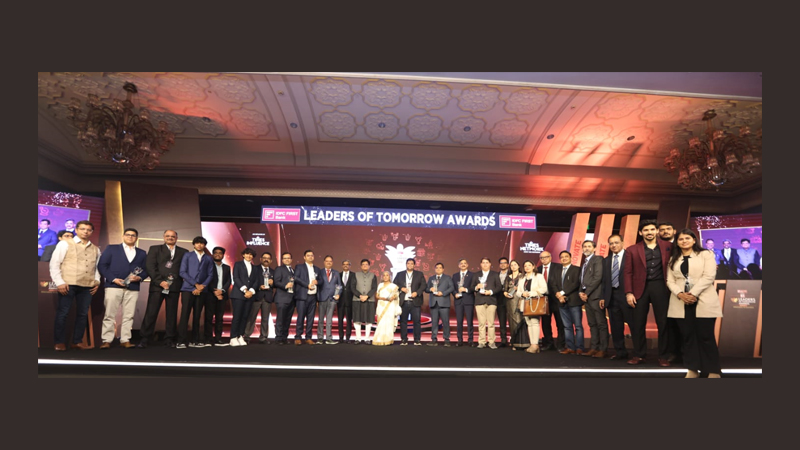
    Mumbai: ET NOW hosted the 11th Season of Leaders of Tomorrow Awards in New Delhi on Saturday, 13 January 2024. India’s largest entrepreneurship platform dedicated to empowering, enabling and celebrating the entrepreneurship spirit, Leaders of Tomorrow Awards in its latest edition themed, “Innovate to Elevate” emphasized the pivotal role of innovation in driving the success and progress of enterprises and the role it plays in driving India’s economic progress.

    Championing the success stories of India’s most innovative and resilient MSMEs and start-ups, Leaders of Tomorrow Awards recognized India’s most promising entrepreneurs and showcased upcoming and enterprising small businesses across 20 categories shortlisted through an exhaustive pan-India screening process and duly evaluated by an esteemed panel of jury (See Annexure for complete list of Winners and Jury Members). The selection process involved benchmarking across a range of quantitative and qualitative parameters such as Business Model, Innovation & Disruption, Clarity of Thought and Business Vision.

    Minister of Commerce and Industry, Consumer Affairs, Food and Public Distribution, Textiles Piyush Goyal delivered the keynote address at the event on ‘Innovation as a Catalyst for Growth’ and felicitated the winners.

    Delivering the opening remarks, MK Anand, MD & CEO, Times Network CEO & MD MK Anand said, “For over a decade, Leaders of Tomorrow, India’s largest entrepreneurship platform has enabled and empowered the spirit of enterprise. Besides contributing to GDP and employment, SMEs, MSMEs and startups fortify the Industrial base through their pivotal role in economic cycles and supply chains. As we mark our latest edition, “Innovate to Elevate,” we proudly recognize 20 remarkable Entrepreneurs for their trailblazing products and ingenious strategies. These champions have not only shown resilience but an unwavering commitment to innovation. From pioneering revolutionary solutions to reshaping entire sectors, they are paving the way for sustainable economic growth on India’s path to being an Economic Superpower. We are thrilled to witness and cheer the rise of this new generation of entrepreneurs. I am confident that these Awards and our commitment to showcasing such entrepreneurial talent will continue to inspire countless individuals to script their own stories of entrepreneurial triumph.”

    Goyal said, “I congratulate ET Now for recognising and honouring India’s entrepreneurs and spirit of innovation. It is the only platform that recognises the unsung heroes, the leaders of tomorrow. There is great excitement about India globally. We are at the cusp of our nation’s history that will catapult India into a high growth economy. As we celebrate Swami Vivekananda’s birthday as National Youth Day, we must recall his call for action. He inspires every youth in the country. Earlier today, Prime Minister Narendra Modi inaugurated India’s longest Atal Sea Link bridge, which will transform Mumbai’s future. It has come up in record time due to PM’s vision and drive, and a state government aligned with it.”

    Goyal highlighted India’s pivotal position poised for transformative growth, stating, ‘India stands at a crucial juncture, ready to catapult into a $35 trillion economy in the next 24 years, marking an era of unprecedented growth.’ Goyal proudly pointed out Atal Setu, highlighting the collaborative efforts between the Modi government and the Maharashtra government, forming a double-engine government, and fostering self-sufficiency through Gati Shakti. Emphasising India’s stature not just as a large economy but a trusted one, he commended the global interest in investing, citing a meeting with a US investment house planning to double their $13 billion investment.

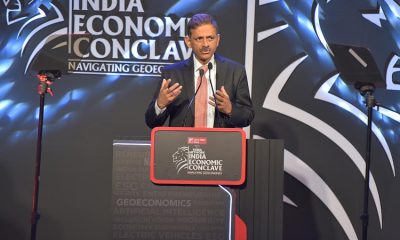
    During a fireside chat, IDFC FIRST BANK MD & CEO V. Vaidyanathan shared insights on the Indian economy and the transformative impact of digital infrastructure for Leaders of Tomorrow.  Regarding India’s digital infrastructure, Mr. Vaidyanathan expressed optimism, stating, “The impact cannot be overstated. With digital connectivity, including Aadhaar and Bharat’s optic network, India has achieved a remarkable feat, formalising the economy, notably for MSMEs. Over 100 million merchants now deal digitally through QR codes, facilitating trade and enabling micro-businesses. The optimistic MSME outlook stems from collective efforts of the government, RBI, and banks, coupled with robust asset quality, digitisation, and ongoing infrastructure investments, empowering micro-entrepreneurs in India.”

    A melting pot of Enterprising Visionaries, Start-up Gurus, Business Icons, Domain Experts, Next-Gen Entrepreneurs and Disruptors, the event witnessed a distinguished line-up of speakers. Leaders in the entrepreneurial space like Sanjeev Bikhchandani, Co-founder-Info Edge(Naukri.com, Jeevansathi.com, 99acres.com & more), Prasiddhi Singh, Founder-Prasiddhi Forest Foundation, Nav Agarwal, Founder- One Step Greener and Advait Thakur, Founder – Apex Infosys engaged in an inspiring panel discussion igniting the spirit of entrepreneurship.

    The ‘Leaders of Tomorrow’ Awardees are:

  • Govt under pressure to finalise Content Code: Sushma

    Govt under pressure to finalise Content Code: Sushma

    NEW DELHI: Information and Broadcasting Ministry Secretary Sushma Singh said today that while the government did not want to interfere with the freedom of the media, the latter should show a sense of responsibility and observe journalistic ethics.

    Speaking at the inaugural session of the Second Indian News Television Summit organized by indiantelevision.com, she said channels should introspect as to whether what they were showing in the name of news was really news.

    She noted sensationalism in the content of news channels often resulted in creating alarm and this was the reason for the government having issued as many as 241 show-cause notices to news and other channels over the past few years.

    She said the Ministry was under pressure from various sources including courts to act faster on creating a suitable Content Code. The Ministry had, therefore, been working with the News Broadcasters Association and the Indian Broadcasting Foundation to finalise a Code as early as possible. She gave examples of the Andhra Pradesh and Delhi High Courts which had been demanding speedier action from the government in this regard. She said the inability of the Ministry in promulgating a Code was being looked at seriously.

    She said that the government had presently given uplinking permission to as many as 191 news channels and had only recently given 33 new licences for news and current affairs channels. This showed the liberal attitude the government had towards encouraging plurality of thought and divergence of opinion. This was one of the reasons for more regional channels coming up in the recent past.

    But the government had a duty to look at the content of the news channels that was being passed off as news. The news channels must also realize that the viewers included children and sensitive audiences.

    Furthermore, maintenance of public order and national interest must take precedence over the content of news.

    She said that technological breakthroughs were creating rapid advances and this made it more imperative that national objectives should be kept in mind. The attitude of the news channels whenever the government approached them should be one of discussion and not confrontation.

    Singh also released on the occasion The NT Magazine, brought out by indiantelevision.com.

    In his keynote address, India TV head Rajat Sharma made a passionate case to say that most channels worked in a very responsible manner and often helped in exposing the ills in society.

    Sharma regretted that news channels were under attack when even the print media was doing the same kind of reporting.

    He said that people had faith in the news channels and this was the reason why many first came to them even before approaching the police or courts of law. He said it could not be denied that news channels had empowered the people, but this responsible behaviour of the channels had gone unnoticed.

    Television channels were now receiving threats from the underworld or terrorist groups for correct reporting, and this was now a major threat facing the news media.

    Admitting there had been some lapses like the recent case of a false sting, he said the entire community of news broadcasters had criticized such things.

    Self-introspection was being done on the Content Code and he said the News Broadcasters Association along with the Ministry was now involving judges to help in drafting the Code.

    He said that it could not be denied that news channels had shown a lot of restraint in cases of violence or wherever social responsibility was required to be shown. Furthermore, he maintained that even as news channels showed astrology or other news in an interesting manner to win eyeballs, 50 per cent was hard news.

    He also said that news channels had become the true ambassadors of the country by beaming overseas, and also functioned as a bridge between the government and the people.

    Giving an alternative viewpoint, ICICI Bank Executive Director V Vaidyanathan said presentation of news should be treated as a corporate responsibility just as some corporate houses put aside some part of their revenues for social good.

    He also said news channels had to be relevant to hold the attention of the viewers, pointing out that most viewers now kept flipping channels instead of sticking to one channel.

    He said most news channels seemed to be suffering from the prisoner’s dilemma: if they did not sensationalise the news, someone else would. But this did not always mean negative news.

    He urged the media to take up its social responsibility more seriously and said it could do things like exposing the parallel economy which was harming the country. At least ten per cent of the news time should be devoted to consumer education, which could be turned into a viable business. ‘So be viable and socially responsible’, he said.

    arlier welcoming the delegates, indiantelevision.com founder and Editor-in-Chief Anil Wanvari said people were now spending an average of two hours and 38 minutes per day in front of their TV sets and so it was necessary for the channels to look towards finding the right balance, which is the theme of the Summit.

  • Government not forcing regulator on broadcast media: Swarup

        
    NEW DELHI: Ministry for information and broadcasting secretary Asha Swarup today reiterated the fact that the government had no intention of forcing checks on broadcasters in the country and that the aim of the Broadcast Regulatory Authority Bill (BRAI) was only to set up an independent regulator.

    She also denied reports that there was any proposal under the proposed Bill or Content Code to bar television channels from conducting sting operations. However, the aim was to ensure that there was no violation of the right of privacy of any individual, as had been seen in some sting operations.

    Swarup was delivering the keynote address at the Indian News Television Summit organised by Indiantelevision.com in the capital. The day-long meet culminating with the NT (News Television) Awards in the evening has been endorsed by the ministry.

    The secretary expressed optimism that the Broadcast Bill would be introduced in Parliament during the monsoon session. She said incorrect reports about the Bill in the media only resulted in more delays in finalizing the draft of the legislation.

    She said in reply to a question that the public service broadcaster Prasar Bharati would also be brought under the ambit of the Bill.

    Both the legislation and the Code were being drawn up keeping in view the sensitivities of the Indian viewer, she said. It was therefore in the interest of the industry that there should be a Bill and a Regulator who is independent and impartial.

    She urged private news channels to share the duty of the public service broadcaster by showing some public service programming. There was need for more positive stories which could motivate people. 

    She noted that there were almost 90 to 100 news channels in the country if one counted all regional channels and those that have news bulletins. There had been an annual growth of 18 per cent in the television industry. But all this gave rise to the basic question – what kind of news do Indians deserve?

    She also said that while there was need for news channels to show care and sensitivity while presenting news, she said accuracy and impartiality should also not be given a go-by. She said that there was also need to help in the maintenance of public order. Repetitive telecasts of old clips of violence only sent out wrong messages. 

    Answering a question after her presentation, she said that the Content Code was being shown to representatives of associations of various stakeholders on 20 July and would then be finalised for being put on the ministry site mib.nic.in for eliciting the views of people.

    Earlier, Indiantelevision.com CEO and editor-in-chief Anil Wanvari said that the future of the television industry was very bright with more entrepreneurs getting into the industry, both in India and overseas. He announced that indiantelevision.com would be organizing a Digital Summit in October.

    Indiantelevision.com editorial director Thomas Abraham said in a presentation that news channels had earned Rs 9.8 billion as revenue from advertisements during 2006-07. He said that this was expected to go up to Rs 12.5 billion this year. India today had 116 million television homes of which 75 million were connected to cable and satellite.

    Asking if the news broadcasters were being able to reach out to specific genres and segments, he observed that news has to be more interactive and has to find ways to reach out to all communities.

    In a presentation giving the Citizen’s Voice, ICICI Bank executive director V Vaidyanathan said that a total of 51.9 million mobiles were being added every year and one in every Indian today owned a personal computer. And now people were taking to web phones. Growth was no longer an option, it just had to happen. He said that communication methodologies were changing both for the urban and the rural Indian.