Tag: User-generated content

  • From Couch Potatoes to Content Creators: Hathway & Den reel it in

    From Couch Potatoes to Content Creators: Hathway & Den reel it in

    MUMBAI—Move over, television executives. The inmates are about to take over the asylum—or at least, the broadcast.

    Cable television multiservice operators Hathway and Den have launched an experiment that could rewrite the rulebook of broadcast media. Their new platform, Hathway/DEN Reels, is turning content creation and  its broadcast on its head – viewers are creating content which is being packaged and shown on a specialised service on Hathway channel no 99 and on  Den channel no 100. 

    Launched on 18 March, Hathway Reels and Den Reels  have already captured the imagination of wannabe performers nationwide. In just five days, over 1,000 user-generated reels have flooded in—a deluge that suggests a deep hunger for democratised stardom.

    “This isn’t television as we know it,” says an industry observer. “It’s television as people have always dreamed it could be”.

    The concept is disarmingly simple. Aspiring performers—be they singers, dancers, comedians, or pure eccentrics—need only a smartphone and a dash of courage. No casting calls, no industry connections, no prohibitive barriers to entry.
    Hathway reels
    Social media has long promised such democratisation, but often delivered only algorithmic mirages of fame. Hathway/DEN Reels promises something more tangible: actual broadcast airtime.

    What sets this initiative apart is its radical inclusivity. It’s not about polished performances but raw, unfiltered talent. A call centre executive in Bengaluru, a farmer in Punjab, or a student in Mumbai can now find themselves beamed into living rooms across India.

    The platform represents more than entertainment—it’s a social leveller. For every frustrated creative soul shelving dreams due to practical constraints, this is a lifeline. No need to quit the day job. No need to move to Mumbai or Delhi. The stage has come to them.

    Initial response suggests the concept has struck a nerve. In an era of algorithmic content and manufactured viral moments, Hathway/DEN Reels offers something revolutionary: genuine human connection.

    As television wrestles with relevance in the streaming age, this could be a blueprint for survival. Not by competing with slick productions, but by becoming a mirror—reflecting the vibrant, diverse, utterly unpredictable talent that pulses through India’s veins.

    For those who’ve ever mumbled “I could do that” at their television, the time has come. The spotlight awaits.

  • ESPN to add user-generated content to new streaming service, targeting younger viewers

    ESPN to add user-generated content to new streaming service, targeting younger viewers

    MUMBAI: ESPN is stepping into the future of streaming, and it’s not coming cheap. In a bid to capture younger, digital-first audiences, Disney’s ESPN is planning to integrate user-generated content into its upcoming flagship streaming service, set to debut later this year.

    While the specifics remain under wraps, sources confirm that ESPN subscribers will eventually be able to upload their own content to the platform. Chasing Youtube? Taking a shot at Instagram? Arriving fashionably late to the game? Maybe. But ESPN has long been the go-to for die-hard sports fans, so if they filter out the fluff and actually build a platform that celebrates real sports content, they might just score big. However, don’t expect to upload your highlight reels at launch. The company is pushing to roll out the service before the NFL season kicks off in September, but no official date has been revealed yet. When pressed for details, ESPN remained as tight-lipped as a coach before the championship game.

    Disney has reportedly explored the possibility of adding user-generated content to Disney+ as well, taking cues from Youtube, the streaming giant that dominates the market. Youtube, a subsidiary of Alphabet, holds an 11.1 per cent share of total TV usage in the U.S., according to Nielsen. With Youtube’s creator-led model proving highly effective, it’s no surprise that ESPN and other media giants are considering ways to tap into this trend.

    ESPN executives are eyeing a premium price point, with a subscription likely costing either $25 or $30 per month. This new service will bundle ESPN’s linear programming with additional digital perks, aiming to provide a comprehensive sports streaming experience.

    An official announcement detailing the service’s name, pricing, and launch timeline is expected in the coming months.

    The push toward interactive content underscores a broader industry trend: capturing younger viewers who are increasingly favouring short-form content on platforms like Youtube and Tiktok over traditional live sports broadcasts. With ESPN spending tens of billions of dollars annually on live sports media rights, the pressure is on to keep audiences engaged and subscribed.

    As the sports media landscape evolves, ESPN is betting on interactivity, exclusivity, and premium pricing to stay ahead. Whether this gamble pays off will depend on how well it balances its core sports content with the participatory elements that younger viewers crave.

    (Cited from CNBC)

  • “Innovation plays a key role in our brand strategy:” Pocket FM’s Vineet Singh

    “Innovation plays a key role in our brand strategy:” Pocket FM’s Vineet Singh

    Mumbai: Netizens today crave personalised, immersive content that fits seamlessly into their busy lives. As digital entertainment evolves, audiences increasingly seek deeper engagement with stories that resonate on a personal and cultural level. With countless platforms vying for attention, it’s no longer enough to simply offer content; brands must deliver unique experiences that captivate and foster loyalty.

    That’s where Pocket FM steps in, transforming the audio landscape with its fresh take on storytelling. Since its launch in 2018, Pocket FM has ignited a new way of consuming content, turning casual listening into a binge-worthy experience. With over 200 million listeners and a vast library of immersive audio series, it’s not just redefining entertainment—it’s creating a global community of engaged listeners who spend hours each day tuned in.

    Delving deeper, Indiantelevision.com’s Arth Chakraborty caught up with Pocket FM’s head of brand marketing and communications, Vineet Singh, to discuss the brand’s approach to standing out in a competitive market, its focus on regional content, and the role of user-generated content in building a loyal community, and more…

    Edited Excerpts:

    On the key challenges you face in building Pocket FM’s brand, and ways in which you address them

    Building Pocket FM’s brand in a cluttered market certainly comes with its challenges. One of the biggest hurdles is the intense competition among numerous audio content platforms, making it tough to stand out. With so many options available, establishing a unique brand identity that resonates with listeners is crucial.

    To tackle this, we’ve focused on positioning Pocket FM as the go-to platform for audio series. By honing in on this niche, we differentiate ourselves. This clear focus helps us create a more recognizable brand and fosters loyalty among our users.

    Another challenge is creating a distinct niche within the broader entertainment landscape. We’ve embraced the growing demand for regional content, which allows us to connect deeply with diverse audiences across India. By prioritising vernacular storytelling, we not only engage listeners but also support local talent, enriching our brand’s cultural relevance.

    In summary, while the cluttered market presents its challenges, we’re committed to refining our brand strategy, focusing on unique content offerings, and building a strong connection with our audience. This approach positions Pocket FM for continued success as a leader in the audio series space.

    On Pocket FM adapting its brand marketing strategy to differentiate itself in the competitive audio entertainment market and addressing changing audience preferences

    To differentiate ourselves in the competitive entertainment market, Pocket FM has focused on understanding our audience’s unique preferences and behaviours.

    We take a hyper-localised approach, tailoring our brand content to reflect the diverse cultures and interests of our listeners. This strategy not only boosts engagement but also fosters a strong sense of loyalty among our users. By connecting with them culturally and contextually, we ensure our content resonates on a personal level.

    Innovation plays a key role in our brand strategy. For example, our interactive storytelling formats don’t just engage listeners; they immerse them in the experience. This helps us create a distinct identity in the market and deepens the emotional bond with our audience.

    Looking ahead, we’re committed to staying agile and exploring new formats and technologies to enhance engagement. By remaining adaptable and audience-centric, Pocket FM aims to strengthen its leadership in the entertainment space.

    On Pocket FM leveraging user-generated content in its marketing strategy and the role it plays in building community and engagement for Pocket FM

    At Pocket FM, user-generated content (UGC) is central to our marketing strategy and community engagement. By tapping into the creativity of our listeners, we amplify our brand reach and foster a sense of ownership within our community.

    UGC helps us in several ways:

    ● Fostering authentic connections: When listeners share their experiences or favourite shows, it creates genuine word-of-mouth marketing. This authenticity builds trust, as potential users see real interactions with our content.

    ●   Expanding reach and visibility: User-shared content on social media broadens our reach organically. It taps into existing networks, increasing our visibility and serving as social proof that encourages new users to explore our platform.

    ●   Building a sense of community: UGC strengthens connections among our listeners. When users share reviews, opinions, or fan art, it sparks conversations and builds micro-communities within our larger audience, fostering loyalty and a shared culture.

    ●   Enhancing personalisation and feedback loops: User reviews and feedback help us tailor our content and marketing strategies. By understanding what resonates with our audience, we refine both our offerings and how we promote them

    In summary, UGC not only amplifies our marketing efforts but also plays a key role in building a vibrant, engaged community at Pocket FM. By empowering our listeners to share their stories, we create a powerful connection that drives our success.

    On Pocket FM measuring ROI for marketing campaigns, and the key metrics; and a recent example of a campaign with significant ROI

    At Pocket FM, we measure the ROI of our marketing campaigns by focusing on a mix of performance and audience-centric metrics. While user acquisition is important, we believe true success lies in the depth of engagement and long-term retention.

    We closely monitor how our campaigns resonate with our community and contribute to sustained engagement. Retention rates, in particular, give us a clear picture of how well we’re building lasting relationships with our audience.

    Additionally, we prioritise understanding audience behaviour—from their first interaction to ongoing loyalty. This holistic approach helps us refine our strategies, ensuring our marketing efforts drive sustainable growth.

    On Pocket FM keeping its brand messaging consistent across platforms and the strategies that you use to boost listener engagement and loyalty

    At Pocket FM, ensuring a unified and consistent brand message across all platforms is a top priority to deliver a seamless listener experience. While we maintain a consistent tone and voice that reflects our brand identity, we adapt our communication to the unique dynamics of each channel. On social media, for example, we embrace a more casual and visually engaging approach to connect quickly with users, whereas on our app, we focus on deeper storytelling and analysis, offering a richer, more immersive experience.

    On the upcoming trends in marketing that you’re excited about, and your plan to integrate them into Pocket FM’s strategy

    Several emerging trends in marketing excite us, and we see great potential to integrate them into Pocket FM’s strategy for driving growth and engagement. To call out a few –

    ● AI-driven personalisation: Personalisation has become essential. With advancements in AI and machine learning, we can dive deeper into user behaviour and preferences. By leveraging AI, we plan to enhance our content across platforms with tailored experiences that align with user interests, delivering hyper-personalised content that keeps our audience engaged.

    ●   We’re particularly excited about immersive audio technologies, like spatial audio, which can elevate brand communication. This technology creates a

    multi-dimensional sound experience that places listeners at the heart of the narrative, making their listening experience more engaging.

    ●   Direct-to-fan platforms: These platforms represent an exciting opportunity for more personalised audience engagement. They allow us to connect directly with our listeners, fostering deeper relationships and gaining real-time insights into their preferences. We’re exploring how to experiment with these platforms to strengthen our bonds with our audience and create tailored experiences that resonate on an individual level.

    Overall, we’re eager to embrace these trends and integrate them into our strategy to enhance listener engagement and loyalty at Pocket FM.

  • GUEST ARTICLE: How will metaverse shape the influencer and consumer engagement landscape

    GUEST ARTICLE: How will metaverse shape the influencer and consumer engagement landscape

    Mumbai: The internet is constantly evolving and has become more interactive. Soon, we will be able to experience it as a network of real-time virtual worlds. The metaverse is a three-dimensional virtual environment that allows your digital avatar to live, play, work, and socialise. It is a self-contained digital counterpart to the real world where you are engaged in your surroundings and experience and have access to various places, events, and activities while sitting in your living room.

    This next-generation version of the virtual space is a powerful tool. It offers excellent comfort, accessibility, interactions, and brand promotion opportunities, with user-generated content (UGC) playing an essential part in the form of text, images, audio, and videos. It will be a crucial building component for the metaverse in the coming years, providing uniqueness, credibility, and scalability.

    Brands and creators have acknowledged the first-mover advantage and are capitalising on consumer interest. As mega brands begin to leverage the metaverse, another trend that can stand to benefit is the realm of influencer marketing.

    Metaverse and influencer marketing

    Influencer marketing as a social media marketing tool emphasises product endorsements and recommendations from experienced influencers with a substantial social following. These influencers are highly regarded by their audience, and their product recommendations serve as social validation for brands’ prospective customers.

    Social media platforms have dramatically boosted the number of niche influencers and viewership in recent years. These creators have begun to engage with their audiences in new ways to widen the influencer-audience engagement time. They are eager to leverage the metaverse as a space to connect with a larger audience and provide a better consumer experience. Numerous opportunities exist for creators to collaborate and create engaging and multi-dimensional content to bond with their audience in the metaverse.

    Growth in virtual circles

    Social media platforms have significantly increased the number of influencers who interact with their audience. However, these interactions are frequently constrained to certain platform features.

    Metaverse can make the experience seamless and convenient for everyone. Creators can host virtual meetups and organise livestream sessions, fan fests, and other activities. Through metaverse, they can connect directly with their audiences’ digital avatars on the platform, garnering better engagement.

    Immersive influencer marketing

    The innovative use of technologies such as AR and VR expands the possibilities for generating immersive and engaging content while allowing creators to enter into new dimensions like the metaverse. For example, influencers in the music industry can stage virtual performances in the metaverse to attract viewers from all over the world, crossing all geographical boundaries.

    Similarly, artists can create and sell 3D art to display in virtual homes; fashion influencers can introduce their digital merchandise that their audience can purchase; and travel influencers can go on virtual world tours with their fans, making the experience more thrilling.

    The growing number of influencers has helped brands reach various demographics and engage with existing and potential consumers. Influencers can be present in more than one virtual space in the metaverse, which amplifies their reach. Brands can leverage this benefit to optimise their marketing strategies and interact with larger consumer segments.

    The future of influencer marketing

    Although celebrity influencers have pioneered influencer campaigns, micro influencers’ growth has expanded and will continue to strengthen business opportunities. Brands can easily connect with their consumers by leveraging a network of smaller influencers rather than investing in one or two big influencers.

    In addition, social media has witnessed an increase in AI influencers across sectors. Interestingly, brands have started creating virtual influencers, aka meta-influencers. This strategy enables brands to have ambassadors who can interact with consumers.

    In the coming years, AI influencers will coexist with their human counterparts in the metaverse, with brands having the power to control how they communicate their message and narrative.

    Way forward

    The metaverse is set to bring about profound changes in how we all live. It will alter our interaction with the physical world, from perception to content creation. There is an enormous potential for all creators to harness technology to create outstanding content in the metaverse and thrive in their domains. Content creators will play a critical role in the development of the metaverse, which will be pivotal to their success in the long term.

    The author of this article is AnyTag India Lead Shuchi Sethi.

  • Nitin Kothari joins OMTV as chief technical officer

    Nitin Kothari joins OMTV as chief technical officer

    Mumbai: Sanatan storytelling platform OMTV has appointed Nitin Kothari as CTO. He will head the technology part and will aim to make OMTV a media tech company by introducing AR/VR for live darshan shows.

    He has been working in the technology space for over 30 years, with extensive experience in design, development, and implementation of complex business software solutions. His expertise lies in business analysis in the finance, manufacturing, and accounting domains. He is an all-rounder, from tech-entrepreneur to product leader and an accomplished tech architect across the complete product suite – mobile, web, and back-end systems. Passionate about design thinking and user interface (UI), he has built and managed web and mobile-based products across various domains for organisations in India, the UK and the US.

    He said, “My constant endeavour is to apply business sense in developing applications where the effort would lead to large impacts on business processes and results. I am happy to be part of this organisation which is doing some good stuff and putting technology into this genre, which is considered to be very old school. I get more excited when I am thrown a challenge to execute something new on the platform. I hope with tech availability I will be able to match the vision of the founders.”

    OMTV founder and MD Nitin Jai Shukla said, “Over the period of Nitin’s professional expertise, he has proven skills in managing teams to work in sync with the corporate set parameters and motivating them to achieve business and individual goals. In his professional career, he has exhibited excellence in developing, piloting, and implementing new business processes. Nitin has a sound ability to identify risks / issues that could affect the project and put in place the required effective solutions. A thorough professional with a proactive attitude, energetic, self-motivated, and capable of thinking and generating new design solutions and ideas. With a soft demeanour, he is very assertive. A team is only happy when we work with like-minded people, and their passion for technology only helps us to experiment and come up with new ideas. I’m happy to have a person who is like-minded and his passion for technology will help us to make the user experience extraordinary.”

    OMTV aims to compete with platforms from the OTT industry. For that, they want to infuse a lot of technology into the whole ecosystem. Spirituality is seen as something very primitive and we need to be tech ready. OMTV has recently closed a pre-seed funding round and is now raising its seed funding to become a revenue-making company. OMTV is also planning to introduce AI in the UGC (user generated content) space and a lot of tech features on the app.

  • How MX TakaTak plans to sustain its initial success

    How MX TakaTak plans to sustain its initial success

    KOLKATA: MX Player entered the short video race with the launch of MX TakaTak when the Indian audience was looking for a TikTok alternative. It was just one aspirant among a bunch of homegrown apps that were looking to fill the void created by the abrupt ban on Chinese-origin apps. These short form video platforms have been aggressive in customer acquisition but some of them clearly have emerged as leaders; MX TakaTak is one of them.

    It is comparatively easy to acquire a bunch of new users but much harder to retain them. The homegrown short video app is focusing on a couple of factors to hold on to the initial success; consumer experience, creation experience being key components of the strategy, said MX TakaTak business head Janhavi Parikh.

    “One is consumption experience on the platform, that is driven by content, content partnerships as well as the creators that we onboard. It is also driven by our ability to provide the right kind of recommendations to the users so that they get the content they are looking to consume. Those are two very big focus areas for us – building our content and continuing to improve our recommendation,” she elaborated.

    The platform is focusing on the right kind of tools, effects, filters, video editing capabilities to help create better content and retain top creators on the platform. Moreover, there is another segment of creators who are not professional, but just enjoy creating content. For the second segment, MX TakaTak is trying to build a product that can be used easily as the platform has a huge number of long-tail creators as well, Parikh added.

    A recent study by RedSeer Consulting had quantified the market leadership enjoyed by MX TakaTak. Interestingly, the report said the app leads in the net promoter score in the metro cities as opposed to the common notion that “I don’t think it is necessarily just metro cities, we have quite a wide audience” held by its peers.

    “Compared to some other players in the market, we are viewed as a good alternative or a good option because of the kind of content, creators we have onboarded so far,” Parikh remarked, further cementing the claim by adding that MX TakaTak has welcomed 11-12 influencers out of the top 20 former TikTok stars.

    The content they create sort of addresses the sensibility of the metro audience, she noted. In addition to that, the app has managed to create a high quality product from camera, effects, as well as overall user experience perspective which has played a critical role to attract those consumers.

    Is it helping the platform rope in premium brands? There are such brands carrying out campaign experiments on the platform but a number of long-tail of brands are also interested in working with MX TakaTak, Parikh claimed. “Because our audience is very large that cuts across all demographics. We have the premium brands on board with us because short video is such a high engagement platform but we also have other brands interested to work with us,” she stated. Nonetheless, it’s very early days for them from a monetisation perspective.

    Right now, most of the traction for MX TakaTak is coming from the Hindi-speaking market, followed by Maharashtra, Gujarat, South India. As part of its push into building regional content and diversity, the platform has started to focus and onboard creators in south India. However, 60-70 per cent focus is on Hindi content currently, followed by regional content.

    One of the major initiatives that has driven engagement for the app is the Famehouse property. The idea is to create a location where creators from different backgrounds, different stages in their career can come and collaborate, create very engaging content, detailed Parikh. This a very exciting proposition for creators as small-scale influencers get to meet some of the larger creators and learn from each other.

    “As long as we sort of focus on the user experience and keep creating a quality supply of content on the platform, make sure the environment is safe for users which we are doing through a variety of steps, there is a huge opportunity to grow,” Parikh signed off.

  • Will Indian short-video apps’ monetisation experiments pay off?

    Will Indian short-video apps’ monetisation experiments pay off?

    KOLKATA: The popularity of short snackable videos exploded in India with the advent of TikTok. While it was on the way to be the indisputable leader with top influencers, premium brands, and a growing number of users, geopolitical tension curtailed the dream journey. When several homegrown apps emerged to plug the market gap left by TikTok, many experts had been sceptical about their sustainability.

    However, these apps did not tank – in fact, the ‘Made in India’ apps collectively have managed to capture TikTok’s market share. These platforms have secured 97 per cent of the Chinese app’s users, a recent report from consulting firm ReedSeer suggested. However, the time spent reaching 55 per cent of what it was in June shows there are more opportunities to boost engagement. While many of these apps are raising funds, using the capital to scale up the operations, build robust technology, adding new features, they have started looking at monetisation potentials as well.

    Unleashing brand partnership opportunities

    One of the apps that have emerged as a leading player in the ecosystem is MX TakaTak, the short video arm of MX Player. “For short video platforms, there are a variety of monetisation opportunities available. One is obviously the ad-based model, where we sell inventory to different brands. We are not focusing on that too much at the moment,” MX TakaTak business head Janhavi Parikh said.

    For now, the platform’s primary focus is to work with brands to run branded hashtag challenges to drive engagement. “Although it’s in pretty early stages for us, a lot of brands are interested in doing this. But we are taking things slow. Branded challenges, influencer marketing are big opportunities to grow monetisation,” Parikh added.

    Chingari has also tried out hashtag challenges for brands that are very popular on the platform, co-founder & CEO Sumit Ghosh said. Brands can float a hashtag and then offer money to influencers, creators to create content for the brand. It’s a win-win for the brands and creators as brands pay the latter and the platform amplifies the brand. However, the app is overall not very bullish about direct advertisements as those disrupt the user experience, he noted.

    Another homegrown app Bolo Indya has partnered with brands to do content marketing using live streaming with creators where there could be a product positioning during the live stream or purely working with a brand for brand recall being the primary objective, Bolo Indya CEO and founder Varun Saxena shared.

    Expanding the role of social commerce

    Rather than depending only on advertisers, the apps are also coming up with innovative initiatives. Take for example Chingari – the app that’s dominating the vernacular markets is experimenting with several routes. “We will get into monetisation at a later stage but right now we are just testing certain methods,” Chingari’s Ghosh said.

     “We have recently produced video commerce technology where every video that gets uploaded to Chingari, you will see a shop button on the video, powered by AI & ML. Basically, what we are doing is finding out shoppable objects within the video and comparing with the live catalogue of Amazon and showing what products you can buy from Amazon,” he explained.

    The chosen model will impact revenue as well. For Bolo Indya, it will not be a backend set-up but will be launched under a partnership model with an e-commerce player. MX TakaTak has also been toying with the idea. Lifestyle content focused short video platform Trell also entered this segment at the beginning of this year, partnering with over 500 brands across makeup, personal care, health and wellness categories.

    Building consumer-creator direct engagement

    “I think everybody is trying to innovate revenue model, somebody is trying e-commerce model, somebody is going the advertisement way. Everybody has to find which model suits their product and how to benefit. The good part for us is we have seen a good trend in terms of users spending on the platform, not just time but some money since last quarter,” Mitron TV CEO and co-founder Shivank Agarwal previously said in an interview.

    The app, which recently celebrated its first anniversary, has opened up different monetisation opportunities. One such feature is Mitron Club, Through the Club, creators can churn out engaging content exclusively for users opting for the service. The Club members can also directly connect with creators to request to create content that they would like to watch. Consumers subscribe for Rs 99 per month to become a part of the entire ecosystem of the creator.

    In addition to that, it has unveiled an on-demand service wherein consumers can ask specific help of creators and they can create videos around the queries asked by the audience.

    Direct engagement between consumers and creators to drive monetisation is a key focus for Bolo Indya. On this app, content creators can create online services and post on the platform which are delivered on a real-time interactive basis to audiences through one-to-one, one-to-many live interactions, Bolo Indya’s Saxena said. This could be an astrologer conducting an astrology session with someone or a comic creator doing stand-up comedy show for a group of audiences on a pre-ticker basis. The app takes a platform fee and the rest of the share goes to creators.

    “Our application primarily revolves around the core of enabling the content creators to monetise their content. When we native them to monetise their content on the platform, we see a revenue share out of it,” Saxena stated.

    Another major mode of monetisation for the app is through live streaming. Any creator can go and live stream and people who are watching those live streams can send gifts to those creators. These gifts can be purchased by the audience paying real money on the platform, Saxena said. Whatever the value of the gifts end up being the earning of the content creators and the platform takes a revenue share out of it. Hence, the app highly relies on consumer microtransactions which start from as low as Rs 10 and goes up to Rs 5000.

    Tapping into booming ed-tech opportunities

    Interestingly, some of these platforms are looking at ed-tech as an opportunity to bring in money. Mitron Academy is one such initiative where the creators get an opportunity to share educational videos to help users learn from the platform. It has onboarded a number of experts on different topics.

    Chingari is also working on an edtech offering called ‘Chingari Skill’ which will be launched soon. Thanks to this product, any Chingari user will be able to sell their skills. According to Ghosh, it will leave a lot of scopes for users to create such content in vernacular language as most ed-tech content is either in English or in Hindi. Notably, a large part of Chingari’s user base comes from tier-3 and tier-4 cities.

    Future opportunities

    “We have few other revenue streams in the pipeline which include launching creator rooms where the creator can post social games live learning sessions around fitness, wellness, health etc on the platform for a closed room of the audience creating their own customisation by the platform,” Saxena said.

    While MX TakaTak is already doing live streaming, Parikh seems optimistic that there are a multitude of monetisation opportunities in live streaming over time. The bigger ones could be e-commerce as well as virtual gifting, all of which will be explored in near future.

    How far is profitability?

    As the platforms are trying to build sustainable revenue models, the question of when these models will turn profitable also arises. However, Chingari is not focusing on profitability at the moment and is devoting its energies to distribution, to reach the maximum numbers of users. Ghosh added that it may take two years down the line to become profitable.

    However, Bolo Indya’s Saxena claimed the platform is very close to breaking even at the current scale as well when it comes to the monetisation side. He expects the app to be profitable in the next 12-15 months.

    “If we look towards China, after the first few years, Kuaishou, as well as Douyin, have done phenomenally well because the growth has been so huge. With all of the different monetisation opportunities kicked in, it probably took three-four or even five-six years. If we follow that China model, revenue opportunity is huge and profitability follows definitely,” Parikh commented without revealing any timeline.

  • Short video platforms rise with Bharat positioning

    Short video platforms rise with Bharat positioning

    KOLKATA: The star of user-generated content was on the rise in India due to TikTok, only to be abruptly curtailed when the government banned the Chinese-origin app. Now, nearly a year after TikTok’s exit, a number of homegrown short form video platforms have emerged to plug the gap. It seems that these apps have been able to capture the space well, as a report from RedSeer says they have retained 65-70 per cent of TikTok users.

    "Indian short form apps have been able to retain over 65-70 per cent of TikTok users, adding 30-35 per cent new users in the past year, essentially back to 97 per cent of the TikTok user base," the report said.

    The newly acquired “30-35 per cent users” have been reeled in through aggressive customer acquisition and marketing push by Indian short form video apps. The new users getting onboarded have a higher share of tier-2+ users driven by stronger focus of platforms on vernacular content and ‘Bharat’ positioning.

    A finding of the report that may give TikTok pause is that nearly 75 per cent of current short-form video users are likely to stick with these domestic apps and are unlikely to switch back to Chinese apps even if the ban was lifted.

    The short form industry has seen strong recovery with respect to both traffic and engagement. It has differentiated itself from other global social media and content through a strong ‘Bharat’ positioning and moving from the middle of the internet funnel towards the top.

    Time spent on short-form video has reached 55 per cent of June 2020, which indicates that Indian platforms are still maturing and there is a strong market opportunity, the report added. At present, daily active users spend close to 30 minutes on average on short-video apps.

    55 per cent users mention availability of regional vernacular content as the key reason for using those apps. 45 per cent users would like more professionally generated content. Live commerce and online education are prominent features in the user wish-list. However, 60 per cent users mention data privacy as the main challenge, while 50 per cent complained about streaming quality and unregulated content.

    Users and influencers are driving each other’s growth on the platforms. While influencer availability is the most important decision making factor for more than half of the users, large user base helps influencers to decide to choose the platform.

    “Moj has been a strong gainer across consumer and business metrics, as compared to the last quarter. The growth has been driven by regional language markets, especially in the southern states. On the other hand, Roposo has shown strong performance in tier-1 cities compared to the smaller ones. MX TakaTak leads in the net promoter score (NPS) in the metro cities. The platform has held challenges and hashtag events similar to TikTok, to gain market share,” the report detailed.

    Josh has fared higher on the NPS primarily on the back of increased satisfaction (47 per cent) of tier-2 users. On the other hand, Moj has performed well in the vernacular region, leading to best satisfaction (51 per cent) in tier-2+, and second best (38 per cent) in tier-1 cities.

    In metro and tier-1+ cities, MX TakaTak and Roposo are leading the pack. The former has secured the highest satisfaction (38 per cent) across the competition in metro cities and Roposo has done reasonably well in tier-1+ cities.

  • Mitron App introduces categories for video content

    Mitron App introduces categories for video content

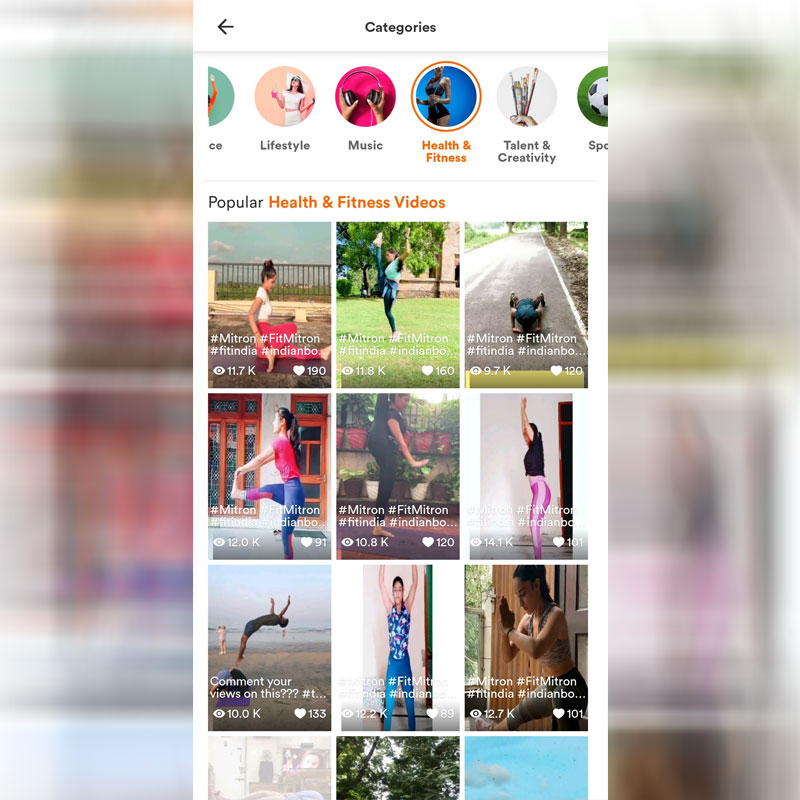
    Indian short-format video app Mitron has become the first in the space to introduce categories. As a result, Mitron is providing a bespoke service that matches categories based on the talent of content creators to specific interests of viewers. On the app users can see content organised in affinity-based categories, enabling them to discover content of their interest with one click. Content creators, based on their skillsets, will be able to create an engaged community of followers. Categories thus enable users to enjoy greater control over the content they view, whilst also providing a fillip to content distribution, by ensuring that the right content is discovered by the right audience. The app downloads have crossed 35 million on the Android play store.

    To begin with, user-generated videos have been mapped against 15 categories such as entertainment, food, funny, sports, travel and nature, education, motivation, devotion, dance, lifestyle, music, health and fitness and pets, amongst others. This will offer an experience that is unlike the typical user experience on short video apps, where users do not necessarily discover videos that have a perfect match with their interests and content creators do not always get the exposure they deserve among the audience that appreciate such content. Mitron app will keep adding more categories for skillsets; enabling more Indian talent to find their following. Going forward Mitron plans to build strong and vibrant micro-communities around categories and give each category a life of its own; content creators and distributors finding an audience that is relevant to them and is invested in them.

    Read more stories on user-generated content

    “With this launch, there’s finally a home for new local independent voices to build, share and inspire audiences in the farthest corners of the nation. This is going to transform how short video content is organised and discovered. Our aim has been to promote and give our content creators an opportunity to showcase their skills to a Bharat audience that is interested in their content. One click is all that it will take to make the match happen. We will grow every category on Mitron into a community of passionate content creators and their followers. The possibilities here are endless, based on the talent of creators and the interest of users. This will be a game changer in the space,” Mitron TV founder Shivank Agarwal said.