Tag: urban

  • BARC week 48: No changes in pecking order of top five Hindi GECs

    BARC week 48: No changes in pecking order of top five Hindi GECs

     MUMBAI: In week 48 of BARC India ratings, Star Ustav has jumped to eight position from tenth last week in the urban market. The channel has also moved one step up on the pay platform from ninth position to eight. On pay platform Sony Pal has replaced &TV at tenth position. Apart from this the pecking order of the top five hindi remained unchanged. 
     
    Star Plus,  Sony SAB, Colors, Sony Entertainment Television, Zee TV,   Dangal, Star Bharat, Star Utsav, &TV and Big Magic were seen at first, second, third, fourth, fifth, sixth, seventh, eighth, ninth and tenth position in the urban market.
     
    Urban
    Rank Channel Name Weekly Impressions (000s) sum
        Week 48
    1 STAR Plus 456855
    2 SONY SAB 403845
    3 Colors 387107
    4 Sony Entertainment Television 364233
    5 Zee TV 336632
    6 Dangal 252081
    7 STAR Bharat 202057
    8 STAR Utsav 108087
    9 &TV 93263
    10 Big Magic 91429
    HSM (Urban) : NCCS All : 2+ Individuals
    On Pay platform, STAR Utsav has moved to eight position and Sony Pal has replaced &TV which was seen on tenth position last week. Star, Sony SAB, Zee TV, Colors, Sony Entertainment Television, Star Bharat, Dangal, Star Utsav, Colors Rishtey and Sony Pal were the top ten channels. 

     
    Pay Platform 
    Rank Channel Name Weekly Impressions (000s) sum
        Week 48
    1 STAR Plus 680936
    2 SONY SAB 604997
    3 Zee TV 599192
    4 Colors 536473
    5 Sony Entertainment Television 500705
    6 STAR Bharat 297613
    7 Dangal 239094
    8 STAR Utsav 183015
    9 Colors Rishtey 150306
    10 Sony Pal 126085
    HSM (U+R) : NCCS All : 2+ Individuals

    In rural space Colors Rishtey slipped down to ninth position, last week it was seen on the eighth position. Dangal, Big Magic, Zee TV, Star PLus, SOny SAB, Colors, Sony Entertainment Television, Star Bharat, Colors Rishtey and Star Utsav were the top ten Hindi GECs in rural market.
     
    Rural
    Rank Channel Name Weekly Impressions (000s) sum
        Week 48
    1 Dangal 929392
    2 Big Magic 352100
    3 Zee TV 263767
    4 STAR Plus 225297
    5 SONY SAB 204521
    6 Colors 150238
    7 Sony Entertainment Television 137888
    8 STAR Bharat 95789
    9 Colors Rishtey 78400
    10 STAR Utsav 75109
    HSM (Rural) : NCCS All : 2+ Individuals
    Dangal, Big Magic, DD National, Manoranjan Grand, DD Bharati, DD Arunprabha, DD Madhya Pradesh, DD Uttar Pradesh and DD Rajasthan were the top nine channel on free platform. 
     
    Free Platform  
    Rank Channel Name Weekly Impressions (000s) sum
        Week 48
    1 Dangal 942379
    2 Big Magic 371819
    3 DD National 45567
    4 Manoranjan Grand 33382
    5 DD Bharati 2532
    6 DD Arunprabha 1940
    7 DD Madhya Pradesh 1555
    8 DD Uttar Pradesh 1459
    9 DD Rajasthan 1336
    HSM (U+R) : NCCS All : 2+ Individuals
     
  • Zee Cinemalu’s rural focus and Telugu movie popularity

    Zee Cinemalu’s rural focus and Telugu movie popularity

    MUMBAI: Zee Cinemalu, the Telugu movie channel from the Zee stable, launched in 2016 has made massive strides in viewership in one of the most cluttered regional markets of India. It has moved from 107 GRPs in FY17 to 244 GRPs in FY20 in the urban market, according to data shared by the channel. The channel has a strong presence in Hyderabad as it moved from fourth position to first while the GRPs moved from 103 in FY17 to 335 in FY20 (as on week 34 in 2019) posting 225 per cent growth. After urban, the channel is planning to strengthen its footprint in the rural market of Andhra Pradesh and Telangana.

    The channel moved from 90 GRPs in FY17 to 222 GRPs in FY20 (as on week 34 2019) in the total market which is 146 per cent growth. It also moved from fourth to second place in the total market while the share moved from around 15 per cent in FY17 to 28 per cent in FY20 (as on week 34 2019).

    Zee Telugu & Zee Cinemalu business head Anuradha Gudur said, “AP/Telangana is a highly competitive market; however Zee Cinemalu is in a formidable position within three years of its launch. Consistent number one is still a long way to go.  In fact, we are in process of capturing the rural market as well to strengthen our current position.”

    She said, “Zee Cinemalu has become the fastest-growing movie channel in AP/Telangana. We positioned the channel to be young and aspirational, we already had existing content which airs on the channel (Zee Telugu) but we were able to reach out to the audience with added flavour of movies with Zee Cinemalu.”

    The channel also broadcasts world television premieres of Telugu movies. Kumari 21F was the first WTP movie which was premiered on the channel. Besides blockbusters and super hits, it has also premiered small budget movies like Idhi Maa Prema Katha starring anchor Ravi and TV actress Meghana Lokesh that delivered big numbers.

    “We were the first to introduce movie premiere on the channels in this market. We reached out to a young audience. Our tag line says ‘Hits that connects to your heart’ and it does not necessarily have to be a blockbuster movie. There are movies that are not box office hits but still, the audience likes to watch them and that was our take to offer them,” said Gudur.

    The company procures Telugu movie for both the channels- Zee Telugu, the GEC, and Zee Cinemalu. Currently, Zee Telugu has 600 exclusive movies which are aired on Zee Cinemalu as well. Zee Cinemalu has four to five movie premieres happening in a year.  

    Gudur said that in the AP/Telangana market, movies as a genre contributes 35-36 per cent to total TV viewership and on an average more than 260 movies (excluding cable channels) get exposed to viewers week-on-week which shows the appetite for movies in this market.  “And in fact, producers are planning to release Telugu movies pan India in theatres,” she added.

    She further added, “As long as we add freshness to the channels, movie channels have life for the next 5 years at least and in fact, nostalgia works here as movie channels broadcast movies from the 1960s to 2019. Movies are always for “Family Viewing” than “Individual viewing” as we have predominantly single TV households.”

    Gudur said that the most challenging time was during the world cup when the channel had 11 movies lined-up, but yet the channel clocked the highest number at that time when everybody assumed that people are not going to see anything except cricket. “But the time spent on our channel grew significantly because we aired 11 movies back to back. That was the most unusual thing on the channel,” she said.

    In this market, Gudur informed that the 12 pm and 3 pm timeslots perform well and it also has Friday bank where it premieres and provides back to back movies on that day. “Friday has been a hit bank for us,” she commented.

    The consumption trend in the South is a bit different from the rest of the markets. Unlike other markets, the consumption starts at 6 am in the morning. 50 per cent of the consumption is movies, especially in the Telugu market.

    The channel has also seen a rise in its revenue from subscription post NTO. “We have revenue from subscription coming in significantly because of TRAI changes and it is the most-watched channel in Telangana. Other than that we have advertising revenue which adds to top line,” said Gudur.  

    “There are issues like channel duplication, landing page issues and the issue will always exist for most of the channels. What has been fantastic is that growth has been steady and this year has been exponential for the channel.  The advertisers are very excited with the kind of growth the channel has shown this year. From the last financial year we have got very good responses from the advertisers,” concluded Gudur.

  • BARC week 26: Dangal TV retains leadership position in Hindi GEC

    BARC week 26: Dangal TV retains leadership position in Hindi GEC

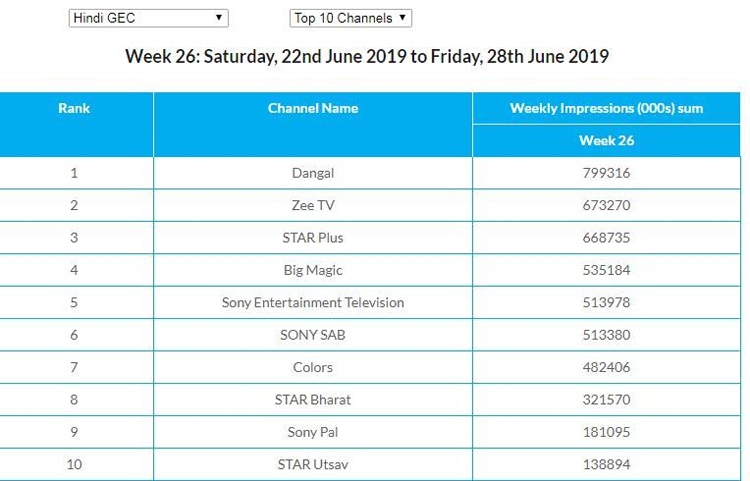
    MUMBAI: There has been no major change in Broadcast Audience Research Council India (BARC) data for week 26 of 2019. While &TV emerged as the new player in the space of Hindi Urban GEC in week 25.

    Hindi GEC (U+R)

    Dangal TV retained its first position this week and Zee TV and Star Plus stood at second and third positions respectively. Sony Entertainment Television has moved up the ladder to fifth position replacing Sony Sab while Colors also came down to seventh position. Star Utsav has come back to the chart at 10th position replacing &TV.

    Hindi rural GEC

    In rural areas, Dangal TV, Big Magic, Zee TV and Star Plus continued to be in first, second, third and fourth positions respectively. Colors, Sony Sab, Sony Entertainment Television, Star Bharat, Sony Pal and Star Utsav also retained earlier positions.

    Hindi urban GEC

    In urban areas, Star Plus retained its leadership position and Zee TV its second position. Sony Entertainment Television emerged in the third position replacing SONY SAB. Colors, Star Bharat, Dangal, Big Magic, &TV and Sony Pal retained their fifth, sixth, seventh, eighth, ninth and tenth positions respectively as compared to the last week.

  • Republic TV continues to lead Eng news in BARC week 34

    Republic TV continues to lead Eng news in BARC week 34

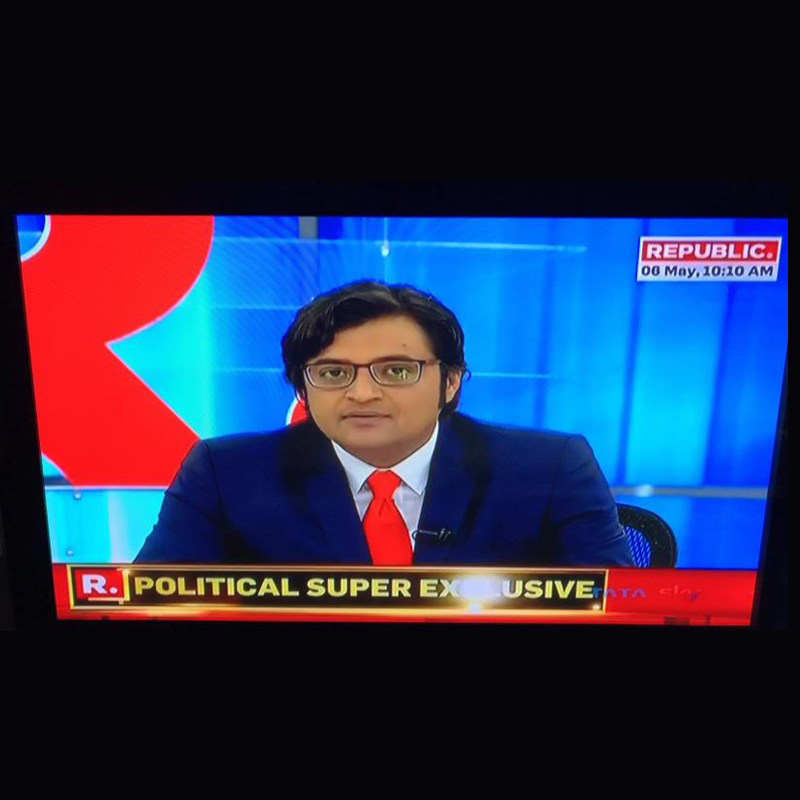
    MUMBAI: Republic TV continued to lead the English news genre according to All India BARC data week 34. No changes were observed this week in the English business news genre. News18 climbed to second position from fifth position as compared to the previous week in Hindi news (U+R). News Nation emerged as the new player, securing fifth position this week in the Hindi news rural area. Moreover, Aaj Tak maintained its top position in Hindi news genre (U).

    English News

    Republic TV continued to dominate the English news genre with 1181 impressions (000s) sum. Times Now, CNN News 18 and India Today Television retained their second, third and fourth positions with 1049 impressions (000s) sum, 802 impressions (000s) sum and 333 impressions (000s) sum respectively. NDTV 24X7 stood at fifth position with 165 impressions (000s) sum.

    English Business News

    No changes were observed this week. CNBC TV 18 continued to rule in the English business news genre with 618 impressions (000s) sum. ET Now and BTVI maintained their second and third positions with 188 impressions (000s) sum and 123 impressions (000s) sum. CNBC TV 18 Prime HD also retained its fourth position with 23 impressions (000s) sum.

    Hindi News (U+R)      

    Aaj Tak continued to lead in Hindi news genre with 140496 impressions (000s) sum as compared to 214534 impressions (000s) sum last week. News18 climbed to second position from fifth position as compared to the previous week with 104394 impressions (000s) sum. Zee News, ABP News and India TV stood at third, fourth and fifth positions with 102154 impressions (000s) sum, 101796 impressions (000s) sum and 94394 impressions (000s) sum respectively.

    Hindi News Rural  

    Aaj Tak and ABP News also continued to dominate in Hindi news (R) with 69737 impressions sum and 51476 impressions sum. News18 and Zee News swapped their second and third positions respectively with 43940 impressions (000s) sum and 43540 impressions (000s) sum. News Nation emerged as the new player, securing fifth position with 39046 impressions (000s) sum.

    Hindi News Urban

    Aaj Tak maintained its top position in Hindi news genre (U) with 70759 impressions (000s) sum. News18, Zee News, India TV and ABP News stood at second, third, fourth and fifth positions with 60454 impressions (000s) sum, 58613 impressions (000s) sum, 56090 impressions (000s) sum and 50320 impressions (000s) sum respectively.

  • Star Plus & Rishtey retain respective market leadership

    MUMBAI: In week 8, Star Plus continued to dominate the Urban+Rural and Urban market with a  leadership position whereas Rishtey too maintained its top position. Colors maintained its second spot this week. Apart from top channels, Sony’s free to air (FTA) channel Sony Pal has gained the positive ratings across markets.  

    Hindi GEC

    Star Plus led the genre with an increase in number with 712076 Impressions (000s) against  657742 Impressions (000s) followed by Colors with 640525 Impressions (000s) on second slot and Rishtey on third with 537507 Impressions (000s).

    In week 8 Sony Pal climbed up at number four with 523334 Impressions (000s) and Zee TV stood at five with 508260 Impressions (000s).

    Zee Anmol stepped down at number six with 504534 Impressions (000s) followed by Sony Entertainment Television grabbed seven spot with 467421 Impressions (000s).

     Star Utsav, Sab TV and Life OK ranked on the eighth, ninth and tenth positions with 448900 Impressions (000s), 390487 Impressions (000s) and 390466 Impressions (000s), respectively.

    Hindi GEC Rural

    Rishtey and Zee Anmol respectively bagged the first and second positions in this category with 409571 Impressions (000s) and 400799 Impressions (000s) followed by Sony Pal  on third slot with 373988 Impressions (000s).

    Star Utsav stood on number four with 342382 Impressions (000s) and Star Plus bagged fifth position with 235398 Impressions (000s).

    Zee TV and Colors  grabbed sixth and seventh spot with 227197 Impressions (000s) and 211405 Impressions (000s), respectively.

    Life OK, Sony Entertainment Television and Big Magic garnered eighth, ninth and tenth spot with 154190 Impressions (000s), 142834 Impressions (000s) and 129779 Impressions (000s), respectively.

    Hindi GEC Urban

    In this category, Star Plus led the chart with 476677 Impressions (000s) followed by Colors on second position with 429120 Impressions (000s).

    Sony Entertainment has maintained its position at third slot with 324587 Impressions (000s) followed by Zee TV on number four with 281062 Impressions (000s) and Sab TV on fifth with 269453 Impressions (000s).

    Life OK stood on number six with 236276 Impressions (000s). Sony Pa, &TVl and Rishtey bagged seventh, eighth and ninth slot with 149345 Impressions (000s), 135671 Impressions (000s) and 127935 Impressions (000s), respectively.

    Star Utsav grabbed tenth spot with week and registered 106518 Impressions (000s). 

  • Star Plus leads Hindi GEC & Urban; Rishtey tops rural HSM

    Star Plus leads Hindi GEC & Urban; Rishtey tops rural HSM

    MUMBAI: Star Plus continued to be the leader in Hindi GEC and Hindi GEC Urban. Sony TV’s dance reality show Super Dance bagged the first spot in Urban Hindi speaking market.  On the other hand, Rishtey led the Rural HSM this week, according to Broadcast Audience Research Council (BARC) All India in week 51.

    Hindi GEC

    Even after a decline in ratings, Star Plus continues to lead the Hindi GECs genre with 647573 Impressions (000s) against  669638 Impressions (000s) in week 50.  Colors too witnessed a fall in ratings with 629203 Impressions (000s) against 668471 Impressions (000s) in previous week followed by Zee TV with 467749 Impressions (000s) bagged the third spot in the Hindi GEC section.

    Sony Entertainment Television maintained its fourth position with 455376 Impressions (000s) and Rishtey stood at number five with 434367 Impressions (000s) followed by Sony Pal on number six with 414077 Impressions (000s) and Life OK fell on seventh with 382480 Impressions (000s).  Zee Anmol garnered the eight slot with 376086 Impression (000s).

    Sab TV and Star Utsav registered 353853 Impressions (000s) and 341745 Impressions (000s) on ninth and tenth spot.  

    Hindi GEC Rural

    Rishtey maintained its reins over Hindi GEC rural Hindi speaking market. The channel garnered the first slot with 326517 Impressions (000s) followed by Sony Pal with 300440 Impressions (000s) stood at number two.

    Zee Anmol bagged the third slot with 283537 Impressions (000s) followed by Star Utsav on fifth spot with 202341 Impressions (000s) and Star Plus stood at number five with 202341 Impressions (000s).

    Colors fell on sixth sloth with 196415 Impressions (000s).  Zee TV, Big Magic and Sony Entertainment Television garnered eighth, ninth and tenth spot with 190390 Impressions (000s), 135358 Impressions (000s) and 130786 Impressions (000s), respectively. Life fell on number tenth with 125901 Impressions (000s).

    Hindi GEC Urban

    Star Plus garnered the pole position with 445233 Impressions (000s) followed by Colors on second place with 432787 Impressions (000s) and Sony Entertainment Television on third with 324590 against 311050 Impressions (000s) in previous week.  

    Zee TV maintained fourth slot with 277360 Impressions (000s) followed by Sab TV  on fifth 263705  Impressions (000s) and Life OK  with 256579 Impressions (000s) stood on sixth.

    &TV maintained its seventh spot with 149443 Impressions (000s). Sony Pal, Rishtey and Zee Anmol bagged 113638 (000s), 107851 (000s) and 92549 Impressions (000s), respectively.


  • Star Plus leads Hindi GEC & Urban; Rishtey tops rural HSM

    Star Plus leads Hindi GEC & Urban; Rishtey tops rural HSM

    MUMBAI: Star Plus continued to be the leader in Hindi GEC and Hindi GEC Urban. Sony TV’s dance reality show Super Dance bagged the first spot in Urban Hindi speaking market.  On the other hand, Rishtey led the Rural HSM this week, according to Broadcast Audience Research Council (BARC) All India in week 51.

    Hindi GEC

    Even after a decline in ratings, Star Plus continues to lead the Hindi GECs genre with 647573 Impressions (000s) against  669638 Impressions (000s) in week 50.  Colors too witnessed a fall in ratings with 629203 Impressions (000s) against 668471 Impressions (000s) in previous week followed by Zee TV with 467749 Impressions (000s) bagged the third spot in the Hindi GEC section.

    Sony Entertainment Television maintained its fourth position with 455376 Impressions (000s) and Rishtey stood at number five with 434367 Impressions (000s) followed by Sony Pal on number six with 414077 Impressions (000s) and Life OK fell on seventh with 382480 Impressions (000s).  Zee Anmol garnered the eight slot with 376086 Impression (000s).

    Sab TV and Star Utsav registered 353853 Impressions (000s) and 341745 Impressions (000s) on ninth and tenth spot.  

    Hindi GEC Rural

    Rishtey maintained its reins over Hindi GEC rural Hindi speaking market. The channel garnered the first slot with 326517 Impressions (000s) followed by Sony Pal with 300440 Impressions (000s) stood at number two.

    Zee Anmol bagged the third slot with 283537 Impressions (000s) followed by Star Utsav on fifth spot with 202341 Impressions (000s) and Star Plus stood at number five with 202341 Impressions (000s).

    Colors fell on sixth sloth with 196415 Impressions (000s).  Zee TV, Big Magic and Sony Entertainment Television garnered eighth, ninth and tenth spot with 190390 Impressions (000s), 135358 Impressions (000s) and 130786 Impressions (000s), respectively. Life fell on number tenth with 125901 Impressions (000s).

    Hindi GEC Urban

    Star Plus garnered the pole position with 445233 Impressions (000s) followed by Colors on second place with 432787 Impressions (000s) and Sony Entertainment Television on third with 324590 against 311050 Impressions (000s) in previous week.  

    Zee TV maintained fourth slot with 277360 Impressions (000s) followed by Sab TV  on fifth 263705  Impressions (000s) and Life OK  with 256579 Impressions (000s) stood on sixth.

    &TV maintained its seventh spot with 149443 Impressions (000s). Sony Pal, Rishtey and Zee Anmol bagged 113638 (000s), 107851 (000s) and 92549 Impressions (000s), respectively.


  • ‘Broadcasters could consider different pricing for rural-urban subscribers’

    ‘Broadcasters could consider different pricing for rural-urban subscribers’

    When DEN Networks promoter Sameer Manchanda set up the national MSO in 2007, one of the key professionals on his team, which was led by CEO Anuj Gandhi, was the cable TV veteran S.N. Sharma. The trio quickly ramped up the company and took it to national level status.  Gandhi then moved on in 2010 to join Network18. And, Sharma who was the president (operations), was promoted as the CEO a year or so later.

    He continued with the company, expanding it nationally, and seeing it through the first two phases of digitization before departing in 2015 to get on board India’s biggest and most funded  startup  — the Mukesh Ambani-backed Reliance Jio.  A former McKinsey professional Pradeep Parameswaran was roped in to lead the company in his place.

    Sharma, meanwhile, at Jio, worked on planning and building the team for company’s foray into cable TV along with another cable TV veteran K. Jayaraman.

    Then, in July 2016, Sharma made a sudden about-turn and decided to return to DEN Networks, a move that raised the eyebrows of many but cheered many in the trade. For he is known for his relationships and his deep understanding of how cable TV should be run in the Indian context.

    Sharma was one of the key notes at indiantelevision.com’s Eleventh India Digital Operators Summit 2016 which concluded over the weekend at the Leela Hotel in south Goa. He had a one-on-one conversation with Indiantelevision.com Founder, CEO  & Editor in chief Anil Wanvari. Read on to get some insights into what is going on at DEN and with Sharma. Excerpts from the conversation:

    Why did you leave DEN in the first case, join Reliance and then why did you choose to come back?

    Having been into the cable industry for over 20 plus years, I thought, let me do something else. And, that’s why I moved to Reliance. Basically, I wanted to roll out fibre to the home (FTTH) over there. It would have been a great experience and learning (I thought). And it was, indeed. I learnt a lot in the short span of one and a half year. It was a wonderful learning that I brought in to my personality.

    But then, there was a call from my previous employer DEN, my friend Sameer.  I am one of the co-founders of DEN Network. And, I requested my employers at Reliance if I could leave. And they were kind enough to let me go back. It was more of an emotional decision than a professional one. All my learnings that I have had  at Reliance, I am
    sure, will help me learn to drive DEN in a better manner,in a positive direction in time to come.

    What are the challenges you are facing?

    The challenge as we all know is primarily monetization.  We started seeding boxes in 2010, now it is 2016. DAS came in 2012. And “hote hote” (by and by) it became 2013. Phase I and II happened quickly.

    There is a lag in monetization. Of course, we all can understand and you will appreciate that an industry which evolved since 1990, almost 30 year old industry, it  takes time for things to change. And, we took tiny, baby steps to monetize it.  But now, the time has come the boxes seeded in 2010 have almost lived their life and new technology is coming in. So my prime task is to see to it that we augment the process of monetization.

    The other challenge that I face immediately which I am working very aggressively on is to reduce the cost. We all know that Phase III digitization got into  a confused state, with boxes having got seeded, and the courts intervening.  Analogue signal has also been taken away from many of us. The MIB says 93 per cent  of digitization has happened. So the monetization process also has to start. But, in the bargain, we have already incurred some expenditure.  And unless I start recovering my revenue, the journey will be difficult.

    This time, in a short span of one and a half month, I addressed my cable TV partners, my business partners and my associates in a very transparent manner. We had a discussion – a whole day discussion wherein I shared with them my experiences with the telco. I shared with them the upcoming technology. I told them there is a change. The technology is not going to spare them.  We all used to think that last mile …last mile. But, my subscriber is not bound by last mile. My biggest threat today is the handset that I carry. The viewing habits are changing. Technology is bringing other alternatives. For the same viewer  who used to be watching their services. It is high time they realized it and accepted this change. And, they all agreed. I was surprised. It was a very open, frank and to-the-point discussion. I told them if we are willing to change, if we are willing to adopt, life will be there for us, otherwise the journey is going to be difficult. Everybody is cooperating. We hope to see a very good upside as far as collections are concerned.

    Third is making the LCOs, our partners realize the pains we are going through.  And, make them see the technology.

    And fourth is we have started conducting sessions with cable TV operator to sensitise them with the consumers. Like the regulator also said: Don’t force things on the consumer. He is in no mood. So the approach has to be friendlier than earlier. We have to change the face of our representative visiting the home of the subscriber. The
    presentation of our package has got lost.  We brought in a digital set-top box, we invested in that. But, we forgot in the process that we had not changed our face to the consumer. The cable TV operators accepted that we need to bring in a lot of ethics and discipline in that part.  You will see our representatives wearing uniforms. Uniform could be ours or the LCO’s.  It has to be in a presentable form. Today, if you are visited by a courier boy, the way he  is approaching is different.

    I am sure the cable TV operators will comply.

    Where are you reducing costs?

    Our priority early on was to penetrate the market, you increase your reach and when you penetrate certain areas, those can be reached through fibre or through links from telcos. After some time, you realize that you have spent an X amount in reaching an area and you have seeded 50 boxes. It does not make sense to you. So, you need to make a quick decision. You retract, you save money on that. Or you go to another MSO who is reaching the same area  and he has done it using a different pipe. And, he has 50,000 subscribers. So, I would tell him, why don’t we share the pipe. That process (of sharing)  has already started.  Then, we have started sharing the infrastructure also in another manner, in terms of content. If a competitor has a pipe serving more subscribers in the same area than I have less or vice-versa, I am open to sharing the pipe with the competitor. This is helping reduce costs. We have started sharing local content with cable operators. The cable operator has local content with him. So, instead of spending separately on the same content, we have started sharing that content too. Then, there are usual steps — reduction of manpower, to hire on a temporary basis, and cutting down the day-to-day expenses.

    Where are you getting your maximum margins?

    You see we have largely been a phase III player.  We have seeded 5.5 million in phase III, and 3-4 million are to go in phase IV. Of the 13 million subscribers, we have seeded 9-9.5 million. My upside will come from revenues of phase III boxes, which were yielding Rs 10-20. We have already crossed a milestone of Rs 40- 45 revenues, By December-end, it will touch  Rs 75 plus — that is a 45 per cent growth. Phase I is likely to give us 15-20 per cent.

    Who is going to get you this money – LCOs or the customer?

    You see the mood is set.  In the exercise, baby steps were taken to augment phase I revenues. It took us four years.  Phase III customer is also aware.  All studies and research show us is that the  buyingcapacity is there,  paying capacity is there too. HD is another example.  Around 70 per cent of TVs are HDTVs going into to Phase III
    areas. As it is for me to perform and deliver, I need my costs to be under control.  On the whole, we have also become very cost-conscious. We want our pie of the revenue.

    The cable sector has been bashed red and blue and cable TV bottomlines are stained with red ink? When will it turn around?

    You will see by Q3 end there should be an upside.

    You are very strong up north. Are you strengthening that or are you expanding into newer territories?

    As of now, my focus is to strengthen where we are. I have 13 million subscribers, I am happy to be limited where we are. As we start seeding boxes, it might go to 15 million as we deliver. I want to have a positive bottomline. I want a fair share of revenue. I want to move towards an era where sharing of revenues has be settled. As of now, there is always a dilemma, am I to stand by the TRAI that cable operators should get 35 per cent of revenue. The fact of the matter is that today we are receiving 35 per cent, and he is getting 65 per cent.

    I am very much focused that let’s first  set it right. It will take time and over few months. But, I see that over the next 12 months, this will move towards 50:50. And then, as we move forward, and add more values in the system, I am sure the operator will also get to earn  more through us if he wants to stay with us and be part of the journey.  If he says, he does not want to do broadband with, that’s his choice. If that arises, then we might go direct or we have leave that with him. I am very focused that instead of spreading thinly, focus where you, monetize it well. Settle a good business model. A good business case.  Business will follow.

    LCOs’ insecurity is less than earlier. Your comments.

    You can’t help it. Even MSOs. Nobody is secure. Times are changing. We have to adapt. You can’t ignore the technolgy. If I don’t change, just because my fellow LCO has not, and even I don’t, that’s a folly. Today, in  a matter of time, we started broadband. We have tested a broadband formula. We have close to 125,00 subscribers. We did this with a focused mind in Delhi and Kanpur. To test how the technology behaved, how the arithmetic works here. Now we find that, with 15-17 per cent of penetration, the project is breaking even. Now, anything added into it, is your upside.  The LCOs who are willing to work with us are very happy as they march around with us. And also, there is a learnin that the normal consumer is consuming 40 GB of internet at a speed of 10 mbps at a price of Rs 800. Broadband consumption is rising fast, 5 GB has gone to 10, and 20 GB has gone to 40 GB. Putting in everything into perspective, the cost is Rs 10 per GB.  Next year, I am sure it will be 100GB. And the speed will touch 50 MBPs. In such a scenario, if  I don’t move, somebody else will move.

    You must be happy Goldman Sachs invested but it was a discount to its earlier price, actually a deep discount What’s the way forward on the investment?

    It’s a subjective analysis . But, you should say that this proves that there is strength in the business model of DEN.

    On broadband there will be an increased investment going in. And besides broadband, we are incorporating OTT and value added services.

    So what’s the way forward on the pay TV market, with 31 December coming up?

    We are looking at it wholly. The boxes are going at a good speed. We are not really pushing. My focus is on getting Phase I, II III right. Once that business model is set in place, everything will also.  It is a matter of time, the  pull should come from the consumer, from the LCO. If he is willing to work with me. In the earlier case, in Phase I and II, we were subsiding the boxes. Today, it is a pure business case. This my product. You want to do business with me, please do.

    How can broadcasters assist the process of digitization till the tariff order comes out?

    There was a time when broadcasters used to have dual pricing policy. For rural, it was lower, and for urban, higher.  Now, that we have invested and are investing, all of a sudden  they have foregone  that policy of theirs, which they were following in analogue, and still they are following in some places even today. The moment we seed STBs in phase III, they start charging digital rates. I would urge broadcasters too relook at this.
  • ‘Broadcasters could consider different pricing for rural-urban subscribers’

    ‘Broadcasters could consider different pricing for rural-urban subscribers’

    When DEN Networks promoter Sameer Manchanda set up the national MSO in 2007, one of the key professionals on his team, which was led by CEO Anuj Gandhi, was the cable TV veteran S.N. Sharma. The trio quickly ramped up the company and took it to national level status.  Gandhi then moved on in 2010 to join Network18. And, Sharma who was the president (operations), was promoted as the CEO a year or so later.

    He continued with the company, expanding it nationally, and seeing it through the first two phases of digitization before departing in 2015 to get on board India’s biggest and most funded  startup  — the Mukesh Ambani-backed Reliance Jio.  A former McKinsey professional Pradeep Parameswaran was roped in to lead the company in his place.

    Sharma, meanwhile, at Jio, worked on planning and building the team for company’s foray into cable TV along with another cable TV veteran K. Jayaraman.

    Then, in July 2016, Sharma made a sudden about-turn and decided to return to DEN Networks, a move that raised the eyebrows of many but cheered many in the trade. For he is known for his relationships and his deep understanding of how cable TV should be run in the Indian context.

    Sharma was one of the key notes at indiantelevision.com’s Eleventh India Digital Operators Summit 2016 which concluded over the weekend at the Leela Hotel in south Goa. He had a one-on-one conversation with Indiantelevision.com Founder, CEO  & Editor in chief Anil Wanvari. Read on to get some insights into what is going on at DEN and with Sharma. Excerpts from the conversation:

    Why did you leave DEN in the first case, join Reliance and then why did you choose to come back?

    Having been into the cable industry for over 20 plus years, I thought, let me do something else. And, that’s why I moved to Reliance. Basically, I wanted to roll out fibre to the home (FTTH) over there. It would have been a great experience and learning (I thought). And it was, indeed. I learnt a lot in the short span of one and a half year. It was a wonderful learning that I brought in to my personality.

    But then, there was a call from my previous employer DEN, my friend Sameer.  I am one of the co-founders of DEN Network. And, I requested my employers at Reliance if I could leave. And they were kind enough to let me go back. It was more of an emotional decision than a professional one. All my learnings that I have had  at Reliance, I am
    sure, will help me learn to drive DEN in a better manner,in a positive direction in time to come.

    What are the challenges you are facing?

    The challenge as we all know is primarily monetization.  We started seeding boxes in 2010, now it is 2016. DAS came in 2012. And “hote hote” (by and by) it became 2013. Phase I and II happened quickly.

    There is a lag in monetization. Of course, we all can understand and you will appreciate that an industry which evolved since 1990, almost 30 year old industry, it  takes time for things to change. And, we took tiny, baby steps to monetize it.  But now, the time has come the boxes seeded in 2010 have almost lived their life and new technology is coming in. So my prime task is to see to it that we augment the process of monetization.

    The other challenge that I face immediately which I am working very aggressively on is to reduce the cost. We all know that Phase III digitization got into  a confused state, with boxes having got seeded, and the courts intervening.  Analogue signal has also been taken away from many of us. The MIB says 93 per cent  of digitization has happened. So the monetization process also has to start. But, in the bargain, we have already incurred some expenditure.  And unless I start recovering my revenue, the journey will be difficult.

    This time, in a short span of one and a half month, I addressed my cable TV partners, my business partners and my associates in a very transparent manner. We had a discussion – a whole day discussion wherein I shared with them my experiences with the telco. I shared with them the upcoming technology. I told them there is a change. The technology is not going to spare them.  We all used to think that last mile …last mile. But, my subscriber is not bound by last mile. My biggest threat today is the handset that I carry. The viewing habits are changing. Technology is bringing other alternatives. For the same viewer  who used to be watching their services. It is high time they realized it and accepted this change. And, they all agreed. I was surprised. It was a very open, frank and to-the-point discussion. I told them if we are willing to change, if we are willing to adopt, life will be there for us, otherwise the journey is going to be difficult. Everybody is cooperating. We hope to see a very good upside as far as collections are concerned.

    Third is making the LCOs, our partners realize the pains we are going through.  And, make them see the technology.

    And fourth is we have started conducting sessions with cable TV operator to sensitise them with the consumers. Like the regulator also said: Don’t force things on the consumer. He is in no mood. So the approach has to be friendlier than earlier. We have to change the face of our representative visiting the home of the subscriber. The
    presentation of our package has got lost.  We brought in a digital set-top box, we invested in that. But, we forgot in the process that we had not changed our face to the consumer. The cable TV operators accepted that we need to bring in a lot of ethics and discipline in that part.  You will see our representatives wearing uniforms. Uniform could be ours or the LCO’s.  It has to be in a presentable form. Today, if you are visited by a courier boy, the way he  is approaching is different.

    I am sure the cable TV operators will comply.

    Where are you reducing costs?

    Our priority early on was to penetrate the market, you increase your reach and when you penetrate certain areas, those can be reached through fibre or through links from telcos. After some time, you realize that you have spent an X amount in reaching an area and you have seeded 50 boxes. It does not make sense to you. So, you need to make a quick decision. You retract, you save money on that. Or you go to another MSO who is reaching the same area  and he has done it using a different pipe. And, he has 50,000 subscribers. So, I would tell him, why don’t we share the pipe. That process (of sharing)  has already started.  Then, we have started sharing the infrastructure also in another manner, in terms of content. If a competitor has a pipe serving more subscribers in the same area than I have less or vice-versa, I am open to sharing the pipe with the competitor. This is helping reduce costs. We have started sharing local content with cable operators. The cable operator has local content with him. So, instead of spending separately on the same content, we have started sharing that content too. Then, there are usual steps — reduction of manpower, to hire on a temporary basis, and cutting down the day-to-day expenses.

    Where are you getting your maximum margins?

    You see we have largely been a phase III player.  We have seeded 5.5 million in phase III, and 3-4 million are to go in phase IV. Of the 13 million subscribers, we have seeded 9-9.5 million. My upside will come from revenues of phase III boxes, which were yielding Rs 10-20. We have already crossed a milestone of Rs 40- 45 revenues, By December-end, it will touch  Rs 75 plus — that is a 45 per cent growth. Phase I is likely to give us 15-20 per cent.

    Who is going to get you this money – LCOs or the customer?

    You see the mood is set.  In the exercise, baby steps were taken to augment phase I revenues. It took us four years.  Phase III customer is also aware.  All studies and research show us is that the  buyingcapacity is there,  paying capacity is there too. HD is another example.  Around 70 per cent of TVs are HDTVs going into to Phase III
    areas. As it is for me to perform and deliver, I need my costs to be under control.  On the whole, we have also become very cost-conscious. We want our pie of the revenue.

    The cable sector has been bashed red and blue and cable TV bottomlines are stained with red ink? When will it turn around?

    You will see by Q3 end there should be an upside.

    You are very strong up north. Are you strengthening that or are you expanding into newer territories?

    As of now, my focus is to strengthen where we are. I have 13 million subscribers, I am happy to be limited where we are. As we start seeding boxes, it might go to 15 million as we deliver. I want to have a positive bottomline. I want a fair share of revenue. I want to move towards an era where sharing of revenues has be settled. As of now, there is always a dilemma, am I to stand by the TRAI that cable operators should get 35 per cent of revenue. The fact of the matter is that today we are receiving 35 per cent, and he is getting 65 per cent.

    I am very much focused that let’s first  set it right. It will take time and over few months. But, I see that over the next 12 months, this will move towards 50:50. And then, as we move forward, and add more values in the system, I am sure the operator will also get to earn  more through us if he wants to stay with us and be part of the journey.  If he says, he does not want to do broadband with, that’s his choice. If that arises, then we might go direct or we have leave that with him. I am very focused that instead of spreading thinly, focus where you, monetize it well. Settle a good business model. A good business case.  Business will follow.

    LCOs’ insecurity is less than earlier. Your comments.

    You can’t help it. Even MSOs. Nobody is secure. Times are changing. We have to adapt. You can’t ignore the technolgy. If I don’t change, just because my fellow LCO has not, and even I don’t, that’s a folly. Today, in  a matter of time, we started broadband. We have tested a broadband formula. We have close to 125,00 subscribers. We did this with a focused mind in Delhi and Kanpur. To test how the technology behaved, how the arithmetic works here. Now we find that, with 15-17 per cent of penetration, the project is breaking even. Now, anything added into it, is your upside.  The LCOs who are willing to work with us are very happy as they march around with us. And also, there is a learnin that the normal consumer is consuming 40 GB of internet at a speed of 10 mbps at a price of Rs 800. Broadband consumption is rising fast, 5 GB has gone to 10, and 20 GB has gone to 40 GB. Putting in everything into perspective, the cost is Rs 10 per GB.  Next year, I am sure it will be 100GB. And the speed will touch 50 MBPs. In such a scenario, if  I don’t move, somebody else will move.

    You must be happy Goldman Sachs invested but it was a discount to its earlier price, actually a deep discount What’s the way forward on the investment?

    It’s a subjective analysis . But, you should say that this proves that there is strength in the business model of DEN.

    On broadband there will be an increased investment going in. And besides broadband, we are incorporating OTT and value added services.

    So what’s the way forward on the pay TV market, with 31 December coming up?

    We are looking at it wholly. The boxes are going at a good speed. We are not really pushing. My focus is on getting Phase I, II III right. Once that business model is set in place, everything will also.  It is a matter of time, the  pull should come from the consumer, from the LCO. If he is willing to work with me. In the earlier case, in Phase I and II, we were subsiding the boxes. Today, it is a pure business case. This my product. You want to do business with me, please do.

    How can broadcasters assist the process of digitization till the tariff order comes out?

    There was a time when broadcasters used to have dual pricing policy. For rural, it was lower, and for urban, higher.  Now, that we have invested and are investing, all of a sudden  they have foregone  that policy of theirs, which they were following in analogue, and still they are following in some places even today. The moment we seed STBs in phase III, they start charging digital rates. I would urge broadcasters too relook at this.

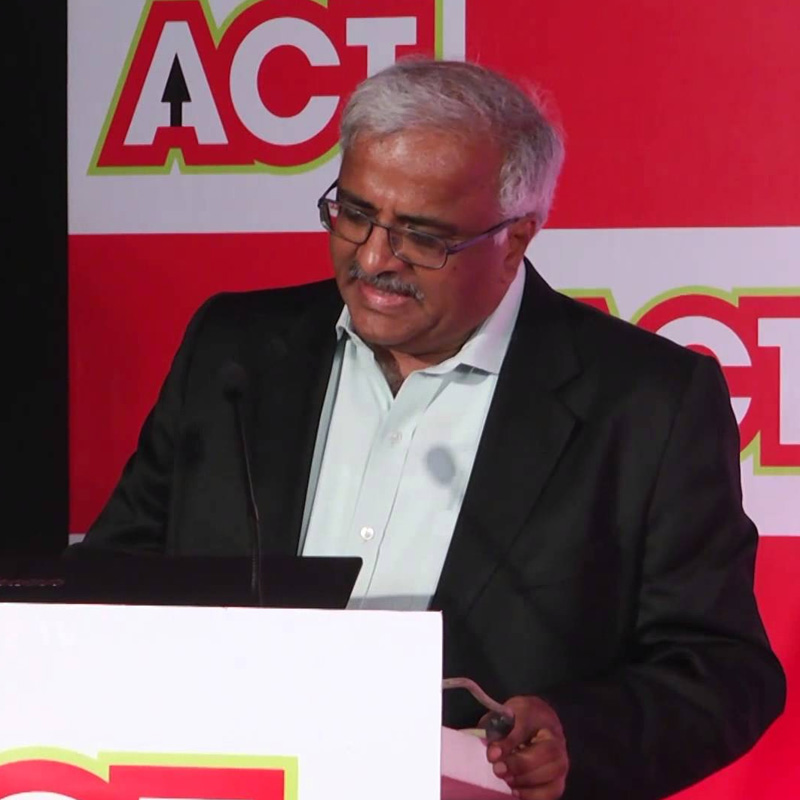
  • 2009 a dynamic year for Indian cable industry – By ACT Television MD Sunder Raju

    2009 a dynamic year for Indian cable industry – By ACT Television MD Sunder Raju

    The year 2009 has been a dynamic one for the Indian cable industry. Several developments and key decisions that took place hint towards a very promising 2010 for the industry as a whole and, of course, the consumer. Continuing its boom, the cable industry is all set to ensure that the TV is not an ‘idiot box‘ anymore!

    Problems faced by Southern operators

    Cable business is spreading its wings all over India. In urban Karnataka and Madhya Pradesh, it has also undergone a massive change in the last couple of years as the industry, from being extremely fragmented earlier, has now become more systematic and corporatised. With a growing market share in these states, digital cable is becoming a larger chunk of the pie and is on its way to give DTH a run for its money.

    However, there are still some pertinent challenges that lie in the path, especially for Southern operators. One of the challenges faced by them is that vis-?-vis digital, DTH has a larger geographical presence. Despite DTH being much more expensive than cable, it has higher penetration because digital runs through a cable network, and that limits any player‘s footprint to the area already cabled by them.

    Also, though the cable industry has changed massively, it is still fragmented. Hence, any operator going national needs to accommodate a number of industry-specific issues, such as adjusting to rapid technological change, working and accommodating with different workforce demographics, changing and restructuring the entire face of the organisation.

    Another challenge lies in the fact that since a large part of the cable industry is still unorganised, the corporate players within the industry at times face content related challenges. Large corporate players, as a policy, do not relay illegal films unlike the small players that telecast all kinds of content in order to get a higher viewership.

    Also there is an oversupply of service providers in the Indian market, with various small players present everywhere. This is also because starting an analogue business requires small investments. In addition to this, with growing inflation, there is less advertising to support the services. Domestic regulations limit advertising to just 10 minutes per hour.

    Last but not the least, with DTH penetrating in every corner of the country, analogue service providers are now facing a major roadblock where profitability is concerned. Consolidation is the way of the future and will bail them out.

    An eventful 2009

    Cable industry has seen a major shift in the last couple of years when more and more organised players have entered the market. This shift in the industry has not only improved customers‘ TV viewing experience with better picture quality, consistent network and improved content on local channels, but it has also drastically improved the quality of overall customer service. For example, ACT Television not only offers a call centre service but also offers instant personalized customer service through its professionally trained cable operators.

    In my opinion, a very important development of 2009 that will make 2010 a smooth year for corporate players is that legal action would be initiated against small cable television operators showing unauthorized and prohibited programmes including obscene films. Moreover, if the programmes televised by the channel create resentment among a particular community, the affected persons can also lodge their complaint with the district administration.

    Towards the end of 2009, HITS (Headend-in-the-Sky) was approved. HITS will allow use of satellites to distribute cable signals instead of the traditional cables that operators use. This is similar to the DTH system – the only difference being that in this case, cable operators will download signals for further distribution in homes.

    As far as the HITS policy is concerned, while the government has taken a major step in addressing the challenges of digitising the country‘s television homes, the work is only half done. They also have to set a timetable for the pay channels to go exclusively digital. Without this step all that has been done is a policy statement without teeth in the area of encouraging enforcement. Ideally both announcements should have come together but a quick decision soon on compulsory digitalisation for pay channels will ensure that the advantage of digital would be experienced by the customer.

    Parts of India have recently been exposed to the Internet Protocol Television (IPTV) services. Companies offering IPTV are mostly conducting pilots in bigger cities of India, such as Delhi, Mumbai, Bangalore.

    A promising 2010

    With 111 million Television Homes and 85 million C&S Homes, India is bound to see many changes in the coming year and years ahead. Indian cable TV industry has a huge potential and that is being recognized by people.

    More and more customers are demanding better picture quality, more channels and better customer service – all at affordable prices. Hence, digitalisation is inevitable and seems to be the only way forward for analog service Providers. Also the need of the hour is clearly training and a reminder that “the customer is King.”

    Also, cable TV offers many other benefits such as city specific channels, that provide complete city related information throughout the day to viewers. This gives viewers a pulse on the city and keeps them updated on events and happenings in their immediate surroundings. Often something that impacts life in the city is covered first by the local city channels and they are surely becoming indispensible.

    Not only this, cable TV has become a great platform for providing, entertainment, information and also education. This is rapidly changing the TV viewing habits in our country which has close to 51 million urban households and 60 million rural households.

    Strategic partnerships with various content houses will determine how any service provider progresses. This will also put an end in the near future to broadcast of pirated content.

    Building a robust subscription income, digitising rapidly and developing broadband as a revenue stream seems to be the business model all the leading multi-system operators (MSOs) are going to chase after having spread their tentacles across the country. Apart from this ‘Value Added Services‘ are a definite means to generating revenues. Services like education on TV, web browsing, gaming and ticket booking have a huge potential in the Indian market.